CENTRIFUGAL COMPRESSOR
INTRODUCTION
Centrifugal Compressor is a machine in which a particular
gas or vapor is compressed by a radial acceleration by an
impeller with the help of a surrounding case. It can then be
arranged multistage for greater proportions of compression.
The compression is largely influenced by a centrifugal
pump.
PRINCIPLE
The compression principle of centrifugal compressor is quite
different from that of reciprocating or rotary type
compressor.
When the air passes through the rotating impeller it
experiences force or work which is performed by centrifugal
forces. The work input takes place as an increase in
pressure and velocity or speed of the air flow through the
impeller.
The air flow loses its velocity after entering in the diffuser
section. The diffuser is actually a fixed or static component
that escorts the air flow when it leaves the impeller. This loss
in velocity eventually results in an additional increase of
pressure. The impeller and the diffuser contributes about
65% and 35% of the total pressure developed or produced
in the compressor.
CONSTRUCTION
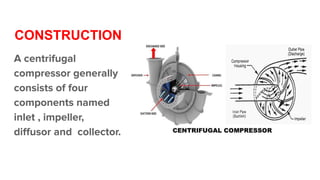
A centrifugal
compressor generally
consists of four
components named
inlet , impeller,
diffusor and collector.
CASING AND INLET
The above mentioned components are usually protected or
guarded by a casing or housing . A case house consists of
number of bearings in order to provide radial and axial
support of the rotor. The case also contain nozzles along
with inlets and discharge flow connections in order to
introduce and extract flow from the compressor.
Casing are of two types :-
a.) Horizontally split
b.) Vertically split
A case is generally build of cast iron or steel.
IMPELLERS
The impellers are assembled or mounted on a steel shaft
and this assembly is known as compressor rotor (mostly in
multi stage compressors). The rotor provide velocity to the
gas with blades that are attached to a rotating disc. These
blades can be forward-leaning , radial or backward-leaning
depending upon the desired output . Most of the multistage
compressors use backward-leaning blades as they provide
the widest range of efficiency.
DIFFUSER
The impeller extracts the gas with great velocity into a
diffuser passage. The diffuser usually compromise two walls
which form a radial channel. Because of these arrangements
the velocity of the gas decreases and dynamic pressure is
converted into static pressure. The diffuser passages are
small space between adjacent diaphragms which generally
turns the gas flow 180° in order to direct it towards the next
impeller.
COLLECTOR
Following the last stage impeller the gas must be collected
and delivered to the discharge flange. The component used
to collect the gas discharged through the diffuser is called
as collector. It may also be termed as volute or scroll. The
collector may also contain valves and other instrumentation
in order to control the compressor.
TYPES
There are two types of it :-
1. Single stage centrifugal compressor
2. Multi stage centrifugal compressor
Both of these compressor work on the same principle but
they do have some drastic difference in their construction
and working.
SINGLE STAGE COMPRESSOR
Single stage compressors consist of only a single impeller
and it is use for moving the air or other gases up to 3 to 1
compression ratio for either pressure or vacuum duty. These
type of compressors are considered to have a beam design
or an overhung impeller arrangement. In this type of
arrangement the impeller is at the non-driving end of the
shaft. One major advantage of it over the multistage
compressor is that it provides high efficiency and the
delivered gas is totally oil and surge free.
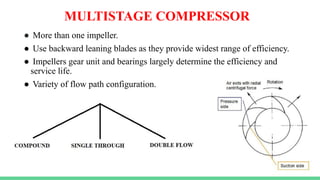
MULTISTAGE COMPRESSOR
● More than one impeller.
● Use backward leaning blades as they provide widest range of efficiency.
● Impellers gear unit and bearings largely determine the efficiency and
service life.
● Variety of flow path configuration.
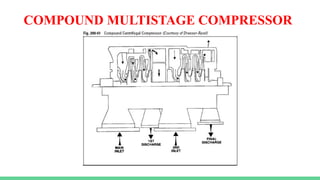
COMPOUND MULTISTAGE COMPRESSOR
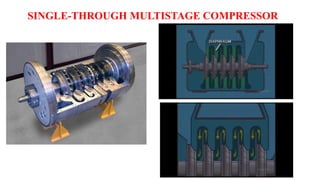
SINGLE-THROUGH MULTISTAGE COMPRESSOR
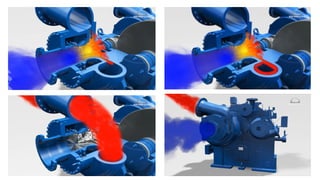
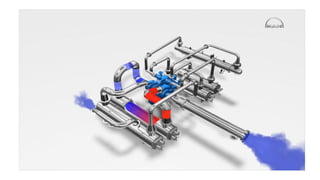
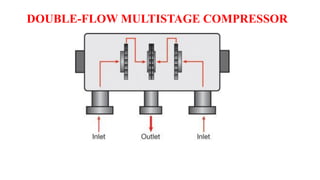
DOUBLE-FLOW MULTISTAGE COMPRESSOR
APPLICATIONS
1. Compressed gas or air: Centrifugal compressor is one of
the most simple and efficient way to obtain or produce
compressed air. They are best suited when the demand of
air or gas is constant and excessive.
2. Food Industry: Food processing industry depends highly
on this type of compressor as it can provide oil free
compressed air which are necessary for some sensitive
petitions.
3. Gas turbines: Gas turbines use either or both axial and
centrifugal compressor to provide the necessary
compression.
a.) Turboshaft
b.) Turboprop
c.) Micro turbines and
d.) Auxiliary power units
4.) Oil refiners , petrochemical and chemical plants: The
centrifugal compressors used for the above purposes
generally have a horizontally split casing and most of them
are multistage compressors. These type of compressors are
generally operated by over-sized steam engines and gas
turbines,
5. Refrigeration and air control: Centrifugal Compressors
support a wide variety of refrigerants and thermodynamics
and are also able to supply compression in water chiller
cycles due to which it has a high demand for usage in
refrigerators and air conditioners.
ADVANTAGES
a.) When compared to other compressors, it is relatively
agile and easy to manufacturer.
b.) As this compressor does not require any special
foundation it is highly energy efficient and reliable.
c.) They consist of a small number of rubbing parts and are
absolutely oil free in nature.
d.) It generates a higher pressure ratio per stage than the
axial flow compressor.
DISADVANTAGES
a.) They produce a limited amount of pressure and are not
suitable for very high compression.
b.) As they work at relatively high speed an enlightened or
worldly mounting is required.
c.) They are very sensitive towards problems such as stalling
and choking.
CONCLUSION
This is all about centrifugal compressor principle, working,
construction, types, advantages, disadvantages with its
application.

Centrifugal compressor: Casing and inlet. Impellers

  • 1.
  • 2.
    INTRODUCTION Centrifugal Compressor isa machine in which a particular gas or vapor is compressed by a radial acceleration by an impeller with the help of a surrounding case. It can then be arranged multistage for greater proportions of compression. The compression is largely influenced by a centrifugal pump.
  • 3.
    PRINCIPLE The compression principleof centrifugal compressor is quite different from that of reciprocating or rotary type compressor. When the air passes through the rotating impeller it experiences force or work which is performed by centrifugal forces. The work input takes place as an increase in pressure and velocity or speed of the air flow through the impeller.
  • 4.
    The air flowloses its velocity after entering in the diffuser section. The diffuser is actually a fixed or static component that escorts the air flow when it leaves the impeller. This loss in velocity eventually results in an additional increase of pressure. The impeller and the diffuser contributes about 65% and 35% of the total pressure developed or produced in the compressor.
  • 5.
    CONSTRUCTION A centrifugal compressor generally consistsof four components named inlet , impeller, diffusor and collector.
  • 6.
    CASING AND INLET Theabove mentioned components are usually protected or guarded by a casing or housing . A case house consists of number of bearings in order to provide radial and axial support of the rotor. The case also contain nozzles along with inlets and discharge flow connections in order to introduce and extract flow from the compressor.
  • 7.
    Casing are oftwo types :- a.) Horizontally split b.) Vertically split A case is generally build of cast iron or steel.
  • 8.
    IMPELLERS The impellers areassembled or mounted on a steel shaft and this assembly is known as compressor rotor (mostly in multi stage compressors). The rotor provide velocity to the gas with blades that are attached to a rotating disc. These blades can be forward-leaning , radial or backward-leaning depending upon the desired output . Most of the multistage compressors use backward-leaning blades as they provide the widest range of efficiency.
  • 9.
    DIFFUSER The impeller extractsthe gas with great velocity into a diffuser passage. The diffuser usually compromise two walls which form a radial channel. Because of these arrangements the velocity of the gas decreases and dynamic pressure is converted into static pressure. The diffuser passages are small space between adjacent diaphragms which generally turns the gas flow 180° in order to direct it towards the next impeller.
  • 10.
    COLLECTOR Following the laststage impeller the gas must be collected and delivered to the discharge flange. The component used to collect the gas discharged through the diffuser is called as collector. It may also be termed as volute or scroll. The collector may also contain valves and other instrumentation in order to control the compressor.
  • 11.
    TYPES There are twotypes of it :- 1. Single stage centrifugal compressor 2. Multi stage centrifugal compressor Both of these compressor work on the same principle but they do have some drastic difference in their construction and working.
  • 12.
    SINGLE STAGE COMPRESSOR Singlestage compressors consist of only a single impeller and it is use for moving the air or other gases up to 3 to 1 compression ratio for either pressure or vacuum duty. These type of compressors are considered to have a beam design or an overhung impeller arrangement. In this type of arrangement the impeller is at the non-driving end of the shaft. One major advantage of it over the multistage compressor is that it provides high efficiency and the delivered gas is totally oil and surge free.
  • 13.
    MULTISTAGE COMPRESSOR ● Morethan one impeller. ● Use backward leaning blades as they provide widest range of efficiency. ● Impellers gear unit and bearings largely determine the efficiency and service life. ● Variety of flow path configuration.
  • 14.
  • 17.
  • 18.
  • 19.
    APPLICATIONS 1. Compressed gasor air: Centrifugal compressor is one of the most simple and efficient way to obtain or produce compressed air. They are best suited when the demand of air or gas is constant and excessive. 2. Food Industry: Food processing industry depends highly on this type of compressor as it can provide oil free compressed air which are necessary for some sensitive petitions.
  • 20.
    3. Gas turbines:Gas turbines use either or both axial and centrifugal compressor to provide the necessary compression. a.) Turboshaft b.) Turboprop c.) Micro turbines and d.) Auxiliary power units
  • 21.
    4.) Oil refiners, petrochemical and chemical plants: The centrifugal compressors used for the above purposes generally have a horizontally split casing and most of them are multistage compressors. These type of compressors are generally operated by over-sized steam engines and gas turbines, 5. Refrigeration and air control: Centrifugal Compressors support a wide variety of refrigerants and thermodynamics and are also able to supply compression in water chiller cycles due to which it has a high demand for usage in refrigerators and air conditioners.
  • 22.
    ADVANTAGES a.) When comparedto other compressors, it is relatively agile and easy to manufacturer. b.) As this compressor does not require any special foundation it is highly energy efficient and reliable. c.) They consist of a small number of rubbing parts and are absolutely oil free in nature. d.) It generates a higher pressure ratio per stage than the axial flow compressor.
  • 23.
    DISADVANTAGES a.) They producea limited amount of pressure and are not suitable for very high compression. b.) As they work at relatively high speed an enlightened or worldly mounting is required. c.) They are very sensitive towards problems such as stalling and choking.
  • 24.
    CONCLUSION This is allabout centrifugal compressor principle, working, construction, types, advantages, disadvantages with its application.