Compressors for fluid machinery in mechanical enginnering
1.
Compressors
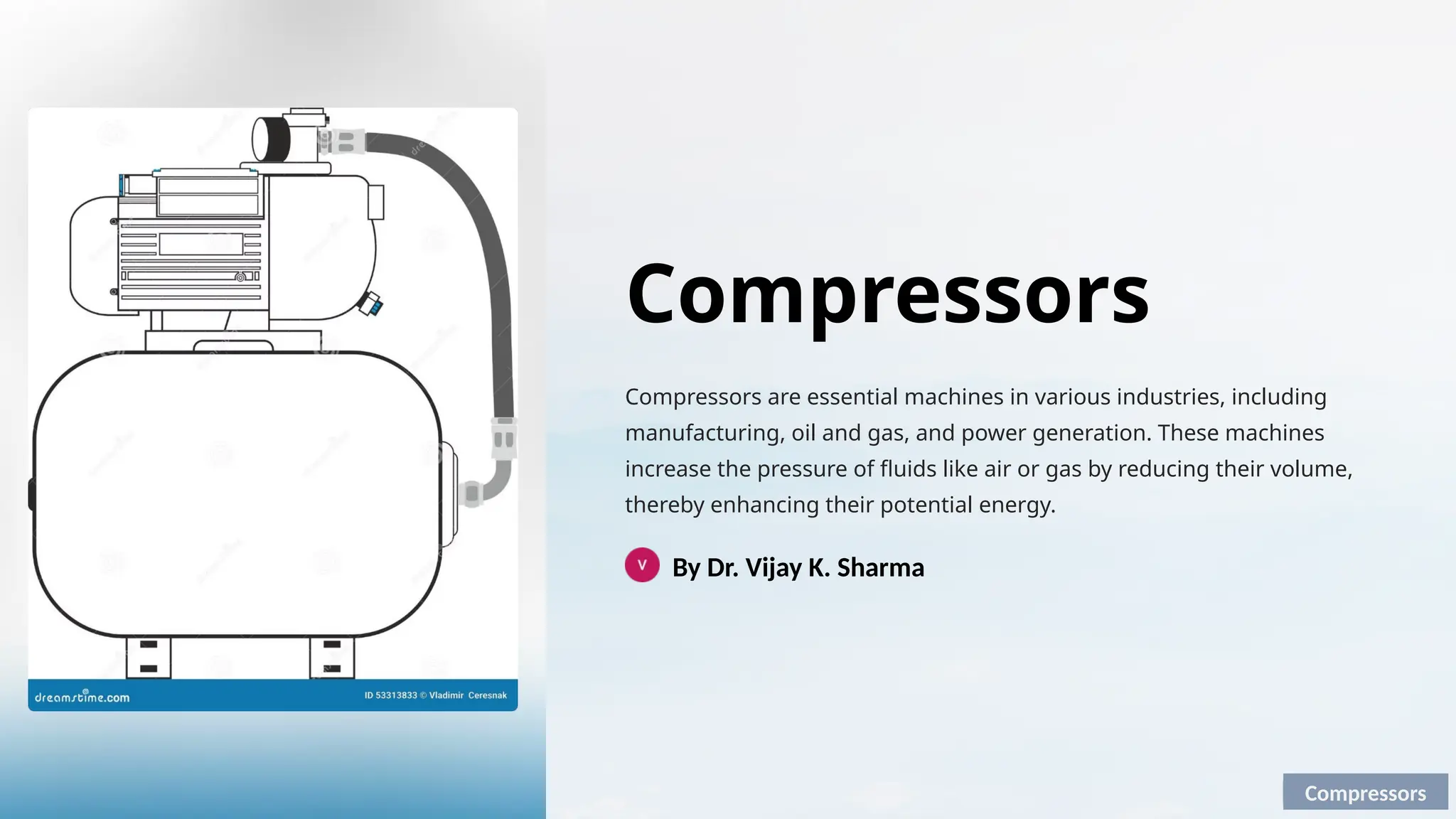
Compressors are essentialmachines in various industries, including
manufacturing, oil and gas, and power generation. These machines
increase the pressure of fluids like air or gas by reducing their volume,
thereby enhancing their potential energy.
By Dr. Vijay K. Sharma
Compressors
2.
Centrifugal Compressor
Introduction
Centrifugal compressorsuse a
rotating impeller to impart energy to
the fluid, increasing its velocity and
pressure.
Key Components
The main components include an
impeller, diffuser, and volute.
• Impeller: rotates to accelerate
the fluid.
• Diffuser: converts kinetic
energy into pressure energy.
• Volute: collects the pressurized
fluid and directs it to the
outlet.
Types
There are different types of
centrifugal compressors, including
single-stage, multi-stage, and radial
flow.
Compressors
3.
Construction of Centrifugal
Compressor
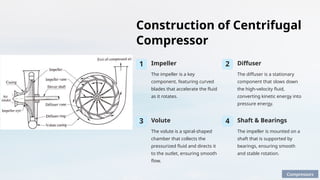
1Impeller
The impeller is a key
component, featuring curved
blades that accelerate the fluid
as it rotates.
2 Diffuser
The diffuser is a stationary
component that slows down
the high-velocity fluid,
converting kinetic energy into
pressure energy.
3 Volute
The volute is a spiral-shaped
chamber that collects the
pressurized fluid and directs it
to the outlet, ensuring smooth
flow.
4 Shaft & Bearings
The impeller is mounted on a
shaft that is supported by
bearings, ensuring smooth
and stable rotation.
Compressors
4.
Working Principle ofCentrifugal Compressor
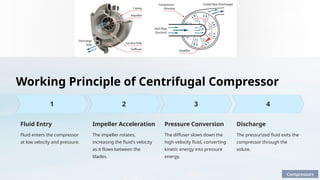
Fluid Entry
Fluid enters the compressor
at low velocity and pressure.
Impeller Acceleration
The impeller rotates,
increasing the fluid's velocity
as it flows between the
blades.
Pressure Conversion
The diffuser slows down the
high-velocity fluid, converting
kinetic energy into pressure
energy.
Discharge
The pressurized fluid exits the
compressor through the
volute.
Compressors
5.
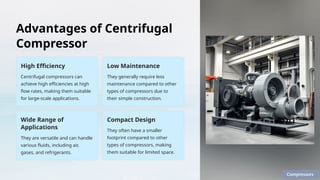
Advantages of Centrifugal
Compressor
HighEfficiency
Centrifugal compressors can
achieve high efficiencies at high
flow rates, making them suitable
for large-scale applications.
Low Maintenance
They generally require less
maintenance compared to other
types of compressors due to
their simple construction.
Wide Range of
Applications
They are versatile and can handle
various fluids, including air,
gases, and refrigerants.
Compact Design
They often have a smaller
footprint compared to other
types of compressors, making
them suitable for limited space.
Compressors
6.
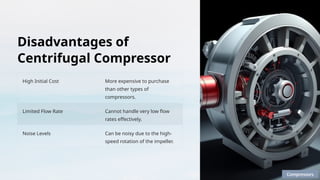
Disadvantages of
Centrifugal Compressor
HighInitial Cost More expensive to purchase
than other types of
compressors.
Limited Flow Rate Cannot handle very low flow
rates effectively.
Noise Levels Can be noisy due to the high-
speed rotation of the impeller.
Compressors
7.
Applications of
Centrifugal Compressor
1Oil & Gas
Used in pipelines, refineries,
and gas processing plants
for compressing natural gas,
oil, and other fluids.
2 Power Generation
Used in power plants to
compress air for combustion
and to enhance efficiency.
3 Chemical Industry
Used in chemical processing
plants to compress gases
and move fluids throughout
the process.
4 Refrigeration
Used in refrigeration
systems to compress
refrigerants, creating the
cooling effect.
Compressors
8.
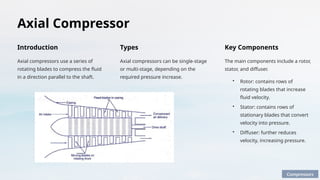
Axial Compressor
Introduction
Axial compressorsuse a series of
rotating blades to compress the fluid
in a direction parallel to the shaft.
Key Components
The main components include a rotor,
stator, and diffuser.
• Rotor: contains rows of
rotating blades that increase
fluid velocity.
• Stator: contains rows of
stationary blades that convert
velocity into pressure.
• Diffuser: further reduces
velocity, increasing pressure.
Types
Axial compressors can be single-stage
or multi-stage, depending on the
required pressure increase.
Compressors
9.
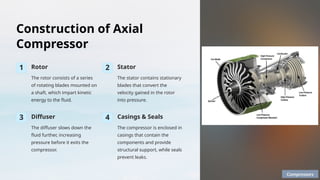
Construction of Axial
Compressor
1Rotor
The rotor consists of a series
of rotating blades mounted on
a shaft, which impart kinetic
energy to the fluid.
2 Stator
The stator contains stationary
blades that convert the
velocity gained in the rotor
into pressure.
3 Diffuser
The diffuser slows down the
fluid further, increasing
pressure before it exits the
compressor.
4 Casings & Seals
The compressor is enclosed in
casings that contain the
components and provide
structural support, while seals
prevent leaks.
Compressors
10.
Comparison between
Centrifugal andAxial
Compressors
Feature Centrifugal Axial
Flow Direction Radial Axial
Pressure Rise High Moderate
Flow Rate Lower Higher
Efficiency Generally higher Lower at low flow
rates
Applications Oil & gas, power
generation, chemical
processing
Aircraft engines, gas
turbines, industrial
processes
Compressors




![Compressor[1].pptx](https://cdn.slidesharecdn.com/ss_thumbnails/compressor1-230705131350-6674b8a9-thumbnail.jpg?width=640&height=640&fit=bounds)


