THE URBAN SYSTEMTHE URBAN SYSTEM
CENTRAL PLACE THEORY and RELATED CONCEPTS
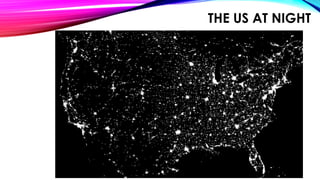
THE US AT NIGHT
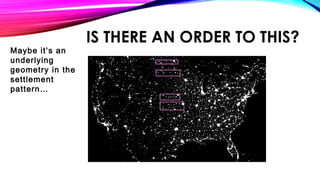
IS THERE AN ORDER TO THIS?
Maybe it’s an
underlying
geometry in the
settlement
pattern…
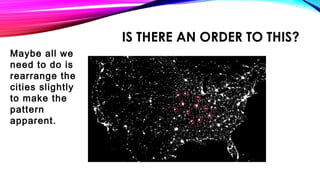
IS THERE AN ORDER TO THIS?
Maybe all we
need to do is
rearrange the
cities slightly
to make the
pattern
apparent.
OBJECTIVE
• to understand the dynamics shaping the urban hierarchy
• what makes cities grow quickly or slowly?
• how do urban settlements of a particular size affect the
emergence and growth of other settlements of the same or
different size?
• what pattern would the system of settlements form in the
absence of complicating factors such as topography and
WHY ASK THESE QUESTIONS?
• to advance toward a more scientific understanding of
urbanization
• to develop a foundation on which to build a positivist
theory of urban growth
• to “raise” urban studies to the “level” of the hard
sciences--assuming the hard sciences are superior to the
soft (humanistic, descriptive, probabilistic) sciences
EVERY SCIENCE NEEDS A FORCE …
• economic competition
• between cities
• rational maximization
• by individuals
• friction of distance as a driving force
• cost distance
• time distance
• (later) cognitive distance
IN SHORT…
• Through rationally maximizing the productivity of their time…
• by minimizing the costs of various activities measured in
money and time,
• people collectively create a system in which facilities of all
sorts…
• including cities,
• are pitted against each other…
• and all facilities emerge from this competition in
advantageous locations and with predictable-sized areas of
dominance.
COMPETITION
PRODUCES ORDER
In other words …
FOUNDERS OF CENTRAL PLACE
THEORY
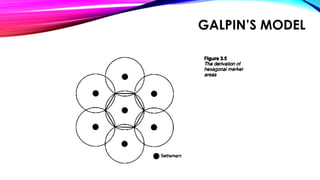
• C.J. Galpin (1915)
• sociologist studying rural communities in Wisconsin
• decided that under ideal conditions settlements
would be spaced evenly
• pattern: overlapping circular service areas with the
central places aligned in a hexagonal array
• overlap of service areas indicates a region in which a
person is equally inclined to shop at either central
place
GALPIN’S MODEL
FOUNDERS OF CENTRAL
PLACE THEORY
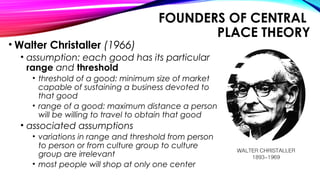
• Walter Christaller (1966)
• assumption: each good has its particular
range and threshold
• threshold of a good: minimum size of market
capable of sustaining a business devoted to
that good
• range of a good: maximum distance a person
will be willing to travel to obtain that good
• associated assumptions
• variations in range and threshold from person
to person or from culture group to culture
group are irrelevant
• most people will shop at only one center
DETAILS OF
CHRISTALLER’S THEORY
• The vast range of retail functions could be grouped into
7 “orders,” corresponding to cities with different sized
hinterlands
• the functions in an order share a similar threshold and
range
• automobiles would be in a different order than loaves of
bread, for example
• What might be in the same order as automobiles?
• What might be in the same order as loaves of bread?
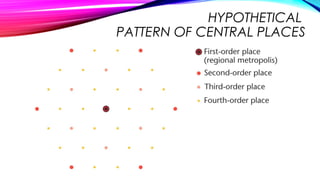
HYPOTHETICAL
PATTERN OF CENTRAL PLACES
MORE TERMINOLOGY
• “Higher order” goods and services are those with a wider
range and higher threshold, located in larger urban
centers
• “Lower order” goods and services are those with a
narrower range and lower threshold, located in smaller
urban centers
• “break point”: the invisible boundary between markets of
competing central places
• “isotropic plain” uniform land surface on which these
ordering principles would generate a hexagonal pattern
of cities
AN INTERPRETATION OF THE URBAN
HIERARCHY (LISTED BY ORDER)
1. largest cities (all functions, highest to lowest)
2. large cities
3. small cities
4. larger towns
5. smaller towns
6. villages
7. hamlets (only the lowest order functions)
VARIATIONS ON THE BASIC
THEORY
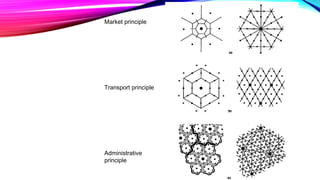
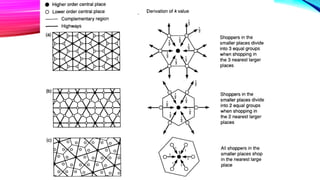
• different patterns result from different values of k
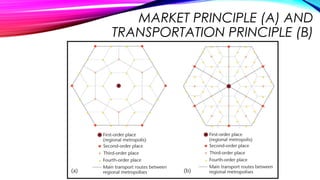
• market optimizing, k=3 (minimizes total number of
settlements serving a region)
• traffic optimizing, k=4 (emerges by minimizing the road
lengths joining all adjacent centers)
• administration optimizing, k=7 (assumes lower-order
places must be contained in the administrative districts of
higher order places; can not be situated on the
breakpoint)
MARKET PRINCIPLE (A) AND
TRANSPORTATION PRINCIPLE (B)
Market principle
Transport principle
Administrative
principle
ADVANTAGE OF CENTRAL PLACE
THEORY
• Central place theory has a number of advantages. It allows
us to see how and why two places differ, and how and why
places differs from the model
• In very flat areas and in primitive societies, central place
theory has been fond to approximate reality.
• It has also been used extensively in rural planning, especially
in the key settlements plans
CRITICISMS OF CENTRAL PLACE
THEORY
• Isotropic plains do not exist
• People are not rational. Even using the limited assumptions
of the model there is preference in terms of shopping, and
increasingly, there is bulk shopping. Time or cost may be a
more useful measure than distance
• It is static and there is no explanation of how patterns
change
• It does not take into account specialty towns such as tourist
town
• In man cases chance has played a part in determining
settlement pattern. The model does not allow for this.
WHAT WOULD THIS INDICATE?
• Urban hierarchy’s regularity may not be caused by the random perturbation
of what would ideally be a step-wise function caused by competition
between cities
• Instead, it may be caused by the natural emergence of dominant (hub)
nodes within a dynamic network

Cental place theory

  • 1.
    THE URBAN SYSTEMTHEURBAN SYSTEM CENTRAL PLACE THEORY and RELATED CONCEPTS
  • 2.
    THE US ATNIGHT
  • 3.
    IS THERE ANORDER TO THIS? Maybe it’s an underlying geometry in the settlement pattern…
  • 4.
    IS THERE ANORDER TO THIS? Maybe all we need to do is rearrange the cities slightly to make the pattern apparent.
  • 5.
    OBJECTIVE • to understandthe dynamics shaping the urban hierarchy • what makes cities grow quickly or slowly? • how do urban settlements of a particular size affect the emergence and growth of other settlements of the same or different size? • what pattern would the system of settlements form in the absence of complicating factors such as topography and
  • 6.
    WHY ASK THESEQUESTIONS? • to advance toward a more scientific understanding of urbanization • to develop a foundation on which to build a positivist theory of urban growth • to “raise” urban studies to the “level” of the hard sciences--assuming the hard sciences are superior to the soft (humanistic, descriptive, probabilistic) sciences
  • 7.
    EVERY SCIENCE NEEDSA FORCE … • economic competition • between cities • rational maximization • by individuals • friction of distance as a driving force • cost distance • time distance • (later) cognitive distance
  • 8.
    IN SHORT… • Throughrationally maximizing the productivity of their time… • by minimizing the costs of various activities measured in money and time, • people collectively create a system in which facilities of all sorts… • including cities, • are pitted against each other… • and all facilities emerge from this competition in advantageous locations and with predictable-sized areas of dominance.
  • 9.
  • 10.
    FOUNDERS OF CENTRALPLACE THEORY • C.J. Galpin (1915) • sociologist studying rural communities in Wisconsin • decided that under ideal conditions settlements would be spaced evenly • pattern: overlapping circular service areas with the central places aligned in a hexagonal array • overlap of service areas indicates a region in which a person is equally inclined to shop at either central place
  • 11.
  • 12.
    FOUNDERS OF CENTRAL PLACETHEORY • Walter Christaller (1966) • assumption: each good has its particular range and threshold • threshold of a good: minimum size of market capable of sustaining a business devoted to that good • range of a good: maximum distance a person will be willing to travel to obtain that good • associated assumptions • variations in range and threshold from person to person or from culture group to culture group are irrelevant • most people will shop at only one center
  • 13.
    DETAILS OF CHRISTALLER’S THEORY •The vast range of retail functions could be grouped into 7 “orders,” corresponding to cities with different sized hinterlands • the functions in an order share a similar threshold and range • automobiles would be in a different order than loaves of bread, for example • What might be in the same order as automobiles? • What might be in the same order as loaves of bread?
  • 14.
  • 15.
    MORE TERMINOLOGY • “Higherorder” goods and services are those with a wider range and higher threshold, located in larger urban centers • “Lower order” goods and services are those with a narrower range and lower threshold, located in smaller urban centers • “break point”: the invisible boundary between markets of competing central places • “isotropic plain” uniform land surface on which these ordering principles would generate a hexagonal pattern of cities
  • 16.
    AN INTERPRETATION OFTHE URBAN HIERARCHY (LISTED BY ORDER) 1. largest cities (all functions, highest to lowest) 2. large cities 3. small cities 4. larger towns 5. smaller towns 6. villages 7. hamlets (only the lowest order functions)
  • 17.
    VARIATIONS ON THEBASIC THEORY • different patterns result from different values of k • market optimizing, k=3 (minimizes total number of settlements serving a region) • traffic optimizing, k=4 (emerges by minimizing the road lengths joining all adjacent centers) • administration optimizing, k=7 (assumes lower-order places must be contained in the administrative districts of higher order places; can not be situated on the breakpoint)
  • 18.
    MARKET PRINCIPLE (A)AND TRANSPORTATION PRINCIPLE (B)
  • 19.
  • 21.
    ADVANTAGE OF CENTRALPLACE THEORY • Central place theory has a number of advantages. It allows us to see how and why two places differ, and how and why places differs from the model • In very flat areas and in primitive societies, central place theory has been fond to approximate reality. • It has also been used extensively in rural planning, especially in the key settlements plans
  • 22.
    CRITICISMS OF CENTRALPLACE THEORY • Isotropic plains do not exist • People are not rational. Even using the limited assumptions of the model there is preference in terms of shopping, and increasingly, there is bulk shopping. Time or cost may be a more useful measure than distance • It is static and there is no explanation of how patterns change • It does not take into account specialty towns such as tourist town • In man cases chance has played a part in determining settlement pattern. The model does not allow for this.
  • 23.
    WHAT WOULD THISINDICATE? • Urban hierarchy’s regularity may not be caused by the random perturbation of what would ideally be a step-wise function caused by competition between cities • Instead, it may be caused by the natural emergence of dominant (hub) nodes within a dynamic network