CENTRAL PLACE
THEORY
PRESENTED BY: MAHAM
SAFDAR
ROLL NO: 19CRP36
PRESENTED TO: Dr.
ZULFIQAR ALI LASHARI
CONTENTS
1. Introduction
2. Hierarchy of settlements
3. Walter Christaller’s Model of Central Place Theory
4. Central Place Theory five assumptions
5. Three principles in the arrangement of Central Place Theory
6. Advantages of Central Place Theory
7. Disadvantages of Central Place Theory
INTRODUCTION
• The German geographer Walter Christaller
introduced central-place theory in his book entitled
Central Places in Southern Germany (1933).
• In geography, it is an element of location theory
concerning the size and distribution of central
places (settlements) within a system.
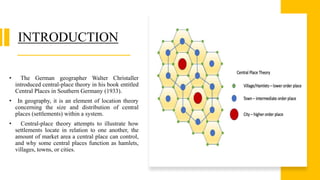
• Central-place theory attempts to illustrate how
settlements locate in relation to one another, the
amount of market area a central place can control,
and why some central places function as hamlets,
villages, towns, or cities.
The primary purpose of a settlement or market town, according to central-place
theory, is the provision of goods and services for the surrounding market area.
Such towns are centrally located and may be called Central Places.
Lower-order central places have small market areas and provide goods and
services that are purchased more frequently than higher-order goods and
services.
Higher-order places are more widely distributed and fewer in number than lower-
order places
• Before testing his theory however,
Christaller had to first define the central
place. In keeping with his economic
focus, he concluded that the central place
exists primarily to provide goods and
services to its surrounding population.
HIERARCHY OF
SETTLEMENTS
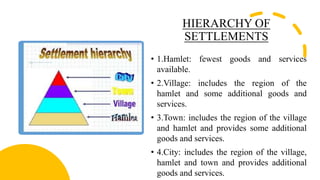
• 1.Hamlet: fewest goods and services
available.
• 2.Village: includes the region of the
hamlet and some additional goods and
services.
• 3.Town: includes the region of the village
and hamlet and provides some additional
goods and services.
• 4.City: includes the region of the village,
hamlet and town and provides additional
goods and services.
WALTER CHRISTALLER’S MODEL OF
CENTRAL PLACE THEORY
Walter Christaller attempted to design
a model that would show how and
where central places in the urban
hierarchy would be functionally and
spatially distributed.
In the flat landscape of southern
Germany, Christaller noticed that
towns of a certain size were roughly
equidistant. By examining and
defining the functions of the
settlement structure and the size of the
hinterland he found it possible to
model the pattern of settlement
locations using geometric shapes.
CENTRAL
PLACE THEORY
FIVE
ASSUMPTIONS
The surface of the ideal region would be flat and have no physical
barriers.
Soil fertility would be universal.
Population, purchasing power evenly distributed.
Uniform transport network that permitted direct travel from each
settlement to the other.
Constant maximum distance or range for the sale of any good or
service produced in a town prevailed in all directions from the
town center.
THREE
PRINCIPLES IN
THE
ARRANGMENT
OF CENTRAL
PLACE THOERY
The marketing principle (K=3
system)
The transportation principle
(K=4 system)
The administrative principle
(K=7 system)
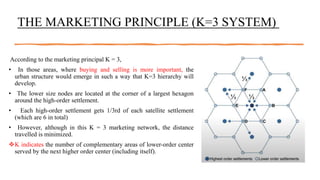
THE MARKETING PRINCIPLE (K=3 SYSTEM)
According to the marketing principal K = 3,
• In those areas, where buying and selling is more important, the
urban structure would emerge in such a way that K=3 hierarchy will
develop.
• The lower size nodes are located at the corner of a largest hexagon
around the high-order settlement.
• Each high-order settlement gets 1/3rd of each satellite settlement
(which are 6 in total)
• However, although in this K = 3 marketing network, the distance
travelled is minimized.
K indicates the number of complementary areas of lower-order center
served by the next higher order center (including itself).
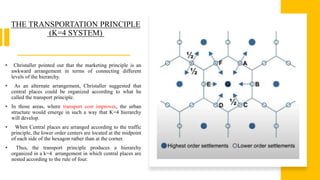
THE TRANSPORTATION PRINCIPLE
(K=4 SYSTEM)
• Christaller pointed out that the marketing principle is an
awkward arrangement in terms of connecting different
levels of the hierarchy.
• As an alternate arrangement, Christaller suggested that
central places could be organized according to what he
called the transport principle.
• In those areas, where transport cost improves, the urban
structure would emerge in such a way that K=4 hierarchy
will develop.
• When Central places are arranged according to the traffic
principle, the lower order centers are located at the midpoint
of each side of the hexagon rather than at the corner.
• Thus, the transport principle produces a hierarchy
organized in a k=4 arrangement in which central places are
nested according to the rule of four.
THE ADMINISTRATIVE PRINCIPLE
(K=7 SYSTEM)
• Christaller’s other suggested organizing principle
was based upon the realization that from a political or
administrative viewpoint centres it was unrealistic
for centres to be ‘shared’.
• In those areas, where the administration is
centralized, the urban structure would emerge in such
a way that K=7 hierarchy will develop.
• All the six lower order centres are fully subordinate
to the higher order centre which, therefore, dominates
the equivalent of seven market areas at the next
lowest level.
ADVANTAGES
OF CENTRAL
PLACE
THEORY
i. The theory does a reasonably good job of
describing the spatial pattern of urbanization.
No other economic theory explains why there
is a hierarchy of urban centers.
ii. Central place theory does a good job of
describing the location of trade and service
activity.
iii. It also does a good job of describing consumer
market-oriented manufacturing.
iv. Small-town community economic developers
can secure quite specific, relevant information
about what kind of trade or service enterprise
will likely work, and what kind of enterprise
will not likely work in each small community.
DISADVANTAGES
OF CENTRAL
PLACE THEORY
i. Large areas of flat land rarely exist-transport
is uneven.
ii. There are many forms of transportation- cost
cannot be proportional to distance.
iii. People and wealth are not evenly distributed.
iv. People do not always to the nearest place.
v. Purchasing power of people differs.
vi. Perfect competition is unreal-some make more
money than others.
vii. Shopping habits have changed.
viii. Theory sees the central place as having a
particular function-in reality, places have
several which changes over time.
THANKYOU

CENTRAL PLACE THEORY .pptx

  • 1.
    CENTRAL PLACE THEORY PRESENTED BY:MAHAM SAFDAR ROLL NO: 19CRP36 PRESENTED TO: Dr. ZULFIQAR ALI LASHARI
  • 2.
    CONTENTS 1. Introduction 2. Hierarchyof settlements 3. Walter Christaller’s Model of Central Place Theory 4. Central Place Theory five assumptions 5. Three principles in the arrangement of Central Place Theory 6. Advantages of Central Place Theory 7. Disadvantages of Central Place Theory
  • 3.
    INTRODUCTION • The Germangeographer Walter Christaller introduced central-place theory in his book entitled Central Places in Southern Germany (1933). • In geography, it is an element of location theory concerning the size and distribution of central places (settlements) within a system. • Central-place theory attempts to illustrate how settlements locate in relation to one another, the amount of market area a central place can control, and why some central places function as hamlets, villages, towns, or cities.
  • 4.
    The primary purposeof a settlement or market town, according to central-place theory, is the provision of goods and services for the surrounding market area. Such towns are centrally located and may be called Central Places. Lower-order central places have small market areas and provide goods and services that are purchased more frequently than higher-order goods and services. Higher-order places are more widely distributed and fewer in number than lower- order places
  • 5.
    • Before testinghis theory however, Christaller had to first define the central place. In keeping with his economic focus, he concluded that the central place exists primarily to provide goods and services to its surrounding population.
  • 6.
    HIERARCHY OF SETTLEMENTS • 1.Hamlet:fewest goods and services available. • 2.Village: includes the region of the hamlet and some additional goods and services. • 3.Town: includes the region of the village and hamlet and provides some additional goods and services. • 4.City: includes the region of the village, hamlet and town and provides additional goods and services.
  • 7.
    WALTER CHRISTALLER’S MODELOF CENTRAL PLACE THEORY Walter Christaller attempted to design a model that would show how and where central places in the urban hierarchy would be functionally and spatially distributed. In the flat landscape of southern Germany, Christaller noticed that towns of a certain size were roughly equidistant. By examining and defining the functions of the settlement structure and the size of the hinterland he found it possible to model the pattern of settlement locations using geometric shapes.
  • 8.
    CENTRAL PLACE THEORY FIVE ASSUMPTIONS The surfaceof the ideal region would be flat and have no physical barriers. Soil fertility would be universal. Population, purchasing power evenly distributed. Uniform transport network that permitted direct travel from each settlement to the other. Constant maximum distance or range for the sale of any good or service produced in a town prevailed in all directions from the town center.
  • 9.
    THREE PRINCIPLES IN THE ARRANGMENT OF CENTRAL PLACETHOERY The marketing principle (K=3 system) The transportation principle (K=4 system) The administrative principle (K=7 system)
  • 10.
    THE MARKETING PRINCIPLE(K=3 SYSTEM) According to the marketing principal K = 3, • In those areas, where buying and selling is more important, the urban structure would emerge in such a way that K=3 hierarchy will develop. • The lower size nodes are located at the corner of a largest hexagon around the high-order settlement. • Each high-order settlement gets 1/3rd of each satellite settlement (which are 6 in total) • However, although in this K = 3 marketing network, the distance travelled is minimized. K indicates the number of complementary areas of lower-order center served by the next higher order center (including itself).
  • 11.
    THE TRANSPORTATION PRINCIPLE (K=4SYSTEM) • Christaller pointed out that the marketing principle is an awkward arrangement in terms of connecting different levels of the hierarchy. • As an alternate arrangement, Christaller suggested that central places could be organized according to what he called the transport principle. • In those areas, where transport cost improves, the urban structure would emerge in such a way that K=4 hierarchy will develop. • When Central places are arranged according to the traffic principle, the lower order centers are located at the midpoint of each side of the hexagon rather than at the corner. • Thus, the transport principle produces a hierarchy organized in a k=4 arrangement in which central places are nested according to the rule of four.
  • 12.
    THE ADMINISTRATIVE PRINCIPLE (K=7SYSTEM) • Christaller’s other suggested organizing principle was based upon the realization that from a political or administrative viewpoint centres it was unrealistic for centres to be ‘shared’. • In those areas, where the administration is centralized, the urban structure would emerge in such a way that K=7 hierarchy will develop. • All the six lower order centres are fully subordinate to the higher order centre which, therefore, dominates the equivalent of seven market areas at the next lowest level.
  • 13.
    ADVANTAGES OF CENTRAL PLACE THEORY i. Thetheory does a reasonably good job of describing the spatial pattern of urbanization. No other economic theory explains why there is a hierarchy of urban centers. ii. Central place theory does a good job of describing the location of trade and service activity. iii. It also does a good job of describing consumer market-oriented manufacturing. iv. Small-town community economic developers can secure quite specific, relevant information about what kind of trade or service enterprise will likely work, and what kind of enterprise will not likely work in each small community.
  • 14.
    DISADVANTAGES OF CENTRAL PLACE THEORY i.Large areas of flat land rarely exist-transport is uneven. ii. There are many forms of transportation- cost cannot be proportional to distance. iii. People and wealth are not evenly distributed. iv. People do not always to the nearest place. v. Purchasing power of people differs. vi. Perfect competition is unreal-some make more money than others. vii. Shopping habits have changed. viii. Theory sees the central place as having a particular function-in reality, places have several which changes over time.
  • 15.