® ECOPOLIS 2010 PAGE 1
General Theories of
Spatial Planning
Central Place Theory by
Walter Christaller
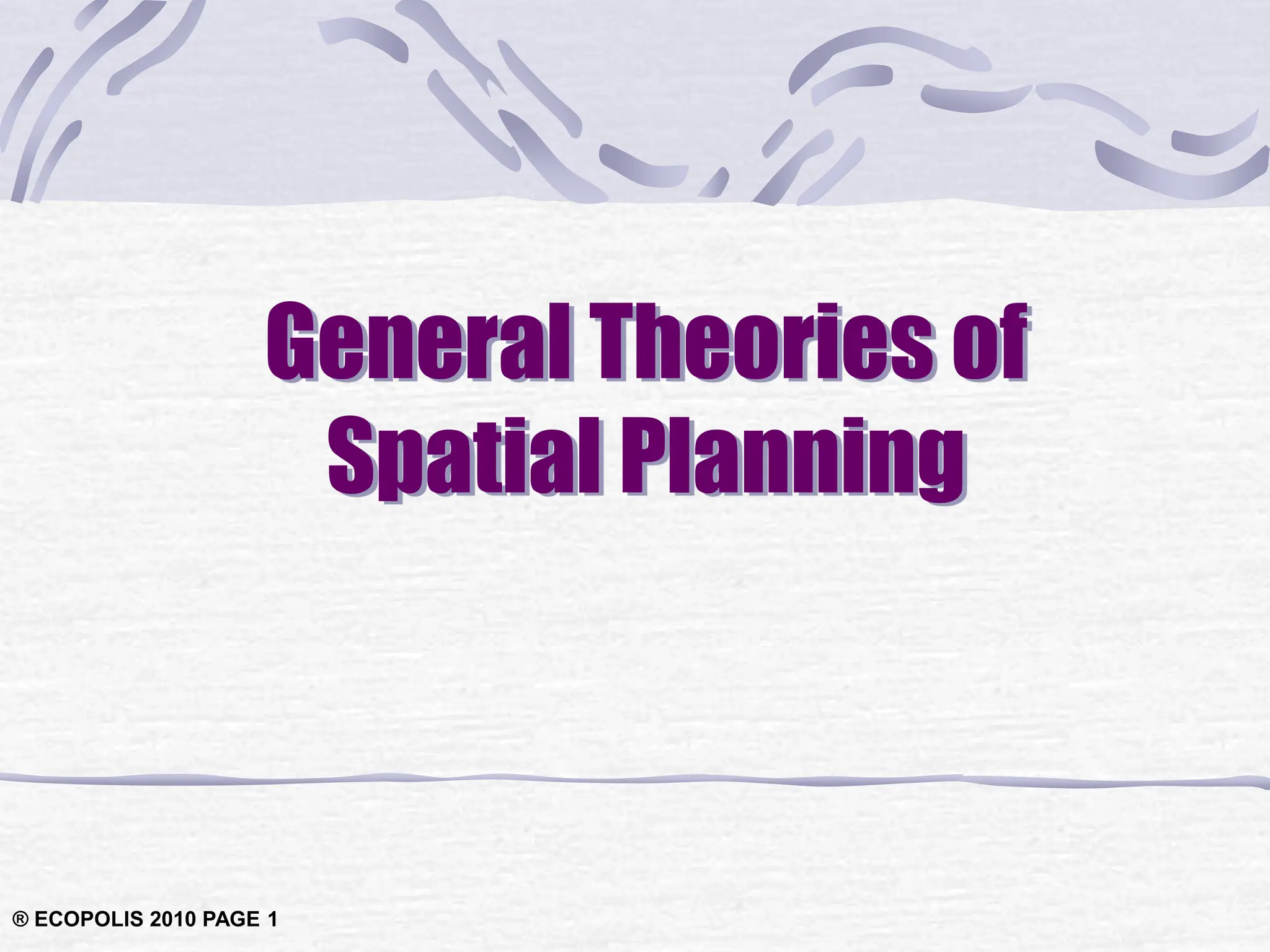
(1) Producers are willing to travel
up to point ‘a’, to purchase
from the other producers
(2) With improved transport and
communication, consumers
willing to travel further to ‘b’
(3) Market areas overlap:
(4) Development of hexagonal
market areas around a system
of central places; tangential
spheres are more efficient
(5) Creation of “higher order” and
“lower order” services
B
A
A
A
B
B
A
B
B
B
C
A
A A
A
‘Central Place Theory’ by Walter Christaller
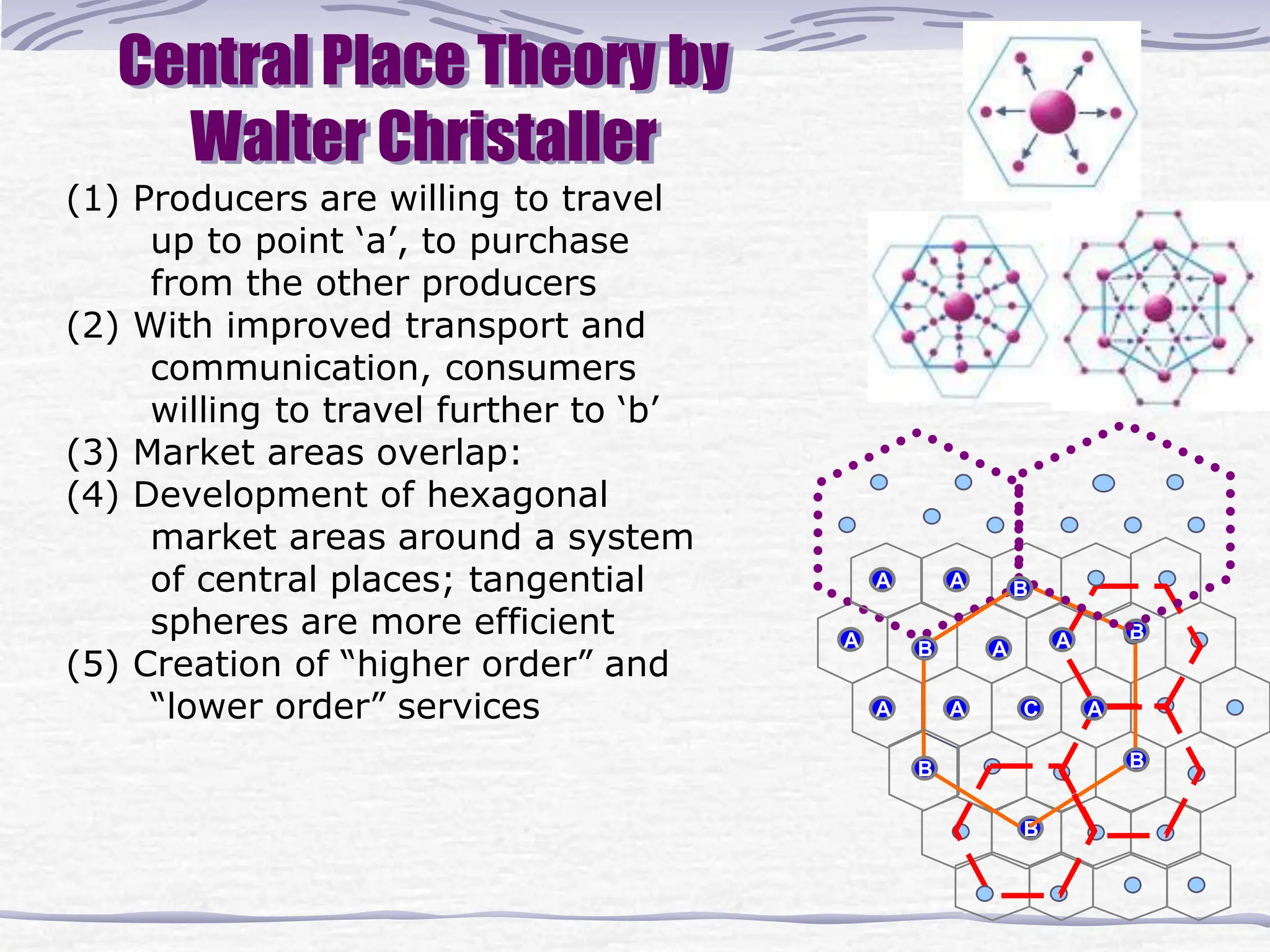
Central Place is a village/town/city that is engaged in
settlement-forming trade and provides a common
location for the local exchange of goods and services
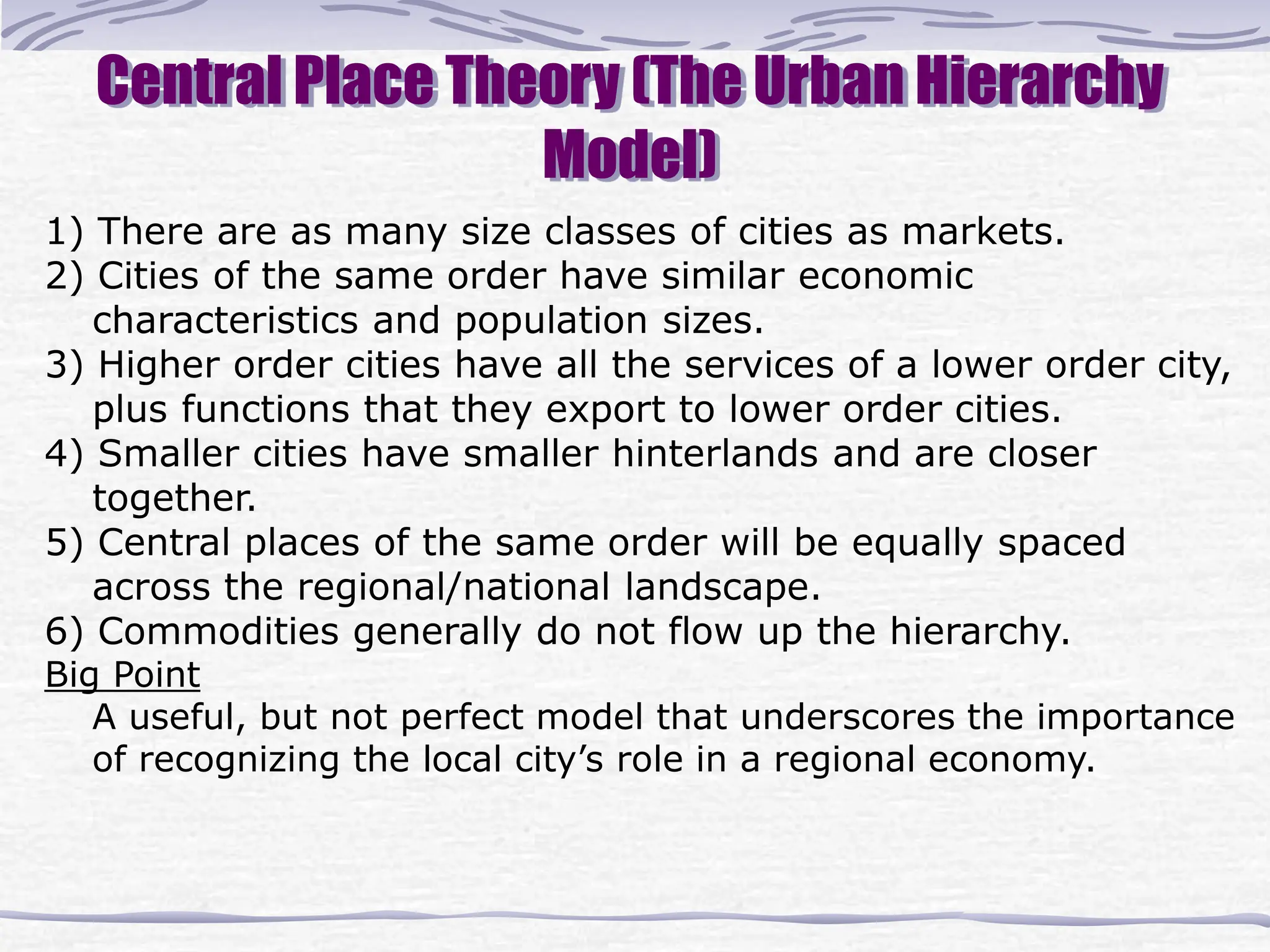
‘Hinterland’ is the surrounding area or Market Area
being served by a central place; it is a large tributary
There is clustering of human population around
Central Places through time until a Hierarchy of
Settlements appears that corresponds to the market’s
need for low-level to high-level services.
The larger the settlements, the fewer their number
The larger a settlement, the farther away a similar
size settlement is.
The range of market increases as the population
increases
The larger the settlement, the higher the order of its
services. Deviations to this rule are:
Tourist resorts that have a small population but large
number of functions.
Dormitory towns that have a large population but a small
number of functions
Central Place Theory (The Urban Hierarchy
Model)
1) There are as many size classes of cities as markets.
2) Cities of the same order have similar economic
characteristics and population sizes.
3) Higher order cities have all the services of a lower order city,
plus functions that they export to lower order cities.
4) Smaller cities have smaller hinterlands and are closer
together.
5) Central places of the same order will be equally spaced
across the regional/national landscape.
6) Commodities generally do not flow up the hierarchy.
Big Point
A useful, but not perfect model that underscores the importance
of recognizing the local city’s role in a regional economy.
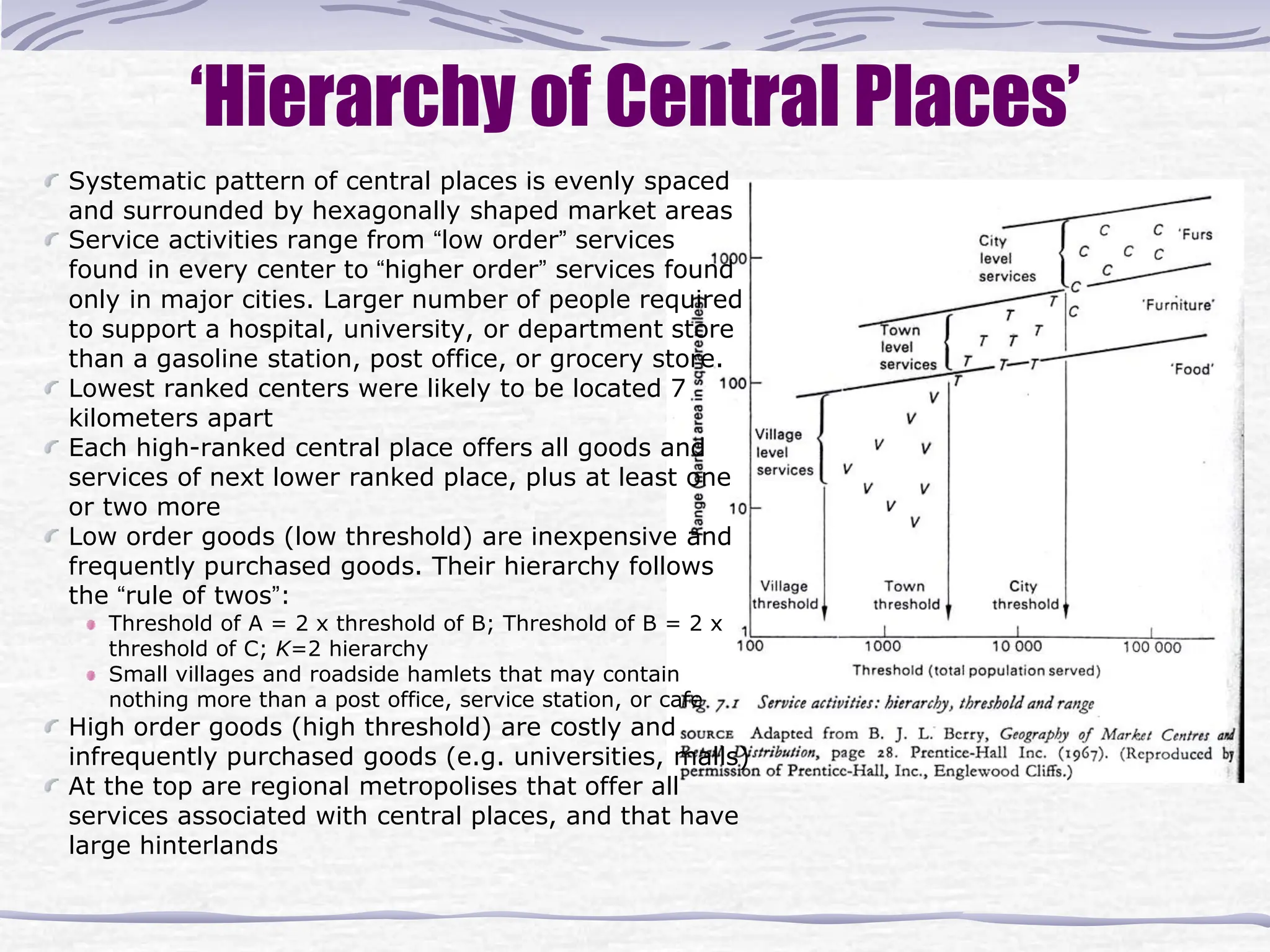
Systematic pattern of central places is evenly spaced
and surrounded by hexagonally shaped market areas
Service activities range from “low order” services
found in every center to “higher order” services found
only in major cities. Larger number of people required
to support a hospital, university, or department store
than a gasoline station, post office, or grocery store.
Lowest ranked centers were likely to be located 7
kilometers apart
Each high-ranked central place offers all goods and
services of next lower ranked place, plus at least one
or two more
Low order goods (low threshold) are inexpensive and
frequently purchased goods. Their hierarchy follows
the “rule of twos”:
Threshold of A = 2 x threshold of B; Threshold of B = 2 x
threshold of C; K=2 hierarchy
Small villages and roadside hamlets that may contain
nothing more than a post office, service station, or cafe
High order goods (high threshold) are costly and
infrequently purchased goods (e.g. universities, malls)
At the top are regional metropolises that offer all
services associated with central places, and that have
large hinterlands
‘Hierarchy of Central Places’
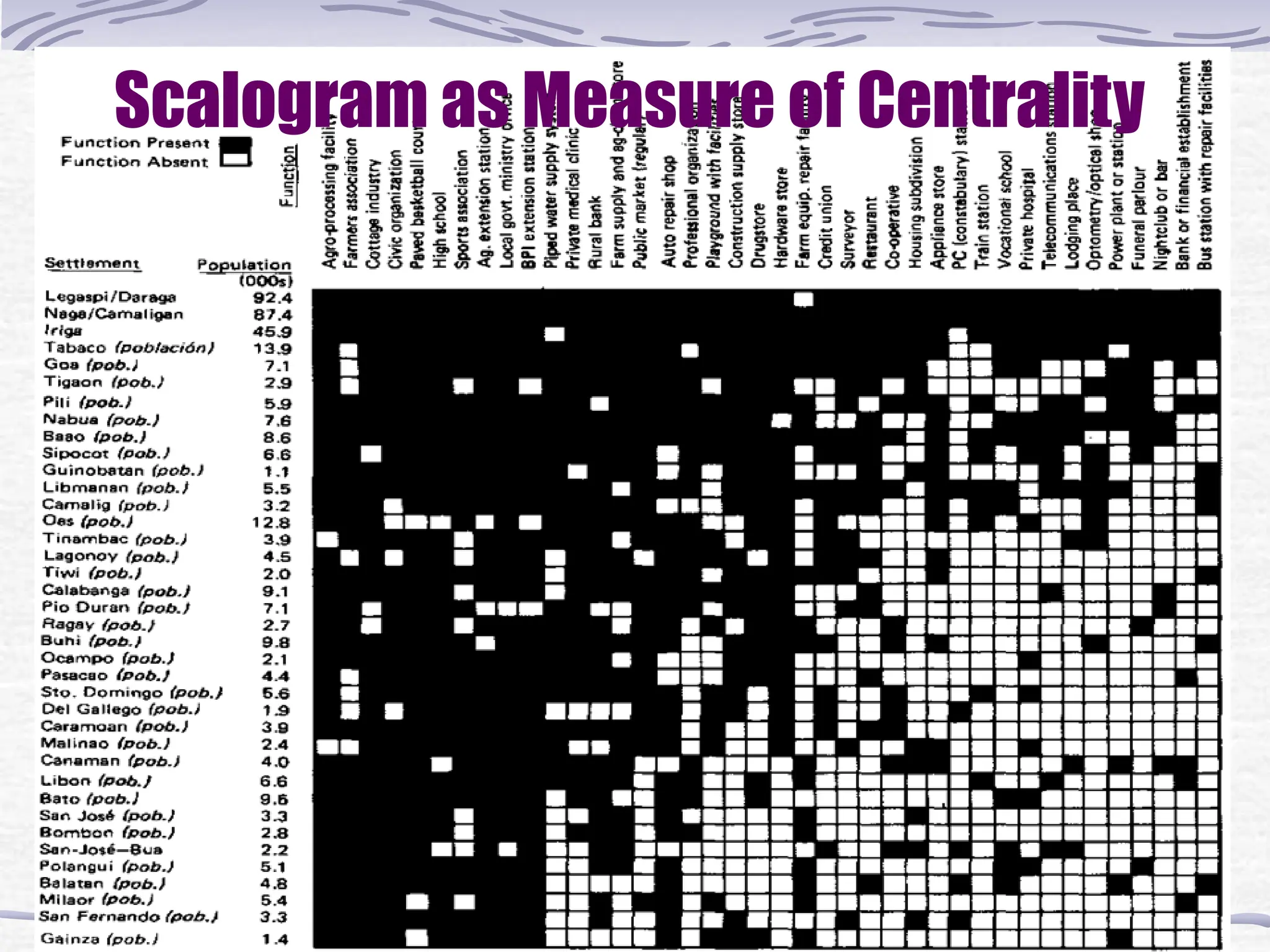
Scalogram as Measure of Centrality
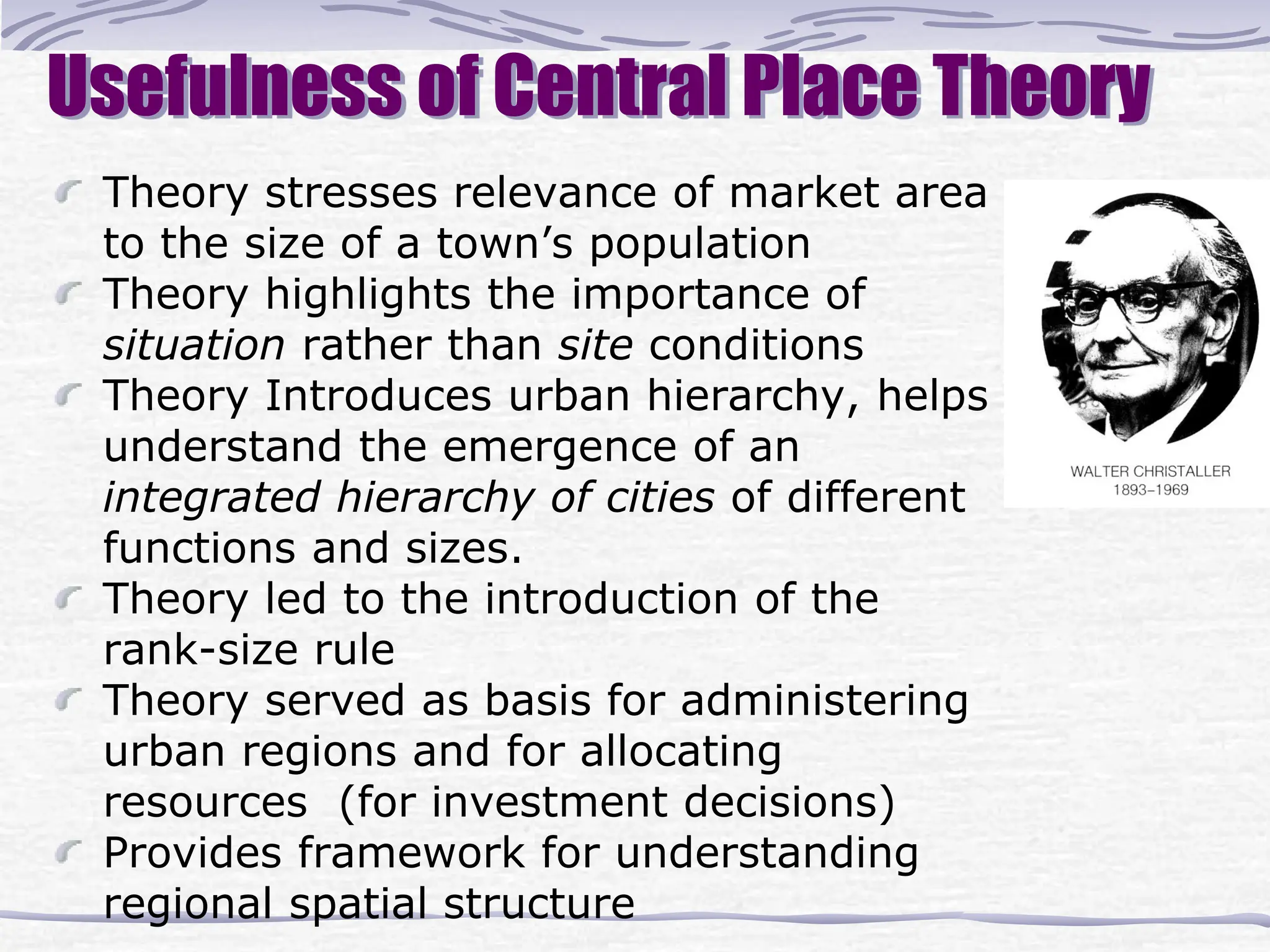
Usefulness of Central Place Theory
Theory stresses relevance of market area
to the size of a town’s population
Theory highlights the importance of
situation rather than site conditions
Theory Introduces urban hierarchy, helps
understand the emergence of an
integrated hierarchy of cities of different
functions and sizes.
Theory led to the introduction of the
rank-size rule
Theory served as basis for administering
urban regions and for allocating
resources (for investment decisions)
Provides framework for understanding
regional spatial structure
What is Regional Planning?
It concerns planning for a sub-national territory with known scale (size)
and extent (scope), normally a contiguous area whose parts have common
or complementary characteristics and are linked by intensive interaction or
flows. The whole region is set apart from neighboring territories by its
distinctive economic and social characteristics, continuities and
discontinuities, opportunities and problems, even though it may not have
defined local authority structures and clear administrative boundaries.
it is intermediate between national and urban levels and straddles the gap
between national and grassroot levels.
Region is always extended urban space – it has urban as well as rural
components.
Aspects of Regional Planning
Physical – planning an area’s physical structures: land use, communications,
utilities, etc. and has its origin in the regulation and control of town development
(direct control), decentralization policies
Economic – concerned with the economic structure of an area and its overall
level of prosperity (works more through the market mechanism), growth poles,
efficiency, how to attract investments, reduction of regional disparities (regional
convergence)
Social – migration of people, issues of equity, allocation, redistribution
Cultural – ethnic identity, common history, homogeneity versus heterogeneity
Environmental – connectedness of ecosystems, sustainability
Principles of Regional Planning
Designate transportation corridors using hubs and spokes
and consider major new infrastructure
Some settlements in the region may be administrative in
nature while others are based upon manufacturing or
transport.
Set regional level policy which encourages a mix of housing
values and communities.
Resist development in flood plains or along earthquake
faults. These areas may be utilized as parks, or farmland.
Designate greenbelt land or similar to resist settlement
amalgamation and protect the environment.
Consider designating essential nuisance land uses locations,
including waste disposal.
Consider building codes, zoning laws and policies that
encourage the best use of the land.
Focus of Regional Planning
Decentralization policies
Distribution of population
Reduction of economic disparities among
regions – versus economic polarization
Inter-regional allocation or redistribution
of resources (regional convergence)
Institutional capacitation (e.g.
reorganization of local governments)
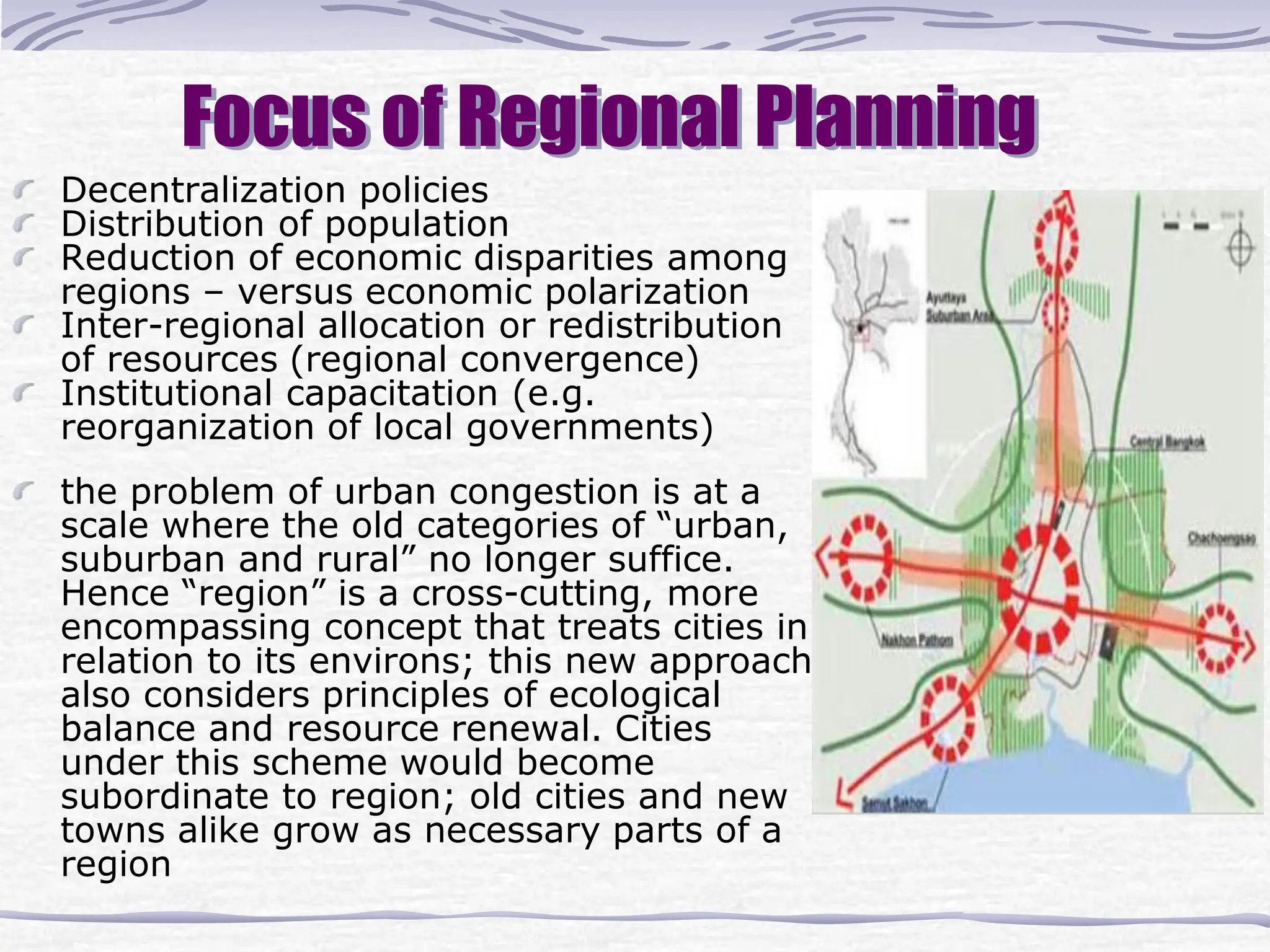
the problem of urban congestion is at a
scale where the old categories of “urban,
suburban and rural” no longer suffice.
Hence “region” is a cross-cutting, more
encompassing concept that treats cities in
relation to its environs; this new approach
also considers principles of ecological
balance and resource renewal. Cities
under this scheme would become
subordinate to region; old cities and new
towns alike grow as necessary parts of a
region
Pioneers of Regional Planning
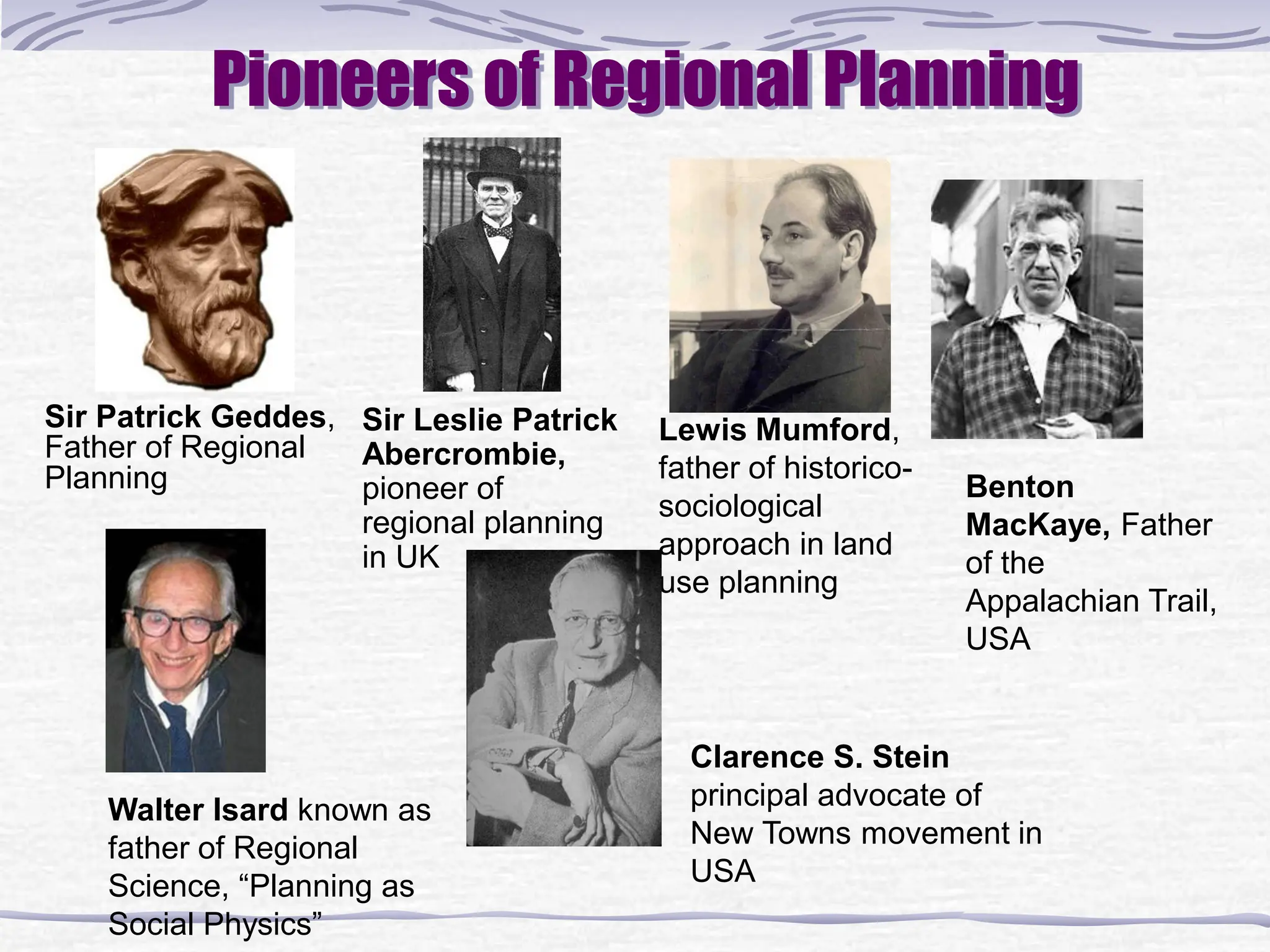
Benton
MacKaye, Father
of the
Appalachian Trail,
USA
Sir Patrick Geddes,
Father of Regional
Planning
Lewis Mumford,
father of historico-
sociological
approach in land
use planning
Sir Leslie Patrick
Abercrombie,
pioneer of
regional planning
in UK
Walter Isard known as
father of Regional
Science, “Planning as
Social Physics”
Clarence S. Stein
principal advocate of
New Towns movement in
USA
History of Regional Planning Movement
1.Early influences from the Garden City Movement (UK) and New Towns
Movement (US)
2.The number of US cities with ‘municipal planning commissions’ grew from
100 to 500 between 1920 1930.
3.Regional Planning Association of America was founded in 1923-25
published “Survey” – a manifesto containing the concept of a region
members - architects, engineers, surveyors, sculptors, artists, sociologists (lawyers
associate members only)
result - interdisciplinary approach to planning
4.Town and Country Planning Act of 1947 (UK)
Concerned with the spatial impact of problems and the spatial coordination of many
different policies
Method of Planning – man assumes control over physical and human matter and
processes it to serve his defined needs
5.Benton MacKaye published The New Exploration: A Philosophy of Regional
Planning, 1928
6.Thomas Adams and Lewis Mumford debated the multi-volume Regional Plan
of New York, 1928-1932
7.Regional Planning on counties, river basins, valleys, dams, rangeland,
ancestral land -- Los Angeles County, 1922; Appalachian Trail, 1928;
Tennessee Valley Authority 1933; Grand Coulee Dam 1935; Colorado River-
Hoover Dam 1936; St Lawrence Seaway, 1959; Delaware River 1961; Miami
(Ohio) Valley 1970.
8.Regional Planning easily dovetailed with Transportation Planning (Penn-
Jersey, 1954; Chicago-Detroit, 1954)
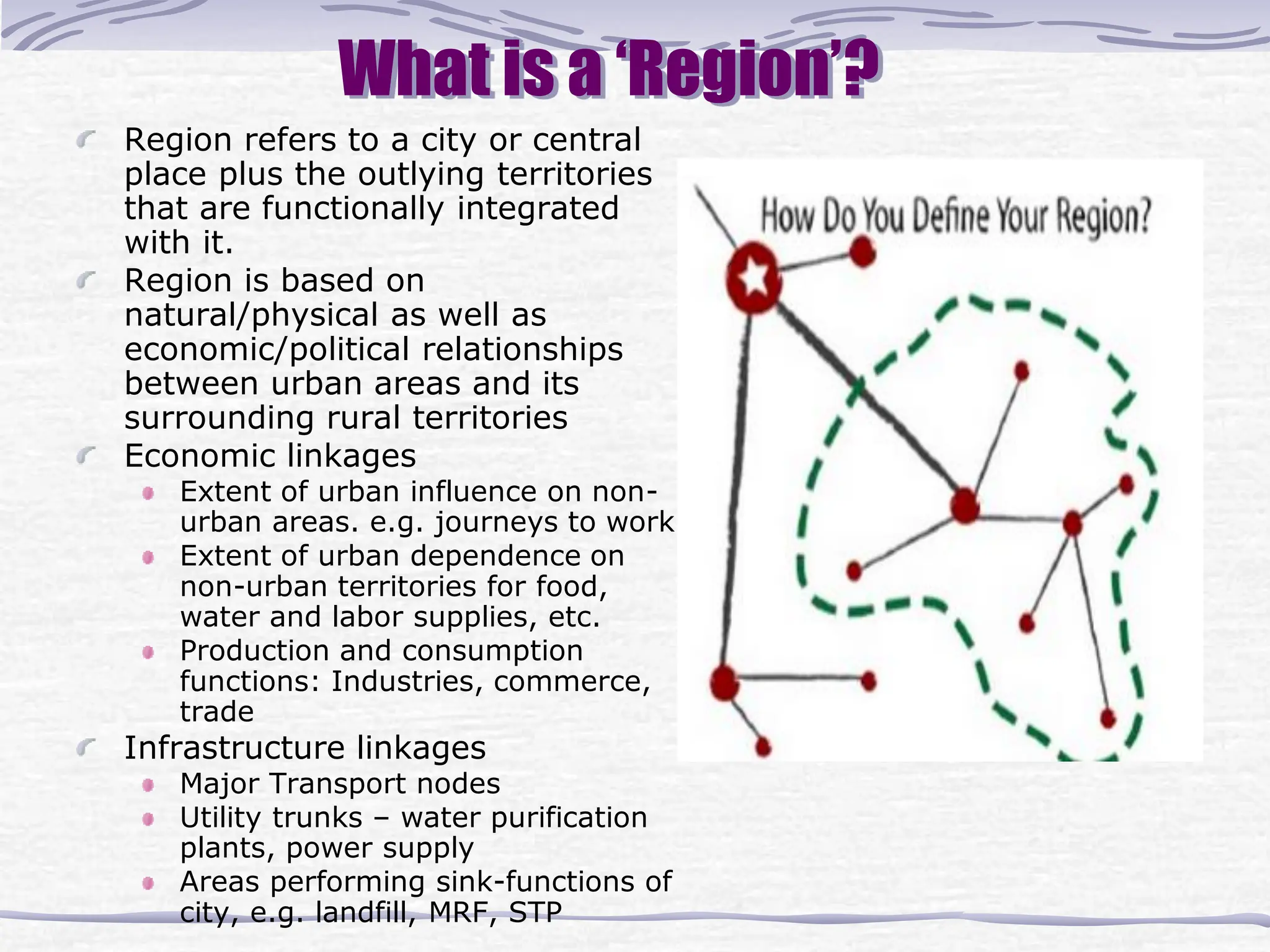
What is a ‘Region’?
Region refers to a city or central
place plus the outlying territories
that are functionally integrated
with it.
Region is based on
natural/physical as well as
economic/political relationships
between urban areas and its
surrounding rural territories
Economic linkages
Extent of urban influence on non-
urban areas. e.g. journeys to work
Extent of urban dependence on
non-urban territories for food,
water and labor supplies, etc.
Production and consumption
functions: Industries, commerce,
trade
Infrastructure linkages
Major Transport nodes
Utility trunks – water purification
plants, power supply
Areas performing sink-functions of
city, e.g. landfill, MRF, STP
Region in Real Space
Functional Region – geographical area which displays a certain functional
coherence, an interdependence of parts, defined on the basis of certain
criteria;
Economic Region – bound by economic linkages, interflows of factors and materials,
inputs-and outputs. Economic Regions are often carved out by Trans-National
Corporations and other agents of Globalization by their interlinking of industrial
clusters, districts, zones and ports.
Region as Space Economy. Traditional Industrial Districts, Clusters, Ecozones,
Natural Region – a geographic area of interdependent ecosystems and natural
communities (this will be discussed in subsequent sessions under Ecosystem-Based
Planning)
Formal Region – geographical area which is uniform and homogeneous in
terms of related criteria; variability is absent; Used generally for analytic
purposes
Political-Administrative Regions defined by common political authority,
administrative boundaries (national, state, local) or electoral constituency.
Urban Region -- region encompassing large cities/towns as well as commuter
villages/communities economically and socially linked to them or dependent upon
them. Urban regions are erroneously treated as homogeneous rather than as physical
and socio-cultural mosaic/collage/palimpsest or as a heterogenous “ecosystem”
Historic Region – area bound together by a common historical past
Types of Natural Region
Natural Region – area defined by
the interdependence and
connectedness of natural units and
habitats
Bio-Region – based on
interdependence and natural
connectedness of life forms and species
Eco-Region – based on
interdependence and natural
connectedness of ecosystems and their
communities
Region in Virtual Space
Virtual Region – a network of
functionally-related areas with high level
of connectivity (ICT) and economic inter-
flows even though these areas are not
spatially proximate or contiguous
Example is a Network Economy. The
ascendancy of ICT has enabled small firms
and even MNCs to create their own
dispersed economic networks.
Regional Divergence -- Regions are
inherently unequal
Causes of Regional Imbalance
Geography & natural endowments: uneven
distribution of harbors, minerals, raw materials
historical factors: invasion, colonization, etc.
specific economic, political, technological,
social, demographic conditions
combination: in the beginning, external
factors, later internal factors
State policies and interventions have to
temper if not rectify Regional Divergence
rather than intensify it.
Clarence Stein’s Six Principles
of New Towns (1920s, USA) –
Earliest Regional Planning
Efforts
Plan simply, but comprehensively
Provide ample sites in the right places for
community use
Put factories and other industrial buildings
where they can be used without wasteful
transportation of people and goods
Cars must be parked and stored (not on the
streets!)
Bring private and public land into relationship
Arrange for the occupancy of houses
Theories of Regional Planning
Growth Pole Theory (Francois Perroux 1950)
Growth Center Theory (Jacques R. Boudeville
1966)
Theory of Cumulative Causation (Gunnar Myrdal
1957)
Industrial Linkage Model (Allan Richard Pred
1977)
Theory of Uneven Development; Polarization and
Trickle Down Effect (Albert Hirschman 1958)
Hierarchical Diffusion Model (Brian JL Berry
1973)
Core-Periphery Model (John Friedmann 1978)
World Bank’s Model of Regional Planning (WDR
2009)
‘Growth Pole’ Theory by Francois Perroux
“Growth does not appear everywhere and all at
once; it manifests itself in points or ‘poles’ of
growth, with variable intensities; it spreads by
different channels with variable terminal effects for
the economy as a whole.”
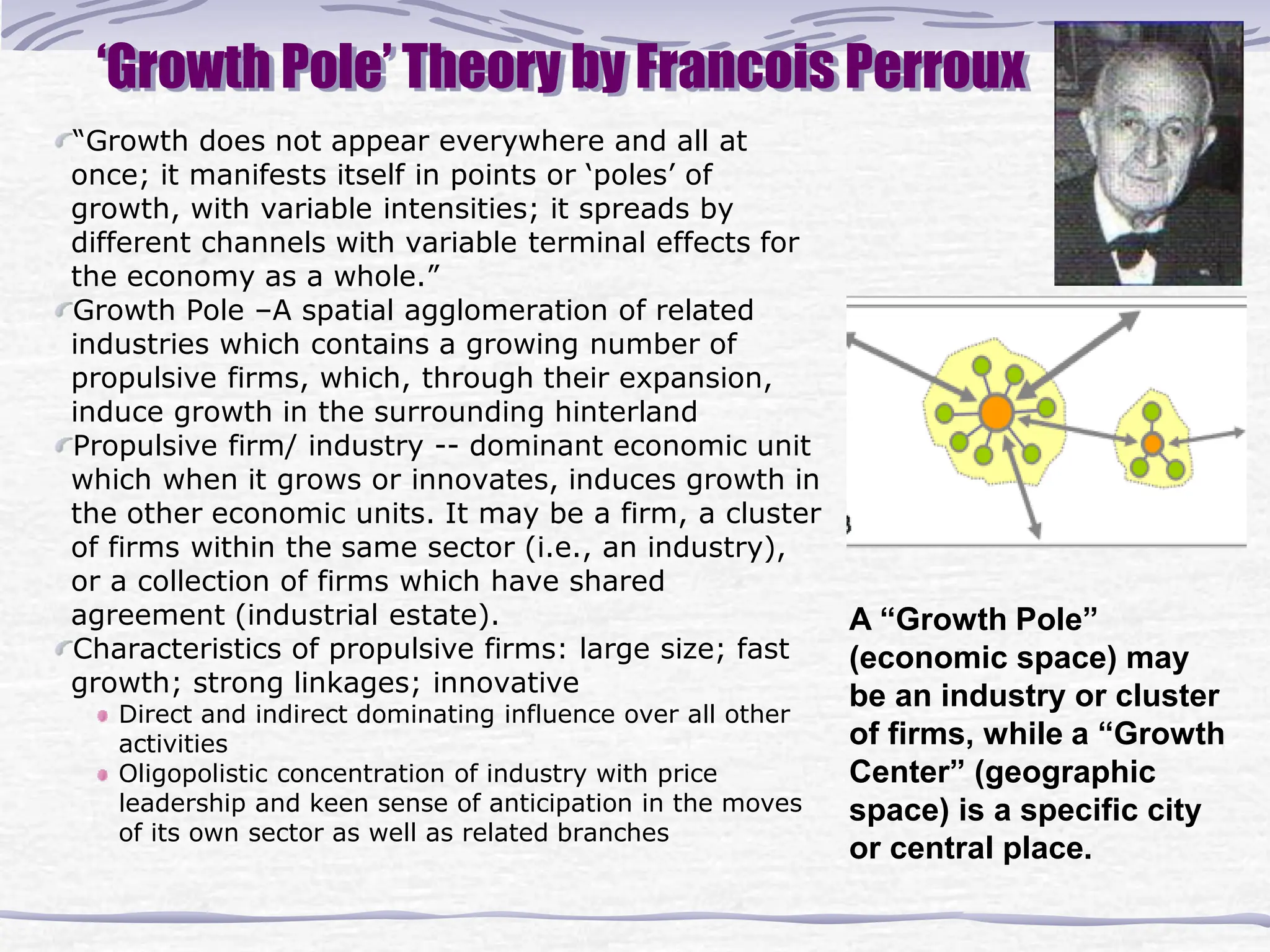
Growth Pole –A spatial agglomeration of related
industries which contains a growing number of
propulsive firms, which, through their expansion,
induce growth in the surrounding hinterland
Propulsive firm/ industry -- dominant economic unit
which when it grows or innovates, induces growth in
the other economic units. It may be a firm, a cluster
of firms within the same sector (i.e., an industry),
or a collection of firms which have shared
agreement (industrial estate).
Characteristics of propulsive firms: large size; fast
growth; strong linkages; innovative
Direct and indirect dominating influence over all other
activities
Oligopolistic concentration of industry with price
leadership and keen sense of anticipation in the moves
of its own sector as well as related branches
A “Growth Pole”
(economic space) may
be an industry or cluster
of firms, while a “Growth
Center” (geographic
space) is a specific city
or central place.
Growth Center by Jacques R. Boudeville
Transformed ‘Growth Pole’ into a specific place within a
region that is heterogeneous, continuous, and not
specialized.
Growth Center (geographic space) is a propulsive urban
center of a region possessing a complex of expanding
industries where the agglomeration of activities induces
growth in its surrounding hinterland. The growth center has
growth rate of population or employment that is greater than
that of total region.
“Regional growth center” refers to “a set of expanding
industries located in an urban area and inducing further
development of economic activity throughout its zone of
influence” with complex activities around propulsive center
Growth Inducement Mechanisms: disturbances or changes
are then spread over the whole region: Polarization,
Agglomeration, Spread Effects
Growth centers are often crafted onto “hierarchy of central
places”
Central place functions = number of functions
Nodal location = predominant flows
Location on the development surface = level of development in
different locations
Population growth rate
Usefulness of Growth Pole / Growth Center
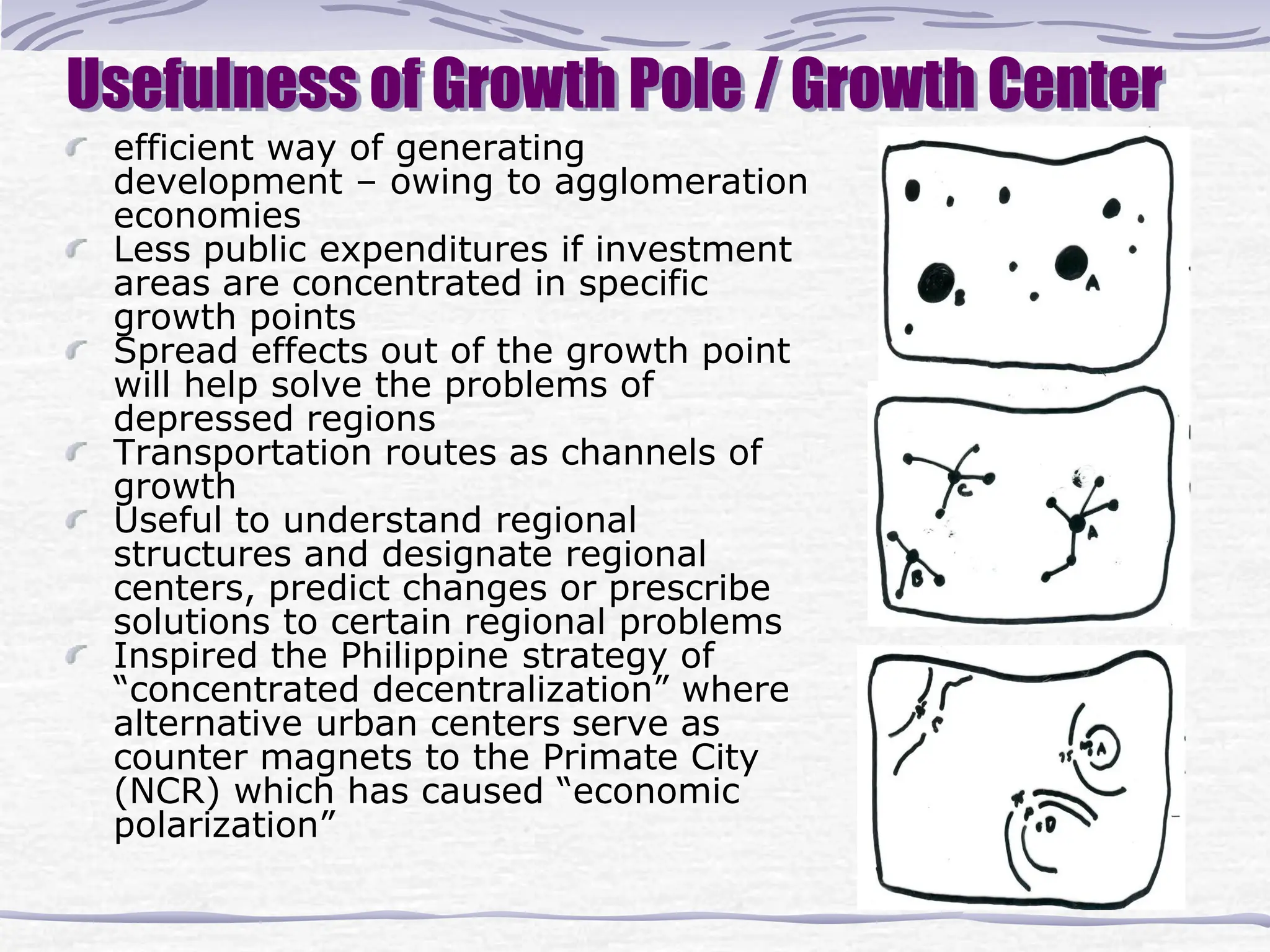
efficient way of generating
development – owing to agglomeration
economies
Less public expenditures if investment
areas are concentrated in specific
growth points
Spread effects out of the growth point
will help solve the problems of
depressed regions
Transportation routes as channels of
growth
Useful to understand regional
structures and designate regional
centers, predict changes or prescribe
solutions to certain regional problems
Inspired the Philippine strategy of
“concentrated decentralization” where
alternative urban centers serve as
counter magnets to the Primate City
(NCR) which has caused “economic
polarization”
‘Theory of Cumulative Causation’ (1957)
by Gunnar Myrdal, Nobel Laureate
Capitalism is characterized by income and welfare inequalities based on history
In countries divided into regions, growth will not be the same. Disequilibrium in
economy is due to market forces; Market forces create regional inequalities and widen
those which already exist. Market forces, if left alone, tend to increase rather than
decrease inequalities between regions
Regions with expanding economic activity will attract net migration from other parts of
the country, thus favoring the growth regions. Capital investments tend to have a
similar effect: increased demand in centers of expansion spur investment, which in
turn will increase incomes and demand and cause a second round of investments, etc.
Circular and cumulative causation
Change in some variables does not bring the system back to equilibrium = induces supporting
changes farther from the initial state
A region or country becomes richer, the poor becomes poorer because of cumulative process
where forces work in circular causation to reinforce development or underdevelopment.
“The poor becomes poorer and the rich becomes richer.”
Social systems are not self-equilibrating (Circular and cumulative causation)
Backwash effect – attention going back to core region; retards growth and widens economic
gap between regions
Spread effects – positive effects initially felt e.g. raw materials but backwash is stronger
Trade operates with the same fundamental bias in favor of more progressive regions
Government policy should be to counteract tendency of capitalist system to foster
regional inequalities. Goverment needs to intervene to decrease imbalances wherever
the normal market mechanisms proves inadequate.
Gunnar Myrdal’s Theory of Cumulative
Causation
Attraction of capital to
exploit expanding
demand for locally
produced goods and
services
Expansion of
employment
and population
Location of
New Industry
Increase in
local pool of
trained
industrial
labor
Expansion of
general wealth
of community
Expansion of
service industries
and others
serving local
market
Development of
auxiliary
industry to
supply inputs to
former industry
Development of
external economies
for former industry’s
production
Expansion of local
government funds
through increased
tax yield
Provision of better
infrastructure for
population and
industrial
development: roads,
factory site, public
utilities, health and
education services
‘Theory of Cumulative Causation’
The combination of forward and backward
linkages creates a potential process of cumulative
causation: expansion of downstream activity
increases demand for upstream output which
attracts entry, improving the supply (price or
varieties) of intermediates, attracting further
downstream entry, and so on.
Linkage – input-output relationships among
firms or among industries
Forward linkage – outputs or sales from one
intermediate firm/industry is maximally utilized
by another firm/industry
Backward linkage – factors of production or
intermediary inputs from one firm/industry is
maximally utilized by another firm/industry
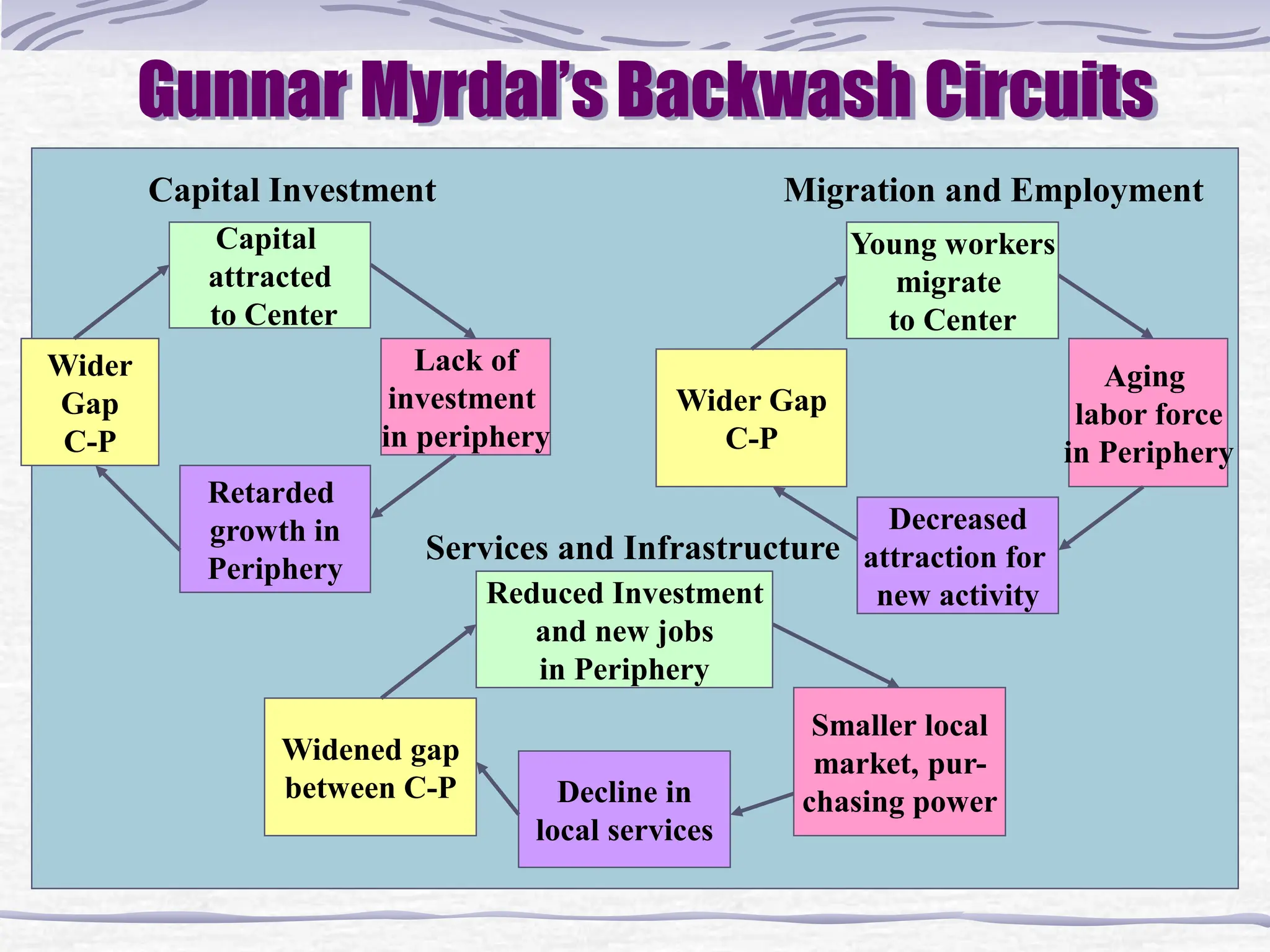
Gunnar Myrdal’s Backwash Circuits
Capital
attracted
to Center
Capital Investment
Young workers
migrate
to Center
Migration and Employment
Lack of
investment
in periphery
Retarded
growth in
Periphery
Wider
Gap
C-P
Aging
labor force
in Periphery
Decreased
attraction for
new activity
Wider Gap
C-P
Services and Infrastructure
Reduced Investment
and new jobs
in Periphery
Smaller local
market, pur-
chasing power
Decline in
local services
Widened gap
between C-P
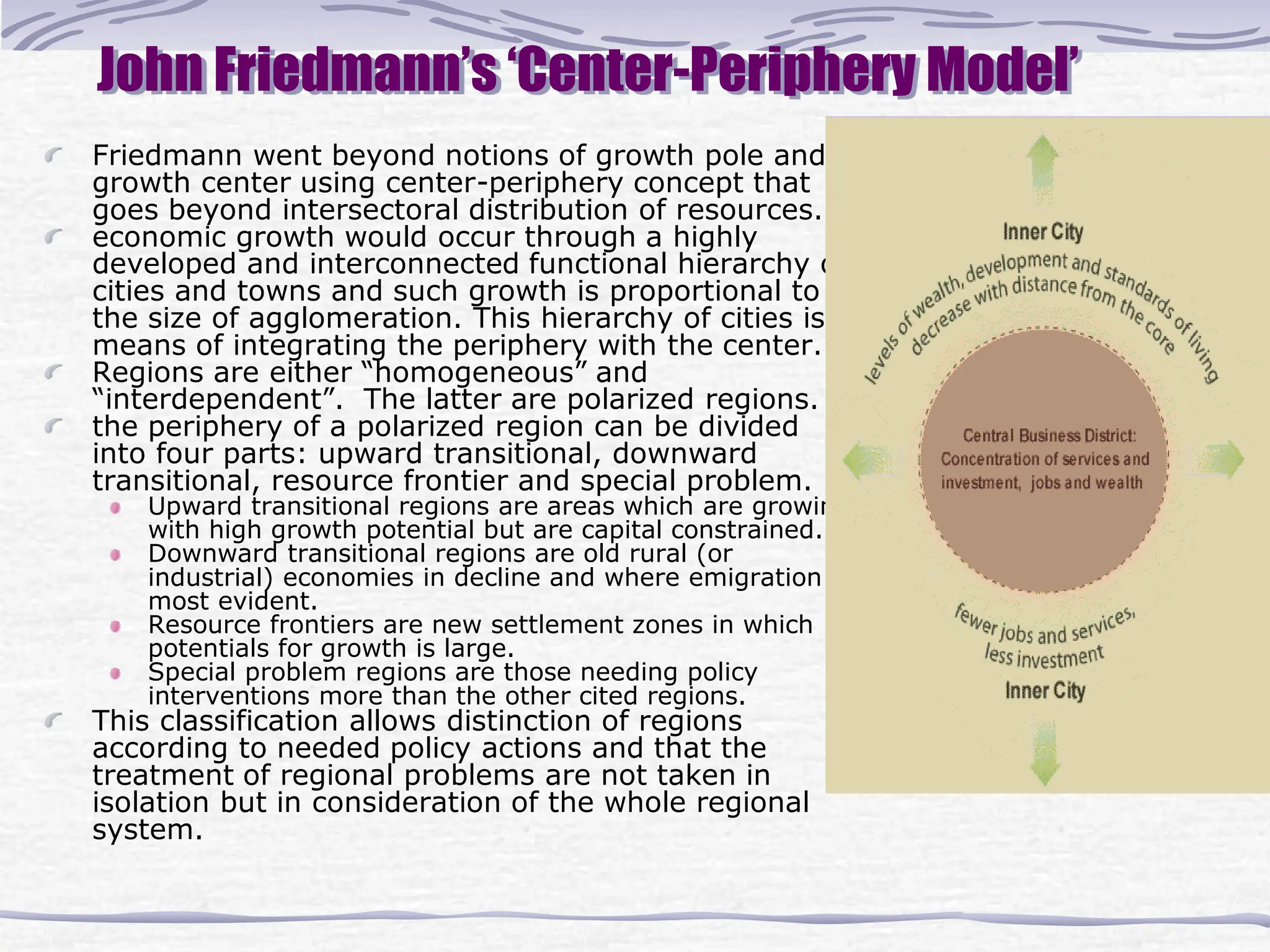
John Friedmann’s ‘Center-Periphery Model’
Friedmann went beyond notions of growth pole and
growth center using center-periphery concept that
goes beyond intersectoral distribution of resources.
economic growth would occur through a highly
developed and interconnected functional hierarchy of
cities and towns and such growth is proportional to
the size of agglomeration. This hierarchy of cities is a
means of integrating the periphery with the center.
Regions are either “homogeneous” and
“interdependent”. The latter are polarized regions.
the periphery of a polarized region can be divided
into four parts: upward transitional, downward
transitional, resource frontier and special problem.
Upward transitional regions are areas which are growing
with high growth potential but are capital constrained.
Downward transitional regions are old rural (or
industrial) economies in decline and where emigration is
most evident.
Resource frontiers are new settlement zones in which
potentials for growth is large.
Special problem regions are those needing policy
interventions more than the other cited regions.
This classification allows distinction of regions
according to needed policy actions and that the
treatment of regional problems are not taken in
isolation but in consideration of the whole regional
system.
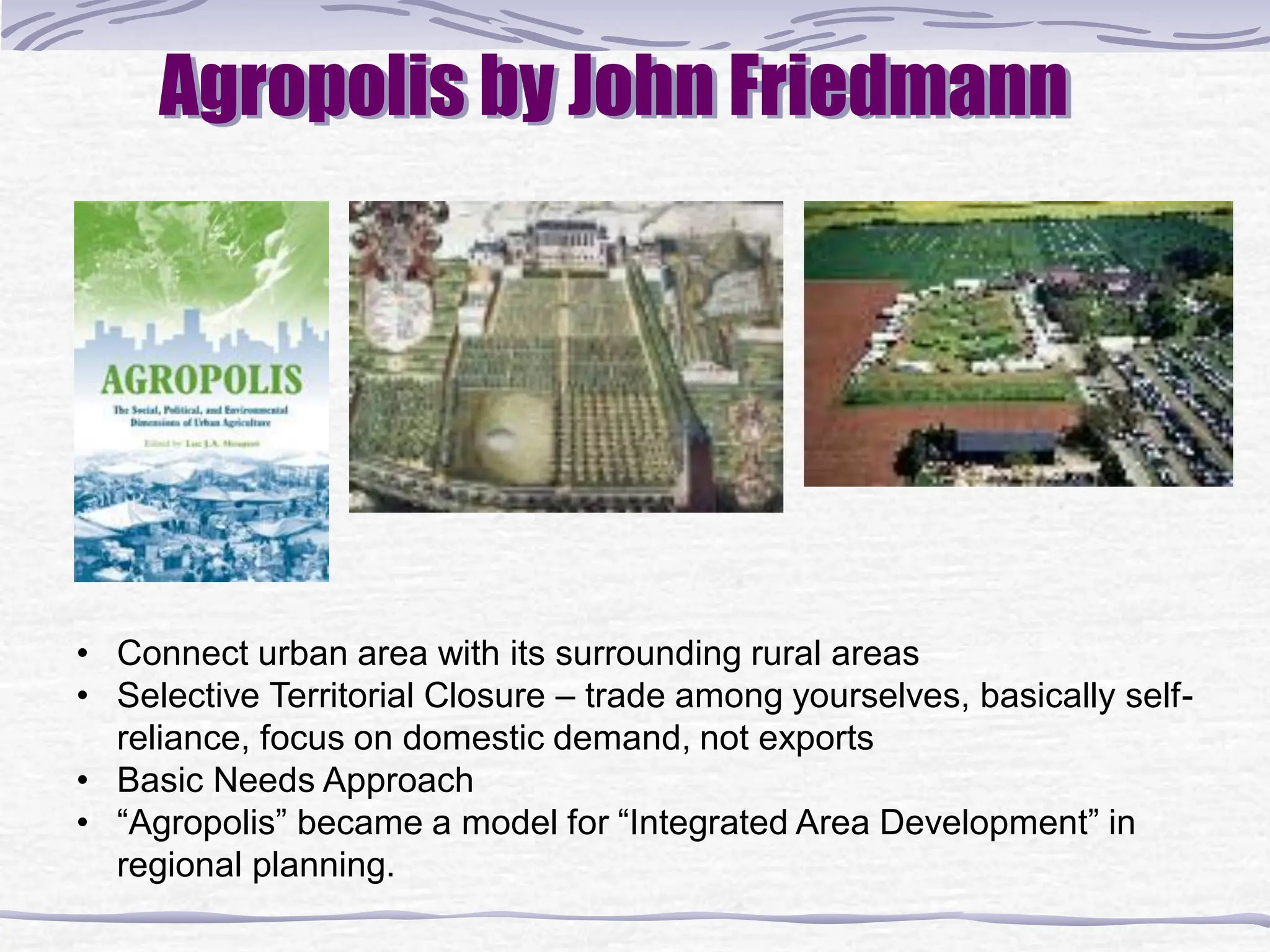
Agropolis by John Friedmann
• Connect urban area with its surrounding rural areas
• Selective Territorial Closure – trade among yourselves, basically self-
reliance, focus on domestic demand, not exports
• Basic Needs Approach
• “Agropolis” became a model for “Integrated Area Development” in
regional planning.
Integrated Area Development
 should be small enough to be “seen steadily and seen whole”,
possessing some kind of cohesion and homogeneity but big
enough to be of some significance in the overall national
development scene.
 conceived or chosen on the basis of the following: influence of feeder
roads, river basin, irrigation projects, erosion zone, reforestation area,
mining area, resettlement area, school districts, among others.
 Philippine experience… establishing the limits to decentralizing IAD units
to keep its operation manageable…. it is better to utilize existing
LGUs unless there are definite reasons they could not be effective.
 In some countries where the LGU is weak or where it is absent,
community organizations or councils were set up and they become the
political authority units or the LGUs in effect.
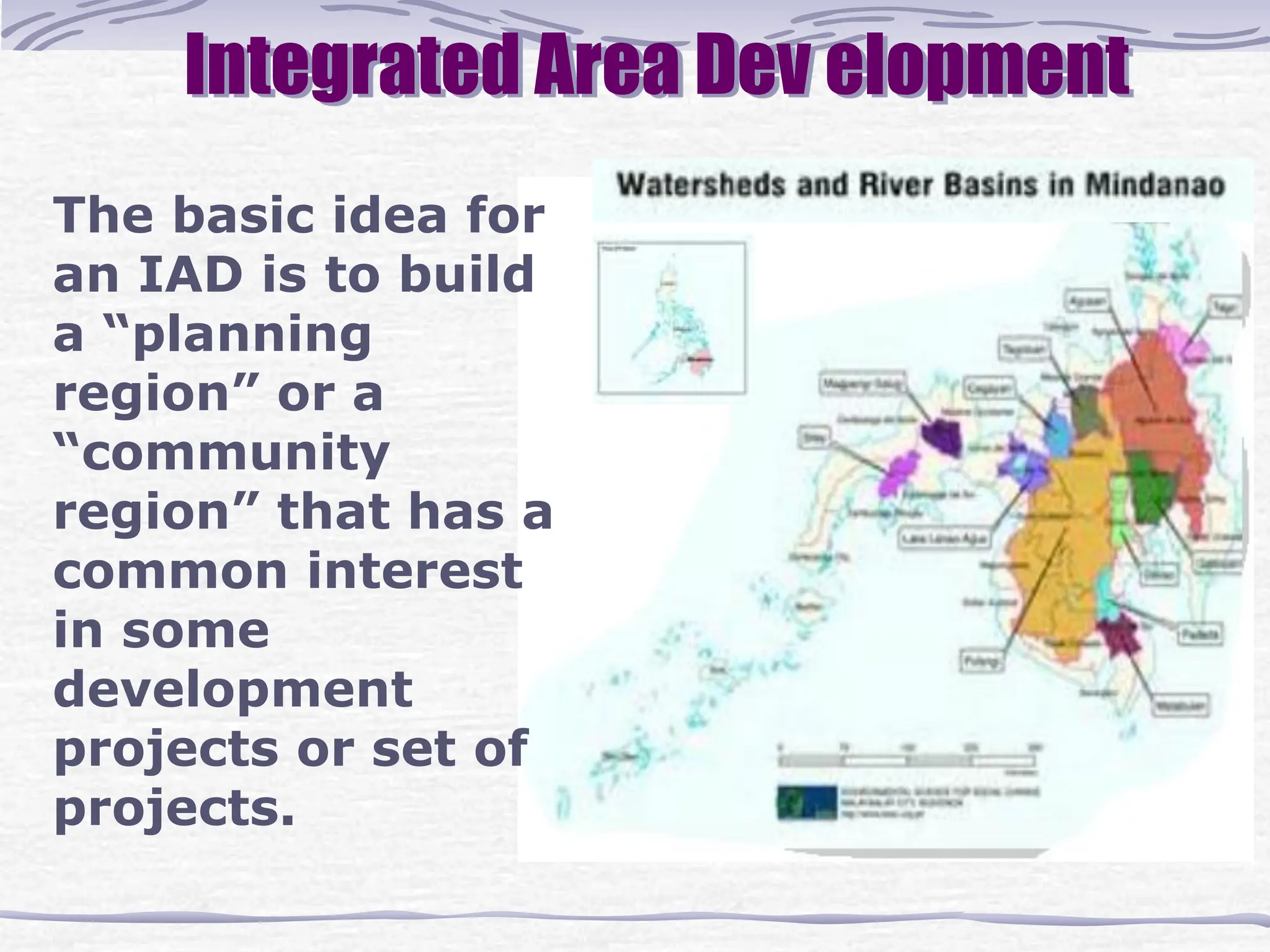
The basic idea for
an IAD is to build
a “planning
region” or a
“community
region” that has a
common interest
in some
development
projects or set of
projects.
Integrated Area Dev elopment
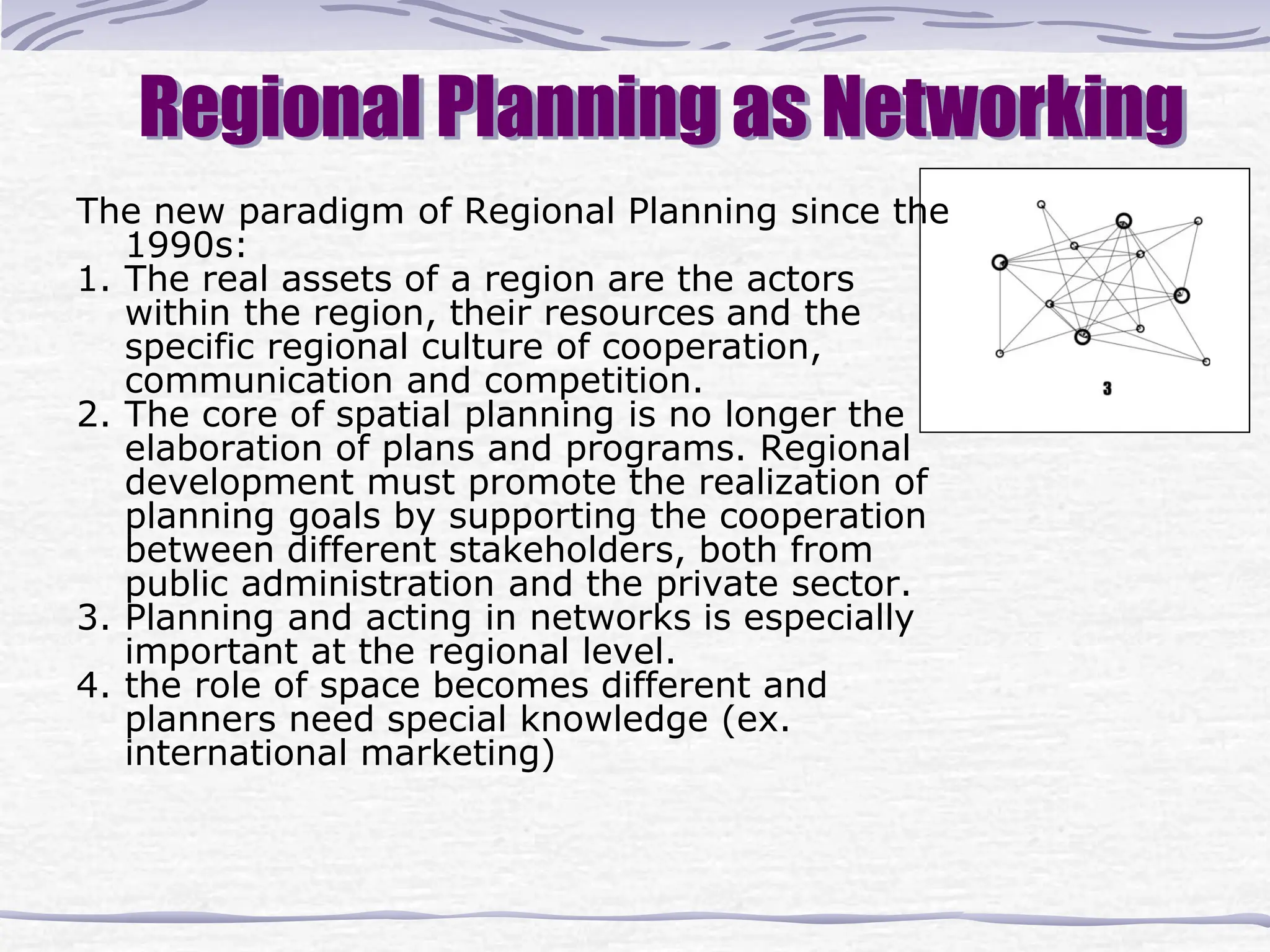
Regional Planning as Networking
The new paradigm of Regional Planning since the
1990s:
1. The real assets of a region are the actors
within the region, their resources and the
specific regional culture of cooperation,
communication and competition.
2. The core of spatial planning is no longer the
elaboration of plans and programs. Regional
development must promote the realization of
planning goals by supporting the cooperation
between different stakeholders, both from
public administration and the private sector.
3. Planning and acting in networks is especially
important at the regional level.
4. the role of space becomes different and
planners need special knowledge (ex.
international marketing)
Theory of Human Capital by Theodore Schultz, Jacob
Mincer (1958/1974), and Gary S.Becker (1964)
Human capital is collective term for “embodied assets” such as education,
good health, knowledge, skills, values, character” as against ‘dis-
embodied assets’ (invention, innovation, technologies)
Human Capital is important for two reasons:
First, a region’s stock of human capital determines its ability to absorb and
use new technology. As the stock of human capital increases, the
economy will be more able to benefit from technological developments,
thereby expanding the economy’s productive capacity. Hence, although
technology may be available everywhere, its efficient use requires an
appropriately skilled workforce.
Second, human capital is an important ingredient in determining the
ability of a region to generate its own technical progress. The capacity of a
region to absorb or create technical progress is not simply a matter of
investing in physical or human capital. A region’s capacity to absorb or
create technical progress is determined by its institutional environment.
The creation of technical progress is determined by a collective learning
process within which many individuals interact and exchange ideas and
information, thereby providing a knowledge-rich environment.
If such an environment exist, knowledge pases quickly from one economic
agent to another, giving rise to the rapid creation of a wide variety of new
ideas.
There are therefore economies of scale to be gained from the geographical
concentration of large numbers of highly educated people since their
proximity to each other results in a more rapid transfer of knowledge and
ideas.
These ideas are then transformed into new products and new processes,
thereby raising labour productivity.
Application of Growth Pole /
Growth Center / Growth Polygons
Agglomeration
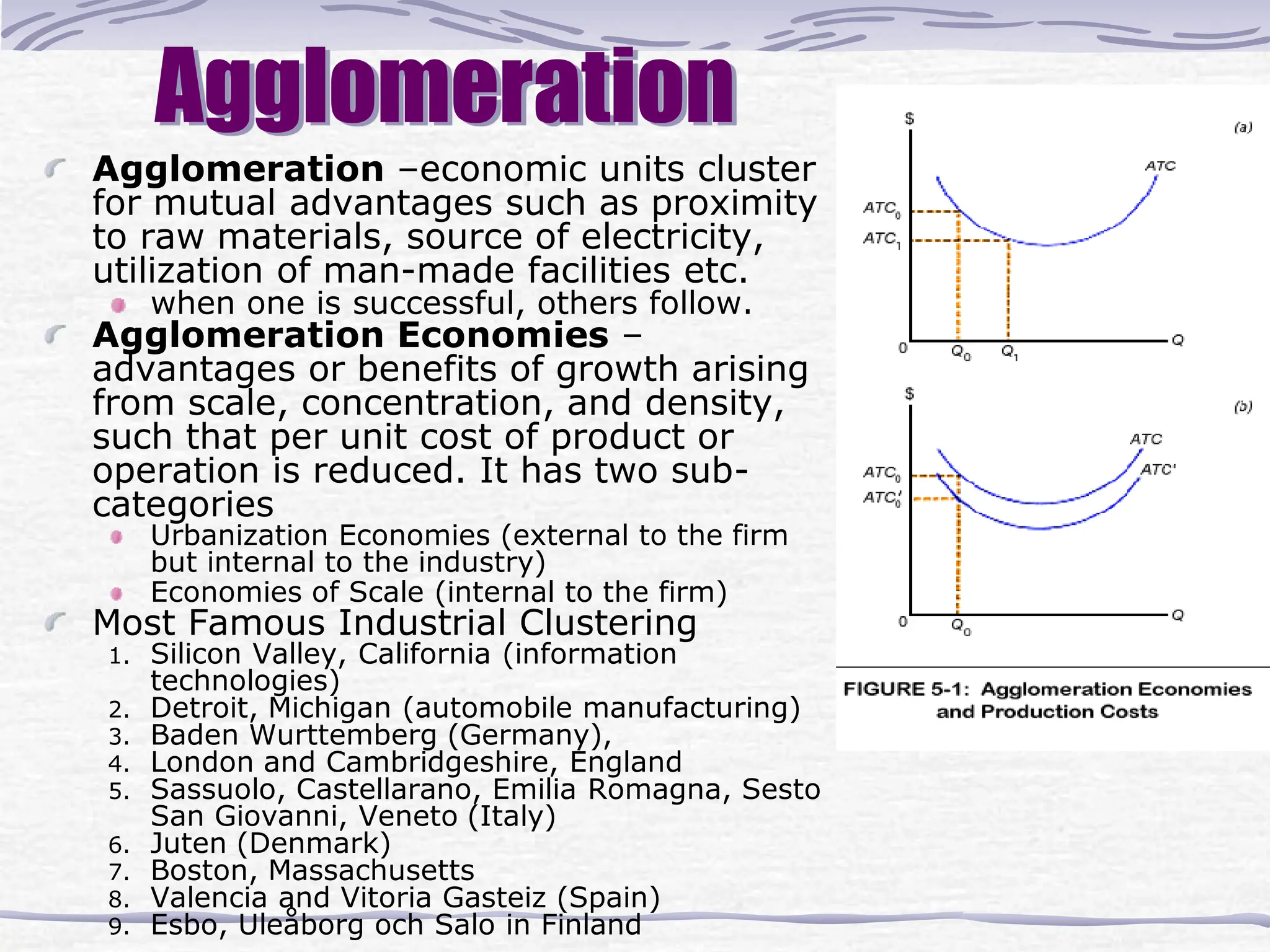
Agglomeration –economic units cluster
for mutual advantages such as proximity
to raw materials, source of electricity,
utilization of man-made facilities etc.
when one is successful, others follow.
Agglomeration Economies –
advantages or benefits of growth arising
from scale, concentration, and density,
such that per unit cost of product or
operation is reduced. It has two sub-
categories
Urbanization Economies (external to the firm
but internal to the industry)
Economies of Scale (internal to the firm)
Most Famous Industrial Clustering
1. Silicon Valley, California (information
technologies)
2. Detroit, Michigan (automobile manufacturing)
3. Baden Wurttemberg (Germany),
4. London and Cambridgeshire, England
5. Sassuolo, Castellarano, Emilia Romagna, Sesto
San Giovanni, Veneto (Italy)
6. Juten (Denmark)
7. Boston, Massachusetts
8. Valencia and Vitoria Gasteiz (Spain)
9. Esbo, Uleåborg och Salo in Finland
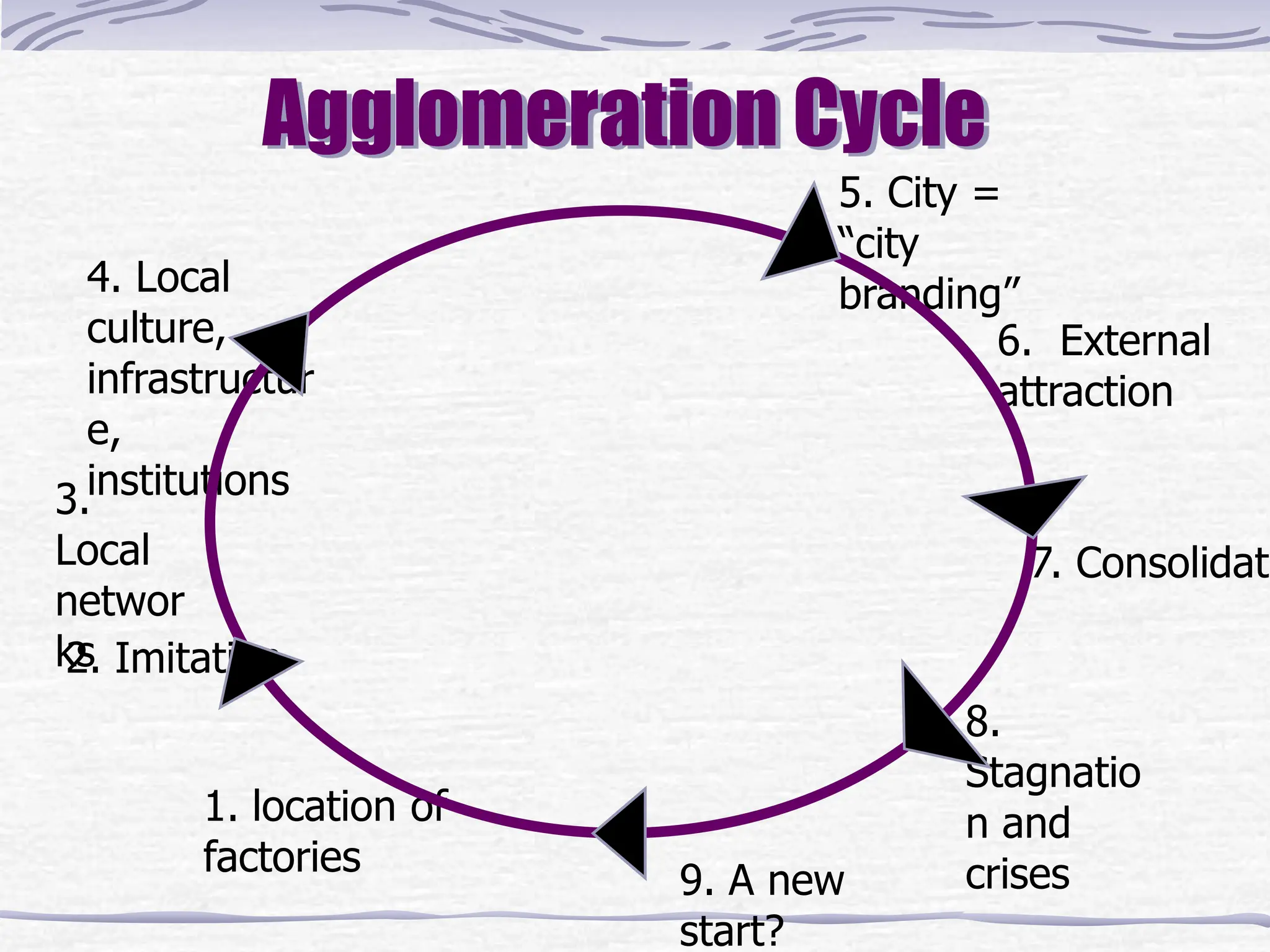
Agglomeration Cycle
9. A new
start?
8.
Stagnatio
n and
crises
7. Consolidati
6. External
attraction
1. location of
factories
2. Imitation
3.
Local
networ
ks
4. Local
culture,
infrastructur
e,
institutions
5. City =
“city
branding”
‘Urbanization Economies’ – external to both firm &
industry
refers to declining average costs of firms as cities increase their population
and population-related service activities. Note that this is a benefit to the
whole community, not from the actions of individual firms.
External to the Firm and External to the Industry
benefits from economic diversity and from activities where face to face
communication is critical
‘Localization Economies’ – internal to industry
• refers to declining average costs of firms as a result of economic and geographic
concentration, proximity or density of economic activity.
• locational proximity of linked firms shift the average cost of each firm downward as
many industries grow in one place; these are benefits from own-industry
concentration
• A particular area gets a reputation for goods/services of high quality and/or
superior characteristics
• Benefits External to the firm but Internal to the industry.
Economies of Scale – Internal to the Firm
• Refers to reductions in unit costs of production as a result of larger designed scale of output
within the firm; note that this entails a shift (downward) of a given marginal-cost curve (supply
curve), rather than a movement along the same (short-run) marginal-cost curve; note that this is a
benefit to the firm based on actions of the firm
• Sources:
– specialized machinery, leading to greater capital and labor productivity
– finer division of labor within the firm, leading to greater labor productivity
– spread of fixed costs over greater output (management, research)
Economies & Dis-economies of Urbanization
Economies of Urbanization
Large markets –
Labor pool shared among firms– large urban population supplies skilled
labor and specialized labor
More efficient exchange of materials and products
Highly developed infrastructure – costs of utilities, processing of waste
materials, and transportation links are shared
Technology Transfer – Innovative ideas move among neighboring firms
through imitation and movement of skilled employees between firms
Easier flow of information
Capabilities for Research and Development (for product upgrading by
firms)
Wider range of specialized services from public and private sector –
schools, retail, entertainment, telecommunications, healthcare, etc.
Diseconomies of Urbanization
High land prices, leading to higher cost of living, leading to demand for
higher wages
Traffic congestion, leading to higher costs of transportation in terms of
money and of time (opportunity loss)
Water and air pollution, noise (would exist anywhere, but density
reduces the natural environment’s ability to dissipate pollutants)
Natural resource depletion, because of the intensity of resource use
Social disorganization – cut-throat competition, crime, social deviance,
disintegration of family and communities, loss of good customs and
traditions
Costs on human psychology – stress, fatigue, leading to disease, health
costs
Industrial Dispersal in the Philippines
• Presidential Decree No. 01 entitled the Integrated Reorganization
Plan (IRP) of 1972 delineated 11 ‘regions’ in the Philippines.
• ‘Industrial Dispersal’ -- Presidential Decree 24 dated December
1973, aimed to decongest Metro Manila by banning the location of
new heavy industries within a 50-kilometer radius of Rizal Park
(Luneta).
• North Luzon Expressway and South Luzon Expressway demarcated
the distance – thus Calamba City and Angeles City became the de
facto new ‘regional industrial hubs’.
• National Industrial Policy of 1973
– promoted new industries or the expansion of existing industries
in areas outside of Metro Manila
– Identified urban centers having superior industrial potential and
/ or better infrastructure for accelerate industrial development
– Became the national development strategy of government since
late seventies
•
Industrial Dispersal – ‘concentrated
decentralization’
• SPATIAL STRATEGIES
– Regional Industrial Center
– Special Economic Zone
– Export Processing Zone
– Industrial Estate
– Growth Corridor
– Countrywide Agro-industrial
Development (Corazon
Aquino)
– Balanced Agro-industrial
Development (FV Ramos)
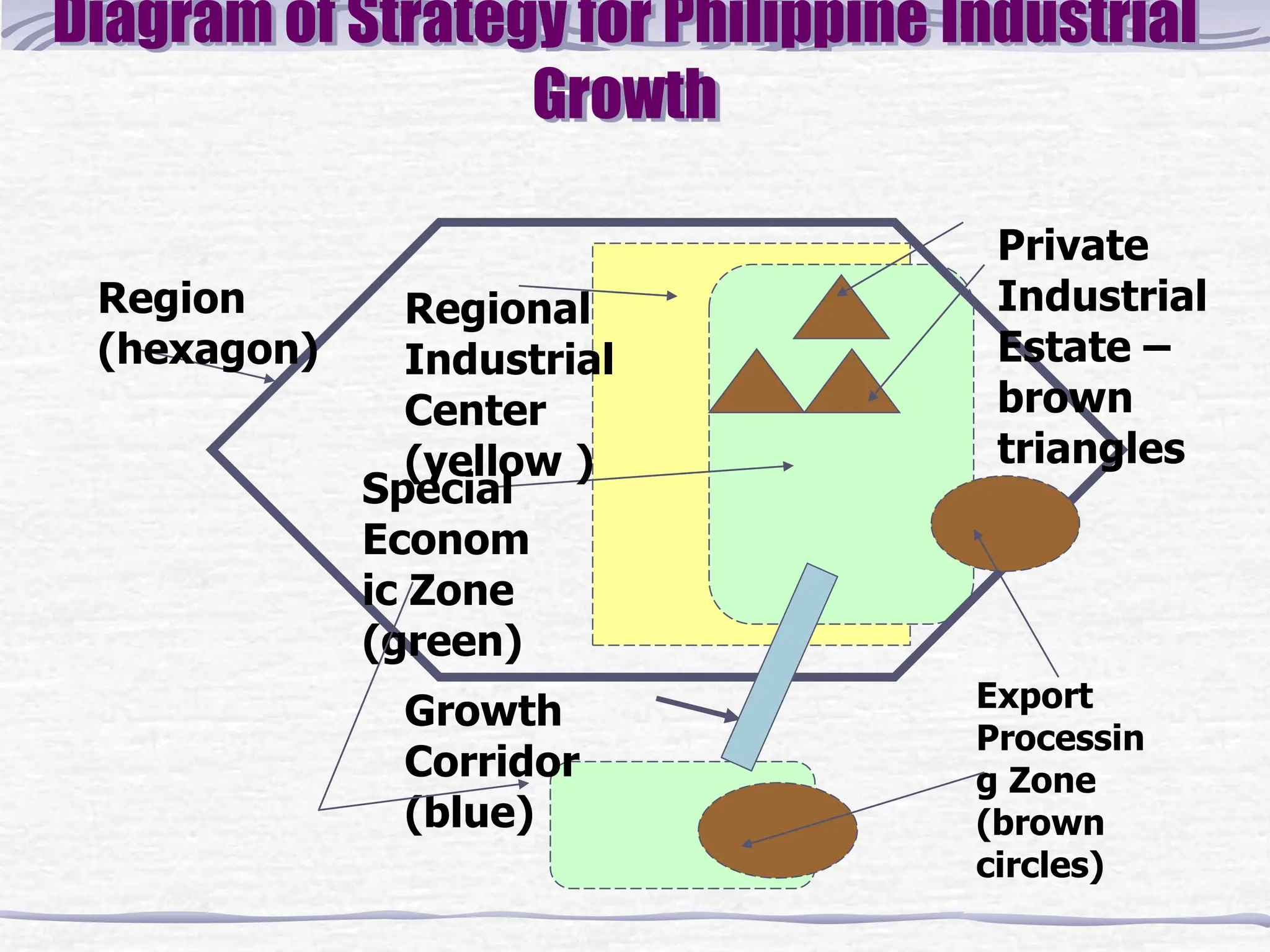
Diagram of Strategy for Philippine Industrial
Growth
Region
(hexagon)
Growth
Corridor
(blue)
Regional
Industrial
Center
(yellow )
Special
Econom
ic Zone
(green)
Private
Industrial
Estate –
brown
triangles
Export
Processin
g Zone
(brown
circles)
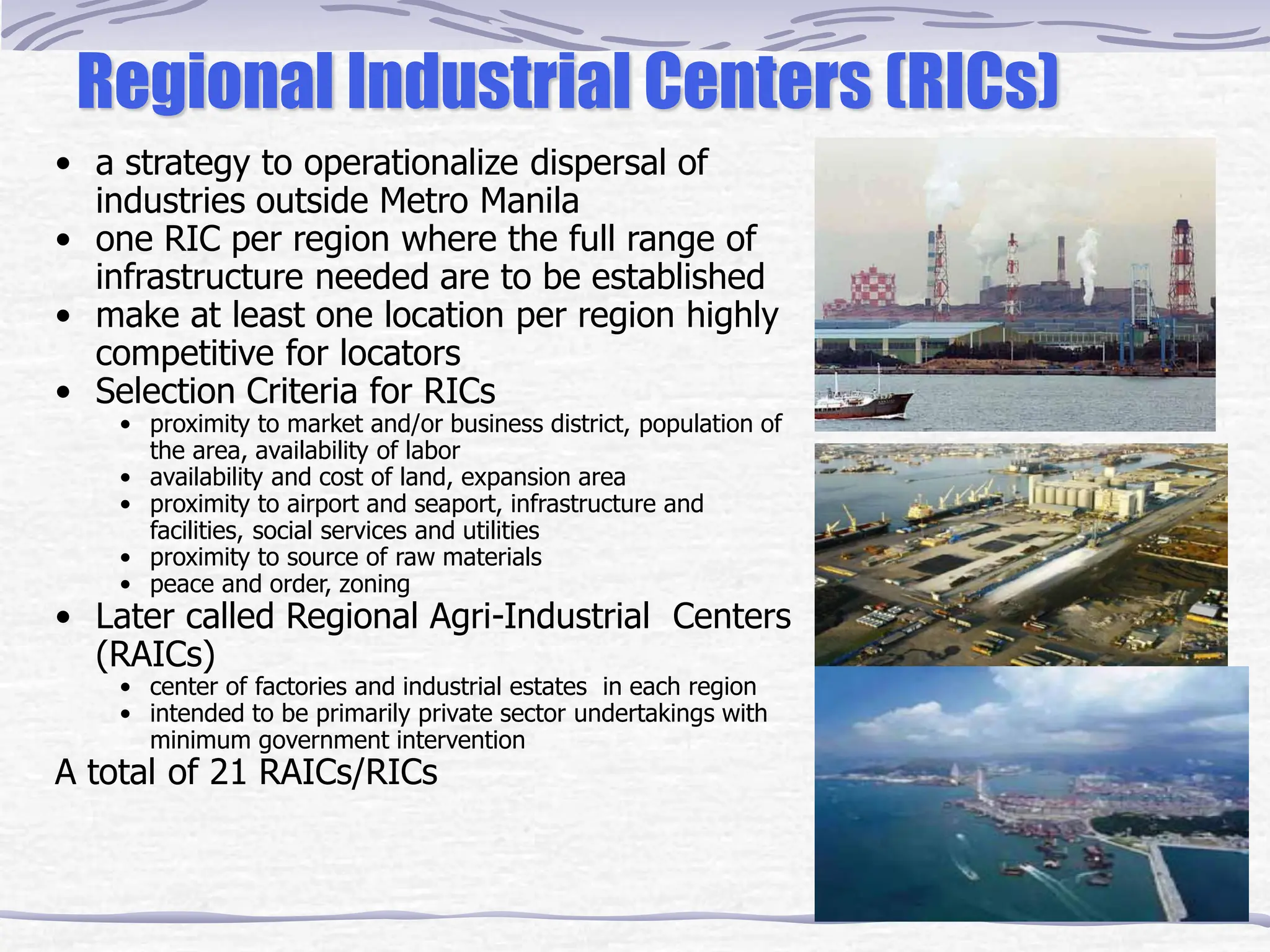
Regional Industrial Centers (RICs)
• a strategy to operationalize dispersal of
industries outside Metro Manila
• one RIC per region where the full range of
infrastructure needed are to be established
• make at least one location per region highly
competitive for locators
• Selection Criteria for RICs
• proximity to market and/or business district, population of
the area, availability of labor
• availability and cost of land, expansion area
• proximity to airport and seaport, infrastructure and
facilities, social services and utilities
• proximity to source of raw materials
• peace and order, zoning
• Later called Regional Agri-Industrial Centers
(RAICs)
• center of factories and industrial estates in each region
• intended to be primarily private sector undertakings with
minimum government intervention
A total of 21 RAICs/RICs
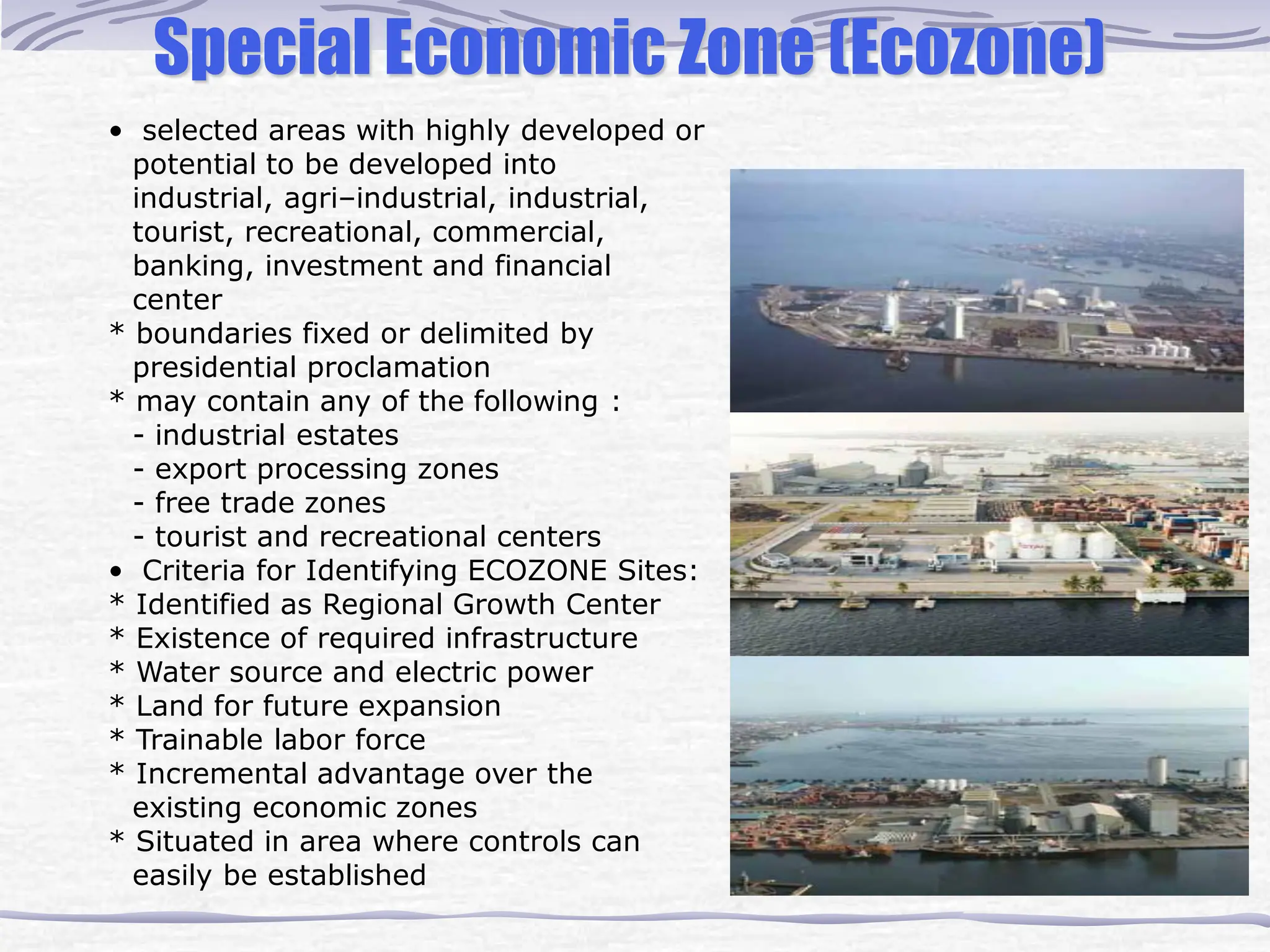
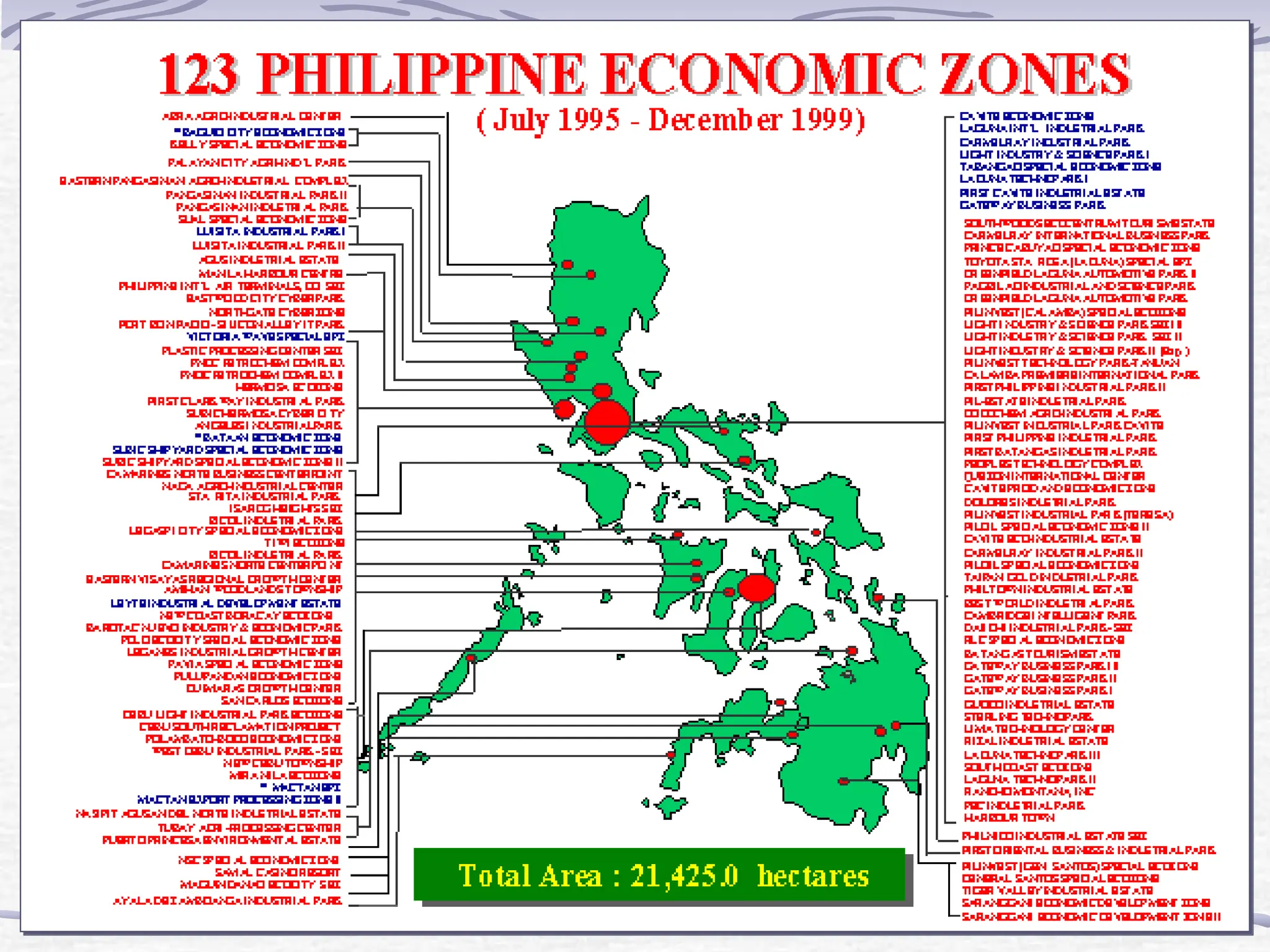
Special Economic Zone (Ecozone)
• selected areas with highly developed or
potential to be developed into
industrial, agri–industrial, industrial,
tourist, recreational, commercial,
banking, investment and financial
center
* boundaries fixed or delimited by
presidential proclamation
* may contain any of the following :
- industrial estates
- export processing zones
- free trade zones
- tourist and recreational centers
• Criteria for Identifying ECOZONE Sites:
* Identified as Regional Growth Center
* Existence of required infrastructure
* Water source and electric power
* Land for future expansion
* Trainable labor force
* Incremental advantage over the
existing economic zones
* Situated in area where controls can
easily be established
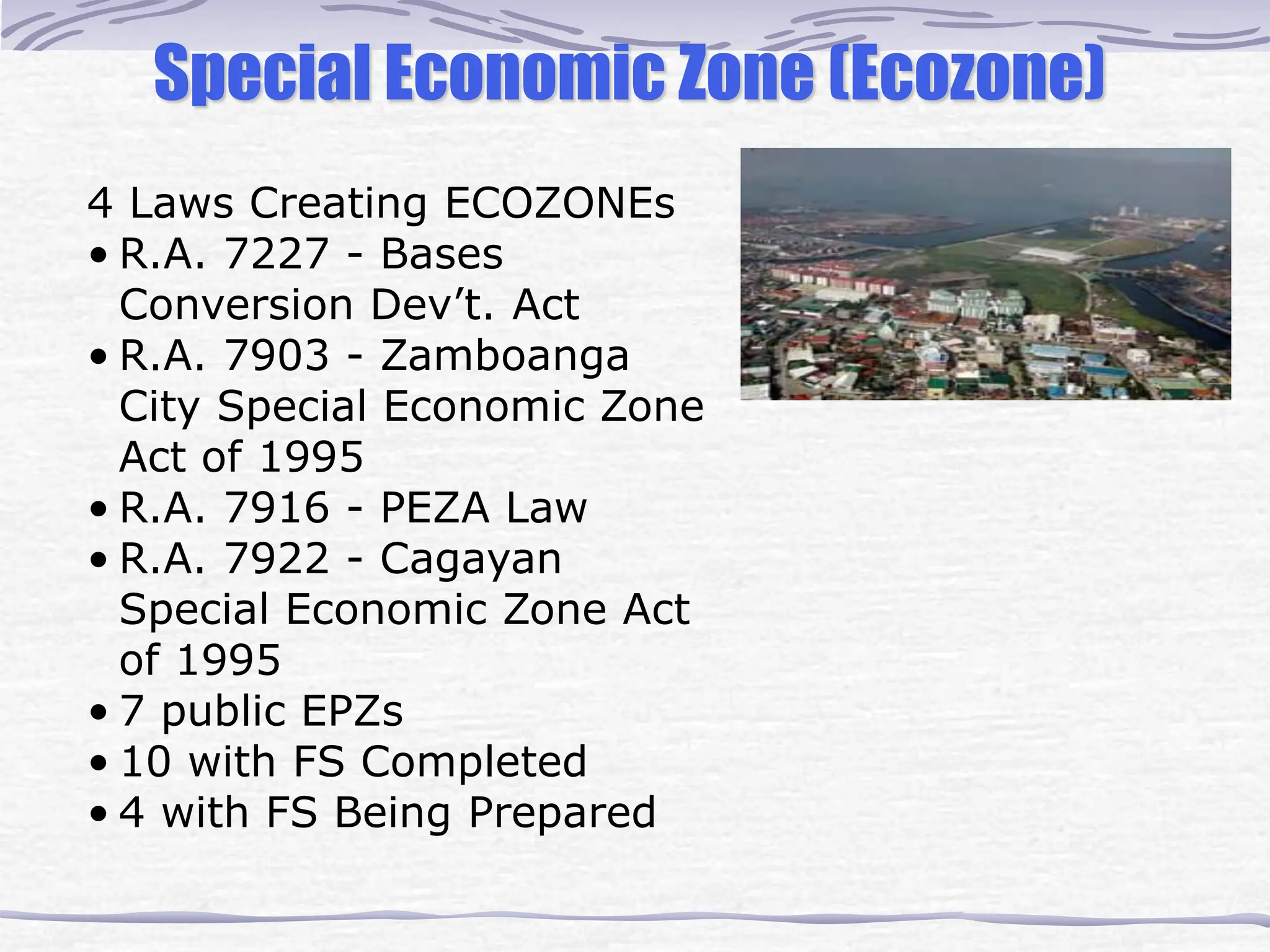
4 Laws Creating ECOZONEs
• R.A. 7227 - Bases
Conversion Dev’t. Act
• R.A. 7903 - Zamboanga
City Special Economic Zone
Act of 1995
• R.A. 7916 - PEZA Law
• R.A. 7922 - Cagayan
Special Economic Zone Act
of 1995
• 7 public EPZs
• 10 with FS Completed
• 4 with FS Being Prepared
Special Economic Zone (Ecozone)
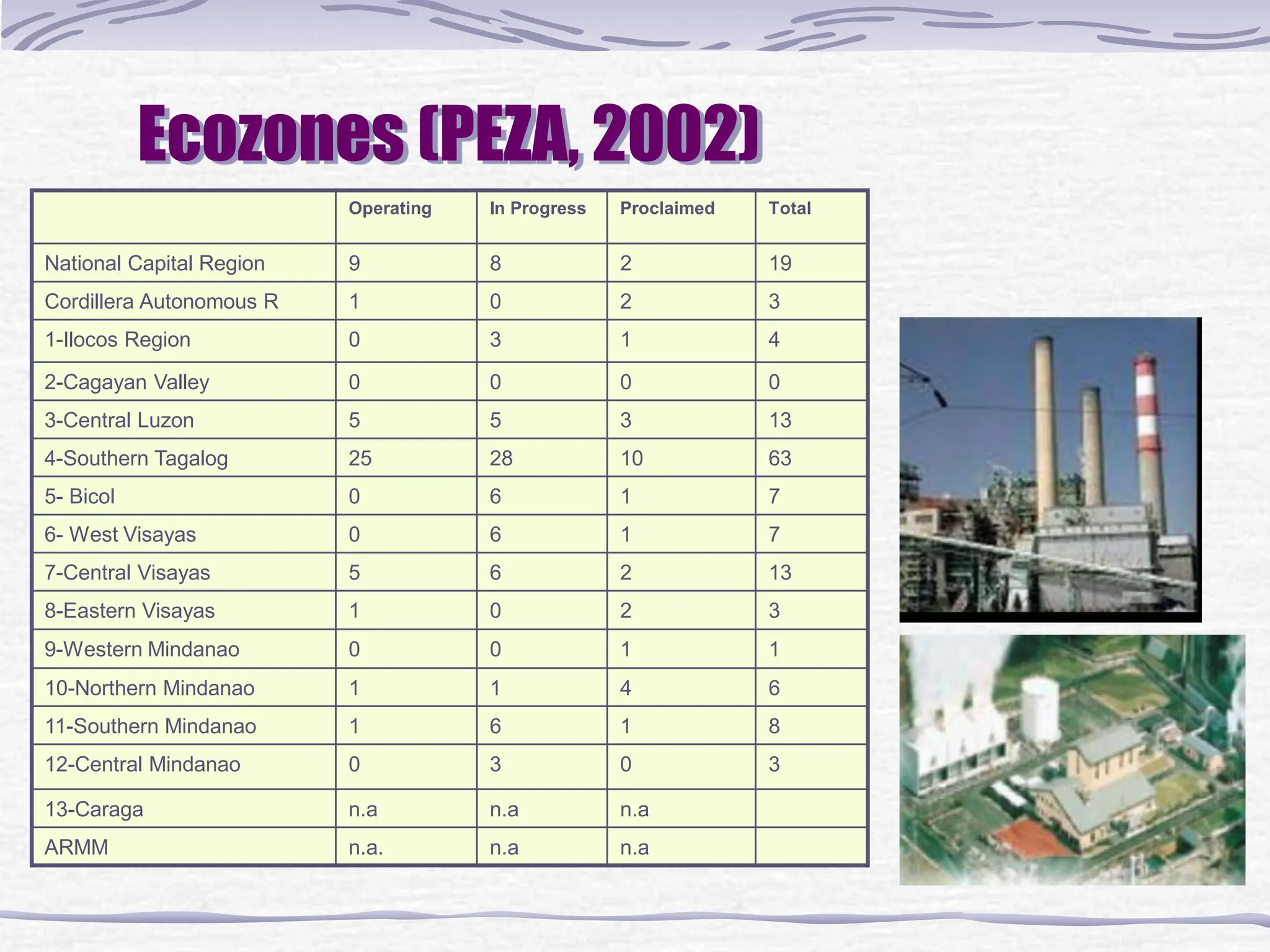
Ecozones (PEZA, 2002)
Operating In Progress Proclaimed Total
National Capital Region 9 8 2 19
Cordillera Autonomous R 1 0 2 3
1-Ilocos Region 0 3 1 4
2-Cagayan Valley 0 0 0 0
3-Central Luzon 5 5 3 13
4-Southern Tagalog 25 28 10 63
5- Bicol 0 6 1 7
6- West Visayas 0 6 1 7
7-Central Visayas 5 6 2 13
8-Eastern Visayas 1 0 2 3
9-Western Mindanao 0 0 1 1
10-Northern Mindanao 1 1 4 6
11-Southern Mindanao 1 6 1 8
12-Central Mindanao 0 3 0 3
13-Caraga n.a n.a n.a
ARMM n.a. n.a n.a
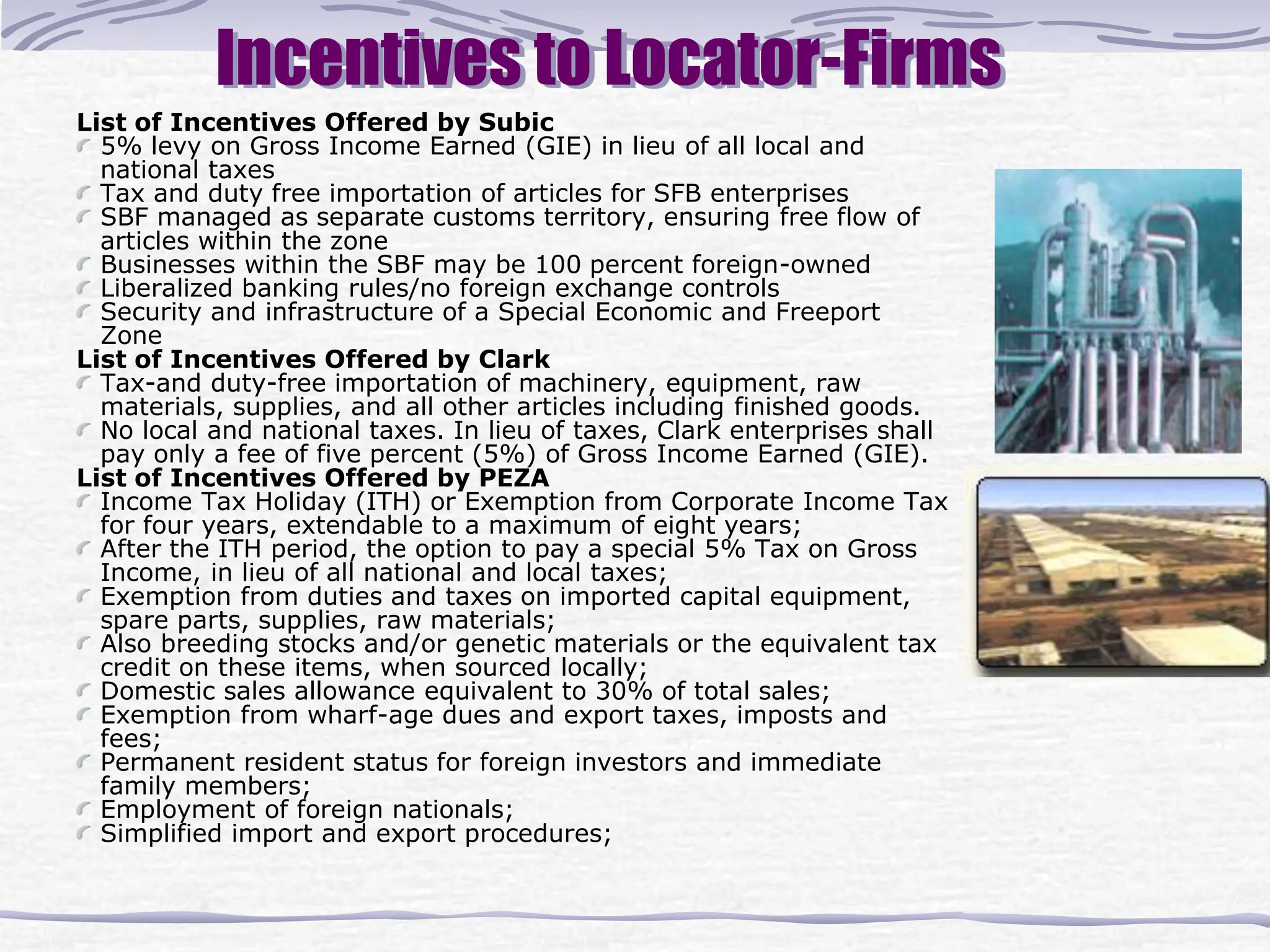
Incentives to Locator-Firms
List of Incentives Offered by Subic
5% levy on Gross Income Earned (GIE) in lieu of all local and
national taxes
Tax and duty free importation of articles for SFB enterprises
SBF managed as separate customs territory, ensuring free flow of
articles within the zone
Businesses within the SBF may be 100 percent foreign-owned
Liberalized banking rules/no foreign exchange controls
Security and infrastructure of a Special Economic and Freeport
Zone
List of Incentives Offered by Clark
Tax-and duty-free importation of machinery, equipment, raw
materials, supplies, and all other articles including finished goods.
No local and national taxes. In lieu of taxes, Clark enterprises shall
pay only a fee of five percent (5%) of Gross Income Earned (GIE).
List of Incentives Offered by PEZA
Income Tax Holiday (ITH) or Exemption from Corporate Income Tax
for four years, extendable to a maximum of eight years;
After the ITH period, the option to pay a special 5% Tax on Gross
Income, in lieu of all national and local taxes;
Exemption from duties and taxes on imported capital equipment,
spare parts, supplies, raw materials;
Also breeding stocks and/or genetic materials or the equivalent tax
credit on these items, when sourced locally;
Domestic sales allowance equivalent to 30% of total sales;
Exemption from wharf-age dues and export taxes, imposts and
fees;
Permanent resident status for foreign investors and immediate
family members;
Employment of foreign nationals;
Simplified import and export procedures;
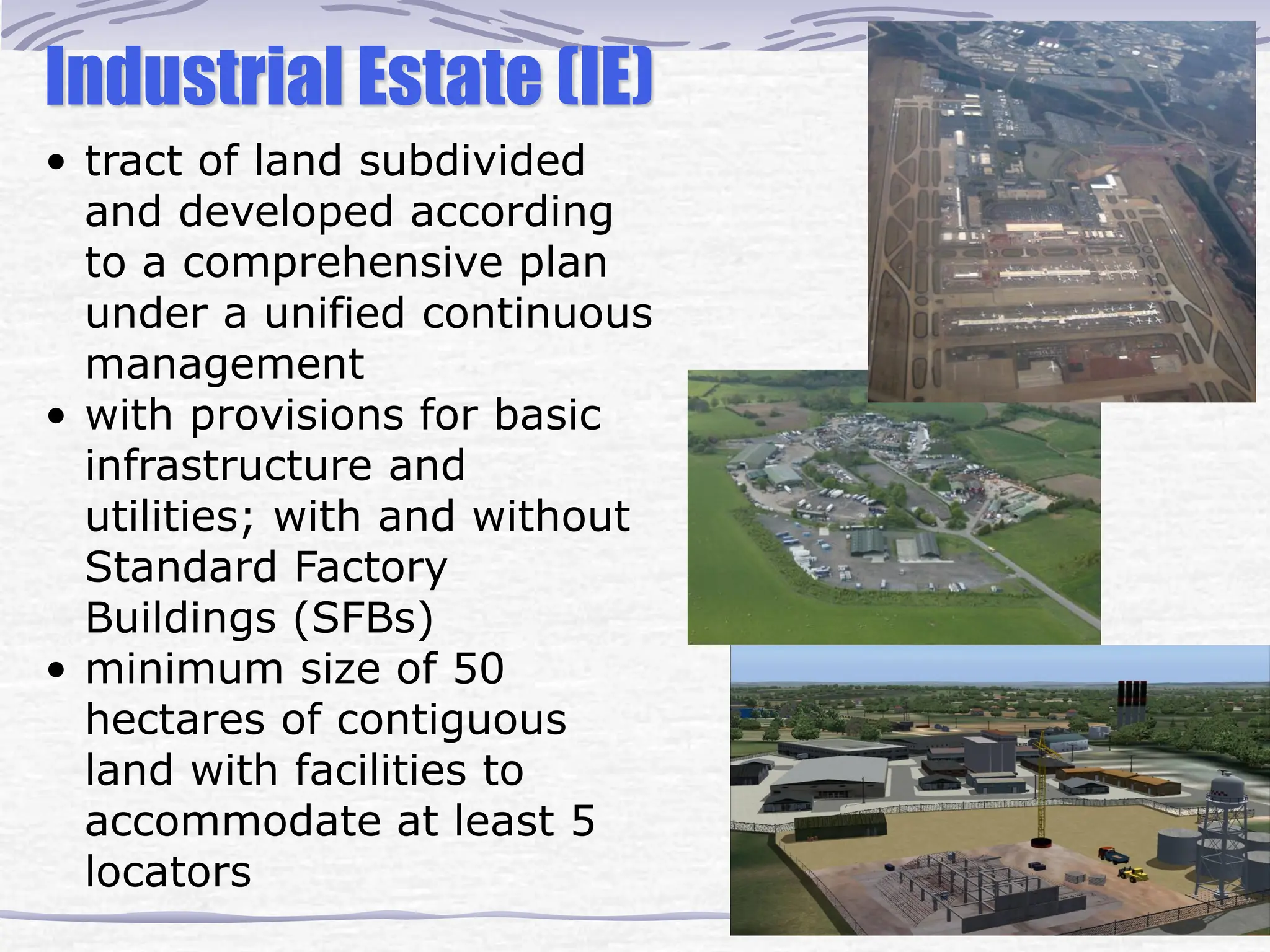
Industrial Estate (IE)
• tract of land subdivided
and developed according
to a comprehensive plan
under a unified continuous
management
• with provisions for basic
infrastructure and
utilities; with and without
Standard Factory
Buildings (SFBs)
• minimum size of 50
hectares of contiguous
land with facilities to
accommodate at least 5
locators
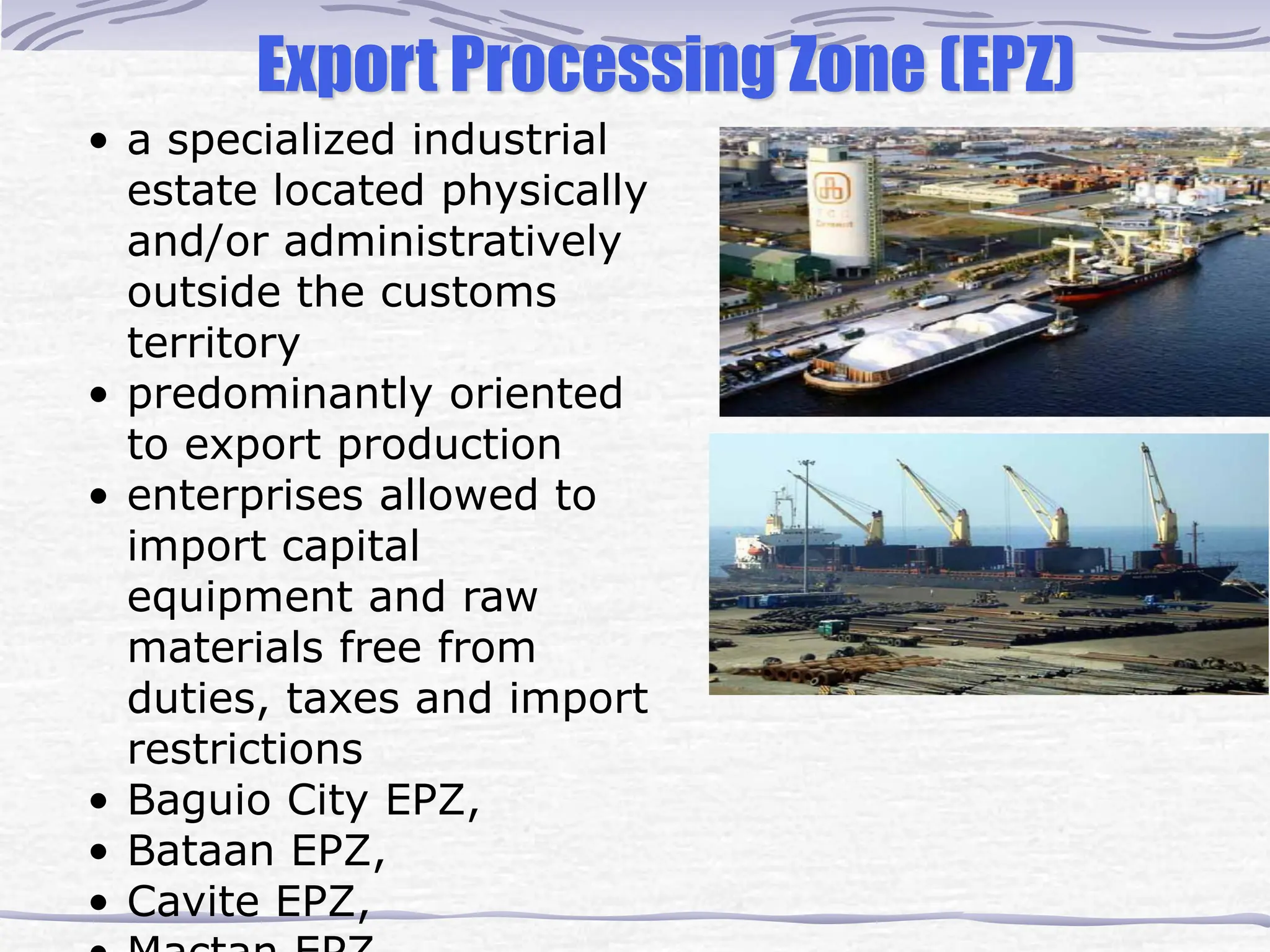
Export Processing Zone (EPZ)
• a specialized industrial
estate located physically
and/or administratively
outside the customs
territory
• predominantly oriented
to export production
• enterprises allowed to
import capital
equipment and raw
materials free from
duties, taxes and import
restrictions
• Baguio City EPZ,
• Bataan EPZ,
• Cavite EPZ,
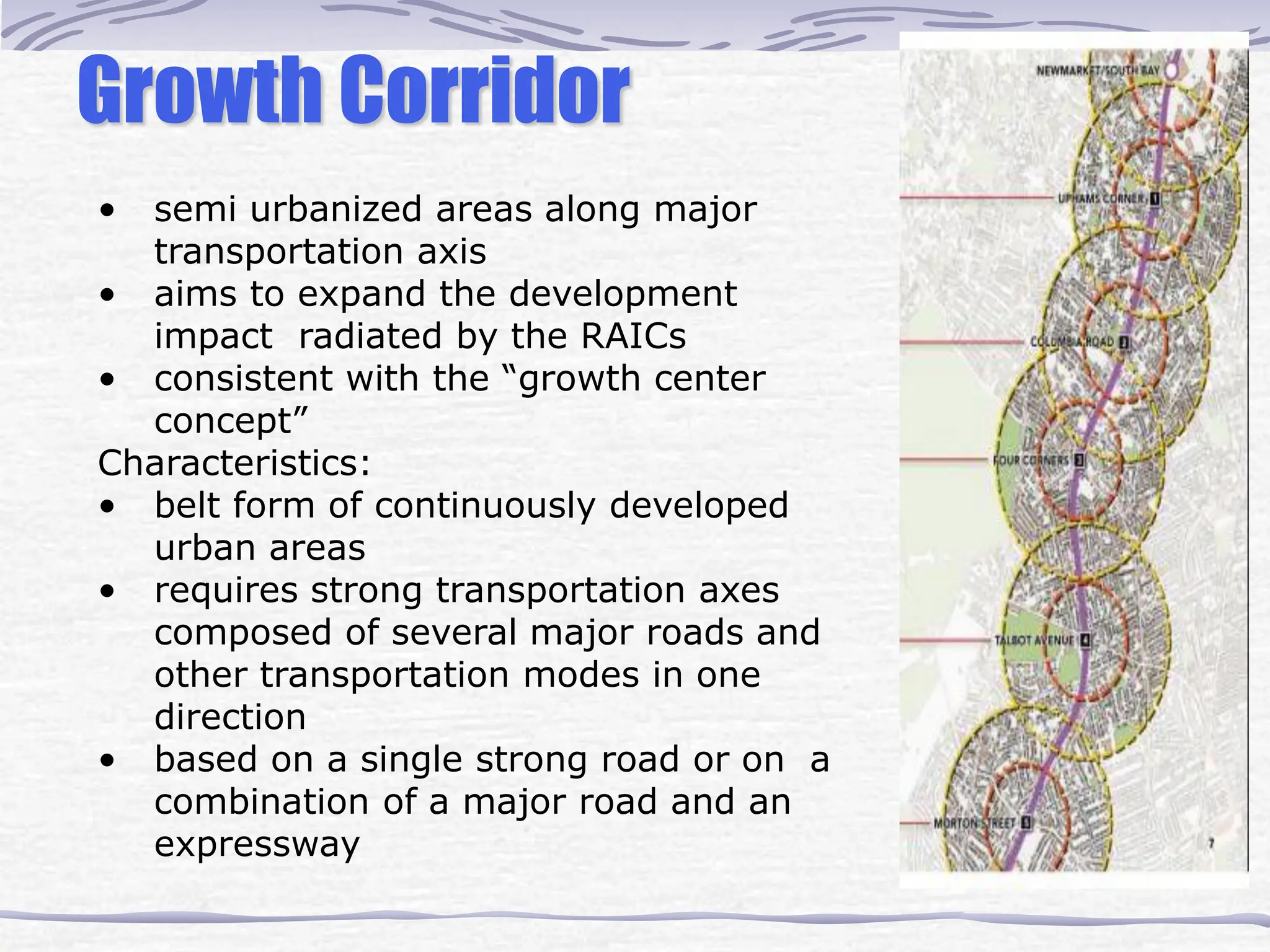
Growth Corridor
• semi urbanized areas along major
transportation axis
• aims to expand the development
impact radiated by the RAICs
• consistent with the “growth center
concept”
Characteristics:
• belt form of continuously developed
urban areas
• requires strong transportation axes
composed of several major roads and
other transportation modes in one
direction
• based on a single strong road or on a
combination of a major road and an
expressway
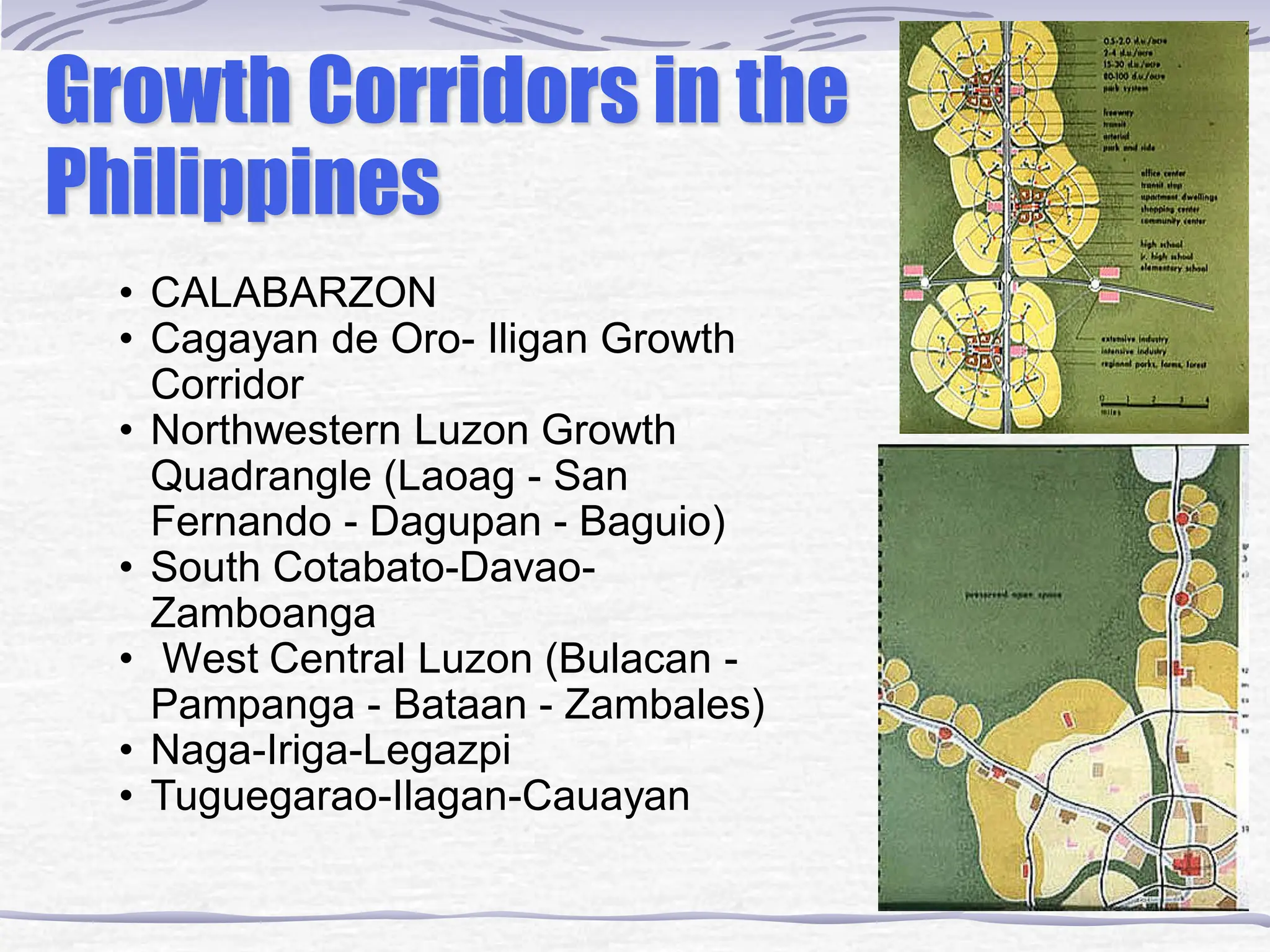
• CALABARZON
• Cagayan de Oro- Iligan Growth
Corridor
• Northwestern Luzon Growth
Quadrangle (Laoag - San
Fernando - Dagupan - Baguio)
• South Cotabato-Davao-
Zamboanga
• West Central Luzon (Bulacan -
Pampanga - Bataan - Zambales)
• Naga-Iriga-Legazpi
• Tuguegarao-Ilagan-Cauayan
Growth Corridors in the
Philippines
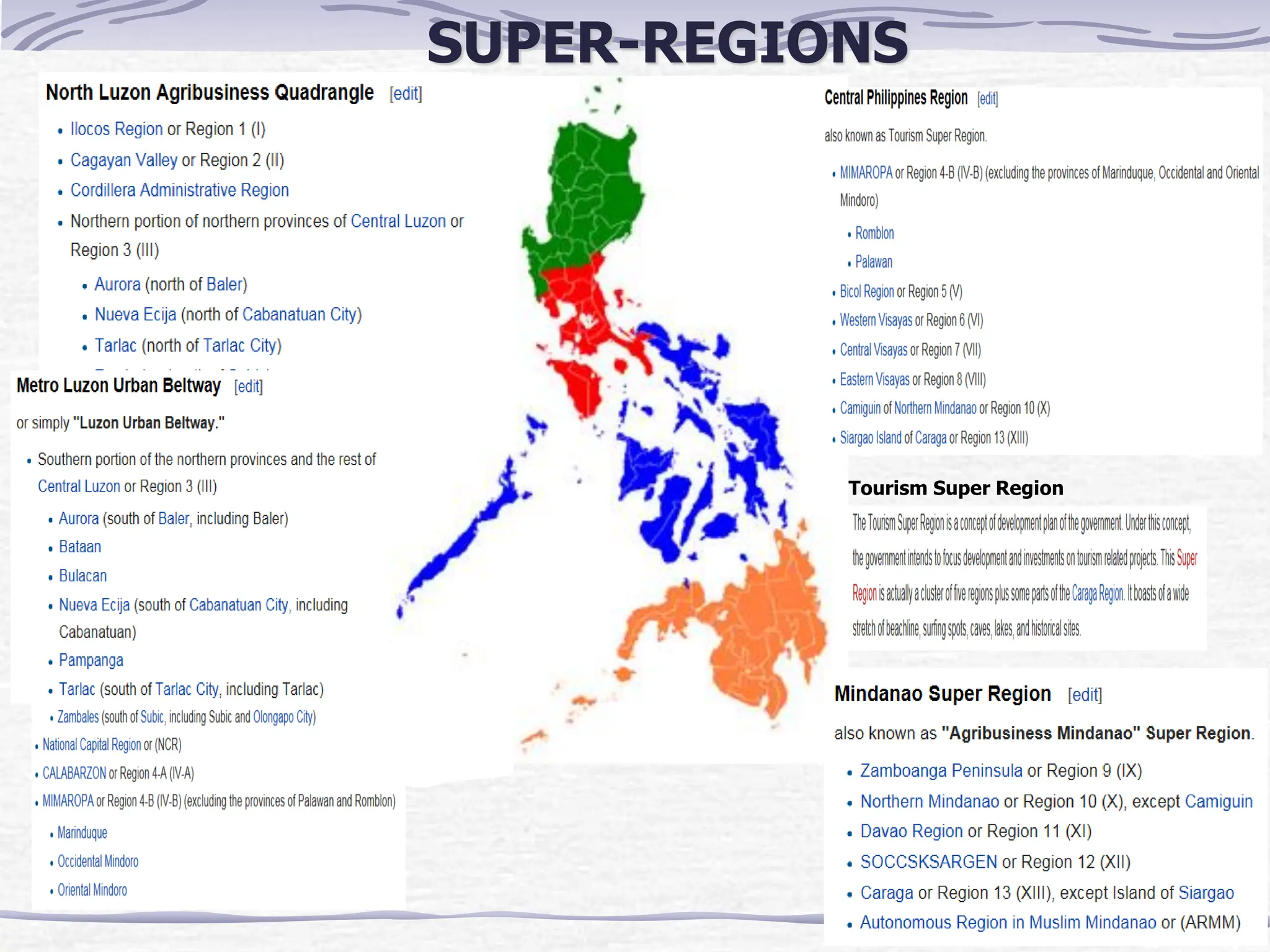
SUPER-REGIONS
The "super" regions of the Philippines are an informal, and de facto
defunct, grouping of parts of regions and provinces of the Philippines
based on their economic strengths.
According to Executive Order No. 561, which establishes these regions,
"[These] groupings neither supersede current political boundaries nor alter
the regional development councils as established by existing laws and
issuances."
The creation of "super" regions was first proposed by the President Gloria
Macapagal-Arroyo in her sixth State of the Nation Address to group the
selected regions/provinces by their economic strengths.
Each "super" region is headed by a Development Champion.
Tourism Super Region
SUPER-REGIONS
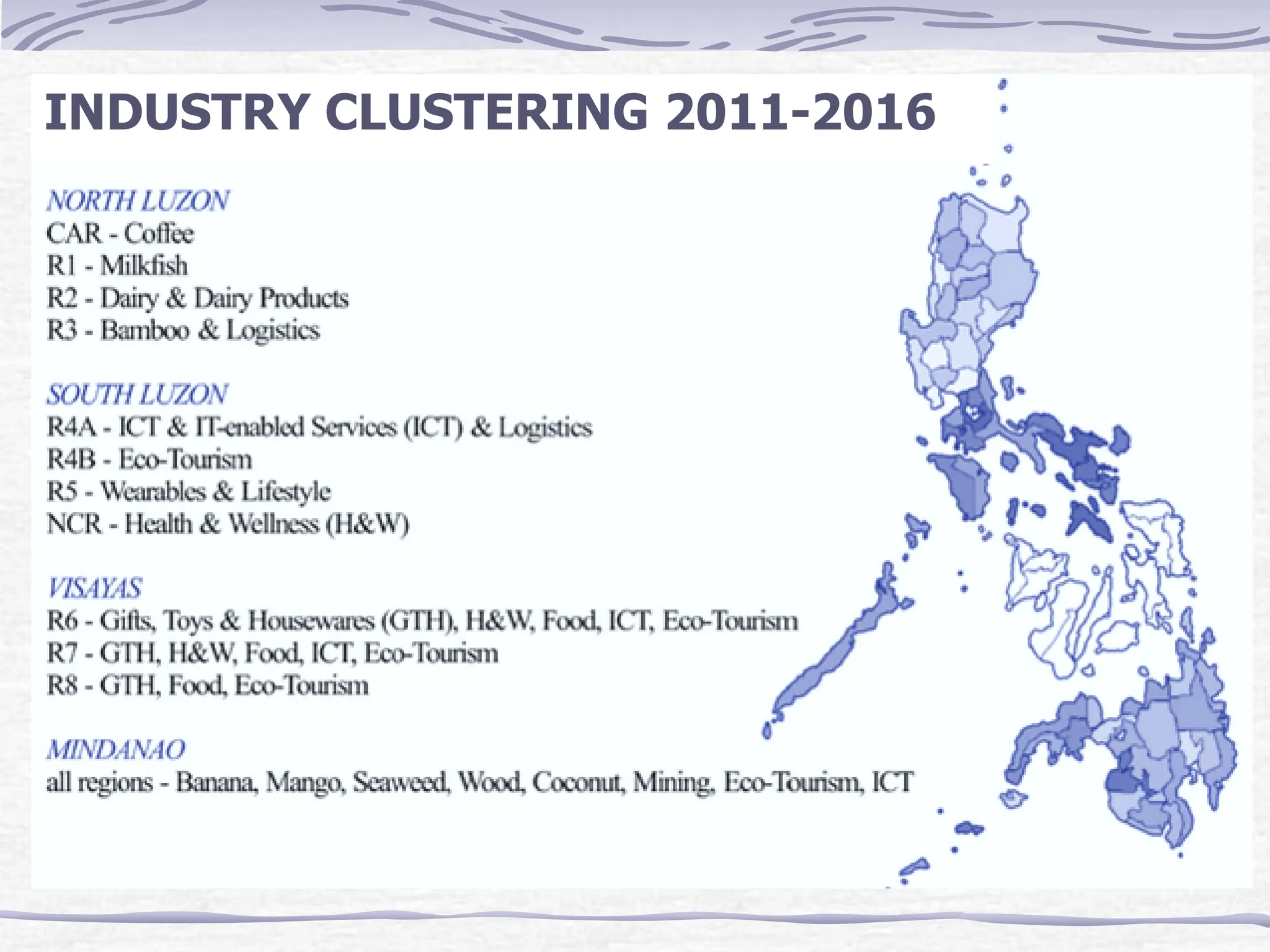
INDUSTRY CLUSTERING 2011-2016
Basics of Regional Planning and the general spatial planning

Basics of Regional Planning and the general spatial planning

  • 1.
    ® ECOPOLIS 2010PAGE 1 General Theories of Spatial Planning
  • 2.
    Central Place Theoryby Walter Christaller (1) Producers are willing to travel up to point ‘a’, to purchase from the other producers (2) With improved transport and communication, consumers willing to travel further to ‘b’ (3) Market areas overlap: (4) Development of hexagonal market areas around a system of central places; tangential spheres are more efficient (5) Creation of “higher order” and “lower order” services B A A A B B A B B B C A A A A
  • 3.
    ‘Central Place Theory’by Walter Christaller Central Place is a village/town/city that is engaged in settlement-forming trade and provides a common location for the local exchange of goods and services ‘Hinterland’ is the surrounding area or Market Area being served by a central place; it is a large tributary There is clustering of human population around Central Places through time until a Hierarchy of Settlements appears that corresponds to the market’s need for low-level to high-level services. The larger the settlements, the fewer their number The larger a settlement, the farther away a similar size settlement is. The range of market increases as the population increases The larger the settlement, the higher the order of its services. Deviations to this rule are: Tourist resorts that have a small population but large number of functions. Dormitory towns that have a large population but a small number of functions
  • 4.
    Central Place Theory(The Urban Hierarchy Model) 1) There are as many size classes of cities as markets. 2) Cities of the same order have similar economic characteristics and population sizes. 3) Higher order cities have all the services of a lower order city, plus functions that they export to lower order cities. 4) Smaller cities have smaller hinterlands and are closer together. 5) Central places of the same order will be equally spaced across the regional/national landscape. 6) Commodities generally do not flow up the hierarchy. Big Point A useful, but not perfect model that underscores the importance of recognizing the local city’s role in a regional economy.
  • 5.
    Systematic pattern ofcentral places is evenly spaced and surrounded by hexagonally shaped market areas Service activities range from “low order” services found in every center to “higher order” services found only in major cities. Larger number of people required to support a hospital, university, or department store than a gasoline station, post office, or grocery store. Lowest ranked centers were likely to be located 7 kilometers apart Each high-ranked central place offers all goods and services of next lower ranked place, plus at least one or two more Low order goods (low threshold) are inexpensive and frequently purchased goods. Their hierarchy follows the “rule of twos”: Threshold of A = 2 x threshold of B; Threshold of B = 2 x threshold of C; K=2 hierarchy Small villages and roadside hamlets that may contain nothing more than a post office, service station, or cafe High order goods (high threshold) are costly and infrequently purchased goods (e.g. universities, malls) At the top are regional metropolises that offer all services associated with central places, and that have large hinterlands ‘Hierarchy of Central Places’
  • 6.
    Scalogram as Measureof Centrality
  • 7.
    Usefulness of CentralPlace Theory Theory stresses relevance of market area to the size of a town’s population Theory highlights the importance of situation rather than site conditions Theory Introduces urban hierarchy, helps understand the emergence of an integrated hierarchy of cities of different functions and sizes. Theory led to the introduction of the rank-size rule Theory served as basis for administering urban regions and for allocating resources (for investment decisions) Provides framework for understanding regional spatial structure
  • 8.
    What is RegionalPlanning? It concerns planning for a sub-national territory with known scale (size) and extent (scope), normally a contiguous area whose parts have common or complementary characteristics and are linked by intensive interaction or flows. The whole region is set apart from neighboring territories by its distinctive economic and social characteristics, continuities and discontinuities, opportunities and problems, even though it may not have defined local authority structures and clear administrative boundaries. it is intermediate between national and urban levels and straddles the gap between national and grassroot levels. Region is always extended urban space – it has urban as well as rural components. Aspects of Regional Planning Physical – planning an area’s physical structures: land use, communications, utilities, etc. and has its origin in the regulation and control of town development (direct control), decentralization policies Economic – concerned with the economic structure of an area and its overall level of prosperity (works more through the market mechanism), growth poles, efficiency, how to attract investments, reduction of regional disparities (regional convergence) Social – migration of people, issues of equity, allocation, redistribution Cultural – ethnic identity, common history, homogeneity versus heterogeneity Environmental – connectedness of ecosystems, sustainability
  • 9.
    Principles of RegionalPlanning Designate transportation corridors using hubs and spokes and consider major new infrastructure Some settlements in the region may be administrative in nature while others are based upon manufacturing or transport. Set regional level policy which encourages a mix of housing values and communities. Resist development in flood plains or along earthquake faults. These areas may be utilized as parks, or farmland. Designate greenbelt land or similar to resist settlement amalgamation and protect the environment. Consider designating essential nuisance land uses locations, including waste disposal. Consider building codes, zoning laws and policies that encourage the best use of the land.
  • 10.
    Focus of RegionalPlanning Decentralization policies Distribution of population Reduction of economic disparities among regions – versus economic polarization Inter-regional allocation or redistribution of resources (regional convergence) Institutional capacitation (e.g. reorganization of local governments) the problem of urban congestion is at a scale where the old categories of “urban, suburban and rural” no longer suffice. Hence “region” is a cross-cutting, more encompassing concept that treats cities in relation to its environs; this new approach also considers principles of ecological balance and resource renewal. Cities under this scheme would become subordinate to region; old cities and new towns alike grow as necessary parts of a region
  • 11.
    Pioneers of RegionalPlanning Benton MacKaye, Father of the Appalachian Trail, USA Sir Patrick Geddes, Father of Regional Planning Lewis Mumford, father of historico- sociological approach in land use planning Sir Leslie Patrick Abercrombie, pioneer of regional planning in UK Walter Isard known as father of Regional Science, “Planning as Social Physics” Clarence S. Stein principal advocate of New Towns movement in USA
  • 12.
    History of RegionalPlanning Movement 1.Early influences from the Garden City Movement (UK) and New Towns Movement (US) 2.The number of US cities with ‘municipal planning commissions’ grew from 100 to 500 between 1920 1930. 3.Regional Planning Association of America was founded in 1923-25 published “Survey” – a manifesto containing the concept of a region members - architects, engineers, surveyors, sculptors, artists, sociologists (lawyers associate members only) result - interdisciplinary approach to planning 4.Town and Country Planning Act of 1947 (UK) Concerned with the spatial impact of problems and the spatial coordination of many different policies Method of Planning – man assumes control over physical and human matter and processes it to serve his defined needs 5.Benton MacKaye published The New Exploration: A Philosophy of Regional Planning, 1928 6.Thomas Adams and Lewis Mumford debated the multi-volume Regional Plan of New York, 1928-1932 7.Regional Planning on counties, river basins, valleys, dams, rangeland, ancestral land -- Los Angeles County, 1922; Appalachian Trail, 1928; Tennessee Valley Authority 1933; Grand Coulee Dam 1935; Colorado River- Hoover Dam 1936; St Lawrence Seaway, 1959; Delaware River 1961; Miami (Ohio) Valley 1970. 8.Regional Planning easily dovetailed with Transportation Planning (Penn- Jersey, 1954; Chicago-Detroit, 1954)
  • 13.
    What is a‘Region’? Region refers to a city or central place plus the outlying territories that are functionally integrated with it. Region is based on natural/physical as well as economic/political relationships between urban areas and its surrounding rural territories Economic linkages Extent of urban influence on non- urban areas. e.g. journeys to work Extent of urban dependence on non-urban territories for food, water and labor supplies, etc. Production and consumption functions: Industries, commerce, trade Infrastructure linkages Major Transport nodes Utility trunks – water purification plants, power supply Areas performing sink-functions of city, e.g. landfill, MRF, STP
  • 14.
    Region in RealSpace Functional Region – geographical area which displays a certain functional coherence, an interdependence of parts, defined on the basis of certain criteria; Economic Region – bound by economic linkages, interflows of factors and materials, inputs-and outputs. Economic Regions are often carved out by Trans-National Corporations and other agents of Globalization by their interlinking of industrial clusters, districts, zones and ports. Region as Space Economy. Traditional Industrial Districts, Clusters, Ecozones, Natural Region – a geographic area of interdependent ecosystems and natural communities (this will be discussed in subsequent sessions under Ecosystem-Based Planning) Formal Region – geographical area which is uniform and homogeneous in terms of related criteria; variability is absent; Used generally for analytic purposes Political-Administrative Regions defined by common political authority, administrative boundaries (national, state, local) or electoral constituency. Urban Region -- region encompassing large cities/towns as well as commuter villages/communities economically and socially linked to them or dependent upon them. Urban regions are erroneously treated as homogeneous rather than as physical and socio-cultural mosaic/collage/palimpsest or as a heterogenous “ecosystem” Historic Region – area bound together by a common historical past
  • 15.
    Types of NaturalRegion Natural Region – area defined by the interdependence and connectedness of natural units and habitats Bio-Region – based on interdependence and natural connectedness of life forms and species Eco-Region – based on interdependence and natural connectedness of ecosystems and their communities
  • 16.
    Region in VirtualSpace Virtual Region – a network of functionally-related areas with high level of connectivity (ICT) and economic inter- flows even though these areas are not spatially proximate or contiguous Example is a Network Economy. The ascendancy of ICT has enabled small firms and even MNCs to create their own dispersed economic networks.
  • 17.
    Regional Divergence --Regions are inherently unequal Causes of Regional Imbalance Geography & natural endowments: uneven distribution of harbors, minerals, raw materials historical factors: invasion, colonization, etc. specific economic, political, technological, social, demographic conditions combination: in the beginning, external factors, later internal factors State policies and interventions have to temper if not rectify Regional Divergence rather than intensify it.
  • 18.
    Clarence Stein’s SixPrinciples of New Towns (1920s, USA) – Earliest Regional Planning Efforts Plan simply, but comprehensively Provide ample sites in the right places for community use Put factories and other industrial buildings where they can be used without wasteful transportation of people and goods Cars must be parked and stored (not on the streets!) Bring private and public land into relationship Arrange for the occupancy of houses
  • 19.
    Theories of RegionalPlanning Growth Pole Theory (Francois Perroux 1950) Growth Center Theory (Jacques R. Boudeville 1966) Theory of Cumulative Causation (Gunnar Myrdal 1957) Industrial Linkage Model (Allan Richard Pred 1977) Theory of Uneven Development; Polarization and Trickle Down Effect (Albert Hirschman 1958) Hierarchical Diffusion Model (Brian JL Berry 1973) Core-Periphery Model (John Friedmann 1978) World Bank’s Model of Regional Planning (WDR 2009)
  • 20.
    ‘Growth Pole’ Theoryby Francois Perroux “Growth does not appear everywhere and all at once; it manifests itself in points or ‘poles’ of growth, with variable intensities; it spreads by different channels with variable terminal effects for the economy as a whole.” Growth Pole –A spatial agglomeration of related industries which contains a growing number of propulsive firms, which, through their expansion, induce growth in the surrounding hinterland Propulsive firm/ industry -- dominant economic unit which when it grows or innovates, induces growth in the other economic units. It may be a firm, a cluster of firms within the same sector (i.e., an industry), or a collection of firms which have shared agreement (industrial estate). Characteristics of propulsive firms: large size; fast growth; strong linkages; innovative Direct and indirect dominating influence over all other activities Oligopolistic concentration of industry with price leadership and keen sense of anticipation in the moves of its own sector as well as related branches A “Growth Pole” (economic space) may be an industry or cluster of firms, while a “Growth Center” (geographic space) is a specific city or central place.
  • 21.
    Growth Center byJacques R. Boudeville Transformed ‘Growth Pole’ into a specific place within a region that is heterogeneous, continuous, and not specialized. Growth Center (geographic space) is a propulsive urban center of a region possessing a complex of expanding industries where the agglomeration of activities induces growth in its surrounding hinterland. The growth center has growth rate of population or employment that is greater than that of total region. “Regional growth center” refers to “a set of expanding industries located in an urban area and inducing further development of economic activity throughout its zone of influence” with complex activities around propulsive center Growth Inducement Mechanisms: disturbances or changes are then spread over the whole region: Polarization, Agglomeration, Spread Effects Growth centers are often crafted onto “hierarchy of central places” Central place functions = number of functions Nodal location = predominant flows Location on the development surface = level of development in different locations Population growth rate
  • 22.
    Usefulness of GrowthPole / Growth Center efficient way of generating development – owing to agglomeration economies Less public expenditures if investment areas are concentrated in specific growth points Spread effects out of the growth point will help solve the problems of depressed regions Transportation routes as channels of growth Useful to understand regional structures and designate regional centers, predict changes or prescribe solutions to certain regional problems Inspired the Philippine strategy of “concentrated decentralization” where alternative urban centers serve as counter magnets to the Primate City (NCR) which has caused “economic polarization”
  • 23.
    ‘Theory of CumulativeCausation’ (1957) by Gunnar Myrdal, Nobel Laureate Capitalism is characterized by income and welfare inequalities based on history In countries divided into regions, growth will not be the same. Disequilibrium in economy is due to market forces; Market forces create regional inequalities and widen those which already exist. Market forces, if left alone, tend to increase rather than decrease inequalities between regions Regions with expanding economic activity will attract net migration from other parts of the country, thus favoring the growth regions. Capital investments tend to have a similar effect: increased demand in centers of expansion spur investment, which in turn will increase incomes and demand and cause a second round of investments, etc. Circular and cumulative causation Change in some variables does not bring the system back to equilibrium = induces supporting changes farther from the initial state A region or country becomes richer, the poor becomes poorer because of cumulative process where forces work in circular causation to reinforce development or underdevelopment. “The poor becomes poorer and the rich becomes richer.” Social systems are not self-equilibrating (Circular and cumulative causation) Backwash effect – attention going back to core region; retards growth and widens economic gap between regions Spread effects – positive effects initially felt e.g. raw materials but backwash is stronger Trade operates with the same fundamental bias in favor of more progressive regions Government policy should be to counteract tendency of capitalist system to foster regional inequalities. Goverment needs to intervene to decrease imbalances wherever the normal market mechanisms proves inadequate.
  • 24.
    Gunnar Myrdal’s Theoryof Cumulative Causation Attraction of capital to exploit expanding demand for locally produced goods and services Expansion of employment and population Location of New Industry Increase in local pool of trained industrial labor Expansion of general wealth of community Expansion of service industries and others serving local market Development of auxiliary industry to supply inputs to former industry Development of external economies for former industry’s production Expansion of local government funds through increased tax yield Provision of better infrastructure for population and industrial development: roads, factory site, public utilities, health and education services
  • 25.
    ‘Theory of CumulativeCausation’ The combination of forward and backward linkages creates a potential process of cumulative causation: expansion of downstream activity increases demand for upstream output which attracts entry, improving the supply (price or varieties) of intermediates, attracting further downstream entry, and so on. Linkage – input-output relationships among firms or among industries Forward linkage – outputs or sales from one intermediate firm/industry is maximally utilized by another firm/industry Backward linkage – factors of production or intermediary inputs from one firm/industry is maximally utilized by another firm/industry
  • 26.
    Gunnar Myrdal’s BackwashCircuits Capital attracted to Center Capital Investment Young workers migrate to Center Migration and Employment Lack of investment in periphery Retarded growth in Periphery Wider Gap C-P Aging labor force in Periphery Decreased attraction for new activity Wider Gap C-P Services and Infrastructure Reduced Investment and new jobs in Periphery Smaller local market, pur- chasing power Decline in local services Widened gap between C-P
  • 27.
    John Friedmann’s ‘Center-PeripheryModel’ Friedmann went beyond notions of growth pole and growth center using center-periphery concept that goes beyond intersectoral distribution of resources. economic growth would occur through a highly developed and interconnected functional hierarchy of cities and towns and such growth is proportional to the size of agglomeration. This hierarchy of cities is a means of integrating the periphery with the center. Regions are either “homogeneous” and “interdependent”. The latter are polarized regions. the periphery of a polarized region can be divided into four parts: upward transitional, downward transitional, resource frontier and special problem. Upward transitional regions are areas which are growing with high growth potential but are capital constrained. Downward transitional regions are old rural (or industrial) economies in decline and where emigration is most evident. Resource frontiers are new settlement zones in which potentials for growth is large. Special problem regions are those needing policy interventions more than the other cited regions. This classification allows distinction of regions according to needed policy actions and that the treatment of regional problems are not taken in isolation but in consideration of the whole regional system.
  • 28.
    Agropolis by JohnFriedmann • Connect urban area with its surrounding rural areas • Selective Territorial Closure – trade among yourselves, basically self- reliance, focus on domestic demand, not exports • Basic Needs Approach • “Agropolis” became a model for “Integrated Area Development” in regional planning.
  • 29.
    Integrated Area Development should be small enough to be “seen steadily and seen whole”, possessing some kind of cohesion and homogeneity but big enough to be of some significance in the overall national development scene.  conceived or chosen on the basis of the following: influence of feeder roads, river basin, irrigation projects, erosion zone, reforestation area, mining area, resettlement area, school districts, among others.  Philippine experience… establishing the limits to decentralizing IAD units to keep its operation manageable…. it is better to utilize existing LGUs unless there are definite reasons they could not be effective.  In some countries where the LGU is weak or where it is absent, community organizations or councils were set up and they become the political authority units or the LGUs in effect.
  • 30.
    The basic ideafor an IAD is to build a “planning region” or a “community region” that has a common interest in some development projects or set of projects. Integrated Area Dev elopment
  • 31.
    Regional Planning asNetworking The new paradigm of Regional Planning since the 1990s: 1. The real assets of a region are the actors within the region, their resources and the specific regional culture of cooperation, communication and competition. 2. The core of spatial planning is no longer the elaboration of plans and programs. Regional development must promote the realization of planning goals by supporting the cooperation between different stakeholders, both from public administration and the private sector. 3. Planning and acting in networks is especially important at the regional level. 4. the role of space becomes different and planners need special knowledge (ex. international marketing)
  • 32.
    Theory of HumanCapital by Theodore Schultz, Jacob Mincer (1958/1974), and Gary S.Becker (1964) Human capital is collective term for “embodied assets” such as education, good health, knowledge, skills, values, character” as against ‘dis- embodied assets’ (invention, innovation, technologies) Human Capital is important for two reasons: First, a region’s stock of human capital determines its ability to absorb and use new technology. As the stock of human capital increases, the economy will be more able to benefit from technological developments, thereby expanding the economy’s productive capacity. Hence, although technology may be available everywhere, its efficient use requires an appropriately skilled workforce. Second, human capital is an important ingredient in determining the ability of a region to generate its own technical progress. The capacity of a region to absorb or create technical progress is not simply a matter of investing in physical or human capital. A region’s capacity to absorb or create technical progress is determined by its institutional environment. The creation of technical progress is determined by a collective learning process within which many individuals interact and exchange ideas and information, thereby providing a knowledge-rich environment. If such an environment exist, knowledge pases quickly from one economic agent to another, giving rise to the rapid creation of a wide variety of new ideas. There are therefore economies of scale to be gained from the geographical concentration of large numbers of highly educated people since their proximity to each other results in a more rapid transfer of knowledge and ideas. These ideas are then transformed into new products and new processes, thereby raising labour productivity.
  • 33.
    Application of GrowthPole / Growth Center / Growth Polygons
  • 34.
    Agglomeration Agglomeration –economic unitscluster for mutual advantages such as proximity to raw materials, source of electricity, utilization of man-made facilities etc. when one is successful, others follow. Agglomeration Economies – advantages or benefits of growth arising from scale, concentration, and density, such that per unit cost of product or operation is reduced. It has two sub- categories Urbanization Economies (external to the firm but internal to the industry) Economies of Scale (internal to the firm) Most Famous Industrial Clustering 1. Silicon Valley, California (information technologies) 2. Detroit, Michigan (automobile manufacturing) 3. Baden Wurttemberg (Germany), 4. London and Cambridgeshire, England 5. Sassuolo, Castellarano, Emilia Romagna, Sesto San Giovanni, Veneto (Italy) 6. Juten (Denmark) 7. Boston, Massachusetts 8. Valencia and Vitoria Gasteiz (Spain) 9. Esbo, Uleåborg och Salo in Finland
  • 35.
    Agglomeration Cycle 9. Anew start? 8. Stagnatio n and crises 7. Consolidati 6. External attraction 1. location of factories 2. Imitation 3. Local networ ks 4. Local culture, infrastructur e, institutions 5. City = “city branding”
  • 36.
    ‘Urbanization Economies’ –external to both firm & industry refers to declining average costs of firms as cities increase their population and population-related service activities. Note that this is a benefit to the whole community, not from the actions of individual firms. External to the Firm and External to the Industry benefits from economic diversity and from activities where face to face communication is critical ‘Localization Economies’ – internal to industry • refers to declining average costs of firms as a result of economic and geographic concentration, proximity or density of economic activity. • locational proximity of linked firms shift the average cost of each firm downward as many industries grow in one place; these are benefits from own-industry concentration • A particular area gets a reputation for goods/services of high quality and/or superior characteristics • Benefits External to the firm but Internal to the industry. Economies of Scale – Internal to the Firm • Refers to reductions in unit costs of production as a result of larger designed scale of output within the firm; note that this entails a shift (downward) of a given marginal-cost curve (supply curve), rather than a movement along the same (short-run) marginal-cost curve; note that this is a benefit to the firm based on actions of the firm • Sources: – specialized machinery, leading to greater capital and labor productivity – finer division of labor within the firm, leading to greater labor productivity – spread of fixed costs over greater output (management, research)
  • 37.
    Economies & Dis-economiesof Urbanization Economies of Urbanization Large markets – Labor pool shared among firms– large urban population supplies skilled labor and specialized labor More efficient exchange of materials and products Highly developed infrastructure – costs of utilities, processing of waste materials, and transportation links are shared Technology Transfer – Innovative ideas move among neighboring firms through imitation and movement of skilled employees between firms Easier flow of information Capabilities for Research and Development (for product upgrading by firms) Wider range of specialized services from public and private sector – schools, retail, entertainment, telecommunications, healthcare, etc. Diseconomies of Urbanization High land prices, leading to higher cost of living, leading to demand for higher wages Traffic congestion, leading to higher costs of transportation in terms of money and of time (opportunity loss) Water and air pollution, noise (would exist anywhere, but density reduces the natural environment’s ability to dissipate pollutants) Natural resource depletion, because of the intensity of resource use Social disorganization – cut-throat competition, crime, social deviance, disintegration of family and communities, loss of good customs and traditions Costs on human psychology – stress, fatigue, leading to disease, health costs
  • 38.
    Industrial Dispersal inthe Philippines • Presidential Decree No. 01 entitled the Integrated Reorganization Plan (IRP) of 1972 delineated 11 ‘regions’ in the Philippines. • ‘Industrial Dispersal’ -- Presidential Decree 24 dated December 1973, aimed to decongest Metro Manila by banning the location of new heavy industries within a 50-kilometer radius of Rizal Park (Luneta). • North Luzon Expressway and South Luzon Expressway demarcated the distance – thus Calamba City and Angeles City became the de facto new ‘regional industrial hubs’. • National Industrial Policy of 1973 – promoted new industries or the expansion of existing industries in areas outside of Metro Manila – Identified urban centers having superior industrial potential and / or better infrastructure for accelerate industrial development – Became the national development strategy of government since late seventies
  • 39.
    • Industrial Dispersal –‘concentrated decentralization’ • SPATIAL STRATEGIES – Regional Industrial Center – Special Economic Zone – Export Processing Zone – Industrial Estate – Growth Corridor – Countrywide Agro-industrial Development (Corazon Aquino) – Balanced Agro-industrial Development (FV Ramos)
  • 40.
    Diagram of Strategyfor Philippine Industrial Growth Region (hexagon) Growth Corridor (blue) Regional Industrial Center (yellow ) Special Econom ic Zone (green) Private Industrial Estate – brown triangles Export Processin g Zone (brown circles)
  • 41.
    Regional Industrial Centers(RICs) • a strategy to operationalize dispersal of industries outside Metro Manila • one RIC per region where the full range of infrastructure needed are to be established • make at least one location per region highly competitive for locators • Selection Criteria for RICs • proximity to market and/or business district, population of the area, availability of labor • availability and cost of land, expansion area • proximity to airport and seaport, infrastructure and facilities, social services and utilities • proximity to source of raw materials • peace and order, zoning • Later called Regional Agri-Industrial Centers (RAICs) • center of factories and industrial estates in each region • intended to be primarily private sector undertakings with minimum government intervention A total of 21 RAICs/RICs
  • 42.
    Special Economic Zone(Ecozone) • selected areas with highly developed or potential to be developed into industrial, agri–industrial, industrial, tourist, recreational, commercial, banking, investment and financial center * boundaries fixed or delimited by presidential proclamation * may contain any of the following : - industrial estates - export processing zones - free trade zones - tourist and recreational centers • Criteria for Identifying ECOZONE Sites: * Identified as Regional Growth Center * Existence of required infrastructure * Water source and electric power * Land for future expansion * Trainable labor force * Incremental advantage over the existing economic zones * Situated in area where controls can easily be established
  • 43.
    4 Laws CreatingECOZONEs • R.A. 7227 - Bases Conversion Dev’t. Act • R.A. 7903 - Zamboanga City Special Economic Zone Act of 1995 • R.A. 7916 - PEZA Law • R.A. 7922 - Cagayan Special Economic Zone Act of 1995 • 7 public EPZs • 10 with FS Completed • 4 with FS Being Prepared Special Economic Zone (Ecozone)
  • 45.
    Ecozones (PEZA, 2002) OperatingIn Progress Proclaimed Total National Capital Region 9 8 2 19 Cordillera Autonomous R 1 0 2 3 1-Ilocos Region 0 3 1 4 2-Cagayan Valley 0 0 0 0 3-Central Luzon 5 5 3 13 4-Southern Tagalog 25 28 10 63 5- Bicol 0 6 1 7 6- West Visayas 0 6 1 7 7-Central Visayas 5 6 2 13 8-Eastern Visayas 1 0 2 3 9-Western Mindanao 0 0 1 1 10-Northern Mindanao 1 1 4 6 11-Southern Mindanao 1 6 1 8 12-Central Mindanao 0 3 0 3 13-Caraga n.a n.a n.a ARMM n.a. n.a n.a
  • 46.
    Incentives to Locator-Firms Listof Incentives Offered by Subic 5% levy on Gross Income Earned (GIE) in lieu of all local and national taxes Tax and duty free importation of articles for SFB enterprises SBF managed as separate customs territory, ensuring free flow of articles within the zone Businesses within the SBF may be 100 percent foreign-owned Liberalized banking rules/no foreign exchange controls Security and infrastructure of a Special Economic and Freeport Zone List of Incentives Offered by Clark Tax-and duty-free importation of machinery, equipment, raw materials, supplies, and all other articles including finished goods. No local and national taxes. In lieu of taxes, Clark enterprises shall pay only a fee of five percent (5%) of Gross Income Earned (GIE). List of Incentives Offered by PEZA Income Tax Holiday (ITH) or Exemption from Corporate Income Tax for four years, extendable to a maximum of eight years; After the ITH period, the option to pay a special 5% Tax on Gross Income, in lieu of all national and local taxes; Exemption from duties and taxes on imported capital equipment, spare parts, supplies, raw materials; Also breeding stocks and/or genetic materials or the equivalent tax credit on these items, when sourced locally; Domestic sales allowance equivalent to 30% of total sales; Exemption from wharf-age dues and export taxes, imposts and fees; Permanent resident status for foreign investors and immediate family members; Employment of foreign nationals; Simplified import and export procedures;
  • 47.
    Industrial Estate (IE) •tract of land subdivided and developed according to a comprehensive plan under a unified continuous management • with provisions for basic infrastructure and utilities; with and without Standard Factory Buildings (SFBs) • minimum size of 50 hectares of contiguous land with facilities to accommodate at least 5 locators
  • 48.
    Export Processing Zone(EPZ) • a specialized industrial estate located physically and/or administratively outside the customs territory • predominantly oriented to export production • enterprises allowed to import capital equipment and raw materials free from duties, taxes and import restrictions • Baguio City EPZ, • Bataan EPZ, • Cavite EPZ,
  • 49.
    Growth Corridor • semiurbanized areas along major transportation axis • aims to expand the development impact radiated by the RAICs • consistent with the “growth center concept” Characteristics: • belt form of continuously developed urban areas • requires strong transportation axes composed of several major roads and other transportation modes in one direction • based on a single strong road or on a combination of a major road and an expressway
  • 50.
    • CALABARZON • Cagayande Oro- Iligan Growth Corridor • Northwestern Luzon Growth Quadrangle (Laoag - San Fernando - Dagupan - Baguio) • South Cotabato-Davao- Zamboanga • West Central Luzon (Bulacan - Pampanga - Bataan - Zambales) • Naga-Iriga-Legazpi • Tuguegarao-Ilagan-Cauayan Growth Corridors in the Philippines
  • 51.
    SUPER-REGIONS The "super" regionsof the Philippines are an informal, and de facto defunct, grouping of parts of regions and provinces of the Philippines based on their economic strengths. According to Executive Order No. 561, which establishes these regions, "[These] groupings neither supersede current political boundaries nor alter the regional development councils as established by existing laws and issuances." The creation of "super" regions was first proposed by the President Gloria Macapagal-Arroyo in her sixth State of the Nation Address to group the selected regions/provinces by their economic strengths. Each "super" region is headed by a Development Champion.
  • 52.
  • 53.