 A Central Place is a settlement which provides one
or more services for the population living around it.
 Simple basic services(e.g. grocery stores) are said
to be of lower order while specialized services
(e.g. universities) are said to be high order.
 Having a high order service implies there are low
order services around it, but not vice versa.
 Settlements which provides low order services are
said to be low order settlements.
 Settlements which provides high order services are
said to be high order settlements.
 The sphere of influence is the area under the
influence of the central place.
 Urban hierarchy is based on the functions available
in a city.
 Is also related to population as well as functions and
services
 Functions and services attract people from the
urban areas as well as the hinterlands
 Every urban center has an economic reach
 Central places compete with each other to provide
goods and services
 Economic reach is a measure of centrality
 Centrality is crucial to the development of urban
places and their service areas
 Hinterland refers to the area surrounding a service
from which consumers are drawn
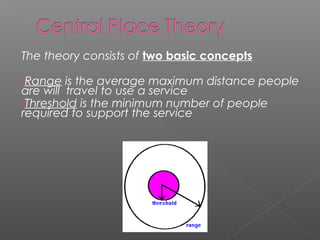
The theory consists of two basic concepts
Range is the average maximum distance people
are will travel to use a service
Threshold is the minimum number of people
required to support the service
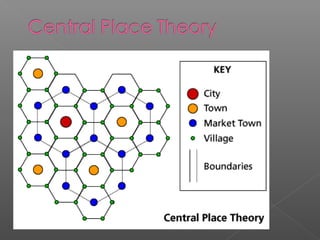
 Christaller attempted to design a model
that would show how and where central
places in the urban hierarchy would be
functionally and spatially distributed
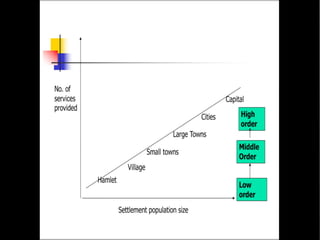
Hamlet: fewest goods and services
available
Village: includes the region of the hamlet
and some additional goods and services
Town: includes the region of the village and
hamlet and provides some additional
goods and services
City: includes the region of the village,
hamlet and town and provides additional
goods and services
 The landscape is an isotropic surface
 The settlement distribution is uniform with
respect to resources
 The distribution of population and their
income level are almost the same
 Both the purchaser and seller are rational or
economic person who try to optimize their
profit
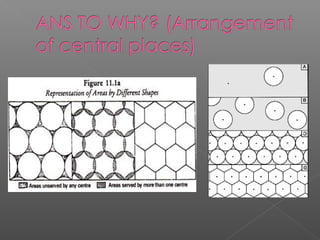
 Hexagonal arrangement of central places
(WHY?)
 The larger the settlement, the less there
are of them and the farther apart they
are
 The less there are of a settlement, the
larger the hinterland, or sphere of
influence, of its goods and services
 Places of the same size will be spaced
the same distance apart (√3x7)km or
12km apart
Three ways:
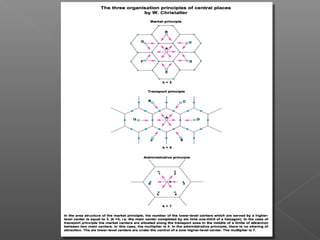
K=3 Marketing principle
K=4 Transportation principle
K=7 Administrative principle
The different layouts predicted by
Christaller have K-values which show how
much the sphere of influence of the
central place takes in
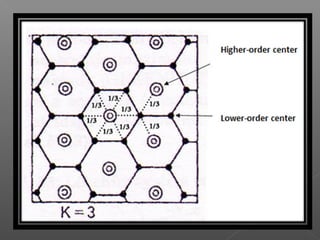
According to marketing principle K=3
The market area of a higher order place occupies
1/3rd
of the market area of each of the consecutive
lower order place which lies on its neighbour.
The lower size nodes (6 in no. and 2nd
larger
circle)are located at the corner of a largest
hexagon around the high-order settlement.
It serves 1/3rd
(6 settlements)+1=3 times its own
population and area
Thus with one at the highest seventh order the no.
are 1, 2, 6, 18, 54, 162 and 486
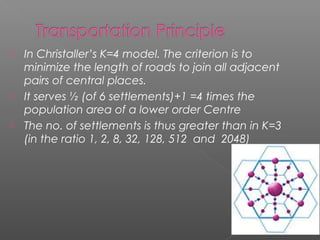
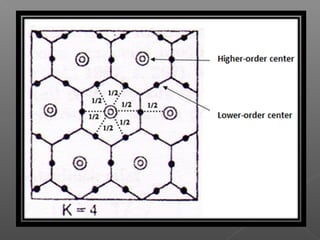
 In Christaller’s K=4 model. The criterion is to
minimize the length of roads to join all adjacent
pairs of central places.
 It serves ½ (of 6 settlements)+1 =4 times the
population area of a lower order Centre
 The no. of settlements is thus greater than in K=3
(in the ratio 1, 2, 8, 32, 128, 512 and 2048)
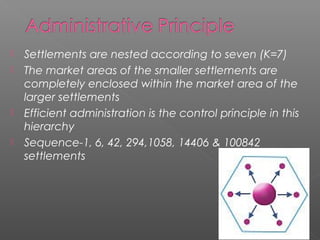
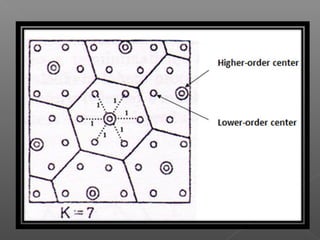
 Settlements are nested according to seven (K=7)
 The market areas of the smaller settlements are
completely enclosed within the market area of the
larger settlements
 Efficient administration is the control principle in this
hierarchy
 Sequence-1, 6, 42, 294,1058, 14406 & 100842
settlements
 An isotropic surface is ideal rarely found in
the world
 The behaviour of consumers and sellers is
not always rational
 The hexagonal pattern of central places is
rarely found in real life
 This theory is primarily suitable for agriculture
regions and it doesn’t account for the
impact of industrial agglomerations and
govt. policies
 The fixed value of ‘K’ shows poor approx.
with reality
Central place theory

Central place theory

  • 5.
     A CentralPlace is a settlement which provides one or more services for the population living around it.  Simple basic services(e.g. grocery stores) are said to be of lower order while specialized services (e.g. universities) are said to be high order.  Having a high order service implies there are low order services around it, but not vice versa.  Settlements which provides low order services are said to be low order settlements.  Settlements which provides high order services are said to be high order settlements.  The sphere of influence is the area under the influence of the central place.
  • 6.
     Urban hierarchyis based on the functions available in a city.  Is also related to population as well as functions and services  Functions and services attract people from the urban areas as well as the hinterlands  Every urban center has an economic reach  Central places compete with each other to provide goods and services  Economic reach is a measure of centrality  Centrality is crucial to the development of urban places and their service areas  Hinterland refers to the area surrounding a service from which consumers are drawn
  • 7.
    The theory consistsof two basic concepts Range is the average maximum distance people are will travel to use a service Threshold is the minimum number of people required to support the service
  • 8.
     Christaller attemptedto design a model that would show how and where central places in the urban hierarchy would be functionally and spatially distributed
  • 9.
    Hamlet: fewest goodsand services available Village: includes the region of the hamlet and some additional goods and services Town: includes the region of the village and hamlet and provides some additional goods and services City: includes the region of the village, hamlet and town and provides additional goods and services
  • 11.
     The landscapeis an isotropic surface  The settlement distribution is uniform with respect to resources  The distribution of population and their income level are almost the same  Both the purchaser and seller are rational or economic person who try to optimize their profit  Hexagonal arrangement of central places (WHY?)
  • 13.
     The largerthe settlement, the less there are of them and the farther apart they are  The less there are of a settlement, the larger the hinterland, or sphere of influence, of its goods and services  Places of the same size will be spaced the same distance apart (√3x7)km or 12km apart
  • 14.
    Three ways: K=3 Marketingprinciple K=4 Transportation principle K=7 Administrative principle The different layouts predicted by Christaller have K-values which show how much the sphere of influence of the central place takes in
  • 15.
    According to marketingprinciple K=3 The market area of a higher order place occupies 1/3rd of the market area of each of the consecutive lower order place which lies on its neighbour. The lower size nodes (6 in no. and 2nd larger circle)are located at the corner of a largest hexagon around the high-order settlement. It serves 1/3rd (6 settlements)+1=3 times its own population and area Thus with one at the highest seventh order the no. are 1, 2, 6, 18, 54, 162 and 486
  • 17.
     In Christaller’sK=4 model. The criterion is to minimize the length of roads to join all adjacent pairs of central places.  It serves ½ (of 6 settlements)+1 =4 times the population area of a lower order Centre  The no. of settlements is thus greater than in K=3 (in the ratio 1, 2, 8, 32, 128, 512 and 2048)
  • 19.
     Settlements arenested according to seven (K=7)  The market areas of the smaller settlements are completely enclosed within the market area of the larger settlements  Efficient administration is the control principle in this hierarchy  Sequence-1, 6, 42, 294,1058, 14406 & 100842 settlements
  • 21.
     An isotropicsurface is ideal rarely found in the world  The behaviour of consumers and sellers is not always rational  The hexagonal pattern of central places is rarely found in real life  This theory is primarily suitable for agriculture regions and it doesn’t account for the impact of industrial agglomerations and govt. policies  The fixed value of ‘K’ shows poor approx. with reality