EDUCATION SYSTEM IN
SINGAPORE.
Compiled By: Big Ben.(CTIE)
Objectives
• An overview on how the education system has developed over time.
• Education structure.
• Core values
• Vision of education
• National goals of education
• All round education system.
• Projected outcomes in the life of the learner after each stage of education.
University (3 - 4 years)
JC (2 years)
Poly (3 years)
ITE (2 years)
Secondary School (4 - 5 years)
Primary School (6 years)
INTRODUCTION.
•This section shall provide in summary the educational system
of Singapore, the vision of the ministry of education, an
overview on the education system, national goals among
others.
•The result of the specific war in 1945 had created severe social
and economic dislocation for the people of Singapore.
Although the British rulers reclaimed control of the trading
port, the halo of British invincibility was totally shattered.
HOW THE SINGAPORE’S EDUCATION SYSTEM HAS
DEVELOPED OVERTIME.
The education system in Singapore is based on the
British systems and puts a lot of emphasis on testing. The
ranking of schools through standardized tests is to know
how well students perform. Singapore students are known
to excel in international tests in practical skills such as
science and mathematics, this is as a result of the
government’s emphasis on those areas.
By the end of the 1970s, social and economic indicators
pointed to a rich and progressive Singapore in the midst
of developing countries still battling with the problem of
poverty.
• The Education system of Singapore believed that people are the only
resource and these people have to exceptional if Singapore is to
survive and prosper.The Government’s struggle on innovating and
gearing education towards the latest needs of society and economic
prosperity. Despite the criticism leveled against it for being
regimented and test-oriented, the Singapore education system is
quite creative. Singaporean teacher consistently rank high in
teaching surveys and are commended for their innovative teaching
methods.
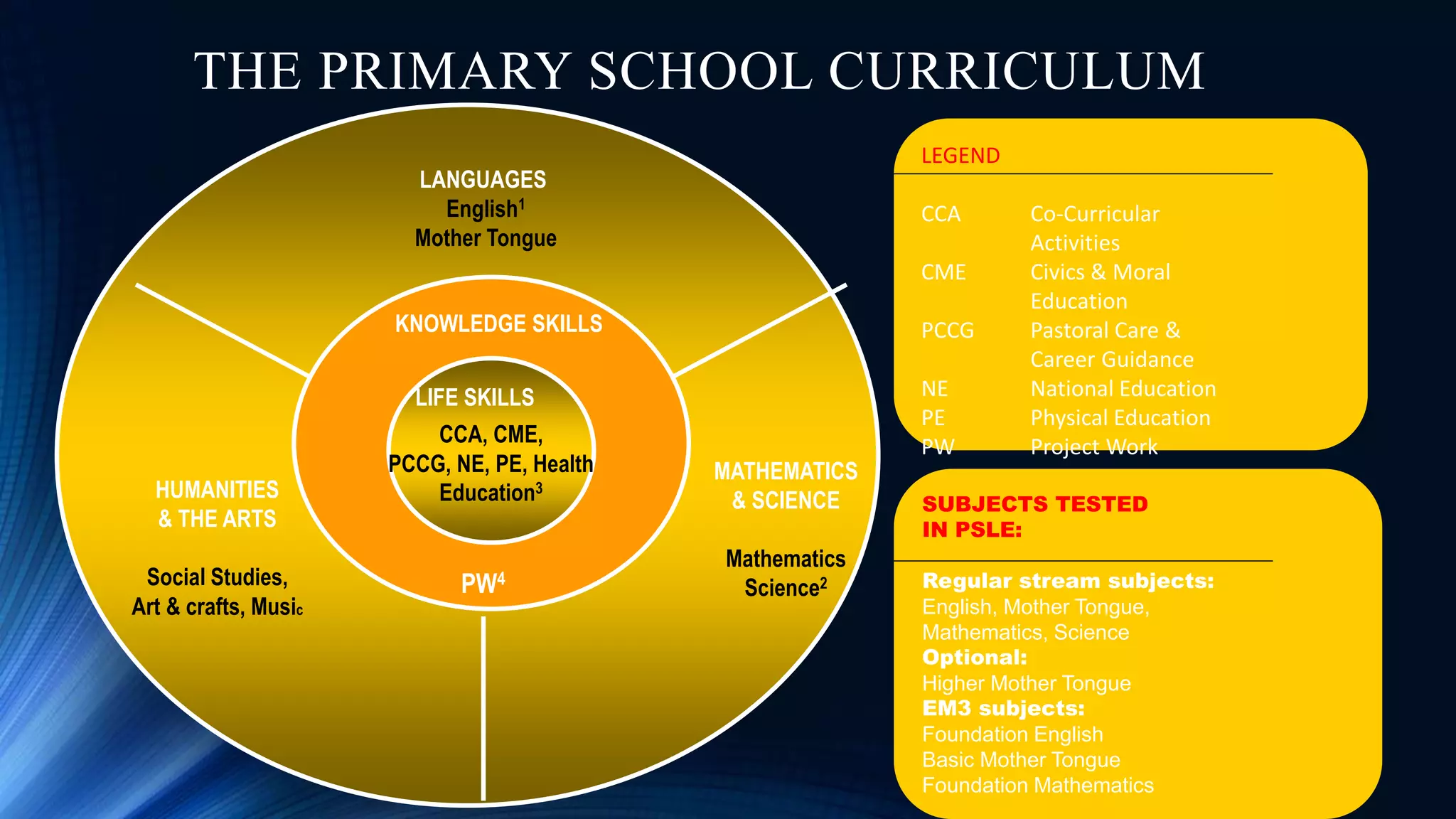
THE PRIMARY SCHOOL CURRICULUM
LIFE SKILLS
CCA, CME,
PCCG, NE, PE, Health
Education3
KNOWLEDGE SKILLS
PW4
LANGUAGES
English1
Mother Tongue
HUMANITIES
& THE ARTS
Social Studies,
Art & crafts, Music
MATHEMATICS
& SCIENCE
Mathematics
Science2
LEGEND
CCA Co-Curricular
Activities
CME Civics & Moral
Education
PCCG Pastoral Care &
Career Guidance
NE National Education
PE Physical Education
PW Project Work
SUBJECTS TESTED
IN PSLE:
Regular stream subjects:
English, Mother Tongue,
Mathematics, Science
Optional:
Higher Mother Tongue
EM3 subjects:
Foundation English
Basic Mother Tongue
Foundation Mathematics
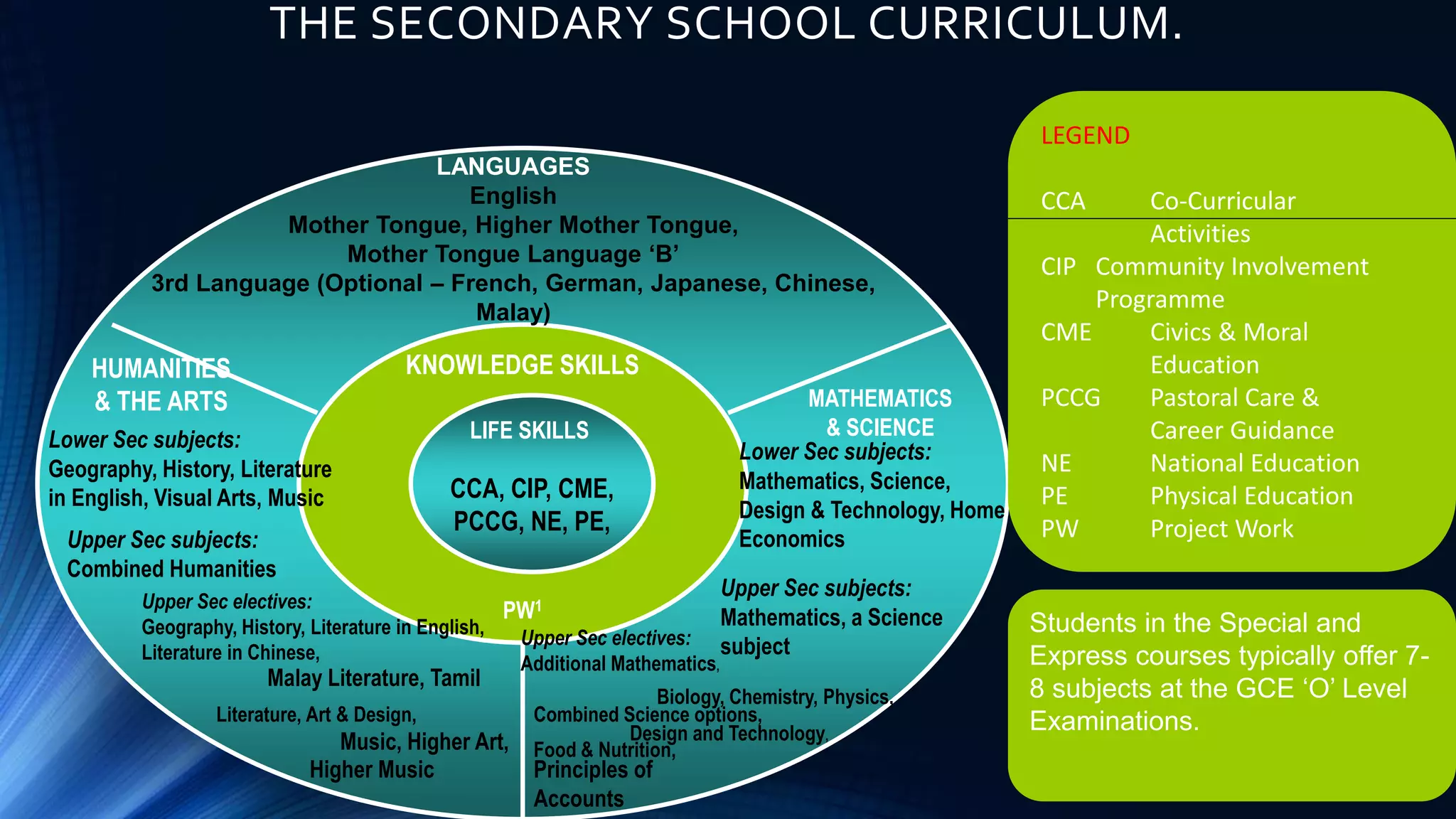
THE SECONDARY SCHOOL CURRICULUM.
LIFE SKILLS
CCA, CIP, CME,
PCCG, NE, PE,
KNOWLEDGE SKILLS
PW1
LANGUAGES
English
Mother Tongue, Higher Mother Tongue,
Mother Tongue Language ‘B’
3rd Language (Optional – French, German, Japanese, Chinese,
Malay)
HUMANITIES
& THE ARTS MATHEMATICS
& SCIENCE
LEGEND
CCA Co-Curricular
Activities
CIP Community Involvement
Programme
CME Civics & Moral
Education
PCCG Pastoral Care &
Career Guidance
NE National Education
PE Physical Education
PW Project Work
Students in the Special and
Express courses typically offer 7-
8 subjects at the GCE ‘O’ Level
Examinations.
Lower Sec subjects:
Geography, History, Literature
in English, Visual Arts, Music
Upper Sec subjects:
Combined Humanities
Upper Sec electives:
Geography, History, Literature in English,
Literature in Chinese,
Malay Literature, Tamil
Literature, Art & Design,
Music, Higher Art,
Higher Music
Lower Sec subjects:
Mathematics, Science,
Design & Technology, Home
Economics
Upper Sec subjects:
Mathematics, a Science
subjectUpper Sec electives:
Additional Mathematics,
Biology, Chemistry, Physics,
Combined Science options,
Design and Technology,
Food & Nutrition,
Principles of
Accounts
THE “A” LEVEL SHOOL CURRICULUM.
China StudiesEnglish Language and
Linguistics
THE NATIONAL GOALS OF EDUCATION IN SINGAPORE.
To develop intellectual depth and higher level thinking
To nurture productive creativity
To develop attitudes for self-directed lifelong learning
To enhance aspirations for individual excellence and
fulfilment
To develop a strong social conscience and commitment
to serve society and nation
To develop moral values and qualities for responsible
leadership.
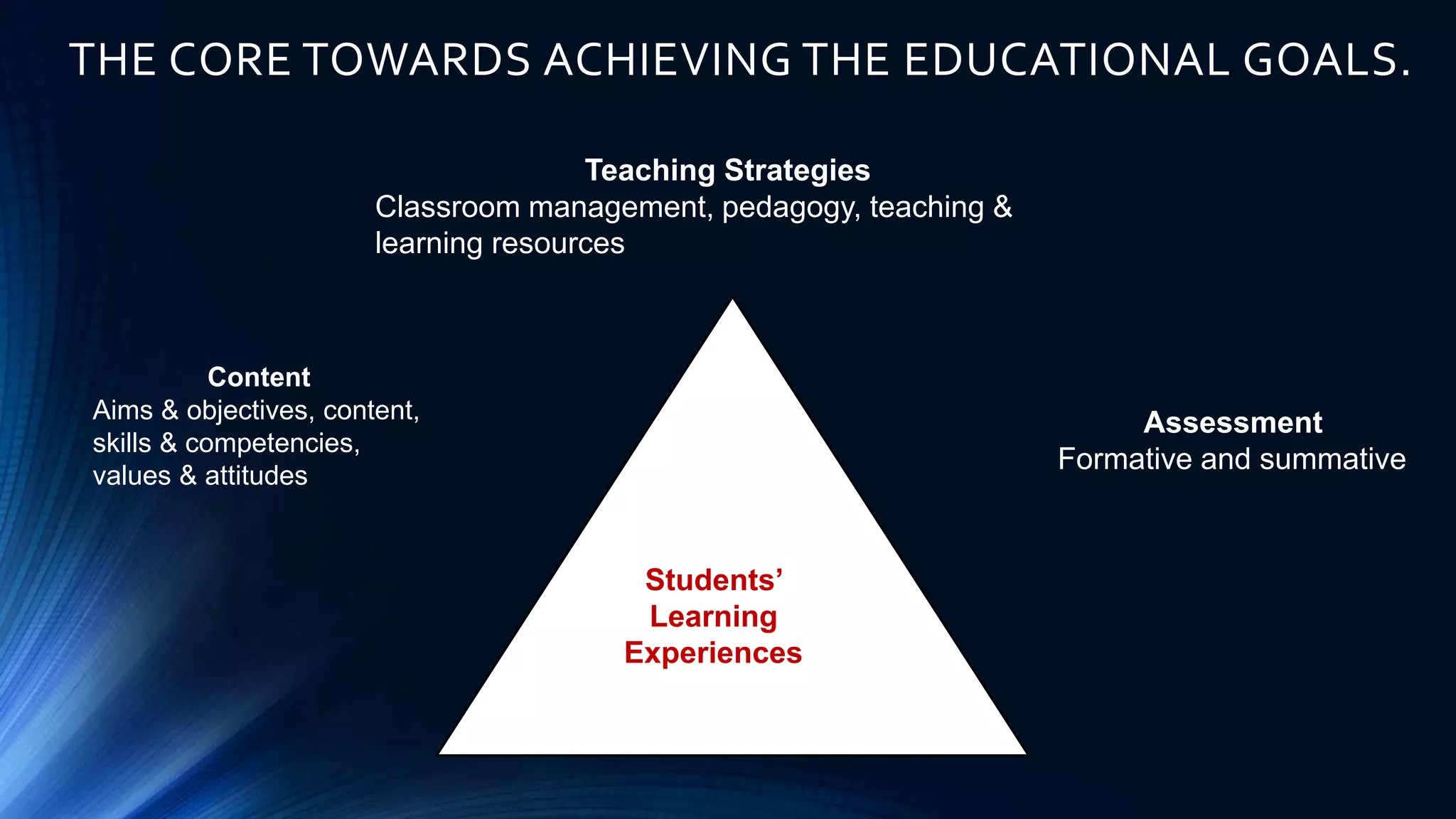
THE CORE TOWARDS ACHIEVING THE EDUCATIONAL GOALS.
Assessment
Formative and summative
Content
Aims & objectives, content,
skills & competencies,
values & attitudes
Teaching Strategies
Classroom management, pedagogy, teaching &
learning resources
Students’
Learning
Experiences
THE VISION OF THE MINISTRY OF EDUCATION
IN SINGAPORE.
• . The vision of the ministry of education in Singapore
is “Thinking Schools, Learning Nation”.
THE EDUCATION COMMISION.
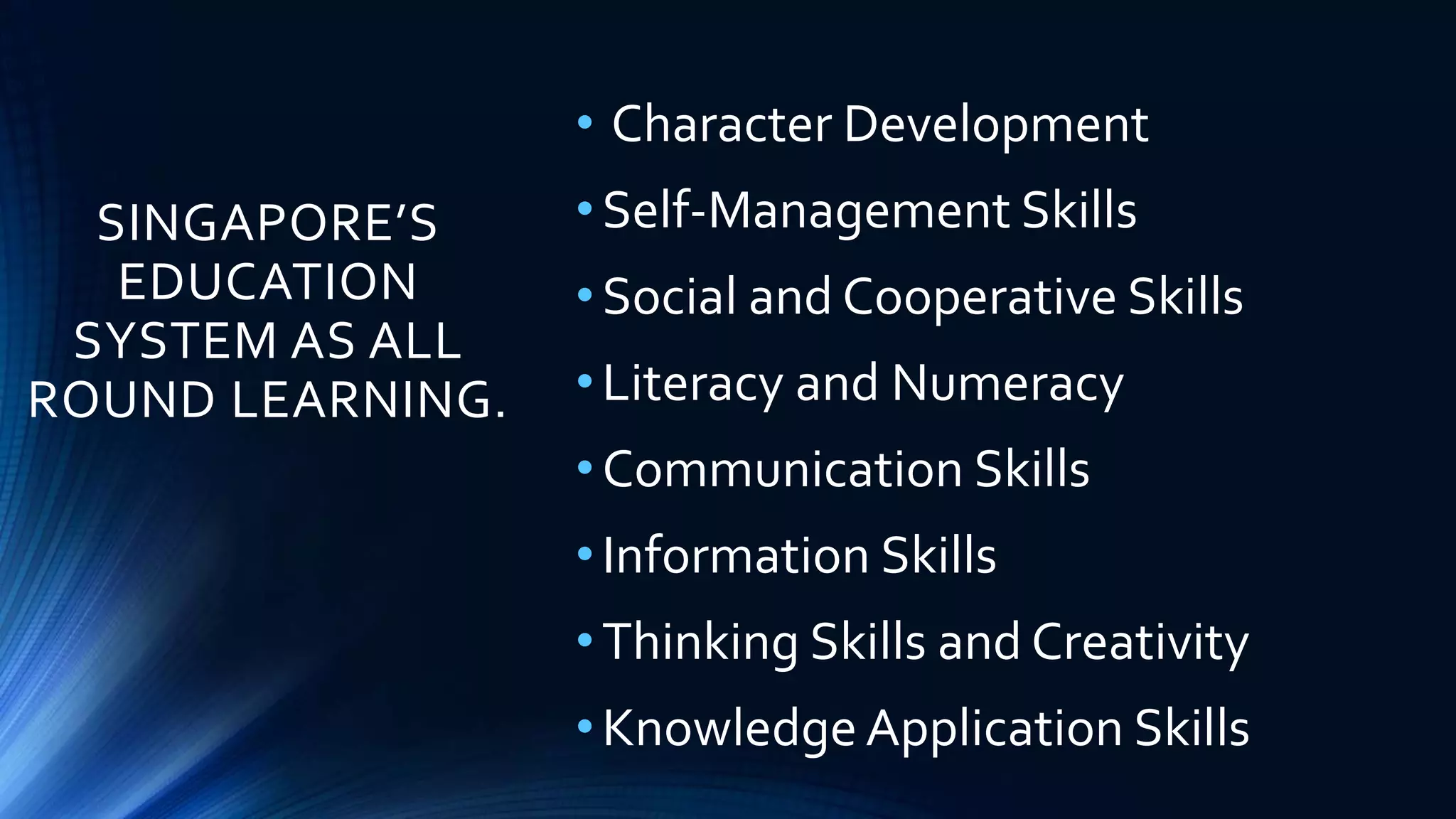
SINGAPORE’S
EDUCATION
SYSTEM AS ALL
ROUND LEARNING.
• Character Development
•Self-Management Skills
•Social and Cooperative Skills
•Literacy and Numeracy
•Communication Skills
•Information Skills
•Thinking Skills and Creativity
•Knowledge Application Skills
REFORMS IN THE EDUCATION SYSTEM OF SINGAPORE.
 In announcing a new government policy calledThinking Schools in 1997, the
Singapore Minister of Education said, “We cannot produce adaptable, innovative and
creative students unless we have adaptable, innovative and creative teachers and
schools.”
Singapore has also made extensive use of international benchmarking as a tool for
improvement and to move up the educational value chain. Staff of the ministry,
other support bodies, and the schools all visit other systems and explore
international best practice.
• Reports of high rankings by Singaporean students on international tests were
first published around the same time as low growth forecasts for the
Singaporean economy. Many people including Prime Minister, began pushing
for education reforms that included less memorization and rote learning and
more creativity and the addition of more art classes, outdoor outing and clubs
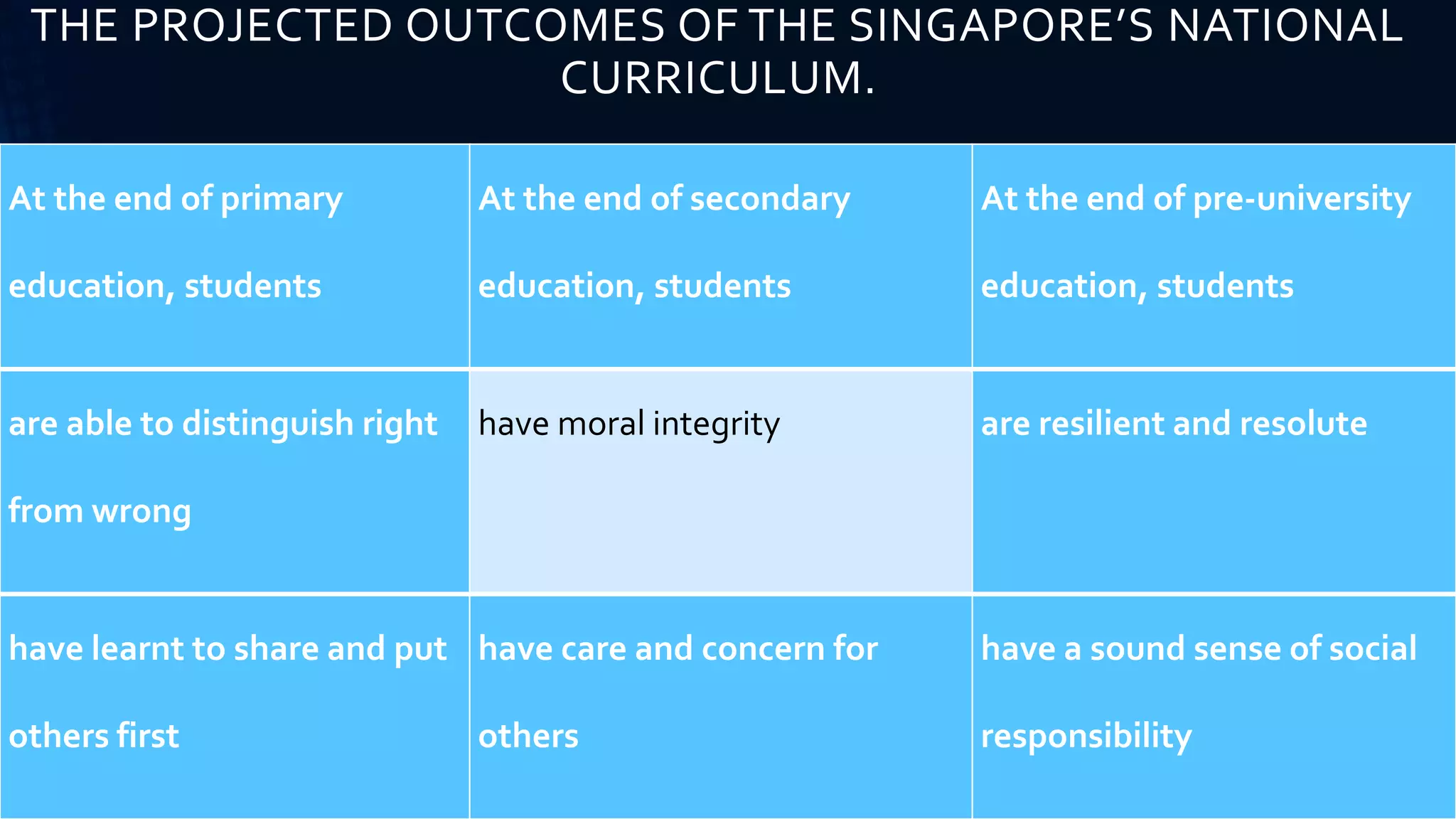
THE PROJECTED OUTCOMES OF THE SINGAPORE’S NATIONAL
CURRICULUM.
At the end of primary
education, students
At the end of secondary
education, students
At the end of pre-university
education, students
are able to distinguish right
from wrong
have moral integrity are resilient and resolute
have learnt to share and put
others first
have care and concern for
others
have a sound sense of social
responsibility
are able to build friendships with
others
are able to work in teams and value
every contribution
understand what it takes to inspire
and motivate others
have a lively curiosity about
things
are enterprising and innovative have an entrepreneurial and
creative spirit
are able to think for and express
themselves
possess a broad-based foundation for
further education
are able to think independently and
creatively
take pride in their work believe in their ability strive for excellence
have cultivated healthy habits have an appreciation of aesthetics have a zest for life
love Singapore know and believe in Singapore understand what it takes to lead
CONCLUSION.
• The Ministry of Education is always ensuring that there is a balance
in curriculum in a way that the curriculum addresses needs of the
present time.
• Singapore’s national curriculum will continue to provide students
with a strong foundation in the core areas of literacy, numeracy and
scientific literacy as these core areas provide the foundation for
future learning.The study of the humanities will be reinforced as the
humanities have the value in developing students’ ability to
understand and appreciate different perspectives, as well as nurture
cultural sensitivities and civic awareness.
•
Education system in singapore.

Education system in singapore.

  • 1.
  • 2.
    Objectives • An overviewon how the education system has developed over time. • Education structure. • Core values • Vision of education • National goals of education • All round education system. • Projected outcomes in the life of the learner after each stage of education.
  • 3.
    University (3 -4 years) JC (2 years) Poly (3 years) ITE (2 years) Secondary School (4 - 5 years) Primary School (6 years)
  • 4.
    INTRODUCTION. •This section shallprovide in summary the educational system of Singapore, the vision of the ministry of education, an overview on the education system, national goals among others. •The result of the specific war in 1945 had created severe social and economic dislocation for the people of Singapore. Although the British rulers reclaimed control of the trading port, the halo of British invincibility was totally shattered.
  • 5.
    HOW THE SINGAPORE’SEDUCATION SYSTEM HAS DEVELOPED OVERTIME. The education system in Singapore is based on the British systems and puts a lot of emphasis on testing. The ranking of schools through standardized tests is to know how well students perform. Singapore students are known to excel in international tests in practical skills such as science and mathematics, this is as a result of the government’s emphasis on those areas. By the end of the 1970s, social and economic indicators pointed to a rich and progressive Singapore in the midst of developing countries still battling with the problem of poverty.
  • 6.
    • The Educationsystem of Singapore believed that people are the only resource and these people have to exceptional if Singapore is to survive and prosper.The Government’s struggle on innovating and gearing education towards the latest needs of society and economic prosperity. Despite the criticism leveled against it for being regimented and test-oriented, the Singapore education system is quite creative. Singaporean teacher consistently rank high in teaching surveys and are commended for their innovative teaching methods.
  • 7.
    THE PRIMARY SCHOOLCURRICULUM LIFE SKILLS CCA, CME, PCCG, NE, PE, Health Education3 KNOWLEDGE SKILLS PW4 LANGUAGES English1 Mother Tongue HUMANITIES & THE ARTS Social Studies, Art & crafts, Music MATHEMATICS & SCIENCE Mathematics Science2 LEGEND CCA Co-Curricular Activities CME Civics & Moral Education PCCG Pastoral Care & Career Guidance NE National Education PE Physical Education PW Project Work SUBJECTS TESTED IN PSLE: Regular stream subjects: English, Mother Tongue, Mathematics, Science Optional: Higher Mother Tongue EM3 subjects: Foundation English Basic Mother Tongue Foundation Mathematics
  • 8.
    THE SECONDARY SCHOOLCURRICULUM. LIFE SKILLS CCA, CIP, CME, PCCG, NE, PE, KNOWLEDGE SKILLS PW1 LANGUAGES English Mother Tongue, Higher Mother Tongue, Mother Tongue Language ‘B’ 3rd Language (Optional – French, German, Japanese, Chinese, Malay) HUMANITIES & THE ARTS MATHEMATICS & SCIENCE LEGEND CCA Co-Curricular Activities CIP Community Involvement Programme CME Civics & Moral Education PCCG Pastoral Care & Career Guidance NE National Education PE Physical Education PW Project Work Students in the Special and Express courses typically offer 7- 8 subjects at the GCE ‘O’ Level Examinations. Lower Sec subjects: Geography, History, Literature in English, Visual Arts, Music Upper Sec subjects: Combined Humanities Upper Sec electives: Geography, History, Literature in English, Literature in Chinese, Malay Literature, Tamil Literature, Art & Design, Music, Higher Art, Higher Music Lower Sec subjects: Mathematics, Science, Design & Technology, Home Economics Upper Sec subjects: Mathematics, a Science subjectUpper Sec electives: Additional Mathematics, Biology, Chemistry, Physics, Combined Science options, Design and Technology, Food & Nutrition, Principles of Accounts
  • 9.
    THE “A” LEVELSHOOL CURRICULUM. China StudiesEnglish Language and Linguistics
  • 10.
    THE NATIONAL GOALSOF EDUCATION IN SINGAPORE. To develop intellectual depth and higher level thinking To nurture productive creativity To develop attitudes for self-directed lifelong learning To enhance aspirations for individual excellence and fulfilment To develop a strong social conscience and commitment to serve society and nation To develop moral values and qualities for responsible leadership.
  • 11.
    THE CORE TOWARDSACHIEVING THE EDUCATIONAL GOALS. Assessment Formative and summative Content Aims & objectives, content, skills & competencies, values & attitudes Teaching Strategies Classroom management, pedagogy, teaching & learning resources Students’ Learning Experiences
  • 12.
    THE VISION OFTHE MINISTRY OF EDUCATION IN SINGAPORE. • . The vision of the ministry of education in Singapore is “Thinking Schools, Learning Nation”. THE EDUCATION COMMISION.
  • 13.
    SINGAPORE’S EDUCATION SYSTEM AS ALL ROUNDLEARNING. • Character Development •Self-Management Skills •Social and Cooperative Skills •Literacy and Numeracy •Communication Skills •Information Skills •Thinking Skills and Creativity •Knowledge Application Skills
  • 14.
    REFORMS IN THEEDUCATION SYSTEM OF SINGAPORE.  In announcing a new government policy calledThinking Schools in 1997, the Singapore Minister of Education said, “We cannot produce adaptable, innovative and creative students unless we have adaptable, innovative and creative teachers and schools.” Singapore has also made extensive use of international benchmarking as a tool for improvement and to move up the educational value chain. Staff of the ministry, other support bodies, and the schools all visit other systems and explore international best practice. • Reports of high rankings by Singaporean students on international tests were first published around the same time as low growth forecasts for the Singaporean economy. Many people including Prime Minister, began pushing for education reforms that included less memorization and rote learning and more creativity and the addition of more art classes, outdoor outing and clubs
  • 15.
    THE PROJECTED OUTCOMESOF THE SINGAPORE’S NATIONAL CURRICULUM. At the end of primary education, students At the end of secondary education, students At the end of pre-university education, students are able to distinguish right from wrong have moral integrity are resilient and resolute have learnt to share and put others first have care and concern for others have a sound sense of social responsibility
  • 16.
    are able tobuild friendships with others are able to work in teams and value every contribution understand what it takes to inspire and motivate others have a lively curiosity about things are enterprising and innovative have an entrepreneurial and creative spirit are able to think for and express themselves possess a broad-based foundation for further education are able to think independently and creatively take pride in their work believe in their ability strive for excellence have cultivated healthy habits have an appreciation of aesthetics have a zest for life love Singapore know and believe in Singapore understand what it takes to lead
  • 17.
    CONCLUSION. • The Ministryof Education is always ensuring that there is a balance in curriculum in a way that the curriculum addresses needs of the present time. • Singapore’s national curriculum will continue to provide students with a strong foundation in the core areas of literacy, numeracy and scientific literacy as these core areas provide the foundation for future learning.The study of the humanities will be reinforced as the humanities have the value in developing students’ ability to understand and appreciate different perspectives, as well as nurture cultural sensitivities and civic awareness. •