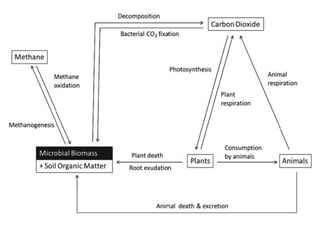
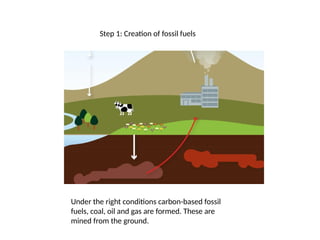
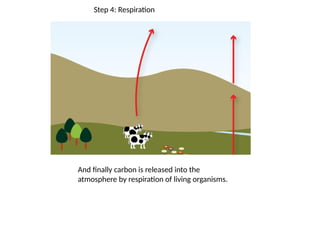
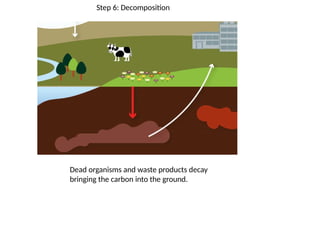
Overtime (millions ofyears) and under the right conditions some decomposed
remains will be turned into fossil fuels such as coal and gas.
Algae as well as bacteria called cyanobacteria are similar to green plants
because they can all make their own food through a process called
photosynthesis.
Photosynthesis
Chlorophyll, the substance that makes algae and plants green, uses the energy
from sunlight. In algae and plants it is contained in a structure called the
chloroplast; cyanobacteria carry out photosynthesis directly in the cytoplasm of
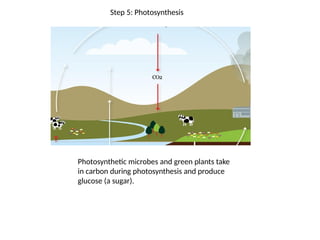
the cell. The microbe uses this energy to change carbon dioxide gas from the air
and the water around them into a sugar called glucose. The sugar is either
transported to other cells and used as food or stored as insoluble starch. This
process is called photosynthesis. The gas oxygen is released as a waste product.
This is very important as animals including humans need oxygen to live. In fact 70
– 80 % of all the oxygen we breathe comes from algae.
9.
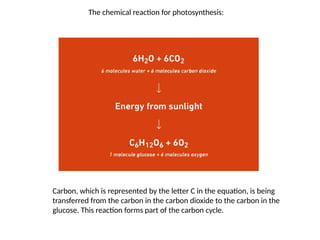
The chemical reactionfor photosynthesis:
Carbon, which is represented by the letter C in the equation, is being
transferred from the carbon in the carbon dioxide to the carbon in the
glucose. This reaction forms part of the carbon cycle.
10.
Aerobic respiration
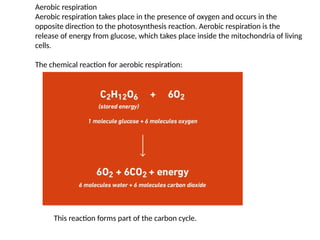
Aerobic respirationtakes place in the presence of oxygen and occurs in the
opposite direction to the photosynthesis reaction. Aerobic respiration is the
release of energy from glucose, which takes place inside the mitochondria of living
cells.
The chemical reaction for aerobic respiration:
This reaction forms part of the carbon cycle.
11.
What is cellulose?
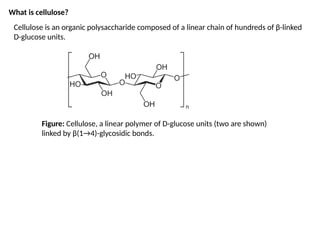
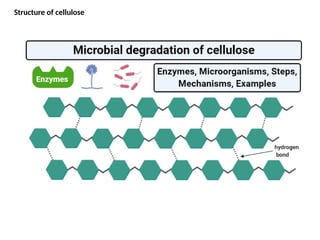
Celluloseis an organic polysaccharide composed of a linear chain of hundreds of β-linked
D-glucose units.
Figure: Cellulose, a linear polymer of D-glucose units (two are shown)
linked by β(1→4)-glycosidic bonds.
12.
Cellulose isthe most abundant extracellular structural polysaccharide or organic
polymer of all biomolecules in the biosphere.
Cellulose is present in all land plants but is completely lacking in meat, egg, fish, and
milk. It is, however, not metabolized by the human system.
It is the most widely distributed carbohydrate of the plant kingdom that comprises
about 50% of all the carbon in vegetation.
Cellulose occurs in the cell walls of plants where it contributes in a major way to the
structure of the organism.
All cellulose-synthesizing organisms, including bacteria, algae, tunicates, and
higher plants, have cellulose synthase proteins, which catalyze the polymerization
of glucan chains.
Even if the human body cannot digest cellulose, it acts as a source of fiber.
In nature, cellulose is a source of food to a wide variety of organisms including
bacteria, fungi, plants, and protists as well as a wide range of invertebrate
animals, like insects, crustaceans, annelids, molluscs, and nematodes.
13.
The mechanicalstrength of the plant cell is attributed to the structural properties
of cellulose as it can retain a semi-crystalline state of aggregation even in the
aqueous environment.
Cellulose is a homopolymer of a glucose derivative, and thus, it acts as a great
source of fermentable sugar.
Cellulose is cultivated in the form of energy crops for the production of ethanol,
ethers, acetic acid, etc.
The abundance of cellulose is due to the constant photosynthetic cycles in higher
plants, synthesizing about 1000 tons of cellulose.
Cellulose is a fibrous, rigid, white solid, insoluble in water but soluble in
ammoniacal cupric hydroxide solution.
Although insoluble in water, cellulose absorbs water and adds to the bulk of the
fecal matter, and facilitates its removal.
Cellulose consistsof a D-glucose unit at one end with a C4-OH group as the non-reducing
end, and the terminating group is C1-OH as the reducing end.
The bond is formed by taking out a molecule of water from the glycosidic OH group on
carbon atom 1 of one β-D-glucose molecule and the alcoholic OH group on carbon atom
4 of the adjacent β-D-glucose molecule.
The overall structure of cellulose is a result of the binding of adjacent cellulose chains
and sheets by hydrogen bonds and van der Waals forces, resulting in a parallel
alignment.
This results in the crystalline structure of cellulose with straight, stable
supramolecular fibers of great tensile strength and low accessibility.
The structure of cellulose resembles in structure with amylose except that the
glucose units are linked together by β-1, 4-glucoside linkages.
16.
The β-1,4-glycosidic linkage in the structure creates a linear glucan chain where every
other glucose residue is rotated at 180° to the neighbor.
The cellulose molecule is very stable, with a half-life of 5–8 million years for b -
glucosidic bond cleavage at 25°C.
Cellulose is of different types on the basis of their structure and accessibility;
crystalline and non-crystalline, accessible and non-accessible.
Most of the cellulose found in wood is highly crystalline with about 65% crystalline
regions. The rest of the structure has a lower packing density, resulting in an
amorphous or non-crystalline structure.
Accessibility of cellulose is used to define the availability of cellulose to water and
microorganisms. The surface of crystalline cellulose is mostly accessible, whereas the
rest of the structure is non-accessible.
17.
What are cellulases?
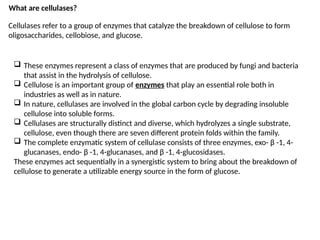
Cellulasesrefer to a group of enzymes that catalyze the breakdown of cellulose to form
oligosaccharides, cellobiose, and glucose.
These enzymes represent a class of enzymes that are produced by fungi and bacteria
that assist in the hydrolysis of cellulose.
Cellulose is an important group of enzymes that play an essential role both in
industries as well as in nature.
In nature, cellulases are involved in the global carbon cycle by degrading insoluble
cellulose into soluble forms.
Cellulases are structurally distinct and diverse, which hydrolyzes a single substrate,
cellulose, even though there are seven different protein folds within the family.
The complete enzymatic system of cellulase consists of three enzymes, exo- β -1, 4-
glucanases, endo- β -1, 4-glucanases, and β -1, 4-glucosidases.
These enzymes act sequentially in a synergistic system to bring about the breakdown of
cellulose to generate a utilizable energy source in the form of glucose.
18.
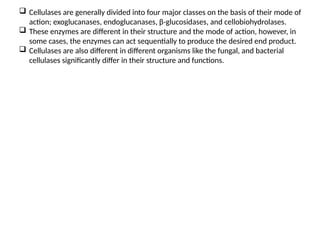
Cellulases aregenerally divided into four major classes on the basis of their mode of
action; exoglucanases, endoglucanases, β-glucosidases, and cellobiohydrolases.
These enzymes are different in their structure and the mode of action, however, in
some cases, the enzymes can act sequentially to produce the desired end product.
Cellulases are also different in different organisms like the fungal, and bacterial
cellulases significantly differ in their structure and functions.
19.
Microorganisms involved incellulose
degradation (cellulolytic microorganisms)
A broad spectrum of cellulolytic microorganisms, mainly fungi, and bacteria, have been
identified over the years. The structure and mode of action of the cellulases produced by
different microorganisms are also different.
20.
Cellulolytic Fungi
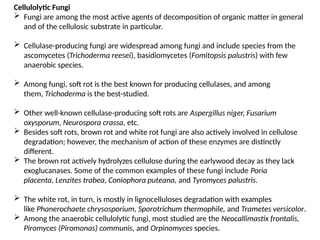
Fungiare among the most active agents of decomposition of organic matter in general
and of the cellulosic substrate in particular.
Cellulase-producing fungi are widespread among fungi and include species from the
ascomycetes (Trichoderma reesei), basidiomycetes (Fomitopsis palustris) with few
anaerobic species.
Among fungi, soft rot is the best known for producing cellulases, and among
them, Trichoderma is the best-studied.
Other well-known cellulase-producing soft rots are Aspergillus niger, Fusarium
oxysporum, Neurospora crassa, etc.
Besides soft rots, brown rot and white rot fungi are also actively involved in cellulose
degradation; however, the mechanism of action of these enzymes are distinctly
different.
The brown rot actively hydrolyzes cellulose during the earlywood decay as they lack
exoglucanases. Some of the common examples of these fungi include Poria
placenta, Lenzites trabea, Coniophora puteana, and Tyromyces palustris.
The white rot, in turn, is mostly in lignocelluloses degradation with examples
like Phanerochaete chrysosporium, Sporotrichum thermophile, and Trametes versicolor.
Among the anaerobic cellulolytic fungi, most studied are the Neocallimastix frontalis,
Piromyces (Piromonas) communis, and Orpinomyces species.
21.
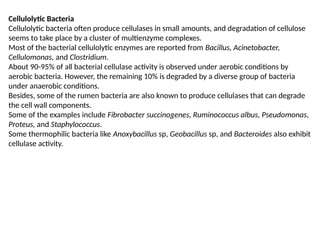
Cellulolytic Bacteria
Cellulolytic bacteriaoften produce cellulases in small amounts, and degradation of cellulose
seems to take place by a cluster of multienzyme complexes.
Most of the bacterial cellulolytic enzymes are reported from Bacillus, Acinetobacter,
Cellulomonas, and Clostridium.
About 90-95% of all bacterial cellulase activity is observed under aerobic conditions by
aerobic bacteria. However, the remaining 10% is degraded by a diverse group of bacteria
under anaerobic conditions.
Besides, some of the rumen bacteria are also known to produce cellulases that can degrade
the cell wall components.
Some of the examples include Fibrobacter succinogenes, Ruminococcus albus, Pseudomonas,
Proteus, and Staphylococcus.
Some thermophilic bacteria like Anoxybacillus sp, Geobacillus sp, and Bacteroides also exhibit
cellulase activity.
22.
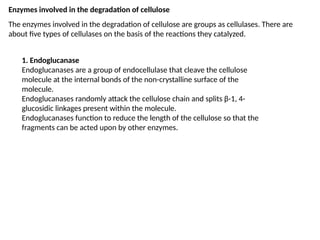
Enzymes involved inthe degradation of cellulose
The enzymes involved in the degradation of cellulose are groups as cellulases. There are
about five types of cellulases on the basis of the reactions they catalyzed.
1. Endoglucanase
Endoglucanases are a group of endocellulase that cleave the cellulose
molecule at the internal bonds of the non-crystalline surface of the
molecule.
Endoglucanases randomly attack the cellulose chain and splits β-1, 4-
glucosidic linkages present within the molecule.
Endoglucanases function to reduce the length of the cellulose so that the
fragments can be acted upon by other enzymes.
23.
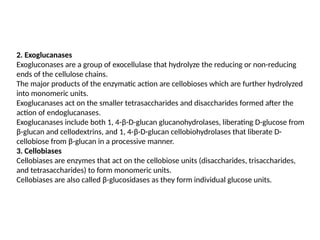
2. Exoglucanases
Exogluconases area group of exocellulase that hydrolyze the reducing or non-reducing
ends of the cellulose chains.
The major products of the enzymatic action are cellobioses which are further hydrolyzed
into monomeric units.
Exoglucanases act on the smaller tetrasaccharides and disaccharides formed after the
action of endoglucanases.
Exoglucanases include both 1, 4-β-D-glucan glucanohydrolases, liberating D-glucose from
β-glucan and cellodextrins, and 1, 4-β-D-glucan cellobiohydrolases that liberate D-
cellobiose from β-glucan in a processive manner.
3. Cellobiases
Cellobiases are enzymes that act on the cellobiose units (disaccharides, trisaccharides,
and tetrasaccharides) to form monomeric units.
Cellobiases are also called β-glucosidases as they form individual glucose units.
24.
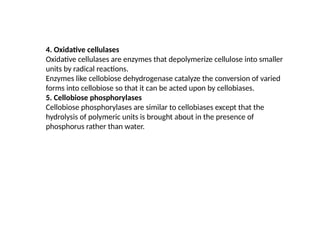
4. Oxidative cellulases
Oxidativecellulases are enzymes that depolymerize cellulose into smaller
units by radical reactions.
Enzymes like cellobiose dehydrogenase catalyze the conversion of varied
forms into cellobiose so that it can be acted upon by cellobiases.
5. Cellobiose phosphorylases
Cellobiose phosphorylases are similar to cellobiases except that the
hydrolysis of polymeric units is brought about in the presence of
phosphorus rather than water.
25.
Aerobic and Anaerobicdegradation of cellulose
1. Aerobic degradation of cellulose
Aerobic cellulolysis is performed by the synergistic action of three types of
enzymatic activities: endoglucanases or 1, 4-β-D-glucan 4-glucanohydrolases,
exoglucanases and β-glucosidases or β-D-glucoside glucohydrolases, resulting in
the release of D-glucose units from soluble cellodextrins and a variety of
glycosides.
Aerobic cellulases are produced in high concentrations and also act in a sequential
manner.
Aerobic hydrolysis is fairly simple and occurs in sequential steps, each of the steps
catalyzed by a different type of cellulase enzyme.
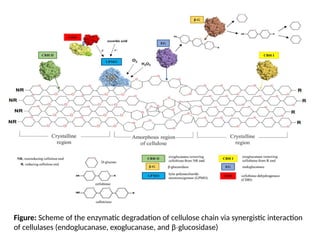
Endoglucanases attack amorphous regions of cellulose fibers, forming sites for
exoglucanases which can then hydrolyze cellobiose units from more crystalline
regions of the fibers.
Finally, β-glucosidases, by hydrolyzing cellobiose, result in the formation of
monomeric glucose units.
26.
2. Anaerobic degradationof cellulose
The mechanism by which cellulases from anaerobic bacteria catalyze the
depolymerization of crystalline cellulose is poorly defined; however, it is
known that the mechanism is distinctly different from that of aerobic
hydrolysis.
The cellulases of most anaerobic microorganisms are organized into large,
multiprotein complexes, called cellulosomes.
The cellulosomes mediate a close neighborhood between cell and
substrate and thus minimize diffusion losses of hydrolytic products.
27.
Figure: Scheme ofthe enzymatic degradation of cellulose chain via synergistic interaction
of cellulases (endoglucanase, exoglucanase, and β‐glucosidase)