AMJAD AL-BLEAHID
DENTISTRY
Cellular secretion and
communication
overview about Cellular
secretion
The definition of cell secretion :
 Cell secretion is the external elimination of
substances produced by the cell .
Examples :
 Hormones
 Mucus
Modes of Secretion :
 Merocrine :
 most abundant form of multicellular exocrine
gland .
 products are secreted by exocytosis (e.g.,
pancreas, sweat, and salivary glands)
 Holocrine :
 products are secreted by the rupture of gland
cells [e.g., sebaceous (oil) glands of the skin]
Cellular communication
Overview about communication :
 Cell-to-cell communication is essential for both
multicellular and unicellular organisms
 Multicellular organism’s cells communicate by
chemical messengers
 Cells most often communicate with each other
via chemical signals
Sutherland suggested that cells receiving signals went
through three processes :
 Reception
 Transduction
 Response
:Modes of cell-cell signaling
 1- Direct cell-cell or cell-matrix .
 2 - Indirect: Secreted molecules .
 A - Endocrine signaling. The signaling molecules are
hormones secreted by endocrine cells and carried
through the circulation system to act on target cells at
distant body sites.
 B - Paracrine signaling. The signaling molecules
released by one cell act on neighboring target cells
(neurotransmitters).
 C - Autocrine signaling. Cells respond to signaling
molecules that they themselves produce (response of
the immune system to foreign antigens, and cancer
cells).
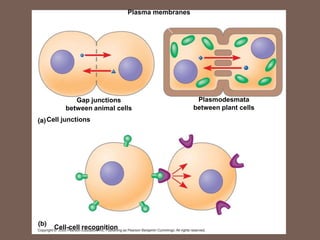
Plasma membranes
Gap junctions
between animal cells
Cell junctions
Cell-cell recognition
Plasmodesmata
between plant cells

Cellular secretion and communication

  • 1.
  • 2.
  • 3.
    The definition ofcell secretion :  Cell secretion is the external elimination of substances produced by the cell .
  • 4.
  • 5.
    Modes of Secretion:  Merocrine :  most abundant form of multicellular exocrine gland .  products are secreted by exocytosis (e.g., pancreas, sweat, and salivary glands)  Holocrine :  products are secreted by the rupture of gland cells [e.g., sebaceous (oil) glands of the skin]
  • 6.
  • 7.
    Overview about communication:  Cell-to-cell communication is essential for both multicellular and unicellular organisms  Multicellular organism’s cells communicate by chemical messengers  Cells most often communicate with each other via chemical signals
  • 8.
    Sutherland suggested thatcells receiving signals went through three processes :  Reception  Transduction  Response
  • 9.
    :Modes of cell-cellsignaling  1- Direct cell-cell or cell-matrix .  2 - Indirect: Secreted molecules .  A - Endocrine signaling. The signaling molecules are hormones secreted by endocrine cells and carried through the circulation system to act on target cells at distant body sites.  B - Paracrine signaling. The signaling molecules released by one cell act on neighboring target cells (neurotransmitters).  C - Autocrine signaling. Cells respond to signaling molecules that they themselves produce (response of the immune system to foreign antigens, and cancer cells).
  • 10.
    Plasma membranes Gap junctions betweenanimal cells Cell junctions Cell-cell recognition Plasmodesmata between plant cells