Third Lecture

Growth and Development of The
Craniofacial Complex
Outlines
Craniofacial Complex.
Why you should be interested in growth and
development?

Factors influencing the development of
occlusion:
Definitions:
Growth
Development
March 5, 2012

Dr. Ahmed Basyouni

2
Outlines

Types of bone formation:
Intramembranous bone
Endochondrial bone
Sites of skull growth:

Growth of the head:
Growth of the cranium:
Cranial vault.
Cranial base.
March 5, 2012

Dr. Ahmed Basyouni

3
Outlines

Growth of the face:
Growth of the upper face (nasomaxillary
complex).

Growth of the mandible.

How to assess growth.
Why do we assess growth.
Human head shape.
March 5, 2012

Dr. Ahmed Basyouni

4
The Craniofacial Complex
Consists of:
I. Cranium:
Cranial vault
Cranial base
II. Face:
Upper face (Nasomaxillary complex)
Mandible
March 5, 2012

Dr. Ahmed Basyouni

5
Why you should be interested in
growth and development?
1. Knowledge of general and facial growth
provides a background of the etiology and
development of malocclusion.
2. As observer of the growing child all dentists
should be able to identify abnormal or unusual
skeletal growth patterns.
3. The dentist should be able to identify
abnormal occlusal development at an early
stage in order to undertake suitable
interceptive orthodontic treatment.
March 5, 2012

Dr. Ahmed Basyouni

6
Why you should be interested in growth and development?

4. Poorly timed extraction (early or delayed loss)
performed by dentist during growth, cause
malocclusion.
5. Many malocclusion are due to skeletal discrepancies
between the jaws (maxilla and mandible) due to
improper differential growth of the jaws.
6. Orthodontic treatment may make use of high growth
rates attained during puberty “Growth modification”.
7. Orthognathic surgery is considered only after facial
growth has been completed.
8. Growth effects have long term effects on the stability
of the occlusion after treatment.
March 5, 2012

Dr. Ahmed Basyouni

7
Factors influencing the
development of occlusion:
1. Bone growth & development.

2. Soft tissue morphology & behavior.
3. The relationship of size of dentition to
size of dental arch.
4. Forces of occlusion.
5. Skeletal pattern.
March 5, 2012

Dr. Ahmed Basyouni

8
Definitions
Growth: It is a physiochemical process by
which an organism becomes larger.
Development: It is sequence of changes from
fertilization of the ovum to maturity, It is
related to cell division, differentiation, and
organization up to maturity.

March 5, 2012

Dr. Ahmed Basyouni

9
The Growing Face

At birth, the largest to smallest dimensions of
the face are width, height and depth.
Postnatally, the face grows most rapidly in
depth, followed by height, with slowest rate of
growth being found in width.

March 5, 2012

Dr. Ahmed Basyouni

10
The Growing Face

8 months, 6 y, 8 y and 20 y old
March 5, 2012

Dr. Ahmed Basyouni

11
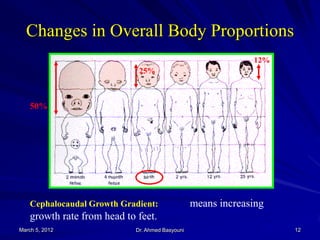
Changes in Overall Body Proportions
12%
25%

50%

Cephalocaudal Growth Gradient:

means increasing

growth rate from head to feet.
March 5, 2012

Dr. Ahmed Basyouni

12
Not all tissue systems of the body grow at the
same rate or mature at the same time

Scammon’s Curve: Growth curves of four major tissue systems.
March 5, 2012

Dr. Ahmed Basyouni

13
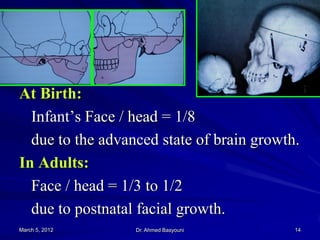
At Birth:
Infant’s Face / head = 1/8
due to the advanced state of brain growth.
In Adults:
Face / head = 1/3 to 1/2
due to postnatal facial growth.
March 5, 2012

Dr. Ahmed Basyouni

14
Types of Bone formation
Bone is mesodermal in origin:
The mesenchymal C. T. would be differentiated into:

Mesenchymal C. T.

Mucous membrane
Cartilage
(Fibrous C.T.)

Bone formed from fibrous C.T. is
called

Bone formed from cartilage is
called

Intramembranous bone

Endochondrial bone

March 5, 2012

Dr. Ahmed Basyouni

15
Intramembranous bone:
– by secretion of bone matrix
directly within C.T. without
any intermediate
formation of cartilage
– Through the activity of cells
in the periosteum
– Cranial vault, face (Mx &
body of Md)
and the clavicles.
March 5, 2012

Dr. Ahmed Basyouni

16
Endochondrial bone:
– Cartilage is replaced by bone
– Cranial base, Md condyle
Epiphyseal plate

Proliferating cartilage

March 5, 2012

Dr. Ahmed Basyouni

17
Sites of Skull Growth
Sutural growth
Surface apposition and remodeling
resorption
Growth of the contained organs as the
brain, eye balls, and the tongue

March 5, 2012

Dr. Ahmed Basyouni

18
Principles of Growth
•Resorption
•Apposition

•Surface remodeling of a bone in the opposite direction
to that in which it is being translated by growth of
adjacent structures

March 5, 2012

Dr. Ahmed Basyouni

19
Theories of Craniofacial Growth
Classical: bone growth is primary, soft tissues
adjust to the growth of the bones.
Functional matrix: soft tissue functional
demands are primary, bones grow in response
to functional demands.

March 5, 2012

Dr. Ahmed Basyouni

20
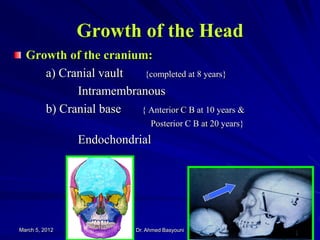
Growth of the Head
Growth of the cranium:
a) Cranial vault
{completed at 8 years}
Intramembranous
b) Cranial base
{ Anterior C B at 10 years &
Posterior C B at 20 years}

Endochondrial

March 5, 2012

Dr. Ahmed Basyouni

21
Growth of the Head

Growth of the Face:
a) Upper face (Nasomaxillary complex)
{completed at 16-18 years}

Intramembranous
b) Mandible {completed at 20-25 years}
Mixed

March 5, 2012

Dr. Ahmed Basyouni

22
Growth of the Cranium
Cranial vault is made up of frontal bone, the two
parietals, squamous part of the temporal bone and squamous
part of the occipital bone. All intramembranous, and separated
by sutures.

March 5, 2012

Dr. Ahmed Basyouni

23
Growth of the Cranium

Cranial vault

• Apposition of new bones at the cranial sutures,
& periosteal activity (remodeling) due to the
pressure from the growing brain.

March 5, 2012

Dr. Ahmed Basyouni

24
Growth of the Cranium

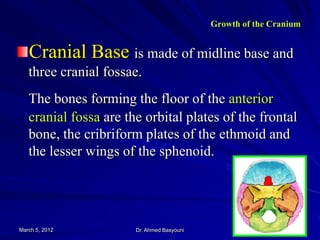
Cranial Base is made of midline base and
three cranial fossae.

The bones forming the floor of the anterior
cranial fossa are the orbital plates of the frontal
bone, the cribriform plates of the ethmoid and
the lesser wings of the sphenoid.

March 5, 2012

Dr. Ahmed Basyouni

25
Growth of the Cranium

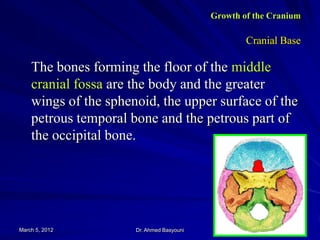
Cranial Base

The bones forming the floor of the middle
cranial fossa are the body and the greater
wings of the sphenoid, the upper surface of the
petrous temporal bone and the petrous part of
the occipital bone.

March 5, 2012

Dr. Ahmed Basyouni

26
Growth of the Cranium

Cranial Base

The bones forming the floor of the posterior
cranial fossa are the occipital in its floor and
the posterior surface of the petrous temporal
bone in front.

March 5, 2012

Dr. Ahmed Basyouni

27
Growth of the Cranium

Bands of cartilage are formed between centers of
ossification called synchondrosis:
– a) Spheno-occipital synchondrosis
– b) Inter-sphenoid synchondrosis
– c) Spheno-ethmoid synchondrosis

March 5, 2012

Dr. Ahmed Basyouni

28
Summary
Craniofacial Complex
Why you should be interested in growth and
development?

Factors influencing the development of
occlusion:
Definitions:
Growth
Development
March 5, 2012

Dr. Ahmed Basyouni

29
Summary

Types of bone formation:
Intramembranous bone
Endochondrial bone
Sites of skull growth:
Growth of the cranium:
Cranial vault.
Cranial base.
March 5, 2012

Dr. Ahmed Basyouni

30
Who Works With Their Minds are
Scientists.
Who Works With Their Hearts are
Artists.
Who Works With Their Hands are
Workers.
Who Works With All of Them are
Orthodontists.
March 5, 2012

Dr. Ahmed Basyouni

31

Growth and Development of Craniofacial Complex I

  • 1.
    Third Lecture Growth andDevelopment of The Craniofacial Complex
  • 2.
    Outlines Craniofacial Complex. Why youshould be interested in growth and development? Factors influencing the development of occlusion: Definitions: Growth Development March 5, 2012 Dr. Ahmed Basyouni 2
  • 3.
    Outlines Types of boneformation: Intramembranous bone Endochondrial bone Sites of skull growth: Growth of the head: Growth of the cranium: Cranial vault. Cranial base. March 5, 2012 Dr. Ahmed Basyouni 3
  • 4.
    Outlines Growth of theface: Growth of the upper face (nasomaxillary complex). Growth of the mandible. How to assess growth. Why do we assess growth. Human head shape. March 5, 2012 Dr. Ahmed Basyouni 4
  • 5.
    The Craniofacial Complex Consistsof: I. Cranium: Cranial vault Cranial base II. Face: Upper face (Nasomaxillary complex) Mandible March 5, 2012 Dr. Ahmed Basyouni 5
  • 6.
    Why you shouldbe interested in growth and development? 1. Knowledge of general and facial growth provides a background of the etiology and development of malocclusion. 2. As observer of the growing child all dentists should be able to identify abnormal or unusual skeletal growth patterns. 3. The dentist should be able to identify abnormal occlusal development at an early stage in order to undertake suitable interceptive orthodontic treatment. March 5, 2012 Dr. Ahmed Basyouni 6
  • 7.
    Why you shouldbe interested in growth and development? 4. Poorly timed extraction (early or delayed loss) performed by dentist during growth, cause malocclusion. 5. Many malocclusion are due to skeletal discrepancies between the jaws (maxilla and mandible) due to improper differential growth of the jaws. 6. Orthodontic treatment may make use of high growth rates attained during puberty “Growth modification”. 7. Orthognathic surgery is considered only after facial growth has been completed. 8. Growth effects have long term effects on the stability of the occlusion after treatment. March 5, 2012 Dr. Ahmed Basyouni 7
  • 8.
    Factors influencing the developmentof occlusion: 1. Bone growth & development. 2. Soft tissue morphology & behavior. 3. The relationship of size of dentition to size of dental arch. 4. Forces of occlusion. 5. Skeletal pattern. March 5, 2012 Dr. Ahmed Basyouni 8
  • 9.
    Definitions Growth: It isa physiochemical process by which an organism becomes larger. Development: It is sequence of changes from fertilization of the ovum to maturity, It is related to cell division, differentiation, and organization up to maturity. March 5, 2012 Dr. Ahmed Basyouni 9
  • 10.
    The Growing Face Atbirth, the largest to smallest dimensions of the face are width, height and depth. Postnatally, the face grows most rapidly in depth, followed by height, with slowest rate of growth being found in width. March 5, 2012 Dr. Ahmed Basyouni 10
  • 11.
    The Growing Face 8months, 6 y, 8 y and 20 y old March 5, 2012 Dr. Ahmed Basyouni 11
  • 12.
    Changes in OverallBody Proportions 12% 25% 50% Cephalocaudal Growth Gradient: means increasing growth rate from head to feet. March 5, 2012 Dr. Ahmed Basyouni 12
  • 13.
    Not all tissuesystems of the body grow at the same rate or mature at the same time Scammon’s Curve: Growth curves of four major tissue systems. March 5, 2012 Dr. Ahmed Basyouni 13
  • 14.
    At Birth: Infant’s Face/ head = 1/8 due to the advanced state of brain growth. In Adults: Face / head = 1/3 to 1/2 due to postnatal facial growth. March 5, 2012 Dr. Ahmed Basyouni 14
  • 15.
    Types of Boneformation Bone is mesodermal in origin: The mesenchymal C. T. would be differentiated into: Mesenchymal C. T. Mucous membrane Cartilage (Fibrous C.T.) Bone formed from fibrous C.T. is called Bone formed from cartilage is called Intramembranous bone Endochondrial bone March 5, 2012 Dr. Ahmed Basyouni 15
  • 16.
    Intramembranous bone: – bysecretion of bone matrix directly within C.T. without any intermediate formation of cartilage – Through the activity of cells in the periosteum – Cranial vault, face (Mx & body of Md) and the clavicles. March 5, 2012 Dr. Ahmed Basyouni 16
  • 17.
    Endochondrial bone: – Cartilageis replaced by bone – Cranial base, Md condyle Epiphyseal plate Proliferating cartilage March 5, 2012 Dr. Ahmed Basyouni 17
  • 18.
    Sites of SkullGrowth Sutural growth Surface apposition and remodeling resorption Growth of the contained organs as the brain, eye balls, and the tongue March 5, 2012 Dr. Ahmed Basyouni 18
  • 19.
    Principles of Growth •Resorption •Apposition •Surfaceremodeling of a bone in the opposite direction to that in which it is being translated by growth of adjacent structures March 5, 2012 Dr. Ahmed Basyouni 19
  • 20.
    Theories of CraniofacialGrowth Classical: bone growth is primary, soft tissues adjust to the growth of the bones. Functional matrix: soft tissue functional demands are primary, bones grow in response to functional demands. March 5, 2012 Dr. Ahmed Basyouni 20
  • 21.
    Growth of theHead Growth of the cranium: a) Cranial vault {completed at 8 years} Intramembranous b) Cranial base { Anterior C B at 10 years & Posterior C B at 20 years} Endochondrial March 5, 2012 Dr. Ahmed Basyouni 21
  • 22.
    Growth of theHead Growth of the Face: a) Upper face (Nasomaxillary complex) {completed at 16-18 years} Intramembranous b) Mandible {completed at 20-25 years} Mixed March 5, 2012 Dr. Ahmed Basyouni 22
  • 23.
    Growth of theCranium Cranial vault is made up of frontal bone, the two parietals, squamous part of the temporal bone and squamous part of the occipital bone. All intramembranous, and separated by sutures. March 5, 2012 Dr. Ahmed Basyouni 23
  • 24.
    Growth of theCranium Cranial vault • Apposition of new bones at the cranial sutures, & periosteal activity (remodeling) due to the pressure from the growing brain. March 5, 2012 Dr. Ahmed Basyouni 24
  • 25.
    Growth of theCranium Cranial Base is made of midline base and three cranial fossae. The bones forming the floor of the anterior cranial fossa are the orbital plates of the frontal bone, the cribriform plates of the ethmoid and the lesser wings of the sphenoid. March 5, 2012 Dr. Ahmed Basyouni 25
  • 26.
    Growth of theCranium Cranial Base The bones forming the floor of the middle cranial fossa are the body and the greater wings of the sphenoid, the upper surface of the petrous temporal bone and the petrous part of the occipital bone. March 5, 2012 Dr. Ahmed Basyouni 26
  • 27.
    Growth of theCranium Cranial Base The bones forming the floor of the posterior cranial fossa are the occipital in its floor and the posterior surface of the petrous temporal bone in front. March 5, 2012 Dr. Ahmed Basyouni 27
  • 28.
    Growth of theCranium Bands of cartilage are formed between centers of ossification called synchondrosis: – a) Spheno-occipital synchondrosis – b) Inter-sphenoid synchondrosis – c) Spheno-ethmoid synchondrosis March 5, 2012 Dr. Ahmed Basyouni 28
  • 29.
    Summary Craniofacial Complex Why youshould be interested in growth and development? Factors influencing the development of occlusion: Definitions: Growth Development March 5, 2012 Dr. Ahmed Basyouni 29
  • 30.
    Summary Types of boneformation: Intramembranous bone Endochondrial bone Sites of skull growth: Growth of the cranium: Cranial vault. Cranial base. March 5, 2012 Dr. Ahmed Basyouni 30
  • 31.
    Who Works WithTheir Minds are Scientists. Who Works With Their Hearts are Artists. Who Works With Their Hands are Workers. Who Works With All of Them are Orthodontists. March 5, 2012 Dr. Ahmed Basyouni 31