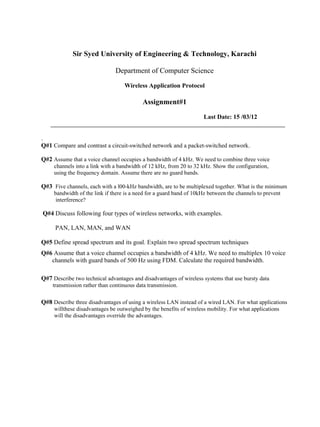
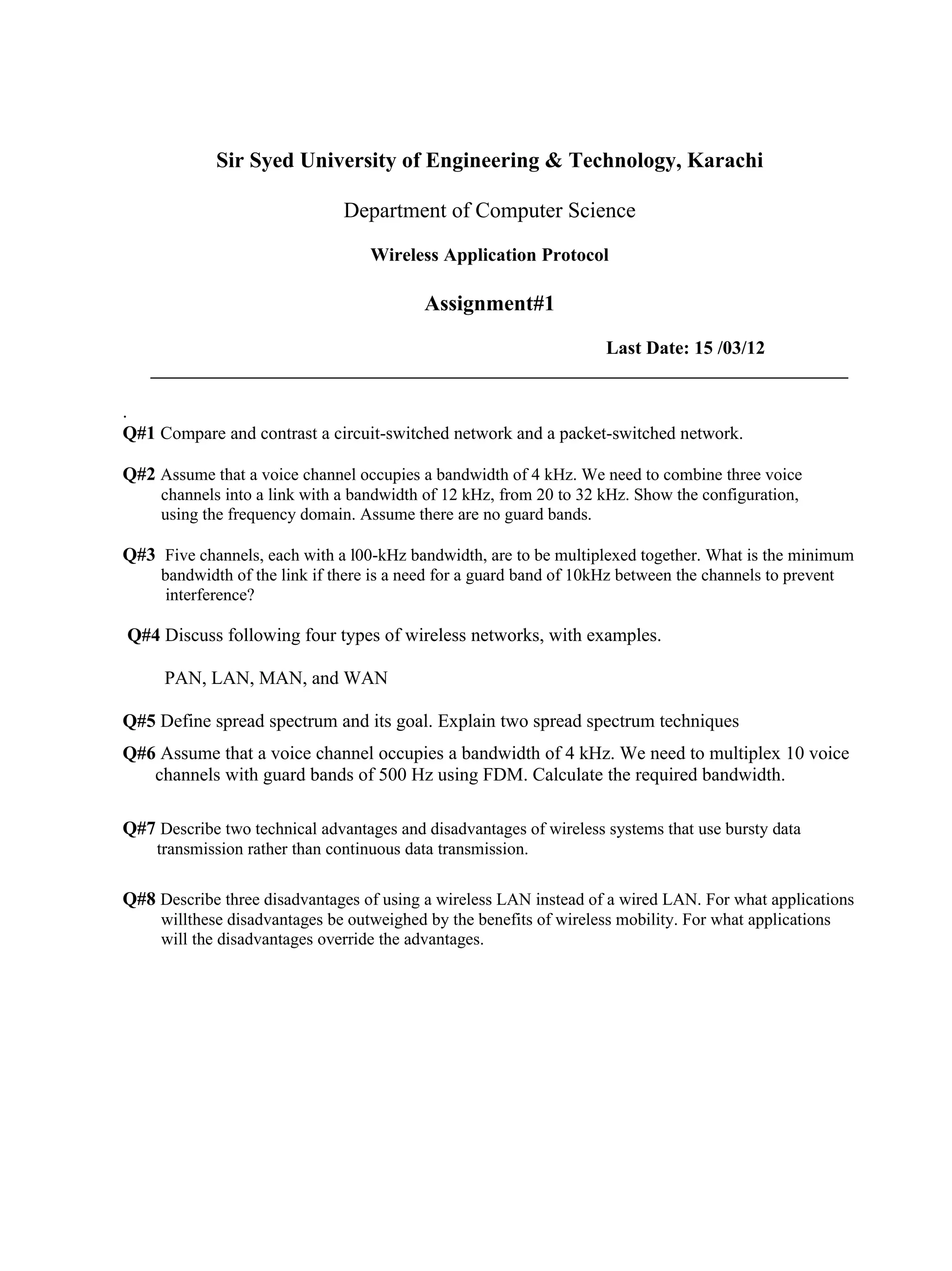
Sir Syed University of Engineering & Technology, Karachi

                               Department of Computer Science

                                   Wireless Application Protocol

                                           Assignment#1

                                                      Last Date: 15 /03/12
   ______________________________________________________________________________

.
Q#1 Compare and contrast a circuit-switched network and a packet-switched network.

Q#2 Assume that a voice channel occupies a bandwidth of 4 kHz. We need to combine three voice
     channels into a link with a bandwidth of 12 kHz, from 20 to 32 kHz. Show the configuration,
     using the frequency domain. Assume there are no guard bands.

Q#3 Five channels, each with a l00-kHz bandwidth, are to be multiplexed together. What is the minimum
     bandwidth of the link if there is a need for a guard band of 10kHz between the channels to prevent
      interference?

Q#4 Discuss following four types of wireless networks, with examples.

     PAN, LAN, MAN, and WAN

Q#5 Define spread spectrum and its goal. Explain two spread spectrum techniques
Q#6 Assume that a voice channel occupies a bandwidth of 4 kHz. We need to multiplex 10 voice
   channels with guard bands of 500 Hz using FDM. Calculate the required bandwidth.

Q#7 Describe two technical advantages and disadvantages of wireless systems that use bursty data
    transmission rather than continuous data transmission.

Q#8 Describe three disadvantages of using a wireless LAN instead of a wired LAN. For what applications
     willthese disadvantages be outweighed by the benefits of wireless mobility. For what applications
     will the disadvantages override the advantages.

Assigments2009

  • 1.
    Sir Syed Universityof Engineering & Technology, Karachi Department of Computer Science Wireless Application Protocol Assignment#1 Last Date: 15 /03/12 ______________________________________________________________________________ . Q#1 Compare and contrast a circuit-switched network and a packet-switched network. Q#2 Assume that a voice channel occupies a bandwidth of 4 kHz. We need to combine three voice channels into a link with a bandwidth of 12 kHz, from 20 to 32 kHz. Show the configuration, using the frequency domain. Assume there are no guard bands. Q#3 Five channels, each with a l00-kHz bandwidth, are to be multiplexed together. What is the minimum bandwidth of the link if there is a need for a guard band of 10kHz between the channels to prevent interference? Q#4 Discuss following four types of wireless networks, with examples. PAN, LAN, MAN, and WAN Q#5 Define spread spectrum and its goal. Explain two spread spectrum techniques Q#6 Assume that a voice channel occupies a bandwidth of 4 kHz. We need to multiplex 10 voice channels with guard bands of 500 Hz using FDM. Calculate the required bandwidth. Q#7 Describe two technical advantages and disadvantages of wireless systems that use bursty data transmission rather than continuous data transmission. Q#8 Describe three disadvantages of using a wireless LAN instead of a wired LAN. For what applications willthese disadvantages be outweighed by the benefits of wireless mobility. For what applications will the disadvantages override the advantages.