Chapter 3
The Cellular Concept - System Design
Fundamentals
Introduction
cell system
Frequency Reuse
Channel Assignment Strategies
Handoff Strategies
Interference and System Capacity
Improving Capacity In Cellular Systems
Older System
• Achieve a large coverage area by using a
simple, high powered transmitter.
• Put BS on top of mountains or tall towers,
so that it could provide coverage for
a large area.
• The next BS was so far away that
interference was not an issue.
• Severely limit the number of users that
could communicate simultaneously.
• Noise-limited system with few users.
• The Bell mobile system in New York City in the 1970s could
only support a maximum of twelve simultaneous calls over a
thousand square miles.
• The number of simultaneous calls a mobile wireless system
can accommodate is essentially determined by the total
spectral allocation for that system and the bandwidth
required for transmitting signals used in handling a call.
Example
• Using a typical analog system, each channel needs to have a
bandwidth of around 25 kHz to enable sufficient audio
quality to be carried, as well as allowing for a guard band
between adjacent signals to ensure there are no undue levels
of interference. Using this concept, it is possible to
accommodate only forty users in a frequency band 1-MHz
wide. Even if 100 MHz were allocated to the system, this
would enable only 4000 users to have access to the system.
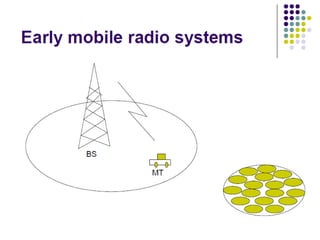
older (Early) mobile radio systems
• A single high powered
transmitter (single cell)
• Large coverage area
• Low frequency resource utility
• Low user capacity
The cellular concept
• A major breakthrough in solving the problem of
spectral congestion and user capacity
• Many low power transmitters (small cells)
• Each cell covers only a small portion of the service
area.
• Each base station is allocated a portion of the total
number of Channels
• Nearby base stations are assigned different groups
of channels so that the interference between base
stations is minimized
Today cellular systems have millions
of subscribers, and therefore a far
more efficient method of using the
available spectrum is needed.
The concept of cells was 1st proposed
as early as 1947 by Bell Laboratories in
the US, with a detailed proposal for a
“High-Capacity Mobile Telephone
System" incorporating the cellular
concept submitted by Bell Laboratories to
the FCC in 1971.
The 1st AMPS system was deployed in
Chicago in 1983.
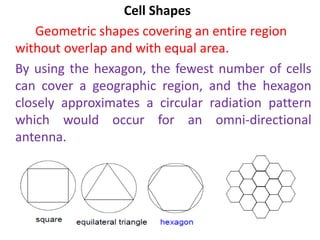
Cell Shapes
Geometric shapes covering an entire region
without overlap and with equal area.
By using the hexagon, the fewest number of cells
can cover a geographic region, and the hexagon
closely approximates a circular radiation pattern
which would occur for an omni-directional
antenna.
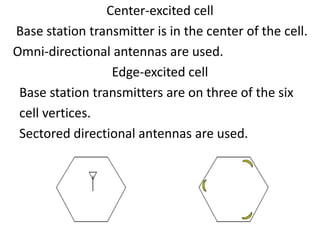
Center-excited cell
Base station transmitter is in the center of the cell.
Omni-directional antennas are used.
Edge-excited cell
Base station transmitters are on three of the six
cell vertices.
Sectored directional antennas are used.
• We use hexagonal cell shape as a simplistic
model of the radio coverage for each base
station.
• Universally adopted since the hexagon permits easy
and manageable analysis of a cellular system.
• The actual radio coverage of a cell is known as the
footprint and is determined from field
measurement
• In reality, it is not possible to define exactly the
edge of a cell. The signal strength gradually reduces,
and towards the edge of the cell performance falls.
• As the mobiles themselves also have different levels
of sensitivity, this adds a further sensitivity of the
edge of the cell.
• It is therefore impossible to have a sharp cut-o
between cells. In some areas they may overlap,
whereas in others there will be a “hole" in coverage.
• Although the real footprint is amorphous in nature,
a regular cell shape is needed for systematic system
design and adaptation for future growth.nts or
propagation prediction models.
Why hexagon?
• Adjacent circles cannot be overlaid upon a map
without leaving gaps or creating overlapping
regions.
• When considering geometric shapes which cover
an entire region without overlap and with equal
area, there are three sensible choices: a square, an
equilateral triangle, and a hexagon.
• A cell must be designed to serve the weakest
mobiles within the footprint, and these are
typically located at the edge of the cell.
For a given distance between the center of a
polygon and its farthest perimeter points, the
hexagon has the largest area of the three.
• By using the hexagon geometry, the fewest
number of cells can cover a geographic region
Closely approximate a circular radiation pattern
which would occur for an omnidirectional base
station antenna and free space propagation.
• Permit easy and manageable analysis of a cellular
system.
Types of cells
• macrocell – their coverage is large (aprox. 6 miles in
diameter); used in remote areas, high-power transmitters and
receivers are used
• microcell – their coverage is small (half a mile in diameter)
and are used in urban zones; low-powered transmitters and
receivers are used to avoid interference with cells in another
clusters
Cellular systems generations
• 1G (first generation) – voice-oriented systems based on analog
technology; ex.: Advanced Mobile Phone Systems (AMPS) and
cordless systems
• 2G (second generation) - voice-oriented systems based on
digital technology; more efficient and used less spectrum than
1G; ex.: Global System for Mobile (GSM) and US Time Division
Multiple Access (US-TDMA)
• 3G (third generation) – high-speed voice-oriented systems
integrated with data services; ex.: General Packet Radio
Service (GPRS), Code Division Multiple Access (CDMA)
• 4G (fourth generation) – WiMax, LTE, based on Internet
protocol networks and will provide voice, data and multimedia
service to subscribers
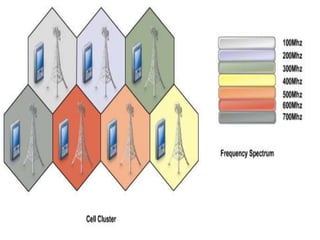
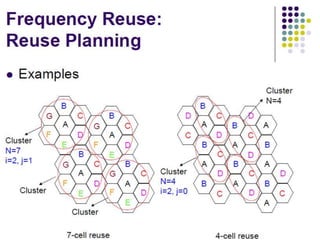
Frequency Reuse
• A service area is split into small geographic areas,
called cells.
• Each cellular base station is allocated a group of
radio channels.
• Base stations in adjacent cells are assigned
different channel groups.
• By limiting the coverage area of a base station, the
same group of channels may be reused by different
cells far away.
• The design process of selecting and allocating
channel groups for all of the cellular base stations
within a system is called frequency reuse or
frequency planning.
Final wc
Final wc

Final wc

  • 1.
    Chapter 3 The CellularConcept - System Design Fundamentals
  • 2.
    Introduction cell system Frequency Reuse ChannelAssignment Strategies Handoff Strategies Interference and System Capacity Improving Capacity In Cellular Systems
  • 3.
    Older System • Achievea large coverage area by using a simple, high powered transmitter. • Put BS on top of mountains or tall towers, so that it could provide coverage for a large area. • The next BS was so far away that interference was not an issue. • Severely limit the number of users that could communicate simultaneously. • Noise-limited system with few users.
  • 4.
    • The Bellmobile system in New York City in the 1970s could only support a maximum of twelve simultaneous calls over a thousand square miles. • The number of simultaneous calls a mobile wireless system can accommodate is essentially determined by the total spectral allocation for that system and the bandwidth required for transmitting signals used in handling a call. Example • Using a typical analog system, each channel needs to have a bandwidth of around 25 kHz to enable sufficient audio quality to be carried, as well as allowing for a guard band between adjacent signals to ensure there are no undue levels of interference. Using this concept, it is possible to accommodate only forty users in a frequency band 1-MHz wide. Even if 100 MHz were allocated to the system, this would enable only 4000 users to have access to the system.
  • 6.
    older (Early) mobileradio systems • A single high powered transmitter (single cell) • Large coverage area • Low frequency resource utility • Low user capacity
  • 7.
    The cellular concept •A major breakthrough in solving the problem of spectral congestion and user capacity • Many low power transmitters (small cells) • Each cell covers only a small portion of the service area. • Each base station is allocated a portion of the total number of Channels • Nearby base stations are assigned different groups of channels so that the interference between base stations is minimized
  • 8.
    Today cellular systemshave millions of subscribers, and therefore a far more efficient method of using the available spectrum is needed.
  • 9.
    The concept ofcells was 1st proposed as early as 1947 by Bell Laboratories in the US, with a detailed proposal for a “High-Capacity Mobile Telephone System" incorporating the cellular concept submitted by Bell Laboratories to the FCC in 1971. The 1st AMPS system was deployed in Chicago in 1983.
  • 10.
    Cell Shapes Geometric shapescovering an entire region without overlap and with equal area. By using the hexagon, the fewest number of cells can cover a geographic region, and the hexagon closely approximates a circular radiation pattern which would occur for an omni-directional antenna.
  • 11.
    Center-excited cell Base stationtransmitter is in the center of the cell. Omni-directional antennas are used. Edge-excited cell Base station transmitters are on three of the six cell vertices. Sectored directional antennas are used.
  • 12.
    • We usehexagonal cell shape as a simplistic model of the radio coverage for each base station. • Universally adopted since the hexagon permits easy and manageable analysis of a cellular system. • The actual radio coverage of a cell is known as the footprint and is determined from field measurement • In reality, it is not possible to define exactly the edge of a cell. The signal strength gradually reduces, and towards the edge of the cell performance falls.
  • 13.
    • As themobiles themselves also have different levels of sensitivity, this adds a further sensitivity of the edge of the cell. • It is therefore impossible to have a sharp cut-o between cells. In some areas they may overlap, whereas in others there will be a “hole" in coverage. • Although the real footprint is amorphous in nature, a regular cell shape is needed for systematic system design and adaptation for future growth.nts or propagation prediction models.
  • 14.
    Why hexagon? • Adjacentcircles cannot be overlaid upon a map without leaving gaps or creating overlapping regions. • When considering geometric shapes which cover an entire region without overlap and with equal area, there are three sensible choices: a square, an equilateral triangle, and a hexagon. • A cell must be designed to serve the weakest mobiles within the footprint, and these are typically located at the edge of the cell.
  • 15.
    For a givendistance between the center of a polygon and its farthest perimeter points, the hexagon has the largest area of the three. • By using the hexagon geometry, the fewest number of cells can cover a geographic region Closely approximate a circular radiation pattern which would occur for an omnidirectional base station antenna and free space propagation. • Permit easy and manageable analysis of a cellular system.
  • 17.
    Types of cells •macrocell – their coverage is large (aprox. 6 miles in diameter); used in remote areas, high-power transmitters and receivers are used • microcell – their coverage is small (half a mile in diameter) and are used in urban zones; low-powered transmitters and receivers are used to avoid interference with cells in another clusters
  • 18.
    Cellular systems generations •1G (first generation) – voice-oriented systems based on analog technology; ex.: Advanced Mobile Phone Systems (AMPS) and cordless systems • 2G (second generation) - voice-oriented systems based on digital technology; more efficient and used less spectrum than 1G; ex.: Global System for Mobile (GSM) and US Time Division Multiple Access (US-TDMA) • 3G (third generation) – high-speed voice-oriented systems integrated with data services; ex.: General Packet Radio Service (GPRS), Code Division Multiple Access (CDMA) • 4G (fourth generation) – WiMax, LTE, based on Internet protocol networks and will provide voice, data and multimedia service to subscribers
  • 19.
    Frequency Reuse • Aservice area is split into small geographic areas, called cells. • Each cellular base station is allocated a group of radio channels. • Base stations in adjacent cells are assigned different channel groups. • By limiting the coverage area of a base station, the same group of channels may be reused by different cells far away. • The design process of selecting and allocating channel groups for all of the cellular base stations within a system is called frequency reuse or frequency planning.