Topic
Subculture and its
importance
Subculture
• In biology, a subculture is a
new cell or microbiological culture made by
transferring some or all cells from a previous
culture to fresh growth medium. This action is
called sub culturing or passaging the cells.
• Subculture is used to prolong the life and/or
expand the number of cells or microorganisms
in the culture.
Importance/Role
• microorganisms cannot be held in culture for
long time due to the gradual rise
in toxic metabolites, use of nutrients and
increase in cell number due to growth.
• Subculture is therefore used to produce a new
culture with a lower density of cells than the
originating culture, fresh nutrients and no toxic
metabolites.
• Subculture is important for both proliferating
(e.g. a microorganism like E. coli) and non-
proliferating (e.g. white blood cells) cells.
• Typically, subculture is from a culture of a
certain volume into fresh growth medium of
equal volume, this allows long-term
maintenance of the cell line (culture).
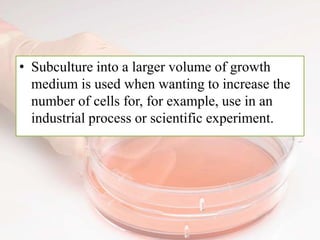
• Subculture into a larger volume of growth
medium is used when wanting to increase the
number of cells for, for example, use in an
industrial process or scientific experiment.
Culture medium
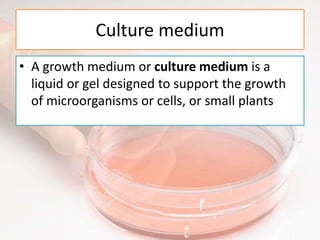
• A growth medium or culture medium is a
liquid or gel designed to support the growth
of microorganisms or cells, or small plants
Components of Culture medium
• Nutrients: proteins/peptides/amino-acids.
• Energy: carbohydrates.
• Essential metals and minerals: calcium, magnesium,
iron, etc.
• Buffering agents: phosphates, acetates etc.
• Indicators for pH change: phenol red, bromo-cresol
purple etc.
• Selective agents: chemicals, antimicrobial agents.
• Gelling agent: usually agar.
• Vitamins
Passage number
• It is often important to record the approximate
number of divisions cells have had in culture
by recording the number of passages or
subcultures.
• In the case of plant tissue cells somaclonal
variation may arise over long periods in
culture. Similarly in mammalian cell
lines chromosomal aberrations have a
tendency to increase over time.
• For microorganisms (contaminations) there is
a tendency to adapt to culture conditions,
which is rarely quite like the microorganisms
in natural environment, which can alter their
biology
Protocols for passaging or sub
culturing
• The protocol for sub culturing cells depends
heavily on the properties of the cells involved.
• Non-adherent cells
• Adherent cells
Non-adherent cells
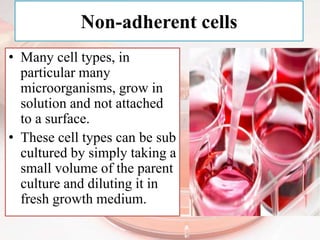
• Many cell types, in
particular many
microorganisms, grow in
solution and not attached
to a surface.
• These cell types can be sub
cultured by simply taking a
small volume of the parent
culture and diluting it in
fresh growth medium.
• Cell density in these cultures is normally
measured in cells per milliliter for large
eukaryotic cells.
• The cells will often have a preferred range of
densities for optimal growth and subculture
will normally try to keep the cells in this range.
Adherent cells
• Adherent cells, for example many mammalian
cell lines, grow attached to a surface such as
the bottom of the culture flask. These cell
types have to be detached from the surface
before they can be sub cultured.
• For subculture cells may be detached by one of
several methods including
• Trypsin EDTA (Ethylenediaminetetraacetic
Acid) treatment to break down the proteins
responsible for surface adherence,
or
• mechanical methods like repeated washing or
use of a cell scraper.
• The detached cells are then re suspended in
fresh growth medium and allowed to settle
back onto their growth surface.
Cell scrapers and cell lifters
Subculturing

Subculturing

  • 1.
  • 2.
    Subculture • In biology,a subculture is a new cell or microbiological culture made by transferring some or all cells from a previous culture to fresh growth medium. This action is called sub culturing or passaging the cells. • Subculture is used to prolong the life and/or expand the number of cells or microorganisms in the culture.
  • 3.
    Importance/Role • microorganisms cannotbe held in culture for long time due to the gradual rise in toxic metabolites, use of nutrients and increase in cell number due to growth. • Subculture is therefore used to produce a new culture with a lower density of cells than the originating culture, fresh nutrients and no toxic metabolites.
  • 4.
    • Subculture isimportant for both proliferating (e.g. a microorganism like E. coli) and non- proliferating (e.g. white blood cells) cells. • Typically, subculture is from a culture of a certain volume into fresh growth medium of equal volume, this allows long-term maintenance of the cell line (culture).
  • 5.
    • Subculture intoa larger volume of growth medium is used when wanting to increase the number of cells for, for example, use in an industrial process or scientific experiment.
  • 6.
    Culture medium • Agrowth medium or culture medium is a liquid or gel designed to support the growth of microorganisms or cells, or small plants
  • 7.
    Components of Culturemedium • Nutrients: proteins/peptides/amino-acids. • Energy: carbohydrates. • Essential metals and minerals: calcium, magnesium, iron, etc. • Buffering agents: phosphates, acetates etc. • Indicators for pH change: phenol red, bromo-cresol purple etc. • Selective agents: chemicals, antimicrobial agents. • Gelling agent: usually agar. • Vitamins
  • 8.
    Passage number • Itis often important to record the approximate number of divisions cells have had in culture by recording the number of passages or subcultures. • In the case of plant tissue cells somaclonal variation may arise over long periods in culture. Similarly in mammalian cell lines chromosomal aberrations have a tendency to increase over time.
  • 9.
    • For microorganisms(contaminations) there is a tendency to adapt to culture conditions, which is rarely quite like the microorganisms in natural environment, which can alter their biology
  • 10.
    Protocols for passagingor sub culturing • The protocol for sub culturing cells depends heavily on the properties of the cells involved. • Non-adherent cells • Adherent cells
  • 11.
    Non-adherent cells • Manycell types, in particular many microorganisms, grow in solution and not attached to a surface. • These cell types can be sub cultured by simply taking a small volume of the parent culture and diluting it in fresh growth medium.
  • 12.
    • Cell densityin these cultures is normally measured in cells per milliliter for large eukaryotic cells. • The cells will often have a preferred range of densities for optimal growth and subculture will normally try to keep the cells in this range.
  • 13.
    Adherent cells • Adherentcells, for example many mammalian cell lines, grow attached to a surface such as the bottom of the culture flask. These cell types have to be detached from the surface before they can be sub cultured.
  • 15.
    • For subculturecells may be detached by one of several methods including • Trypsin EDTA (Ethylenediaminetetraacetic Acid) treatment to break down the proteins responsible for surface adherence,
  • 16.
    or • mechanical methodslike repeated washing or use of a cell scraper. • The detached cells are then re suspended in fresh growth medium and allowed to settle back onto their growth surface.
  • 18.
    Cell scrapers andcell lifters