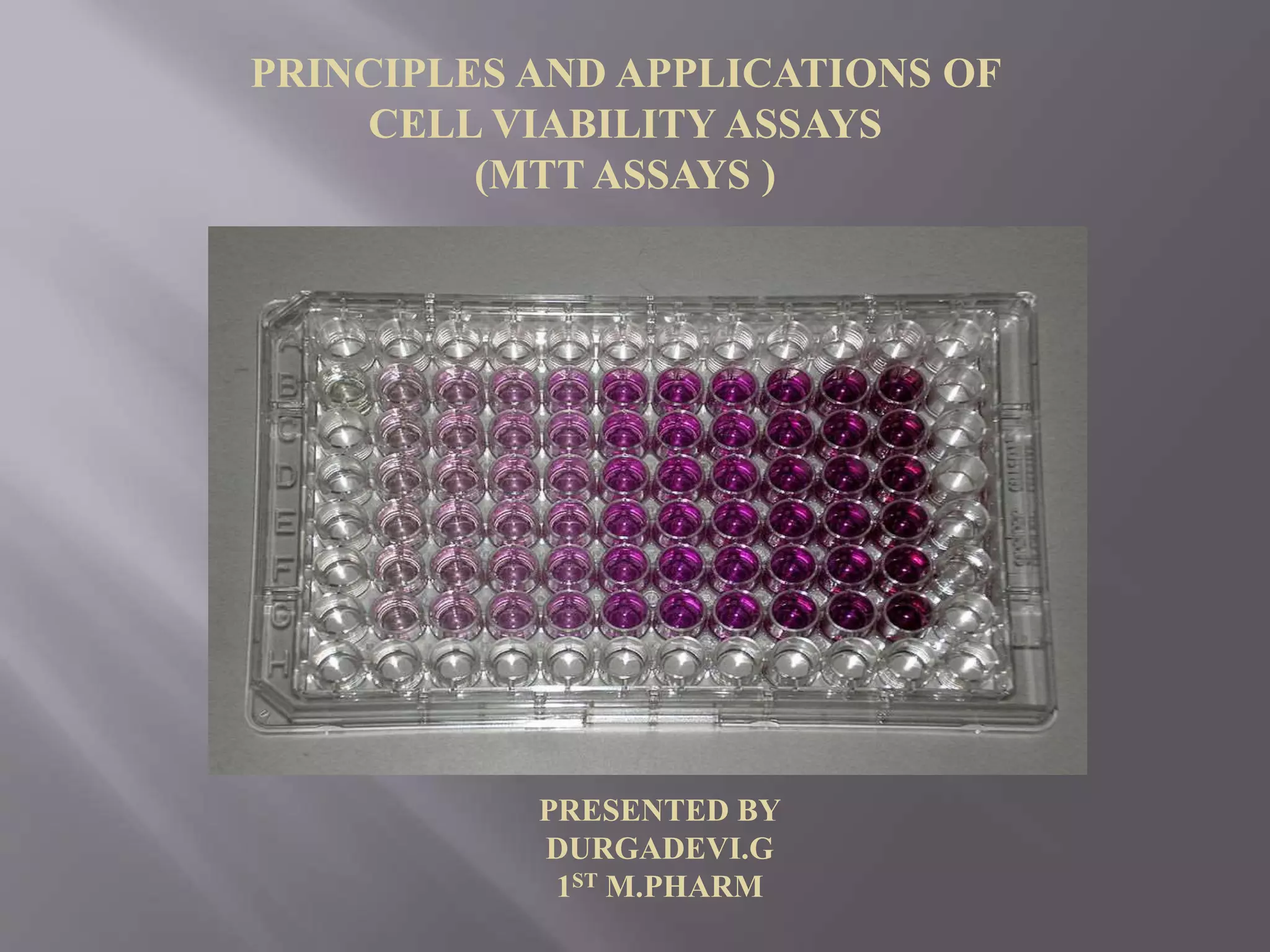
PRINCIPLES AND APPLICATIONS OF
CELL VIABILITY ASSAYS
(MTT ASSAYS )
PRESENTED BY
DURGADEVI.G
1ST M.PHARM
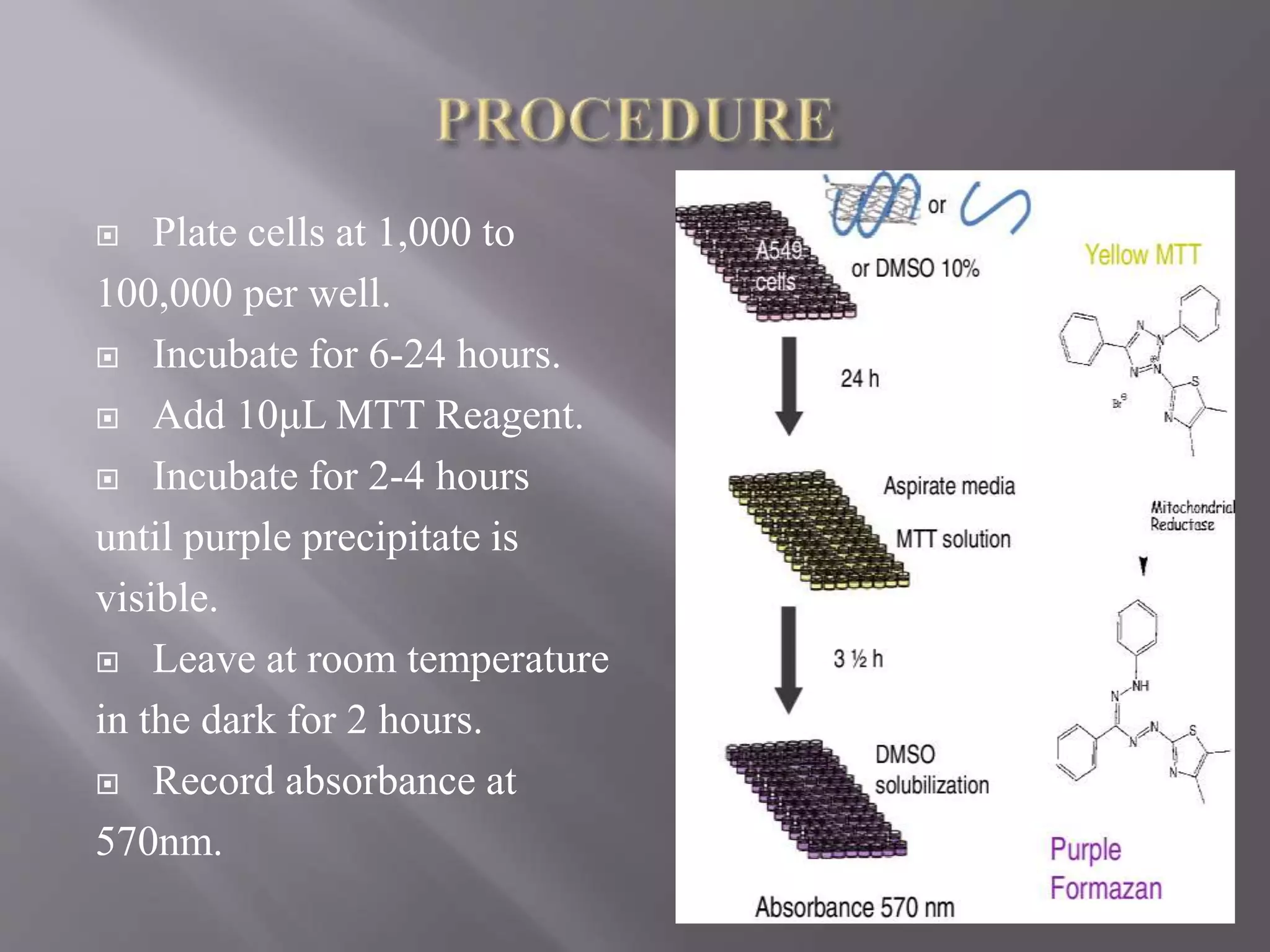
 This is a colorimetric assay that measures the reduction of
yellow 3-(4,5-dimethythiazol- 2-yl)-2,5- diphenyl
tetrazolium bromide (MTT) by mitochondrial succinate
dehydrogenase.
 The MTT enters the cells and passes into the mitochondria
where it is reduced to an insoluble, coloured (dark purple)
formazan product.
 The cells are then solubilized with an organic solvent (e.g.:
Isopropanol /dimethyl sulfoxide[DMSO]) and the released,
solubilized formazan reagent is measured
spectrophotometrically.
 Since reduction of MTT can only occur in metabolically
active cells the level of activity is a measure of the viability
of the cells.
 The MTT Cell Proliferation Assay measures the cell
proliferation rate and conversely, when metabolic events
lead to apoptosis or necrosis, the reduction in cell
viability.
 The number of assay steps has been minimized as much
as possible to expedite sample processing.
 The MTT Reagent yields low background absorbance
values in the absence of cells.
 For each cell type the linear relationship between cell
number and signal produced is established, thus
allowing an accurate quantification of changes in the
rate of cell proliferation.
 MTT is light-sensitive, and should be kept in the dark as
much as possible. It is always a good idea to cover MTT
bottles with foil.
 Make sure you do not contaminate your MTT stock. If it is
green or blue (it should be yellow), you can assume it has
either been contaminated by cells or bacteria, or exposed
to light. If properly looked after and stored at 4°C, your
MTT stock can last up to 18 months.
 Always handle MTT using the appropriate personal
protection equipment, as it is can cause skin and eye
irritation.
 To dissolve formazan crystals, you can use DMSO,
acidified isopropanol, or SDS. Test to find out which
works best for your experiment.
MTT solution:
 5mg/ml MTT in phosphated buffered saline(PBS).
 Solution must be filter sterilized (0.22um filter) after
adding MTT.
 For long term storage keep the MTT solution in -
20°C.
MTT solvent:
 Option1: 400ul HCl 1M, 10ml triton 100%, 90ml
isopropanol.
 Option2: DMSO 100% room temperature.
 Trypsinization or scrapping the cells .
 Resuspend or splitting cells at 96 well plate .
 Check the cell confluency (if 90%-100% of the cell then it is
ready for using)
 100~ 200 µl of desired drugs or compound in each well
(usually 1 compound /drugs should have triplicates)
 Incubate the cells (12~24 hours)
 Dissolve 1mg MTT in 1ml PBS solution then the molar
concentration will be 2.41m M
 In each well add 20 µl MTT reagent and rest 160 µl culture
media and incubate it for 3~4 hours
 Check the cells to see the purple precipitation and the purple
color is clearly visible then discard the media carefully as it
does not drain the cells.
 After discarding media add 100 µl DMSO/ isopropanol.
 Cover it with aluminum foil and mildly shake it for 10 ~15
minutes
 Read plate in fluorescent Reader – measure OD in 570nm
(background wavelength is 630nm)
 Plate cells at 1,000 to
100,000 per well.
 Incubate for 6-24 hours.
 Add 10μL MTT Reagent.
 Incubate for 2-4 hours
until purple precipitate is
visible.
 Leave at room temperature
in the dark for 2 hours.
 Record absorbance at
570nm.
 Absorbance readings should fall between 0.75 and
1.25. If readings are too low, try increasing the
number of cells plated or the incubation time, and
make sure your cell culture conditions are appropriate.
On the other hand, plating too many cells per well will
yield very high absorbance readings, as will
contamination by yeast or bacteria.
 To determine the optimal cell number per well,
prepare and plate serial dilutions of cells in medium
from 106 to 10³ cells/mL. This will help you decide
which number of cells yields appropriate absorbance
values.
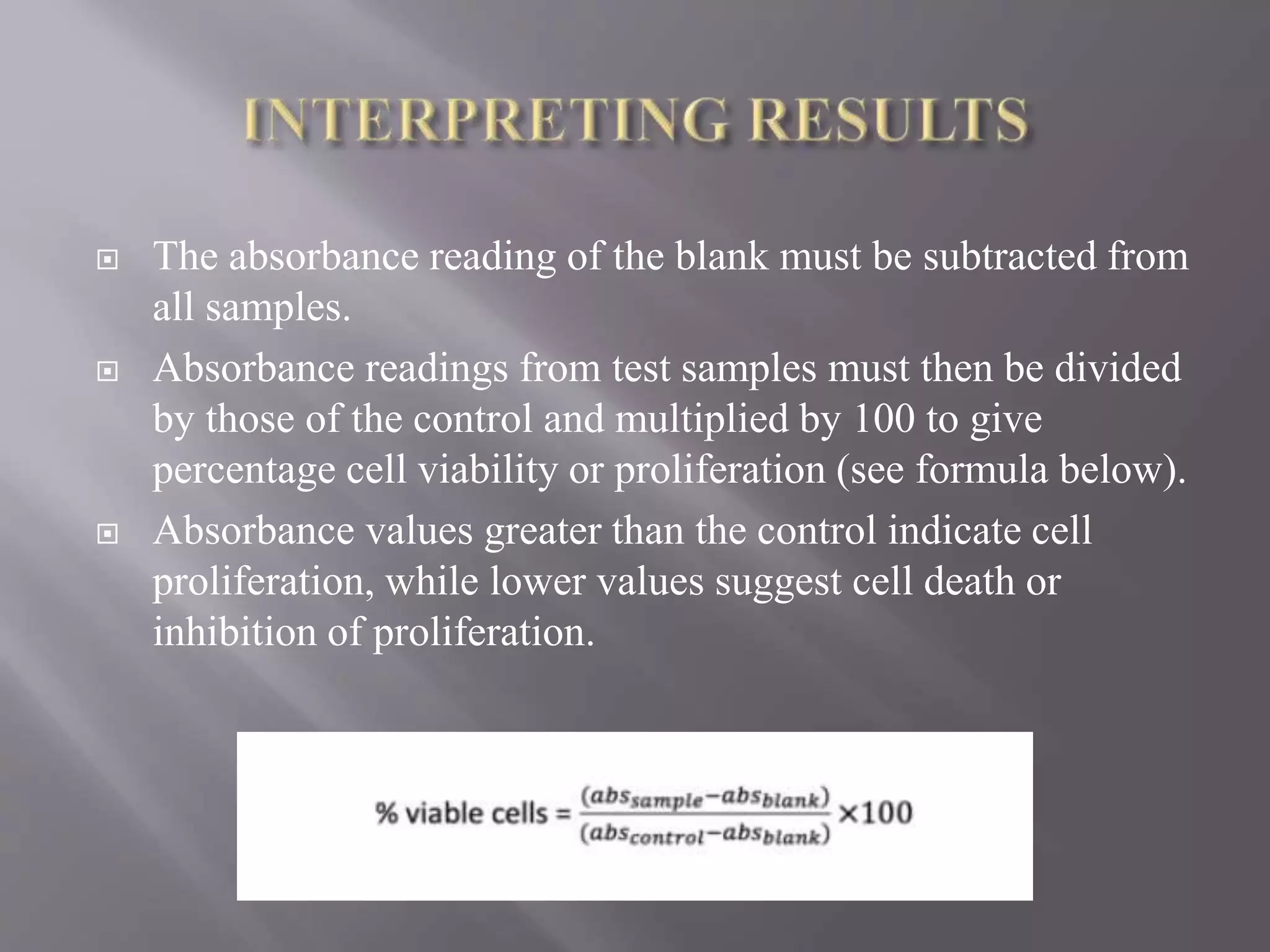
 The absorbance reading of the blank must be subtracted from
all samples.
 Absorbance readings from test samples must then be divided
by those of the control and multiplied by 100 to give
percentage cell viability or proliferation (see formula below).
 Absorbance values greater than the control indicate cell
proliferation, while lower values suggest cell death or
inhibition of proliferation.
 MTT solution is stable when stored frozen.
 Storage at 2-8ᵒC may result in decomposition.
 Microbial contamination will contribute to the cleavage of
MTT and formation of MTT formazan yielding erroneous
results.
 MTT assay must be performed in dark.
 Always include a positive control (untreated cells) and a
blank (well containing medium only), and plate these and
samples in triplicate.
 Always wash cells with PBS before adding MTT in order to
remove dead cells and cellular debris, which could give
inaccurate results.
PROBLEMS REMEDIES
MTT Reagent is blue-green Discard it and Store solution in the
dark at 4°C
Blanks give high absorbance readings May be due to contamination. Use
aseptic techniques
Absorbance readings too high Decrease cell density at plating
Replicates have different values Increase accuracy of cell plating, check
accuracy of pipette
Absorbance readings are too low. •Increase cell density at plating.
•Increase incubation time with MTT
reagent or with detergent reagent
•Check that culture conditions are
appropriate. View cells periodically to
check condition.
•Increase time in culture after plating
for cell recovery
 No transfer of the cells; the entire assay is
performed in a single microplate.
 MTT is metabolized by all cells; the assay can be
used with all cell types.
 Inexpensive
 Rapid, versatile, quantitative and highly
reproducible.
 Adaptable to large scale screening, relevant for
most cells.
 Most sensitive and early predictor of toxicity
than LDH and NR assays.
 The sensitivity of an MTT assay is lower than that of fluorescent or luminescent
assays, particularly with cells that do not readily proliferate or cells with low
metabolic activity.
 Furthermore, certain chemical compounds interfere with the reduction of MTT to
formazan and are therefore not easily compatible with MTT assays.
 These include polyphenols, vitamin A, coenzyme A, and DTT (dithiothreitol)
 It should also be noted that both exposure to MTT and formation of formazan
crystals are cytotoxicand cause damaging changes to cellular morphology.
 If performed correctly, an MTT assay is an extremely useful part to many
experiments.
 However, it may not always be the best choice for particular needs. Assay is not
linear over a broad logarithmic cell proliferation range due to the ELISA plate
reader.
 Insoluble reaction product; resolubilization of the reaction product required.
 Cannot take multiple time points in a single assay.
 Cells with low metabolic activity (e.g., lymphocytes) must be used in high
numbers.
 Cell proliferation and activation assay
Examples:in response to growth factors and cytokines.
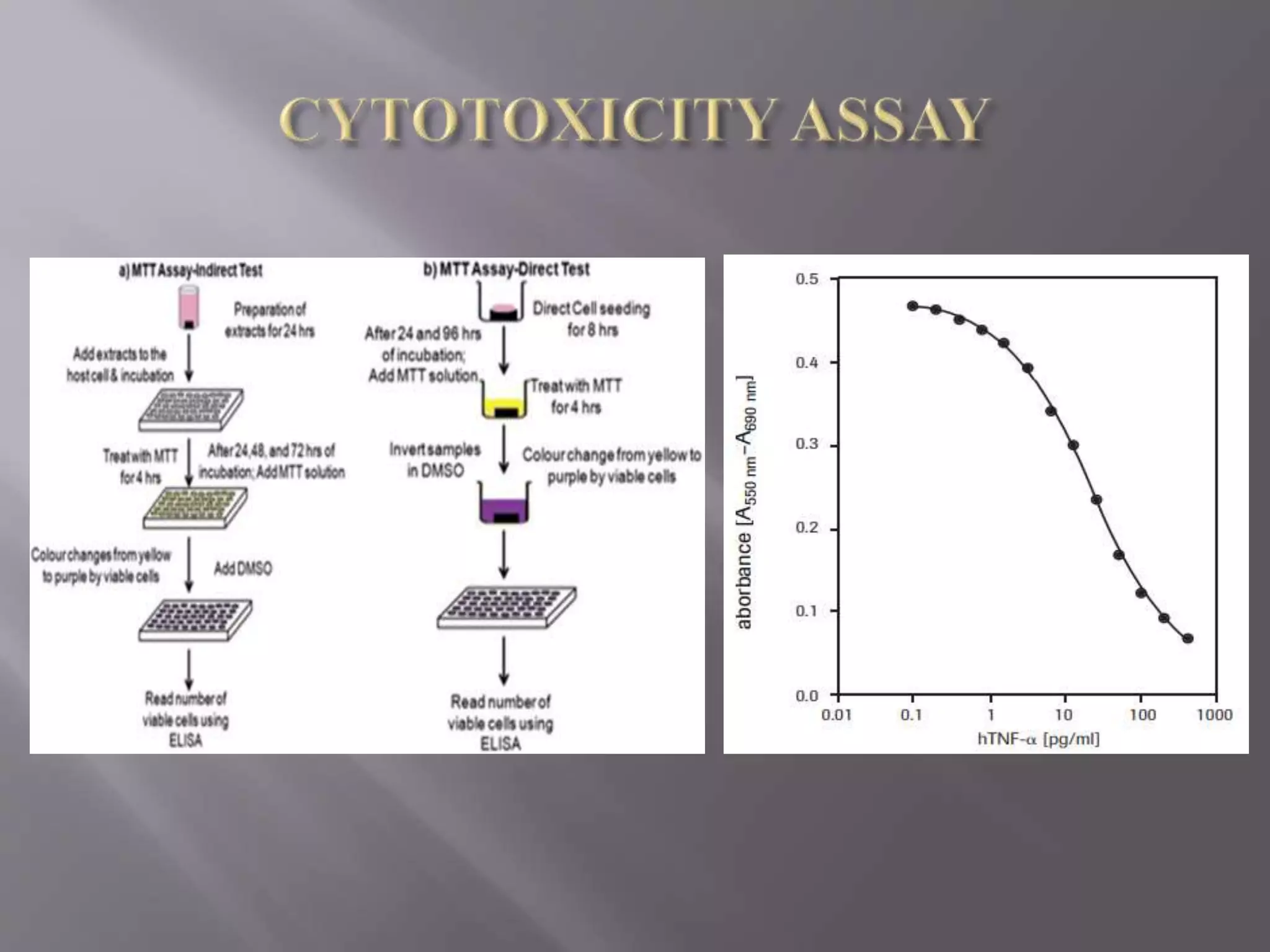
 Cytotoxicity Assay
Examples: quantification of tumor necrosis factor-α or -β effects.
 Drug action, cytotoxic agents and screening other biologically
active compounds.
 Measuring drug sensitivity ex vivo to predict clinical outcome.
 Response to growth factors
 Study of cross resistance between related and unrelated drugs.
 Sensitivity testing of new drugs.
 Drug screening on cell lines and/or patient samples.
 Testing drug combinations on cell lines and/or patient material.
PRINCIPLES AND APPLICATIONS OF CELL VIABILITY ASSAY (MTT ASSAY)

PRINCIPLES AND APPLICATIONS OF CELL VIABILITY ASSAY (MTT ASSAY)

  • 1.
    PRINCIPLES AND APPLICATIONSOF CELL VIABILITY ASSAYS (MTT ASSAYS ) PRESENTED BY DURGADEVI.G 1ST M.PHARM
  • 2.
     This isa colorimetric assay that measures the reduction of yellow 3-(4,5-dimethythiazol- 2-yl)-2,5- diphenyl tetrazolium bromide (MTT) by mitochondrial succinate dehydrogenase.  The MTT enters the cells and passes into the mitochondria where it is reduced to an insoluble, coloured (dark purple) formazan product.
  • 3.
     The cellsare then solubilized with an organic solvent (e.g.: Isopropanol /dimethyl sulfoxide[DMSO]) and the released, solubilized formazan reagent is measured spectrophotometrically.  Since reduction of MTT can only occur in metabolically active cells the level of activity is a measure of the viability of the cells.
  • 4.
     The MTTCell Proliferation Assay measures the cell proliferation rate and conversely, when metabolic events lead to apoptosis or necrosis, the reduction in cell viability.  The number of assay steps has been minimized as much as possible to expedite sample processing.  The MTT Reagent yields low background absorbance values in the absence of cells.  For each cell type the linear relationship between cell number and signal produced is established, thus allowing an accurate quantification of changes in the rate of cell proliferation.
  • 5.
     MTT islight-sensitive, and should be kept in the dark as much as possible. It is always a good idea to cover MTT bottles with foil.  Make sure you do not contaminate your MTT stock. If it is green or blue (it should be yellow), you can assume it has either been contaminated by cells or bacteria, or exposed to light. If properly looked after and stored at 4°C, your MTT stock can last up to 18 months.  Always handle MTT using the appropriate personal protection equipment, as it is can cause skin and eye irritation.  To dissolve formazan crystals, you can use DMSO, acidified isopropanol, or SDS. Test to find out which works best for your experiment.
  • 6.
    MTT solution:  5mg/mlMTT in phosphated buffered saline(PBS).  Solution must be filter sterilized (0.22um filter) after adding MTT.  For long term storage keep the MTT solution in - 20°C. MTT solvent:  Option1: 400ul HCl 1M, 10ml triton 100%, 90ml isopropanol.  Option2: DMSO 100% room temperature.
  • 7.
     Trypsinization orscrapping the cells .  Resuspend or splitting cells at 96 well plate .  Check the cell confluency (if 90%-100% of the cell then it is ready for using)  100~ 200 µl of desired drugs or compound in each well (usually 1 compound /drugs should have triplicates)  Incubate the cells (12~24 hours)  Dissolve 1mg MTT in 1ml PBS solution then the molar concentration will be 2.41m M
  • 8.
     In eachwell add 20 µl MTT reagent and rest 160 µl culture media and incubate it for 3~4 hours  Check the cells to see the purple precipitation and the purple color is clearly visible then discard the media carefully as it does not drain the cells.  After discarding media add 100 µl DMSO/ isopropanol.  Cover it with aluminum foil and mildly shake it for 10 ~15 minutes  Read plate in fluorescent Reader – measure OD in 570nm (background wavelength is 630nm)
  • 9.
     Plate cellsat 1,000 to 100,000 per well.  Incubate for 6-24 hours.  Add 10μL MTT Reagent.  Incubate for 2-4 hours until purple precipitate is visible.  Leave at room temperature in the dark for 2 hours.  Record absorbance at 570nm.
  • 10.
     Absorbance readingsshould fall between 0.75 and 1.25. If readings are too low, try increasing the number of cells plated or the incubation time, and make sure your cell culture conditions are appropriate. On the other hand, plating too many cells per well will yield very high absorbance readings, as will contamination by yeast or bacteria.  To determine the optimal cell number per well, prepare and plate serial dilutions of cells in medium from 106 to 10³ cells/mL. This will help you decide which number of cells yields appropriate absorbance values.
  • 11.
     The absorbancereading of the blank must be subtracted from all samples.  Absorbance readings from test samples must then be divided by those of the control and multiplied by 100 to give percentage cell viability or proliferation (see formula below).  Absorbance values greater than the control indicate cell proliferation, while lower values suggest cell death or inhibition of proliferation.
  • 12.
     MTT solutionis stable when stored frozen.  Storage at 2-8ᵒC may result in decomposition.  Microbial contamination will contribute to the cleavage of MTT and formation of MTT formazan yielding erroneous results.  MTT assay must be performed in dark.  Always include a positive control (untreated cells) and a blank (well containing medium only), and plate these and samples in triplicate.  Always wash cells with PBS before adding MTT in order to remove dead cells and cellular debris, which could give inaccurate results.
  • 13.
    PROBLEMS REMEDIES MTT Reagentis blue-green Discard it and Store solution in the dark at 4°C Blanks give high absorbance readings May be due to contamination. Use aseptic techniques Absorbance readings too high Decrease cell density at plating Replicates have different values Increase accuracy of cell plating, check accuracy of pipette Absorbance readings are too low. •Increase cell density at plating. •Increase incubation time with MTT reagent or with detergent reagent •Check that culture conditions are appropriate. View cells periodically to check condition. •Increase time in culture after plating for cell recovery
  • 15.
     No transferof the cells; the entire assay is performed in a single microplate.  MTT is metabolized by all cells; the assay can be used with all cell types.  Inexpensive  Rapid, versatile, quantitative and highly reproducible.  Adaptable to large scale screening, relevant for most cells.  Most sensitive and early predictor of toxicity than LDH and NR assays.
  • 16.
     The sensitivityof an MTT assay is lower than that of fluorescent or luminescent assays, particularly with cells that do not readily proliferate or cells with low metabolic activity.  Furthermore, certain chemical compounds interfere with the reduction of MTT to formazan and are therefore not easily compatible with MTT assays.  These include polyphenols, vitamin A, coenzyme A, and DTT (dithiothreitol)  It should also be noted that both exposure to MTT and formation of formazan crystals are cytotoxicand cause damaging changes to cellular morphology.  If performed correctly, an MTT assay is an extremely useful part to many experiments.  However, it may not always be the best choice for particular needs. Assay is not linear over a broad logarithmic cell proliferation range due to the ELISA plate reader.  Insoluble reaction product; resolubilization of the reaction product required.  Cannot take multiple time points in a single assay.  Cells with low metabolic activity (e.g., lymphocytes) must be used in high numbers.
  • 17.
     Cell proliferationand activation assay Examples:in response to growth factors and cytokines.  Cytotoxicity Assay Examples: quantification of tumor necrosis factor-α or -β effects.  Drug action, cytotoxic agents and screening other biologically active compounds.  Measuring drug sensitivity ex vivo to predict clinical outcome.  Response to growth factors  Study of cross resistance between related and unrelated drugs.  Sensitivity testing of new drugs.  Drug screening on cell lines and/or patient samples.  Testing drug combinations on cell lines and/or patient material.