R E P O R T E R :
N O V A A . C O R C I E G A
Developmental Biology
I . D E V E L O P M E N T I L L U S T R A T E D I N N E M A T O D E S
I. Developmental Axes
II. Cell-cell interaction and cell fate
I I . D E V E L O P M E N T I L L U S T R A T E D I N M O L L U S K S
I. Developmental Axes
II. Cell-cell interaction and cell fate
I I I . D E V E L O P M E N T I L L U S T R A T E D I N A N N E L I D S
I. Developmental Axes
II. Cell-cell interaction and cell fate
III. Teloblast in annelids as specified by localization of cryptopalsmic
factors
Outline
I V . D E V E L O P M E N T I L L U S T R A T E D I N A N D
E C H I N O D E R M S
I. Developmental Axes
II. Cell-cell interaction and cell fate
Outline
The C. Elegans zygote exhibits rotational
holoblastic cleavage (figure 8.42c). During early
cleavage, each asymmetrical division produces one
founder cell (denoted AB, MS, E, C, and D), which
produces differentiated descendants, and one stem
cell (the P1-P4 lineage). In the first cell division,
the cleavage furrow is located asymmetrically along
the anterior-posterior axis of the egg, closer to
what will be the posterior pole. It forms a founder
cell (AB) and a stem cell (P1).
Development Illustrated in
Nematodes developmental axes
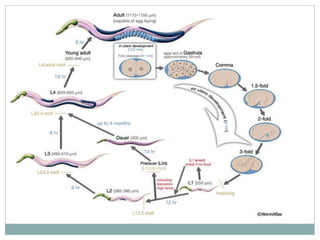
Rotational cleavage of the C. elegans
egg
(A) Side view of adult
hermaphrodite. Sperm
are stored so that a
mature egg must pass
through the sperm on
its way to the vulva.
(B) The gonads. Near
the distal end, the
germ cells undergo
mitosis. As they get
further from the distal
tip, they enter meiosis.
Early meiosis forms
sperm that are stored
in the spermatheca.
Later meioses form
eggs that become
fertilized as they roll
through the
spermatheca.
Rotational cleavage of the C. elegans
egg
(C) Early
development, as
the egg is
fertilized and
moves toward
the vulva. The p-
lineage are stem
cells that will
eventually form
the germ cells.
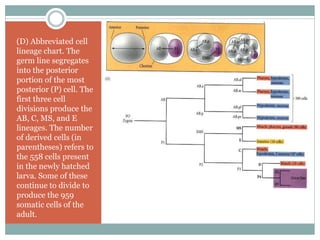
(D) Abbreviated cell
lineage chart. The
germ line segregates
into the posterior
portion of the most
posterior (P) cell. The
first three cell
divisions produce the
AB, C, MS, and E
lineages. The number
of derived cells (in
parentheses) refers to
the 558 cells present
in the newly hatched
larva. Some of these
continue to divide to
produce the 959
somatic cells of the
adult.
Development Illustrated in Nematodes
developmental axes
 The elongated axis of the C. elegans egg defines the
future anterior-posterior axis of the nematode's
body. The decision as to which end will become the
anterior and which the posterior seems to reside with
the position of sperm pronucleus. When it enters the
oocyte cytoplasm, the centriole associated with the
sperm pronucleus initiates cytoplasmic movements
that push the male pronucleus to the nearest end of
the oblong oocyte. This end becomes the posterior
pole (Goldstein and Hird 1996).
Development Illustrated in Nematodes
developmental axes
 A second anterior-posterior asymmetry seen shortly
after fertilization is the migration of the P-
granules. P-granules are ribonucleoprotein
complexes that probably function in specifying the
germ cells. Using fluorescent antibodies to a
component of the P-granules, Strome and Wood
(1983) discovered that shortly after fertilization, the
randomly scattered P-granules move toward the
posterior end of the zygote, so that they enter only
the blastomere (P1) formed from the posterior
cytoplasm (Figure 8.43).
Segregation of the P-
granules into the germ
line lineage of the C.
elegans embryo. The left
column shows the cell
nuclei (the DNA is
stained blue by Hoescht
dye), while the right
column shows the same
embryos stained for P-
granules. At each
successive division, the
P-granules enter into the
P-lineage blastomere,
the one that will form
the germ cells.
(Photographs courtesy of
S. Strome.)
Cell-cell interaction and cell fate
 The determination of the P1 lineages appears to be
autonomous, with the cell fates determined by internal
cytoplasmic factors rather than by interactions with
neighboring cells. It is thought that protein factors might
determine cell fate by entering the nuclei of the
appropriate blastomeres and activating or repressing
specific fate-determining genes.
 Conditional specification can be seen in the development
of the endoderm cell lineage. At the 4-cell stage, the EMS
cell requires a signal from its neighbor (and sister), the
P2 blastomere.
Cell-cell signaling in
the 4-cell embryo
of C. elegans. The P2
cell produces two
signals: (1) the
juxtacrine protein
APX-1 (Delta), which
is bound by GLP-1
(Notch) on the ABp
cell, and (2) the
paracrine protein
MOM-2 (Wnt), which
is bound by the
MOM-5 (Frizzled)
protein on the EMS
cell.
Spiral holoblastic cleavage is characteristic of several animal
groups, including annelid worms, some flatworms, and most
molluscs. It differs from radial cleavage in numerous ways. First,
the cleavage planes are not parallel or perpendicular to the
animal-vegetal axis of the egg; rather, cleavage is at oblique
angles, forming a “spiral” arrangement of daughter blastomeres .
Second, the cells touch one another at more places than do
those of radially cleaving embryos. In fact, they assume the most
thermodynamically stable packing orientation, much like that of
adjacent soap bubbles.
Development Illustrated in
Mollusks:
Developmental Axes
Third, spirally cleaving embryos usually undergo fewer
divisions before they begin gastrulation, making it possible to
follow the fate of each cell of the blastula. When the fates of
the individual blastomeres from annelid, flatworm, and mollusc
embryos were compared, many of the same cells were seen in
the same places, and their general fates were identical
(wilson 1898). Blastulae produced by radial cleavage have no
blastocoel and are called stereoblastulae .
Development Illustrated in
Mollusks:
Developmental Axes
Spiral cleavage of the mollusc Trochus
Spiral cleavage of
the
mollusc Trochus vie
wed (A) from the
animal pole and (B)
from one side. In
(B), the cells
derived from the A
blastomere are
shown in color. The
mitotic spindles,
sketched in the
early stages, divide
the cells unequally
and at an angle to
the vertical and
horizontal axes.
 The orientation of the cleavage plane to the left or to
the right is controlled by cytoplasmic factors within
the oocyte. This was discovered by analyzing
mutations of snail coiling. Some snails have their
coils opening to the right of their shells
(dextral coiling), whereas other snails have their
coils opening to the left (sinistral coiling). Usually,
the direction of coiling is the same for all members of
a given species.
Cell-cell interaction and cell fate
 Molluscs provide some of the most impressive
examples of mosaic development, in which the
blastomeres are specified autonomously, and of
cytoplasmic localization, wherein morphogenetic
determinants are placed in a specific region of the
oocyte
Cell-cell interaction and cell fate
 Mosaic development is widespread throughout the
animal kingdom, especially in protostomal
organisms such as annelids, nematodes, and
molluscs, all of which initiate gastrulation at the
future anterior end after only a few cell divisions.
Moreover, the cytoplasmic factors responsible for
specification are actively moved to one pole of the
cell so that a blastomere containing these factors can
restrict their transmission to only one of its two
daughter cells. The fate of the two daughter cells is
thus changed by which one of them gets the
morphogenetic determinant.
Cell-cell interaction and cell fate
 Certain spirally cleaving embryos (mostly in the
mollusc and annelid phyla) extrude a bulb of
cytoplasm immediately before first cleavage (Figure
8.31). This protrusion is called the polar lobe. In
certain species of snails, the region uniting the polar
lobe to the rest of the egg becomes a fine tube. The
first cleavage splits the zygote asymmetrically, so
that the polar lobe is connected only to the CD
blastomere.
Cleavage in the
mollusc Dentalium.
Extrusion and
reincorporation of
the polar lobe occur
twice.
Spiral cleavage of the
snail Ilyanassa. The D
blastomere is larger than
the others, allowing the
identification of each
cell. Cleavage is dextral.
(A) 8-cell stage. PB is a
polar body. (B) Mid-
fourth cleavage (12-cell
embryo). The
macromeres have
already divided into
large and small spirally
oriented cells; 1a-d have
not divided yet. (C) 32-
cell embryo. (From Craig
and Morrill 1986;
photographs courtesy of
the authors.)
Fate map of the
snail Ilyanassa
obsoleta. Beads
containing Lucifer
Yellow were injected
into individual
blastomeres at the 32-
cell stage. When the
embryos developed
into larvae , their
descendants could be
identified by their
fluorescence.
Annelida, is one of the phyla that undergoes spiral
cleavage. Spiral cleavage first becomes most obvious
at the third cleavage, which generates eight cells
(blastomeres), occurring at an oblique angle to the
animal-vegetal axis. This cleavage leads to an upper
(animal) cell tier that lies over the cell boundaries of
the lower (vegetal) tier of blastomeres. Subsequent
cleavages continue to produce cell layers that are
offset from each other
Development Illustrated in
Annelids:
Developmental Axes
Spiral cleavage. At the
third cell division, the
upper (animal) quartet of
cells comes to lie over the
cell boundaries of the
lower (vegetal) quartet of
blastomeres. Such spiral
cleavages continue
through subsequent cell
divisions. The logic behind
the naming of individual
cells, which is facilitated
by these stereotypic
cleavages, is outlined in
Meyer et al. Figure
reproduced with
permission from Meyer et
al. The brown shading
distinguishes the D
blastomere lineage,
including its progeny, to
illustrate the ‘quadrant’
organisation of the early
embryo.
Cell-cell interaction and cell fate
 Subsequently, fluorochrome molecules have been used, usually
conjugated to dextrans to prevent them from moving into
uninjected cells through gap junctions and to allow them to be
fixed and visualised (Gimlich and Braun, 1985; Ackermann et al.,
2005). Alternatively, the lipophilic dye DiI has been injected
(Meyer et al., 2010). Further refinement and improved resolution
has been achieved by injecting mRNA coding for nuclear-
localised fluorescent proteins (Zhang and Weisblat, 2005), which
improves cellular resolution by labelling the nuclei rather than
having the signal distributed throughout the cytoplasm. Most
recently, the degradation of these injected mRNAs has been
circumvented by injecting plasmids, from which nuclear-
localised fluorescent protein coding sequences can be transcribed
within the injected cells and any descendants that inherit the
plasmid (Gline et al., 2009).
The normal development
of the nereidid
Platynereis dumerilii.
Segment formation is
clearly segregated in two
phases. The 3 anterior-
most leg-bearing
segments are formed
more or less
simultaneously starting
32 hours after
fertilization. Notice that
while the setal sacs
component of the
appendages of the three
segments appear
simultaneously, the
paratrochs (ciliary belts
born by each segment
anlagen, in green) appear
in an unusual posterior to
anterior succession.
Teloblast in annelids as specified by localization
of cryptopalsmic factors
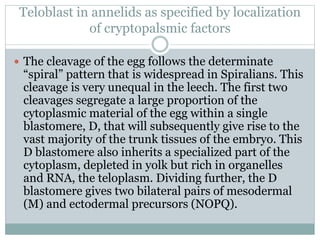
 The cleavage of the egg follows the determinate
“spiral” pattern that is widespread in Spiralians. This
cleavage is very unequal in the leech. The first two
cleavages segregate a large proportion of the
cytoplasmic material of the egg within a single
blastomere, D, that will subsequently give rise to the
vast majority of the trunk tissues of the embryo. This
D blastomere also inherits a specialized part of the
cytoplasm, depleted in yolk but rich in organelles
and RNA, the teloplasm. Dividing further, the D
blastomere gives two bilateral pairs of mesodermal
(M) and ectodermal precursors (NOPQ).
Teloblasts divide
asymmetrically to
form small blast cells
which wrap around
the embryo and
extend rostrally.
Here, the embryo is
shown at late stage 7
(upper right). The N,
O, P, Q, and M
teloblasts are always
positioned in the
same relative
orientations (lower
left).
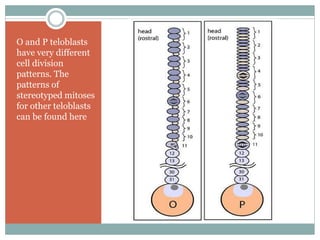
O and P teloblasts
have very different
cell division
patterns. The
patterns of
stereotyped mitoses
for other teloblasts
can be found here
 A new comprehensive definition of annelid teloblasts Gazave
and coauthors propose that these posterior stem cells are at
the origin of all the segmental tissues of Platynereis and are
behaving like teloblasts. These cells however display
important differences with the leech teloblasts. They are true
stem cells, present during most of the life cycle of the animal,
sitting in a niche near the pygidium, where they are constantly
supplied with nutrients by the general blood circulation.
Given their small size, it is difficult to carry out the sort of dye
injection experiments that have been performed on the leech
teloblasts to analyse the progeny of Platynereis teloblasts.
Cytological characteristics suggest that these cells divide
asymmetrically but the divisions of these cells have not been
observed directly so far
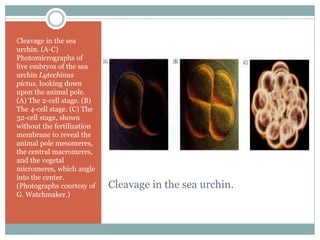
Sea urchins exhibit radial holoblastic cleavage. The first and
second cleavages are both meridional and are perpendicular to
each other. That is to say, the cleavage furrows pass through
the animal and vegetal poles. The third cleavage is equatorial,
perpendicular to the first two cleavage planes, and separates
the animal and vegetal hemispheres from one another ( figures
8.8 and 8.9). The fourth cleavage, however, is very different
from the first three. The four cells of the animal tier divide
meridionally into eight blastomeres , each with the same volume.
These cells are called mesomeres.
Development Illustrated in and
Echinoderms: Developmental Axes
Cleavage in the sea
urchin. Planes of
cleavage in the first
three divisions and
the formation of
tiers of cells in
divisions 3–6.
Cleavage in the sea urchin.
Cleavage in the sea
urchin. (A-C)
Photomicrographs of
live embryos of the sea
urchin Lytechinus
pictus, looking down
upon the animal pole.
(A) The 2-cell stage. (B)
The 4-cell stage. (C) The
32-cell stage, shown
without the fertilization
membrane to reveal the
animal pole mesomeres,
the central macromeres,
and the vegetal
micromeres, which angle
into the center.
(Photographs courtesy of
G. Watchmaker.)
 The blastula stage of sea urchin development
begins at the 128-cell stage. Here the cells form a
hollow sphere surrounding a central cavity,
or blastocoel (Figure 8.11A). By this time, all the
cells are the same size, the micromeres having
slowed down their cell division. Every cell is in
contact with the proteinaceous fluid of the blastocoel
on the inside and with the hyaline layer on the
outside.
Sea urchin blastulae. (A)
Formation of a
blastocoel as cell
division continues. (B)
Soon after the rapid
divisions of cleavage
end, the previously
rounded cells unite to
form a true epithelium.
The fertilization
envelope can still be
seen. As cilia develop,
the blastula rotates
within that envelope. (C)
The vegetal plate
thickens, while the
animal hemisphere cells
secrete hatching enzyme
and allow the blastula to
hatch from the
fertilization envelope.
 These rapid and invariant cell cleavages last through
the ninth or tenth cell division, depending upon the
species. After that time, there is a mid-blastula
transition, when the synchrony of cell division ends,
new genes become expressed, and many of the
nondividing cells develop cilia on their outer
surfaces; Masuda and Sato 1984). The ciliated
blastula begins to rotate within the fertilization
envelope. Soon afterward, differences are seen in the
cells. The cells at the vegetal pole of the blastula
begin to thicken, forming a vegetal plate.
Cell-cell interaction and cell fate
 The fate map of the sea urchin embryo was originally
created by observing each of the cell layers and what its
descendants became. More recent investigations have
refined these maps by following the fates of individual
cells injected with fluorescent dyes such as diI (see
Chapter 1). These studies have shown that by the 60-cell
stage, most of the embryonic cell fates are specified, but
that the cells are not irreversibly committed. In other
words, particular blastomeres consistently produce the
same cell types in each embryo, but these cells remain
pluripotent and can give rise to other cell types if
experimentally placed in a different part of the embryo.
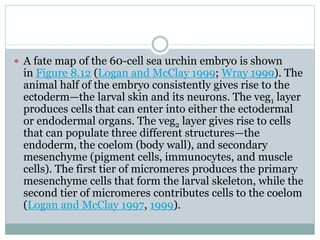
 A fate map of the 60-cell sea urchin embryo is shown
in Figure 8.12 (Logan and McClay 1999; Wray 1999). The
animal half of the embryo consistently gives rise to the
ectoderm—the larval skin and its neurons. The veg1 layer
produces cells that can enter into either the ectodermal
or endodermal organs. The veg2 layer gives rise to cells
that can populate three different structures—the
endoderm, the coelom (body wall), and secondary
mesenchyme (pigment cells, immunocytes, and muscle
cells). The first tier of micromeres produces the primary
mesenchyme cells that form the larval skeleton, while the
second tier of micromeres contributes cells to the coelom
(Logan and McClay 1997, 1999).
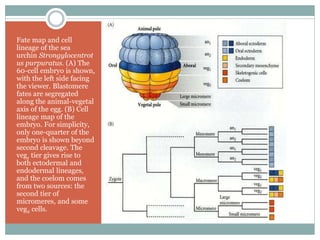
Fate map and cell
lineage of the sea
urchin Strongylocentrot
us purpuratus. (A) The
60-cell embryo is shown,
with the left side facing
the viewer. Blastomere
fates are segregated
along the animal-vegetal
axis of the egg. (B) Cell
lineage map of the
embryo. For simplicity,
only one-quarter of the
embryo is shown beyond
second cleavage. The
veg1 tier gives rise to
both ectodermal and
endodermal lineages,
and the coelom comes
from two sources: the
second tier of
micromeres, and some
veg2 cells.
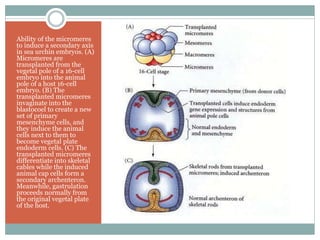
Ability of the micromeres
to induce a secondary axis
in sea urchin embryos. (A)
Micromeres are
transplanted from the
vegetal pole of a 16-cell
embryo into the animal
pole of a host 16-cell
embryo. (B) The
transplanted micromeres
invaginate into the
blastocoel to create a new
set of primary
mesenchyme cells, and
they induce the animal
cells next to them to
become vegetal plate
endoderm cells. (C) The
transplanted micromeres
differentiate into skeletal
cables while the induced
animal cap cells form a
secondary archenteron.
Meanwhile, gastrulation
proceeds normally from
the original vegetal plate
of the host.
Ability of the
micromeres to induce
presumptive ectodermal
cells to acquire other
fates. (A) Normal
development of the 64-
cell sea urchin embryo,
showing the fates of the
different layers. (B) An
isolated animal
hemisphere becomes a
ciliated ball of
ectodermal cells. (C)
When an isolated animal
hemisphere is combined
with isolated
micromeres, a
recognizable pluteus
larva is formed, with all
the endoderm derived
from the animal
hemisphere.
 In most sea urchins, the dorsal-ventral and left-right axes
are specified after fertilization, but the manner of their
specification is not well understood. Since the first
cleavage plane can be either parallel, perpendicular, or
oblique with respect to the eventual dorsal-ventral axis, it
is probable that the dorsal-ventral axis is not specified
until the 8-cell stage, when there are cell boundaries that
correspond to these positions (Kominami 1983; Henry et
al. 1992). Interestingly, in those sea urchins that bypass
the larval stage to develop directly into juveniles, the
dorsal-ventral axis is specified maternally in the egg
cytoplasm (Henry and Raff 1990).
REFERENCES:
 Gilbert SF., Sunderland (MA): Sinauer Associates;
Developmental Biology. 6th edition. 2000.
 Ferrier, David E. K. , Evolutionary crossroads in
developmental biology: annelids.
Development 2012 139: 2643-2653
 Balavoine, Guillaume. Segment formation in
Annelids: patterns, processes and evolution.
Institut Jacques Monod, CNRS / Université Paris
Diderot, Paris, France. 2014
REFERENCES:
 https://www.ncbi.nlm.nih.gov/books/NBK9992/
 https://dev.biologists.org/content/139/15/2643
 https://www.ncbi.nlm.nih.gov/books/NBK10074/
 https://www.ncbi.nlm.nih.gov/books/NBK10011/
 https://www.ncbi.nlm.nih.gov/books/NBK9987/

Developmental biology

  • 1.
    R E PO R T E R : N O V A A . C O R C I E G A Developmental Biology
  • 2.
    I . DE V E L O P M E N T I L L U S T R A T E D I N N E M A T O D E S I. Developmental Axes II. Cell-cell interaction and cell fate I I . D E V E L O P M E N T I L L U S T R A T E D I N M O L L U S K S I. Developmental Axes II. Cell-cell interaction and cell fate I I I . D E V E L O P M E N T I L L U S T R A T E D I N A N N E L I D S I. Developmental Axes II. Cell-cell interaction and cell fate III. Teloblast in annelids as specified by localization of cryptopalsmic factors Outline
  • 3.
    I V .D E V E L O P M E N T I L L U S T R A T E D I N A N D E C H I N O D E R M S I. Developmental Axes II. Cell-cell interaction and cell fate Outline
  • 4.
    The C. Eleganszygote exhibits rotational holoblastic cleavage (figure 8.42c). During early cleavage, each asymmetrical division produces one founder cell (denoted AB, MS, E, C, and D), which produces differentiated descendants, and one stem cell (the P1-P4 lineage). In the first cell division, the cleavage furrow is located asymmetrically along the anterior-posterior axis of the egg, closer to what will be the posterior pole. It forms a founder cell (AB) and a stem cell (P1). Development Illustrated in Nematodes developmental axes
  • 5.
    Rotational cleavage ofthe C. elegans egg (A) Side view of adult hermaphrodite. Sperm are stored so that a mature egg must pass through the sperm on its way to the vulva. (B) The gonads. Near the distal end, the germ cells undergo mitosis. As they get further from the distal tip, they enter meiosis. Early meiosis forms sperm that are stored in the spermatheca. Later meioses form eggs that become fertilized as they roll through the spermatheca.
  • 7.
    Rotational cleavage ofthe C. elegans egg (C) Early development, as the egg is fertilized and moves toward the vulva. The p- lineage are stem cells that will eventually form the germ cells.
  • 8.
    (D) Abbreviated cell lineagechart. The germ line segregates into the posterior portion of the most posterior (P) cell. The first three cell divisions produce the AB, C, MS, and E lineages. The number of derived cells (in parentheses) refers to the 558 cells present in the newly hatched larva. Some of these continue to divide to produce the 959 somatic cells of the adult.
  • 9.
    Development Illustrated inNematodes developmental axes  The elongated axis of the C. elegans egg defines the future anterior-posterior axis of the nematode's body. The decision as to which end will become the anterior and which the posterior seems to reside with the position of sperm pronucleus. When it enters the oocyte cytoplasm, the centriole associated with the sperm pronucleus initiates cytoplasmic movements that push the male pronucleus to the nearest end of the oblong oocyte. This end becomes the posterior pole (Goldstein and Hird 1996).
  • 10.
    Development Illustrated inNematodes developmental axes  A second anterior-posterior asymmetry seen shortly after fertilization is the migration of the P- granules. P-granules are ribonucleoprotein complexes that probably function in specifying the germ cells. Using fluorescent antibodies to a component of the P-granules, Strome and Wood (1983) discovered that shortly after fertilization, the randomly scattered P-granules move toward the posterior end of the zygote, so that they enter only the blastomere (P1) formed from the posterior cytoplasm (Figure 8.43).
  • 11.
    Segregation of theP- granules into the germ line lineage of the C. elegans embryo. The left column shows the cell nuclei (the DNA is stained blue by Hoescht dye), while the right column shows the same embryos stained for P- granules. At each successive division, the P-granules enter into the P-lineage blastomere, the one that will form the germ cells. (Photographs courtesy of S. Strome.)
  • 12.
    Cell-cell interaction andcell fate  The determination of the P1 lineages appears to be autonomous, with the cell fates determined by internal cytoplasmic factors rather than by interactions with neighboring cells. It is thought that protein factors might determine cell fate by entering the nuclei of the appropriate blastomeres and activating or repressing specific fate-determining genes.  Conditional specification can be seen in the development of the endoderm cell lineage. At the 4-cell stage, the EMS cell requires a signal from its neighbor (and sister), the P2 blastomere.
  • 13.
    Cell-cell signaling in the4-cell embryo of C. elegans. The P2 cell produces two signals: (1) the juxtacrine protein APX-1 (Delta), which is bound by GLP-1 (Notch) on the ABp cell, and (2) the paracrine protein MOM-2 (Wnt), which is bound by the MOM-5 (Frizzled) protein on the EMS cell.
  • 14.
    Spiral holoblastic cleavageis characteristic of several animal groups, including annelid worms, some flatworms, and most molluscs. It differs from radial cleavage in numerous ways. First, the cleavage planes are not parallel or perpendicular to the animal-vegetal axis of the egg; rather, cleavage is at oblique angles, forming a “spiral” arrangement of daughter blastomeres . Second, the cells touch one another at more places than do those of radially cleaving embryos. In fact, they assume the most thermodynamically stable packing orientation, much like that of adjacent soap bubbles. Development Illustrated in Mollusks: Developmental Axes
  • 15.
    Third, spirally cleavingembryos usually undergo fewer divisions before they begin gastrulation, making it possible to follow the fate of each cell of the blastula. When the fates of the individual blastomeres from annelid, flatworm, and mollusc embryos were compared, many of the same cells were seen in the same places, and their general fates were identical (wilson 1898). Blastulae produced by radial cleavage have no blastocoel and are called stereoblastulae . Development Illustrated in Mollusks: Developmental Axes
  • 16.
    Spiral cleavage ofthe mollusc Trochus Spiral cleavage of the mollusc Trochus vie wed (A) from the animal pole and (B) from one side. In (B), the cells derived from the A blastomere are shown in color. The mitotic spindles, sketched in the early stages, divide the cells unequally and at an angle to the vertical and horizontal axes.
  • 17.
     The orientationof the cleavage plane to the left or to the right is controlled by cytoplasmic factors within the oocyte. This was discovered by analyzing mutations of snail coiling. Some snails have their coils opening to the right of their shells (dextral coiling), whereas other snails have their coils opening to the left (sinistral coiling). Usually, the direction of coiling is the same for all members of a given species.
  • 18.
    Cell-cell interaction andcell fate  Molluscs provide some of the most impressive examples of mosaic development, in which the blastomeres are specified autonomously, and of cytoplasmic localization, wherein morphogenetic determinants are placed in a specific region of the oocyte
  • 19.
    Cell-cell interaction andcell fate  Mosaic development is widespread throughout the animal kingdom, especially in protostomal organisms such as annelids, nematodes, and molluscs, all of which initiate gastrulation at the future anterior end after only a few cell divisions. Moreover, the cytoplasmic factors responsible for specification are actively moved to one pole of the cell so that a blastomere containing these factors can restrict their transmission to only one of its two daughter cells. The fate of the two daughter cells is thus changed by which one of them gets the morphogenetic determinant.
  • 20.
    Cell-cell interaction andcell fate  Certain spirally cleaving embryos (mostly in the mollusc and annelid phyla) extrude a bulb of cytoplasm immediately before first cleavage (Figure 8.31). This protrusion is called the polar lobe. In certain species of snails, the region uniting the polar lobe to the rest of the egg becomes a fine tube. The first cleavage splits the zygote asymmetrically, so that the polar lobe is connected only to the CD blastomere.
  • 21.
    Cleavage in the molluscDentalium. Extrusion and reincorporation of the polar lobe occur twice.
  • 22.
    Spiral cleavage ofthe snail Ilyanassa. The D blastomere is larger than the others, allowing the identification of each cell. Cleavage is dextral. (A) 8-cell stage. PB is a polar body. (B) Mid- fourth cleavage (12-cell embryo). The macromeres have already divided into large and small spirally oriented cells; 1a-d have not divided yet. (C) 32- cell embryo. (From Craig and Morrill 1986; photographs courtesy of the authors.)
  • 23.
    Fate map ofthe snail Ilyanassa obsoleta. Beads containing Lucifer Yellow were injected into individual blastomeres at the 32- cell stage. When the embryos developed into larvae , their descendants could be identified by their fluorescence.
  • 24.
    Annelida, is oneof the phyla that undergoes spiral cleavage. Spiral cleavage first becomes most obvious at the third cleavage, which generates eight cells (blastomeres), occurring at an oblique angle to the animal-vegetal axis. This cleavage leads to an upper (animal) cell tier that lies over the cell boundaries of the lower (vegetal) tier of blastomeres. Subsequent cleavages continue to produce cell layers that are offset from each other Development Illustrated in Annelids: Developmental Axes
  • 25.
    Spiral cleavage. Atthe third cell division, the upper (animal) quartet of cells comes to lie over the cell boundaries of the lower (vegetal) quartet of blastomeres. Such spiral cleavages continue through subsequent cell divisions. The logic behind the naming of individual cells, which is facilitated by these stereotypic cleavages, is outlined in Meyer et al. Figure reproduced with permission from Meyer et al. The brown shading distinguishes the D blastomere lineage, including its progeny, to illustrate the ‘quadrant’ organisation of the early embryo.
  • 26.
    Cell-cell interaction andcell fate  Subsequently, fluorochrome molecules have been used, usually conjugated to dextrans to prevent them from moving into uninjected cells through gap junctions and to allow them to be fixed and visualised (Gimlich and Braun, 1985; Ackermann et al., 2005). Alternatively, the lipophilic dye DiI has been injected (Meyer et al., 2010). Further refinement and improved resolution has been achieved by injecting mRNA coding for nuclear- localised fluorescent proteins (Zhang and Weisblat, 2005), which improves cellular resolution by labelling the nuclei rather than having the signal distributed throughout the cytoplasm. Most recently, the degradation of these injected mRNAs has been circumvented by injecting plasmids, from which nuclear- localised fluorescent protein coding sequences can be transcribed within the injected cells and any descendants that inherit the plasmid (Gline et al., 2009).
  • 27.
    The normal development ofthe nereidid Platynereis dumerilii. Segment formation is clearly segregated in two phases. The 3 anterior- most leg-bearing segments are formed more or less simultaneously starting 32 hours after fertilization. Notice that while the setal sacs component of the appendages of the three segments appear simultaneously, the paratrochs (ciliary belts born by each segment anlagen, in green) appear in an unusual posterior to anterior succession.
  • 28.
    Teloblast in annelidsas specified by localization of cryptopalsmic factors  The cleavage of the egg follows the determinate “spiral” pattern that is widespread in Spiralians. This cleavage is very unequal in the leech. The first two cleavages segregate a large proportion of the cytoplasmic material of the egg within a single blastomere, D, that will subsequently give rise to the vast majority of the trunk tissues of the embryo. This D blastomere also inherits a specialized part of the cytoplasm, depleted in yolk but rich in organelles and RNA, the teloplasm. Dividing further, the D blastomere gives two bilateral pairs of mesodermal (M) and ectodermal precursors (NOPQ).
  • 29.
    Teloblasts divide asymmetrically to formsmall blast cells which wrap around the embryo and extend rostrally. Here, the embryo is shown at late stage 7 (upper right). The N, O, P, Q, and M teloblasts are always positioned in the same relative orientations (lower left).
  • 30.
    O and Pteloblasts have very different cell division patterns. The patterns of stereotyped mitoses for other teloblasts can be found here
  • 32.
     A newcomprehensive definition of annelid teloblasts Gazave and coauthors propose that these posterior stem cells are at the origin of all the segmental tissues of Platynereis and are behaving like teloblasts. These cells however display important differences with the leech teloblasts. They are true stem cells, present during most of the life cycle of the animal, sitting in a niche near the pygidium, where they are constantly supplied with nutrients by the general blood circulation. Given their small size, it is difficult to carry out the sort of dye injection experiments that have been performed on the leech teloblasts to analyse the progeny of Platynereis teloblasts. Cytological characteristics suggest that these cells divide asymmetrically but the divisions of these cells have not been observed directly so far
  • 33.
    Sea urchins exhibitradial holoblastic cleavage. The first and second cleavages are both meridional and are perpendicular to each other. That is to say, the cleavage furrows pass through the animal and vegetal poles. The third cleavage is equatorial, perpendicular to the first two cleavage planes, and separates the animal and vegetal hemispheres from one another ( figures 8.8 and 8.9). The fourth cleavage, however, is very different from the first three. The four cells of the animal tier divide meridionally into eight blastomeres , each with the same volume. These cells are called mesomeres. Development Illustrated in and Echinoderms: Developmental Axes
  • 34.
    Cleavage in thesea urchin. Planes of cleavage in the first three divisions and the formation of tiers of cells in divisions 3–6.
  • 35.
    Cleavage in thesea urchin. Cleavage in the sea urchin. (A-C) Photomicrographs of live embryos of the sea urchin Lytechinus pictus, looking down upon the animal pole. (A) The 2-cell stage. (B) The 4-cell stage. (C) The 32-cell stage, shown without the fertilization membrane to reveal the animal pole mesomeres, the central macromeres, and the vegetal micromeres, which angle into the center. (Photographs courtesy of G. Watchmaker.)
  • 36.
     The blastulastage of sea urchin development begins at the 128-cell stage. Here the cells form a hollow sphere surrounding a central cavity, or blastocoel (Figure 8.11A). By this time, all the cells are the same size, the micromeres having slowed down their cell division. Every cell is in contact with the proteinaceous fluid of the blastocoel on the inside and with the hyaline layer on the outside.
  • 37.
    Sea urchin blastulae.(A) Formation of a blastocoel as cell division continues. (B) Soon after the rapid divisions of cleavage end, the previously rounded cells unite to form a true epithelium. The fertilization envelope can still be seen. As cilia develop, the blastula rotates within that envelope. (C) The vegetal plate thickens, while the animal hemisphere cells secrete hatching enzyme and allow the blastula to hatch from the fertilization envelope.
  • 38.
     These rapidand invariant cell cleavages last through the ninth or tenth cell division, depending upon the species. After that time, there is a mid-blastula transition, when the synchrony of cell division ends, new genes become expressed, and many of the nondividing cells develop cilia on their outer surfaces; Masuda and Sato 1984). The ciliated blastula begins to rotate within the fertilization envelope. Soon afterward, differences are seen in the cells. The cells at the vegetal pole of the blastula begin to thicken, forming a vegetal plate.
  • 39.
    Cell-cell interaction andcell fate  The fate map of the sea urchin embryo was originally created by observing each of the cell layers and what its descendants became. More recent investigations have refined these maps by following the fates of individual cells injected with fluorescent dyes such as diI (see Chapter 1). These studies have shown that by the 60-cell stage, most of the embryonic cell fates are specified, but that the cells are not irreversibly committed. In other words, particular blastomeres consistently produce the same cell types in each embryo, but these cells remain pluripotent and can give rise to other cell types if experimentally placed in a different part of the embryo.
  • 40.
     A fatemap of the 60-cell sea urchin embryo is shown in Figure 8.12 (Logan and McClay 1999; Wray 1999). The animal half of the embryo consistently gives rise to the ectoderm—the larval skin and its neurons. The veg1 layer produces cells that can enter into either the ectodermal or endodermal organs. The veg2 layer gives rise to cells that can populate three different structures—the endoderm, the coelom (body wall), and secondary mesenchyme (pigment cells, immunocytes, and muscle cells). The first tier of micromeres produces the primary mesenchyme cells that form the larval skeleton, while the second tier of micromeres contributes cells to the coelom (Logan and McClay 1997, 1999).
  • 41.
    Fate map andcell lineage of the sea urchin Strongylocentrot us purpuratus. (A) The 60-cell embryo is shown, with the left side facing the viewer. Blastomere fates are segregated along the animal-vegetal axis of the egg. (B) Cell lineage map of the embryo. For simplicity, only one-quarter of the embryo is shown beyond second cleavage. The veg1 tier gives rise to both ectodermal and endodermal lineages, and the coelom comes from two sources: the second tier of micromeres, and some veg2 cells.
  • 42.
    Ability of themicromeres to induce a secondary axis in sea urchin embryos. (A) Micromeres are transplanted from the vegetal pole of a 16-cell embryo into the animal pole of a host 16-cell embryo. (B) The transplanted micromeres invaginate into the blastocoel to create a new set of primary mesenchyme cells, and they induce the animal cells next to them to become vegetal plate endoderm cells. (C) The transplanted micromeres differentiate into skeletal cables while the induced animal cap cells form a secondary archenteron. Meanwhile, gastrulation proceeds normally from the original vegetal plate of the host.
  • 43.
    Ability of the micromeresto induce presumptive ectodermal cells to acquire other fates. (A) Normal development of the 64- cell sea urchin embryo, showing the fates of the different layers. (B) An isolated animal hemisphere becomes a ciliated ball of ectodermal cells. (C) When an isolated animal hemisphere is combined with isolated micromeres, a recognizable pluteus larva is formed, with all the endoderm derived from the animal hemisphere.
  • 44.
     In mostsea urchins, the dorsal-ventral and left-right axes are specified after fertilization, but the manner of their specification is not well understood. Since the first cleavage plane can be either parallel, perpendicular, or oblique with respect to the eventual dorsal-ventral axis, it is probable that the dorsal-ventral axis is not specified until the 8-cell stage, when there are cell boundaries that correspond to these positions (Kominami 1983; Henry et al. 1992). Interestingly, in those sea urchins that bypass the larval stage to develop directly into juveniles, the dorsal-ventral axis is specified maternally in the egg cytoplasm (Henry and Raff 1990).
  • 45.
    REFERENCES:  Gilbert SF.,Sunderland (MA): Sinauer Associates; Developmental Biology. 6th edition. 2000.  Ferrier, David E. K. , Evolutionary crossroads in developmental biology: annelids. Development 2012 139: 2643-2653  Balavoine, Guillaume. Segment formation in Annelids: patterns, processes and evolution. Institut Jacques Monod, CNRS / Université Paris Diderot, Paris, France. 2014
  • 46.
    REFERENCES:  https://www.ncbi.nlm.nih.gov/books/NBK9992/  https://dev.biologists.org/content/139/15/2643 https://www.ncbi.nlm.nih.gov/books/NBK10074/  https://www.ncbi.nlm.nih.gov/books/NBK10011/  https://www.ncbi.nlm.nih.gov/books/NBK9987/

Editor's Notes

  • #8 Chorion The outer shell or covering of a nematode egg.
  • #14 Endomesodermal precursor (EMS) cell
  • #22 this three-lobed structure is often referred to as the trefoil-stage embryo 
  • #29 A teloblast is a large cell in the embryos of clitellate annelids which asymmetrically divide to form many smaller cells known as blast cells. These blast cells further proliferate and differentiate to form the segmental tissues of the annelid.