Neurulation :
• Neurulation refers to the folding process in vertebrate embryos which
includes the transformation of the neural plate into the neural tube.
• The embryo at this stage is termed as neurula.
• The neural tube is derived from the ectoderm along the mid dorsal axis of
the vertebrate gastrulae.
• During neurulization of mid dorsal axis becomes thicker than the remaining
ectoderm and called neural plate.
• In different vertebrates the neural plate differentiate into neural tube by
following t wo methods.
3. Early Vertebrate Development
Smart Study 1
3.1 :
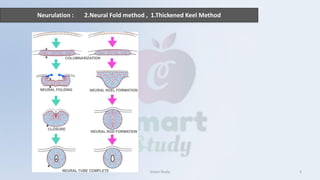
• During neural stage the neural plate materials become aggregated in the
form of a thickened elongated ridge or Keel along the mid dorsal axis of the
embryo.
• The keel separates from the rest of the ectoderm and sinks below the
overlying skin ectoderm.
• Eventually it becoming hollow forming the neural tube.
• Example - Cyclostomes, Teleosts and Ganoid fishes
(Polypterus,Amia,Lapidosteus and Acipencer)
Smart Study 2
2.Neural Fold method
 The neural plate formation begins by the division or accumulation of cells in the region of
neuro-ectoderm .
 The ectoderm cells immediately in front of the blastopore(or in front of primitive streak in
chick and mammals)begins to divide forming a thick plateof ectoderm.
 Soon the margin of neural plate elevates and its centre get depressed forming a shallow
neural groove.
 Later on the margin of the neural groove meet dorsally in middle line completing the
formation of neural tube. Subsequently it separates from the parent ectoderm.
 Example - amphibians,reptiles, birds and mammals.
Smart Study 3
Neurulation : 2.Neural Fold method , 1.Thickened Keel Method
Smart Study 4
3.1 Ectoderm :
 The germ layer that covers the outside of the embryo.
 It is the one of the two tissue layers present in diploblasts along with the endoderm
and one of the three layers found in the triploblasts along with the endoderm and
mesoderm.
Ectoderm formation -
 The ectoderm forms during gastrulation.
 Early in development when the embryo has undergoes several cell divisions but has
no yet begun gastrulation,cells in the upper animal region are already earmarked
as future ectodermal cells. Smart Study 5
 In amphibian the ectoderm is restricted to the animal region of the blastula until
gastrulation, at which point it extends to cover the entire embryo in the process called
epiboly.
 In fish and birds the future mesodermal and endoderm cells migrate inwards in a process
(Ingresion)leaving the cells that remain on the outside surface is the future ectoderm cells.
 in placental mammals, blastula composed of a trophoblast and inner cell mass, the inner cell
mass develops into the embryo proper and trophoblast forms placenta, the embryo is then
differentiated into primitive endoderm and ectoderm.The embryonic ectoderm bigins

gastrulation on the inner side of the embryo.
Smart Study 6
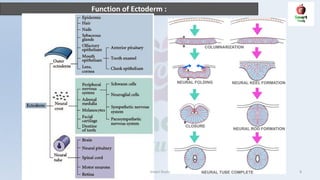
Function of Ectoderm :
Ectoderm are of two types-
1. Epidermal ectoderm
2. Neural ectoderm
 Epidermal ectoderm forms external structures such as skin,sweat glands, skin receptors
hair follicles, external surfaces of the eyes (cornea and lens),teeth (enamel) mouth and
rectum.
 Neural ectoderm forms central nervous system by a process of neurulation in which neural
tube are formed, which ultimately become brain and spinal cord.
 The point where the neural tubes separates from the dorsal ectoderm is neural crest, the
cells of neural crest will eventually differentiated into number of cells including peripheral
nerves and skull bones. Smart Study 7
Function of Ectoderm :
Smart Study 8
3.2 Endoderm :
Smart Study 9
Endoderm
Definition -The endoderm is an embryonic germ layer that give rise to
tissue that form internal structure and organs the endoderm is found in both
vertebrate and invertebrate embryos and is responsible for the formation of
the gut and associated organs and present both Diploblasts and Triploblasts.
Formation of Endoderm :
Smart Study 10
Endoderm formation
 Endoderm forms during gastrulation although the cells are specified even earlier in development.
 The cells that will become the endoderm are found in the vegetal Half of egg adjacent to the
equatorial band.
 It has been suggested that the future endodermal cell fat is predetermined by maternal factors in
the egg.
 Although the endoderm ultimately will develop into internal structures,the future endoderm cells
are initially located on the surface of blastula.
 During gastrulation cells rearrange so that the germ layer end up in correct position.
 The cells migrates interior of embryo as a sheet of cells in amphibions or as individual cell in
birds and mammals (ingression).
Function of Endoderm :
Smart Study 11
Function of Endoderm
 The endoderm will become the digestive tract as well as a number of associated
organs and glands.It will give rise to the lungs,liver and pancreas,as well as the
thymus,thyroid and parathyroid glands.In addition,endoderm cells will form the
lining of the body's organ system, including the respiratory system,the digestive
system,the urinary system and the reproductive system.
3.2 Mesoderm :
 The mesoderm is a germ layer which is present in trophoblastic organisms; it is
found between ectoderm and endoderm.
 It goes on to form many central structures including the skeletal system,muscular
system and notochord.
Mesoderm formation -
The mesoderm form during gastrulation.Early in development egg consist of animal
region and vegetal region. Future mesodermal cells form from animal region cells at the
boundary of these two regions as an equatorial band.Unlike the other two germ layers
whose fate is determined by maternal factors present in egg,future mesodeal cells form
in responce to signals from future endodermal cells in vegetal region.
Smart Study 12
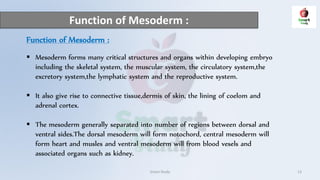
Function of Mesoderm :
 Mesoderm forms many critical structures and organs within developing embryo
including the skeletal system, the muscular system, the circulatory system,the
excretory system,the lymphatic system and the reproductive system.
 It also give rise to connective tissue,dermis of skin, the lining of coelom and
adrenal cortex.
 The mesoderm generally separated into number of regions between dorsal and
ventral sides.The dorsal mesoderm will form notochord, central mesoderm will
form heart and musles and ventral mesoderm will from blood vesels and
associated organs such as kidney.
Smart Study 13
Smart Study 14
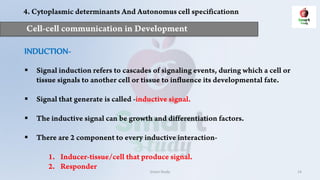
INDUCTION-




Smart Study 15



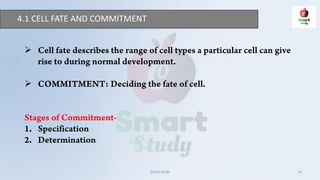
4.1 CELL FATE AND COMMITMENT
Smart Study 16


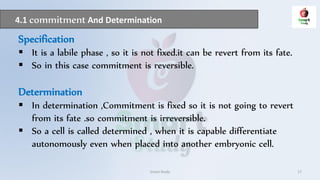
4.1 commitment And Determination
Smart Study 17
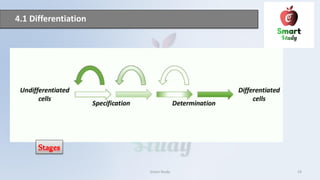
Specification
 It is a labile phase , so it is not fixed.it can be revert from its fate.
 So in this case commitment is reversible.
Determination
 In determination ,Commitment is fixed so it is not going to revert
from its fate .so commitment is irreversible.
 So a cell is called determined , when it is capable differentiate
autonomously even when placed into another embryonic cell.
4.1 Differentiation
Smart Study 18
 Cell differentiation is the process by which cells become
structurally and functionally specialized, allowing the formation of
distinct cell types.
 The structural and functional specificity of a cell depends proteins
it synthesizes.
Smart Study 19
4.1 Differentiation
Stages
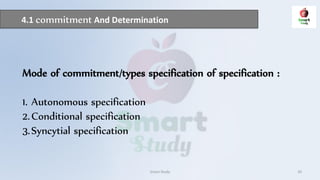
4.1 commitment And Determination
Smart Study 20
Mode of commitment/types specification of specification :
1. Autonomous specification
2.Conditional specification
3.Syncytial specification
Smart Study 21
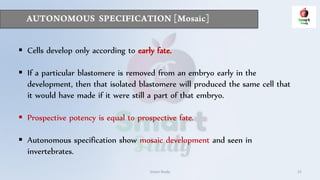
 Cells develop only according to early fate.
 If a particular blastomere is removed from an embryo early in the
development, then that isolated blastomere will produced the same cell that
it would have made if it were still a part of that embryo.
 Prospective potency is equal to prospective fate.
 Autonomous specification show mosaic development and seen in
invertebrates.
Smart Study 22
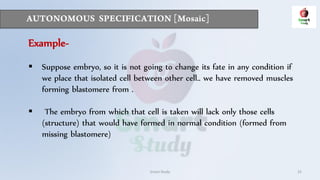
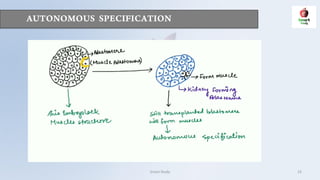
Example-
 Suppose embryo, so it is not going to change its fate in any condition if
we place that isolated cell between other cell.. we have removed muscles
forming blastomere from .
 The embryo from which that cell is taken will lack only those cells
(structure) that would have formed in normal condition (formed from
missing blastomere)
Smart Study 23
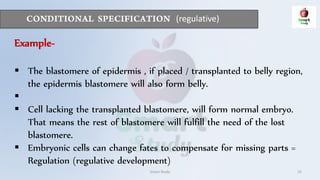
(regulative)
Smart Study 24
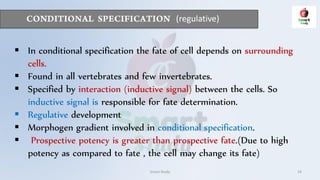
 In conditional specification the fate of cell depends on surrounding
cells.
 Found in all vertebrates and few invertebrates.
 Specified by interaction (inductive signal) between the cells. So
inductive signal is responsible for fate determination.
 Regulative development
 Morphogen gradient involved in conditional specification.
 Prospective potency is greater than prospective fate.(Due to high
potency as compared to fate , the cell may change its fate)
(regulative)
Smart Study 25
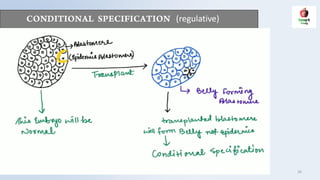
Example-
 The blastomere of epidermis , if placed / transplanted to belly region,
the epidermis blastomere will also form belly.

 Cell lacking the transplanted blastomere, will form normal embryo.
That means the rest of blastomere will fulfill the need of the lost
blastomere.
 Embryonic cells can change fates to compensate for missing parts =
Regulation (regulative development)
(regulative)
Smart Study 26
Smart Study 27
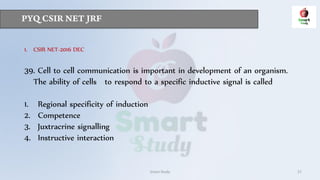
1. CSIR NET-2016 DEC
39. Cell to cell communication is important in development of an organism.
The ability of cells to respond to a specific inductive signal is called
1. Regional specificity of induction
2. Competence
3. Juxtracrine signalling
4. Instructive interaction
Smart Study 28
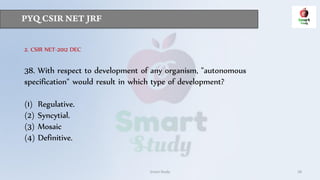
2. CSIR NET-2012 DEC
38. With respect to development of any organism, "autonomous
specification" would result in which type of development?
(1) Regulative.
(2) Syncytial.
(3) Mosaic
(4) Definitive.
Smart Study 29
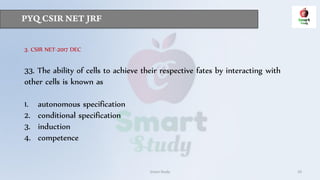
3. CSIR NET-2017 DEC
33. The ability of cells to achieve their respective fates by interacting with
other cells is known as
1. autonomous specification
2. conditional specification
3. induction
4. competence
Smart Study 30

Neurulation ecto endo annd meso.pdf

  • 1.
    Neurulation : • Neurulationrefers to the folding process in vertebrate embryos which includes the transformation of the neural plate into the neural tube. • The embryo at this stage is termed as neurula. • The neural tube is derived from the ectoderm along the mid dorsal axis of the vertebrate gastrulae. • During neurulization of mid dorsal axis becomes thicker than the remaining ectoderm and called neural plate. • In different vertebrates the neural plate differentiate into neural tube by following t wo methods. 3. Early Vertebrate Development Smart Study 1 3.1 :
  • 2.
    • During neuralstage the neural plate materials become aggregated in the form of a thickened elongated ridge or Keel along the mid dorsal axis of the embryo. • The keel separates from the rest of the ectoderm and sinks below the overlying skin ectoderm. • Eventually it becoming hollow forming the neural tube. • Example - Cyclostomes, Teleosts and Ganoid fishes (Polypterus,Amia,Lapidosteus and Acipencer) Smart Study 2
  • 3.
    2.Neural Fold method The neural plate formation begins by the division or accumulation of cells in the region of neuro-ectoderm .  The ectoderm cells immediately in front of the blastopore(or in front of primitive streak in chick and mammals)begins to divide forming a thick plateof ectoderm.  Soon the margin of neural plate elevates and its centre get depressed forming a shallow neural groove.  Later on the margin of the neural groove meet dorsally in middle line completing the formation of neural tube. Subsequently it separates from the parent ectoderm.  Example - amphibians,reptiles, birds and mammals. Smart Study 3
  • 4.
    Neurulation : 2.NeuralFold method , 1.Thickened Keel Method Smart Study 4
  • 5.
    3.1 Ectoderm : The germ layer that covers the outside of the embryo.  It is the one of the two tissue layers present in diploblasts along with the endoderm and one of the three layers found in the triploblasts along with the endoderm and mesoderm. Ectoderm formation -  The ectoderm forms during gastrulation.  Early in development when the embryo has undergoes several cell divisions but has no yet begun gastrulation,cells in the upper animal region are already earmarked as future ectodermal cells. Smart Study 5
  • 6.
     In amphibianthe ectoderm is restricted to the animal region of the blastula until gastrulation, at which point it extends to cover the entire embryo in the process called epiboly.  In fish and birds the future mesodermal and endoderm cells migrate inwards in a process (Ingresion)leaving the cells that remain on the outside surface is the future ectoderm cells.  in placental mammals, blastula composed of a trophoblast and inner cell mass, the inner cell mass develops into the embryo proper and trophoblast forms placenta, the embryo is then differentiated into primitive endoderm and ectoderm.The embryonic ectoderm bigins gastrulation on the inner side of the embryo. Smart Study 6
  • 7.
    Function of Ectoderm: Ectoderm are of two types- 1. Epidermal ectoderm 2. Neural ectoderm  Epidermal ectoderm forms external structures such as skin,sweat glands, skin receptors hair follicles, external surfaces of the eyes (cornea and lens),teeth (enamel) mouth and rectum.  Neural ectoderm forms central nervous system by a process of neurulation in which neural tube are formed, which ultimately become brain and spinal cord.  The point where the neural tubes separates from the dorsal ectoderm is neural crest, the cells of neural crest will eventually differentiated into number of cells including peripheral nerves and skull bones. Smart Study 7
  • 8.
    Function of Ectoderm: Smart Study 8
  • 9.
    3.2 Endoderm : SmartStudy 9 Endoderm Definition -The endoderm is an embryonic germ layer that give rise to tissue that form internal structure and organs the endoderm is found in both vertebrate and invertebrate embryos and is responsible for the formation of the gut and associated organs and present both Diploblasts and Triploblasts.
  • 10.
    Formation of Endoderm: Smart Study 10 Endoderm formation  Endoderm forms during gastrulation although the cells are specified even earlier in development.  The cells that will become the endoderm are found in the vegetal Half of egg adjacent to the equatorial band.  It has been suggested that the future endodermal cell fat is predetermined by maternal factors in the egg.  Although the endoderm ultimately will develop into internal structures,the future endoderm cells are initially located on the surface of blastula.  During gastrulation cells rearrange so that the germ layer end up in correct position.  The cells migrates interior of embryo as a sheet of cells in amphibions or as individual cell in birds and mammals (ingression).
  • 11.
    Function of Endoderm: Smart Study 11 Function of Endoderm  The endoderm will become the digestive tract as well as a number of associated organs and glands.It will give rise to the lungs,liver and pancreas,as well as the thymus,thyroid and parathyroid glands.In addition,endoderm cells will form the lining of the body's organ system, including the respiratory system,the digestive system,the urinary system and the reproductive system.
  • 12.
    3.2 Mesoderm : The mesoderm is a germ layer which is present in trophoblastic organisms; it is found between ectoderm and endoderm.  It goes on to form many central structures including the skeletal system,muscular system and notochord. Mesoderm formation - The mesoderm form during gastrulation.Early in development egg consist of animal region and vegetal region. Future mesodermal cells form from animal region cells at the boundary of these two regions as an equatorial band.Unlike the other two germ layers whose fate is determined by maternal factors present in egg,future mesodeal cells form in responce to signals from future endodermal cells in vegetal region. Smart Study 12
  • 13.
    Function of Mesoderm: Function of Mesoderm :  Mesoderm forms many critical structures and organs within developing embryo including the skeletal system, the muscular system, the circulatory system,the excretory system,the lymphatic system and the reproductive system.  It also give rise to connective tissue,dermis of skin, the lining of coelom and adrenal cortex.  The mesoderm generally separated into number of regions between dorsal and ventral sides.The dorsal mesoderm will form notochord, central mesoderm will form heart and musles and ventral mesoderm will from blood vesels and associated organs such as kidney. Smart Study 13
  • 14.
  • 15.
  • 16.
    4.1 CELL FATEAND COMMITMENT Smart Study 16  
  • 17.
    4.1 commitment AndDetermination Smart Study 17 Specification  It is a labile phase , so it is not fixed.it can be revert from its fate.  So in this case commitment is reversible. Determination  In determination ,Commitment is fixed so it is not going to revert from its fate .so commitment is irreversible.  So a cell is called determined , when it is capable differentiate autonomously even when placed into another embryonic cell.
  • 18.
    4.1 Differentiation Smart Study18  Cell differentiation is the process by which cells become structurally and functionally specialized, allowing the formation of distinct cell types.  The structural and functional specificity of a cell depends proteins it synthesizes.
  • 19.
    Smart Study 19 4.1Differentiation Stages
  • 20.
    4.1 commitment AndDetermination Smart Study 20 Mode of commitment/types specification of specification : 1. Autonomous specification 2.Conditional specification 3.Syncytial specification
  • 21.
    Smart Study 21 Cells develop only according to early fate.  If a particular blastomere is removed from an embryo early in the development, then that isolated blastomere will produced the same cell that it would have made if it were still a part of that embryo.  Prospective potency is equal to prospective fate.  Autonomous specification show mosaic development and seen in invertebrates.
  • 22.
    Smart Study 22 Example- Suppose embryo, so it is not going to change its fate in any condition if we place that isolated cell between other cell.. we have removed muscles forming blastomere from .  The embryo from which that cell is taken will lack only those cells (structure) that would have formed in normal condition (formed from missing blastomere)
  • 23.
  • 24.
    (regulative) Smart Study 24 In conditional specification the fate of cell depends on surrounding cells.  Found in all vertebrates and few invertebrates.  Specified by interaction (inductive signal) between the cells. So inductive signal is responsible for fate determination.  Regulative development  Morphogen gradient involved in conditional specification.  Prospective potency is greater than prospective fate.(Due to high potency as compared to fate , the cell may change its fate)
  • 25.
    (regulative) Smart Study 25 Example- The blastomere of epidermis , if placed / transplanted to belly region, the epidermis blastomere will also form belly.   Cell lacking the transplanted blastomere, will form normal embryo. That means the rest of blastomere will fulfill the need of the lost blastomere.  Embryonic cells can change fates to compensate for missing parts = Regulation (regulative development)
  • 26.
  • 27.
    Smart Study 27 1.CSIR NET-2016 DEC 39. Cell to cell communication is important in development of an organism. The ability of cells to respond to a specific inductive signal is called 1. Regional specificity of induction 2. Competence 3. Juxtracrine signalling 4. Instructive interaction
  • 28.
    Smart Study 28 2.CSIR NET-2012 DEC 38. With respect to development of any organism, "autonomous specification" would result in which type of development? (1) Regulative. (2) Syncytial. (3) Mosaic (4) Definitive.
  • 29.
    Smart Study 29 3.CSIR NET-2017 DEC 33. The ability of cells to achieve their respective fates by interacting with other cells is known as 1. autonomous specification 2. conditional specification 3. induction 4. competence
  • 30.