HINA NASIR # 93
TAHIRA MEER # 06
MARYAM TAHIR # 04
GROUP MEMBERS
BS Biotechnology
Semester 6th
>CELL SIGNALING
>GENES INVOLVED IN CELL SIGNALING
>DISEASES CAUSED BY WEAK CELL
SIGNALING
CELL
SIGNALINNG
The science of understanding how individual
cells sense their environment and response to
stimuli
CELL SIGNALING
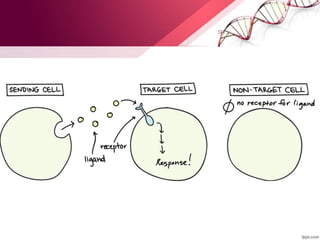
• Cell signaling is part of any communication process
that governs basic activities of cells and coordinates
all cell actions.
• The ability of cells to perceive and correctly respond
to their microenvironment is the basis of
development, tissue repair, and immunity as well as
normal tissue homeostasis.
• how so many functionally different cells can come
from one fertilized egg....?
Communication by extracellular
signaling usually involves eight
steps
1. Synthesis of the signaling molecule by the signaling cell
2. Release of the signaling molecule by the signaling cell
3. Transport of the signal to the target cell
4. Binding of the signal by a specific receptor protein 􀃆
conformational change
5. Initiation of intracellular signal-transduction pathways by
the activated receptor
6. A change in cellular metabolism, function, structure, or
development triggered immediately by the receptor-signal
complex
7. Usually deactivation of the receptor
8. Removal of the signal, which usually terminates the
cellular response
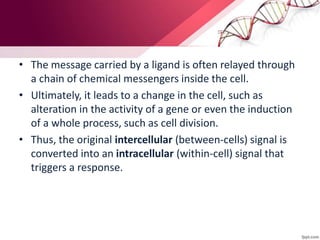
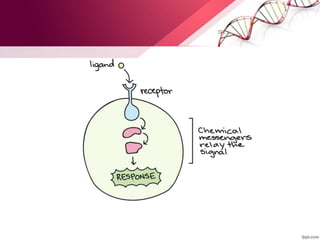
• The message carried by a ligand is often relayed through
a chain of chemical messengers inside the cell.
• Ultimately, it leads to a change in the cell, such as
alteration in the activity of a gene or even the induction
of a whole process, such as cell division.
• Thus, the original intercellular (between-cells) signal is
converted into an intracellular (within-cell) signal that
triggers a response.
Forms of signaling
• Cell-cell signaling involves the transmission of a
signal from a sending cell to a receiving cell
• There are four basic categories of chemical signaling
found in multicellular organisms:
 paracrine signaling,
 autocrine signaling,
 endocrine signaling,
 and signaling by direct contact.
• The main difference between the different categories
of signaling is the distance that the signal travels
through the organism to reach the target cell.
Signaling molecules operate over
various distances in animals
Receptors and Ligands
• Receptors come in many types, but they can be
divided into two categories:
1. Intracellular receptors,
2. Cell surface receptors,
• Ligands
1. Ligands that can enter the cell
2. Ligands that bind on the outside of the cell
From plasma membrane to
nucleus
• Many cellular responses induced by water-soluble
hormones, growth factors, and neurotransmitters
result from their effects on gene expression
• Such pathways usually involve activation of protein
kinases that directly or indirectly phosphorylate
specific transcription factors
G protein-coupled receptors
• G protein-coupled receptors (GPCRs) are a large
family of cell surface receptors that share a common
structure and method of signaling.
• The members of the GPCR family all have seven
different protein segments that cross the membrane,
and they transmit signals inside the cell through a
type of protein called a G protein.
• GPCRs are involved in a range of signaling pathways,
including light detection, odorant detection, and
detection of certain hormones and
neurotransmitters
Insulin Signaling Pathway
Neurotransmitters Pathways
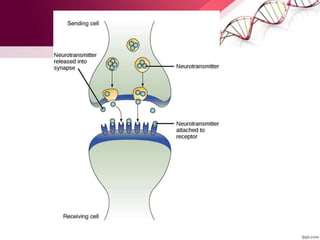
• Synaptic signaling, in which nerve cells transmit
signals.
• This process is named for the synapse, the junction
between two nerve cells where signal transmission
occurs.
• When the sending neuron fires, an electrical impulse
moves rapidly through the cell, traveling down a long,
fiber-like extension called an axon.
• When the impulse reaches the synapse, it triggers the
release of ligands called neurotransmitters, which
quickly cross the small gap between the nerve cells.
• When the neurotransmitters arrive at the receiving cell,
they bind to receptors and cause a chemical change
inside of the cell (often, opening ion channels and
changing the electrical potential across the membrane).
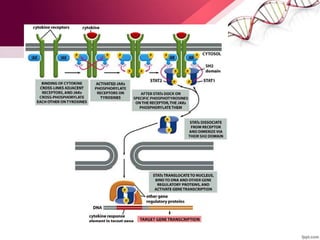
JAK-STAT signaling pathway
• The JAK-STAT signalling cascade consists of three
main components:
a. a cell surface receptor,
b. a Janus kinase(JAK)
c. and two Signal Transducer and Activator of
Transcription (STAT) proteins
• Disrupted or dysregulated JAK-STAT functionality can
result in immune deficiency syndromes and cancers.
JAK-STAT signaling pathway
• Cytokines are polypeptide hormones or growth
factors that act as a local mediator in cell-cell
communication.
• Immune cells secrete cytokines when pathogens are
encountered.
• Cytokines recruit immune cells in response to
pathogens.
• Cytokine receptors activate the JAK-STAT signaling
pathway.
• JAK-STAT pathway provides a fast track to the
nucleus.
Genetics of cell signaling
 Multifunctional process
 Many genes are involved.
Proto Oncogenes:
• Gene operating positive growth regulator.
• There over expression can lead to cancer in our body.
• Due to mutation >bad gene > Onco gene
• In contrast to onco genes we have “Tumour
Supressor genes”
• Supresses or slow down cell division.
RAS ONCOGENES:
• Ras genes are only a small group of genes.
• Function of cell signalling.
• Ras gene were originally identifies from genome of
rat sarcoma virus. And gained importance in 1980
when ras mutation were identified in human
tumours.
• Ras protein control cellular pathways for growth.
• Activated by extra cellular stimuli
• Overactive ras signals lead to cancer
Mechanism:
• When ras in switched on by incoming signals, it
subsequently switches on other protein which
ultimately turn on gene involve in cell growth
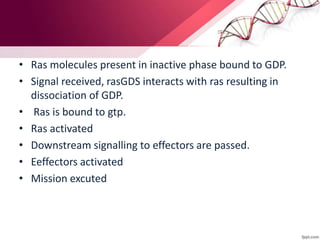
• Ras molecules present in inactive phase bound to GDP.
• Signal received, rasGDS interacts with ras resulting in
dissociation of GDP.
• Ras is bound to gtp.
• Ras activated
• Downstream signalling to effectors are passed.
• Eeffectors activated
• Mission excuted
Growth factor signalling:
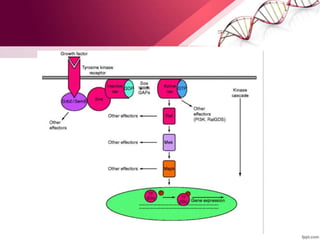
• Signals triggered by EGF.
• Interacts with surface receptors of cells.
• RasGDS activates raf by dissociation of GDP.
• It in turn activates RAF (Kinase).
• Raf then activates another downstream protein MEK
which inturn activated Erk.
• ERK is translocated to nucleus that in response activated
a number of transcription factors.
• Execute action triggered by original signal (EGF) by
inducing appropriate genes.
DISEASE CAUSED BY WEAK CELL
SIGNALING
 A large no of diseases are caused by defects in
signaling pathways.
 In fact most diseases involve at least one breakdown
in cell communication.
 Most of the serious diseases in humans such as
hypertension , heart diseases , diabetes and many
form of mental illness seem to arise from week
signaling pathways.
 Losing the signal
 Normally cells in pancreas release a signal called
insulin.
 In type I diabetes the pancreatic cell that produce
insulin are lost.
 As a result sugar accumulates to toxic level in blood.
 Without treatment, diabetes can lead to kidney
failure blindness and heart disease in later life.
 When signal doesn’t reaches
it target
 Multiple sclerosis is a disease in which the protective
wrappings around nerve cells in the brain and spinal
cord are destroyed.
 Effective nerve cells can no longer transmit signals
from one area of brain to another.
 Nerve damage caused due to this disease can lead to
muscle weakness, blurred or double vision difficulty
with balance and depression.
 When the Target Ignores
the Signal
 Type I and type II diabetes have very similar
symptoms, but they have different causes.
 While people who have type I diabetes are unable to
produce the insulin signal, those with type II diabetes
do produce insulin.
 However, the cells of type II diabetics have lost the
ability to respond to insulin.
 The end result is the same: blood sugar levels
become dangerously high.
 Too Much Signal
o Excitotoxicity:
 After a brain injury such as a
stroke, lethal amounts of signaling
molecules leak out of dying
nerve cells resulting in widespread
damage to the brain.
 Cancer
 In cancer , cell signaling breaks down in multiple places.
 Cancer can occur in may ways but it always requires
multiple signaling breakdowns.
 Often, cancer begins when a cell gains the ability to grow
and divide even in the absence of a signal.
 Ordinarily this unregulated growth triggers a signal for
self-destruction.
 But when the cell also loses the ability to respond to
death signals, it divides out of control, forming a tumor.
 Later cell communication events cause blood vessels to
grow into the tumor, enabling it to grow larger.
 Additional signals allow the cancer to spread to other
parts of the body.
 Treatments
 Just as cell signaling can go wrong resulting in disease,
many disease treatments rely on cell communication.
 If you think of disease as a roadblock in cell signaling,
treatment is an alternate route.
 The first step is to locate the problem.
 The second step is to find a way around the problem.
Sometimes it's easy.
 For example : The treatment for type I diabetes is to
inject insulin into the blood stream.
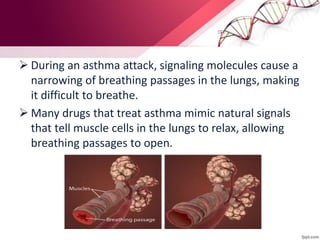
 During an asthma attack, signaling molecules cause a
narrowing of breathing passages in the lungs, making
it difficult to breathe.
 Many drugs that treat asthma mimic natural signals
that tell muscle cells in the lungs to relax, allowing
breathing passages to open.
THANKYOU


Cell signaling

  • 2.
    HINA NASIR #93 TAHIRA MEER # 06 MARYAM TAHIR # 04 GROUP MEMBERS BS Biotechnology Semester 6th
  • 3.
    >CELL SIGNALING >GENES INVOLVEDIN CELL SIGNALING >DISEASES CAUSED BY WEAK CELL SIGNALING
  • 4.
    CELL SIGNALINNG The science ofunderstanding how individual cells sense their environment and response to stimuli
  • 5.
    CELL SIGNALING • Cellsignaling is part of any communication process that governs basic activities of cells and coordinates all cell actions. • The ability of cells to perceive and correctly respond to their microenvironment is the basis of development, tissue repair, and immunity as well as normal tissue homeostasis.
  • 6.
    • how somany functionally different cells can come from one fertilized egg....?
  • 7.
    Communication by extracellular signalingusually involves eight steps 1. Synthesis of the signaling molecule by the signaling cell 2. Release of the signaling molecule by the signaling cell 3. Transport of the signal to the target cell 4. Binding of the signal by a specific receptor protein 􀃆 conformational change 5. Initiation of intracellular signal-transduction pathways by the activated receptor 6. A change in cellular metabolism, function, structure, or development triggered immediately by the receptor-signal complex 7. Usually deactivation of the receptor 8. Removal of the signal, which usually terminates the cellular response
  • 9.
    • The messagecarried by a ligand is often relayed through a chain of chemical messengers inside the cell. • Ultimately, it leads to a change in the cell, such as alteration in the activity of a gene or even the induction of a whole process, such as cell division. • Thus, the original intercellular (between-cells) signal is converted into an intracellular (within-cell) signal that triggers a response.
  • 11.
    Forms of signaling •Cell-cell signaling involves the transmission of a signal from a sending cell to a receiving cell • There are four basic categories of chemical signaling found in multicellular organisms:  paracrine signaling,  autocrine signaling,  endocrine signaling,  and signaling by direct contact. • The main difference between the different categories of signaling is the distance that the signal travels through the organism to reach the target cell.
  • 12.
    Signaling molecules operateover various distances in animals
  • 13.
    Receptors and Ligands •Receptors come in many types, but they can be divided into two categories: 1. Intracellular receptors, 2. Cell surface receptors, • Ligands 1. Ligands that can enter the cell 2. Ligands that bind on the outside of the cell
  • 14.
    From plasma membraneto nucleus • Many cellular responses induced by water-soluble hormones, growth factors, and neurotransmitters result from their effects on gene expression • Such pathways usually involve activation of protein kinases that directly or indirectly phosphorylate specific transcription factors
  • 15.
    G protein-coupled receptors •G protein-coupled receptors (GPCRs) are a large family of cell surface receptors that share a common structure and method of signaling. • The members of the GPCR family all have seven different protein segments that cross the membrane, and they transmit signals inside the cell through a type of protein called a G protein. • GPCRs are involved in a range of signaling pathways, including light detection, odorant detection, and detection of certain hormones and neurotransmitters
  • 17.
  • 18.
    Neurotransmitters Pathways • Synapticsignaling, in which nerve cells transmit signals. • This process is named for the synapse, the junction between two nerve cells where signal transmission occurs.
  • 19.
    • When thesending neuron fires, an electrical impulse moves rapidly through the cell, traveling down a long, fiber-like extension called an axon. • When the impulse reaches the synapse, it triggers the release of ligands called neurotransmitters, which quickly cross the small gap between the nerve cells. • When the neurotransmitters arrive at the receiving cell, they bind to receptors and cause a chemical change inside of the cell (often, opening ion channels and changing the electrical potential across the membrane).
  • 21.
    JAK-STAT signaling pathway •The JAK-STAT signalling cascade consists of three main components: a. a cell surface receptor, b. a Janus kinase(JAK) c. and two Signal Transducer and Activator of Transcription (STAT) proteins • Disrupted or dysregulated JAK-STAT functionality can result in immune deficiency syndromes and cancers.
  • 22.
    JAK-STAT signaling pathway •Cytokines are polypeptide hormones or growth factors that act as a local mediator in cell-cell communication. • Immune cells secrete cytokines when pathogens are encountered. • Cytokines recruit immune cells in response to pathogens. • Cytokine receptors activate the JAK-STAT signaling pathway. • JAK-STAT pathway provides a fast track to the nucleus.
  • 24.
    Genetics of cellsignaling  Multifunctional process  Many genes are involved.
  • 25.
    Proto Oncogenes: • Geneoperating positive growth regulator. • There over expression can lead to cancer in our body. • Due to mutation >bad gene > Onco gene • In contrast to onco genes we have “Tumour Supressor genes” • Supresses or slow down cell division.
  • 26.
    RAS ONCOGENES: • Rasgenes are only a small group of genes. • Function of cell signalling. • Ras gene were originally identifies from genome of rat sarcoma virus. And gained importance in 1980 when ras mutation were identified in human tumours.
  • 27.
    • Ras proteincontrol cellular pathways for growth. • Activated by extra cellular stimuli • Overactive ras signals lead to cancer
  • 28.
    Mechanism: • When rasin switched on by incoming signals, it subsequently switches on other protein which ultimately turn on gene involve in cell growth
  • 29.
    • Ras moleculespresent in inactive phase bound to GDP. • Signal received, rasGDS interacts with ras resulting in dissociation of GDP. • Ras is bound to gtp. • Ras activated • Downstream signalling to effectors are passed. • Eeffectors activated • Mission excuted
  • 30.
    Growth factor signalling: •Signals triggered by EGF. • Interacts with surface receptors of cells. • RasGDS activates raf by dissociation of GDP. • It in turn activates RAF (Kinase). • Raf then activates another downstream protein MEK which inturn activated Erk. • ERK is translocated to nucleus that in response activated a number of transcription factors. • Execute action triggered by original signal (EGF) by inducing appropriate genes.
  • 32.
    DISEASE CAUSED BYWEAK CELL SIGNALING
  • 33.
     A largeno of diseases are caused by defects in signaling pathways.  In fact most diseases involve at least one breakdown in cell communication.  Most of the serious diseases in humans such as hypertension , heart diseases , diabetes and many form of mental illness seem to arise from week signaling pathways.
  • 34.
     Losing thesignal  Normally cells in pancreas release a signal called insulin.  In type I diabetes the pancreatic cell that produce insulin are lost.  As a result sugar accumulates to toxic level in blood.  Without treatment, diabetes can lead to kidney failure blindness and heart disease in later life.
  • 36.
     When signaldoesn’t reaches it target  Multiple sclerosis is a disease in which the protective wrappings around nerve cells in the brain and spinal cord are destroyed.  Effective nerve cells can no longer transmit signals from one area of brain to another.  Nerve damage caused due to this disease can lead to muscle weakness, blurred or double vision difficulty with balance and depression.
  • 38.
     When theTarget Ignores the Signal  Type I and type II diabetes have very similar symptoms, but they have different causes.  While people who have type I diabetes are unable to produce the insulin signal, those with type II diabetes do produce insulin.  However, the cells of type II diabetics have lost the ability to respond to insulin.  The end result is the same: blood sugar levels become dangerously high.
  • 40.
     Too MuchSignal o Excitotoxicity:  After a brain injury such as a stroke, lethal amounts of signaling molecules leak out of dying nerve cells resulting in widespread damage to the brain.
  • 41.
     Cancer  Incancer , cell signaling breaks down in multiple places.  Cancer can occur in may ways but it always requires multiple signaling breakdowns.  Often, cancer begins when a cell gains the ability to grow and divide even in the absence of a signal.  Ordinarily this unregulated growth triggers a signal for self-destruction.  But when the cell also loses the ability to respond to death signals, it divides out of control, forming a tumor.
  • 42.
     Later cellcommunication events cause blood vessels to grow into the tumor, enabling it to grow larger.  Additional signals allow the cancer to spread to other parts of the body.
  • 43.
     Treatments  Justas cell signaling can go wrong resulting in disease, many disease treatments rely on cell communication.  If you think of disease as a roadblock in cell signaling, treatment is an alternate route.  The first step is to locate the problem.  The second step is to find a way around the problem. Sometimes it's easy.  For example : The treatment for type I diabetes is to inject insulin into the blood stream.
  • 44.
     During anasthma attack, signaling molecules cause a narrowing of breathing passages in the lungs, making it difficult to breathe.  Many drugs that treat asthma mimic natural signals that tell muscle cells in the lungs to relax, allowing breathing passages to open.
  • 45.