EXAMINATION REFORMS
        AND
  CONTINUOUS AND
   COMPREHENSIVE
     EVALUATION


   A CBSE INITIATIVE
WHY
             CONTINUOUS COMPREHENSIVE
                     EVALUATION
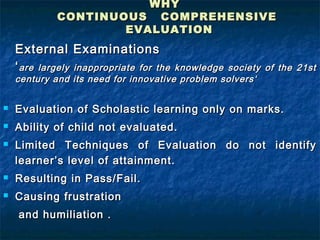
    External Examinations
    ‘ are largely inappropriate for theknowledge society of the 21st
    century and its need for innovative problem solvers‘


   Evaluation of Scholastic learning only on marks.
   Ability of child not evaluated.
   Limited Techniques of Evaluation do not identify
    learner’s level of attainment.
   Resulting in Pass/Fail.
   Causing frustration
    and humiliation .
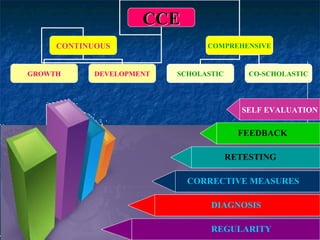
CCE
     CONTINUOUS                 COMPREHENSIVE


GROWTH      DEVELOPMENT   SCHOLASTIC       CO-SCHOLASTIC


                                         SELF EVALUATION

                                         FEEDBACK

                                       RETESTING

                            CORRECTIVE MEASURES

                                 DIAGNOSIS

                                 REGULARITY
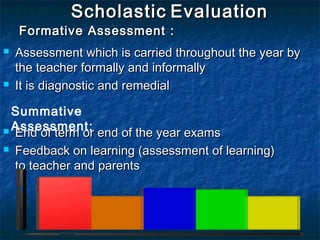
Scholastic Evaluation
    Formative Assessment :
   Assessment which is carried throughout the year by
    the teacher formally and informally
   It is diagnostic and remedial

  Summative
 Assessment: end of the year exams
  End of term or
 Feedback on learning (assessment of learning)

  to teacher and parents
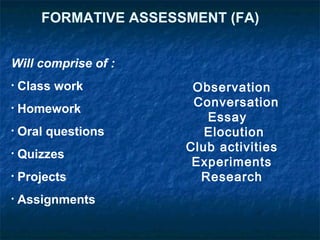
FORMATIVE ASSESSMENT (FA)


Will comprise of :
•   Class work          Observation
                        Conversation
•   Homework
                          Essay
•   Oral questions        Elocution
                       Club activities
•   Quizzes
                        Experiments
•   Projects             Research
•   Assignments
CLASS IX & X
   Academic year will have 2 terms -


FIRST TERM :
April to September

SECOND TERM:
October to March
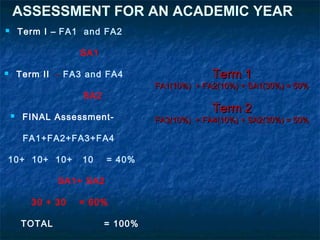
ASSESSMENT FOR AN ACADEMIC YEAR
       Term I – FA1 and FA2

                    SA1

       Term II - FA3 and FA4                    Term 1
                                    FA1(10%) + FA2(10%) + SA1(30%) = 50%
                     SA2
                                                 Term 2
        FINAL Assessment-          FA3(10%) + FA4(10%) + SA2(30%) = 50%

         FA1+FA2+FA3+FA4

10+ 10+ 10+          10    = 40%

                SA1+ SA2

          30 + 30   = 60%

        TOTAL              = 100%
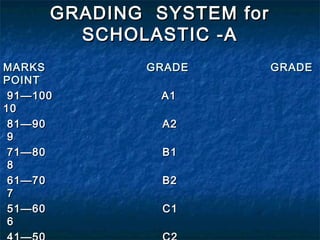
GRADING SYSTEM for
        SCHOLASTIC -A
MARKS        GRADE         GRADE
POINT
 91—100        A1
10
 81—90         A2
 9
 71—80         B1
 8
 61—70         B2
 7
 51—60         C1
 6
CCE Reporting
   Minimum qualifying grade in all the subjects under Scholastic
    Domain is D.
   All assessment with regard to the academic status of the
    students shall be done in marks and the assessment will be
    given in grades.
    CGPA (Cumulative Grade point Average) will be provided
    excluding additional 6th subject as per Scheme of Studies.
   An indicative equivalence of Grade Point and Percentage of
    marks can be computed as follows:
    Subject wise indicative percentage of marks = 9.5 x GP of the
    subject
    Overall indicative percentage of marks = 9.5 x CGPA
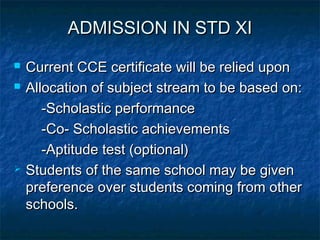
ADMISSION IN STD XI
   Current CCE certificate will be relied upon
   Allocation of subject stream to be based on:
       -Scholastic performance
       -Co- Scholastic achievements
       -Aptitude test (optional)
   Students of the same school may be given
    preference over students coming from other
    schools.
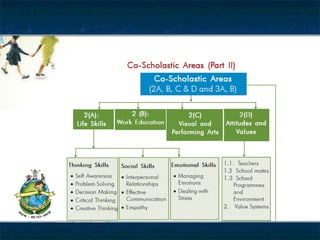
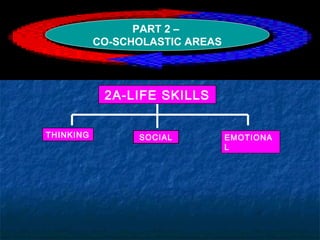
PART 2 –
           CO-SCHOLASTIC AREAS


            2A-LIFE SKILLS


THINKING         SOCIAL          EMOTIONA
                                 L
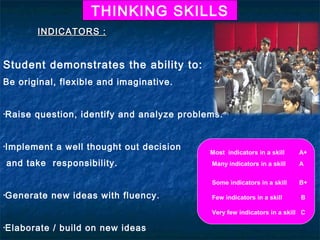
THINKING SKILLS
         INDICATORS :


Student demonstrates the ability to:
Be original, flexible and imaginative.


•Raise   question, identify and analyze problems.


•Implement    a well thought out decision
                                              Most indicators in a skill   A+
and take responsibility.                      Many indicators in a skill   A


                                              Some indicators in a skill   B+
•Generate    new ideas with fluency.          Few indicators in a skill     B

                                              Very few indicators in a skill C

•Elaborate   / build on new ideas
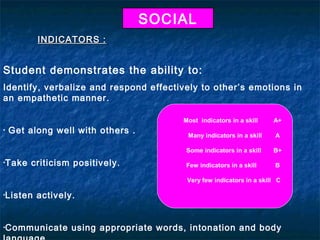
SOCIAL
          INDICATORS :


Student demonstrates the ability to:
Identify, verbalize and respond effectively to other’s emotions in
an empathetic manner.

                                         Most indicators in a skill    A+
•   Get along well with others .          Many indicators in a skill    A

                                          Some indicators in a skill   B+
•Take    criticism positively.            Few indicators in a skill     B

                                          Very few indicators in a skill C

•Listen   actively.


•Communicate      using appropriate words, intonation and body
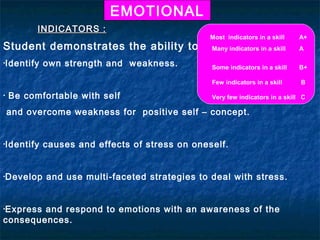
EMOTIONAL
          INDICATORS :
                                                Most indicators in a skill   A+
Student demonstrates the ability to:            Many indicators in a skill   A

•Identify   own strength and weakness.          Some indicators in a skill   B+

                                                Few indicators in a skill     B

•   Be comfortable with self                    Very few indicators in a skill C

    and overcome weakness for positive self – concept.


•Identify   causes and effects of stress on oneself.


•Develop    and use multi-faceted strategies to deal with stress.


•Expressand respond to emotions with an awareness of the
consequences.
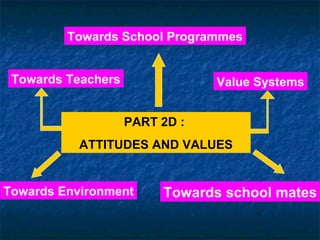
Towards School Programmes


 Towards Teachers               Value Systems


                    PART 2D :
           ATTITUDES AND VALUES


Towards Environment      Towards school mates
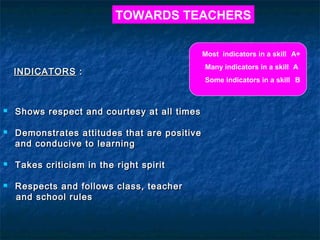
TOWARDS TEACHERS

                                               Most indicators in a skill A+
                                               Many indicators in a skill A
    INDICATORS :
                                               Some indicators in a skill B


   Shows respect and courtesy at all times

   Demonstrates attitudes that are positive
    and conducive to learning

   Takes criticism in the right spirit

   Respects and follows class, teacher
    and school rules
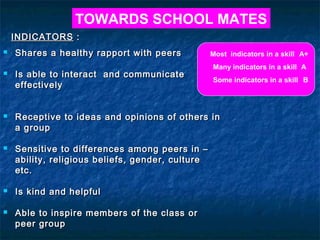
TOWARDS SCHOOL MATES
    INDICATORS :
   Shares a healthy rapport with peers           Most indicators in a skill A+
                                                  Many indicators in a skill A
   Is able to interact and communicate
                                                  Some indicators in a skill B
    effectively


   Receptive to ideas and opinions of others in
    a group

   Sensitive to differences among peers in –
    ability, religious beliefs, gender, culture
    etc.

   Is kind and helpful

   Able to inspire members of the class or
    peer group
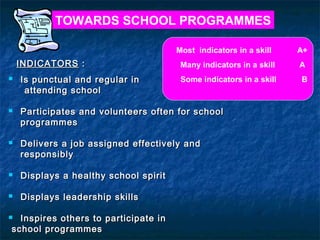
TOWARDS SCHOOL PROGRAMMES

                                       Most indicators in a skill    A+
    INDICATORS :                        Many indicators in a skill   A
   Is punctual and regular in          Some indicators in a skill   B
     attending school

   Participates and volunteers often for school
    programmes

   Delivers a job assigned effectively and
    responsibly

   Displays a healthy school spirit

   Displays leadership skills

 Inspires others to participate in
school programmes
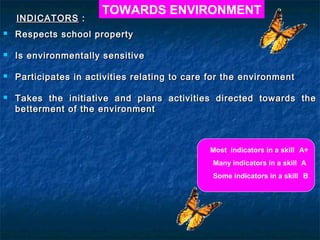
TOWARDS ENVIRONMENT
    INDICATORS :
   Respects school property

   Is environmentally sensitive

   Participates in activities relating to care for the environment

   Takes the    initiative and plans activities directed towards the
    betterment   of the environment


                                               Most indicators in a skill A+
                                                Many indicators in a skill A
                                                Some indicators in a skill B
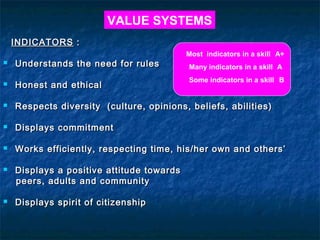
VALUE SYSTEMS
    INDICATORS :
                                           Most indicators in a skill A+
   Understands the need for rules         Many indicators in a skill A
                                           Some indicators in a skill B
   Honest and ethical

   Respects diversity (culture, opinions, beliefs, abilities)

   Displays commitment

   Works efficiently, respecting time, his/her own and others’

   Displays a positive attitude towards
    peers, adults and community

   Displays spirit of citizenship
PART-3 CO-SCHOLASTIC AREAS
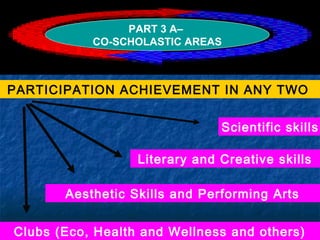
                 PART 3 A–
           CO-SCHOLASTIC AREAS


PARTICIPATION ACHIEVEMENT IN ANY TWO


                               Scientific skills

                  Literary and Creative skills

       Aesthetic Skills and Performing Arts


Clubs (Eco, Health and Wellness and others)
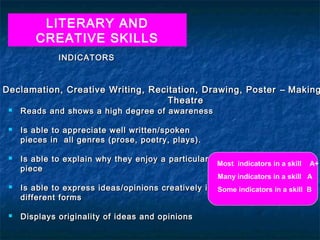
LITERARY AND
         CREATIVE SKILLS
              INDICATORS


Declamation, Creative Writing, Recitation, Drawing, Poster – Making
                                  Theatre
    Reads and shows a high degree of awareness

    Is able to appreciate well written/spoken
     pieces in all genres (prose, poetry, plays).

    Is able to explain why they enjoy a particular
                                                        Most indicators in a skill   A+
     piece
                                                        Many indicators in a skill A
    Is able to express ideas/opinions creatively in Some indicators in a skill B
     different forms

    Displays originality of ideas and opinions
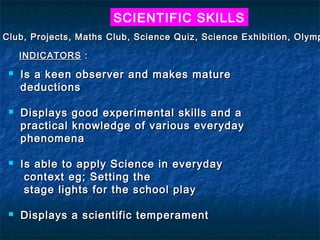
SCIENTIFIC SKILLS
Club, Projects, Maths Club, Science Quiz, Science Exhibition, Olymp

     INDICATORS :
    Is a keen observer and makes mature
     deductions

    Displays good experimental skills and a
     practical knowledge of various everyday
     phenomena

    Is able to apply Science in everyday
      context eg; Setting the
      stage lights for the school play

    Displays a scientific temperament
AESTHETIC SKILLS AND PERFORMING
c   (Vocal, Instrumental), Dance, ARTS Craft, Sculpture, Puppetry, Fo
                                  Drama,
       INDICATORS :

          Is able to appreciate well written/
            spoken pieces in all genres (prose, poetry, plays) and all
           languages

          Is able to explain why he/she enjoy a particular piece

          Shows a keen interest and an aptitude towards a particular
           art form.

          Is able to apply skills to performances/art forms

          Displays creative expression and a good presentation piece
LUBS (ECO, HEALTH & WELLNESS AND OTHER

 INDICATORS :


     Displays originality of ideas and the ability to see
      them through

     Delivers job assigned effectively
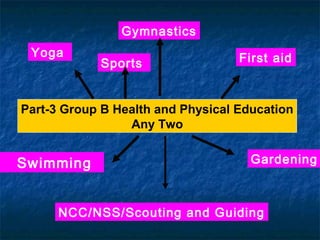
Gymnastics
 Yoga                              First aid
            Sports


Part-3 Group B Health and Physical Education
                 Any Two


Swimming                             Gardening


      NCC/NSS/Scouting and Guiding
REPORTING FOR CO-SCHOLASTIC
                   ACTIVITIES
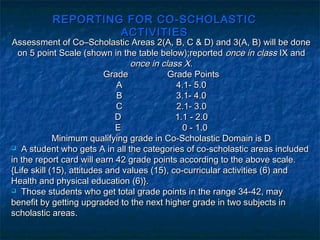
Assessment of Co–Scholastic Areas 2(A, B, C & D) and 3(A, B) will be done
  on 5 point Scale (shown in the table below);reported once in class IX and
                                  once in class X.
                           Grade            Grade Points
                              A               4.1- 5.0
                              B               3.1- 4.0
                              C               2.1- 3.0
                              D               1.1 - 2.0
                              E                 0 - 1.0
             Minimum qualifying grade in Co-Scholastic Domain is D
 A student who gets A in all the categories of co-scholastic areas included

in the report card will earn 42 grade points according to the above scale.
{Life skill (15), attitudes and values (15), co-curricular activities (6) and
Health and physical education (6)}.
 Those students who get total grade points in the range 34-42, may

benefit by getting upgraded to the next higher grade in two subjects in
scholastic areas.
 Those students who get total grade points in the range 19-33, may benefit by
getting upgraded to the next higher grade in one subject in scholastic areas.
 If a student gets less than 19 total grade points in co-scholastic areas,

separate remark may be made in the report card stating that participation and
achievement in co-scholastic areas needs improvement. However, this should
not affect the student’s promotion to higher class.
 A star may be put on every up-scaled grade to indicate that the final grade

has been arrived after including the achievement of the student in co-scholastic
areas. A footnote in this regard may be given at appropriate place in the report
card.
 The benefit of upscaling the grade in different subjects may start from the

subject in which a student obtains lowest grade followed by next higher grade
and so on.
 Benefit shall be given to the students who win I/II positions/prizes in

competitions held at state level and/or participation in competitions held at
national/international level organized by a body recognized by the state/central
Government /CBSE. Any competition organized by such agencies related to
the co-Scholastic areas included in the Board’s CCE Card may be considered
for giving this benefit. Those students who qualify under this provision will
benefit by getting their grade up-scaled to the next higher grade in two subjects
provided this benefit has not been given to the student under the aforesaid
grade point scheme.
EXAMINATION REFORMS
        AND
  CONTINUOUS AND
   COMPREHENSIVE
     EVALUATION


   A CBSE INITIATIVE

CCE PATTERN (IX-X)

  • 1.
    EXAMINATION REFORMS AND CONTINUOUS AND COMPREHENSIVE EVALUATION A CBSE INITIATIVE
  • 2.
    WHY CONTINUOUS COMPREHENSIVE EVALUATION External Examinations ‘ are largely inappropriate for theknowledge society of the 21st century and its need for innovative problem solvers‘  Evaluation of Scholastic learning only on marks.  Ability of child not evaluated.  Limited Techniques of Evaluation do not identify learner’s level of attainment.  Resulting in Pass/Fail.  Causing frustration and humiliation .
  • 3.
    CCE CONTINUOUS COMPREHENSIVE GROWTH DEVELOPMENT SCHOLASTIC CO-SCHOLASTIC SELF EVALUATION FEEDBACK RETESTING CORRECTIVE MEASURES DIAGNOSIS REGULARITY
  • 4.
    Scholastic Evaluation Formative Assessment :  Assessment which is carried throughout the year by the teacher formally and informally  It is diagnostic and remedial Summative  Assessment: end of the year exams End of term or  Feedback on learning (assessment of learning) to teacher and parents
  • 5.
    FORMATIVE ASSESSMENT (FA) Willcomprise of : • Class work Observation Conversation • Homework Essay • Oral questions Elocution Club activities • Quizzes Experiments • Projects Research • Assignments
  • 6.
    CLASS IX &X  Academic year will have 2 terms - FIRST TERM : April to September SECOND TERM: October to March
  • 7.
    ASSESSMENT FOR ANACADEMIC YEAR  Term I – FA1 and FA2 SA1  Term II - FA3 and FA4 Term 1 FA1(10%) + FA2(10%) + SA1(30%) = 50% SA2 Term 2  FINAL Assessment- FA3(10%) + FA4(10%) + SA2(30%) = 50% FA1+FA2+FA3+FA4 10+ 10+ 10+ 10 = 40% SA1+ SA2 30 + 30 = 60% TOTAL = 100%
  • 8.
    GRADING SYSTEM for SCHOLASTIC -A MARKS GRADE GRADE POINT 91—100 A1 10 81—90 A2 9 71—80 B1 8 61—70 B2 7 51—60 C1 6
  • 9.
    CCE Reporting  Minimum qualifying grade in all the subjects under Scholastic Domain is D.  All assessment with regard to the academic status of the students shall be done in marks and the assessment will be given in grades.  CGPA (Cumulative Grade point Average) will be provided excluding additional 6th subject as per Scheme of Studies.  An indicative equivalence of Grade Point and Percentage of marks can be computed as follows: Subject wise indicative percentage of marks = 9.5 x GP of the subject Overall indicative percentage of marks = 9.5 x CGPA
  • 10.
    ADMISSION IN STDXI  Current CCE certificate will be relied upon  Allocation of subject stream to be based on: -Scholastic performance -Co- Scholastic achievements -Aptitude test (optional)  Students of the same school may be given preference over students coming from other schools.
  • 12.
    PART 2 – CO-SCHOLASTIC AREAS 2A-LIFE SKILLS THINKING SOCIAL EMOTIONA L
  • 13.
    THINKING SKILLS INDICATORS : Student demonstrates the ability to: Be original, flexible and imaginative. •Raise question, identify and analyze problems. •Implement a well thought out decision Most indicators in a skill A+ and take responsibility. Many indicators in a skill A Some indicators in a skill B+ •Generate new ideas with fluency. Few indicators in a skill B Very few indicators in a skill C •Elaborate / build on new ideas
  • 14.
    SOCIAL INDICATORS : Student demonstrates the ability to: Identify, verbalize and respond effectively to other’s emotions in an empathetic manner. Most indicators in a skill A+ • Get along well with others . Many indicators in a skill A Some indicators in a skill B+ •Take criticism positively. Few indicators in a skill B Very few indicators in a skill C •Listen actively. •Communicate using appropriate words, intonation and body
  • 15.
    EMOTIONAL INDICATORS : Most indicators in a skill A+ Student demonstrates the ability to: Many indicators in a skill A •Identify own strength and weakness. Some indicators in a skill B+ Few indicators in a skill B • Be comfortable with self Very few indicators in a skill C and overcome weakness for positive self – concept. •Identify causes and effects of stress on oneself. •Develop and use multi-faceted strategies to deal with stress. •Expressand respond to emotions with an awareness of the consequences.
  • 16.
    Towards School Programmes Towards Teachers Value Systems PART 2D : ATTITUDES AND VALUES Towards Environment Towards school mates
  • 17.
    TOWARDS TEACHERS Most indicators in a skill A+ Many indicators in a skill A INDICATORS : Some indicators in a skill B  Shows respect and courtesy at all times  Demonstrates attitudes that are positive and conducive to learning  Takes criticism in the right spirit  Respects and follows class, teacher and school rules
  • 18.
    TOWARDS SCHOOL MATES INDICATORS :  Shares a healthy rapport with peers Most indicators in a skill A+ Many indicators in a skill A  Is able to interact and communicate Some indicators in a skill B effectively  Receptive to ideas and opinions of others in a group  Sensitive to differences among peers in – ability, religious beliefs, gender, culture etc.  Is kind and helpful  Able to inspire members of the class or peer group
  • 19.
    TOWARDS SCHOOL PROGRAMMES Most indicators in a skill A+ INDICATORS : Many indicators in a skill A  Is punctual and regular in Some indicators in a skill B attending school  Participates and volunteers often for school programmes  Delivers a job assigned effectively and responsibly  Displays a healthy school spirit  Displays leadership skills  Inspires others to participate in school programmes
  • 20.
    TOWARDS ENVIRONMENT INDICATORS :  Respects school property  Is environmentally sensitive  Participates in activities relating to care for the environment  Takes the initiative and plans activities directed towards the betterment of the environment Most indicators in a skill A+ Many indicators in a skill A Some indicators in a skill B
  • 21.
    VALUE SYSTEMS INDICATORS : Most indicators in a skill A+  Understands the need for rules Many indicators in a skill A Some indicators in a skill B  Honest and ethical  Respects diversity (culture, opinions, beliefs, abilities)  Displays commitment  Works efficiently, respecting time, his/her own and others’  Displays a positive attitude towards peers, adults and community  Displays spirit of citizenship
  • 22.
    PART-3 CO-SCHOLASTIC AREAS PART 3 A– CO-SCHOLASTIC AREAS PARTICIPATION ACHIEVEMENT IN ANY TWO Scientific skills Literary and Creative skills Aesthetic Skills and Performing Arts Clubs (Eco, Health and Wellness and others)
  • 23.
    LITERARY AND CREATIVE SKILLS INDICATORS Declamation, Creative Writing, Recitation, Drawing, Poster – Making Theatre  Reads and shows a high degree of awareness  Is able to appreciate well written/spoken pieces in all genres (prose, poetry, plays).  Is able to explain why they enjoy a particular Most indicators in a skill A+ piece Many indicators in a skill A  Is able to express ideas/opinions creatively in Some indicators in a skill B different forms  Displays originality of ideas and opinions
  • 24.
    SCIENTIFIC SKILLS Club, Projects,Maths Club, Science Quiz, Science Exhibition, Olymp INDICATORS :  Is a keen observer and makes mature deductions  Displays good experimental skills and a practical knowledge of various everyday phenomena  Is able to apply Science in everyday context eg; Setting the stage lights for the school play  Displays a scientific temperament
  • 25.
    AESTHETIC SKILLS ANDPERFORMING c (Vocal, Instrumental), Dance, ARTS Craft, Sculpture, Puppetry, Fo Drama, INDICATORS :  Is able to appreciate well written/ spoken pieces in all genres (prose, poetry, plays) and all languages  Is able to explain why he/she enjoy a particular piece  Shows a keen interest and an aptitude towards a particular art form.  Is able to apply skills to performances/art forms  Displays creative expression and a good presentation piece
  • 26.
    LUBS (ECO, HEALTH& WELLNESS AND OTHER INDICATORS :  Displays originality of ideas and the ability to see them through  Delivers job assigned effectively
  • 27.
    Gymnastics Yoga First aid Sports Part-3 Group B Health and Physical Education Any Two Swimming Gardening NCC/NSS/Scouting and Guiding
  • 28.
    REPORTING FOR CO-SCHOLASTIC ACTIVITIES Assessment of Co–Scholastic Areas 2(A, B, C & D) and 3(A, B) will be done on 5 point Scale (shown in the table below);reported once in class IX and once in class X. Grade Grade Points A 4.1- 5.0 B 3.1- 4.0 C 2.1- 3.0 D 1.1 - 2.0 E 0 - 1.0 Minimum qualifying grade in Co-Scholastic Domain is D  A student who gets A in all the categories of co-scholastic areas included in the report card will earn 42 grade points according to the above scale. {Life skill (15), attitudes and values (15), co-curricular activities (6) and Health and physical education (6)}.  Those students who get total grade points in the range 34-42, may benefit by getting upgraded to the next higher grade in two subjects in scholastic areas.
  • 29.
     Those studentswho get total grade points in the range 19-33, may benefit by getting upgraded to the next higher grade in one subject in scholastic areas.  If a student gets less than 19 total grade points in co-scholastic areas, separate remark may be made in the report card stating that participation and achievement in co-scholastic areas needs improvement. However, this should not affect the student’s promotion to higher class.  A star may be put on every up-scaled grade to indicate that the final grade has been arrived after including the achievement of the student in co-scholastic areas. A footnote in this regard may be given at appropriate place in the report card.  The benefit of upscaling the grade in different subjects may start from the subject in which a student obtains lowest grade followed by next higher grade and so on.  Benefit shall be given to the students who win I/II positions/prizes in competitions held at state level and/or participation in competitions held at national/international level organized by a body recognized by the state/central Government /CBSE. Any competition organized by such agencies related to the co-Scholastic areas included in the Board’s CCE Card may be considered for giving this benefit. Those students who qualify under this provision will benefit by getting their grade up-scaled to the next higher grade in two subjects provided this benefit has not been given to the student under the aforesaid grade point scheme.
  • 30.
    EXAMINATION REFORMS AND CONTINUOUS AND COMPREHENSIVE EVALUATION A CBSE INITIATIVE