EDU 703 Modern Educational
Practices
Part A
Educational Evaluation and Research
Evaluation in Education
• Making Judgement about something
• Systematic Determination of a subject’s
worth, merit and significance
Evaluation involves..
• Assessment
assessment refers to the
processes and product which
are used to describe the
nature and extent of some
attribute
• Measurement
measurement is the
process of assigning
numerals to objects or
qualities
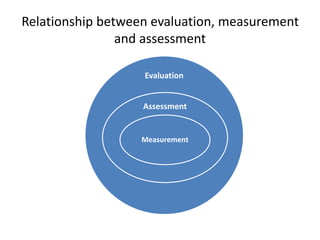
Relationship between evaluation, measurement
and assessment
Evaluation
Assessment
Measurement
Difference between
measurement and evaluation
MEASUREMENT
• Quantitative
• Objective
• Precise and specific
• Scope is limited to
scholastic
• Independent of evaluation
• Not continuous
EVALUATION
• Qualitative
• Subjective
• Interpretive and
philosophical
• Unlimited to scholastic and
non scholastic
• Depends on measurement
• continuous
Significance of Evaluation
• Evaluation is an important component of
teaching and learning process
Instructional
Objectives
Learning
Experince
Evaluation
Significance of Evaluation
• Motivates students for better learning
• Diagnoses strength and weakness of students
• It judges effectiveness of the instruction
• It helps in determining how far the learning
objectives are achieved
Significance of Evaluation
• It determines the rate of progress of students
• It provides the base for certifying the students
• It helps in classifying students
• It predicts the success of the student in future.
Significance of Evaluation
• Gives reinforcement for teacher and learners
• It is a procedure for improving the product
• It is a procedure of quality control
Functions of Evaluation
• Evaluation assesses or make appraisal of
 Educational objectives,
 Programmes
 Curriculum
 Instructional material
 Performance of teachers and learners
Functions of Evaluation
• Evaluation enhance the quality of the teacher
– It helps the teacher to find out how far they have
succeeded in their teaching
– Evaluation helps the teacher to adopt appropriate
instructional Strategies
Functions of Evaluation
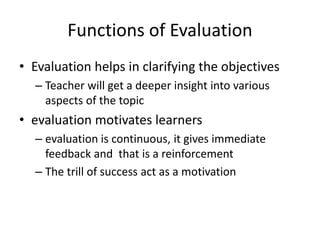
• Evaluation helps in clarifying the objectives
– Teacher will get a deeper insight into various
aspects of the topic
• evaluation motivates learners
– evaluation is continuous, it gives immediate
feedback and that is a reinforcement
– The trill of success act as a motivation
Functions of evaluation
• Guidance can be given on the basis of
evaluation
– Evaluation makes the individual difference clear
– Specific difficulties can be identified
• Evaluation helps in bringing changes in the
curriculum
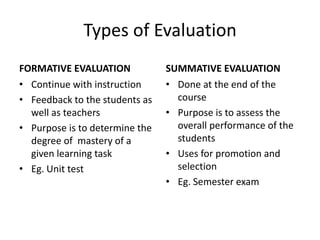
Types of Evaluation
FORMATIVE EVALUATION
• Continue with instruction
• Feedback to the students as
well as teachers
• Purpose is to determine the
degree of mastery of a
given learning task
• Eg. Unit test
SUMMATIVE EVALUATION
• Done at the end of the
course
• Purpose is to assess the
overall performance of the
students
• Uses for promotion and
selection
• Eg. Semester exam
Types of Evalution
Scholastic Evaluation
• The evaluation procedure
which analyses the
cognitive abilities of the
students
• Eg. Knowledge,
understanding, application,
synthesis, analysis
Co-scholastic Evaluation
• The evaluation procedure
which analyses the factors
like physical health, habits,
interest, attitude etc. (Other
than subjects)
• Eg. Study habits, literary
interest, musical inteest,
scientific interest, attitudes,
values etc..
System of Evaluation
Introduced in Kerala
i. Evaluation of Scholastic skill
ii. Evaluation of Co-scholastic skill
iii.Evaluation of Personal and Social
Qualities
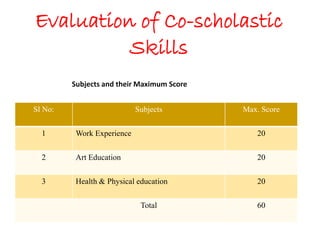
Evaluation of Co-scholastic
Skills
Subjects and their Maximum Score
Sl No: Subjects Max. Score
1 Work Experience 20
2 Art Education 20
3 Health & Physical education 20
Total 60
Evaluation of Personal & Social
Qualities
Items to be Evaluated
Sl No: Quality Grade
1 Communication Skill
2 Character & Conduct
3 Regularity
4 Group Working Skill
5 Leadership Quality
6 School Club Activities
Continuous and comprehensive
evaluation (CCE)
• CCE is an approach that aims at assessing
those attributes which cannot be assessed
through one attempt written examination
• Student must be evaluated continuously
through out the academic year. Project work,
practical, collections, assignments, seminars,
internal examinations are to be considered
while evaluating the student.
CCE
• Comprehensive evaluation means evaluation
of the all aspects of the individual
• Students’ achievements in sports and games,
art and work experience etc. should give due
importance in evaluation. Personal and social
qualities of the students also to be considered
to evaluate the students’ performance.
CCE
Scholastic
Achievements
Co- Scholastics
Achievements
Personal and
social qualities
Norm referenced evaluation
• The classroom test and standardised test that
report test report in terms of

Edu 703 modern educational practices

  • 1.
    EDU 703 ModernEducational Practices Part A Educational Evaluation and Research
  • 2.
    Evaluation in Education •Making Judgement about something • Systematic Determination of a subject’s worth, merit and significance
  • 3.
    Evaluation involves.. • Assessment assessmentrefers to the processes and product which are used to describe the nature and extent of some attribute • Measurement measurement is the process of assigning numerals to objects or qualities
  • 4.
    Relationship between evaluation,measurement and assessment Evaluation Assessment Measurement
  • 5.
    Difference between measurement andevaluation MEASUREMENT • Quantitative • Objective • Precise and specific • Scope is limited to scholastic • Independent of evaluation • Not continuous EVALUATION • Qualitative • Subjective • Interpretive and philosophical • Unlimited to scholastic and non scholastic • Depends on measurement • continuous
  • 6.
    Significance of Evaluation •Evaluation is an important component of teaching and learning process Instructional Objectives Learning Experince Evaluation
  • 7.
    Significance of Evaluation •Motivates students for better learning • Diagnoses strength and weakness of students • It judges effectiveness of the instruction • It helps in determining how far the learning objectives are achieved
  • 8.
    Significance of Evaluation •It determines the rate of progress of students • It provides the base for certifying the students • It helps in classifying students • It predicts the success of the student in future.
  • 9.
    Significance of Evaluation •Gives reinforcement for teacher and learners • It is a procedure for improving the product • It is a procedure of quality control
  • 10.
    Functions of Evaluation •Evaluation assesses or make appraisal of  Educational objectives,  Programmes  Curriculum  Instructional material  Performance of teachers and learners
  • 11.
    Functions of Evaluation •Evaluation enhance the quality of the teacher – It helps the teacher to find out how far they have succeeded in their teaching – Evaluation helps the teacher to adopt appropriate instructional Strategies
  • 12.
    Functions of Evaluation •Evaluation helps in clarifying the objectives – Teacher will get a deeper insight into various aspects of the topic • evaluation motivates learners – evaluation is continuous, it gives immediate feedback and that is a reinforcement – The trill of success act as a motivation
  • 13.
    Functions of evaluation •Guidance can be given on the basis of evaluation – Evaluation makes the individual difference clear – Specific difficulties can be identified • Evaluation helps in bringing changes in the curriculum
  • 14.
    Types of Evaluation FORMATIVEEVALUATION • Continue with instruction • Feedback to the students as well as teachers • Purpose is to determine the degree of mastery of a given learning task • Eg. Unit test SUMMATIVE EVALUATION • Done at the end of the course • Purpose is to assess the overall performance of the students • Uses for promotion and selection • Eg. Semester exam
  • 15.
    Types of Evalution ScholasticEvaluation • The evaluation procedure which analyses the cognitive abilities of the students • Eg. Knowledge, understanding, application, synthesis, analysis Co-scholastic Evaluation • The evaluation procedure which analyses the factors like physical health, habits, interest, attitude etc. (Other than subjects) • Eg. Study habits, literary interest, musical inteest, scientific interest, attitudes, values etc..
  • 16.
    System of Evaluation Introducedin Kerala i. Evaluation of Scholastic skill ii. Evaluation of Co-scholastic skill iii.Evaluation of Personal and Social Qualities
  • 17.
    Evaluation of Co-scholastic Skills Subjectsand their Maximum Score Sl No: Subjects Max. Score 1 Work Experience 20 2 Art Education 20 3 Health & Physical education 20 Total 60
  • 18.
    Evaluation of Personal& Social Qualities Items to be Evaluated Sl No: Quality Grade 1 Communication Skill 2 Character & Conduct 3 Regularity 4 Group Working Skill 5 Leadership Quality 6 School Club Activities
  • 19.
    Continuous and comprehensive evaluation(CCE) • CCE is an approach that aims at assessing those attributes which cannot be assessed through one attempt written examination • Student must be evaluated continuously through out the academic year. Project work, practical, collections, assignments, seminars, internal examinations are to be considered while evaluating the student.
  • 20.
    CCE • Comprehensive evaluationmeans evaluation of the all aspects of the individual • Students’ achievements in sports and games, art and work experience etc. should give due importance in evaluation. Personal and social qualities of the students also to be considered to evaluate the students’ performance.
  • 21.
  • 22.
    Norm referenced evaluation •The classroom test and standardised test that report test report in terms of