2013 © Next Education India Private Limited.2014 © Next Education India Private Limited.
CCE & CBSE INITIATIVES
Understanding: Clarity and Structure
Rashmi Kaushal Baveja
General Manager Academics
Next Education
2013 © Next Education India Private Limited.
Mudaliar Commission
(1952-53)
Kothari Commission
(1966)
National Policy of Education
(1986)
CABE Committee Report
(1992)
National Curriculum Framework
(2005)
Position Paper on Examination Reforms
(2006)
REPORTS AND RECOMMENDATIONS
2013 © Next Education India Private Limited.
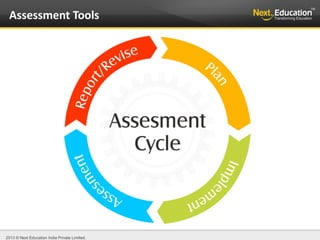
Assessment Tools
2013 © Next Education India Private Limited.
●
Use a variety of ways to collect information about the learner’s
learning and progress in all subjects.
●
Collect information continuously and record the same.
●
Give importance to each learner’s way of responding and
learning and the span of time the child takes to do so.
●
Report on continuous basis and be sensitive to every learner’s
response.
●
Provide feedback that will lead to positive action and help the
learner to do better.
Assessment needs to:
2013 © Next Education India Private Limited.
●
Continuous and Comprehensive Evaluation (CCE) refers to a
system of school-based evaluation of students that covers all
aspects of students development.
What is ‘Continuous’ and ‘Comprehensive’
Evaluation?
2013 © Next Education India Private Limited.
●
CCE helps in improving student’s performance by identifying
his/her learning difficulties at regular time intervals right from
the beginning of the academic session and employing suitable
remedial measures for enhancing their learning performance.
CBSE Quotes
2013 © Next Education India Private Limited.
●
Regularity of assessment, frequency of unit testing, diagnosis
of learning gaps, use of corrective measures, retesting and
feedback of evidence to teachers and students for their self
evaluation.
Continuous means:
2013 © Next Education India Private Limited.
●
Attempt to cover both the scholastic and the co-scholastic
aspects of students’ growth and development.
Comprehensive means:
2013 © Next Education India Private Limited.
●
Makes learning more useful and relevant
●
Promotes active learning
●
Extends the boundaries of the classroom
●
Provides students with real-life application of what they learn in the class
●
Promotes the value of diversity
●
Strengthens analytical and critical thinking skills
●
Strengthens interpersonal and communication skills
●
Promotes students' intellectual growth, leadership development, and personal
and social growth
●
Fosters a sense of civic responsibility
●
Allows for integration and synthesis of knowledge
●
Helps prepare students for the world of work
What & Why of CCE?
2013 © Next Education India Private Limited.
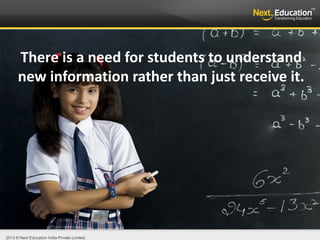
There is a need for students to understand
new information rather than just receive it.
2013 © Next Education India Private Limited.
●
Inspiration and invigoration of teaching methods (innovation)
●
Increased student contact through greater emphasis on student-
centered teaching
●
A new perspective on learning and an increased understanding of
how learning occurs
●
Connecting the community with curriculum and becoming more
aware of current societal issues as they relate to academic areas
of interest
●
Identifying areas for research and publication related to current
trends
Benefits for Academic Staff
2013 © Next Education India Private Limited.
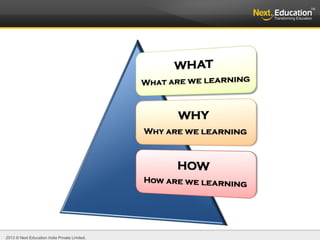
How to survive life?
2013 © Next Education India Private Limited.
●
The Central Board of Secondary Education introduced Continuous and
Comprehensive Evaluation (CCE) in Primary classes (class I to V) in 2004.
(Circular No. 5/18/25/04)
●
For this the Board recommended a five Point rating scale, it also
recommended the elimination of the pass /fail system at the primary classes
(Circular No. 31/04/21/05)
●
The focus was on identifying the talents of the learner and empowering with
positive inputs.
●
The Board has also followed it up by extending this scheme up to Classes VI to
VIII and developed a CCE card on School Based Assessment for the same.
(Circular No. 2/06)
History of CCE in India
2013 © Next Education India Private Limited.
●
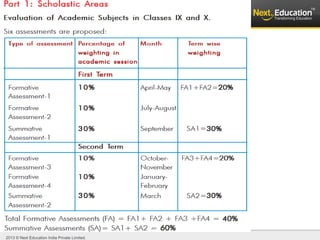
The Class IX & X students are also being assessed through the
CCE by the school itself.
●
In general, for the purpose of the CCE, an academic year has
been divided into two terms.
●
The first term will be from April – Sept and the second term
from October – March.
2013 © Next Education India Private Limited.
●
The Continuous and Comprehensive Evaluation (CCE) has to be
strengthened in all affiliated schools.
●
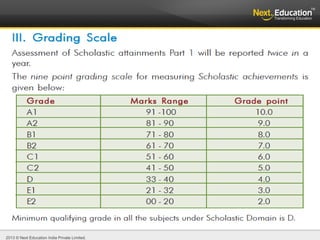
The new 9 point Grading system has been introduced at Secondary
School level (for Classes IX & X) effective from 2009-10 Academic
Session.
Implementation of CCE
2013 © Next Education India Private Limited.
●
It will reduce stress and anxiety which often builds up during and
after the examination
●
It will reduce the dropout rate as there will be less fear and
anxiety related to performance.
●
The emphasis on conceptual clarification through experiential
learning in the classroom
How would the Scheme help?
2013 © Next Education India Private Limited.
●
It is expected to prepare the students for life by making students
physically fit, mentally alert and emotionally balanced.
●
The students will have more time on their hands to develop their
interests, hobbies and personalities.
●
It will enable the students, parents and teachers to make an
informed choice about subjects in Class XI.
●
Schools have been asked to appoint Full time Counselors as a
process.
Expectation being delivered by CCE:
2013 © Next Education India Private Limited.
In the assessment process, one should be careful NEVER
to:
●
Label learners as slow, poor, intelligent etc.
●
Make comparisons between them.
●
Make negative statements.
Priority while testing……
2013 © Next Education India Private Limited.
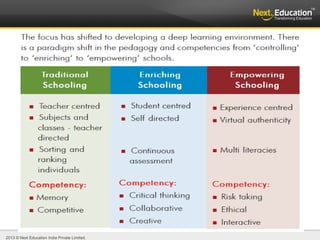
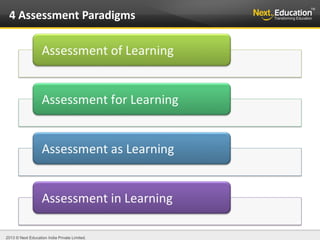
4 Assessment Paradigms
2013 © Next Education India Private Limited.
●
It will motivate learning in a friendly environment rather than
in a fearful situation.
●
It will equip students with Life Skills especially Creative and
Critical thinking skills, social skills and coping skills which will
keep them in a good stead when they enter into a highly
competitive environment later on.
Expectation being delivered by CCE:
2013 © Next Education India Private Limited.
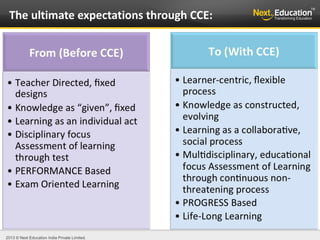
The ultimate expectations through CCE:
2013 © Next Education India Private Limited.
●
Shared lesson planning:
●
Not only the same subject teachers, but also collaboration of resources
ought to happen with teachers taking up different subject areas.
What goes behind the implementation of CCE?
2013 © Next Education India Private Limited.
●
Reduced teacher pupil ratio:
●
It is absolutely essential to have a small class, with the teacher-
student ratio not exceeding 1:30 for effective implementation of the
scheme.
CCE Initiates:
2013 © Next Education India Private Limited.
●
Sustained reading time:
●
It is often observed that classroom issues remain only the prerogative of
the class teacher. Reading needs to be a sustained school routine where
pedagogical issues are addressed.
CCE Inspires towards:
2013 © Next Education India Private Limited.
●
Flexible timetable:
●
The implementation of the scheme also implies flexible timetables.
Imagine the plight of the child’s mind buffering between different
subjects one after the other, switching on and off within the span of 30
minutes.
CCE Explores !!
2013 © Next Education India Private Limited.
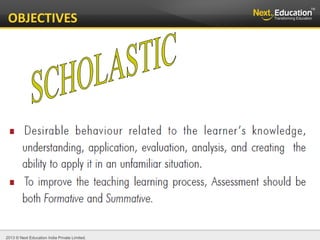
OBJECTIVES
2013 © Next Education India Private Limited.
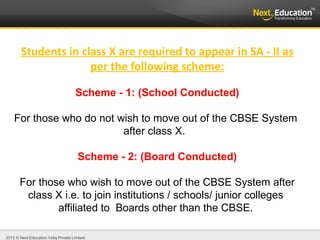
Students in class X are required to appear in SA - II as
per the following scheme:
Scheme - 1: (School Conducted)
For those who do not wish to move out of the CBSE System
after class X.
Scheme - 2: (Board Conducted)
For those who wish to move out of the CBSE System after
class X i.e. to join institutions / schools/ junior colleges
affiliated to Boards other than the CBSE.
2013 © Next Education India Private Limited.
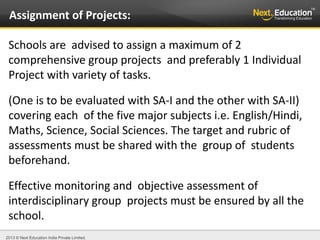
Schools are advised to assign a maximum of 2
comprehensive group projects and preferably 1 Individual
Project with variety of tasks.
(One is to be evaluated with SA-I and the other with SA-II)
covering each of the five major subjects i.e. English/Hindi,
Maths, Science, Social Sciences. The target and rubric of
assessments must be shared with the group of students
beforehand.
Effective monitoring and objective assessment of
interdisciplinary group projects must be ensured by all the
school.
Assignment of Projects:
2013 © Next Education India Private Limited.
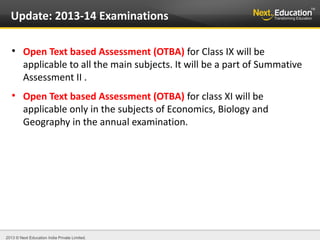
Update: 2013-14 Examinations

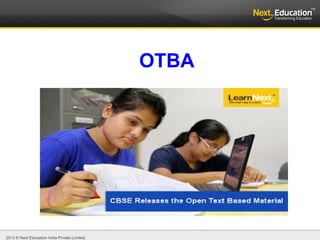
Open Text based Assessment (OTBA) for Class IX will be
applicable to all the main subjects. It will be a part of Summative
Assessment II .

Open Text based Assessment (OTBA) for class XI will be
applicable only in the subjects of Economics, Biology and
Geography in the annual examination.
2013 © Next Education India Private Limited.
OTBA
2013 © Next Education India Private Limited.
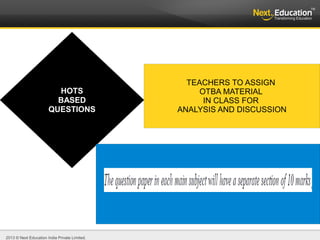
HOTS
BASED
QUESTIONS
TEACHERS TO ASSIGN
OTBA MATERIAL
IN CLASS FOR
ANALYSIS AND DISCUSSION
2013 © Next Education India Private Limited.
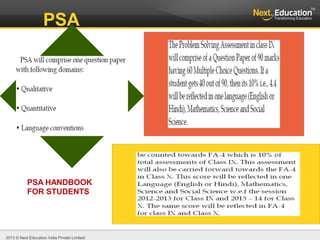
PSA HANDBOOK
FOR STUDENTS
PSA
2013 © Next Education India Private Limited.
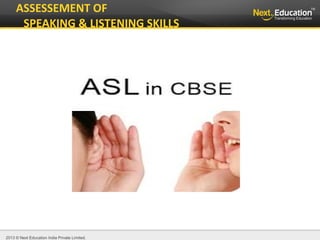
ASSESSEMENT OF
SPEAKING & LISTENING SKILLS
2013 © Next Education India Private Limited.
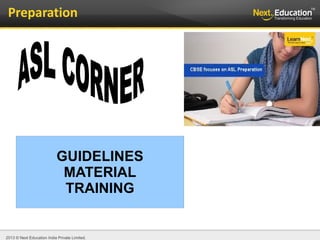
Preparation
GUIDELINES
MATERIAL
TRAINING
2013 © Next Education India Private Limited.
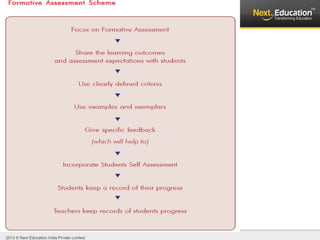
The basic assumption of Formative Assessment is that
every child can improve. When children are engaged in
activities they feel like participating in the assessment
process, projects, homework. They themselves grow,
feeling in control of their success, and believing that
continued success is within their reach if they keep trying.
A priority: Formative Assessment
2013 © Next Education India Private Limited.
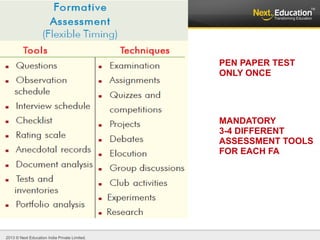
PEN PAPER TEST
ONLY ONCE
MANDATORY
3-4 DIFFERENT
ASSESSMENT TOOLS
FOR EACH FA
2013 © Next Education India Private Limited.
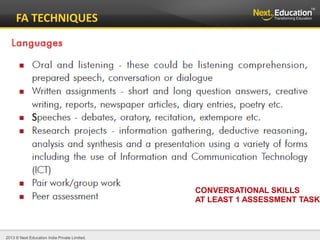
FA TECHNIQUES
CONVERSATIONAL SKILLS
AT LEAST 1 ASSESSMENT TASK
2013 © Next Education India Private Limited.
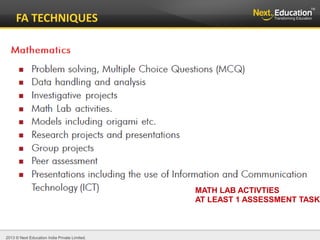
FA TECHNIQUES
MATH LAB ACTIVTIES
AT LEAST 1 ASSESSMENT TASK
2013 © Next Education India Private Limited.
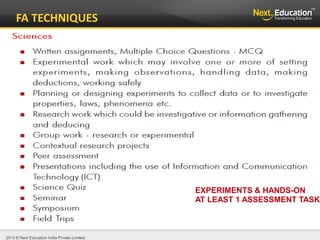
FA TECHNIQUES
EXPERIMENTS & HANDS-ON
AT LEAST 1 ASSESSMENT TASK
2013 © Next Education India Private Limited.
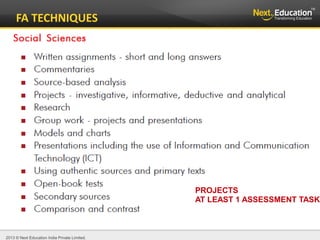
FA TECHNIQUES
PROJECTS
AT LEAST 1 ASSESSMENT TASK
2013 © Next Education India Private Limited.
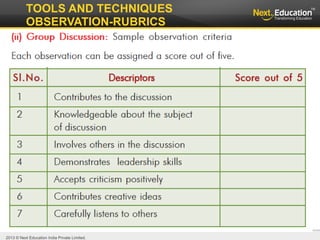
TOOLS AND TECHNIQUES
OBSERVATION-RUBRICS
2013 © Next Education India Private Limited.
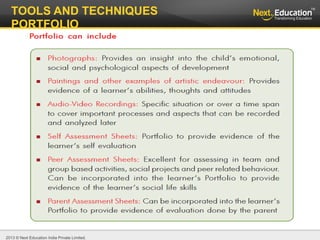
TOOLS AND TECHNIQUES
PORTFOLIO
2013 © Next Education India Private Limited.
FEATURES OF SUMMATIVE ASSESSMENT
●Assessment OF learning
●'Sums up' what students have/have not
learnt
2013 © Next Education India Private Limited.

S2 cce understanding-scholastics

  • 1.
    2013 © NextEducation India Private Limited.2014 © Next Education India Private Limited. CCE & CBSE INITIATIVES Understanding: Clarity and Structure Rashmi Kaushal Baveja General Manager Academics Next Education
  • 2.
    2013 © NextEducation India Private Limited. Mudaliar Commission (1952-53) Kothari Commission (1966) National Policy of Education (1986) CABE Committee Report (1992) National Curriculum Framework (2005) Position Paper on Examination Reforms (2006) REPORTS AND RECOMMENDATIONS
  • 3.
    2013 © NextEducation India Private Limited.
  • 4.
    2013 © NextEducation India Private Limited.
  • 5.
    2013 © NextEducation India Private Limited. Assessment Tools
  • 6.
    2013 © NextEducation India Private Limited. ● Use a variety of ways to collect information about the learner’s learning and progress in all subjects. ● Collect information continuously and record the same. ● Give importance to each learner’s way of responding and learning and the span of time the child takes to do so. ● Report on continuous basis and be sensitive to every learner’s response. ● Provide feedback that will lead to positive action and help the learner to do better. Assessment needs to:
  • 7.
    2013 © NextEducation India Private Limited. ● Continuous and Comprehensive Evaluation (CCE) refers to a system of school-based evaluation of students that covers all aspects of students development. What is ‘Continuous’ and ‘Comprehensive’ Evaluation?
  • 8.
    2013 © NextEducation India Private Limited. ● CCE helps in improving student’s performance by identifying his/her learning difficulties at regular time intervals right from the beginning of the academic session and employing suitable remedial measures for enhancing their learning performance. CBSE Quotes
  • 9.
    2013 © NextEducation India Private Limited. ● Regularity of assessment, frequency of unit testing, diagnosis of learning gaps, use of corrective measures, retesting and feedback of evidence to teachers and students for their self evaluation. Continuous means:
  • 10.
    2013 © NextEducation India Private Limited. ● Attempt to cover both the scholastic and the co-scholastic aspects of students’ growth and development. Comprehensive means:
  • 11.
    2013 © NextEducation India Private Limited. ● Makes learning more useful and relevant ● Promotes active learning ● Extends the boundaries of the classroom ● Provides students with real-life application of what they learn in the class ● Promotes the value of diversity ● Strengthens analytical and critical thinking skills ● Strengthens interpersonal and communication skills ● Promotes students' intellectual growth, leadership development, and personal and social growth ● Fosters a sense of civic responsibility ● Allows for integration and synthesis of knowledge ● Helps prepare students for the world of work What & Why of CCE?
  • 12.
    2013 © NextEducation India Private Limited. There is a need for students to understand new information rather than just receive it.
  • 13.
    2013 © NextEducation India Private Limited. ● Inspiration and invigoration of teaching methods (innovation) ● Increased student contact through greater emphasis on student- centered teaching ● A new perspective on learning and an increased understanding of how learning occurs ● Connecting the community with curriculum and becoming more aware of current societal issues as they relate to academic areas of interest ● Identifying areas for research and publication related to current trends Benefits for Academic Staff
  • 14.
    2013 © NextEducation India Private Limited. How to survive life?
  • 15.
    2013 © NextEducation India Private Limited.
  • 16.
    2013 © NextEducation India Private Limited. ● The Central Board of Secondary Education introduced Continuous and Comprehensive Evaluation (CCE) in Primary classes (class I to V) in 2004. (Circular No. 5/18/25/04) ● For this the Board recommended a five Point rating scale, it also recommended the elimination of the pass /fail system at the primary classes (Circular No. 31/04/21/05) ● The focus was on identifying the talents of the learner and empowering with positive inputs. ● The Board has also followed it up by extending this scheme up to Classes VI to VIII and developed a CCE card on School Based Assessment for the same. (Circular No. 2/06) History of CCE in India
  • 17.
    2013 © NextEducation India Private Limited. ● The Class IX & X students are also being assessed through the CCE by the school itself. ● In general, for the purpose of the CCE, an academic year has been divided into two terms. ● The first term will be from April – Sept and the second term from October – March.
  • 18.
    2013 © NextEducation India Private Limited. ● The Continuous and Comprehensive Evaluation (CCE) has to be strengthened in all affiliated schools. ● The new 9 point Grading system has been introduced at Secondary School level (for Classes IX & X) effective from 2009-10 Academic Session. Implementation of CCE
  • 19.
    2013 © NextEducation India Private Limited. ● It will reduce stress and anxiety which often builds up during and after the examination ● It will reduce the dropout rate as there will be less fear and anxiety related to performance. ● The emphasis on conceptual clarification through experiential learning in the classroom How would the Scheme help?
  • 20.
    2013 © NextEducation India Private Limited. ● It is expected to prepare the students for life by making students physically fit, mentally alert and emotionally balanced. ● The students will have more time on their hands to develop their interests, hobbies and personalities. ● It will enable the students, parents and teachers to make an informed choice about subjects in Class XI. ● Schools have been asked to appoint Full time Counselors as a process. Expectation being delivered by CCE:
  • 21.
    2013 © NextEducation India Private Limited. In the assessment process, one should be careful NEVER to: ● Label learners as slow, poor, intelligent etc. ● Make comparisons between them. ● Make negative statements. Priority while testing……
  • 22.
    2013 © NextEducation India Private Limited. 4 Assessment Paradigms
  • 23.
    2013 © NextEducation India Private Limited. ● It will motivate learning in a friendly environment rather than in a fearful situation. ● It will equip students with Life Skills especially Creative and Critical thinking skills, social skills and coping skills which will keep them in a good stead when they enter into a highly competitive environment later on. Expectation being delivered by CCE:
  • 24.
    2013 © NextEducation India Private Limited. The ultimate expectations through CCE:
  • 25.
    2013 © NextEducation India Private Limited. ● Shared lesson planning: ● Not only the same subject teachers, but also collaboration of resources ought to happen with teachers taking up different subject areas. What goes behind the implementation of CCE?
  • 26.
    2013 © NextEducation India Private Limited. ● Reduced teacher pupil ratio: ● It is absolutely essential to have a small class, with the teacher- student ratio not exceeding 1:30 for effective implementation of the scheme. CCE Initiates:
  • 27.
    2013 © NextEducation India Private Limited. ● Sustained reading time: ● It is often observed that classroom issues remain only the prerogative of the class teacher. Reading needs to be a sustained school routine where pedagogical issues are addressed. CCE Inspires towards:
  • 28.
    2013 © NextEducation India Private Limited. ● Flexible timetable: ● The implementation of the scheme also implies flexible timetables. Imagine the plight of the child’s mind buffering between different subjects one after the other, switching on and off within the span of 30 minutes. CCE Explores !!
  • 29.
    2013 © NextEducation India Private Limited. OBJECTIVES
  • 30.
    2013 © NextEducation India Private Limited.
  • 31.
    2013 © NextEducation India Private Limited. Students in class X are required to appear in SA - II as per the following scheme: Scheme - 1: (School Conducted) For those who do not wish to move out of the CBSE System after class X. Scheme - 2: (Board Conducted) For those who wish to move out of the CBSE System after class X i.e. to join institutions / schools/ junior colleges affiliated to Boards other than the CBSE.
  • 32.
    2013 © NextEducation India Private Limited. Schools are advised to assign a maximum of 2 comprehensive group projects and preferably 1 Individual Project with variety of tasks. (One is to be evaluated with SA-I and the other with SA-II) covering each of the five major subjects i.e. English/Hindi, Maths, Science, Social Sciences. The target and rubric of assessments must be shared with the group of students beforehand. Effective monitoring and objective assessment of interdisciplinary group projects must be ensured by all the school. Assignment of Projects:
  • 33.
    2013 © NextEducation India Private Limited. Update: 2013-14 Examinations  Open Text based Assessment (OTBA) for Class IX will be applicable to all the main subjects. It will be a part of Summative Assessment II .  Open Text based Assessment (OTBA) for class XI will be applicable only in the subjects of Economics, Biology and Geography in the annual examination.
  • 34.
    2013 © NextEducation India Private Limited. OTBA
  • 35.
    2013 © NextEducation India Private Limited. HOTS BASED QUESTIONS TEACHERS TO ASSIGN OTBA MATERIAL IN CLASS FOR ANALYSIS AND DISCUSSION
  • 36.
    2013 © NextEducation India Private Limited. PSA HANDBOOK FOR STUDENTS PSA
  • 37.
    2013 © NextEducation India Private Limited.
  • 38.
    2013 © NextEducation India Private Limited.
  • 39.
    2013 © NextEducation India Private Limited.
  • 40.
    2013 © NextEducation India Private Limited. ASSESSEMENT OF SPEAKING & LISTENING SKILLS
  • 41.
    2013 © NextEducation India Private Limited. Preparation GUIDELINES MATERIAL TRAINING
  • 42.
    2013 © NextEducation India Private Limited.
  • 43.
    2013 © NextEducation India Private Limited. The basic assumption of Formative Assessment is that every child can improve. When children are engaged in activities they feel like participating in the assessment process, projects, homework. They themselves grow, feeling in control of their success, and believing that continued success is within their reach if they keep trying. A priority: Formative Assessment
  • 44.
    2013 © NextEducation India Private Limited. PEN PAPER TEST ONLY ONCE MANDATORY 3-4 DIFFERENT ASSESSMENT TOOLS FOR EACH FA
  • 45.
    2013 © NextEducation India Private Limited. FA TECHNIQUES CONVERSATIONAL SKILLS AT LEAST 1 ASSESSMENT TASK
  • 46.
    2013 © NextEducation India Private Limited. FA TECHNIQUES MATH LAB ACTIVTIES AT LEAST 1 ASSESSMENT TASK
  • 47.
    2013 © NextEducation India Private Limited. FA TECHNIQUES EXPERIMENTS & HANDS-ON AT LEAST 1 ASSESSMENT TASK
  • 48.
    2013 © NextEducation India Private Limited. FA TECHNIQUES PROJECTS AT LEAST 1 ASSESSMENT TASK
  • 49.
    2013 © NextEducation India Private Limited. TOOLS AND TECHNIQUES OBSERVATION-RUBRICS
  • 50.
    2013 © NextEducation India Private Limited. TOOLS AND TECHNIQUES PORTFOLIO
  • 51.
    2013 © NextEducation India Private Limited.
  • 52.
    2013 © NextEducation India Private Limited. FEATURES OF SUMMATIVE ASSESSMENT ●Assessment OF learning ●'Sums up' what students have/have not learnt
  • 53.
    2013 © NextEducation India Private Limited.
  • 54.
    2013 © NextEducation India Private Limited.