Cognitive-behavioural therapies
Cognitive Behavioural Therapy 
(CBT) 
CBT aims to work through the negative 
thoughts of clients and helps them to 
set new, rational and positive goals. 
We shall look at: 
• Rational-Emotive Behaviour Therapy 
(REBT)
REBT 
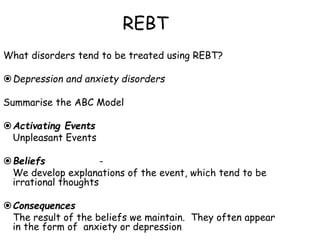
What disorders tend to be treated using REBT? 
Depression and anxiety disorders 
Summarise the ABC Model 
Activating Events 
Unpleasant Events 
Beliefs - 
We develop explanations of the event, which tend to be 
irrational thoughts 
Consequences 
The result of the beliefs we maintain. They often appear 
in the form of anxiety or depression
What is it? 
• Developed by Albert Ellis who formulated the 
ABC model. 
• Problems are based up on irrational thinking. 
• Self Defeating habits are formulated due to 
faulty beliefs. 
• Helps a client understand this irrationality and 
the consequences of working in such a way. 
• Allows substitution of more effective methods.
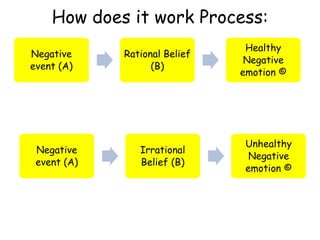
How does it work Process: 
Negative 
event (A) 
Rational Belief 
(B) 
Healthy 
Negative 
emotion © 
Negative 
event (A) 
Irrational 
Belief (B) 
Unhealthy 
Negative 
emotion ©
How does it work? 
• What are the main influence behind our 
emotional well being? 
• Describe the effect of irrational 
beliefs. 
• What does REBT aim to do?
REBT 
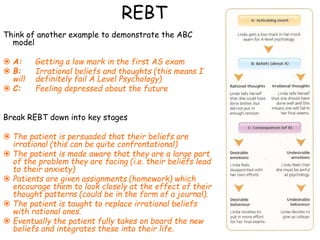
Think of another example to demonstrate the ABC 
model 
 A: Getting a low mark in the first AS exam 
 B: Irrational beliefs and thoughts (this means I 
will definitely fail A Level Psychology) 
 C: Feeling depressed about the future 
Break REBT down into key stages 
 The patient is persuaded that their beliefs are 
irrational (this can be quite confrontational) 
 The patient is made aware that they are a large part 
of the problem they are facing (i.e. their beliefs lead 
to their anxiety) 
 Patients are given assignments (homework) which 
encourage them to look closely at the effect of their 
thought patterns (could be in the form of a journal). 
 The patient is taught to replace irrational beliefs 
with rational ones. 
 Eventually the patient fully takes on board the new 
beliefs and integrates these into their life.
Challenging Irrational beliefs 
• It is not the activating events themselves that 
cause unproductive consequences. REBT focuses 
on self defeating beliefs that come with them. 
• Disputing the beliefs: Logical, empirical, and 
Pragmatic. 
Task: 
• Describe these processes. 
• Describe the effect of effective disputing.
evaluation 
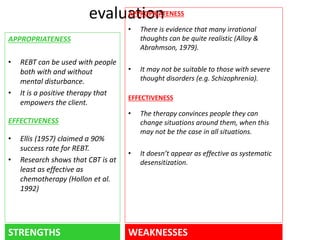
APPROPRIATENESS 
• REBT can be used with people 
both with and without 
mental disturbance. 
• It is a positive therapy that 
empowers the client. 
EFFECTIVENESS 
• Ellis (1957) claimed a 90% 
success rate for REBT. 
• Research shows that CBT is at 
least as effective as 
chemotherapy (Hollon et al. 
1992) 
APPROPRIATENESS 
• There is evidence that many irrational 
thoughts can be quite realistic (Alloy & 
Abrahmson, 1979). 
• It may not be suitable to those with severe 
thought disorders (e.g. Schizophrenia). 
EFFECTIVENESS 
• The therapy convinces people they can 
change situations around them, when this 
may not be the case in all situations. 
• It doesn’t appear as effective as systematic 
desensitization. 
STRENGTHS WEAKNESSES
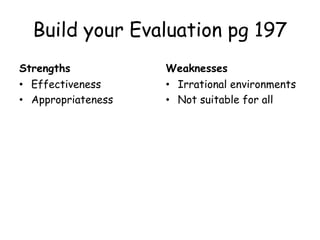
Build your Evaluation pg 197 
Strengths 
• Effectiveness 
• Appropriateness 
Weaknesses 
• Irrational environments 
• Not suitable for all
Task 
Handout 187

CBT treatement

  • 1.
  • 2.
    Cognitive Behavioural Therapy (CBT) CBT aims to work through the negative thoughts of clients and helps them to set new, rational and positive goals. We shall look at: • Rational-Emotive Behaviour Therapy (REBT)
  • 3.
    REBT What disorderstend to be treated using REBT? Depression and anxiety disorders Summarise the ABC Model Activating Events Unpleasant Events Beliefs - We develop explanations of the event, which tend to be irrational thoughts Consequences The result of the beliefs we maintain. They often appear in the form of anxiety or depression
  • 4.
    What is it? • Developed by Albert Ellis who formulated the ABC model. • Problems are based up on irrational thinking. • Self Defeating habits are formulated due to faulty beliefs. • Helps a client understand this irrationality and the consequences of working in such a way. • Allows substitution of more effective methods.
  • 5.
    How does itwork Process: Negative event (A) Rational Belief (B) Healthy Negative emotion © Negative event (A) Irrational Belief (B) Unhealthy Negative emotion ©
  • 6.
    How does itwork? • What are the main influence behind our emotional well being? • Describe the effect of irrational beliefs. • What does REBT aim to do?
  • 7.
    REBT Think ofanother example to demonstrate the ABC model  A: Getting a low mark in the first AS exam  B: Irrational beliefs and thoughts (this means I will definitely fail A Level Psychology)  C: Feeling depressed about the future Break REBT down into key stages  The patient is persuaded that their beliefs are irrational (this can be quite confrontational)  The patient is made aware that they are a large part of the problem they are facing (i.e. their beliefs lead to their anxiety)  Patients are given assignments (homework) which encourage them to look closely at the effect of their thought patterns (could be in the form of a journal).  The patient is taught to replace irrational beliefs with rational ones.  Eventually the patient fully takes on board the new beliefs and integrates these into their life.
  • 8.
    Challenging Irrational beliefs • It is not the activating events themselves that cause unproductive consequences. REBT focuses on self defeating beliefs that come with them. • Disputing the beliefs: Logical, empirical, and Pragmatic. Task: • Describe these processes. • Describe the effect of effective disputing.
  • 9.
    evaluation APPROPRIATENESS •REBT can be used with people both with and without mental disturbance. • It is a positive therapy that empowers the client. EFFECTIVENESS • Ellis (1957) claimed a 90% success rate for REBT. • Research shows that CBT is at least as effective as chemotherapy (Hollon et al. 1992) APPROPRIATENESS • There is evidence that many irrational thoughts can be quite realistic (Alloy & Abrahmson, 1979). • It may not be suitable to those with severe thought disorders (e.g. Schizophrenia). EFFECTIVENESS • The therapy convinces people they can change situations around them, when this may not be the case in all situations. • It doesn’t appear as effective as systematic desensitization. STRENGTHS WEAKNESSES
  • 10.
    Build your Evaluationpg 197 Strengths • Effectiveness • Appropriateness Weaknesses • Irrational environments • Not suitable for all
  • 11.