COGNITIVE
BEHAVIOURAL
THERAPY
(CBT)MARCH 5, 2014 / BSPSY3B
Ann Marjorie T. Brizo
Ma. Aira Mae Comia
Queenie Kelleway
Mary Rose S. Quirim
WHAT IS CBT?
how you think about
yourself, the world and
other people
 how what you do affects
your thoughts and feelings.
CBT can help you
to change how you think ('Cognitive')
and
what you do ('Behaviour').
These changes can help you to feel better.
Unlike some of the other talking treatments, it
focuses on the 'here and now' problems and
difficulties.
Instead of focusing on the causes of your
distress or symptoms in the past, it looks for
ways to improve your state of mind now.
WHEN DOES CBT HELP?
CBT has been shown to help with many
different types of problems. These include:
anxiety, depression, panic, phobias (including
agoraphobia and social
phobia), stress, bulimia, obsessive
compulsive disorder, post-traumatic stress
disorder, bipolar disorder and psychosis. CBT
may also help if you have difficulties with
anger, a low opinion of yourself or physical
health problems, like pain or fatigue.
HOW DOES IT WORK?
CBT can help you to make sense of overwhelming problems by
breaking them down into smaller parts. This makes it easier to
see how they are connected and how they affect you. These parts
are:
 A Situation - a problem, event or difficult situation
 From this can follow:
 Thoughts
 Emotions
 Physical feelings
 Actions
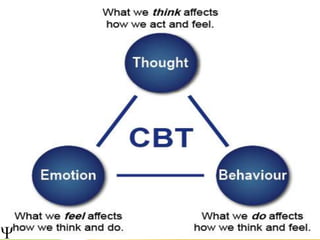
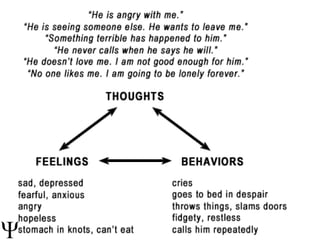
Each of these areas can affect the others.
How you think about a problem can
affect how you feel physically and
emotionally. It can also alter what you do
about it. There are helpful and unhelpful
ways of reacting to most
situations, depending on how you think
about them.
FOR EXAMPLE
Situation: You've had a bad day, feel fed up, so go out shopping. As you
walk down the road, someone you know walks by
and, apparently, ignores you.
UNHELPFUL HELPFUL
THOUGHTS He/she ignored me -
they
don't like me
He/she looks a bit
wrapped
up in themselves - I
wonder if there's
something
wrong?
EMOTIONAL FEELINGS Low, sad and rejected Concerned for the other
person
PHYSICAL Stomach cramps, low
energy, feel sick
None - feel comfortable
ACTION
Go home and avoid
them
Get in touch to make
sure they're OK
FIVE AREAS' ASSESSMENT
WHAT DOES CBT INVOLVE?
THE SESSIONS
If you have individual therapy:
o You will usually meet with a therapist for between 5 and 20, weekly, or
fortnightly sessions. Each session will last between 30 and 60 minutes.
o In the first 2-4 sessions, the therapist will check that you can use this sort of
o treatment and you will check that you feel comfortable with it.
o The therapist will also ask you questions about your past life and
background.
o Although CBT concentrates on the here and now, at times you may need to
talk
o about the past to understand how it is affecting you now.
o You decide what you want to deal with in the short, medium and long term.
o You and the therapist will usually start by agreeing on what to discuss that
day.
The work
• With the therapist, you break each problem down into its separate parts, as in the
example above. To help this process, your therapist may ask you to keep a diary. This
will help you to identify your individual patterns of thoughts, emotions, bodily feelings
and actions.
• Together you will look at your thoughts, feelings and behaviours to work out:
• if they are unrealistic or unhelpful
• how they affect each other, and you.
• The therapist will then help you to work out how to change unhelpful thoughts and
behaviours.
• It's easy to talk about doing something, much harder to actually do it. So, after you
have identified what you can change, your therapist will recommend "homework" - you
practice these changes in your everyday life. Depending on the situation, you might
start to:
• question a self-critical or upsetting thought and replace it with a more helpful (and more realistic) one that
you have developed in CBT
• recognize that you are about to do something that will make you feel worse and, instead, do something
more helpful.
• At each meeting you discuss how you've got on since the last session. Your therapist
can help with suggestions if any of the tasks seem too hard or don't seem to be
helping.
• They will not ask you to do things you don't want to do - you decide the pace of the
treatment and what you will and won't try. The strength of CBT is that you can
HOW EFFECTIVE IS CBT?
It is one of the most effective
treatments for conditions where
anxiety or depression is the main
problem.
 It is the most effective psychological
treatment for moderate and severe
depression.
It is as effective as antidepressants for
many types of depression.
PROBLEMS WITH CBT
 CBT is not a quick fix. A therapist is like a personal
trainer that advises and encourages - but cannot 'do' it for
you.
 If you are feeling low, it can be difficult to
concentrate and get motivated.
 To overcome anxiety, you need to confront it. This may
lead you to feel more anxious for a short time.
A good therapist will pace your sessions. You
decide what you do together, so you stay in
control.
HOW LONG WILL THE TREATMENT LAST?
A course may be from 6 weeks
to 6 months. It will depend on
the type of problem and how it
is working for you. The
availability of CBT varies
between different areas and
there may be a waiting list for
treatment.
CHANGE VIEW:
10 KEYS FACTS ABOUT CBT
Change: your thoughts and
actions
Homework: practice makes perfect View: events from another angle
Action: don't just talk, do! I can do it: self-help approach
Need: pinpoint the problem Experience: test out your beliefs
Goals: move towards them Write it down: to remember progress
Evidence: shows CBT can work

CBT

  • 1.
    COGNITIVE BEHAVIOURAL THERAPY (CBT)MARCH 5, 2014/ BSPSY3B Ann Marjorie T. Brizo Ma. Aira Mae Comia Queenie Kelleway Mary Rose S. Quirim
  • 4.
    WHAT IS CBT? howyou think about yourself, the world and other people  how what you do affects your thoughts and feelings.
  • 5.
    CBT can helpyou to change how you think ('Cognitive') and what you do ('Behaviour'). These changes can help you to feel better. Unlike some of the other talking treatments, it focuses on the 'here and now' problems and difficulties. Instead of focusing on the causes of your distress or symptoms in the past, it looks for ways to improve your state of mind now.
  • 6.
    WHEN DOES CBTHELP? CBT has been shown to help with many different types of problems. These include: anxiety, depression, panic, phobias (including agoraphobia and social phobia), stress, bulimia, obsessive compulsive disorder, post-traumatic stress disorder, bipolar disorder and psychosis. CBT may also help if you have difficulties with anger, a low opinion of yourself or physical health problems, like pain or fatigue.
  • 7.
    HOW DOES ITWORK? CBT can help you to make sense of overwhelming problems by breaking them down into smaller parts. This makes it easier to see how they are connected and how they affect you. These parts are:  A Situation - a problem, event or difficult situation  From this can follow:  Thoughts  Emotions  Physical feelings  Actions
  • 8.
    Each of theseareas can affect the others. How you think about a problem can affect how you feel physically and emotionally. It can also alter what you do about it. There are helpful and unhelpful ways of reacting to most situations, depending on how you think about them.
  • 9.
    FOR EXAMPLE Situation: You'vehad a bad day, feel fed up, so go out shopping. As you walk down the road, someone you know walks by and, apparently, ignores you. UNHELPFUL HELPFUL THOUGHTS He/she ignored me - they don't like me He/she looks a bit wrapped up in themselves - I wonder if there's something wrong? EMOTIONAL FEELINGS Low, sad and rejected Concerned for the other person PHYSICAL Stomach cramps, low energy, feel sick None - feel comfortable ACTION Go home and avoid them Get in touch to make sure they're OK
  • 11.
  • 13.
    WHAT DOES CBTINVOLVE? THE SESSIONS If you have individual therapy: o You will usually meet with a therapist for between 5 and 20, weekly, or fortnightly sessions. Each session will last between 30 and 60 minutes. o In the first 2-4 sessions, the therapist will check that you can use this sort of o treatment and you will check that you feel comfortable with it. o The therapist will also ask you questions about your past life and background. o Although CBT concentrates on the here and now, at times you may need to talk o about the past to understand how it is affecting you now. o You decide what you want to deal with in the short, medium and long term. o You and the therapist will usually start by agreeing on what to discuss that day.
  • 15.
    The work • Withthe therapist, you break each problem down into its separate parts, as in the example above. To help this process, your therapist may ask you to keep a diary. This will help you to identify your individual patterns of thoughts, emotions, bodily feelings and actions. • Together you will look at your thoughts, feelings and behaviours to work out: • if they are unrealistic or unhelpful • how they affect each other, and you. • The therapist will then help you to work out how to change unhelpful thoughts and behaviours. • It's easy to talk about doing something, much harder to actually do it. So, after you have identified what you can change, your therapist will recommend "homework" - you practice these changes in your everyday life. Depending on the situation, you might start to: • question a self-critical or upsetting thought and replace it with a more helpful (and more realistic) one that you have developed in CBT • recognize that you are about to do something that will make you feel worse and, instead, do something more helpful. • At each meeting you discuss how you've got on since the last session. Your therapist can help with suggestions if any of the tasks seem too hard or don't seem to be helping. • They will not ask you to do things you don't want to do - you decide the pace of the treatment and what you will and won't try. The strength of CBT is that you can
  • 16.
    HOW EFFECTIVE ISCBT? It is one of the most effective treatments for conditions where anxiety or depression is the main problem.  It is the most effective psychological treatment for moderate and severe depression. It is as effective as antidepressants for many types of depression.
  • 17.
    PROBLEMS WITH CBT CBT is not a quick fix. A therapist is like a personal trainer that advises and encourages - but cannot 'do' it for you.  If you are feeling low, it can be difficult to concentrate and get motivated.  To overcome anxiety, you need to confront it. This may lead you to feel more anxious for a short time. A good therapist will pace your sessions. You decide what you do together, so you stay in control.
  • 18.
    HOW LONG WILLTHE TREATMENT LAST? A course may be from 6 weeks to 6 months. It will depend on the type of problem and how it is working for you. The availability of CBT varies between different areas and there may be a waiting list for treatment.
  • 19.
    CHANGE VIEW: 10 KEYSFACTS ABOUT CBT Change: your thoughts and actions Homework: practice makes perfect View: events from another angle Action: don't just talk, do! I can do it: self-help approach Need: pinpoint the problem Experience: test out your beliefs Goals: move towards them Write it down: to remember progress Evidence: shows CBT can work