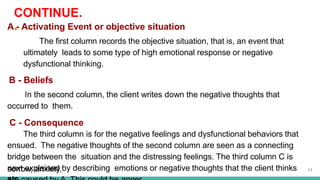
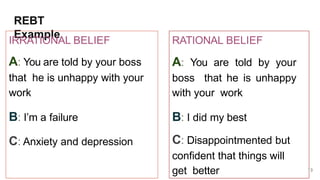
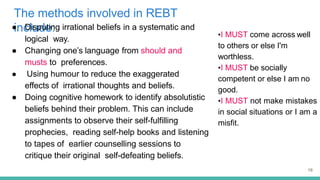
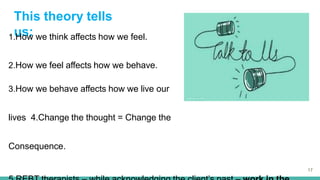
Albert Ellis developed Rational Emotive Behavior Therapy (REBT) in 1955. REBT is a short-term cognitive-behavioral therapy that helps clients identify irrational and self-defeating thoughts that lead to negative emotions and behaviors. It uses the A-B-C model to show how an activating event (A) interacts with a person's beliefs (B) to cause emotional and behavioral consequences (C). The therapist challenges clients' irrational beliefs (B) and teaches more rational thinking to disrupt the link between beliefs and negative consequences. REBT aims to help clients adopt beliefs like "I did my best" instead of "I'm a failure" to feel less distress and behave more productively.