MASTERCLASS
Compensation	
and	the	Spine
Paul	Licina
disc herniation
discogenic pain
spinal stenosis
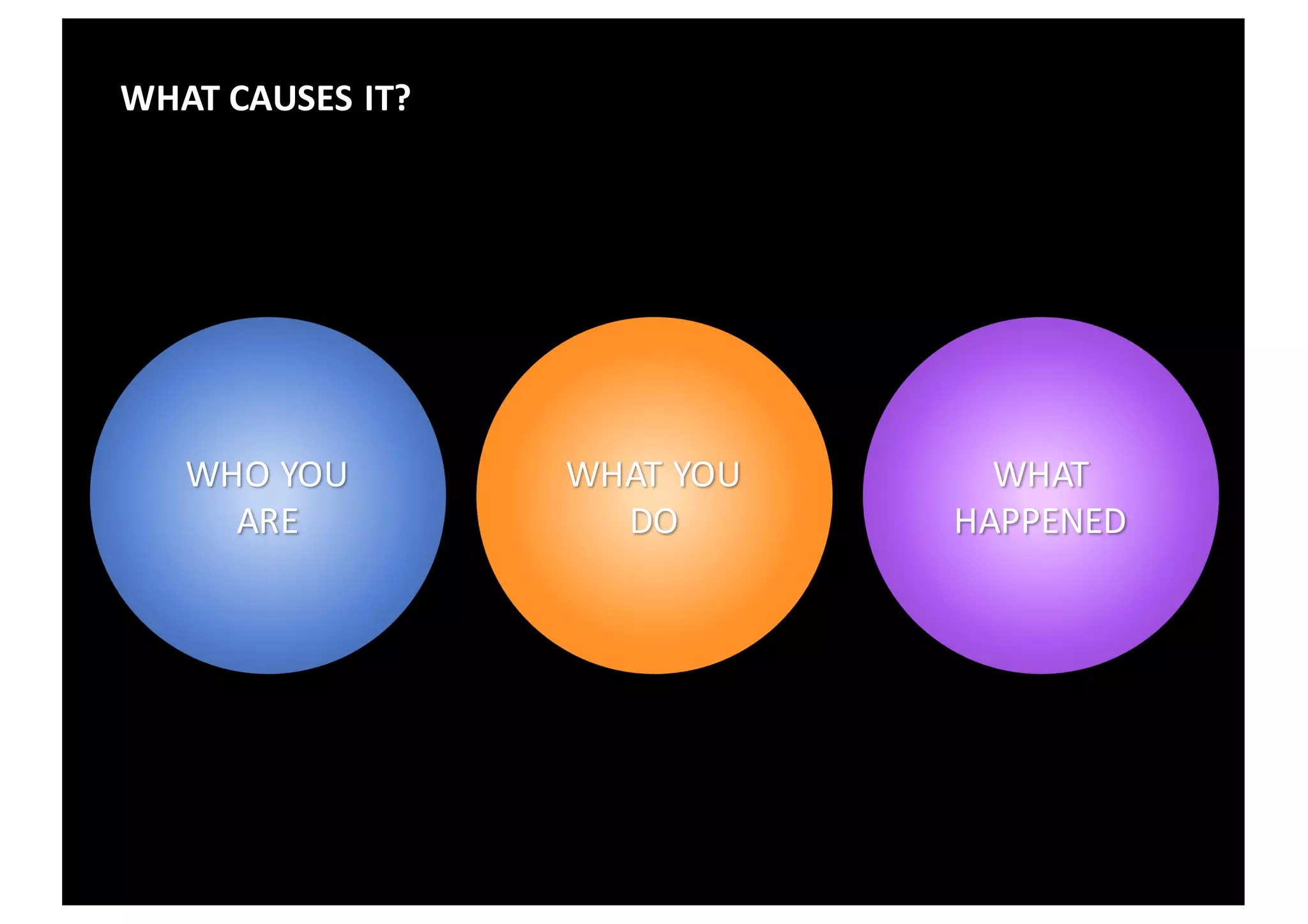
WHAT	CAUSES	IT?
WHO	YOU	
ARE
WHAT	YOU	
DO
WHAT	
HAPPENED
genetics	
weight
fitness psychology
age
WHO	YOU	ARE
WHAT	CAUSES	IT?
WHAT	YOU	DO
occupation
pastimes
WHAT	CAUSES	IT?
previous	injuries
smoking
WHAT	HAPPENED
injury
repetitive	load
WHAT	CAUSES	IT?
WHO	YOU	
ARE
WHAT	YOU	
DO
WHAT	
HAPPENED
WHAT	CAUSES	IT?
WHAT	CAUSES	IT?
The once commonly held view that disc degeneration is primarily a
result of aging and “wear and tear” from mechanical insults and
injuries was not supported by this series of studies. Instead, disc
degeneration appears to be determined in great part by genetic
influences. Although environmental factors also play a role, it is not
primarily through routine physical loading exposures (eg, heavy vs.
light physical demands) as once suspected.
Previously, heavy physical loading was the main suspected risk factor
for disc degeneration. Recent research indicates that heredity has a
dominant role in disc degeneration, explaining 74% of the variance in
adult populations studied to date.
WHO	YOU	
ARE
WHAT	YOU	
DO
WHAT	
HAPPENED
WHAT	CAUSES	IT?
HOW	DO	WE	DECIDE	IF	IT	IS	WORK-RELATED?
mechanism																
of	injury
• was	there	a	specific	event?
• was	it	an	unusual	event?
• could	that	injury	have	caused	damage?
1 2 3 4 5
1 2 3 4 5
1 2 3 4 5
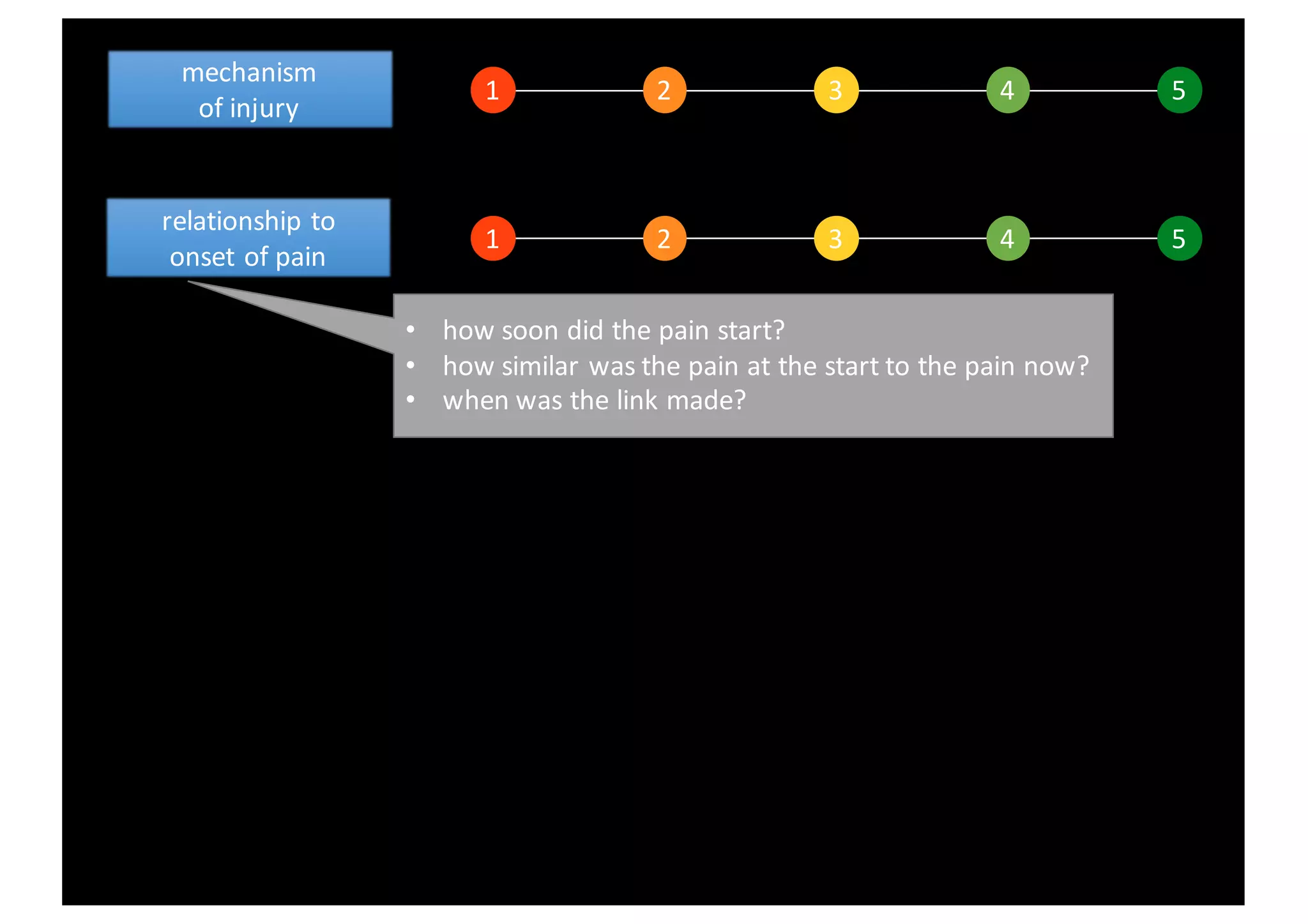
mechanism																
of	injury
relationship	to	
onset	of	pain
• how	soon	did	the	pain	start?
• how	similar	was	the	pain	at	the	start	to	the	pain	now?
• when	was	the	link	made?
1 2 3 4 5
1 2 3 4 5
1 2 3 4 5
mechanism																
of	injury
relationship	to	
onset	of	pain
preexisting	
problems
• have	there	been	similar	problems?
• how	long	ago?
• how	much	degeneration	is	present?
1 2 3 4 5
1 2 3 4 5
1 2 3 4 5
1 2 3 4 5
mechanism																
of	injury
relationship	to	
onset	of	pain
preexisting	
problems
current	
pathology
• is	there	something	objective	wrong?
• does	it	explain	the	pain?
• is	trauma	a	factor	in	that	condition?
1 2 3 4 5
1 2 3 4 5
1 2 3 4 5
1 2 3 4 5
1 2 3 4 5
mechanism																
of	injury
relationship	to	
onset	of	pain
preexisting	
problems
current	
pathology
consistency	of	
presentation
• abnormal	illness	behaviour
• pain	behaviour
• credibility
1 2 3 4 5
1 2 3 4 5
1 2 3 4 5
1 2 3 4 5
1 2 3 4 5
1 2 3 4 5
mechanism																
of	injury
relationship	to	
onset	of	pain
preexisting	
problems
current	
pathology
consistency	of	
presentation
TOTAL
HOW	DO	WE	DECIDE	WHETHER	TO	APPROVE	SURGERY?
1 2 3 4 5
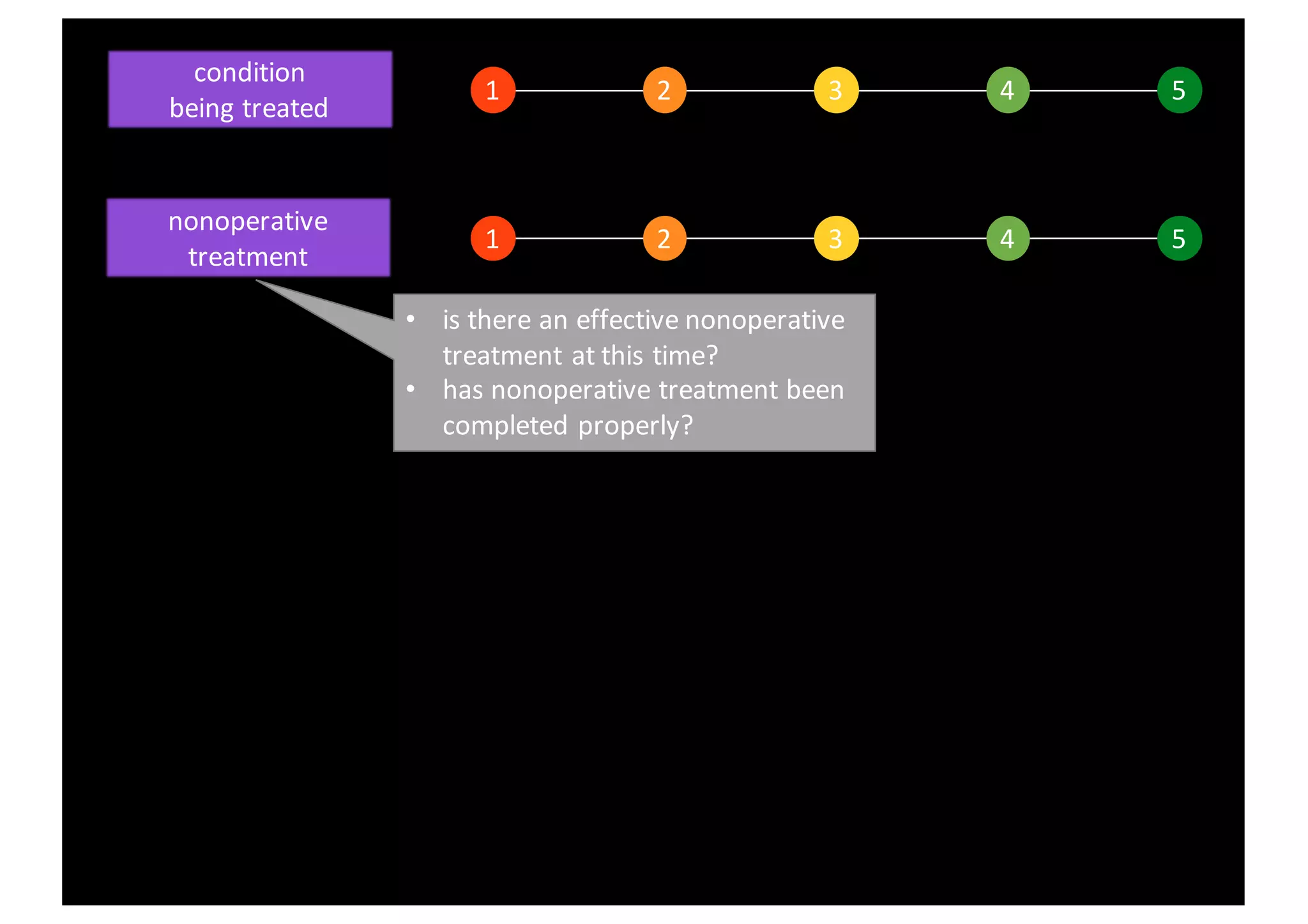
condition
being	treated
• is	the	surgery	aimed	at	the	acute	injury	
or	the	preexisting	condition?
• is	there	a	simpler	procedure	that	just	
addresses	the	acute	injury?
1 2 3 4 5
1 2 3 4 5
condition
being	treated
nonoperative
treatment
• is	there	an	effective	nonoperative
treatment	at	this	time?
• has	nonoperative treatment	been	
completed	properly?
1 2 3 4 5
1 2 3 4 5
1 2 3 4 5
condition
being	treated
nonoperative
treatment
effectiveness	
of	surgery
• is	surgery	normally	effective	for	
this	diagnosis?
• in	this	circumstance	is	surgery	
likely	to	be	more	or	less	effective?
1 2 3 4 5
1 2 3 4 5
1 2 3 4 5
1 2 3 4 5
condition
being	treated
nonoperative
treatment
effectiveness	
of	surgery
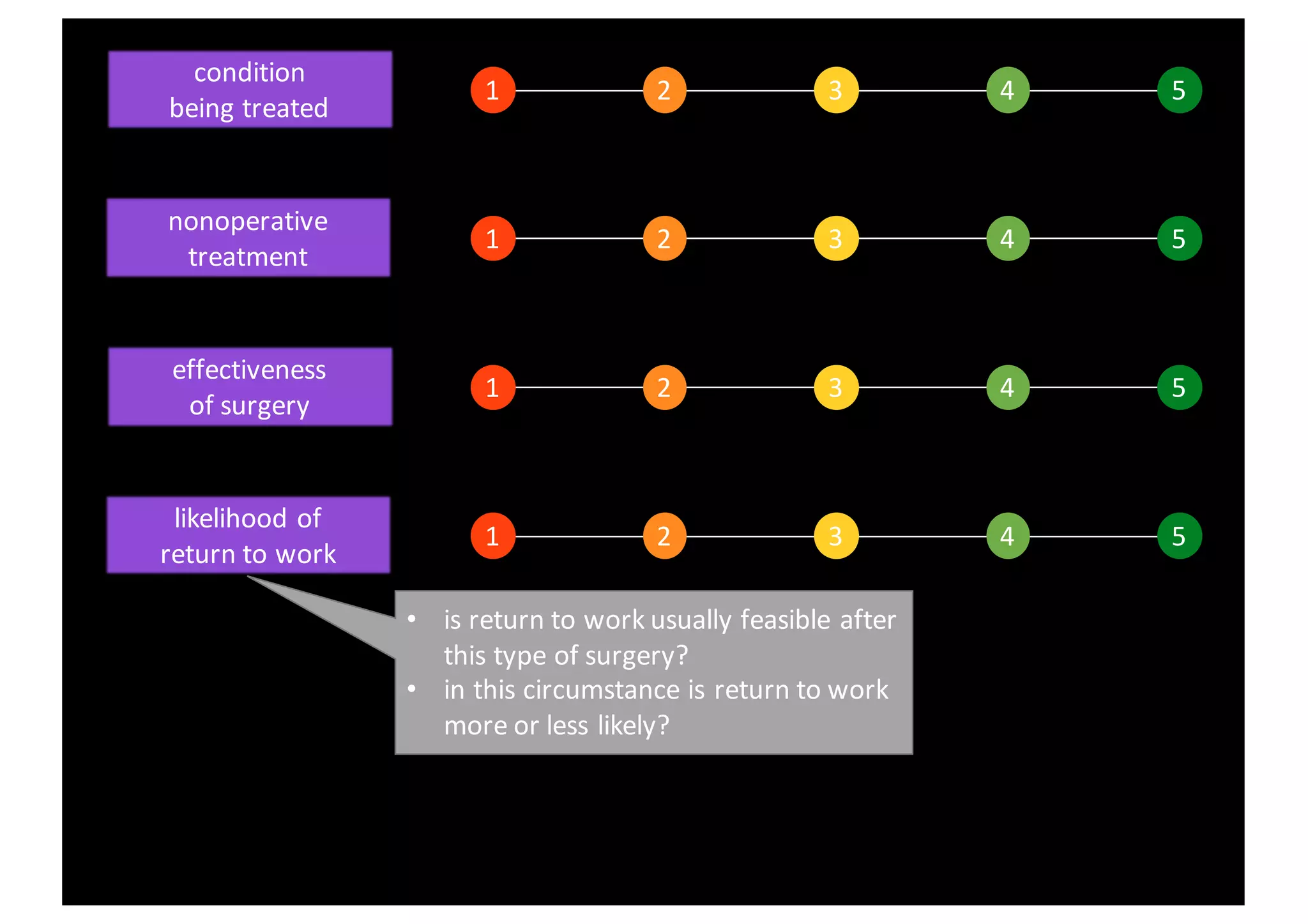
likelihood	of	
return	to	work
• is	return	to	work	usually	feasible	after	
this	type	of	surgery?
• in	this	circumstance	is	return	to	work	
more	or	less	likely?
1 2 3 4 5
1 2 3 4 5
1 2 3 4 5
1 2 3 4 5
1 2 3 4 5
condition
being	treated
nonoperative
treatment
effectiveness	
of	surgery
likelihood	of	
return	to	work
capability	of	
surgeon
• are	their	outcomes	usually	
favourable?
• is	the	request	reasonable?
1 2 3 4 5
1 2 3 4 5
1 2 3 4 5
1 2 3 4 5
1 2 3 4 5
1 2 3 4 5
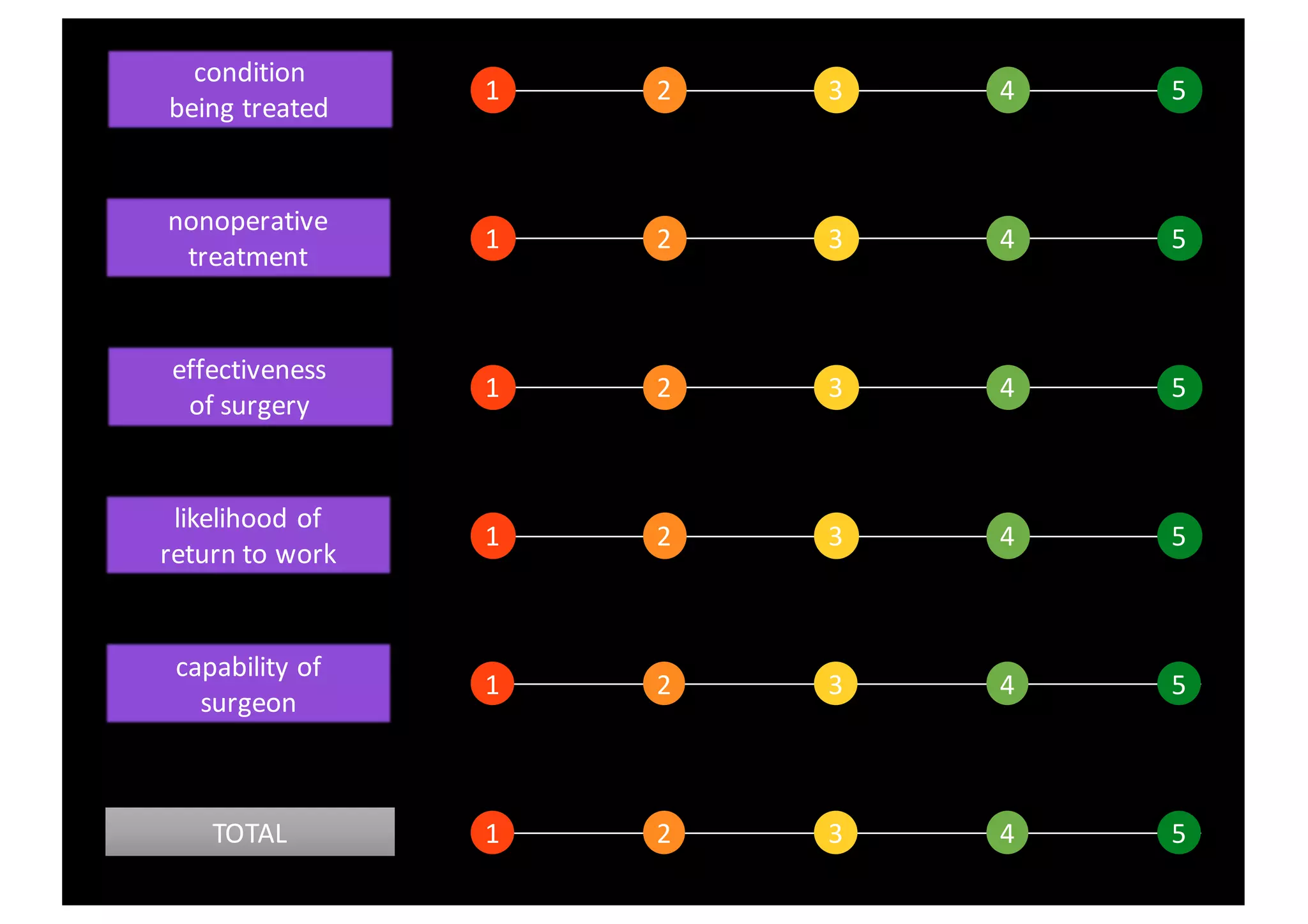
condition
being	treated
nonoperative
treatment
effectiveness	
of	surgery
likelihood	of	
return	to	work
capability	of	
surgeon
TOTAL
mechanism																
of	injury
relationship	to	
onset	of	pain
preexisting	
problems
current	
pathology
consistency	of	
presentation
• abnormal	illness	behaviour
• pain	behaviour
• credibility
• is	there	something	objective	wrong?
• does	it	explain	the	pain?
• is	trauma	a	factor	in	that	condition?
• have	there	been	similar	problems?
• how	long	ago?
• how	much	degeneration	is	present?
• how	soon	did	the	pain	start?
• how	similar	was	the	pain	at	the	start	to	the	pain	now?
• when	was	the	link	made?
• was	there	a	specific	event?
• was	it	an	unusual	event?
• could	that	injury	have	caused	damage?
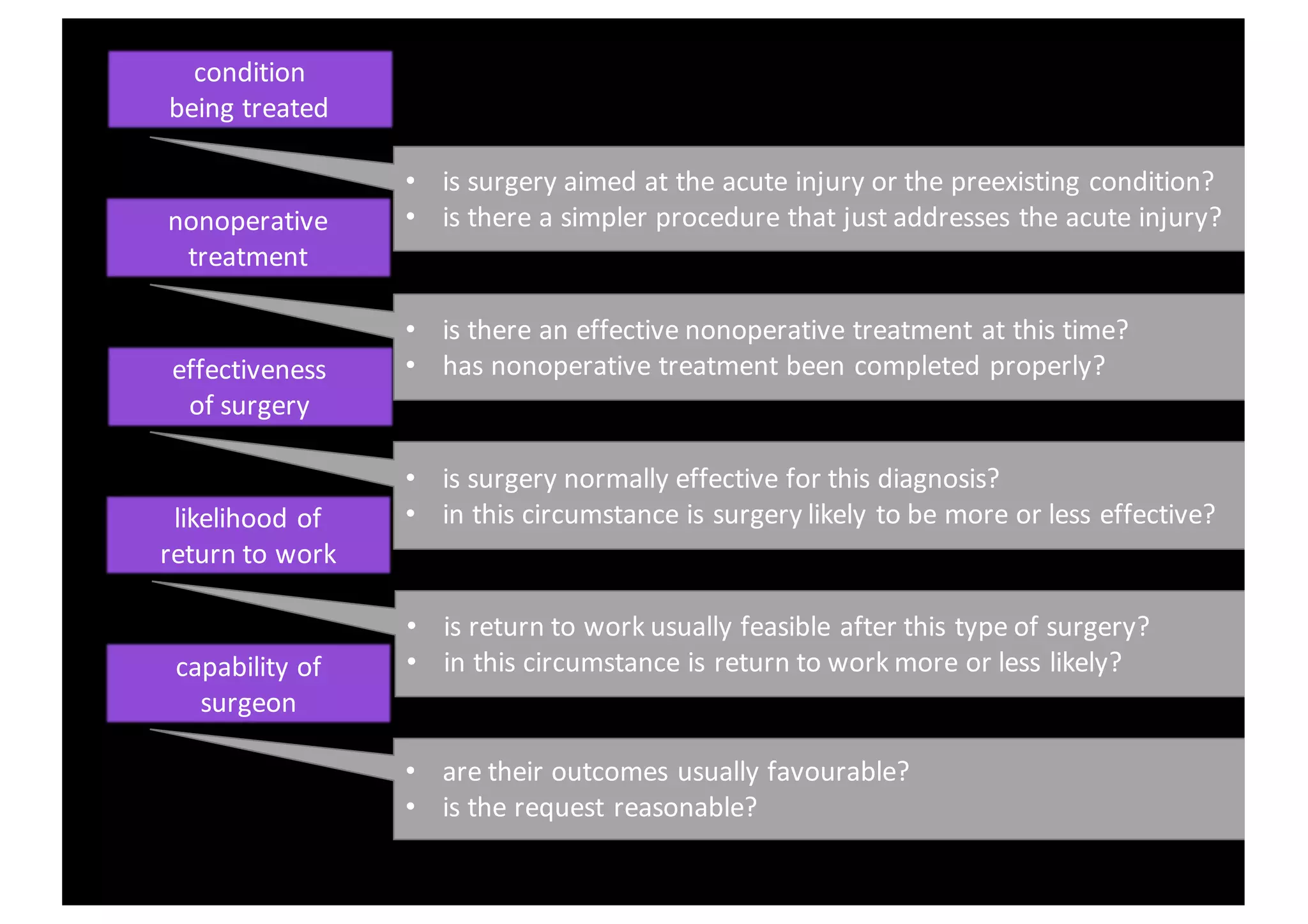
condition
being	treated
nonoperative
treatment
effectiveness	
of	surgery
likelihood	of	
return	to	work
capability	of	
surgeon
• are	their	outcomes	usually	favourable?
• is	the	request	reasonable?
• is	return	to	work	usually	feasible	after	this	type	of	surgery?
• in	this	circumstance	is	return	to	work	more	or	less	likely?
• is	surgery	normally	effective	for	this	diagnosis?
• in	this	circumstance	is	surgery	likely	to	be	more	or	less	effective?
• is	there	an	effective	nonoperative treatment	at	this	time?
• has	nonoperative treatment	been	completed	properly?
• is	surgery	aimed	at	the	acute	injury	or	the	preexisting	condition?
• is	there	a	simpler	procedure	that	just	addresses	the	acute	injury?

Causation and decision making