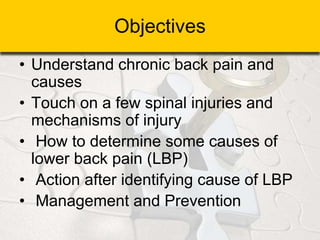
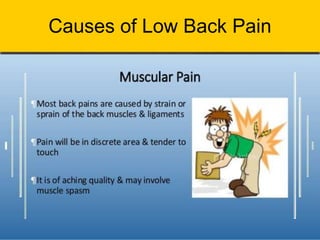
Low Back Pain (Lumbago):
Management and Prevention
Objectives
• Understand chronic back pain and
causes
• Touch on a few spinal injuries and
mechanisms of injury
• How to determine some causes of
lower back pain (LBP)
• Action after identifying cause of LBP
• Management and Prevention
Low Back Pain
WELCOME
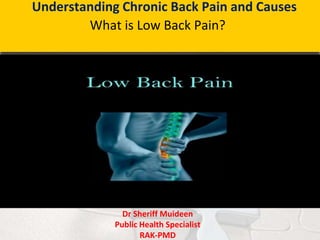
Understanding Chronic Back Pain and Causes
What is Low Back Pain?
jj
Dr Sheriff Muideen
Public Health Specialist
RAK-PMD
Introduction and Definition
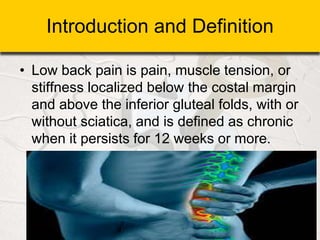
• Low back pain is pain, muscle tension, or
stiffness localized below the costal margin
and above the inferior gluteal folds, with or
without sciatica, and is defined as chronic
when it persists for 12 weeks or more.
Low Back Pain (Lumbago)
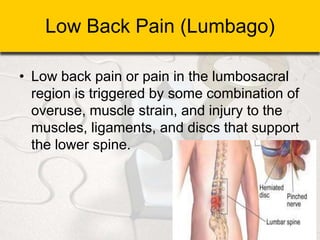
• Low back pain or pain in the lumbosacral
region is triggered by some combination of
overuse, muscle strain, and injury to the
muscles, ligaments, and discs that support
the lower spine.
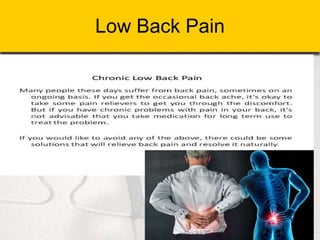
Low Back Pain
WHY LOWER BACK?
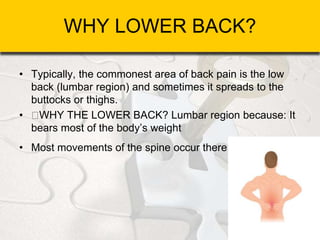
• Typically, the commonest area of back pain is the low
back (lumbar region) and sometimes it spreads to the
buttocks or thighs.
• WHY THE LOWER BACK? Lumbar region because: It
bears most of the body’s weight
• Most movements of the spine occur there.
Sources of Low Back Pain
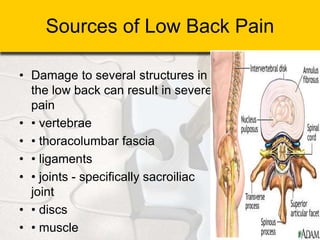
• Damage to several structures in
the low back can result in severe
pain
• • vertebrae
• • thoracolumbar fascia
• • ligaments
• • joints - specifically sacroiliac
joint
• • discs
• • muscle
Epidemiology of Low back Pain
Prevalence
• 60-80% of people will have LBP sometime in their lives.
• 30% are referred to Ortho; 3% admitted; 0.5% operated.
• 90% LBP resolves in 6w, 75% may experience
symptoms & disability one year after initial consultation.
• The prevalence of LBP has changed little over the years,
but the associated disability has increased four fold.
Epidemiology of Low Back Pain
Low Back Pain (LBP), most often affects people
between the ages of 25 and 60 years and those
aged between 50 and 60 years are likely to
become disabled (Corbin et al, 2002).
Up to 70%-85% of the population in the United
Kingdom (UK) experience back pain at some point
in their lives.
In Ghana, over 60% of the adult population
complains of back pain at one time or the other
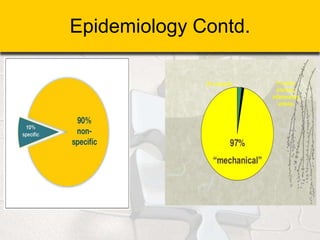
Epidemiology Contd.
Epidemiology Contd.
 60 – 90% of lifetime prevalence
 80 – 90% have recurrence episode
 Second most common complain to prompt
a medical evaluation
 Leading cause of long term work disability
Natural History of Back Pain
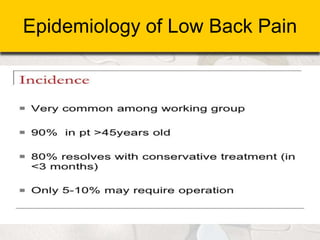
80 – 90% resolves within 1 month
20 – 30% remain chronic
5 – 10% causes disability in life
Causes of Low Back Pain
• Causes may be anatomical or even psychological
• Pain may be due to:
Sitting for long periods of time (?)
Causes of Low Back Pain
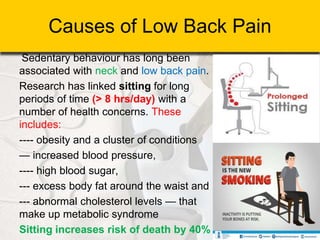
Sedentary behaviour has long been
associated with neck and low back pain.
Research has linked sitting for long
periods of time (> 8 hrs/day) with a
number of health concerns. These
includes:
---- obesity and a cluster of conditions
— increased blood pressure,
---- high blood sugar,
--- excess body fat around the waist and
--- abnormal cholesterol levels — that
make up metabolic syndrome
Sitting increases risk of death by 40%
Causes of Low Back Pain
The most basic solution to avoid
the risk of prolonged sitting at
workplace is;
• Sit, Stand, and move
around…
 One option is to switch to a stand
up table and they are gaining
popularity today
 An electric standing desk will give you
the option of raising and lowering you
desk quickly and easily throughout the
day
 Sit up for 5 -10 mins every 1 hr
But if this is not possible:
Causes of Low Back Pain
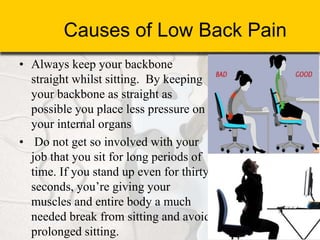
• Always keep your backbone
straight whilst sitting. By keeping
your backbone as straight as
possible you place less pressure on
your internal organs
• Do not get so involved with your
job that you sit for long periods of
time. If you stand up even for thirty
seconds, you’re giving your
muscles and entire body a much
needed break from sitting and avoid
prolonged sitting.
Causes of Low Back Pain
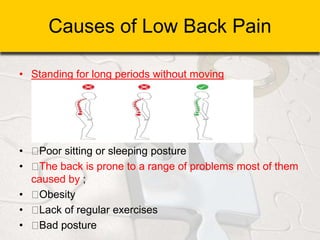
• Standing for long periods without moving
• Poor sitting or sleeping posture
• The back is prone to a range of problems most of them
caused by ;
• Obesity
• Lack of regular exercises
• Bad posture
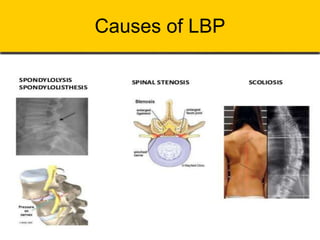
Causes of LBP
Causes of Low Back Pain
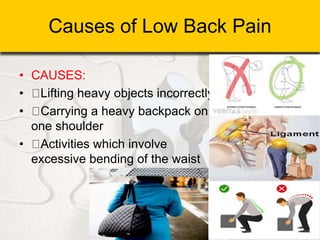
• CAUSES:
• Lifting heavy objects incorrectly
• Carrying a heavy backpack on
one shoulder
• Activities which involve
excessive bending of the waist
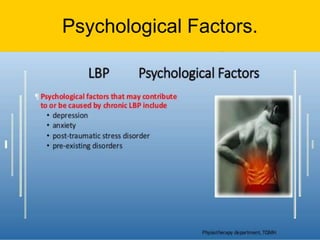
Psychological Factors.
Socio-economic risk Factors
• Social Issues May Contribute to Chronic LBP
• Job dissatisfaction/loss of ability to work Pursuit
of disability compensation Substance abuse
• Family dynamics
• Financial issues
• Loss of social identity or context
• Loss of ability to participate in recreational
activities
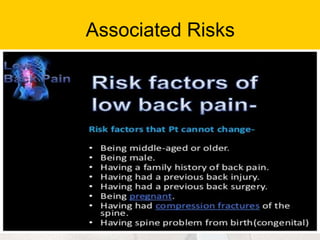
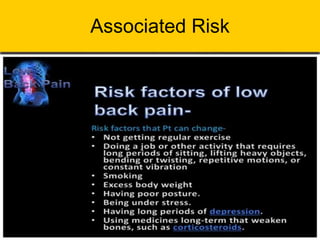
Associated Risks
Associated Risk
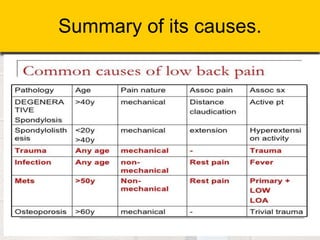
Summary of its causes.
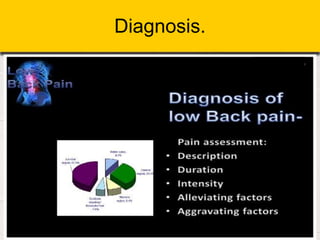
Diagnosis.
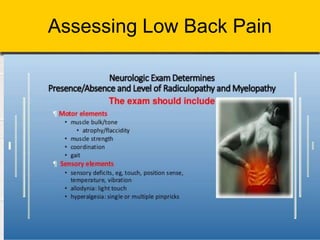
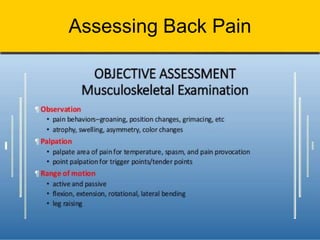
Assessing Back Pain
Assessing Low Back Pain
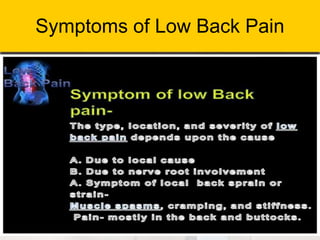
Symptoms of Low Back Pain
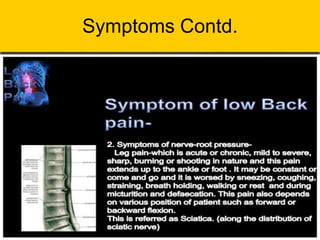
Symptoms Contd.
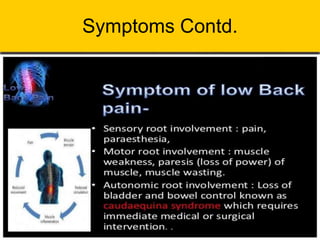
Symptoms Contd.
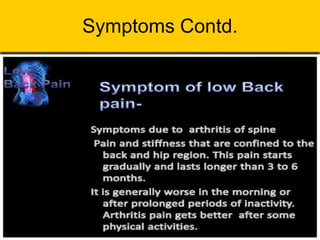
Symptoms Contd.
Implication:
• WORK AND PRODUCTIVITY LOSS
Investigation
• Investigations
• X-rays: bone spurs, decreased disc height and
facet hypertrophy in older patients.
• CT: more accurate and detailed picture of the
bony anatomy – less accurate than MRI in
estimating the degree of compromise of the soft
tissue elements. – thus can underestimate the
degree of stenosis – spinal canal < 10mm AP
diameter = Absolute Stenosis
Investigations
Investigations Contd.
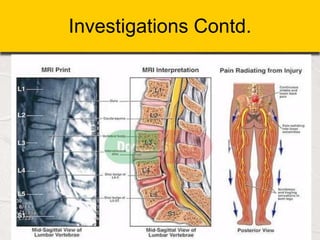
• MRI: (without gadolinium) – currently
represents the "gold standard" in the
evaluation of central stenosis. – allows
visualization of disc, neural elements,
ligamentum flavum & thecal sac
Investigations Contd.
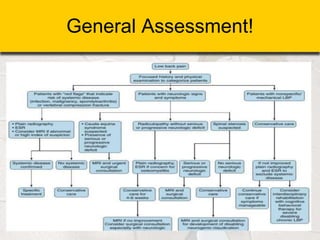
General Assessment!
Pitfalls!
• Up to 80% of patients cannot be given a
definite diagnosis because of the poor co-
relation between symptoms, clinical
findings and imaging results
• High incidence of false negatives on
imaging
• No diagnostic lab tests that reveal the
cause of LBP Outcome of treatment
difficult to quantify and predict
Management
 Pharmacological
– NSAIDS – intolerance, cautions, gels,
coxibs –
 Co-analgesics – TCA, anticonvulsants,
ms –relaxants
– Opioids & compound codeine
preparations
Management
• Injection Therapy – Epidural steroids –
lumbar, caudal – Facet joint injection,
Sacro-iliac joint injection, coccyx – Nerve
root infiltration
• Physiotherapy
• Acupuncture & TENS
• Pain management – psychological
approaches
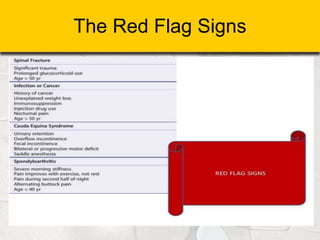
The Red Flag Signs
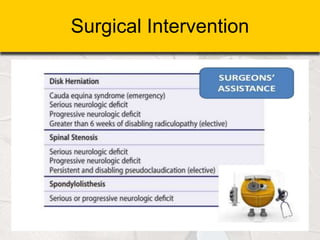
Surgical Intervention
Management.
• Surgical treatment
• Urgent operations are required in cases like
progressive neural deficit, cauda equine
syndrome, lumbar trauma with instability,
tumours and infections (the red flags ) .
• The non-urgent operation
• operation is for persistent pain that does not
respond to proper conservative measures or
mechanical LBP with instability.
Management Contd.
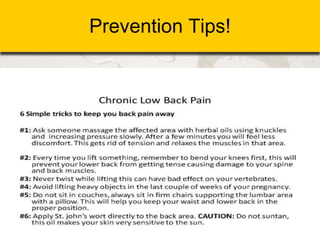
Prevention of Low Back Pain
• It is quite difficult to prevent low back pain
due to the typical wear and tear that
occurs at the back
• Certain practices can however be used to
minimize the occurrence of the condition
such as:
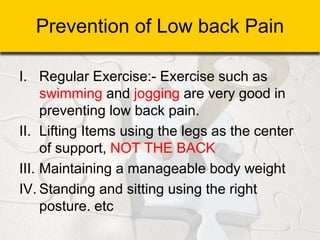
Prevention of Low back Pain
I. Regular Exercise:- Exercise such as
swimming and jogging are very good in
preventing low back pain.
II. Lifting Items using the legs as the center
of support, NOT THE BACK
III. Maintaining a manageable body weight
IV. Standing and sitting using the right
posture. etc
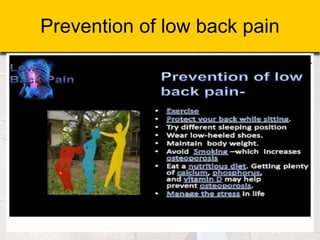
Prevention of low back pain
Prevention Tips!
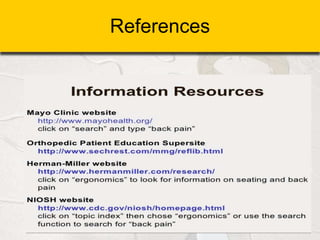
References
Thank You!

Low back pain (lumbago)

  • 1.
    Low Back Pain(Lumbago): Management and Prevention
  • 2.
    Objectives • Understand chronicback pain and causes • Touch on a few spinal injuries and mechanisms of injury • How to determine some causes of lower back pain (LBP) • Action after identifying cause of LBP • Management and Prevention
  • 3.
  • 4.
    Understanding Chronic BackPain and Causes What is Low Back Pain? jj Dr Sheriff Muideen Public Health Specialist RAK-PMD
  • 5.
    Introduction and Definition •Low back pain is pain, muscle tension, or stiffness localized below the costal margin and above the inferior gluteal folds, with or without sciatica, and is defined as chronic when it persists for 12 weeks or more.
  • 6.
    Low Back Pain(Lumbago) • Low back pain or pain in the lumbosacral region is triggered by some combination of overuse, muscle strain, and injury to the muscles, ligaments, and discs that support the lower spine.
  • 7.
  • 8.
    WHY LOWER BACK? •Typically, the commonest area of back pain is the low back (lumbar region) and sometimes it spreads to the buttocks or thighs. • WHY THE LOWER BACK? Lumbar region because: It bears most of the body’s weight • Most movements of the spine occur there.
  • 9.
    Sources of LowBack Pain • Damage to several structures in the low back can result in severe pain • • vertebrae • • thoracolumbar fascia • • ligaments • • joints - specifically sacroiliac joint • • discs • • muscle
  • 10.
    Epidemiology of Lowback Pain Prevalence • 60-80% of people will have LBP sometime in their lives. • 30% are referred to Ortho; 3% admitted; 0.5% operated. • 90% LBP resolves in 6w, 75% may experience symptoms & disability one year after initial consultation. • The prevalence of LBP has changed little over the years, but the associated disability has increased four fold.
  • 11.
  • 12.
    Epidemiology of LowBack Pain Low Back Pain (LBP), most often affects people between the ages of 25 and 60 years and those aged between 50 and 60 years are likely to become disabled (Corbin et al, 2002). Up to 70%-85% of the population in the United Kingdom (UK) experience back pain at some point in their lives. In Ghana, over 60% of the adult population complains of back pain at one time or the other
  • 13.
  • 14.
    Epidemiology Contd.  60– 90% of lifetime prevalence  80 – 90% have recurrence episode  Second most common complain to prompt a medical evaluation  Leading cause of long term work disability
  • 15.
    Natural History ofBack Pain 80 – 90% resolves within 1 month 20 – 30% remain chronic 5 – 10% causes disability in life
  • 16.
    Causes of LowBack Pain
  • 17.
    Causes of LowBack Pain • Causes may be anatomical or even psychological • Pain may be due to: Sitting for long periods of time (?)
  • 18.
    Causes of LowBack Pain Sedentary behaviour has long been associated with neck and low back pain. Research has linked sitting for long periods of time (> 8 hrs/day) with a number of health concerns. These includes: ---- obesity and a cluster of conditions — increased blood pressure, ---- high blood sugar, --- excess body fat around the waist and --- abnormal cholesterol levels — that make up metabolic syndrome Sitting increases risk of death by 40%
  • 19.
    Causes of LowBack Pain The most basic solution to avoid the risk of prolonged sitting at workplace is; • Sit, Stand, and move around…  One option is to switch to a stand up table and they are gaining popularity today  An electric standing desk will give you the option of raising and lowering you desk quickly and easily throughout the day  Sit up for 5 -10 mins every 1 hr But if this is not possible:
  • 20.
    Causes of LowBack Pain • Always keep your backbone straight whilst sitting. By keeping your backbone as straight as possible you place less pressure on your internal organs • Do not get so involved with your job that you sit for long periods of time. If you stand up even for thirty seconds, you’re giving your muscles and entire body a much needed break from sitting and avoid prolonged sitting.
  • 21.
    Causes of LowBack Pain
  • 22.
    Causes of LowBack Pain • Standing for long periods without moving • Poor sitting or sleeping posture • The back is prone to a range of problems most of them caused by ; • Obesity • Lack of regular exercises • Bad posture
  • 23.
  • 24.
    Causes of LowBack Pain • CAUSES: • Lifting heavy objects incorrectly • Carrying a heavy backpack on one shoulder • Activities which involve excessive bending of the waist
  • 25.
  • 26.
    Socio-economic risk Factors •Social Issues May Contribute to Chronic LBP • Job dissatisfaction/loss of ability to work Pursuit of disability compensation Substance abuse • Family dynamics • Financial issues • Loss of social identity or context • Loss of ability to participate in recreational activities
  • 27.
  • 28.
  • 29.
  • 30.
  • 31.
  • 32.
  • 33.
    Symptoms of LowBack Pain
  • 34.
  • 35.
  • 36.
  • 37.
    Implication: • WORK ANDPRODUCTIVITY LOSS
  • 38.
    Investigation • Investigations • X-rays:bone spurs, decreased disc height and facet hypertrophy in older patients. • CT: more accurate and detailed picture of the bony anatomy – less accurate than MRI in estimating the degree of compromise of the soft tissue elements. – thus can underestimate the degree of stenosis – spinal canal < 10mm AP diameter = Absolute Stenosis
  • 39.
  • 40.
    Investigations Contd. • MRI:(without gadolinium) – currently represents the "gold standard" in the evaluation of central stenosis. – allows visualization of disc, neural elements, ligamentum flavum & thecal sac
  • 41.
  • 42.
  • 43.
    Pitfalls! • Up to80% of patients cannot be given a definite diagnosis because of the poor co- relation between symptoms, clinical findings and imaging results • High incidence of false negatives on imaging • No diagnostic lab tests that reveal the cause of LBP Outcome of treatment difficult to quantify and predict
  • 44.
    Management  Pharmacological – NSAIDS– intolerance, cautions, gels, coxibs –  Co-analgesics – TCA, anticonvulsants, ms –relaxants – Opioids & compound codeine preparations
  • 45.
    Management • Injection Therapy– Epidural steroids – lumbar, caudal – Facet joint injection, Sacro-iliac joint injection, coccyx – Nerve root infiltration • Physiotherapy • Acupuncture & TENS • Pain management – psychological approaches
  • 46.
  • 47.
  • 48.
    Management. • Surgical treatment •Urgent operations are required in cases like progressive neural deficit, cauda equine syndrome, lumbar trauma with instability, tumours and infections (the red flags ) . • The non-urgent operation • operation is for persistent pain that does not respond to proper conservative measures or mechanical LBP with instability.
  • 49.
  • 50.
    Prevention of LowBack Pain • It is quite difficult to prevent low back pain due to the typical wear and tear that occurs at the back • Certain practices can however be used to minimize the occurrence of the condition such as:
  • 51.
    Prevention of Lowback Pain I. Regular Exercise:- Exercise such as swimming and jogging are very good in preventing low back pain. II. Lifting Items using the legs as the center of support, NOT THE BACK III. Maintaining a manageable body weight IV. Standing and sitting using the right posture. etc
  • 52.
  • 53.
  • 54.
  • 56.