Dr. Ramkrishna Dahal (Clinical Fellow Spinal Reconstructive Surgery)
Department of Spine Services
Grande International Hospital
2018
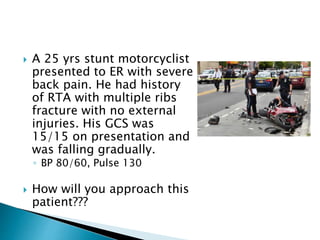
 A 25 yrs stunt motorcyclist
presented to ER with severe
back pain. He had history
of RTA with multiple ribs
fracture with no external
injuries. His GCS was
15/15 on presentation and
was falling gradually.
◦ BP 80/60, Pulse 130
 How will you approach this
patient???
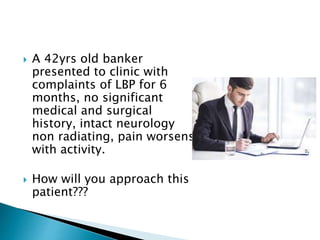
 A 42yrs old banker
presented to clinic with
complaints of LBP for 6
months, no significant
medical and surgical
history, intact neurology
non radiating, pain worsens
with activity.
 How will you approach this
patient???
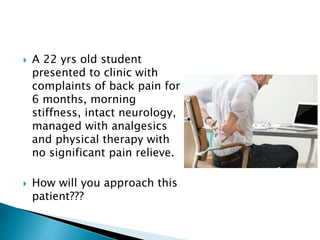
 A 22 yrs old student
presented to clinic with
complaints of back pain for
6 months, morning
stiffness, intact neurology,
managed with analgesics
and physical therapy with
no significant pain relieve.
 How will you approach this
patient???
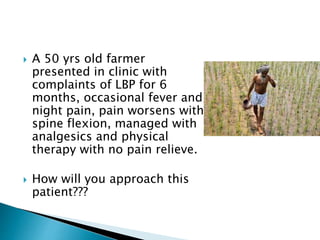
 A 50 yrs old farmer
presented in clinic with
complaints of LBP for 6
months, occasional fever and
night pain, pain worsens with
spine flexion, managed with
analgesics and physical
therapy with no pain relieve.
 How will you approach this
patient???
 A 75 yrs old patient with
complaints of LBP for 6 months,
incresed in severity for past few
days, with no constitutional
symptoms, but gives history of
difficulty in micturition for past
10 yrs seen by urologist and
gave some medication for his
urinary symptoms.
 How will you approach this
patient???
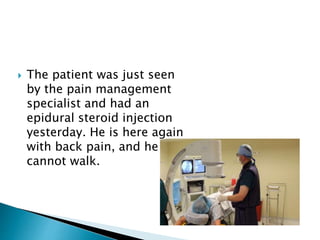
 The patient was just seen
by the pain management
specialist and had an
epidural steroid injection
yesterday. He is here again
with back pain, and he
cannot walk.
 He seems weak in his legs, but that’s just
pain.” Patients who are status post procedure
are at increased risk for developing
complications that include epidural
hematoma and spinal infection. These
patients need imaging if they have new
neurologic findings.
 You got a call from ER in
the midnight with your
patient presented with
generalised tonic clonic
seizure. You had seen that
patient yesterday for LBP
and you had prescribed
some medicine for it.
 How will you approach this
patient???
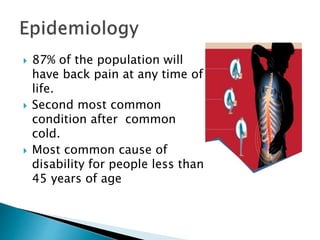
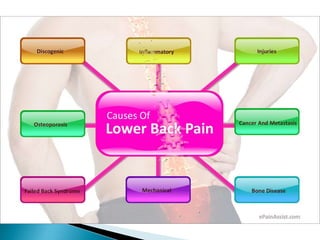
 87% of the population will
have back pain at any time of
life.
 Second most common
condition after common
cold.
 Most common cause of
disability for people less than
45 years of age
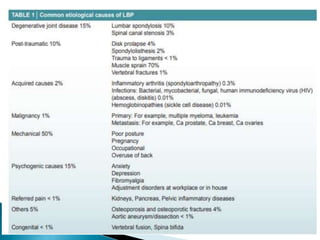
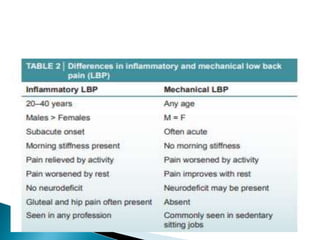
 Inflammatory LBP common
in 18–40 years
 Degenerative conditions,
malignancy and
osteoporosis are common
causes above 40 years
 Infective causes can occur
in all age groups
• Sphincter disturbance: bowel
or bladder
• History of cancer
• Unexplained weight loss
• Immunosuppression
• Intravenous drug use
• Recent onset of structural
deformity
• Recent or on-going infection
• Fever
• Night sweats
• Non-mechanical pattern of
pain
• Constant pain
• Wide spread neurological
signs or symptoms
• Disproportionate night pain
• Lack of treatment response
• Thoracic dominant pain
• Under 20 and over 55
 Rupture of aortic
aneurysm
 Epidural hemorrhage
 Anterior spinal artery
thrombosis
 Epidural abscess
 Spinal cord tumors
 Cauda equina syndrome
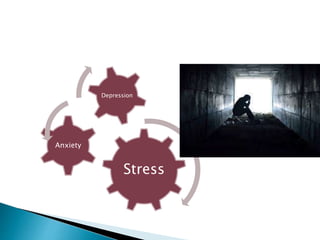
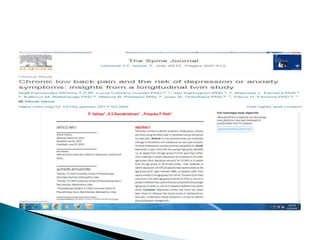
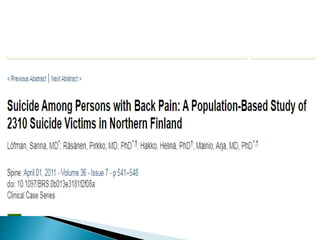
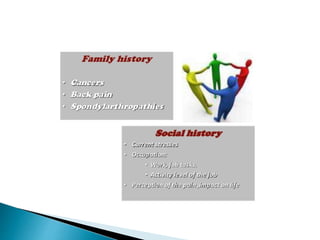
Stress
Anxiety
Depression
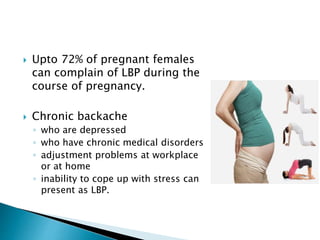
 Upto 72% of pregnant females
can complain of LBP during the
course of pregnancy.
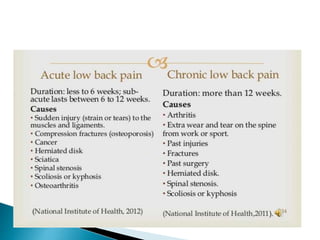
 Chronic backache
◦ who are depressed
◦ who have chronic medical disorders
◦ adjustment problems at workplace
or at home
◦ inability to cope up with stress can
present as LBP.
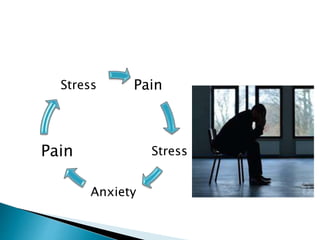
Pain
Stress
Anxiety
Pain
Stress
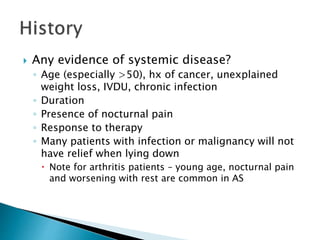
 Any evidence of systemic disease?
◦ Age (especially >50), hx of cancer, unexplained
weight loss, IVDU, chronic infection
◦ Duration
◦ Presence of nocturnal pain
◦ Response to therapy
◦ Many patients with infection or malignancy will not
have relief when lying down
 Note for arthritis patients – young age, nocturnal pain
and worsening with rest are common in AS
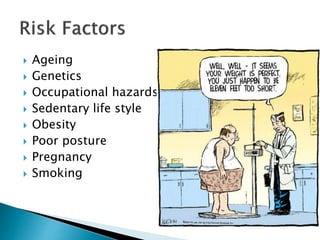
 Ageing
 Genetics
 Occupational hazards
 Sedentary life style
 Obesity
 Poor posture
 Pregnancy
 Smoking
Investigate
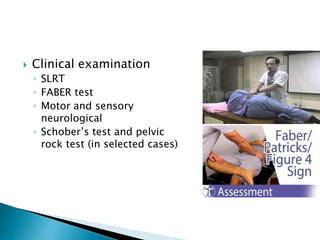
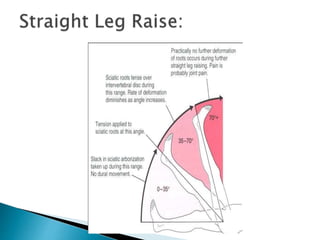
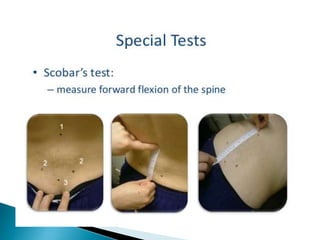
 Clinical examination
◦ SLRT
◦ FABER test
◦ Motor and sensory
neurological
◦ Schober’s test and pelvic
rock test (in selected cases)
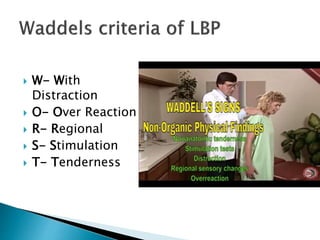
 W- With
Distraction
 O- Over Reaction
 R- Regional
 S- Stimulation
 T- Tenderness
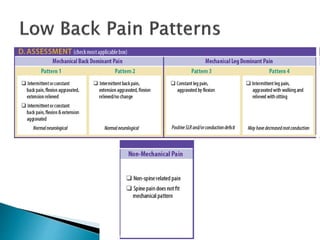
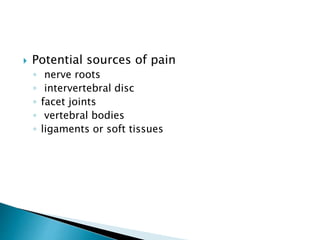
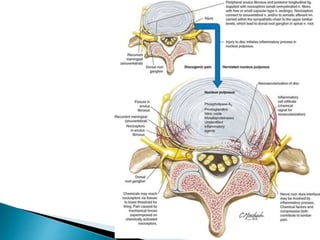
 Potential sources of pain
◦ nerve roots
◦ intervertebral disc
◦ facet joints
◦ vertebral bodies
◦ ligaments or soft tissues
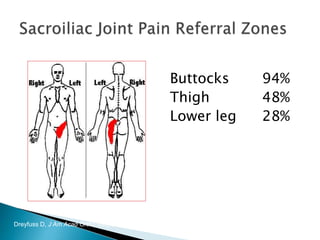
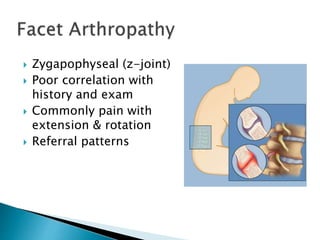
 Zygapophyseal (z-joint)
 Poor correlation with
history and exam
 Commonly pain with
extension & rotation
 Referral patterns
1. Schwarzer AC, et al. Spine 1994;19:1132-7.
2. Slipman, C. Arch PM&R 81:334-338, 2000.
Buttocks 94%
Thigh 48%
Lower leg 28%
Dreyfuss D, J Am Acad Ortho Surg 2004, 12.
 Most recover rapidly
◦ 90% of patients seen within 3 days of symptom
onset recovered within 2 weeks
 Recurrences are common
◦ Most have chronic disease with intermittent
exacerbations
 Spinal stenosis is the exception  usually
gets progressively worse with time
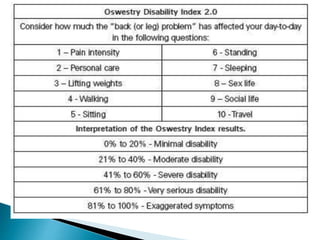
 Oswestry Disability Score
Vs
 Rolland Morris Questionnare
 Xray
 Biochemistry
 CT scan
 MRI
 CT and MRI
◦ detection of infection and cancer
◦ Also able to image herniated discs and spinal
stenosis, which cannot be appreciated on plain
films
◦ Beware: herniated/bulging discs often found in
asymptomatic volunteers  may lead to
overdiagnosis/overtreatment
◦ MRI better than CT for detection of infection,
metastases, rare neural tumours
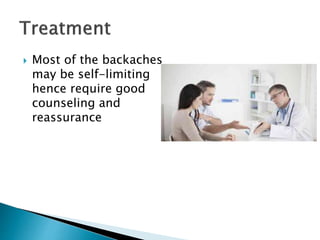
 Most of the backaches
may be self-limiting
hence require good
counseling and
reassurance
 With all our technology we can identify the
specific patho-anatomic source of pain in only
20% of back pain patients.
 Everything else is labeled “non-specific” back
pain. It is treated “non-specifically”,
 NSAIDs first line drugs as pain medication for
acute low back pain unless contraindicated.
 No evidence of one superior to another.
 Prescribe regularly for short period of time
rather than PRN basis
 All have cardiovascular risk except Naproxen.
 COX-2 have increased cardiovascular risk so
avoid in elderly.
European guidelines for management of
CLBP
 Muscle relaxants work better if added with
NSAIDs.
 Tramadol inferior to NSAIDs for pain
management
 TCA are good for chronic low back pain except
◦ Renal failure
◦ Cardiac failure
◦ Glaucoma
◦ Pregnancy
◦ COPD
 NSAIDs not recommended in radicular LBP
 Herbal pain medications can be beneficial for
chronic low back pain for long tern use.
European guidelines for management
of CLBP
 Exercise therapy- recommended (Gr. A
evidence) for treating pain and disability due
to CLBP.
 Short course of Manual therapy (Gr. C
evidence)
 IPRP-Holistic approach
European guidelines for management
of CLBP
 Pain physician
 Psychologists (for counselling)
 Physiotherapist
 Occupational therapists
Grade B evidence
European guidelines for management
of CLBP
 Bed rest
 Lumbar spinal support
 TENS
 Lumbar traction
 Massage therapy
 Systemic/local use of steroids
European guidelines for management
of CLBP
 Leading cause of disability
 Rule out red flag signs
 Do not investigate in all cases with LBP
 Conservative therapy is the mainstay
 Proper counseling
 Interdisciplinary pain rehabilitation program
(IPRP)
Approach to Low Back Pain

Approach to Low Back Pain

  • 1.
    Dr. Ramkrishna Dahal(Clinical Fellow Spinal Reconstructive Surgery) Department of Spine Services Grande International Hospital 2018
  • 2.
     A 25yrs stunt motorcyclist presented to ER with severe back pain. He had history of RTA with multiple ribs fracture with no external injuries. His GCS was 15/15 on presentation and was falling gradually. ◦ BP 80/60, Pulse 130  How will you approach this patient???
  • 3.
     A 42yrsold banker presented to clinic with complaints of LBP for 6 months, no significant medical and surgical history, intact neurology non radiating, pain worsens with activity.  How will you approach this patient???
  • 4.
     A 22yrs old student presented to clinic with complaints of back pain for 6 months, morning stiffness, intact neurology, managed with analgesics and physical therapy with no significant pain relieve.  How will you approach this patient???
  • 5.
     A 50yrs old farmer presented in clinic with complaints of LBP for 6 months, occasional fever and night pain, pain worsens with spine flexion, managed with analgesics and physical therapy with no pain relieve.  How will you approach this patient???
  • 6.
     A 75yrs old patient with complaints of LBP for 6 months, incresed in severity for past few days, with no constitutional symptoms, but gives history of difficulty in micturition for past 10 yrs seen by urologist and gave some medication for his urinary symptoms.  How will you approach this patient???
  • 7.
     The patientwas just seen by the pain management specialist and had an epidural steroid injection yesterday. He is here again with back pain, and he cannot walk.
  • 8.
     He seemsweak in his legs, but that’s just pain.” Patients who are status post procedure are at increased risk for developing complications that include epidural hematoma and spinal infection. These patients need imaging if they have new neurologic findings.
  • 9.
     You gota call from ER in the midnight with your patient presented with generalised tonic clonic seizure. You had seen that patient yesterday for LBP and you had prescribed some medicine for it.  How will you approach this patient???
  • 10.
     87% ofthe population will have back pain at any time of life.  Second most common condition after common cold.  Most common cause of disability for people less than 45 years of age
  • 11.
     Inflammatory LBPcommon in 18–40 years  Degenerative conditions, malignancy and osteoporosis are common causes above 40 years  Infective causes can occur in all age groups
  • 12.
    • Sphincter disturbance:bowel or bladder • History of cancer • Unexplained weight loss • Immunosuppression • Intravenous drug use • Recent onset of structural deformity • Recent or on-going infection • Fever
  • 13.
    • Night sweats •Non-mechanical pattern of pain • Constant pain • Wide spread neurological signs or symptoms • Disproportionate night pain • Lack of treatment response • Thoracic dominant pain • Under 20 and over 55
  • 14.
     Rupture ofaortic aneurysm  Epidural hemorrhage  Anterior spinal artery thrombosis  Epidural abscess  Spinal cord tumors  Cauda equina syndrome
  • 16.
  • 19.
     Upto 72%of pregnant females can complain of LBP during the course of pregnancy.  Chronic backache ◦ who are depressed ◦ who have chronic medical disorders ◦ adjustment problems at workplace or at home ◦ inability to cope up with stress can present as LBP.
  • 20.
  • 21.
     Any evidenceof systemic disease? ◦ Age (especially >50), hx of cancer, unexplained weight loss, IVDU, chronic infection ◦ Duration ◦ Presence of nocturnal pain ◦ Response to therapy ◦ Many patients with infection or malignancy will not have relief when lying down  Note for arthritis patients – young age, nocturnal pain and worsening with rest are common in AS
  • 24.
     Ageing  Genetics Occupational hazards  Sedentary life style  Obesity  Poor posture  Pregnancy  Smoking
  • 25.
  • 28.
     Clinical examination ◦SLRT ◦ FABER test ◦ Motor and sensory neurological ◦ Schober’s test and pelvic rock test (in selected cases)
  • 32.
     W- With Distraction O- Over Reaction  R- Regional  S- Stimulation  T- Tenderness
  • 35.
     Potential sourcesof pain ◦ nerve roots ◦ intervertebral disc ◦ facet joints ◦ vertebral bodies ◦ ligaments or soft tissues
  • 38.
     Zygapophyseal (z-joint) Poor correlation with history and exam  Commonly pain with extension & rotation  Referral patterns 1. Schwarzer AC, et al. Spine 1994;19:1132-7. 2. Slipman, C. Arch PM&R 81:334-338, 2000.
  • 40.
    Buttocks 94% Thigh 48% Lowerleg 28% Dreyfuss D, J Am Acad Ortho Surg 2004, 12.
  • 46.
     Most recoverrapidly ◦ 90% of patients seen within 3 days of symptom onset recovered within 2 weeks  Recurrences are common ◦ Most have chronic disease with intermittent exacerbations  Spinal stenosis is the exception  usually gets progressively worse with time
  • 47.
     Oswestry DisabilityScore Vs  Rolland Morris Questionnare
  • 49.
  • 50.
     CT andMRI ◦ detection of infection and cancer ◦ Also able to image herniated discs and spinal stenosis, which cannot be appreciated on plain films ◦ Beware: herniated/bulging discs often found in asymptomatic volunteers  may lead to overdiagnosis/overtreatment ◦ MRI better than CT for detection of infection, metastases, rare neural tumours
  • 51.
     Most ofthe backaches may be self-limiting hence require good counseling and reassurance
  • 54.
     With allour technology we can identify the specific patho-anatomic source of pain in only 20% of back pain patients.  Everything else is labeled “non-specific” back pain. It is treated “non-specifically”,
  • 55.
     NSAIDs firstline drugs as pain medication for acute low back pain unless contraindicated.  No evidence of one superior to another.  Prescribe regularly for short period of time rather than PRN basis  All have cardiovascular risk except Naproxen.  COX-2 have increased cardiovascular risk so avoid in elderly. European guidelines for management of CLBP
  • 56.
     Muscle relaxantswork better if added with NSAIDs.  Tramadol inferior to NSAIDs for pain management  TCA are good for chronic low back pain except ◦ Renal failure ◦ Cardiac failure ◦ Glaucoma ◦ Pregnancy ◦ COPD  NSAIDs not recommended in radicular LBP  Herbal pain medications can be beneficial for chronic low back pain for long tern use. European guidelines for management of CLBP
  • 57.
     Exercise therapy-recommended (Gr. A evidence) for treating pain and disability due to CLBP.  Short course of Manual therapy (Gr. C evidence)  IPRP-Holistic approach European guidelines for management of CLBP
  • 58.
     Pain physician Psychologists (for counselling)  Physiotherapist  Occupational therapists Grade B evidence European guidelines for management of CLBP
  • 59.
     Bed rest Lumbar spinal support  TENS  Lumbar traction  Massage therapy  Systemic/local use of steroids European guidelines for management of CLBP
  • 61.
     Leading causeof disability  Rule out red flag signs  Do not investigate in all cases with LBP  Conservative therapy is the mainstay  Proper counseling  Interdisciplinary pain rehabilitation program (IPRP)