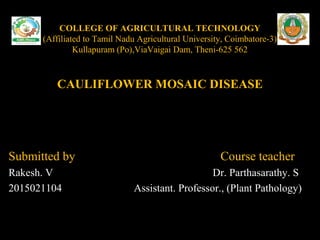
COLLEGE OF AGRICULTURAL TECHNOLOGY
(Affiliated to Tamil Nadu Agricultural University, Coimbatore-3)
Kullapuram (Po),ViaVaigai Dam, Theni-625 562
CAULIFLOWER MOSAIC DISEASE
Submitted by Course teacher
Rakesh. V Dr. Parthasarathy. S
2015021104 Assistant. Professor., (Plant Pathology)
Disease name : Cauliflower Mosaic disease
Pathogen name: Cauliflower mosaic virus
Hosts: Cauliflower, cabbage, other crucifers.
Systematic position
Domain: Virus
Group: Group VII (ds DNA-RT)
Family: Caulimoviridae
Genus: Caulimovirus
Species: Cauliflower mosaic virus
History
 CaMV affects the plant development, especially in early infections
when also the inflorescence is prevented. Low seed yields have been
also reported (Sutic et al., 1999).
 CaMV incidence can easily exceed 70% and subsequent yields may
be reduced up to 20-50% (Shepherd, 1981. Sutic et al., 1999).
 All CaMV isolates are able to infect a wide variety of cruciferous
plants, but only a few of them can infect species of the family
Solanaceae, including Datura and Nicotiana genera (Gracia and
Shepherd, 1985. Lung and Pirone, 1972. Schoelz et al., 1986).
Distribution
• World: India, Israel, Iran, Africa, North America and
Europe.
• India: Himachal pradesh, Assam, Uttar pradesh and West
Bengal.
Report
 First reported in Brassica campestris and
B. oleracea from the U.S.A. by Tompkins (1937).
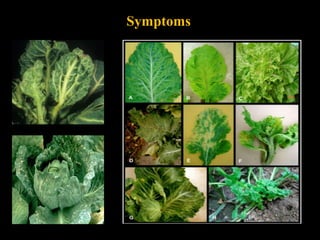
Symptoms
.
Symptoms associated with natural infections by
CaMV
 Mosaic banding.
 Vein-clearing.
 Leaf deformation, rugosity, stunting.
 Necrotic spots.
 Yellowing.
Pathogen Characters
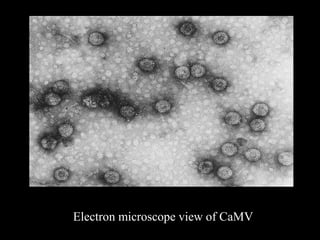
 The CaMV particle is an icosahedron with a diameter of 52 nm
built from 420 capsid protein (CP) subunits.
 CaMV contains a circular double-stranded DNA molecule .
 Cauliflower mosaic virus (CaMV) is the type species of the
family Caulimoviridae.
 Cauliflower mosaic virus (CaMV) is a member of the
genus Caulimovirus, one of the six genera in
the Caulimoviridae family, which are pararetroviruses that
infect plants and replicate through reverse transcription just
like retroviruses, but the viral particles contain DNA.
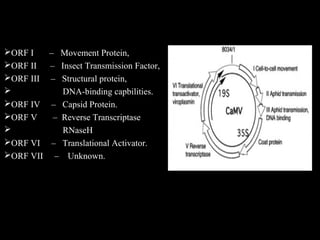
ORF I – Movement Protein,
ORF II – Insect Transmission Factor,
ORF III – Structural protein,
 DNA-binding capbilities.
ORF IV – Capsid Protein.
ORF V – Reverse Transcriptase
 RNaseH
ORF VI – Translational Activator.
ORF VII – Unknown.
Electron microscope view of CaMV
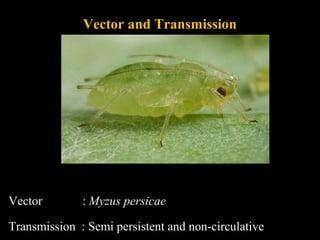
Vector and Transmission
Vector : Myzus persicae
Transmission : Semi persistent and non-circulative
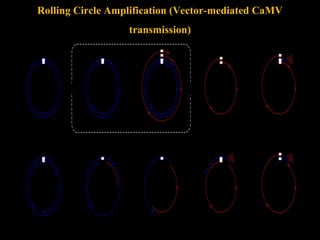
Rolling Circle Amplification (Vector-mediated CaMV
transmission)
Management
• Control of aphid vectors through the use of insecticides
like metasystox (0.1%) at an appropriate stage is helpful
in reducing the spread of the disease.
References
• Gupta.S.K., R.C.Sharma, Monica sharma, 2017.,
Diseases of vegetable ornamental and spice crops,
Pg.No.50-63.
• https://en.wikipedia.org/wiki/Cauliflower_mosaic_virus.
• https://www.cabi.org/isc/datasheet/15099.

Cauliflower mosaic disease

  • 1.
    COLLEGE OF AGRICULTURALTECHNOLOGY (Affiliated to Tamil Nadu Agricultural University, Coimbatore-3) Kullapuram (Po),ViaVaigai Dam, Theni-625 562 CAULIFLOWER MOSAIC DISEASE Submitted by Course teacher Rakesh. V Dr. Parthasarathy. S 2015021104 Assistant. Professor., (Plant Pathology)
  • 2.
    Disease name :Cauliflower Mosaic disease Pathogen name: Cauliflower mosaic virus Hosts: Cauliflower, cabbage, other crucifers.
  • 3.
    Systematic position Domain: Virus Group:Group VII (ds DNA-RT) Family: Caulimoviridae Genus: Caulimovirus Species: Cauliflower mosaic virus
  • 4.
    History  CaMV affectsthe plant development, especially in early infections when also the inflorescence is prevented. Low seed yields have been also reported (Sutic et al., 1999).  CaMV incidence can easily exceed 70% and subsequent yields may be reduced up to 20-50% (Shepherd, 1981. Sutic et al., 1999).  All CaMV isolates are able to infect a wide variety of cruciferous plants, but only a few of them can infect species of the family Solanaceae, including Datura and Nicotiana genera (Gracia and Shepherd, 1985. Lung and Pirone, 1972. Schoelz et al., 1986).
  • 5.
    Distribution • World: India,Israel, Iran, Africa, North America and Europe. • India: Himachal pradesh, Assam, Uttar pradesh and West Bengal.
  • 6.
    Report  First reportedin Brassica campestris and B. oleracea from the U.S.A. by Tompkins (1937).
  • 7.
  • 8.
    Symptoms associated withnatural infections by CaMV  Mosaic banding.  Vein-clearing.  Leaf deformation, rugosity, stunting.  Necrotic spots.  Yellowing.
  • 9.
    Pathogen Characters  TheCaMV particle is an icosahedron with a diameter of 52 nm built from 420 capsid protein (CP) subunits.  CaMV contains a circular double-stranded DNA molecule .  Cauliflower mosaic virus (CaMV) is the type species of the family Caulimoviridae.  Cauliflower mosaic virus (CaMV) is a member of the genus Caulimovirus, one of the six genera in the Caulimoviridae family, which are pararetroviruses that infect plants and replicate through reverse transcription just like retroviruses, but the viral particles contain DNA.
  • 10.
    ORF I –Movement Protein, ORF II – Insect Transmission Factor, ORF III – Structural protein,  DNA-binding capbilities. ORF IV – Capsid Protein. ORF V – Reverse Transcriptase  RNaseH ORF VI – Translational Activator. ORF VII – Unknown.
  • 11.
  • 12.
    Vector and Transmission Vector: Myzus persicae Transmission : Semi persistent and non-circulative
  • 13.
    Rolling Circle Amplification(Vector-mediated CaMV transmission)
  • 14.
    Management • Control ofaphid vectors through the use of insecticides like metasystox (0.1%) at an appropriate stage is helpful in reducing the spread of the disease.
  • 15.
    References • Gupta.S.K., R.C.Sharma,Monica sharma, 2017., Diseases of vegetable ornamental and spice crops, Pg.No.50-63. • https://en.wikipedia.org/wiki/Cauliflower_mosaic_virus. • https://www.cabi.org/isc/datasheet/15099.