CASTING PROCEDURES
Introduction
• Casting is the process by which a wax pattern
of a restoration is converted to a replicate in a
dental alloy.
• The casting process is used to make dental
restorations such as inlays, onlays, crowns,
bridges, and removable partial dentures.
Casting Procedure
The various steps in casting procedure are as
follows : -
• Preparation of die
• Wax pattern
• Investing of the pattern
• Burnout of the wax
• Casting
• Cleaning of the casting
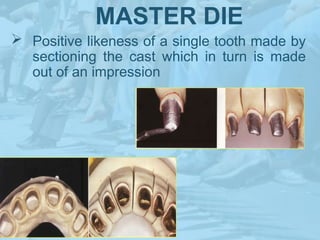
MASTER DIE
 Positive likeness of a single tooth made by
sectioning the cast which in turn is made
out of an impression
Wax Pattern
There are two fundamental ways to prepare a
wax pattern for a dental restoration : -
 In the direct method the pattern is prepared
on the tooth in the mouth. This method can be
used for small inlay restorations.
 In the indirect method a model ( die ) of the
tooth is first made and the pattern is made on
the die. The indirect method is used for all
types of restorations
INVESTMENTS
DEFINITIONS:
Invest: To surround or envelop in an investment material.
.
Investing: The process of covering or enveloping, wholly or
in parts; an object such as a denture, tooth, wax form, crown
etc. with a suitable investment material before processing,
soldering or casting.
Investment (K.J. Anusavice) refractory material used to
form a mould casting for cast metals or hot pressed
ceramics.
Classification according to Binders used:
GYPSUM BONDED INVESTMENT:
- alloys that fuse below 1975F (1080c)
- Casting of gold alloys inlays, onlays, crowns and fixed
partial dentures.
PHOSPHATE BONDED INVESTMENTS:
- for higher fusing alloys
- Designed primarily for alloys used to produce copings or
frame works for metal ceramic prosthesis and for some base
metal alloys. It can also be used for press able ceramics.
ETHYL SILICATE- BONDED INVESTMENTS:
- for casting of removable partial dentures with base metal
alloys (cobalt based or nickel based alloys)
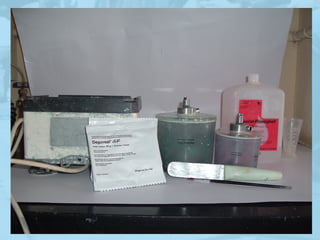
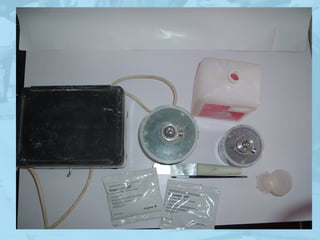
Armamentarium
Vacuum mixer and bowl
Vibrator
Investment powder (gypsum or phosphate
bonded)
Water or colloidal silica
Spatula
Brush
Surfactant
Casting ring and liner
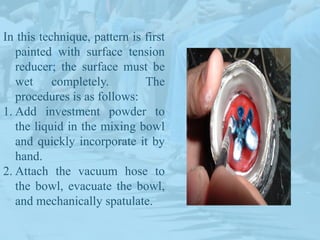
In this technique, pattern is first
painted with surface tension
reducer; the surface must be
wet completely. The
procedures is as follows:
1. Add investment powder to
the liquid in the mixing bowl
and quickly incorporate it by
hand.
2. Attach the vacuum hose to
the bowl, evacuate the bowl,
and mechanically spatulate.
The mixing should be carefully timed in accordance
with the manufacturer’s instructions and the type of
mixing bowl used (high speed versus low speed).
3. Coat the entire pattern with investment, pushing the
material ahead of the brush from a single point.
Gently vibrate through out the application of
investment, being especially careful to coat the
internal surface and the margin of the pattern.
After the pattern has been completely coated, the
ring is immediately filled by vibrating the remaining
investment out of the bowl.
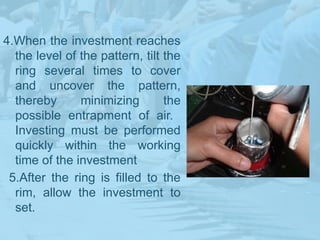
4.When the investment reaches
the level of the pattern, tilt the
ring several times to cover
and uncover the pattern,
thereby minimizing the
possible entrapment of air.
Investing must be performed
quickly within the working
time of the investment
5.After the ring is filled to the
rim, allow the investment to
set.
Wax pattern removal
• The sprue former should be attached to the wax
pattern with the pattern on the master die, provided
the pattern can be removed directly in line with its
path of withdrawal from the die.
• Any motion that might distort the wax pattern should
be avoided during removal.
• The gauge selection and design for the sprue former
are often empirical , but optimal performance during
the casting process is based on the following five
general principles.
Sprue Diameter
• Select a sprue former with a diameter that is
approximately the same size as the thickest area of
the wax pattern.
• If the the pattern is small , the sprue former must
also be small, because attaching a large sprue
former to a thin, delicate pattern could cause
distortion.
• On the other hand, if the sprue former diameter is
too small , this area will solidify before the casting
itself and localized shrinkage porosity may develop.
• Reservoir sprues are used to help to overcome this
problem
Sprue Position
• Some clinicians prefer placement at the occlusal
surface, whereas others choose sites such as a
proximal wall or just below the non functional cusp
to minimize the subsequent grinding of occlusal
anatomy and contact areas.
• The ideal area for the sprue former is the point of
greatest bulk in the pattern to avoid distorting thin
areas of wax during attachment to the pattern and to
permit complete flow of the alloy.
Sprue Attachment
• The Sprue former connection to the wax pattern is
generally flared for high density gold alloys, but it is
often restricted for lower density alloys.
• The sprue former should be attached to the portion
of the pattern with a largest cross sectional area.
• It is best for the molten alloy to flow from a thick
section to surrounding thin areas ( eg. The margins)
rather than the reverse.
• This design minimizes the risk for turbulence
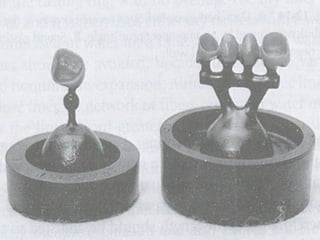
• Patterns may be sprued either directly or
indirectly.
• For direct spruing , the sprue former provides
a direct connection between the pattern area
and sprue base.
• With indirect spruing a connector or reservoir
bar is positioned between the pattern and
crucible former.
• It is common to use indirect spruing for
multiple single units and fixed partial
dentures, although several single units can be
sprued with multiple direct sprue formers.
• A reservoir should be added to sprue network
to prevent localized shrinkage porosity.
• When the molten alloy fills the heated casting
ring, the pattern area should solidify first and
the reservoir last.
• Because of its large mass of alloy and position
in the heat center of the ring , the reservoir
remains molten to furnish liquid alloy into the
mold as it solidifies.
• The resulting solidification shrinkage occurs
in the reservoir bar and not in the prosthesis.
Sprue direction
• The sprue former should be directed away from any
thin or delicate parts of the pattern, because the
molten metal may abrade or fracture investment in
this area and result in a casting failure .
• The sprue former should not be attached at a right
angle to a broad flat surface.
• Such an orientation leads to turbulence within the
mold cavity and severe porosity in this region.
Sprue length
• The length of the sprue former depends on
the length of the casting ring.
• If the sprue is too short , the wax pattern may
be so far removed from the end of the casting
ring that gases cannot be adequately vented
to permit the molten alloy to fill the ring
completely.
• When these gases are not completely
eliminated, porosity may result
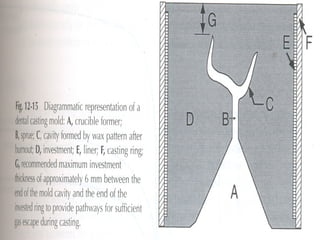
• Sprue length should be adjusted so that the
top of the wax pattern is within 6mm of the
open end of the ring for gypsum bonded
investments.
• With the higher strength phosphate bonded
investments it may be possible to position the
wax pattern within 3 to 4 mm of the top of the
investment for reproducibility of casting
accuracy, the pattern should be placed as
close as possible to the center of the ring.
Casting ring liner
• The most commonly used techniques to provide
investment expansion is to line the walls of the ring
with a ring liner.
• Traditionally, asbestos was the material of choice,
but it can no longer be used because its
carcinogenic potential makes it a biohazard.
• Two types of non asbestos ring liner materials have
been produced ;
- An aluminosilicate ceramic liner and
- A cellulose (paper) liner
BURNOUT OF THE WAX
PATTERN
• After the wax pattern has been invested, it should be
set aside until the investment has hardened, usually
45 to 60 minutes.
• Investment must withstand the impact force exerted
by the molten metal when it enters the hot mold
during casting.
• During burnout, the mold is placed in an oven to
completely eliminate the wax, thereby forming a
cavity into which the molten metal is cast.
• During wax elimination, the investment expands
thermally, which is necessary to compensate for the
casting shrinkage.
• Although wax melts at a comparatively low
temperature, its complete elimination requires much
higher temperatures.
• When the molten metal enters the sprue hole, the
resulting force causes the air in the mold cavity to be
driven out through the pores of the investment, thus
the mold cavity is filled completely.
• This process takes less than a second.
• When heated to higher temperatures, any
organic material decomposes and forms
carbon dioxide, water, or nitrogen oxides, all
of which are gases and can be easily
eliminated.
• However, formation of these gases depends
on the presence of a sufficient supply of
oxygen, the relatively high temperature of the
oven, and adequate heating time of the ring
• A satisfactory way of eliminating the wax
pattern is to set the mold in the furnace with
the sprue hole placed downward at first, so
most of the wax drains out and is eliminated
as a liquid.
• The ring is then inverted with the sprue hole
placed upward.
• In this position the oxygen in the oven
atmosphere can circulate more readily into
the cavity, react with the wax, and form gases
rather than the fine carbon that interferes with
the venting of the mold cavity.
Casting Machines:
Alloys are melted in one of the four following
ways, depending on the available types
of casting machines.
1) The Alloy is melted in a separate crucible by
a torch flame and is cast into mold by
centrifugal force .
2) The Alloy is melted electrically by a
resistance heating or induction furnace, then
cast into the mold centrifugally by motor or
spring action.
• 3) The Alloy is melted by induction heating,
then cast into the mold centrifugally by motor
or spring action.

• 4) The Alloy is vacuum arc melted and cast
by pressure in an argon atmosphere. In
addition to these 3 melting machine the
molten metal may be caste by air pressure ,
by vacuum , or both.
Cleaning the casting
• Often the surface of the casting appears
dark with oxides and tarnish.
• Such a surface film can be removed by a
process known as pickling, which consists
of heating the discolored casting in an acid.
• One of the best pickling solutions for
gypsum bonded investments is 50%
hydrochloric acid solution.
• The hydrochloric acid aids in the removal of any
residual investments, as well as the oxide coating.
• The disadvantage of hydrochloric acid is that the
fumes from the acid are likely to corrode laboratory
metal furnishings.
• In addition these fumes are a health hazard and
should be vented via fume hood.
• A solution of sulfuric acid may also be more
advantageous in this respect.
• The best method for pickling is to place the casting
in a test tube or dish and to pour the acid over it .
• It may be necessary to heat the acid , but boiling
should be avoided because of the considerable
amount of acid fumes involved . After pickling, the
acid is poured off and the casting is removed.
• The pickling solution should be renewed frequently,
because it is likely to become contaminated after
reusing the solutions several times
THANK YOU

Casting Procedures used in dentistry.pptx

  • 1.
  • 2.
    Introduction • Casting isthe process by which a wax pattern of a restoration is converted to a replicate in a dental alloy. • The casting process is used to make dental restorations such as inlays, onlays, crowns, bridges, and removable partial dentures.
  • 3.
    Casting Procedure The varioussteps in casting procedure are as follows : - • Preparation of die • Wax pattern • Investing of the pattern • Burnout of the wax • Casting • Cleaning of the casting
  • 4.
    MASTER DIE  Positivelikeness of a single tooth made by sectioning the cast which in turn is made out of an impression
  • 5.
    Wax Pattern There aretwo fundamental ways to prepare a wax pattern for a dental restoration : -  In the direct method the pattern is prepared on the tooth in the mouth. This method can be used for small inlay restorations.  In the indirect method a model ( die ) of the tooth is first made and the pattern is made on the die. The indirect method is used for all types of restorations
  • 6.
    INVESTMENTS DEFINITIONS: Invest: To surroundor envelop in an investment material. . Investing: The process of covering or enveloping, wholly or in parts; an object such as a denture, tooth, wax form, crown etc. with a suitable investment material before processing, soldering or casting. Investment (K.J. Anusavice) refractory material used to form a mould casting for cast metals or hot pressed ceramics.
  • 7.
    Classification according toBinders used: GYPSUM BONDED INVESTMENT: - alloys that fuse below 1975F (1080c) - Casting of gold alloys inlays, onlays, crowns and fixed partial dentures. PHOSPHATE BONDED INVESTMENTS: - for higher fusing alloys - Designed primarily for alloys used to produce copings or frame works for metal ceramic prosthesis and for some base metal alloys. It can also be used for press able ceramics. ETHYL SILICATE- BONDED INVESTMENTS: - for casting of removable partial dentures with base metal alloys (cobalt based or nickel based alloys)
  • 8.
    Armamentarium Vacuum mixer andbowl Vibrator Investment powder (gypsum or phosphate bonded) Water or colloidal silica Spatula Brush Surfactant Casting ring and liner
  • 11.
    In this technique,pattern is first painted with surface tension reducer; the surface must be wet completely. The procedures is as follows: 1. Add investment powder to the liquid in the mixing bowl and quickly incorporate it by hand. 2. Attach the vacuum hose to the bowl, evacuate the bowl, and mechanically spatulate.
  • 12.
    The mixing shouldbe carefully timed in accordance with the manufacturer’s instructions and the type of mixing bowl used (high speed versus low speed). 3. Coat the entire pattern with investment, pushing the material ahead of the brush from a single point. Gently vibrate through out the application of investment, being especially careful to coat the internal surface and the margin of the pattern. After the pattern has been completely coated, the ring is immediately filled by vibrating the remaining investment out of the bowl.
  • 13.
    4.When the investmentreaches the level of the pattern, tilt the ring several times to cover and uncover the pattern, thereby minimizing the possible entrapment of air. Investing must be performed quickly within the working time of the investment 5.After the ring is filled to the rim, allow the investment to set.
  • 14.
    Wax pattern removal •The sprue former should be attached to the wax pattern with the pattern on the master die, provided the pattern can be removed directly in line with its path of withdrawal from the die. • Any motion that might distort the wax pattern should be avoided during removal. • The gauge selection and design for the sprue former are often empirical , but optimal performance during the casting process is based on the following five general principles.
  • 15.
    Sprue Diameter • Selecta sprue former with a diameter that is approximately the same size as the thickest area of the wax pattern. • If the the pattern is small , the sprue former must also be small, because attaching a large sprue former to a thin, delicate pattern could cause distortion. • On the other hand, if the sprue former diameter is too small , this area will solidify before the casting itself and localized shrinkage porosity may develop. • Reservoir sprues are used to help to overcome this problem
  • 17.
    Sprue Position • Someclinicians prefer placement at the occlusal surface, whereas others choose sites such as a proximal wall or just below the non functional cusp to minimize the subsequent grinding of occlusal anatomy and contact areas. • The ideal area for the sprue former is the point of greatest bulk in the pattern to avoid distorting thin areas of wax during attachment to the pattern and to permit complete flow of the alloy.
  • 18.
    Sprue Attachment • TheSprue former connection to the wax pattern is generally flared for high density gold alloys, but it is often restricted for lower density alloys. • The sprue former should be attached to the portion of the pattern with a largest cross sectional area. • It is best for the molten alloy to flow from a thick section to surrounding thin areas ( eg. The margins) rather than the reverse. • This design minimizes the risk for turbulence
  • 19.
    • Patterns maybe sprued either directly or indirectly. • For direct spruing , the sprue former provides a direct connection between the pattern area and sprue base. • With indirect spruing a connector or reservoir bar is positioned between the pattern and crucible former. • It is common to use indirect spruing for multiple single units and fixed partial dentures, although several single units can be sprued with multiple direct sprue formers.
  • 20.
    • A reservoirshould be added to sprue network to prevent localized shrinkage porosity. • When the molten alloy fills the heated casting ring, the pattern area should solidify first and the reservoir last. • Because of its large mass of alloy and position in the heat center of the ring , the reservoir remains molten to furnish liquid alloy into the mold as it solidifies. • The resulting solidification shrinkage occurs in the reservoir bar and not in the prosthesis.
  • 21.
    Sprue direction • Thesprue former should be directed away from any thin or delicate parts of the pattern, because the molten metal may abrade or fracture investment in this area and result in a casting failure . • The sprue former should not be attached at a right angle to a broad flat surface. • Such an orientation leads to turbulence within the mold cavity and severe porosity in this region.
  • 22.
    Sprue length • Thelength of the sprue former depends on the length of the casting ring. • If the sprue is too short , the wax pattern may be so far removed from the end of the casting ring that gases cannot be adequately vented to permit the molten alloy to fill the ring completely. • When these gases are not completely eliminated, porosity may result
  • 23.
    • Sprue lengthshould be adjusted so that the top of the wax pattern is within 6mm of the open end of the ring for gypsum bonded investments. • With the higher strength phosphate bonded investments it may be possible to position the wax pattern within 3 to 4 mm of the top of the investment for reproducibility of casting accuracy, the pattern should be placed as close as possible to the center of the ring.
  • 24.
    Casting ring liner •The most commonly used techniques to provide investment expansion is to line the walls of the ring with a ring liner. • Traditionally, asbestos was the material of choice, but it can no longer be used because its carcinogenic potential makes it a biohazard. • Two types of non asbestos ring liner materials have been produced ; - An aluminosilicate ceramic liner and - A cellulose (paper) liner
  • 26.
    BURNOUT OF THEWAX PATTERN • After the wax pattern has been invested, it should be set aside until the investment has hardened, usually 45 to 60 minutes. • Investment must withstand the impact force exerted by the molten metal when it enters the hot mold during casting. • During burnout, the mold is placed in an oven to completely eliminate the wax, thereby forming a cavity into which the molten metal is cast.
  • 27.
    • During waxelimination, the investment expands thermally, which is necessary to compensate for the casting shrinkage. • Although wax melts at a comparatively low temperature, its complete elimination requires much higher temperatures. • When the molten metal enters the sprue hole, the resulting force causes the air in the mold cavity to be driven out through the pores of the investment, thus the mold cavity is filled completely. • This process takes less than a second.
  • 28.
    • When heatedto higher temperatures, any organic material decomposes and forms carbon dioxide, water, or nitrogen oxides, all of which are gases and can be easily eliminated. • However, formation of these gases depends on the presence of a sufficient supply of oxygen, the relatively high temperature of the oven, and adequate heating time of the ring
  • 29.
    • A satisfactoryway of eliminating the wax pattern is to set the mold in the furnace with the sprue hole placed downward at first, so most of the wax drains out and is eliminated as a liquid. • The ring is then inverted with the sprue hole placed upward. • In this position the oxygen in the oven atmosphere can circulate more readily into the cavity, react with the wax, and form gases rather than the fine carbon that interferes with the venting of the mold cavity.
  • 30.
    Casting Machines: Alloys aremelted in one of the four following ways, depending on the available types of casting machines. 1) The Alloy is melted in a separate crucible by a torch flame and is cast into mold by centrifugal force . 2) The Alloy is melted electrically by a resistance heating or induction furnace, then cast into the mold centrifugally by motor or spring action.
  • 31.
    • 3) TheAlloy is melted by induction heating, then cast into the mold centrifugally by motor or spring action. • 4) The Alloy is vacuum arc melted and cast by pressure in an argon atmosphere. In addition to these 3 melting machine the molten metal may be caste by air pressure , by vacuum , or both.
  • 32.
    Cleaning the casting •Often the surface of the casting appears dark with oxides and tarnish. • Such a surface film can be removed by a process known as pickling, which consists of heating the discolored casting in an acid. • One of the best pickling solutions for gypsum bonded investments is 50% hydrochloric acid solution.
  • 33.
    • The hydrochloricacid aids in the removal of any residual investments, as well as the oxide coating. • The disadvantage of hydrochloric acid is that the fumes from the acid are likely to corrode laboratory metal furnishings. • In addition these fumes are a health hazard and should be vented via fume hood. • A solution of sulfuric acid may also be more advantageous in this respect.
  • 34.
    • The bestmethod for pickling is to place the casting in a test tube or dish and to pour the acid over it . • It may be necessary to heat the acid , but boiling should be avoided because of the considerable amount of acid fumes involved . After pickling, the acid is poured off and the casting is removed. • The pickling solution should be renewed frequently, because it is likely to become contaminated after reusing the solutions several times
  • 35.