DENTAL CASTING
PROCEDURES
Dr.BHUVANESH KUMAR.D.V
Contents
•Introduction
•Definition
•Casting procedure
Wax pattern
Spruing
Investing
Burnout
Casting retrieval
Finishing & Polishing
Introduction
• Casting is one the most widely used methods for fabrication of
metallic restorations.
• The lost wax casting technique was first described at the end of
19th century as a means of making dental castings
Definition
•Casting is defined as
something that has been
cast in a mold, an object
formed by the solidification
of fluid that has been cast
into a refractory-- GPT 9
Casting procedure
• Steps
Tooth preparation and Impression
Wax pattern
Spruing
Attachment to crucible
Investing
Burnout
Casting
Recovery
Finishing and polishing
LAB PROCEDURES
CLINICAL PROCEDURE
Tooth Preparation
Impression and Pouring with Die
Stone
CLINICAL PROCEDURE
Conditioning of the Die
1 - DIE DITCHING 2 - MARKING THE MARGINS 3 -APPLYING DIE HARDENER
4 - APPLYING DIE SPACER
AND DIE SEPERATOR
5 -WAX PATTERN
FABRICATION
Wax pattern
• First procedure in the casting of an inlay
or crown for the lost-wax process is the
preparation of a dental wax pattern.
• It is contouring of wax pattern into desired
shape and form.
• All aspects of final restoration are
incorporated into the wax pattern.
• Shortest time should elapse between the
time the pattern is removed from the die
& the time it is invested.
Casting assembly
•
Spruing
• SPRUE:- The channel for elimination of wax after burnout and pushing
of molten metal during casting.
Basic requirements of sprue
• Used as handle to remove wax
pattern.
• To form a mount for the wax pattern
& fix the pattern in space.
• Creates a channel for elimination of
wax during burn out.
• Facilitate flow of molten metal from
crucible to mold .
Types of sprue
• The sprue can be wax, plastic, or metal.
• Wax sprues are preferred for most castings because they melt
at the same rate as the pattern and thus allow easy escape of
the molten wax
Factors affecting sprue
1.Diameter
2.Position
3.Attachment
4.Direction
5.Length
Sprue diameter
The diameter of sprue should be equal to
the thickest portion the wax pattern.
• Recommended sprue diameters –
•2.5mm (10 gauge) for molar metal ceramic
restorations.
•2.0mm (12 gauge) for premolar partial
veneer restoration.
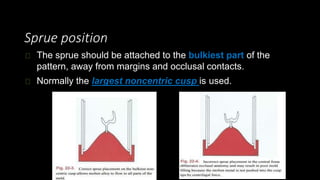
Sprue position
The sprue should be attached to the bulkiest part of the
pattern, away from margins and occlusal contacts.
Normally the largest noncentric cusp is used.
Sprue attachment
The attachment of sprue former
to the wax pattern should be
smooth and do not posses
pits or irregularities.
Should be attached to the
portion of the pattern with the
largest cross sectional area
Sprue Direction
Should be directed away from any thin or delicate parts of
pattern - molten metal may abrade or fracture investment in
this area.
It should be attached 45 degrees to the walls of mold, which
decreases the turbulence of molten alloy
•Shouldn’t be sprued at 90 degrees to a broad flat surface as it
causes turbulence within the mold cavity leading to severe
porosity
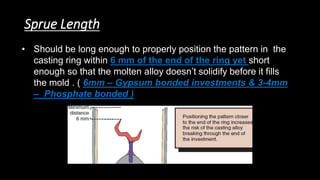
Sprue Length
• Should be long enough to properly position the pattern in the
casting ring within 6 mm of the end of the ring yet short
enough so that the molten alloy doesn’t solidify before it fills
the mold . ( 6mm – Gypsum bonded investments & 3-4mm
– Phosphate bonded )
Reservoir
Function
Piece of wax attached to the sprue about 1mm away from
the pattern, as a enlarged round mass or a connector bar
between the wax pattern and sprue former.
Venting
• Small auxiliary sprues or vents have been recommended to
improve casting of thin patterns and may help in :
 Escape of gases during casting.
 Compensate for the shrinkage during solidification.
 Solidification begins in critical areas by acting as a heat sink.
Crucible Former
The sprue is attached to crucible former which constitutes the
base of the casting ring during investing.
The exact shape of the crucible former depends on the type of
casting machine used.
Crucible formers are basically of 2 types:
a) Steep-sided cone: used with metal when casted using
centrifugal casting force.
b) Shallow cone: used to cast metal using stream/air
pressure.
• They are available as-
 Rubber crucible former
 Metallic Crucible former
 Plastic crucible former
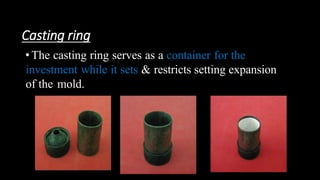
Casting ring
•The casting ring serves as a container for the
investment while it sets & restricts setting expansion
of the mold.
SHAPE
•Round
•Oval
COMPLETE
RING
•Rigid : Metal ,
plastic
•Flexible:
Rubber
SPLIT
RING
• Metal
• Plastic
Types of Casting Ring
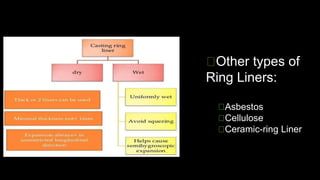
Casting Ring Liners
The most commonly used technique to provide room for
Investment expansion.
Triple fold function : - Freedom to expand which
would otherwise be restricted by the ring .
Helps to offset the contraction of the more rapidly
coolingring while the gold alloy is being melted .
In a wet liner certain amount of hygroscopic expansion is
afforded and a thicker liner provides even greater semi
hygroscopic expansion.
Other types of
Ring Liners:
Asbestos
Cellulose
Ceramic-ring Liner
Wax pattern- crucible former attachment
• Wax pattern is attached to the crucible
former with a sprue ready for investing.
• A ring liner is in place.
Surface Treatment of Wax pattern
• Cleaning the wax pattern
of debris, grease or oil by
surfactants-
1. Pattern cleanser.
2. Synthetic detergent/
Acetylene.
3. Debubblizer.
DEBUBBLIZER
• A debubblizer is a surface tension reducing agent that is used
to reduce the prevalence of bubbles in industrial processes such
as wax casting.
• It is also referred to as surfactant or a wetting agent that is
sprayed on the set impression material.
• Composition –
• Citric acid
• Sodium 2-phenylpropane-2-sulfonate
• Propylene glycol
Investing
• The process of covering or enveloping an object such as a
denture, tooth, wax form, crown, with a suitable investment
material before processing, or casting
• Investment material – Gypsum bonded, Phosphate bonded, Ethyl
silicate bonded
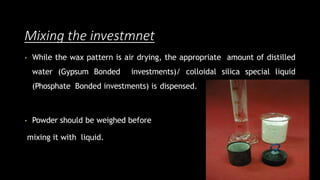
Mixing the investmnet
• While the wax pattern is air drying, the appropriate amount of distilled
water (Gypsum Bonded investments)/ colloidal silica special liquid
(Phosphate Bonded investments) is dispensed.
• Powder should be weighed before
mixing it with liquid.
Mixing the investment
• The liquid is added to clean dry mixing bowl, and the powder is
gradually added to the liquid using care and caution to minimize air
entrapment.
• Vacuum mixing of investment materials is highly
recommended for consistent results in investing and casting
with minimal surface defects, especially when phosphate-
bonded investments are used.
.
Vacuum
investing
machines
DISPENSING
• Poured into the ring (thin consistency) from
a height (20-30 cm), at a slight angle from
bottom to the top of a ring.
PAINT ON TECHNIQUE
•Wet investment material is gently painted over a complex wax
pattern by the use of fine hair brush, covering it completely.
•No. 6 or No. 8 brush is used to coat the
pattern.
SETTING OF INVESTMENT
•(For thermal expansion technique) -
•Allow the investment ring to bench set undisturbed for the
time recommended by manufacturer (approximately - 1 hour).
•(For hygroscopic technique) –
•Immediately place the filled casting ring in 37 degree
• water bath with crucible former-side down.
A - When the investment has set,
the “skin” at the top of the
ring is trimmed off.
B - The rubber crucible former is
removed, and any loose
particles of investment are blown off.
C - The ring is then
placed in the furnace
for the
recommended burnout
schedule.
BURNOUT
• Wax elimination or burnout consists of heating
the investment in a thermostatically controlled
furnace until all traces of the wax are vaporized.
• Once the investment has set for an appropriate
period 1 hour it is ready for burnout.
• The crucible former is then carefully removed and
the invested rings are placed in a room
temperature furnace and heated to the
prescribed maximum temperature.
• The ring should be maintained
long enough at the maximum
temperature, i.e “heat-soak”
to minimize a sudden drop in
temperature upon removal from
the oven.
• Such a drop could result in an
incomplete casting because
of excessively rapid
solidification of the alloy as it
enters the mold.
• Ring is placed in a room temperature furnace and
heated to the prescribed max. Temperature.
• For gypsum bonded investments –
Hygroscopic technique – 500 C
Thermal expansion technique – 700 C
• For Phosphate bonded investments –
Maximum temperature (700 – 1030 C)
Manual
Semiauto-
matic
Fully
Programm-
able controls
Burnout ovens
CASTING
Casting procedure: It is a process of obtaining a metallic
duplicate of a missing tooth structure by pouring molten metal
into a mold of a required form & allowing it to solidify to obtain
a metallic duplicate.
Something that has been cast in a mold; an
object formed by the solidification of a fluid that
has been poured or injected into a refractory
mold.(GPT-9)
Casting of an alloy into the mold space uses 2 basic requirements:
1. Heat source – to melt the alloy
2. Casting force – to force molten alloy into mold
Heat source
Torch Melting
Gas air torch
Gas oxygen
Oxy acetylene
torch
Hydrogen
oxygen
generator
Electricity
Torch Melting
Zones of Combustion
Zones Color
Zone 1
Non combustion
zone
Dark • No heat is present.
• Air and gas are mixed before combustion.
Zone 2
Combustion zone
Green • Gas and air are partially burned here.
• Definitely oxidizing zone, should always be kept
away from the molten alloy during fusion
Zone 3
Reducing zone
Dimly
blue
• Hottest zone
• Should be kept constantly on the alloy during
melting
Zone 4
Oxidizing zone
• Area where combustion occurs with oxygen in the
air.
• Shouldn’t be used to melt the alloy because it
oxidizes the alloy and its temperature is lower than
that of the Reducing zone.
Gas air torch • Used to melt conventional noble metal alloys whose melting points
less than 1000⁰ C (used for inlays, crown and bridge).
Gas oxy torch • Used to melt metal-ceramic alloys of higher temperature up to
1200⁰C.
• Oxygen pressure - 10 - 15 psi.
• The flame is directed onto metal with the nozzle of the torch about
1.5 cm away from the metal.
• Complete fluid should be obtained within 30 seconds at the point
of which the metal is poured into the mold.
Oxyacetylene
torch
• One part acetylene + 2.5 parts oxygen
• Distance of 10 cm between the face of the nozzle and the base of
crucible.
• If distance is reduced to :
7.5 mm - slight porosity.
5 mm - increased porosity due to occluded H2 gas.
Gas air torch
Gas oxy torch
DIFFERENCE BETWEEN TORCH AND
ELECTRICAL MELTING OF ALLOYS
A) TORCH MELTING
• For low temperature
metals.
• Mixture of natural/artificial
gas,
oxygen/tank, gas–
oxyacetylene.
• Slower than electric heating
but more
faster than resistance
heating.
B) ELECTRICAL MELTING
• For higher temperature
metals.
• Electric resistance
melting,
induction melting.
• Melts alloy faster and
can be
easily over heated.
1. Air pressure casting machine.
2. Centrifugal casting machine.
3. Electrical resistance–heated casting machine.
4. Induction melting casting machine.
5. Vacuum or pressure assisted casting machine.
6. Direct-current arc melting machine.
CASTING MACHINES
▪ Alloy is melted in the hollow left by the crucible former by
torch flame and then air pressure is applied through a piston.
▪ Carbon dioxide, carbon monoxide or nitrogen gas can be used.
▪ Pressure - 10-15 psi.
Air pressure casting machine
• This machine makes use of centrifugal force
to thrust the liquid metal into the mold.
• The method involves pouring
molten metal into a cylindrical mold
spinning about its axis of symmetry.
• The mold is kept rotating till the
metal has solidified.
Centrifugal casting machine.
• Metal is melted by induction field that develops within the crucible surrounded by water
cooled metal tubing. Molten metal is forced in to mold by air pressure or both.
Induction melting casting machine
The casting crucible acts as a platform on which heat can be
applied to the metal to facilitate the melting of the alloy.
CERAMIC
CRUCIBLE
PLASTIC
CRUCIBLE
CASTING CRUCIBLES
1. Clay - High and noble metal types.
2. Carbon - High noble crown and bridge, alloys also
for higher fusing gold-based metal ceramic alloys.
3. Quartz - Higher fusing, gold based metal ceramic
alloy & palladium alloys.
4. Ceramic–alumina - High fusing alloys of any type :
specially for alloys that have a high melting
temperature or are sensitive to carbon
contamination.
TYPES
• The crucibles used with noble metal alloys should not be used for melting base metal alloy.
•Crucible should be discarded if it contains large amount of oxides and
contaminants from previous metals.
• Sufficient mass of alloy must be present to sustain adequate casting pressure -
• 6 gm - adequate for premolar and anterior casting.
• 10 gm - adequate for molar casting.
Casting force must be greater surface tension of alloy + resistance offered by gas in the mold.
This can be done by use of following different type of forces -
1. Vacuum force
2. Air or Gas Pressure
3. Centrifugal force
COURTESY : https://www.youtube.com/watch?v=L_s5IDKBJmc
DEVESTING
• The retrieval of casting or prosthesis from an investing medium
A - Trimming is done from the bottom
end of the ring.
B - Investment is being pushed
out of the casting ring.
C - The mold is broken open.
D - Investment is removed
from the casting.
•Care must be taken to avoid damaging
the margin
• After the casting is recovered , it is
quenched in water.
•Advantages of quenching -
•When water contacts the hot
investment, a violent reaction
ensues, resulting in a soft, granular
investment that is easily removed.
•This leaves the cast metal in
annealed condition for burnishing
polishing.
Quenching
•Often the surface of casting appears dark with oxides and
tarnish, such a surface film can be removed by process
known as “PICKLING”.
• Solutions used-
1. (50%) HCL
2. (50%) Sulphuric acid
• Others –
• Ultrasonic devices
• Abrasive devices
Pickling
• When steel tongs contact the copper
residues from previous casting, a small
galvanic cell is created and copper is
deposited on the casting at the point
of contact of the tongs.
• The pickling sol. should be renewed
frequently, because it is likely to
become contaminated after reusing
the sol. several times
Caution while Pickling
The casting is held in a sandblasting machine to clean the
remaining investment from its surface.
Aluminum oxide particles of size 50 – 200 µ are fired.
SANDBLASTING UNIT
Sandblasting
Cleaned casting
• The casting is trimmed, shaped and
smoothen with suitable burs or stones.
• The sprue is sectioned off with a cutting
disc.
• White stone, rubber wheels, rubber disks,
and fine-grits are included in the finishing
and polishing agents.
Trimming and polishing
• Tiny air bubbles in the investment create very minute nodules
on the inner surface,
which interfere with the fitting of the casting.
Inspection and Finishing
•Inner surface should be
carefully examined under
higher magnification &
illumination for any
discrepancy.
• Tiny air bubble/ nodules
should be removed by a
small round bur.
• Slightly more, rather
than less, than the size of
the nodule should be
removed to ensure that
the casting does not bind
during seating

Casting procedures

  • 1.
  • 2.
  • 3.
    Introduction • Casting isone the most widely used methods for fabrication of metallic restorations. • The lost wax casting technique was first described at the end of 19th century as a means of making dental castings
  • 4.
    Definition •Casting is definedas something that has been cast in a mold, an object formed by the solidification of fluid that has been cast into a refractory-- GPT 9
  • 5.
    Casting procedure • Steps Toothpreparation and Impression Wax pattern Spruing Attachment to crucible Investing Burnout Casting Recovery Finishing and polishing LAB PROCEDURES CLINICAL PROCEDURE
  • 6.
    Tooth Preparation Impression andPouring with Die Stone CLINICAL PROCEDURE
  • 7.
    Conditioning of theDie 1 - DIE DITCHING 2 - MARKING THE MARGINS 3 -APPLYING DIE HARDENER 4 - APPLYING DIE SPACER AND DIE SEPERATOR 5 -WAX PATTERN FABRICATION
  • 8.
    Wax pattern • Firstprocedure in the casting of an inlay or crown for the lost-wax process is the preparation of a dental wax pattern. • It is contouring of wax pattern into desired shape and form. • All aspects of final restoration are incorporated into the wax pattern. • Shortest time should elapse between the time the pattern is removed from the die & the time it is invested.
  • 9.
  • 10.
    Spruing • SPRUE:- Thechannel for elimination of wax after burnout and pushing of molten metal during casting.
  • 11.
    Basic requirements ofsprue • Used as handle to remove wax pattern. • To form a mount for the wax pattern & fix the pattern in space. • Creates a channel for elimination of wax during burn out. • Facilitate flow of molten metal from crucible to mold .
  • 12.
    Types of sprue •The sprue can be wax, plastic, or metal. • Wax sprues are preferred for most castings because they melt at the same rate as the pattern and thus allow easy escape of the molten wax
  • 13.
  • 14.
    Sprue diameter The diameterof sprue should be equal to the thickest portion the wax pattern. • Recommended sprue diameters – •2.5mm (10 gauge) for molar metal ceramic restorations. •2.0mm (12 gauge) for premolar partial veneer restoration.
  • 15.
    Sprue position The sprueshould be attached to the bulkiest part of the pattern, away from margins and occlusal contacts. Normally the largest noncentric cusp is used.
  • 16.
    Sprue attachment The attachmentof sprue former to the wax pattern should be smooth and do not posses pits or irregularities. Should be attached to the portion of the pattern with the largest cross sectional area
  • 17.
    Sprue Direction Should bedirected away from any thin or delicate parts of pattern - molten metal may abrade or fracture investment in this area. It should be attached 45 degrees to the walls of mold, which decreases the turbulence of molten alloy •Shouldn’t be sprued at 90 degrees to a broad flat surface as it causes turbulence within the mold cavity leading to severe porosity
  • 18.
    Sprue Length • Shouldbe long enough to properly position the pattern in the casting ring within 6 mm of the end of the ring yet short enough so that the molten alloy doesn’t solidify before it fills the mold . ( 6mm – Gypsum bonded investments & 3-4mm – Phosphate bonded )
  • 19.
    Reservoir Function Piece of waxattached to the sprue about 1mm away from the pattern, as a enlarged round mass or a connector bar between the wax pattern and sprue former.
  • 20.
    Venting • Small auxiliarysprues or vents have been recommended to improve casting of thin patterns and may help in :  Escape of gases during casting.  Compensate for the shrinkage during solidification.  Solidification begins in critical areas by acting as a heat sink.
  • 21.
    Crucible Former The sprueis attached to crucible former which constitutes the base of the casting ring during investing. The exact shape of the crucible former depends on the type of casting machine used.
  • 22.
    Crucible formers arebasically of 2 types: a) Steep-sided cone: used with metal when casted using centrifugal casting force. b) Shallow cone: used to cast metal using stream/air pressure.
  • 23.
    • They areavailable as-  Rubber crucible former  Metallic Crucible former  Plastic crucible former
  • 24.
    Casting ring •The castingring serves as a container for the investment while it sets & restricts setting expansion of the mold.
  • 25.
    SHAPE •Round •Oval COMPLETE RING •Rigid : Metal, plastic •Flexible: Rubber SPLIT RING • Metal • Plastic Types of Casting Ring
  • 26.
    Casting Ring Liners Themost commonly used technique to provide room for Investment expansion. Triple fold function : - Freedom to expand which would otherwise be restricted by the ring . Helps to offset the contraction of the more rapidly coolingring while the gold alloy is being melted . In a wet liner certain amount of hygroscopic expansion is afforded and a thicker liner provides even greater semi hygroscopic expansion.
  • 27.
    Other types of RingLiners: Asbestos Cellulose Ceramic-ring Liner
  • 28.
    Wax pattern- crucibleformer attachment • Wax pattern is attached to the crucible former with a sprue ready for investing. • A ring liner is in place.
  • 29.
    Surface Treatment ofWax pattern • Cleaning the wax pattern of debris, grease or oil by surfactants- 1. Pattern cleanser. 2. Synthetic detergent/ Acetylene. 3. Debubblizer.
  • 30.
    DEBUBBLIZER • A debubblizeris a surface tension reducing agent that is used to reduce the prevalence of bubbles in industrial processes such as wax casting. • It is also referred to as surfactant or a wetting agent that is sprayed on the set impression material. • Composition – • Citric acid • Sodium 2-phenylpropane-2-sulfonate • Propylene glycol
  • 31.
    Investing • The processof covering or enveloping an object such as a denture, tooth, wax form, crown, with a suitable investment material before processing, or casting • Investment material – Gypsum bonded, Phosphate bonded, Ethyl silicate bonded
  • 32.
    Mixing the investmnet •While the wax pattern is air drying, the appropriate amount of distilled water (Gypsum Bonded investments)/ colloidal silica special liquid (Phosphate Bonded investments) is dispensed. • Powder should be weighed before mixing it with liquid.
  • 33.
    Mixing the investment •The liquid is added to clean dry mixing bowl, and the powder is gradually added to the liquid using care and caution to minimize air entrapment.
  • 34.
    • Vacuum mixingof investment materials is highly recommended for consistent results in investing and casting with minimal surface defects, especially when phosphate- bonded investments are used. . Vacuum investing machines
  • 35.
    DISPENSING • Poured intothe ring (thin consistency) from a height (20-30 cm), at a slight angle from bottom to the top of a ring.
  • 36.
    PAINT ON TECHNIQUE •Wetinvestment material is gently painted over a complex wax pattern by the use of fine hair brush, covering it completely. •No. 6 or No. 8 brush is used to coat the pattern.
  • 37.
    SETTING OF INVESTMENT •(Forthermal expansion technique) - •Allow the investment ring to bench set undisturbed for the time recommended by manufacturer (approximately - 1 hour). •(For hygroscopic technique) – •Immediately place the filled casting ring in 37 degree • water bath with crucible former-side down.
  • 38.
    A - Whenthe investment has set, the “skin” at the top of the ring is trimmed off. B - The rubber crucible former is removed, and any loose particles of investment are blown off. C - The ring is then placed in the furnace for the recommended burnout schedule.
  • 39.
    BURNOUT • Wax eliminationor burnout consists of heating the investment in a thermostatically controlled furnace until all traces of the wax are vaporized. • Once the investment has set for an appropriate period 1 hour it is ready for burnout. • The crucible former is then carefully removed and the invested rings are placed in a room temperature furnace and heated to the prescribed maximum temperature.
  • 40.
    • The ringshould be maintained long enough at the maximum temperature, i.e “heat-soak” to minimize a sudden drop in temperature upon removal from the oven. • Such a drop could result in an incomplete casting because of excessively rapid solidification of the alloy as it enters the mold.
  • 41.
    • Ring isplaced in a room temperature furnace and heated to the prescribed max. Temperature. • For gypsum bonded investments – Hygroscopic technique – 500 C Thermal expansion technique – 700 C • For Phosphate bonded investments – Maximum temperature (700 – 1030 C)
  • 42.
  • 43.
    CASTING Casting procedure: Itis a process of obtaining a metallic duplicate of a missing tooth structure by pouring molten metal into a mold of a required form & allowing it to solidify to obtain a metallic duplicate. Something that has been cast in a mold; an object formed by the solidification of a fluid that has been poured or injected into a refractory mold.(GPT-9)
  • 44.
    Casting of analloy into the mold space uses 2 basic requirements: 1. Heat source – to melt the alloy 2. Casting force – to force molten alloy into mold Heat source Torch Melting Gas air torch Gas oxygen Oxy acetylene torch Hydrogen oxygen generator Electricity
  • 45.
  • 46.
    Zones of Combustion ZonesColor Zone 1 Non combustion zone Dark • No heat is present. • Air and gas are mixed before combustion. Zone 2 Combustion zone Green • Gas and air are partially burned here. • Definitely oxidizing zone, should always be kept away from the molten alloy during fusion Zone 3 Reducing zone Dimly blue • Hottest zone • Should be kept constantly on the alloy during melting Zone 4 Oxidizing zone • Area where combustion occurs with oxygen in the air. • Shouldn’t be used to melt the alloy because it oxidizes the alloy and its temperature is lower than that of the Reducing zone.
  • 47.
    Gas air torch• Used to melt conventional noble metal alloys whose melting points less than 1000⁰ C (used for inlays, crown and bridge). Gas oxy torch • Used to melt metal-ceramic alloys of higher temperature up to 1200⁰C. • Oxygen pressure - 10 - 15 psi. • The flame is directed onto metal with the nozzle of the torch about 1.5 cm away from the metal. • Complete fluid should be obtained within 30 seconds at the point of which the metal is poured into the mold. Oxyacetylene torch • One part acetylene + 2.5 parts oxygen • Distance of 10 cm between the face of the nozzle and the base of crucible. • If distance is reduced to : 7.5 mm - slight porosity. 5 mm - increased porosity due to occluded H2 gas.
  • 48.
  • 49.
    DIFFERENCE BETWEEN TORCHAND ELECTRICAL MELTING OF ALLOYS A) TORCH MELTING • For low temperature metals. • Mixture of natural/artificial gas, oxygen/tank, gas– oxyacetylene. • Slower than electric heating but more faster than resistance heating. B) ELECTRICAL MELTING • For higher temperature metals. • Electric resistance melting, induction melting. • Melts alloy faster and can be easily over heated.
  • 50.
    1. Air pressurecasting machine. 2. Centrifugal casting machine. 3. Electrical resistance–heated casting machine. 4. Induction melting casting machine. 5. Vacuum or pressure assisted casting machine. 6. Direct-current arc melting machine. CASTING MACHINES
  • 51.
    ▪ Alloy ismelted in the hollow left by the crucible former by torch flame and then air pressure is applied through a piston. ▪ Carbon dioxide, carbon monoxide or nitrogen gas can be used. ▪ Pressure - 10-15 psi. Air pressure casting machine
  • 52.
    • This machinemakes use of centrifugal force to thrust the liquid metal into the mold. • The method involves pouring molten metal into a cylindrical mold spinning about its axis of symmetry. • The mold is kept rotating till the metal has solidified. Centrifugal casting machine.
  • 53.
    • Metal ismelted by induction field that develops within the crucible surrounded by water cooled metal tubing. Molten metal is forced in to mold by air pressure or both. Induction melting casting machine
  • 54.
    The casting crucibleacts as a platform on which heat can be applied to the metal to facilitate the melting of the alloy. CERAMIC CRUCIBLE PLASTIC CRUCIBLE CASTING CRUCIBLES 1. Clay - High and noble metal types. 2. Carbon - High noble crown and bridge, alloys also for higher fusing gold-based metal ceramic alloys. 3. Quartz - Higher fusing, gold based metal ceramic alloy & palladium alloys. 4. Ceramic–alumina - High fusing alloys of any type : specially for alloys that have a high melting temperature or are sensitive to carbon contamination. TYPES
  • 55.
    • The cruciblesused with noble metal alloys should not be used for melting base metal alloy. •Crucible should be discarded if it contains large amount of oxides and contaminants from previous metals. • Sufficient mass of alloy must be present to sustain adequate casting pressure - • 6 gm - adequate for premolar and anterior casting. • 10 gm - adequate for molar casting. Casting force must be greater surface tension of alloy + resistance offered by gas in the mold. This can be done by use of following different type of forces - 1. Vacuum force 2. Air or Gas Pressure 3. Centrifugal force
  • 56.
  • 57.
    DEVESTING • The retrievalof casting or prosthesis from an investing medium A - Trimming is done from the bottom end of the ring. B - Investment is being pushed out of the casting ring. C - The mold is broken open. D - Investment is removed from the casting. •Care must be taken to avoid damaging the margin
  • 58.
    • After thecasting is recovered , it is quenched in water. •Advantages of quenching - •When water contacts the hot investment, a violent reaction ensues, resulting in a soft, granular investment that is easily removed. •This leaves the cast metal in annealed condition for burnishing polishing. Quenching
  • 59.
    •Often the surfaceof casting appears dark with oxides and tarnish, such a surface film can be removed by process known as “PICKLING”. • Solutions used- 1. (50%) HCL 2. (50%) Sulphuric acid • Others – • Ultrasonic devices • Abrasive devices Pickling • When steel tongs contact the copper residues from previous casting, a small galvanic cell is created and copper is deposited on the casting at the point of contact of the tongs. • The pickling sol. should be renewed frequently, because it is likely to become contaminated after reusing the sol. several times Caution while Pickling
  • 60.
    The casting isheld in a sandblasting machine to clean the remaining investment from its surface. Aluminum oxide particles of size 50 – 200 µ are fired. SANDBLASTING UNIT Sandblasting Cleaned casting
  • 61.
    • The castingis trimmed, shaped and smoothen with suitable burs or stones. • The sprue is sectioned off with a cutting disc. • White stone, rubber wheels, rubber disks, and fine-grits are included in the finishing and polishing agents. Trimming and polishing
  • 62.
    • Tiny airbubbles in the investment create very minute nodules on the inner surface, which interfere with the fitting of the casting. Inspection and Finishing
  • 63.
    •Inner surface shouldbe carefully examined under higher magnification & illumination for any discrepancy. • Tiny air bubble/ nodules should be removed by a small round bur. • Slightly more, rather than less, than the size of the nodule should be removed to ensure that the casting does not bind during seating