Recent advances in
Implantology
Presented by
Pallavi Chavan
Introduction
◉ The science of implantology is highly dynamic. Ever since its
introduction into the field of dentistry by Dr. Branemark, it has
undergone numerous modifications and improvements.
◉ With each improvement and advancement made, implantology
has proved to be a boon in disguise to the society
Contents
◉ Advances in Diagnostic imaging
◉ Recent advances in Implant design
◉ Advances in Implant materials
◉ Advances in commercially available implant systems
◉ Software simplifying treatment planning
◉ Recent advances in Implant Abutments
◉ Implant -Abutment connection
◉ New concepts in Implant rehabilitation
◉ Conclusion
◉ References
Advances in
Diagnostic
Imaging
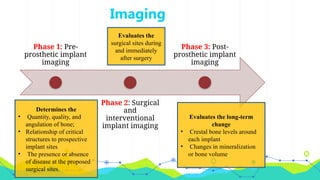
Imaging
Phase 1: Pre-
prosthetic implant
imaging
Phase 2: Surgical
and
interventional
implant imaging
Phase 3: Post-
prosthetic implant
imaging
Determines the
• Quantity, quality, and
angulation of bone;
• Relationship of critical
structures to prospective
implant sites
• The presence or absence
of disease at the proposed
surgical sites.
Evaluates the
surgical sites during
and immediately
after surgery
Evaluates the long-term
change
• Crestal bone levels around
each implant
• Changes in mineralization
or bone volume.
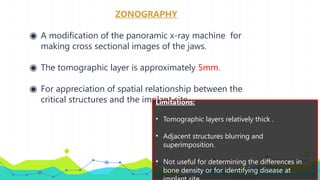
ZONOGRAPHY
◉ A modification of the panoramic x-ray machine for
making cross sectional images of the jaws.
◉ The tomographic layer is approximately 5mm.
◉ For appreciation of spatial relationship between the
critical structures and the implant site.
Limitations:
• Tomographic layers relatively thick .
• Adjacent structures blurring and
superimposition.
• Not useful for determining the differences in
bone density or for identifying disease at
Tomography
◉ Tomography is the generic name formed by the greek
words ‘tomo’(slice) and ‘graphy’(picture).
◉ Enables visualization of a section of patient’s anatomy by
blurring other regions above and below the site of
interest.
◉ For dental implant patients, high quality complex motion
tomography is required.
Computed tomography (CT)
✘CT was invented by Sir Godfrey Hounsfield and was introduced in
1972.
✘Computed tomography (CT) is a digital and mathematical imaging
technique that creates tomographic sections and allows soft tissues
and hard tissues to be visualized simultaneously
✘Ideally, tomographic sections spaced 1 to 2 mm enable evaluation of
implant site and 3D appearance of alveolus
✘With latest CT scanners, images with sectional thickness of 0.25 mm
can be obtained
The advantages of CT based systems are
◉ Uniform magnification
◉ High contrast image with well-defined image layer, free of
blurring
◉ Easier identification of bone grafts or hydroxyappatite materials
used to augment maxillary bone in sinus region
◉ Multiplanar views
◉ Three-dimensional reconstruction
◉ Simultaneous study of multiple implant sites
◉ Availability of soft tissue for image analysis
Disadvantages
◉ Limited availability of reconstructive software
◉ Higher dose of radiation
◉ Lack of understanding of dentists
◉ Lack of usefulness for implant interface follow-up because of
metallic streak artifacts
◉ Expense
Recent advances in Computed Tomography(CT)
Tuned Aperture CT (TACT)
◉ Tuned aperture computed tomography (TACT) by Webber is a
relatively simple, faster method for reconstructing tomographic
images
◉ It is based on the concept of tomo-synthesis and optical-
aperture theory
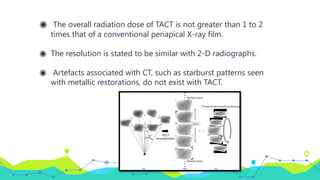
◉ TACT uses 2-D periapical radiographs acquired from different
projection angles as base images and permits retrospective
generation of longitudinal tomographic slices (TACT-S) lining up
in the Z axis of the area of interest
◉ The overall radiation dose of TACT is not greater than 1 to 2
times that of a conventional periapical X-ray film.
◉ The resolution is stated to be similar with 2-D radiographs.
◉ Artefacts associated with CT, such as starburst patterns seen
with metallic restorations, do not exist with TACT.
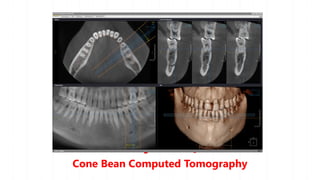
The big concept!
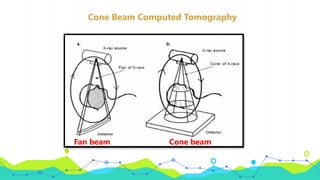
Cone Bean Computed Tomography
Cone Beam Computed Tomography
Fan beam Cone beam
◉ Software programs incorporating sophisticated
algorithms including back-filtered projection are
applied to these image data to generate a 3D
volumetric data set, which can be used to provide
primary reconstruction images in 3 orthogonal planes
(axial, sagittal and coronal).
◉ CBCT is devoted to maxillofacial area to scan and
visualize jaw bone lesions especially cancellous
bone
◉ It gives all the information of a CT but, at 1/8th
the
radiation dose and at a lower cost
◉ CBCT is categorized into large, medium, and limited volume units based on the
size of their field of view (FOV)
Large (FOV)
• 15-23 cm
• Maxillofacial
trauma
• Orthodontic
use
• TMJ diseases
Medium FOV
• 10-15 cm
• Mandibulo-
maxillary
imaging
• Pre-implant
planning
• Pathology
Small FOV
• < 10 cm
• Endodontic
applications
Advantages of CBCT
◉ X-ray beam limitation
◉ Image accuracy
◉ Rapid scan time: 10–70 seconds
◉ Software can be made available to the user
◉ Dose reduction :Effective dose is 98% smaller than conventional CT
◉ Reduced image artifact
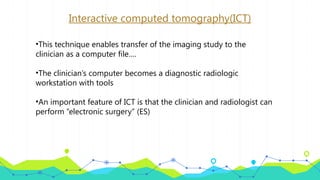
Interactive computed tomography(ICT)
•This technique enables transfer of the imaging study to the
clinician as a computer file….
•The clinician’s computer becomes a diagnostic radiologic
workstation with tools
•An important feature of ICT is that the clinician and radiologist can
perform “electronic surgery” (ES)
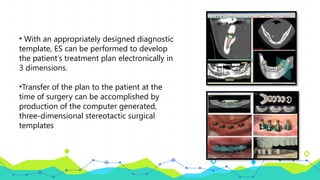
• With an appropriately designed diagnostic
template, ES can be performed to develop
the patient’s treatment plan electronically in
3 dimensions.
•Transfer of the plan to the patient at the
time of surgery can be accomplished by
production of the computer generated,
three-dimensional stereotactic surgical
templates
Recent advances in
Computed Tomography(CT)
Microtomograph:
Modification of CT, it is specially useful in acquiring serial sections of bone
implant interface.
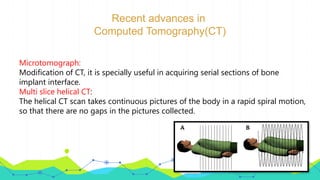
Multi slice helical CT:
The helical CT scan takes continuous pictures of the body in a rapid spiral motion,
so that there are no gaps in the pictures collected.
Recent Advances
in Implant Design
Mini implants
◉ Mini dental implants (MDIs) are small diameter dental implants.
◉ Are sometimes referred to as SDIs (small diameter implants), as
well as NDIs (narrow body implants).
◉ Diameter: 1.8mm to 2.9mm (less than 3mm)
◉ Various lengths: 10, 13, 15 & 18 mm’s
◉ The MDI are available with either an O-ball head for use with
removable or fixed dentures, or a square head for fixed
prostheses or retrofitting a poorly adapted partial denture
◉ The body connects the tip with the prosthetic head and can be a
parallel sided cylinder or a progressively tapered cone
◉ A small pilot bit is used to create the opening for the implant to
be threaded into the bone.
◉ The definitive implant supported crowns are usually delivered
within 2 weeks of surgery
Advantages
◉ Immediate loading,
◉ Can be inserted in minimal tissues without relying on grafting
techniques
◉ Minimally invasive procedure
◉ One-stage denture stabilization
◉ Does not require osteotomy
◉ Cost-effective
◉ Can be placed with a simple technique in patients with ridge
too narrow for conventional implants
◉ .
Narrow-diameter implants: Are they a predictable
treatment option? A literature review
José-Luis Sierra-Sánchez Med Oral Patol Oral Cir Bucal. 2014
Jan 1;19 (1):e74-81.
◉ The review included
◉ Four randomized clinical trials
◉ Ten prospective studies
◉ Seven retrospective studies
◉ The follow-up periods -12 months to 12 years.
◉ Total of 1607 patients
◉ The patient age - 13 to 87 years
◉ 2980 implants
◉ The recorded implant survival rates were above 90% in all the
studies. Six studies published a survival rate of 100% at the end
of the follow-up period
◉ The lowest survival rate (90.9%) corresponded to the study
published by Barter et al.
◉ 58 failures (implant loss) were recorded out of a total of 2980
implants
◉ A larger number of failures were recorded with implants
measuring ≤ 13 mm in length
◉ Nineteen studies measured changes in peri-implant bone height
after implant loading :0.065 mm the first year to 1.74 mm after a
follow-up period of 10 years
◉ Araujo published a retrospective study on 3.3 mm implants
placed in posterior areas and rehabilitated following an
immediate loading protocol.
 Implant survival rate was 95.5% after 9 years of follow-
up.
◉ That same year, Degidi et al. published a study comparing
delayed and immediate loading in narrow-diameter implants
placed in both anterior and posterior zones.
 Survival rate was 99.4% after a mean follow-up of 20
months.
TRANSITIONAL IMPLANTS
◉ Diameter ranges -1.8 to 2.8 mm
◉ Length -7mm to 14mm.
◉ Fabricated with pure titanium in a single body with treated
surface.
◉ Primary function is to absorb masticatory stress during healing
phase
◉ They should be placed at least 1.5 mm from adjacent teeth and
the distance between any transitional implant and a definitive
implant must be at least 1.5-2 mm
Fully edentulous mandible- four transitional implants are recommended
for a fixed provisional restoration.
Fully edentulous maxilla- at least five transitional implants are required
For partially edentulous situations, two or three transitional implants are
used.
The number of pontics should generally be restricted to two, for
posterior regions if a temporary bridge is being made
The length of these implants can be shortened by a simple disc. The
head can also be bent to change its angulation up to 45 degrees to
achieve parallelism between abutments.
◉ The abutment head generally has a 5 degree taper, which makes
it optimal for retention of cement retained prostheses.
◉ Only one drill, a 1.5 mm or 2 mm twist drill is required for
placement of the implants.
Advantages :
 Provisionalisation of fully and partially edentulous jaws
 Undisturbed healing of bone grafts
 Effective way to generate aesthetic transitional
appliances
 Allows evaluation of phonetics and function.
 Cost effective.
Contraindications
Depth of supporting bone is less than 10mm with insufficient cortical bone to
provide implant stabilization.
Patients with excessive bruxism.
When placement of sufficient number of transitional implants is not possible…..
One – Piece Implants
◉ The implant is machined from a piece of titanium that
incorporates both the implant body and an integral fixed
abutment in a single component.
◉ 3 diameters -3.5, 4.3, and 5 mm
◉ 4 lengths -10, 13, 15 and 16 mm
Clinical and radiographic evaluation of one-piece implants
used for immediate function
Jack a. Hahn, journal of oral implantology vol. 33(3)2007
◉ The aim of the present research was to evaluate the
radiographic outcome of a 1-piece implant when used for
immediate function in an ordinary patient pool
◉ Forty-seven NobelDirect and NobelPerfect 1-piece implants
(Nobel Biocare, Go¨teborg, Sweden) were placed in maxillae
and mandibles.
◉ In this study 1 of the 47 implants had to be removed, resulting in
a cumulative implant survival rate of 97.9% throughout the
follow-up period
◉ The mean marginal bone level relative to the reference point
after 1 year of loading (0.78 - 1.60 mm), as well as after 2 and 3
years of loading, was located above the first implant thread
◉ In this study, a bone level 2 mm apical to the reference point
after 1 year of loading was observed at 2 implants (6%).
◉ The 1-piece implant design enables undisturbed
healing of the peri-implant soft tissue and avoids
disruption of the soft tissue seal when placing the
definitive prosthetic restoration.
◉ Annibali, et al reported a series of patients treated
consecutively for first molar replacement according
to :
◉ Immediate = group 1,
◉ Early = group 2
◉ Late = Group 3
The implant survival rate:
91.7% for early implants
95.0% for immediate post-
extraction implants
100% for implants placed in
healed sites.
Short Dental Implants
◉ A dental implant with length of 7 mm or less. (Friberg et al.
2000)
◉ Any implant under 10 mm in length referred to as a ‘‘short’’
implant (Griffin TJ, Cheung WS. 2004)
◉ A device with an intra-bony length of 8 mm or less. (Renouard
and Nisand 2006)
Indication :
Atropic Jaw
Proximity to vital structure
Single crowns
Overdentures
Advantages:
1. Bone grafting for height often unnecessary
2. Less money, pain, and time prior to restoration of the implant.
3. Simplified bone surgery.
4. Implant insertion easier.
◉ Goodacre, et al in 2003 reviewed ,
 2,754 implants - <10 mm
 3,015 implants - >10 mm in length.
◉ The failure rate of implants 10 mm or less was 10%,
compared to a 3% failure rate of implants longer than 10
mm.
◉ Ivanoff, et al in 1999 found an 8-mm-long, 5-mm-diameter
implant failed 25% of the time in the maxilla and 33% of the
time in the mandible. On the other hand, the 10-mm and
12-mm implants that were 5 mm in diameter reported no
mandibular failure and a 10% failure in the maxilla.
Misch CE Short Dental Implants: A Literature Review and Rationale for Use Dent Today. 2005 Aug;24(8):64-6, 68
◉ On the other hand, a retrospective report by Misch, et al was compiled
from 2 private offices using a square thread implant body design
(BioHorizons) rather than a v-shaped thread as primarily reported in
the previous literature.
◉ During a 3-year period, 126 patients received implants less than 10 mm
long
◉ Of the 437 implants there were 3 implant failures in the posterior
mandible and 1 failure in the posterior maxilla (99% survival)
◉ All these failures were implants 9 mm long and 4 mm in diameter.
Advances in Implant materials
◉ Previously implants had macro-irregularities like macroscopic
threads, fenestrations, pores, grooves, steps, threads, or other
surface irregularities that were visible.
◉ However, difficulty in achieving initial stability, post
implantation relative motion, adverse interfacial bone
remodelling all lead to search for improvement of the surface
quality of a titanium dental implant
BLASTING
◉ Blasting -aluminium oxide, titanium oxide and calcium
phosphate with particle size ranging from small, medium to
large (150- 350 µm)
◉ Blasting a smooth Ti surface with Al2 O3 particles of 25 µm, 75
µm, or 250 µm produces surfaces with roughness values of 1.16
to 1.20, 1.43, and 1.94 to 2.20, respectively.
◉ A series of investigations have demonstrated a firmer bone
fixation of the implant with an average surface roughness (sa) of
1-1.5µm than those of smoother implants with an average
surface roughness of 0.6µm
Blasting and Acid Etching
◉ Acid etching can be done by using an HCL/ H2 SO4 mixture or
by pickling in 2% HF/10%HNO3 . These processes leave pits and
craters.
◉ Alumina or TiO2 for blasting the surface:
◉ Small - 25μm
◉ large grit -0.25-0.5mm
◉ medium grit - 250-500μm
◉ Sand blasted and acid etched surfaces have a hydrophobic
surface.
◉ The etching leads to the formation of Titanium hydrides and the
replacement of hydride by oxygen results in the slow transformation
of the implant surface, resulting in nanometre sized particles of
titanium on the surface, which helps in protein adhesion on implant
surface
◉ Dual acid etching with HCl and H2SO4 heated above 100ᴼC has
produced surface topography able to attach to fibrin scaffold and
promote adhesion of osteogenic cells.
◉ Sand blasting and etching can increase the rate and amount of the
bone formation
Flouride Surface Treatments
◉ This treatment enhances osseointegration and osteoblastic
differentitation with increased expression of Cbfa1, osterix and
bone sialoprotein
◉ Fluoridated rough implants also withstood greater push-out
forces and showed a significantly higher removal torque than
control implants
◉ However, detrimental effect of F on the corrosion resistance of
titanium and titanium alloys has been extensively reported
Anodized Surface Implants
◉ Anodized surface implants are implants which are placed as
anodes in galvanic cells, with phosphoric acid as the electrolyte
and current is passed through them – also c/a “Tiunite surface”
◉ The surface oxides grow from the native state of 5nm to
approximately 10,000nm
◉ The sa of TiUnite is reported to be 1.1µm and its sdr 37%
◉ Anodic oxidation results in the growth of a native titanium oxide
layer and a porous topography, with the bone formation
occurring directly on the moderately rough oxidized surface
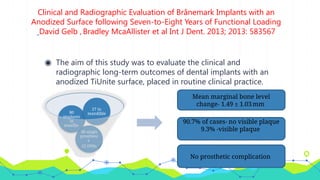
Clinical and Radiographic Evaluation of Brånemark Implants with an
Anodized Surface following Seven-to-Eight Years of Functional Loading
David Gelb , Bradley McaAllister et al Int J Dent. 2013; 2013: 583567
◉ The aim of this study was to evaluate the clinical and
radiographic long-term outcomes of dental implants with an
anodized TiUnite surface, placed in routine clinical practice.
38 single
prosthesi
s
22 FPDs
80
implants
in
maxilla
27 in
mandible
Mean marginal bone level
change- 1.49 ± 1.03 mm
90.7% of cases- no visible plaque
9.3% -visible plaque
No prosthetic complication
◉ Calandriello evaluated immediately placed anodized
implants in 33 patients and found a mean marginal
bone loss of 1.17 mm after 5 years
◉ Friberg and Jemt compared 280 TiUnite implants to
110 machined implants in 111 patients and found
marginal bone loss after 5 years to be 0.75 and 0.6
mm, respectively, with no significant difference
between the two types of implants.
Laser etching and Micro Arc Oxidation
◉ After the implants are ultrasonically cleaned, they are laser
etched by using an Nd:YAG laser at a power of 50kw, frequency
of 7.5khz and 16.4A current.
◉ They are then processed in an electrolyte solution with 3.5%
glyceroposphate disodium salt pentahydrate and 1.2% calcium
acetate monohydrate by microarc oxidation (voltage 350v,
frequency 800hz) for 15 seconds
◉ Microarc oxidation produces a titania film with a porous
structure and micropores of 1-5µm
◉ The mechanism of osseointegration of the oxidized implants
has been shown to be mechanical interlocking and biochemical
bonding
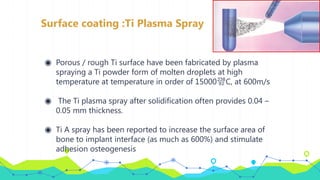
Surface coating :Ti Plasma Spray
◉ Porous / rough Ti surface have been fabricated by plasma
spraying a Ti powder form of molten droplets at high
temperature at temperature in order of 15000C, at 600m/s
◉ The Ti plasma spray after solidification often provides 0.04 –
0.05 mm thickness.
◉ Ti A spray has been reported to increase the surface area of
bone to implant interface (as much as 600%) and stimulate
adhesion osteogenesis
◉ Advantages:
 Enhance attachment by increasing ionic interactions
 Increased load bearing capability by 25%-30%
 Increased tensile strength through ingrowth of bony tissues into 3D
feature
◉ Disadvantages
 Cracking and scaling of coating because of stresses produced by
elevated temprature processing
 Risk of accumulation of abraded material in the interface zone during
implantation of TPS
Hydroxyapatite coatings
◉ Hydroxyapatite [Ca10(PO4)6OH]2 coating was brought to the
dental profession by DeGroot
◉ HA forms a strong chemical bond with bone due to the
presence of free calcium and phosphate compounds at the
implant surface
◉ The HA coating consists of amorphous and crystalline forms
with a large density of cracks.
◉ The top 1-2 µm of the HA layer being amorphous, while the
rest of the crystalline layer is hexagonally packed
◉Indicated: Fresh extraction sites.
Newly grafted sites.
Advantages :
1. Protection of surrounding bone against metal ion release from the
substrate.
2. Reported chemical bonding between HA and living bone-intimate
contact-biointegration
3. Partial dissolution of HA makes surrounding fluid rich in calcium
and phosphate ions which trigger cellular differentiation and bone
formation
Disadvantages:
◉ Induction of impurities due to thermal decomposition during
processing- affecting long term clinical fixation
◉ Dissolution of HA at lower pH
HA coating on the implant surface (50-70µm) by various methods
1. Plasma spraying
2. The vacuum deposition technique(ion beam sputtering, radiofrequency
sputtering)
3. The sol gel and dip coating method
4. Electrolytic process
Nanotitania coatings
◉ Nanotitania coatings were prepared by using the sol-gel
technique
◉ Nanotitania implants had an increased feature density and a
large feature coverage area as compared to the nano-HA
implants.
◉ This could present more binding sites for the protein cell
attachment and for increased bone contact
◉ he Nanotitania implants exhibited an ordered arrangement,
forming a homogenous layer on underlying topography
Biologically active drugs incorporated dental
implants
◉ Bisphosphonates :Bisphosphate-loaded implant surfaces have
been reported to improve implant osseointegration.
◉ Simvastatin:
◉ Simvastatin, could induce the expression of bone
morphogenetic protein (BMP) , mRNA that might promote
bone formation and increase bone mineral density
◉ Gentamycin along with the layer of HA can be coated onto the
implant surface which may act as a local prophylactic agent
along with the systemic antibiotics in dental implant surgery
Biochemical Methods
of the Surface
Modifications
Biochemical Methods of the Surface
Modifications
◉ Their goal is to immobilize proteins, enzymes or peptides on
biomaterials for the purpose of inducing specific cell and tissue
responses,
1. One approach uses cell-adhesion molecules like fibronectin,
vitronectin, Type I collagen, osteogenin and bone sialoprotein
2. The second approach uses biomolecules with osteotropic
effects which range from mitogenicity (interleukin growth
factor-I, FGF-2, platelet derived growth factor –BB) to the
increasing activity of the bone cells, which enhances the
collagen synthesis for osteoinduction
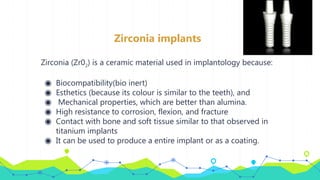
Zirconia implants
Zirconia (Zr02) is a ceramic material used in implantology because:
◉ Biocompatibility(bio inert)
◉ Esthetics (because its colour is similar to the teeth), and
◉ Mechanical properties, which are better than alumina.
◉ High resistance to corrosion, flexion, and fracture
◉ Contact with bone and soft tissue similar to that observed in
titanium implants
◉ It can be used to produce a entire implant or as a coating.
Advantages of Zirconia Dental Implants
◉ No dark colour of the metal showing through the
gums
◉ No corrosion of the zirconia as with titanium
◉ No piezo-electric currents between dissimilar metal in
the mouth
◉ It is thermally non-conductive
◉ Greater BIC (Bone – Implant Contact)
◉ 20% more bone apposition than titanium implants
Zeynep O¨ zkurt ,Zirconia Dental Implants: A Literature Review Journal of Oral Implantology Vol. 37(3)2011
◉ RTQ (removal torque testing): Gahlert et al evaluated the RTQ values of
machined zirconia implants, sandblasted zirconia implants, and SLA
titanium implants. The mean RTQ for machined zirconia implants was 25.9
N/cm, the mean RTQ for zirconia rough implants was 40.5 N/cm, and the
mean RTQ for SLA titanium implants was 105.2 N/cm
◉ Fracture strength : within clinically acceptable limits
◉ Stress analysis: . Kohal et al observed the stress distribution patterns of
zirconia implants (ReImplant), which were found to have low, well
distributed, and similar stress distribution compared with titanium
implants
PEEK implants (poly etheretherketone)
◉ These implants are available in three fundamentally different
designs;
◉ TAU : Diameter -4..8 mm ; lengths :10 , 12.5 ,15 mm
immediate loading possible
Low density bone
◉ THETA : Similar to TAU but D1 bone
◉ IOTA : It is a 3mm diameter implant (10 and 12 mm)
used in narrow ridges
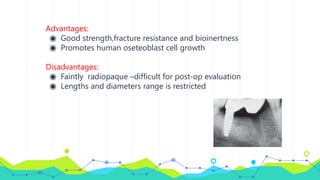
Advantages:
◉ Good strength,fracture resistance and bioinertness
◉ Promotes human oseteoblast cell growth
Disadvantages:
◉ Faintly radiopaque –difficult for post-op evaluation
◉ Lengths and diameters range is restricted
Advances in
commercially
available implant
systems
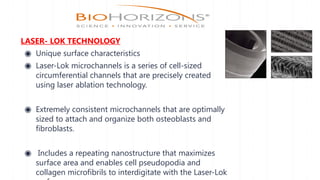
LASER- LOK TECHNOLOGY
◉ Unique surface characteristics
◉ Laser-Lok microchannels is a series of cell-sized
circumferential channels that are precisely created
using laser ablation technology.
◉ Extremely consistent microchannels that are optimally
sized to attach and organize both osteoblasts and
fibroblasts.
◉ Includes a repeating nanostructure that maximizes
surface area and enables cell pseudopodia and
collagen microfibrils to interdigitate with the Laser-Lok
Biologic response :
◉ The inhibition of epithelial downgrowth and the attachment of
connective tissue (unlike Sharpey fibers).
◉ This physical attachment produces a biologic seal around the
implant that protects and maintains crestal bone health.
◉ More effective than other implant designs in reducing bone
loss.
◉ The Laser-Lok surface has been shown in several studies to offer
a clinical advantage over other implant designs to reduce bone
loss by 70% .
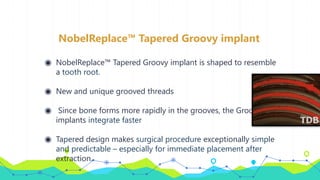
NobelReplace™ Tapered Groovy implant
◉ NobelReplace™ Tapered Groovy implant is shaped to resemble
a tooth root.
◉ New and unique grooved threads
◉ Since bone forms more rapidly in the grooves, the Groovy
implants integrate faster
◉ Tapered design makes surgical procedure exceptionally simple
and predictable – especially for immediate placement after
extraction.
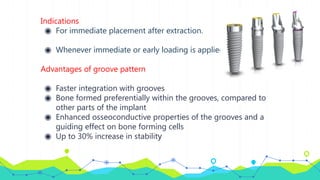
Indications
◉ For immediate placement after extraction.
◉ Whenever immediate or early loading is applied.
Advantages of groove pattern
◉ Faster integration with grooves
◉ Bone formed preferentially within the grooves, compared to
other parts of the implant
◉ Enhanced osseoconductive properties of the grooves and a
guiding effect on bone forming cells
◉ Up to 30% increase in stability
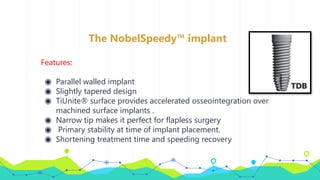
The NobelSpeedy™ implant
Features:
◉ Parallel walled implant
◉ Slightly tapered design
◉ TiUnite® surface provides accelerated osseointegration over
machined surface implants .
◉ Narrow tip makes it perfect for flapless surgery
◉ Primary stability at time of implant placement.
◉ Shortening treatment time and speeding recovery
◉ The innovative implant tip is sharp so the implant works as
an osteotome.
◉ This feature allows variable, and if needed, extensive under-
preparation of the site.
◉ The resulting higher initial stability, especially in soft bone,
supports immediate function.
◉ The sharp tip also secures a smooth insertion
◉ It provides the possibility to increase torque and place the
implant further down without repeating the drilling
procedure
NobelSpeedy™ Replace
◉ Narrow Tip ,Sharper Chamfers
◉ Internal Abutment Connection
◉ Slightly Tapered
◉ TiUnite® all the way up
◉ Extremely Short Drill Protocol
◉ Grooves on threads
◉ Increased initial stability in soft bone
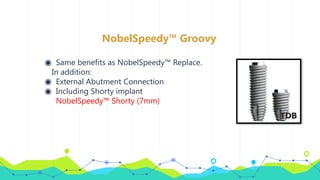
NobelSpeedy™ Groovy
◉ Same benefits as NobelSpeedy™ Replace.
In addition:
◉ External Abutment Connection
◉ Including Shorty implant
NobelSpeedy™ Shorty (7mm)
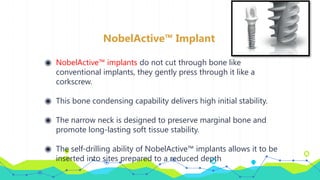
NobelActive™ Implant
◉ NobelActive™ implants do not cut through bone like
conventional implants, they gently press through it like a
corkscrew.
◉ This bone condensing capability delivers high initial stability.
◉ The narrow neck is designed to preserve marginal bone and
promote long-lasting soft tissue stability.
◉ The self-drilling ability of NobelActive™ implants allows it to be
inserted into sites prepared to a reduced depth
◉ This is useful where sites are close to vital anatomical
structures: the mandibular nerve canal or the maxillary
sinus, and nose cavity.
◉ Immediate placement in the esthetic region, even
when buccal bone plate is very thin
◉ Excellent stabilization in wide sockets
NobelPerfect™
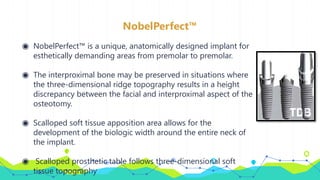
◉ NobelPerfect™ is a unique, anatomically designed implant for
esthetically demanding areas from premolar to premolar.
◉ The interproximal bone may be preserved in situations where
the three-dimensional ridge topography results in a height
discrepancy between the facial and interproximal aspect of the
osteotomy.
◉ Scalloped soft tissue apposition area allows for the
development of the biologic width around the entire neck of
the implant.
◉ Scalloped prosthetic table follows three-dimensional soft
tissue topography
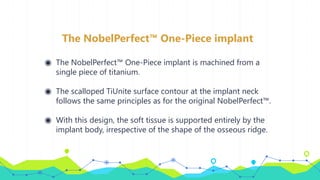
The NobelPerfect™ One-Piece implant
◉ The NobelPerfect™ One-Piece implant is machined from a
single piece of titanium.
◉ The scalloped TiUnite surface contour at the implant neck
follows the same principles as for the original NobelPerfect™.
◉ With this design, the soft tissue is supported entirely by the
implant body, irrespective of the shape of the osseous ridge.
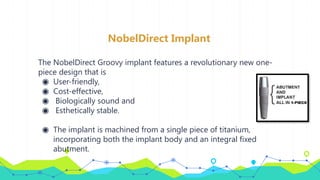
NobelDirect Implant
The NobelDirect Groovy implant features a revolutionary new one-
piece design that is
◉ User-friendly,
◉ Cost-effective,
◉ Biologically sound and
◉ Esthetically stable.
◉ The implant is machined from a single piece of titanium,
incorporating both the implant body and an integral fixed
abutment.
Astra Tech implant system
◉ OsseoSpeed™ -chemically modified titanium surface,
◉ Providing unique nano scale topography
◉ Stimulates early bone healing and speeds up the bone healing
process.
◉ The result of the micro-roughened titanium surface treated
with fluoride is increased bone formation and stronger bone-
to-implant bonding.
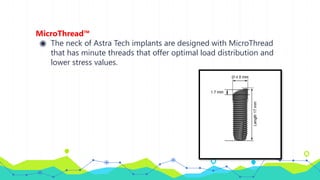
MicroThread™
◉ The neck of Astra Tech implants are designed with MicroThread
that has minute threads that offer optimal load distribution and
lower stress values.
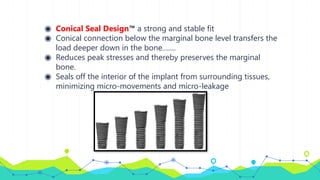
◉ Conical Seal Design™ a strong and stable fit
◉ Conical connection below the marginal bone level transfers the
load deeper down in the bone…….
◉ Reduces peak stresses and thereby preserves the marginal
bone.
◉ Seals off the interior of the implant from surrounding tissues,
minimizing micro-movements and micro-leakage
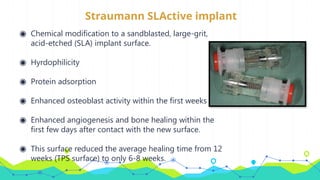
Straumann SLActive implant
◉ Chemical modification to a sandblasted, large-grit,
acid-etched (SLA) implant surface.
◉ Hyrdophilicity
◉ Protein adsorption
◉ Enhanced osteoblast activity within the first weeks
◉ Enhanced angiogenesis and bone healing within the
first few days after contact with the new surface.
◉ This surface reduced the average healing time from 12
weeks (TPS surface) to only 6-8 weeks.
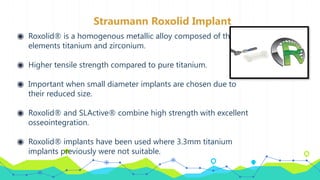
Straumann Roxolid Implant
◉ Roxolid® is a homogenous metallic alloy composed of the
elements titanium and zirconium.
◉ Higher tensile strength compared to pure titanium.
◉ Important when small diameter implants are chosen due to
their reduced size.
◉ Roxolid® and SLActive® combine high strength with excellent
osseointegration.
◉ Roxolid® implants have been used where 3.3mm titanium
implants previously were not suitable.
Software Simplifying
Treatment Planning
SimPlant software
◉ Surgi Guides are computer-generated drilling guides that are
fabricated through the process of stereolithography.
◉ The SurgiGuide concept is based on the presurgical treatment
planning using SimPlant software for ideal implant positioning.
◉ These successive diameter surgical osteotomy drill guides may
be either bone, teeth, or mucosa-borne.
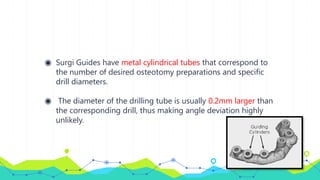
◉ Surgi Guides have metal cylindrical tubes that correspond to
the number of desired osteotomy preparations and specific
drill diameters.
◉ The diameter of the drilling tube is usually 0.2mm larger than
the corresponding drill, thus making angle deviation highly
unlikely.
NobelGuide
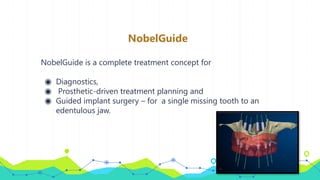
NobelGuide is a complete treatment concept for
◉ Diagnostics,
◉ Prosthetic-driven treatment planning and
◉ Guided implant surgery – for a single missing tooth to an
edentulous jaw.
NobelClinician Software
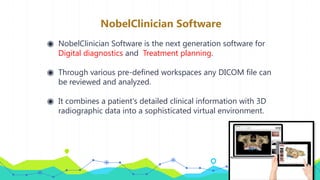
◉ NobelClinician Software is the next generation software for
Digital diagnostics and Treatment planning.
◉ Through various pre-defined workspaces any DICOM file can
be reviewed and analyzed.
◉ It combines a patient's detailed clinical information with 3D
radiographic data into a sophisticated virtual environment.
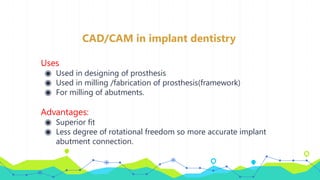
CAD/CAM in implant dentistry
Uses
◉ Used in designing of prosthesis
◉ Used in milling /fabrication of prosthesis(framework)
◉ For milling of abutments.
Advantages:
◉ Superior fit
◉ Less degree of rotational freedom so more accurate implant
abutment connection.
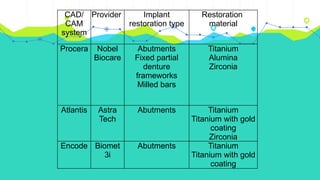
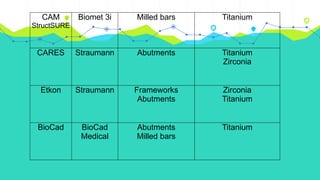
CAD/
CAM
system
Provider Implant
restoration type
Restoration
material
Procera Nobel
Biocare
Abutments
Fixed partial
denture
frameworks
Milled bars
Titanium
Alumina
Zirconia
Atlantis Astra
Tech
Abutments Titanium
Titanium with gold
coating
Zirconia
Encode Biomet
3i
Abutments Titanium
Titanium with gold
coating
CAM
StructSURE
Biomet 3i Milled bars Titanium
CARES Straumann Abutments Titanium
Zirconia
Etkon Straumann Frameworks
Abutments
Zirconia
Titanium
BioCad BioCad
Medical
Abutments
Milled bars
Titanium
Recent advances in
Implant Abutments
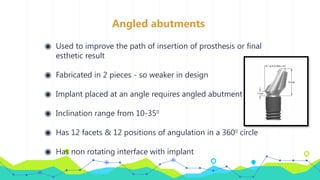
Angled abutments
◉ Used to improve the path of insertion of prosthesis or final
esthetic result
◉ Fabricated in 2 pieces - so weaker in design
◉ Implant placed at an angle requires angled abutment
◉ Inclination range from 10-350
◉ Has 12 facets & 12 positions of angulation in a 3600
circle
◉ Has non rotating interface with implant
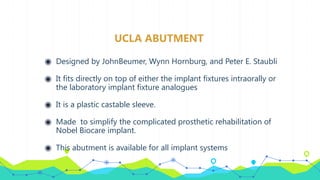
UCLA ABUTMENT
◉ Designed by JohnBeumer, Wynn Hornburg, and Peter E. Staubli
◉ It fits directly on top of either the implant fixtures intraorally or
the laboratory implant fixture analogues
◉ It is a plastic castable sleeve.
◉ Made to simplify the complicated prosthetic rehabilitation of
Nobel Biocare implant.
◉ This abutment is available for all implant systems
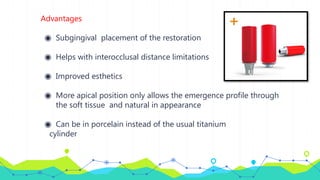
Advantages
◉ Subgingival placement of the restoration
◉ Helps with interocclusal distance limitations
◉ Improved esthetics
◉ More apical position only allows the emergence profile through
the soft tissue and natural in appearance
◉ Can be in porcelain instead of the usual titanium
cylinder
Ceramic abutments
◉ Densely sintered high-purity alumina (al2o3) ceramic
◉ Yttria (Y2O3) -stabilized tetragonal zirconia polycrystal
ceramics
Alumina abutments :
◉ Flexural strength of 400 mpa
◉ A fracture toughness value between 5 and 6 mpa ⁄ m0.5
◉ Modulus of elasticity of 350 GPa
Advantages
◉ Easier to prepare intraorally
◉ Less whitish than zirconia abutments
The problems
◉ Radioopalescence at the time of radiographic examination
◉ Weak resistance to fracture
Zirconia abutments
◉ Twice the flexural strength of alumina ceramic -900–1400 mpa
◉ A fracture toughness of up to 10 mpa ⁄ m0.5,
◉ Modulus of elasticity value -210 gpa
Advantages :
◉ Perfect aesthetics and stability
◉ Outstanding anatomical design
◉ Dual concept: titanium base / ZrO2 abutment
◉ Highest precision of fit
Indications:
◉ Fixed restorations, single crowns and bridgework.
CERADAPT ABUTMENT
◉ All ceramic alternative to metal abutments
◉ Pre machined precision milled abutment made to fit the implant
hex - made up of densely sintered 99.8% pure aluminium oxide
◉ It is a non metallic , non corrosive , bio compatible
◉ Soft tissue response is excellent
◉ Tooth coloured and light diffusion property
◉ Used for implant supported single and multiple tooth
restoration in the anterior canine and premolar regions
◉ The CerAdapt abutment is a cylinder of 12 mm high and 6 mm
in diameter
◉ Indications
1. An implant placed too superficially,resulting in exposed Ti at
the buccal aspect
2. An implant with excessively buccal placement & thin peri-
implant mucosa -"shining-through" effect of the Ti abutment
3. A slight disangulation of the implant, resulting in a need to
correct the direction of the implant pillar to create a
harmonious embrasure & anatomy of the crown restoration
Multi-Unit abutment
◉ Serve as a one-piece abutment.
◉ Available in 7 lengths for each platform, from a 1-to 9-mm
collar
◉ Total height of multi-unit abutment, including the gold cylinder
& the unigrip prosthetic screw is 5.05 mm.
◉ Allows for a disangulation of as much as 40 degrees between
the long axis of the implants.
◉ In situations with greater disangulation, the angulated
abutment is used
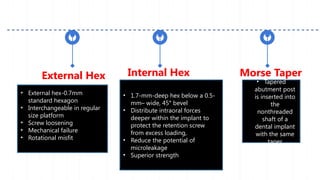
Implant –Abutment
Interface
External Hex Internal Hex Morse Taper
• External hex-0.7mm
standard hexagon
• Interchangeable in regular
size platform
• Screw loosening
• Mechanical failure
• Rotational misfit
• 1.7-mm-deep hex below a 0.5-
mm– wide, 45° bevel
• Distribute intraoral forces
deeper within the implant to
protect the retention screw
from excess loading,
• Reduce the potential of
microleakage
• Superior strength
• Tapered
abutment post
is inserted into
the
nonthreaded
shaft of a
dental implant
with the same
taper
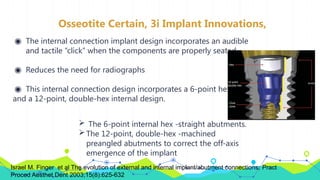
Osseotite Certain, 3i Implant Innovations,
◉ The internal connection implant design incorporates an audible
and tactile “click” when the components are properly seated.
◉ Reduces the need for radiographs
◉ This internal connection design incorporates a 6-point hex
and a 12-point, double-hex internal design.
 The 6-point internal hex -straight abutments.
The 12-point, double-hex -machined
preangled abutments to correct the off-axis
emergence of the implant
Israel M. Finger et al The evolution of external and internal implant/abutment connections; Pract
Proced Aesthet Dent 2003;15(8):625-632
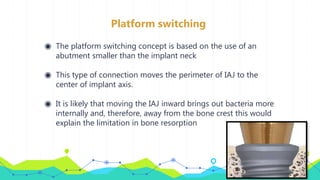
Platform switching
◉ The platform switching concept is based on the use of an
abutment smaller than the implant neck
◉ This type of connection moves the perimeter of IAJ to the
center of implant axis.
◉ It is likely that moving the IAJ inward brings out bacteria more
internally and, therefore, away from the bone crest this would
explain the limitation in bone resorption
◉ Atieh et al. (2010) conducted a systematic review on the clinical
relevance of platform switching and preservation of peri-
implant crest bone levels. Ten clinical studies reported a
statistically significant influence of the platform switching on
the maintenance of marginal bone levels.
◉ Annibali et al. (2012) conducted a similar systematic review en
randomized controlled trials were selected for review dated
from 2007 to 2011. Six of the ten clinical studies noted a
significant difference of reduced marginal bone loss around
platform switching implant-abutment group versus a
traditional design.
José Paulo Macedo et al Morse taper dental implants and platform switching: The new paradigm in oral
implantology Eur J Dent. 2016 JanMar; 10(1): 148–154.
New concepts in
Implants
All on Four
◉ Four implants in edentulous jaws,: two straight ;two tilted
providing a secure and optimal support for a prosthetic
fixed bridge (even with minimum bone volume)
◉ Maximizes the use of available bone by tilting the
posterior implants by up to a maximum of 45º
◉Benefits of Angled posterior implants:
• Help avoid relevant anatomical structures and can be
anchored in better quality anterior bone
• Offer improved support of the prosthesis by reducing
cantilevers
• Reduce the need for bone grafting by maximizing the use
of available bone
◉Final restoration:
• Full-arch restoration with only 4 implants
• Fixed and removable final prosthetic solutions
• Flexible solutions
◉Efficient Treatment Flow:
• Immediately loaded for shorter treatment times and improved patient
satisfaction
◉Implant Placement Accuracy
• All-on-4 Guide assists with accurate placement of implants
• Can be combined with computer-aided diagnostics and treatment
concept NobelGuide
Zygoma Implants
◉ Branemark developed a specific implant called the zygomaticus
fixture to provide fixed solutions even when the conditions for
implant insertion were poor in the posterior maxilla.
◉ zygomatic implants as self-tapping screws in commercially pure
titanium with a well-defined machined surface.
◉ 8 different lengths, ranging from 30 to 52.5 mm.
◉ 45 angulated head to compensate for the angulation between
the zygoma and the maxilla.
◉ The portion that engages the zygoma, the apical two thirds, has
a diameter of 4.0 mm and the portion that engages the residual
maxillary alveolar process, alveolar one third, has a diameter of
4.5 mm to 5 mm.
◉ Provide immediate or early loading with immediate function
◉ Less morbidity,
Indications
◉ Severe resorption of maxilla.
◉ Free-end situations in maxilla with insufficient bone height
◉ Total edentulism together with reduced bone height
◉ Pneumatization of maxillary sinus.
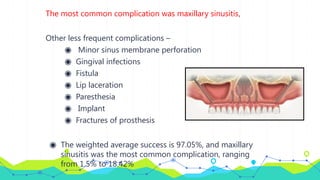
The most common complication was maxillary sinusitis,
Other less frequent complications –
◉ Minor sinus membrane perforation
◉ Gingival infections
◉ Fistula
◉ Lip laceration
◉ Paresthesia
◉ Implant
◉ Fractures of prosthesis
◉ The weighted average success is 97.05%, and maxillary
sinusitis was the most common complication, ranging
from 1.5% to 18.42%
Conclusion
•With the advancements in bioengineering and biomaterials fields
continued effort of dedicated dental faculties, several innovation have made
implant dental treatment a highly successful option for patient.
•The incorporation of new tech. and by methods has improved the specific
areas of conventional treatment procedures.
•Continued research will determine if specific implant modification will
diminish complication and improve implant serviceability additionally, future
deviation in material and tech will surely improve their efficacy
References
◉ Carl e misch contemporary implant dentistry 3 rd edition
◉ Israel m. Fingerthe evolution of external and internal implant/abutment
connections ; pract proced aesthet dent 2003;15(8):625-632
◉ Eugenia candel-martı rehabilitation of atrophic posterior maxilla with
zygomatic implants: review journal of oral implantology vol. Xxxviii/no.
Five/2012
◉ Suraksha shrestha current concepts in biomaterials in dental implant science
research. Vol. 2, no. 1, 2014, pp. 7-12.
◉ Hemlata garg et al ; implant surface modification : a review ;journal of clinical
and diagnostic research. 2012 april, vol-6(2): 319-324
◉ S.Anil et al dental implant surface enhancement and osseointegration
implant dentistry ;a rapidly evolving practice
◉ William c. Scarfe clinical applications of cone-beam computed
◉ Tomography in dental practice jcda february 2006, vol. 72, no. 1
◉ David gelb; clinical and radiographic evaluation of brånemark
implants with an anodized surface following seventoeight years
of functional loading int j dent. 2013; 2013: 583567
◉ Dental implant surface treatments using laserlok microchannels
| biohorizons
◉ Aishwarya nagarajan et al diagnostic imaging for dental implant
therapy clin imaging sci. 2014; 4(suppl 2): 4.
◉ Jack a. Hahn clinical and radiographic evaluation of one-piece
implants used for immediate function journal of oral
implantology; vol. Xxxiii/no. Three/2007
◉ Ralf-j. Kohal ceramic abutments and ceramic
◉ Oral implants. An update periodontology 2000, vol. 47, 2008,
224–243
◉ Reham b. Osman a critical review of dental implant materials with
an emphasis on titanium versus zirconia materials 2015, 8, 932-
958
◉ Puneet chopra mini dental implants-the same day
implants;ijcd ;june ,2011 (3)
◉ José paulo macedo et al morse taper dental implants and platform
switching: the new paradigm in oral implantology eur j dent. 2016
janmar; 10(1): 148–154.
◉ Mohit g kheur transitional implants: an asset to implantologyj
interdiscip dentistry year : 2011 | volume : 1 | issue : 1 | page : 49
◉ Zeynep o¨ zkurt zirconia dental implants: a literature review ;
journal of oral implantology vol. Xxxvii/no. Three/2011
◉ Ashu sharma; zygomatic implants/fixture: a systematic review
journal of oral implantology ; vol. Xxxix/no. Two/2013
Thank you!

recent advances in implants in dentistry.pptx

  • 2.
  • 3.
    Introduction ◉ The scienceof implantology is highly dynamic. Ever since its introduction into the field of dentistry by Dr. Branemark, it has undergone numerous modifications and improvements. ◉ With each improvement and advancement made, implantology has proved to be a boon in disguise to the society
  • 4.
    Contents ◉ Advances inDiagnostic imaging ◉ Recent advances in Implant design ◉ Advances in Implant materials ◉ Advances in commercially available implant systems ◉ Software simplifying treatment planning ◉ Recent advances in Implant Abutments ◉ Implant -Abutment connection ◉ New concepts in Implant rehabilitation ◉ Conclusion ◉ References
  • 5.
  • 6.
    Imaging Phase 1: Pre- prostheticimplant imaging Phase 2: Surgical and interventional implant imaging Phase 3: Post- prosthetic implant imaging Determines the • Quantity, quality, and angulation of bone; • Relationship of critical structures to prospective implant sites • The presence or absence of disease at the proposed surgical sites. Evaluates the surgical sites during and immediately after surgery Evaluates the long-term change • Crestal bone levels around each implant • Changes in mineralization or bone volume.
  • 7.
    ZONOGRAPHY ◉ A modificationof the panoramic x-ray machine for making cross sectional images of the jaws. ◉ The tomographic layer is approximately 5mm. ◉ For appreciation of spatial relationship between the critical structures and the implant site. Limitations: • Tomographic layers relatively thick . • Adjacent structures blurring and superimposition. • Not useful for determining the differences in bone density or for identifying disease at
  • 8.
    Tomography ◉ Tomography isthe generic name formed by the greek words ‘tomo’(slice) and ‘graphy’(picture). ◉ Enables visualization of a section of patient’s anatomy by blurring other regions above and below the site of interest. ◉ For dental implant patients, high quality complex motion tomography is required.
  • 9.
    Computed tomography (CT) ✘CTwas invented by Sir Godfrey Hounsfield and was introduced in 1972. ✘Computed tomography (CT) is a digital and mathematical imaging technique that creates tomographic sections and allows soft tissues and hard tissues to be visualized simultaneously ✘Ideally, tomographic sections spaced 1 to 2 mm enable evaluation of implant site and 3D appearance of alveolus ✘With latest CT scanners, images with sectional thickness of 0.25 mm can be obtained
  • 10.
    The advantages ofCT based systems are ◉ Uniform magnification ◉ High contrast image with well-defined image layer, free of blurring ◉ Easier identification of bone grafts or hydroxyappatite materials used to augment maxillary bone in sinus region ◉ Multiplanar views ◉ Three-dimensional reconstruction ◉ Simultaneous study of multiple implant sites ◉ Availability of soft tissue for image analysis
  • 11.
    Disadvantages ◉ Limited availabilityof reconstructive software ◉ Higher dose of radiation ◉ Lack of understanding of dentists ◉ Lack of usefulness for implant interface follow-up because of metallic streak artifacts ◉ Expense
  • 12.
    Recent advances inComputed Tomography(CT) Tuned Aperture CT (TACT) ◉ Tuned aperture computed tomography (TACT) by Webber is a relatively simple, faster method for reconstructing tomographic images ◉ It is based on the concept of tomo-synthesis and optical- aperture theory ◉ TACT uses 2-D periapical radiographs acquired from different projection angles as base images and permits retrospective generation of longitudinal tomographic slices (TACT-S) lining up in the Z axis of the area of interest
  • 13.
    ◉ The overallradiation dose of TACT is not greater than 1 to 2 times that of a conventional periapical X-ray film. ◉ The resolution is stated to be similar with 2-D radiographs. ◉ Artefacts associated with CT, such as starburst patterns seen with metallic restorations, do not exist with TACT.
  • 14.
    The big concept! ConeBean Computed Tomography
  • 15.
    Cone Beam ComputedTomography Fan beam Cone beam
  • 16.
    ◉ Software programsincorporating sophisticated algorithms including back-filtered projection are applied to these image data to generate a 3D volumetric data set, which can be used to provide primary reconstruction images in 3 orthogonal planes (axial, sagittal and coronal). ◉ CBCT is devoted to maxillofacial area to scan and visualize jaw bone lesions especially cancellous bone ◉ It gives all the information of a CT but, at 1/8th the radiation dose and at a lower cost
  • 17.
    ◉ CBCT iscategorized into large, medium, and limited volume units based on the size of their field of view (FOV) Large (FOV) • 15-23 cm • Maxillofacial trauma • Orthodontic use • TMJ diseases Medium FOV • 10-15 cm • Mandibulo- maxillary imaging • Pre-implant planning • Pathology Small FOV • < 10 cm • Endodontic applications
  • 18.
    Advantages of CBCT ◉X-ray beam limitation ◉ Image accuracy ◉ Rapid scan time: 10–70 seconds ◉ Software can be made available to the user ◉ Dose reduction :Effective dose is 98% smaller than conventional CT ◉ Reduced image artifact
  • 19.
    Interactive computed tomography(ICT) •Thistechnique enables transfer of the imaging study to the clinician as a computer file…. •The clinician’s computer becomes a diagnostic radiologic workstation with tools •An important feature of ICT is that the clinician and radiologist can perform “electronic surgery” (ES)
  • 20.
    • With anappropriately designed diagnostic template, ES can be performed to develop the patient’s treatment plan electronically in 3 dimensions. •Transfer of the plan to the patient at the time of surgery can be accomplished by production of the computer generated, three-dimensional stereotactic surgical templates
  • 21.
    Recent advances in ComputedTomography(CT) Microtomograph: Modification of CT, it is specially useful in acquiring serial sections of bone implant interface. Multi slice helical CT: The helical CT scan takes continuous pictures of the body in a rapid spiral motion, so that there are no gaps in the pictures collected.
  • 22.
  • 23.
    Mini implants ◉ Minidental implants (MDIs) are small diameter dental implants. ◉ Are sometimes referred to as SDIs (small diameter implants), as well as NDIs (narrow body implants). ◉ Diameter: 1.8mm to 2.9mm (less than 3mm) ◉ Various lengths: 10, 13, 15 & 18 mm’s
  • 24.
    ◉ The MDIare available with either an O-ball head for use with removable or fixed dentures, or a square head for fixed prostheses or retrofitting a poorly adapted partial denture ◉ The body connects the tip with the prosthetic head and can be a parallel sided cylinder or a progressively tapered cone ◉ A small pilot bit is used to create the opening for the implant to be threaded into the bone. ◉ The definitive implant supported crowns are usually delivered within 2 weeks of surgery
  • 25.
    Advantages ◉ Immediate loading, ◉Can be inserted in minimal tissues without relying on grafting techniques ◉ Minimally invasive procedure ◉ One-stage denture stabilization ◉ Does not require osteotomy ◉ Cost-effective ◉ Can be placed with a simple technique in patients with ridge too narrow for conventional implants ◉ .
  • 26.
    Narrow-diameter implants: Arethey a predictable treatment option? A literature review José-Luis Sierra-Sánchez Med Oral Patol Oral Cir Bucal. 2014 Jan 1;19 (1):e74-81. ◉ The review included ◉ Four randomized clinical trials ◉ Ten prospective studies ◉ Seven retrospective studies ◉ The follow-up periods -12 months to 12 years. ◉ Total of 1607 patients ◉ The patient age - 13 to 87 years ◉ 2980 implants
  • 27.
    ◉ The recordedimplant survival rates were above 90% in all the studies. Six studies published a survival rate of 100% at the end of the follow-up period ◉ The lowest survival rate (90.9%) corresponded to the study published by Barter et al. ◉ 58 failures (implant loss) were recorded out of a total of 2980 implants ◉ A larger number of failures were recorded with implants measuring ≤ 13 mm in length ◉ Nineteen studies measured changes in peri-implant bone height after implant loading :0.065 mm the first year to 1.74 mm after a follow-up period of 10 years
  • 28.
    ◉ Araujo publisheda retrospective study on 3.3 mm implants placed in posterior areas and rehabilitated following an immediate loading protocol.  Implant survival rate was 95.5% after 9 years of follow- up. ◉ That same year, Degidi et al. published a study comparing delayed and immediate loading in narrow-diameter implants placed in both anterior and posterior zones.  Survival rate was 99.4% after a mean follow-up of 20 months.
  • 29.
    TRANSITIONAL IMPLANTS ◉ Diameterranges -1.8 to 2.8 mm ◉ Length -7mm to 14mm. ◉ Fabricated with pure titanium in a single body with treated surface. ◉ Primary function is to absorb masticatory stress during healing phase ◉ They should be placed at least 1.5 mm from adjacent teeth and the distance between any transitional implant and a definitive implant must be at least 1.5-2 mm
  • 30.
    Fully edentulous mandible-four transitional implants are recommended for a fixed provisional restoration. Fully edentulous maxilla- at least five transitional implants are required For partially edentulous situations, two or three transitional implants are used. The number of pontics should generally be restricted to two, for posterior regions if a temporary bridge is being made The length of these implants can be shortened by a simple disc. The head can also be bent to change its angulation up to 45 degrees to achieve parallelism between abutments.
  • 31.
    ◉ The abutmenthead generally has a 5 degree taper, which makes it optimal for retention of cement retained prostheses. ◉ Only one drill, a 1.5 mm or 2 mm twist drill is required for placement of the implants. Advantages :  Provisionalisation of fully and partially edentulous jaws  Undisturbed healing of bone grafts  Effective way to generate aesthetic transitional appliances  Allows evaluation of phonetics and function.  Cost effective.
  • 32.
    Contraindications Depth of supportingbone is less than 10mm with insufficient cortical bone to provide implant stabilization. Patients with excessive bruxism. When placement of sufficient number of transitional implants is not possible…..
  • 33.
    One – PieceImplants ◉ The implant is machined from a piece of titanium that incorporates both the implant body and an integral fixed abutment in a single component. ◉ 3 diameters -3.5, 4.3, and 5 mm ◉ 4 lengths -10, 13, 15 and 16 mm
  • 34.
    Clinical and radiographicevaluation of one-piece implants used for immediate function Jack a. Hahn, journal of oral implantology vol. 33(3)2007 ◉ The aim of the present research was to evaluate the radiographic outcome of a 1-piece implant when used for immediate function in an ordinary patient pool ◉ Forty-seven NobelDirect and NobelPerfect 1-piece implants (Nobel Biocare, Go¨teborg, Sweden) were placed in maxillae and mandibles.
  • 35.
    ◉ In thisstudy 1 of the 47 implants had to be removed, resulting in a cumulative implant survival rate of 97.9% throughout the follow-up period ◉ The mean marginal bone level relative to the reference point after 1 year of loading (0.78 - 1.60 mm), as well as after 2 and 3 years of loading, was located above the first implant thread ◉ In this study, a bone level 2 mm apical to the reference point after 1 year of loading was observed at 2 implants (6%).
  • 36.
    ◉ The 1-pieceimplant design enables undisturbed healing of the peri-implant soft tissue and avoids disruption of the soft tissue seal when placing the definitive prosthetic restoration. ◉ Annibali, et al reported a series of patients treated consecutively for first molar replacement according to : ◉ Immediate = group 1, ◉ Early = group 2 ◉ Late = Group 3 The implant survival rate: 91.7% for early implants 95.0% for immediate post- extraction implants 100% for implants placed in healed sites.
  • 37.
    Short Dental Implants ◉A dental implant with length of 7 mm or less. (Friberg et al. 2000) ◉ Any implant under 10 mm in length referred to as a ‘‘short’’ implant (Griffin TJ, Cheung WS. 2004) ◉ A device with an intra-bony length of 8 mm or less. (Renouard and Nisand 2006) Indication : Atropic Jaw Proximity to vital structure Single crowns Overdentures
  • 38.
    Advantages: 1. Bone graftingfor height often unnecessary 2. Less money, pain, and time prior to restoration of the implant. 3. Simplified bone surgery. 4. Implant insertion easier.
  • 39.
    ◉ Goodacre, etal in 2003 reviewed ,  2,754 implants - <10 mm  3,015 implants - >10 mm in length. ◉ The failure rate of implants 10 mm or less was 10%, compared to a 3% failure rate of implants longer than 10 mm. ◉ Ivanoff, et al in 1999 found an 8-mm-long, 5-mm-diameter implant failed 25% of the time in the maxilla and 33% of the time in the mandible. On the other hand, the 10-mm and 12-mm implants that were 5 mm in diameter reported no mandibular failure and a 10% failure in the maxilla. Misch CE Short Dental Implants: A Literature Review and Rationale for Use Dent Today. 2005 Aug;24(8):64-6, 68
  • 40.
    ◉ On theother hand, a retrospective report by Misch, et al was compiled from 2 private offices using a square thread implant body design (BioHorizons) rather than a v-shaped thread as primarily reported in the previous literature. ◉ During a 3-year period, 126 patients received implants less than 10 mm long ◉ Of the 437 implants there were 3 implant failures in the posterior mandible and 1 failure in the posterior maxilla (99% survival) ◉ All these failures were implants 9 mm long and 4 mm in diameter.
  • 41.
  • 43.
    ◉ Previously implantshad macro-irregularities like macroscopic threads, fenestrations, pores, grooves, steps, threads, or other surface irregularities that were visible. ◉ However, difficulty in achieving initial stability, post implantation relative motion, adverse interfacial bone remodelling all lead to search for improvement of the surface quality of a titanium dental implant
  • 44.
    BLASTING ◉ Blasting -aluminiumoxide, titanium oxide and calcium phosphate with particle size ranging from small, medium to large (150- 350 µm) ◉ Blasting a smooth Ti surface with Al2 O3 particles of 25 µm, 75 µm, or 250 µm produces surfaces with roughness values of 1.16 to 1.20, 1.43, and 1.94 to 2.20, respectively. ◉ A series of investigations have demonstrated a firmer bone fixation of the implant with an average surface roughness (sa) of 1-1.5µm than those of smoother implants with an average surface roughness of 0.6µm
  • 45.
    Blasting and AcidEtching ◉ Acid etching can be done by using an HCL/ H2 SO4 mixture or by pickling in 2% HF/10%HNO3 . These processes leave pits and craters. ◉ Alumina or TiO2 for blasting the surface: ◉ Small - 25μm ◉ large grit -0.25-0.5mm ◉ medium grit - 250-500μm ◉ Sand blasted and acid etched surfaces have a hydrophobic surface.
  • 46.
    ◉ The etchingleads to the formation of Titanium hydrides and the replacement of hydride by oxygen results in the slow transformation of the implant surface, resulting in nanometre sized particles of titanium on the surface, which helps in protein adhesion on implant surface ◉ Dual acid etching with HCl and H2SO4 heated above 100ᴼC has produced surface topography able to attach to fibrin scaffold and promote adhesion of osteogenic cells. ◉ Sand blasting and etching can increase the rate and amount of the bone formation
  • 47.
    Flouride Surface Treatments ◉This treatment enhances osseointegration and osteoblastic differentitation with increased expression of Cbfa1, osterix and bone sialoprotein ◉ Fluoridated rough implants also withstood greater push-out forces and showed a significantly higher removal torque than control implants ◉ However, detrimental effect of F on the corrosion resistance of titanium and titanium alloys has been extensively reported
  • 48.
    Anodized Surface Implants ◉Anodized surface implants are implants which are placed as anodes in galvanic cells, with phosphoric acid as the electrolyte and current is passed through them – also c/a “Tiunite surface” ◉ The surface oxides grow from the native state of 5nm to approximately 10,000nm ◉ The sa of TiUnite is reported to be 1.1µm and its sdr 37% ◉ Anodic oxidation results in the growth of a native titanium oxide layer and a porous topography, with the bone formation occurring directly on the moderately rough oxidized surface
  • 49.
    Clinical and RadiographicEvaluation of Brånemark Implants with an Anodized Surface following Seven-to-Eight Years of Functional Loading David Gelb , Bradley McaAllister et al Int J Dent. 2013; 2013: 583567 ◉ The aim of this study was to evaluate the clinical and radiographic long-term outcomes of dental implants with an anodized TiUnite surface, placed in routine clinical practice. 38 single prosthesi s 22 FPDs 80 implants in maxilla 27 in mandible Mean marginal bone level change- 1.49 ± 1.03 mm 90.7% of cases- no visible plaque 9.3% -visible plaque No prosthetic complication
  • 50.
    ◉ Calandriello evaluatedimmediately placed anodized implants in 33 patients and found a mean marginal bone loss of 1.17 mm after 5 years ◉ Friberg and Jemt compared 280 TiUnite implants to 110 machined implants in 111 patients and found marginal bone loss after 5 years to be 0.75 and 0.6 mm, respectively, with no significant difference between the two types of implants.
  • 51.
    Laser etching andMicro Arc Oxidation ◉ After the implants are ultrasonically cleaned, they are laser etched by using an Nd:YAG laser at a power of 50kw, frequency of 7.5khz and 16.4A current. ◉ They are then processed in an electrolyte solution with 3.5% glyceroposphate disodium salt pentahydrate and 1.2% calcium acetate monohydrate by microarc oxidation (voltage 350v, frequency 800hz) for 15 seconds ◉ Microarc oxidation produces a titania film with a porous structure and micropores of 1-5µm ◉ The mechanism of osseointegration of the oxidized implants has been shown to be mechanical interlocking and biochemical bonding
  • 52.
    Surface coating :TiPlasma Spray ◉ Porous / rough Ti surface have been fabricated by plasma spraying a Ti powder form of molten droplets at high temperature at temperature in order of 15000C, at 600m/s ◉ The Ti plasma spray after solidification often provides 0.04 – 0.05 mm thickness. ◉ Ti A spray has been reported to increase the surface area of bone to implant interface (as much as 600%) and stimulate adhesion osteogenesis
  • 53.
    ◉ Advantages:  Enhanceattachment by increasing ionic interactions  Increased load bearing capability by 25%-30%  Increased tensile strength through ingrowth of bony tissues into 3D feature ◉ Disadvantages  Cracking and scaling of coating because of stresses produced by elevated temprature processing  Risk of accumulation of abraded material in the interface zone during implantation of TPS
  • 54.
    Hydroxyapatite coatings ◉ Hydroxyapatite[Ca10(PO4)6OH]2 coating was brought to the dental profession by DeGroot ◉ HA forms a strong chemical bond with bone due to the presence of free calcium and phosphate compounds at the implant surface ◉ The HA coating consists of amorphous and crystalline forms with a large density of cracks. ◉ The top 1-2 µm of the HA layer being amorphous, while the rest of the crystalline layer is hexagonally packed
  • 55.
    ◉Indicated: Fresh extractionsites. Newly grafted sites. Advantages : 1. Protection of surrounding bone against metal ion release from the substrate. 2. Reported chemical bonding between HA and living bone-intimate contact-biointegration 3. Partial dissolution of HA makes surrounding fluid rich in calcium and phosphate ions which trigger cellular differentiation and bone formation
  • 56.
    Disadvantages: ◉ Induction ofimpurities due to thermal decomposition during processing- affecting long term clinical fixation ◉ Dissolution of HA at lower pH HA coating on the implant surface (50-70µm) by various methods 1. Plasma spraying 2. The vacuum deposition technique(ion beam sputtering, radiofrequency sputtering) 3. The sol gel and dip coating method 4. Electrolytic process
  • 57.
    Nanotitania coatings ◉ Nanotitaniacoatings were prepared by using the sol-gel technique ◉ Nanotitania implants had an increased feature density and a large feature coverage area as compared to the nano-HA implants. ◉ This could present more binding sites for the protein cell attachment and for increased bone contact ◉ he Nanotitania implants exhibited an ordered arrangement, forming a homogenous layer on underlying topography
  • 58.
    Biologically active drugsincorporated dental implants ◉ Bisphosphonates :Bisphosphate-loaded implant surfaces have been reported to improve implant osseointegration. ◉ Simvastatin: ◉ Simvastatin, could induce the expression of bone morphogenetic protein (BMP) , mRNA that might promote bone formation and increase bone mineral density ◉ Gentamycin along with the layer of HA can be coated onto the implant surface which may act as a local prophylactic agent along with the systemic antibiotics in dental implant surgery
  • 59.
    Biochemical Methods of theSurface Modifications
  • 60.
    Biochemical Methods ofthe Surface Modifications ◉ Their goal is to immobilize proteins, enzymes or peptides on biomaterials for the purpose of inducing specific cell and tissue responses, 1. One approach uses cell-adhesion molecules like fibronectin, vitronectin, Type I collagen, osteogenin and bone sialoprotein 2. The second approach uses biomolecules with osteotropic effects which range from mitogenicity (interleukin growth factor-I, FGF-2, platelet derived growth factor –BB) to the increasing activity of the bone cells, which enhances the collagen synthesis for osteoinduction
  • 61.
    Zirconia implants Zirconia (Zr02)is a ceramic material used in implantology because: ◉ Biocompatibility(bio inert) ◉ Esthetics (because its colour is similar to the teeth), and ◉ Mechanical properties, which are better than alumina. ◉ High resistance to corrosion, flexion, and fracture ◉ Contact with bone and soft tissue similar to that observed in titanium implants ◉ It can be used to produce a entire implant or as a coating.
  • 62.
    Advantages of ZirconiaDental Implants ◉ No dark colour of the metal showing through the gums ◉ No corrosion of the zirconia as with titanium ◉ No piezo-electric currents between dissimilar metal in the mouth ◉ It is thermally non-conductive ◉ Greater BIC (Bone – Implant Contact) ◉ 20% more bone apposition than titanium implants Zeynep O¨ zkurt ,Zirconia Dental Implants: A Literature Review Journal of Oral Implantology Vol. 37(3)2011
  • 63.
    ◉ RTQ (removaltorque testing): Gahlert et al evaluated the RTQ values of machined zirconia implants, sandblasted zirconia implants, and SLA titanium implants. The mean RTQ for machined zirconia implants was 25.9 N/cm, the mean RTQ for zirconia rough implants was 40.5 N/cm, and the mean RTQ for SLA titanium implants was 105.2 N/cm ◉ Fracture strength : within clinically acceptable limits ◉ Stress analysis: . Kohal et al observed the stress distribution patterns of zirconia implants (ReImplant), which were found to have low, well distributed, and similar stress distribution compared with titanium implants
  • 64.
    PEEK implants (polyetheretherketone) ◉ These implants are available in three fundamentally different designs; ◉ TAU : Diameter -4..8 mm ; lengths :10 , 12.5 ,15 mm immediate loading possible Low density bone ◉ THETA : Similar to TAU but D1 bone ◉ IOTA : It is a 3mm diameter implant (10 and 12 mm) used in narrow ridges
  • 65.
    Advantages: ◉ Good strength,fractureresistance and bioinertness ◉ Promotes human oseteoblast cell growth Disadvantages: ◉ Faintly radiopaque –difficult for post-op evaluation ◉ Lengths and diameters range is restricted
  • 66.
  • 68.
    LASER- LOK TECHNOLOGY ◉Unique surface characteristics ◉ Laser-Lok microchannels is a series of cell-sized circumferential channels that are precisely created using laser ablation technology. ◉ Extremely consistent microchannels that are optimally sized to attach and organize both osteoblasts and fibroblasts. ◉ Includes a repeating nanostructure that maximizes surface area and enables cell pseudopodia and collagen microfibrils to interdigitate with the Laser-Lok
  • 69.
    Biologic response : ◉The inhibition of epithelial downgrowth and the attachment of connective tissue (unlike Sharpey fibers). ◉ This physical attachment produces a biologic seal around the implant that protects and maintains crestal bone health. ◉ More effective than other implant designs in reducing bone loss. ◉ The Laser-Lok surface has been shown in several studies to offer a clinical advantage over other implant designs to reduce bone loss by 70% .
  • 70.
    NobelReplace™ Tapered Groovyimplant ◉ NobelReplace™ Tapered Groovy implant is shaped to resemble a tooth root. ◉ New and unique grooved threads ◉ Since bone forms more rapidly in the grooves, the Groovy implants integrate faster ◉ Tapered design makes surgical procedure exceptionally simple and predictable – especially for immediate placement after extraction.
  • 71.
    Indications ◉ For immediateplacement after extraction. ◉ Whenever immediate or early loading is applied. Advantages of groove pattern ◉ Faster integration with grooves ◉ Bone formed preferentially within the grooves, compared to other parts of the implant ◉ Enhanced osseoconductive properties of the grooves and a guiding effect on bone forming cells ◉ Up to 30% increase in stability
  • 72.
    The NobelSpeedy™ implant Features: ◉Parallel walled implant ◉ Slightly tapered design ◉ TiUnite® surface provides accelerated osseointegration over machined surface implants . ◉ Narrow tip makes it perfect for flapless surgery ◉ Primary stability at time of implant placement. ◉ Shortening treatment time and speeding recovery
  • 73.
    ◉ The innovativeimplant tip is sharp so the implant works as an osteotome. ◉ This feature allows variable, and if needed, extensive under- preparation of the site. ◉ The resulting higher initial stability, especially in soft bone, supports immediate function. ◉ The sharp tip also secures a smooth insertion ◉ It provides the possibility to increase torque and place the implant further down without repeating the drilling procedure
  • 74.
    NobelSpeedy™ Replace ◉ NarrowTip ,Sharper Chamfers ◉ Internal Abutment Connection ◉ Slightly Tapered ◉ TiUnite® all the way up ◉ Extremely Short Drill Protocol ◉ Grooves on threads ◉ Increased initial stability in soft bone
  • 75.
    NobelSpeedy™ Groovy ◉ Samebenefits as NobelSpeedy™ Replace. In addition: ◉ External Abutment Connection ◉ Including Shorty implant NobelSpeedy™ Shorty (7mm)
  • 76.
    NobelActive™ Implant ◉ NobelActive™implants do not cut through bone like conventional implants, they gently press through it like a corkscrew. ◉ This bone condensing capability delivers high initial stability. ◉ The narrow neck is designed to preserve marginal bone and promote long-lasting soft tissue stability. ◉ The self-drilling ability of NobelActive™ implants allows it to be inserted into sites prepared to a reduced depth
  • 77.
    ◉ This isuseful where sites are close to vital anatomical structures: the mandibular nerve canal or the maxillary sinus, and nose cavity. ◉ Immediate placement in the esthetic region, even when buccal bone plate is very thin ◉ Excellent stabilization in wide sockets
  • 78.
    NobelPerfect™ ◉ NobelPerfect™ isa unique, anatomically designed implant for esthetically demanding areas from premolar to premolar. ◉ The interproximal bone may be preserved in situations where the three-dimensional ridge topography results in a height discrepancy between the facial and interproximal aspect of the osteotomy. ◉ Scalloped soft tissue apposition area allows for the development of the biologic width around the entire neck of the implant. ◉ Scalloped prosthetic table follows three-dimensional soft tissue topography
  • 79.
    The NobelPerfect™ One-Pieceimplant ◉ The NobelPerfect™ One-Piece implant is machined from a single piece of titanium. ◉ The scalloped TiUnite surface contour at the implant neck follows the same principles as for the original NobelPerfect™. ◉ With this design, the soft tissue is supported entirely by the implant body, irrespective of the shape of the osseous ridge.
  • 80.
    NobelDirect Implant The NobelDirectGroovy implant features a revolutionary new one- piece design that is ◉ User-friendly, ◉ Cost-effective, ◉ Biologically sound and ◉ Esthetically stable. ◉ The implant is machined from a single piece of titanium, incorporating both the implant body and an integral fixed abutment.
  • 81.
    Astra Tech implantsystem ◉ OsseoSpeed™ -chemically modified titanium surface, ◉ Providing unique nano scale topography ◉ Stimulates early bone healing and speeds up the bone healing process. ◉ The result of the micro-roughened titanium surface treated with fluoride is increased bone formation and stronger bone- to-implant bonding.
  • 82.
    MicroThread™ ◉ The neckof Astra Tech implants are designed with MicroThread that has minute threads that offer optimal load distribution and lower stress values.
  • 83.
    ◉ Conical SealDesign™ a strong and stable fit ◉ Conical connection below the marginal bone level transfers the load deeper down in the bone……. ◉ Reduces peak stresses and thereby preserves the marginal bone. ◉ Seals off the interior of the implant from surrounding tissues, minimizing micro-movements and micro-leakage
  • 84.
    Straumann SLActive implant ◉Chemical modification to a sandblasted, large-grit, acid-etched (SLA) implant surface. ◉ Hyrdophilicity ◉ Protein adsorption ◉ Enhanced osteoblast activity within the first weeks ◉ Enhanced angiogenesis and bone healing within the first few days after contact with the new surface. ◉ This surface reduced the average healing time from 12 weeks (TPS surface) to only 6-8 weeks.
  • 85.
    Straumann Roxolid Implant ◉Roxolid® is a homogenous metallic alloy composed of the elements titanium and zirconium. ◉ Higher tensile strength compared to pure titanium. ◉ Important when small diameter implants are chosen due to their reduced size. ◉ Roxolid® and SLActive® combine high strength with excellent osseointegration. ◉ Roxolid® implants have been used where 3.3mm titanium implants previously were not suitable.
  • 86.
  • 87.
    SimPlant software ◉ SurgiGuides are computer-generated drilling guides that are fabricated through the process of stereolithography. ◉ The SurgiGuide concept is based on the presurgical treatment planning using SimPlant software for ideal implant positioning. ◉ These successive diameter surgical osteotomy drill guides may be either bone, teeth, or mucosa-borne.
  • 88.
    ◉ Surgi Guideshave metal cylindrical tubes that correspond to the number of desired osteotomy preparations and specific drill diameters. ◉ The diameter of the drilling tube is usually 0.2mm larger than the corresponding drill, thus making angle deviation highly unlikely.
  • 89.
    NobelGuide NobelGuide is acomplete treatment concept for ◉ Diagnostics, ◉ Prosthetic-driven treatment planning and ◉ Guided implant surgery – for a single missing tooth to an edentulous jaw.
  • 90.
    NobelClinician Software ◉ NobelClinicianSoftware is the next generation software for Digital diagnostics and Treatment planning. ◉ Through various pre-defined workspaces any DICOM file can be reviewed and analyzed. ◉ It combines a patient's detailed clinical information with 3D radiographic data into a sophisticated virtual environment.
  • 91.
    CAD/CAM in implantdentistry Uses ◉ Used in designing of prosthesis ◉ Used in milling /fabrication of prosthesis(framework) ◉ For milling of abutments. Advantages: ◉ Superior fit ◉ Less degree of rotational freedom so more accurate implant abutment connection.
  • 92.
    CAD/ CAM system Provider Implant restoration type Restoration material ProceraNobel Biocare Abutments Fixed partial denture frameworks Milled bars Titanium Alumina Zirconia Atlantis Astra Tech Abutments Titanium Titanium with gold coating Zirconia Encode Biomet 3i Abutments Titanium Titanium with gold coating
  • 93.
    CAM StructSURE Biomet 3i Milledbars Titanium CARES Straumann Abutments Titanium Zirconia Etkon Straumann Frameworks Abutments Zirconia Titanium BioCad BioCad Medical Abutments Milled bars Titanium
  • 94.
  • 95.
    Angled abutments ◉ Usedto improve the path of insertion of prosthesis or final esthetic result ◉ Fabricated in 2 pieces - so weaker in design ◉ Implant placed at an angle requires angled abutment ◉ Inclination range from 10-350 ◉ Has 12 facets & 12 positions of angulation in a 3600 circle ◉ Has non rotating interface with implant
  • 96.
    UCLA ABUTMENT ◉ Designedby JohnBeumer, Wynn Hornburg, and Peter E. Staubli ◉ It fits directly on top of either the implant fixtures intraorally or the laboratory implant fixture analogues ◉ It is a plastic castable sleeve. ◉ Made to simplify the complicated prosthetic rehabilitation of Nobel Biocare implant. ◉ This abutment is available for all implant systems
  • 97.
    Advantages ◉ Subgingival placementof the restoration ◉ Helps with interocclusal distance limitations ◉ Improved esthetics ◉ More apical position only allows the emergence profile through the soft tissue and natural in appearance ◉ Can be in porcelain instead of the usual titanium cylinder
  • 98.
    Ceramic abutments ◉ Denselysintered high-purity alumina (al2o3) ceramic ◉ Yttria (Y2O3) -stabilized tetragonal zirconia polycrystal ceramics Alumina abutments : ◉ Flexural strength of 400 mpa ◉ A fracture toughness value between 5 and 6 mpa ⁄ m0.5 ◉ Modulus of elasticity of 350 GPa
  • 99.
    Advantages ◉ Easier toprepare intraorally ◉ Less whitish than zirconia abutments The problems ◉ Radioopalescence at the time of radiographic examination ◉ Weak resistance to fracture Zirconia abutments ◉ Twice the flexural strength of alumina ceramic -900–1400 mpa ◉ A fracture toughness of up to 10 mpa ⁄ m0.5, ◉ Modulus of elasticity value -210 gpa
  • 100.
    Advantages : ◉ Perfectaesthetics and stability ◉ Outstanding anatomical design ◉ Dual concept: titanium base / ZrO2 abutment ◉ Highest precision of fit Indications: ◉ Fixed restorations, single crowns and bridgework.
  • 101.
    CERADAPT ABUTMENT ◉ Allceramic alternative to metal abutments ◉ Pre machined precision milled abutment made to fit the implant hex - made up of densely sintered 99.8% pure aluminium oxide ◉ It is a non metallic , non corrosive , bio compatible ◉ Soft tissue response is excellent ◉ Tooth coloured and light diffusion property ◉ Used for implant supported single and multiple tooth restoration in the anterior canine and premolar regions ◉ The CerAdapt abutment is a cylinder of 12 mm high and 6 mm in diameter
  • 102.
    ◉ Indications 1. Animplant placed too superficially,resulting in exposed Ti at the buccal aspect 2. An implant with excessively buccal placement & thin peri- implant mucosa -"shining-through" effect of the Ti abutment 3. A slight disangulation of the implant, resulting in a need to correct the direction of the implant pillar to create a harmonious embrasure & anatomy of the crown restoration
  • 103.
    Multi-Unit abutment ◉ Serveas a one-piece abutment. ◉ Available in 7 lengths for each platform, from a 1-to 9-mm collar ◉ Total height of multi-unit abutment, including the gold cylinder & the unigrip prosthetic screw is 5.05 mm. ◉ Allows for a disangulation of as much as 40 degrees between the long axis of the implants. ◉ In situations with greater disangulation, the angulated abutment is used
  • 104.
  • 105.
    External Hex InternalHex Morse Taper • External hex-0.7mm standard hexagon • Interchangeable in regular size platform • Screw loosening • Mechanical failure • Rotational misfit • 1.7-mm-deep hex below a 0.5- mm– wide, 45° bevel • Distribute intraoral forces deeper within the implant to protect the retention screw from excess loading, • Reduce the potential of microleakage • Superior strength • Tapered abutment post is inserted into the nonthreaded shaft of a dental implant with the same taper
  • 106.
    Osseotite Certain, 3iImplant Innovations, ◉ The internal connection implant design incorporates an audible and tactile “click” when the components are properly seated. ◉ Reduces the need for radiographs ◉ This internal connection design incorporates a 6-point hex and a 12-point, double-hex internal design.  The 6-point internal hex -straight abutments. The 12-point, double-hex -machined preangled abutments to correct the off-axis emergence of the implant Israel M. Finger et al The evolution of external and internal implant/abutment connections; Pract Proced Aesthet Dent 2003;15(8):625-632
  • 107.
    Platform switching ◉ Theplatform switching concept is based on the use of an abutment smaller than the implant neck ◉ This type of connection moves the perimeter of IAJ to the center of implant axis. ◉ It is likely that moving the IAJ inward brings out bacteria more internally and, therefore, away from the bone crest this would explain the limitation in bone resorption
  • 108.
    ◉ Atieh etal. (2010) conducted a systematic review on the clinical relevance of platform switching and preservation of peri- implant crest bone levels. Ten clinical studies reported a statistically significant influence of the platform switching on the maintenance of marginal bone levels. ◉ Annibali et al. (2012) conducted a similar systematic review en randomized controlled trials were selected for review dated from 2007 to 2011. Six of the ten clinical studies noted a significant difference of reduced marginal bone loss around platform switching implant-abutment group versus a traditional design. José Paulo Macedo et al Morse taper dental implants and platform switching: The new paradigm in oral implantology Eur J Dent. 2016 JanMar; 10(1): 148–154.
  • 109.
  • 110.
    All on Four ◉Four implants in edentulous jaws,: two straight ;two tilted providing a secure and optimal support for a prosthetic fixed bridge (even with minimum bone volume) ◉ Maximizes the use of available bone by tilting the posterior implants by up to a maximum of 45º ◉Benefits of Angled posterior implants: • Help avoid relevant anatomical structures and can be anchored in better quality anterior bone • Offer improved support of the prosthesis by reducing cantilevers • Reduce the need for bone grafting by maximizing the use of available bone
  • 111.
    ◉Final restoration: • Full-archrestoration with only 4 implants • Fixed and removable final prosthetic solutions • Flexible solutions ◉Efficient Treatment Flow: • Immediately loaded for shorter treatment times and improved patient satisfaction ◉Implant Placement Accuracy • All-on-4 Guide assists with accurate placement of implants • Can be combined with computer-aided diagnostics and treatment concept NobelGuide
  • 112.
    Zygoma Implants ◉ Branemarkdeveloped a specific implant called the zygomaticus fixture to provide fixed solutions even when the conditions for implant insertion were poor in the posterior maxilla. ◉ zygomatic implants as self-tapping screws in commercially pure titanium with a well-defined machined surface. ◉ 8 different lengths, ranging from 30 to 52.5 mm. ◉ 45 angulated head to compensate for the angulation between the zygoma and the maxilla.
  • 113.
    ◉ The portionthat engages the zygoma, the apical two thirds, has a diameter of 4.0 mm and the portion that engages the residual maxillary alveolar process, alveolar one third, has a diameter of 4.5 mm to 5 mm. ◉ Provide immediate or early loading with immediate function ◉ Less morbidity, Indications ◉ Severe resorption of maxilla. ◉ Free-end situations in maxilla with insufficient bone height ◉ Total edentulism together with reduced bone height ◉ Pneumatization of maxillary sinus.
  • 114.
    The most commoncomplication was maxillary sinusitis, Other less frequent complications – ◉ Minor sinus membrane perforation ◉ Gingival infections ◉ Fistula ◉ Lip laceration ◉ Paresthesia ◉ Implant ◉ Fractures of prosthesis ◉ The weighted average success is 97.05%, and maxillary sinusitis was the most common complication, ranging from 1.5% to 18.42%
  • 115.
    Conclusion •With the advancementsin bioengineering and biomaterials fields continued effort of dedicated dental faculties, several innovation have made implant dental treatment a highly successful option for patient. •The incorporation of new tech. and by methods has improved the specific areas of conventional treatment procedures. •Continued research will determine if specific implant modification will diminish complication and improve implant serviceability additionally, future deviation in material and tech will surely improve their efficacy
  • 116.
    References ◉ Carl emisch contemporary implant dentistry 3 rd edition ◉ Israel m. Fingerthe evolution of external and internal implant/abutment connections ; pract proced aesthet dent 2003;15(8):625-632 ◉ Eugenia candel-martı rehabilitation of atrophic posterior maxilla with zygomatic implants: review journal of oral implantology vol. Xxxviii/no. Five/2012 ◉ Suraksha shrestha current concepts in biomaterials in dental implant science research. Vol. 2, no. 1, 2014, pp. 7-12. ◉ Hemlata garg et al ; implant surface modification : a review ;journal of clinical and diagnostic research. 2012 april, vol-6(2): 319-324 ◉ S.Anil et al dental implant surface enhancement and osseointegration implant dentistry ;a rapidly evolving practice ◉ William c. Scarfe clinical applications of cone-beam computed ◉ Tomography in dental practice jcda february 2006, vol. 72, no. 1
  • 117.
    ◉ David gelb;clinical and radiographic evaluation of brånemark implants with an anodized surface following seventoeight years of functional loading int j dent. 2013; 2013: 583567 ◉ Dental implant surface treatments using laserlok microchannels | biohorizons ◉ Aishwarya nagarajan et al diagnostic imaging for dental implant therapy clin imaging sci. 2014; 4(suppl 2): 4. ◉ Jack a. Hahn clinical and radiographic evaluation of one-piece implants used for immediate function journal of oral implantology; vol. Xxxiii/no. Three/2007 ◉ Ralf-j. Kohal ceramic abutments and ceramic ◉ Oral implants. An update periodontology 2000, vol. 47, 2008, 224–243
  • 118.
    ◉ Reham b.Osman a critical review of dental implant materials with an emphasis on titanium versus zirconia materials 2015, 8, 932- 958 ◉ Puneet chopra mini dental implants-the same day implants;ijcd ;june ,2011 (3) ◉ José paulo macedo et al morse taper dental implants and platform switching: the new paradigm in oral implantology eur j dent. 2016 janmar; 10(1): 148–154. ◉ Mohit g kheur transitional implants: an asset to implantologyj interdiscip dentistry year : 2011 | volume : 1 | issue : 1 | page : 49 ◉ Zeynep o¨ zkurt zirconia dental implants: a literature review ; journal of oral implantology vol. Xxxvii/no. Three/2011 ◉ Ashu sharma; zygomatic implants/fixture: a systematic review journal of oral implantology ; vol. Xxxix/no. Two/2013
  • 119.

Editor's Notes

  • #3 This ppt gives a brief review of the current concepts and the possible future trends in the field of implantology.
  • #6 The objectives of imaging are to decide if implant treatment is appropriate for the patient, to identify the location of vital anatomical structures such as the inferior alveolar nerve and maxillary sinus, to ascertain bone quantity, height, buccolingual width, and angulation of alveolar process, to detect any possible pathological conditions, and also to decide the length and width of the implant to be placed. Phase 2:assists in the optimal positioning and orientation of dental implants, and ascertains the healing and integration phase of implant surgery. It also ensures appropriate abutment positioning and prosthesis fabrication.
  • #7 Imaging modalities for implants IOPA Intra-oral imaging using electronic or charge-coupled device imaging techniques Occlusal radiography Cephalometric radiography Panoramic radiography
  • #16 Data are acquired using a narrow fan-shaped x-ray beam transmittedthrough the patient. The patient is imaged slice-byslice,usually in the axial plane, and interpretation of theimages is achieved by stacking the slices to obtain multiple2D representations The cone-beam technique involves a single 360° scan inwhich the x-ray source and a reciprocating area detector synchronously move around the patient’s head, which is stabilizedwith a head holder
  • #18 The size of the FOV depicts the scan volume of CBCT machines. It depends on various factors like the size and shape of the detector, beam projection geometry and the ability to collimate the beam. Collimation of the beam limits the X-radiation exposure to the region of interest and ensures the most favorable FOV to be selected, maller scan volumes produce higher resolution images and lowers the effective radiation dose to the patient. Size of the field irradiated is the principal limitation of large FOV cone beam imaging
  • #19 In conventional CT, the voxels are anisotropic — rectangular cubes where the longest dimension of the voxel is the axial slice thickness and is determined by slice pitch, a function of gantry motion. Although CT voxel surfaces can be as small as 0.625 mm square, their depth is usually in the order of 1–2 mm. All CBCT units provide voxel resolutions that are isotropic — equal in all 3 dimensions. This produces sub-millimetre resolution (often exceeding the highest grade multi-slice CT) ranging from 0.4 mm to as low as 0.125 mm (Accuitomo). This reduces the effective patient dose to approximately that of a film-based periapical survey of the dentition (13–100 μSv)18–20 or 4–15 times that of a single panoramic radiograph (2.9–11 μSv) (average range 36.9–50.3 microsievert [μSv])
  • #21 ES and ICT enable the development of 3 dimensional treatment plan…. Refinement and exact orientation of the implant positions is difficult and cumbersome. Limitations of ICT: Executing the plan may be difficult for the surgical team.
  • #22 Conventional CT scans take pictures of slices of the body (like slices of bread). These slices are a few millimeters apart. The newer spiral (also called helical)
  • #24 Although mini dental implant is actually a trade name for the most widely used small diameter implant, the 3M™ ESPE™ MDI Mini Dental Implant, the dental industry has adopted the term to describe this class of implants. Some small diameter implants are used as anchors in orthodontic cases and are called TADs, or temporary anchorage devices. One example of a TAD is the Unitek™ Temporary Anchorage Device System. These differ from the more common mini dental implants in that they are removed after they are no longer needed and orthodontic treatment is completed.
  • #25 The interim crown is kept out of occlusion, with minimal interproximal contacts. This approach is defined as nonfunctional immediate loading. (
  • #28 (12-18,20-30,32). The values ranged between according to Galindo-Moreno et al. (13) and in the study published by Malo and de Araújo
  • #36 (NobelDirect, Nobel Biocare) A 3.0-mm-diameter implant is also manufactured
  • #37 . This is a preliminary report on outcomes of up to 3 years.
  • #38 This is in accordance with, or better than, previously reported results from studies that investigated 2-piece implant designs
  • #39 Peri-apical radiographs obtained upon delivery of the definitive crown and 1 year later were digitized and assessed to evaluate marginal bone loss
  • #42  should be noted that the failure rates in these reports are not surgical failures or failures to osseointegrate. The failures reported occurred after prosthesis delivery and prosthetic loading. In other words, the surgical success did not vary relative to implant length, but once the prosthesis was loaded, an in-crease in failure was observed, especially within the first 2 years.
  • #43 he majority of these restorations were in the posterior mandible or maxilla. The restorations in this report were loaded for at least 18 months.
  • #46 The idea was to create mechanical interlocking between implant and bone at the macro leve
  • #48 . In addition to the surface roughness, sand blasting and acid etching can remove the surface contaminants and increase the surface reactivity of the metal [ SLA – sand blasted Large grit ,acid etched
  • #50 Titanium is very reactive to fluoride forming soluble titanium fluoride in F solution Gene transcripts
  • #51 Sa –surface roughness Sdr developed interfacial area ratio :Sdr, the Developed Interfacial Area Ratio, is expressed as the percentage of additional surface area contributed by the texture as compared to an ideal plane the size of the measurement region
  • #52 Both one- and two-stage techniques were used for 38 and 69 implants, respectively
  • #55 Although tremedous increase in total surface area occurs. The actual load bearing capability of the coating increases the functional area by 25-30% which is still substantiate. The increase surface roughness may also improve initial stability esp. in softer bone.
  • #57 The HA ceramic is the only material in which all the osteotropic phenomena (epitaxy, apatite protein affinity and structural osteotropism) are combined.
  • #60 Commercially available tetra isopropyl orthotitanate
  • #61 Bisphosphates are antiresorptive agents that have beneficial effects for the patients on preventing further bone loss, and their effects on increasing the bone mass is modest Statins are commonly prescribed drugs that inhibit 3-hydroxy-3-methylglutaryl coenzyme reductase to decrease cholesterol biosynthesis by the liver, thereby reducing serum cholesterol concentrations and lowering the risk of heart attack
  • #66 Investigators evaluated the fracture strength of 1-piece zirconia implants (Sigma) after exposure to the artificial mouth, where a clinical service of 5 years was simulated. Zirconia implant fracture occurred at 725 to 850 N when the implant heads were not prepared, and at 539 to 607 N when prepared. They concluded that the mean fracture strength of zirconia implants ranged within the limits of clinical acceptance.
  • #67 They are relatively a new family of high temperature, thermoplastic polymers which consist of an aromatic backbone molecular chain which is interconnected by ketone and ether functional groups. The chemical structure of the aromatic ketones confers stability at higher temperatures, resistance to chemical and radiation damage, compatibility with many reinforcing agents as glass and carbon fibres and a greater strength on a per mass basis than many metals They are one piece implants that can be modified intraorally
  • #68 Thus making it osteoconductive
  • #72 Virtually all dental implant surfaces on the market are grit-blasted and/or acid-etched. These manufacturing methods create random surfaces that vary from point to point on the implant
  • #76 Since the implant cuts through any bone quality it's especially suitable for grafted bone. The bone graft can be of various density levels, and the ability to under-prepare gives the necessary flexibility when preparing the grafted site. The implant will cut even in under-prepared block graft sites
  • #87 SLActive surfaces are produced with the same sandblasting and acid-etching, but they are rinsed under nitrogen protection to prevent exposure to air and then stored in a sealed glass tube containing isotonic NaCl solution
  • #93 he Digital Imaging and Communications in Medicine 
  • #99 - University of California Los Angeles abutment
  • #100 The UCLA castable abutment has a shoulder in the apical region, which extends occlusally O.75mm shoulder design provides adequate bulk of porcelain at the finish line without overbuilding the restoration
  • #104 - can be either screw or cement retained
  • #108  This connection was developed by Stephen A. Morse, in 1864, and since has been globally used to connect drilling machines to a removable rotating drill piece. In implant dentistry, a conical “male” abutment is tightened into a “female” conical implant design. This internally tapered design creates significant friction via the high propensity of parallelism between the two structures within the joint space
  • #109 30-degree increments of rotational flexibility
  • #111 . Plaque associated inflammatory cell infiltrate associated with gingival sulcus( P/ICI). 2. About 1.5 mm zone of inflammatory cell infiltrate associated with IAJ( A/ICI). A/ICI was always separated by bone crest by approx. 1 mm of healthy connective tissue.
  • #118 Three different surgical techniques exist for placing zygomatic implants: the sinus window technique (classic), the sinus slot technique, and the procedure for extrasinus zygomatic implants