






Wrought AlloysWrought Alloys
ByBy
Dr.Reham Mohammed Abdallah
Production & Uses of wrought alloys
Requirements of wrought wires
Types of wrought alloys
1. Stainless steel alloy‫كله‬
2. Wrought cobalt-chromium-nickel alloy
‫بس‬ ‫كمقارنة‬
3. Wrought Nickel- titanium alloy‫كله‬
4. Beta-Titanium alloy ‫بس‬ ‫كمقارنة‬
Production of wrought alloys
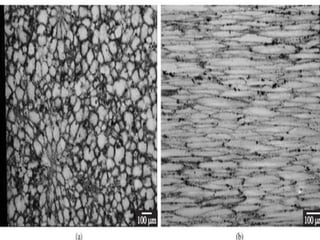
• Wrought alloys are prepared by altering
the casting alloy mechanically into a
prefabricated shape.
• Wrought alloys have a fibrous grain
structure compared with crystalline
structure of casting alloys.
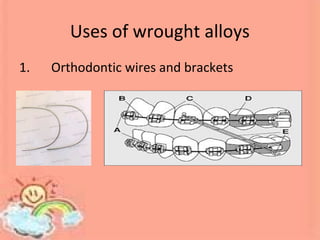
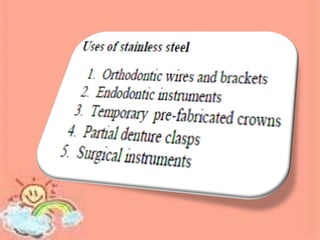
Uses of wrought alloys
1. Orthodontic wires and brackets
Requirements of wrought wires usedRequirements of wrought wires used
in dentistryin dentistry
1. Springiness (flexibility); It is the ability of
the wire to undergo large deflection
without permanent deformation.
• Spring back potential =
yield strength/Elastic modulus
• Spring back should be high which results in
an increase in its range of action.
• Spring back is the measure of how far a
wire can be deflected without causing
permanent deformation.
Requirements of wrought wires usedRequirements of wrought wires used
in dentistryin dentistry
2. Stiffness;
certain stiffness is required to apply a
suitable force for tooth movement
during orthodontic treatment.
• Clinically, it represents the
magnitude of the force required to
deflect or bend a wire.
3. Least friction at bracket – wire
interface. Otherwise it limits the
tooth movement
Requirements of wrought wires usedRequirements of wrought wires used
in dentistryin dentistry
4. Formability (ductility);It is the ability to
be bent without fracture.
5. Corrosion resistance.
6. Ability to be joined by soldering or
welding.
7. Resilience is a property of arch wires
whereby they store energy when
deformed elastically, and release energy
when unloaded.
It represents the stored energy available in
the wire to move teeth during
deactivation.
Types of wrought alloys used inTypes of wrought alloys used in
dentistrydentistry
1.1. Stainless steel alloyStainless steel alloy
• St.st alloy are iron- carbon-
chromium alloy.
• Chromium ranges from 13-28 %
• Chromium improve corrosion
resistance
Mechanism of passivationMechanism of passivation
• The chromium exposed at the surface
of the alloy is readily oxidized to form a
tenacious layer of chromium oxide,
•Resists further attack from
aqueous media
•Prevents corrosion
Properties of St-St wiresProperties of St-St wires
• 1. Lower spring-back action and also
store less energy compared to those of
beta-titanium or nickel titanium.
• 2. High stiffness ( modulus of elasticity
180 Mpa). So, they produce high
force applied on tooth during shorter
time periods.
3. High ductility.
4. Good corrosion resistance.
Properties of St-St wiresProperties of St-St wires
5. Greater ease of welding and
soldering
6. Low resilience
7. Lowest cost
8. Low friction(advantage) with brackets.
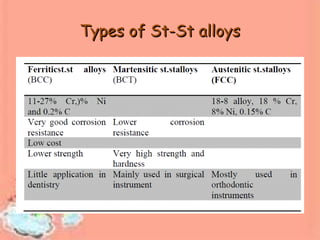
Types of St-St alloysTypes of St-St alloys
Sensitization of 18-8 st.stSensitization of 18-8 st.st
Definition
•Loss of corrosion resistance if st.st
is heated between 400-900o
C
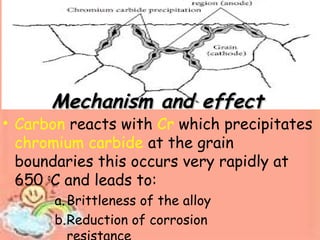
Mechanism and effectMechanism and effect
• Carbon reacts with Cr which precipitates
chromium carbide at the grain
boundaries this occurs very rapidly at
650 o
C and leads to:
a.Brittleness of the alloy
b.Reduction of corrosion
Methods of preventing sensitizationMethods of preventing sensitization
a. Avoid heating too high
b. Carbon content in the alloy
c. Severe cold working of the alloy
distribute the carbides evenly
decrease the areas of chromium
deficiency
d.d. Stabilization of stainless steel;Stabilization of stainless steel;
• Addition of a stabilizing element as
titanium, niobium or tantalum
• This forms titanium carbide instead
of chromium carbide such that
chromium remains in its place
““stabilized austenitic stainless steel”stabilized austenitic stainless steel”
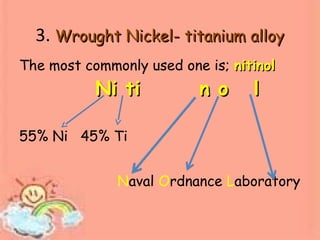
3. Wrought Nickel- titanium alloyWrought Nickel- titanium alloy
The most commonly used one is; nitinolnitinol
Ni ti n o lNi ti n o l
55% Ni 45% Ti
Naval Ordnance Laboratory
Characters of NiTi wiresCharacters of NiTi wires
1. Good spring back action and
flexibility
2. Low stiffness low
force
3. Excellent corrosion resistance
4. Larger stored energy than st-st, so
fewer activation or changes are
required
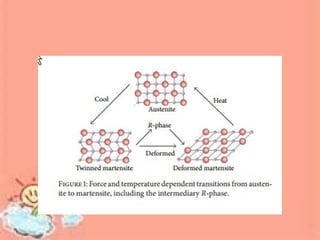
5. Nitinol is characterized by phasephase
transformationtransformation by changing the
temperaturetemperature
or the stresses;or the stresses;
• At high temperature and low stress
austenitic (BCC, ordered)
• At low temperature and high stress
martensitic ( HCP, disordered)
This transformation is associated withThis transformation is associated with
volumetric changes.volumetric changes.
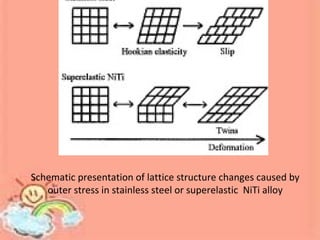
Schematic presentation of lattice structure changes caused by
outer stress in stainless steel or superelastic NiTi alloy
According to transformation, Ni-Ti wire has 2According to transformation, Ni-Ti wire has 2
unique propertiesunique properties
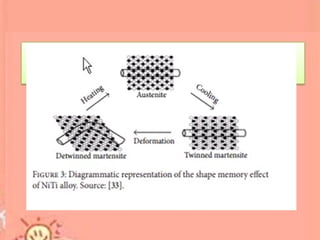
1. Shape memory
Definition: It describes the effect of
restoring the original shape of a
plastically deformed sample by heating it.
• This phenomenon results from a
crystalline phase change known as
"thermoelastic martensitic
transformation".
• At temperatures below the
transformation temperature, shape
memory alloys are martensitic.
• In this condition. their microstructure is
characterized by "self-accommodating
twins“.
• The manensite is soft and can be
deformed quite easily by de-twinning.
• Heating above the transformation
temperature recovers the original shape
and converts the material to its high
strength austenitic condition.
• Shape memory is achieved by first
establishing a shape at temperatures
near 482° C .
• If the appliance wire is then cooled and
formed into a second shape and heated
through a lower transition temperature
range (TTR), the wire will return to its
original shape.
• The cobalt content is used to control
the transition temperature range, which
can be near mouth temperature.
m
pe
Clinical significance
In orthodontic treatment, the wire is
shaped at high temperature into a
ready made arch shape.
After adaptation by clinician into
brackets bonded to the mal-posed
teeth, the wire returns to its original
form which promotes tooth
movement.
C
In
de
lo
to
w
In
pe
av
in
st
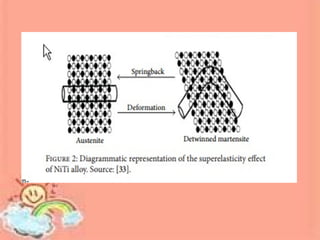
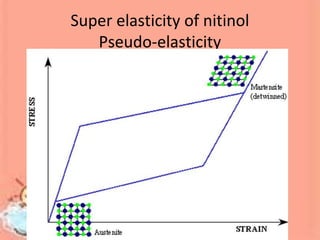
2. Superelasticity (pseudoelastic nitinol)
• It is a stress induced crystalgraphic
transformation from austinitic to
martensitic.
• Within the upper super elastic plateau
region, the markedly increased strain
for a small increase in bending stress
facilitates adaptation of the instrument
along a sharply curved root canal,
thereby minimizing the risk for root
perforations.
Super elasticity of nitinol
Pseudo-elasticity
minimizing the risk for root
perforation.
s
a
o
d
al
h
Clinical significance
In orthodontic treatment, it is
desirable clinically because very
low and nearly constant forces or
tooth movement are provided by
wire during deactivation.
In endodontic treatment,
perforation of curved canals is
avoided due to the
increased stress decrease
stiffness.
Uses of NitinolUses of Nitinol
1. Good for orthodontic wires when low
force and large working range are
needed.
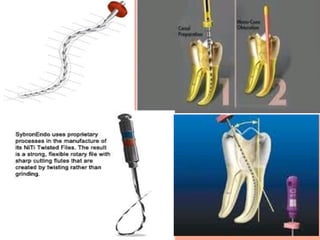
2. Good for endodontic files in curved
root canalto avoid perforation.
Disadvantages of NitinolDisadvantages of Nitinol
1. Limited formability
2. Higher friction than st-st and lower
than ß Titanium
3. Difficulty in soldering
4. Expensive
5. Ni has got some hazardous and
allergic effect
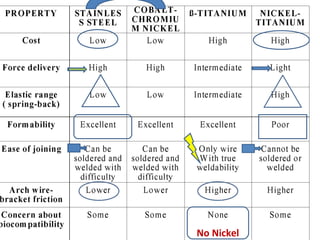
No Nickel
Wrought alloys

Wrought alloys

  • 1.
  • 2.
    Production & Usesof wrought alloys Requirements of wrought wires Types of wrought alloys 1. Stainless steel alloy‫كله‬ 2. Wrought cobalt-chromium-nickel alloy ‫بس‬ ‫كمقارنة‬ 3. Wrought Nickel- titanium alloy‫كله‬ 4. Beta-Titanium alloy ‫بس‬ ‫كمقارنة‬
  • 3.
  • 4.
    • Wrought alloysare prepared by altering the casting alloy mechanically into a prefabricated shape. • Wrought alloys have a fibrous grain structure compared with crystalline structure of casting alloys.
  • 5.
    Uses of wroughtalloys 1. Orthodontic wires and brackets
  • 10.
    Requirements of wroughtwires usedRequirements of wrought wires used in dentistryin dentistry 1. Springiness (flexibility); It is the ability of the wire to undergo large deflection without permanent deformation. • Spring back potential = yield strength/Elastic modulus • Spring back should be high which results in an increase in its range of action. • Spring back is the measure of how far a wire can be deflected without causing permanent deformation.
  • 11.
    Requirements of wroughtwires usedRequirements of wrought wires used in dentistryin dentistry 2. Stiffness; certain stiffness is required to apply a suitable force for tooth movement during orthodontic treatment. • Clinically, it represents the magnitude of the force required to deflect or bend a wire. 3. Least friction at bracket – wire interface. Otherwise it limits the tooth movement
  • 12.
    Requirements of wroughtwires usedRequirements of wrought wires used in dentistryin dentistry 4. Formability (ductility);It is the ability to be bent without fracture. 5. Corrosion resistance. 6. Ability to be joined by soldering or welding. 7. Resilience is a property of arch wires whereby they store energy when deformed elastically, and release energy when unloaded. It represents the stored energy available in the wire to move teeth during deactivation.
  • 13.
    Types of wroughtalloys used inTypes of wrought alloys used in dentistrydentistry
  • 14.
    1.1. Stainless steelalloyStainless steel alloy • St.st alloy are iron- carbon- chromium alloy. • Chromium ranges from 13-28 % • Chromium improve corrosion resistance
  • 15.
    Mechanism of passivationMechanismof passivation • The chromium exposed at the surface of the alloy is readily oxidized to form a tenacious layer of chromium oxide, •Resists further attack from aqueous media •Prevents corrosion
  • 16.
    Properties of St-StwiresProperties of St-St wires • 1. Lower spring-back action and also store less energy compared to those of beta-titanium or nickel titanium. • 2. High stiffness ( modulus of elasticity 180 Mpa). So, they produce high force applied on tooth during shorter time periods. 3. High ductility. 4. Good corrosion resistance.
  • 17.
    Properties of St-StwiresProperties of St-St wires 5. Greater ease of welding and soldering 6. Low resilience 7. Lowest cost 8. Low friction(advantage) with brackets.
  • 19.
    Types of St-StalloysTypes of St-St alloys
  • 20.
    Sensitization of 18-8st.stSensitization of 18-8 st.st Definition •Loss of corrosion resistance if st.st is heated between 400-900o C
  • 21.
    Mechanism and effectMechanismand effect • Carbon reacts with Cr which precipitates chromium carbide at the grain boundaries this occurs very rapidly at 650 o C and leads to: a.Brittleness of the alloy b.Reduction of corrosion
  • 22.
    Methods of preventingsensitizationMethods of preventing sensitization a. Avoid heating too high b. Carbon content in the alloy c. Severe cold working of the alloy distribute the carbides evenly decrease the areas of chromium deficiency
  • 23.
    d.d. Stabilization ofstainless steel;Stabilization of stainless steel; • Addition of a stabilizing element as titanium, niobium or tantalum • This forms titanium carbide instead of chromium carbide such that chromium remains in its place ““stabilized austenitic stainless steel”stabilized austenitic stainless steel”
  • 24.
    3. Wrought Nickel-titanium alloyWrought Nickel- titanium alloy The most commonly used one is; nitinolnitinol Ni ti n o lNi ti n o l 55% Ni 45% Ti Naval Ordnance Laboratory
  • 25.
    Characters of NiTiwiresCharacters of NiTi wires 1. Good spring back action and flexibility 2. Low stiffness low force 3. Excellent corrosion resistance 4. Larger stored energy than st-st, so fewer activation or changes are required
  • 26.
    5. Nitinol ischaracterized by phasephase transformationtransformation by changing the temperaturetemperature or the stresses;or the stresses; • At high temperature and low stress austenitic (BCC, ordered) • At low temperature and high stress martensitic ( HCP, disordered) This transformation is associated withThis transformation is associated with volumetric changes.volumetric changes.
  • 30.
    Schematic presentation oflattice structure changes caused by outer stress in stainless steel or superelastic NiTi alloy
  • 31.
    According to transformation,Ni-Ti wire has 2According to transformation, Ni-Ti wire has 2 unique propertiesunique properties 1. Shape memory Definition: It describes the effect of restoring the original shape of a plastically deformed sample by heating it. • This phenomenon results from a crystalline phase change known as "thermoelastic martensitic transformation". • At temperatures below the transformation temperature, shape memory alloys are martensitic.
  • 32.
    • In thiscondition. their microstructure is characterized by "self-accommodating twins“. • The manensite is soft and can be deformed quite easily by de-twinning. • Heating above the transformation temperature recovers the original shape and converts the material to its high strength austenitic condition.
  • 33.
    • Shape memoryis achieved by first establishing a shape at temperatures near 482° C . • If the appliance wire is then cooled and formed into a second shape and heated through a lower transition temperature range (TTR), the wire will return to its original shape. • The cobalt content is used to control the transition temperature range, which can be near mouth temperature.
  • 35.
    m pe Clinical significance In orthodontictreatment, the wire is shaped at high temperature into a ready made arch shape. After adaptation by clinician into brackets bonded to the mal-posed teeth, the wire returns to its original form which promotes tooth movement. C In de lo to w In pe av in st
  • 36.
    2. Superelasticity (pseudoelasticnitinol) • It is a stress induced crystalgraphic transformation from austinitic to martensitic. • Within the upper super elastic plateau region, the markedly increased strain for a small increase in bending stress facilitates adaptation of the instrument along a sharply curved root canal, thereby minimizing the risk for root perforations.
  • 37.
    Super elasticity ofnitinol Pseudo-elasticity
  • 38.
    minimizing the riskfor root perforation. s a o d al h Clinical significance In orthodontic treatment, it is desirable clinically because very low and nearly constant forces or tooth movement are provided by wire during deactivation. In endodontic treatment, perforation of curved canals is avoided due to the increased stress decrease stiffness.
  • 40.
    Uses of NitinolUsesof Nitinol 1. Good for orthodontic wires when low force and large working range are needed. 2. Good for endodontic files in curved root canalto avoid perforation.
  • 41.
    Disadvantages of NitinolDisadvantagesof Nitinol 1. Limited formability 2. Higher friction than st-st and lower than ß Titanium 3. Difficulty in soldering 4. Expensive 5. Ni has got some hazardous and allergic effect
  • 42.