Investing and Casting
Fixed Prosthodontics
Done by: Lina Nashawati
Introduction
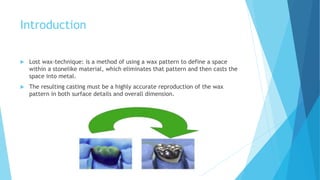
 Lost wax-technique: is a method of using a wax pattern to define a space
within a stonelike material, which eliminates that pattern and then casts the
space into metal.
 The resulting casting must be a highly accurate reproduction of the wax
pattern in both surface details and overall dimension.
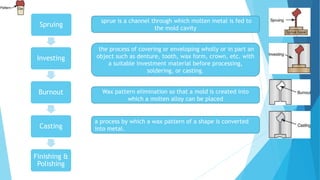
Spruing
Investing
Burnout
Casting
Finishing &
Polishing
sprue is a channel through which molten metal is fed to
the mold cavity
Wax pattern elimination so that a mold is created into
which a molten alloy can be placed
a process by which a wax pattern of a shape is converted
into metal.
the process of covering or enveloping wholly or in part an
object such as denture, tooth, wax form, crown, etc. with
a suitable investment material before processing,
soldering, or casting.
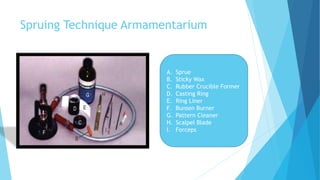
Spruing Technique Armamentarium
A. Sprue
B. Sticky Wax
C. Rubber Crucible Former
D. Casting Ring
E. Ring Liner
F. Bunsen Burner
G. Pattern Cleaner
H. Scalpel Blade
I. Forceps
1- Sprue
 Three basic requirements:
1. The sprue must allow the molten wax to escape from the mold.
2. The sprue must enable the molten metal to flow into the mold with as little
turbulence as possible.
3. The metal within it must remain molten slightly longer than the alloy that has
filled the mold. This provides a reservoir to compensate for the shrinkage that
occurs during solidification of the casting alloy.
 The sprue can be made from wax, plastic, or metal. Wax sprues are preferred
for most castings because they melt at the same rate as the pattern and thus
allow easy escape rate as the molten wax.
 Diameter:
A relatively large-diameter is recommended because this improves the flow
of molten metal into the mold and ensures a reservoir during solidification.
 Molars and metal-ceramic patterns = 2.5 mm sprue
 Premolar and partial-coverage restorations = 2.0 mm sprue
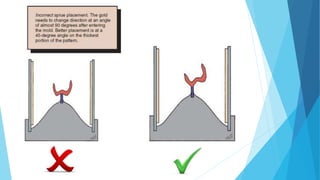
 Location:
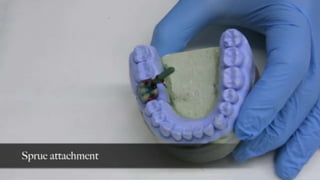
The sprue should be attached to the bulkiest noncritical part of the pattern, away
from margins and occlusal contacts.
Normally the largest nonfunctional cusp is used.
The point of attachment should allow a stream of metal to be directed to all parts of
the mold without having to flow in an opposite direction to the casting force.
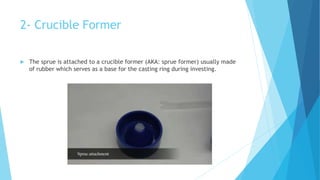
2- Crucible Former
 The sprue is attached to a crucible former (AKA: sprue former) usually made
of rubber which serves as a base for the casting ring during investing.
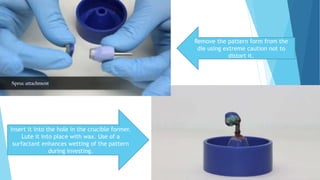
Remove the pattern form from the
die using extreme caution not to
distort it.
Insert it into the hole in the crucible former.
Lute it into place with wax. Use of a
surfactant enhances wetting of the pattern
during investing.
3- Casting Ring and Liner
 The casting ring serves as a container for the investment while it sets and restricts the
setting expansion of the mold
 Therefore, a liner is placed inside the ring to allow for more expansion of the investment
material during setting and burnout since the liner is somewhat compressible.
 In case of wetting the liner, the absorbed water help in hygroscopic expansion.
 The amount of expansion depends on the number of the liners used.
 Types of Liners:
1. Asbestos liners have carcinogenic potential (used earlier)
2. Non-asbestos:
 Cellulose paper liner
 Ceramic ring liner (alumino-silicate fibrous material)
 Combination of cellulose and ceramic ring liner
Note: no liner  expansion is toward the center of the mold  distorted cast
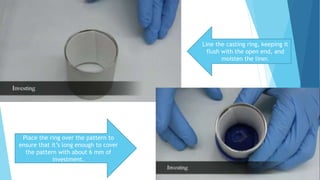
Line the casting ring, keeping it
flush with the open end, and
moisten the liner.
Place the ring over the pattern to
ensure that it’s long enough to cover
the pattern with about 6 mm of
investment.
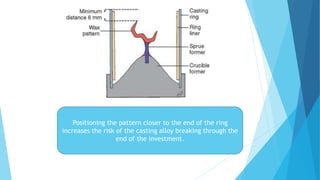
Positioning the pattern closer to the end of the ring
increases the risk of the casting alloy breaking through the
end of the investment.
Material Science:
 Several investment materials are available for fabricating a dental casting
mold.
 Typically consist of a refractory material (usually silica) and a binder material
provides strength.
 Refractory: A material that withstand high temperature and resist corrosion.
 Any addition material that a manufacture adds, it’s only to improve handling
characteristics.
 When we want to classify the investment material by it’s binder, we have
three groups:
-Gypsum-bonded: for casting made from ADA type II, type III, & type IV gold
alloys
-Phosphate-bonded: recommended for metal-ceramic restorations
-Silica-bonded: for high-melting base metal alloys used in casting partial
removable dental prostheses
Investing:
 Vacuum mixing of investment materials is recommended to obtain results in
casting with minimal surface defects.
Armamentarium:
A. Vacuum mixer and a bowl
B. Vibrator
C. Investment powder(gypsum or phosphate bonded)
D. Water or colloidal silica
E. Spatula
F. Brush
G. Surfactant
H. Crucible former
I. Casting ring and liner
Procedure:
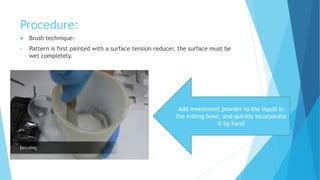
 Brush technique:
• Pattern is first painted with a surface tension reducer, the surface must be
wet completely.
Add investment powder to the liquid in
the mixing bowl, and quickly incorporate
it by hand
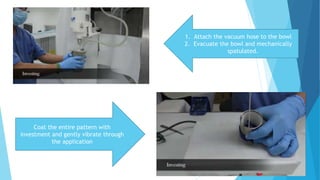
1. Attach the vacuum hose to the bowl
2. Evacuate the bowl and mechanically
spatulated.
Coat the entire pattern with
investment and gently vibrate through
the application
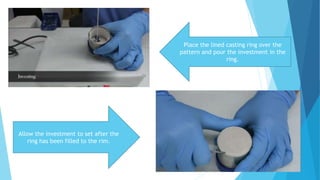
Place the lined casting ring over the
pattern and pour the investment in the
ring.
Allow the investment to set after the
ring has been filled to the rim.
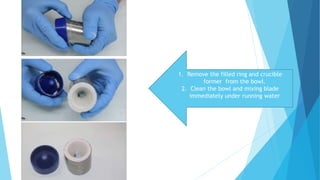
1. Remove the filled ring and crucible
former from the bowl.
2. Clean the bowl and mixing blade
immediately under running water
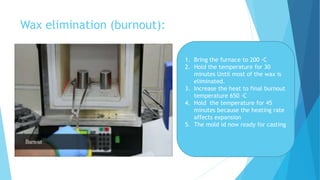
Wax elimination (burnout):
1. Bring the furnace to 200 ◦C
2. Hold the temperature for 30
minutes Until most of the wax is
eliminated.
3. Increase the heat to final burnout
temperature 650 ◦C
4. Hold the temperature for 45
minutes because the heating rate
affects expansion
5. The mold id now ready for casting
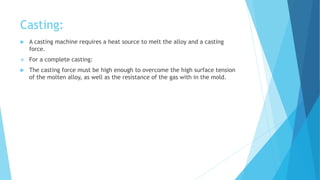
Casting:
 A casting machine requires a heat source to melt the alloy and a casting
force.
 For a complete casting:
 The casting force must be high enough to overcome the high surface tension
of the molten alloy, as well as the resistance of the gas with in the mold.
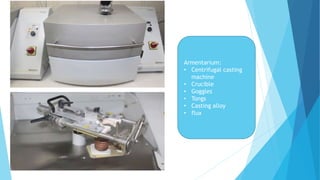
Armentarium:
• Centrifugal casting
machine
• Crucible
• Goggles
• Tongs
• Casting alloy
• flux
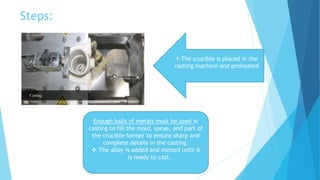
Steps:
1-The crucible is placed in the
casting machine and preheated
Enough balls of metals must be used in
casting to fill the mold, sprue, and part of
the crucible former to ensure sharp and
complete details in the casting.
 The alloy is added and melted until it
is ready to cast.
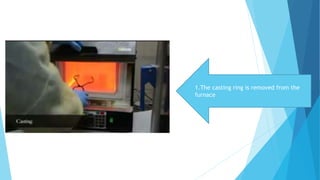
1.The casting ring is removed from the
furnace
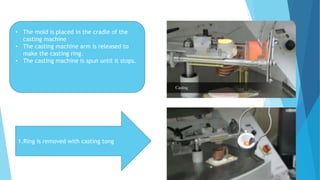
• The mold is placed in the cradle of the
casting machine
• The casting machine arm is released to
make the casting ring.
• The casting machine is spun until it stops.
1.Ring is removed with casting tong
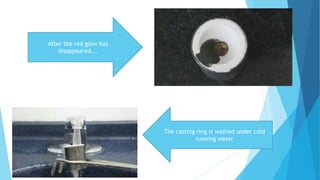
After the red glow has
disappeared….
The casting ring is washed under cold
running water
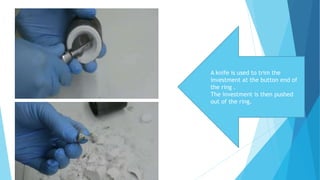
A knife is used to trim the
investment at the button end of
the ring .
The investment is then pushed
out of the ring.
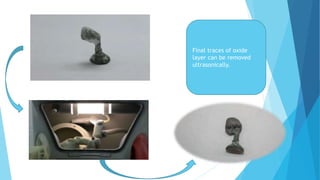
Final traces of oxide
layer can be removed
ultrasonically.
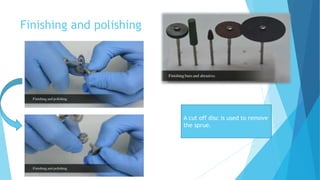
Finishing and polishing
A cut off disc is used to remove
the sprue.
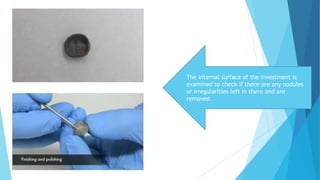
The internal surface of the investment is
examined to check if there are any nodules
or irregularities left in there and are
removed.
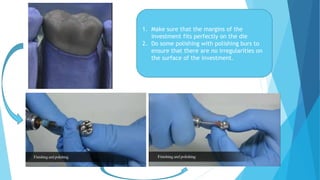
1. Make sure that the margins of the
investment fits perfectly on the die
2. Do some polishing with polishing burs to
ensure that there are no irregularities on
the surface of the investment.
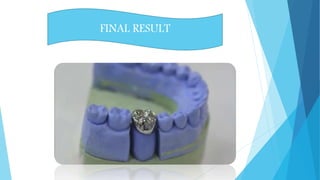
FINAL RESULT
Investing and Casting

Investing and Casting

  • 1.
    Investing and Casting FixedProsthodontics Done by: Lina Nashawati
  • 2.
    Introduction  Lost wax-technique:is a method of using a wax pattern to define a space within a stonelike material, which eliminates that pattern and then casts the space into metal.  The resulting casting must be a highly accurate reproduction of the wax pattern in both surface details and overall dimension.
  • 3.
    Spruing Investing Burnout Casting Finishing & Polishing sprue isa channel through which molten metal is fed to the mold cavity Wax pattern elimination so that a mold is created into which a molten alloy can be placed a process by which a wax pattern of a shape is converted into metal. the process of covering or enveloping wholly or in part an object such as denture, tooth, wax form, crown, etc. with a suitable investment material before processing, soldering, or casting.
  • 5.
    Spruing Technique Armamentarium A.Sprue B. Sticky Wax C. Rubber Crucible Former D. Casting Ring E. Ring Liner F. Bunsen Burner G. Pattern Cleaner H. Scalpel Blade I. Forceps
  • 7.
    1- Sprue  Threebasic requirements: 1. The sprue must allow the molten wax to escape from the mold. 2. The sprue must enable the molten metal to flow into the mold with as little turbulence as possible. 3. The metal within it must remain molten slightly longer than the alloy that has filled the mold. This provides a reservoir to compensate for the shrinkage that occurs during solidification of the casting alloy.
  • 8.
     The spruecan be made from wax, plastic, or metal. Wax sprues are preferred for most castings because they melt at the same rate as the pattern and thus allow easy escape rate as the molten wax.  Diameter: A relatively large-diameter is recommended because this improves the flow of molten metal into the mold and ensures a reservoir during solidification.  Molars and metal-ceramic patterns = 2.5 mm sprue  Premolar and partial-coverage restorations = 2.0 mm sprue
  • 9.
     Location: The sprueshould be attached to the bulkiest noncritical part of the pattern, away from margins and occlusal contacts. Normally the largest nonfunctional cusp is used. The point of attachment should allow a stream of metal to be directed to all parts of the mold without having to flow in an opposite direction to the casting force.
  • 11.
    2- Crucible Former The sprue is attached to a crucible former (AKA: sprue former) usually made of rubber which serves as a base for the casting ring during investing.
  • 12.
    Remove the patternform from the die using extreme caution not to distort it. Insert it into the hole in the crucible former. Lute it into place with wax. Use of a surfactant enhances wetting of the pattern during investing.
  • 13.
    3- Casting Ringand Liner  The casting ring serves as a container for the investment while it sets and restricts the setting expansion of the mold  Therefore, a liner is placed inside the ring to allow for more expansion of the investment material during setting and burnout since the liner is somewhat compressible.  In case of wetting the liner, the absorbed water help in hygroscopic expansion.  The amount of expansion depends on the number of the liners used.  Types of Liners: 1. Asbestos liners have carcinogenic potential (used earlier) 2. Non-asbestos:  Cellulose paper liner  Ceramic ring liner (alumino-silicate fibrous material)  Combination of cellulose and ceramic ring liner Note: no liner  expansion is toward the center of the mold  distorted cast
  • 14.
    Line the castingring, keeping it flush with the open end, and moisten the liner. Place the ring over the pattern to ensure that it’s long enough to cover the pattern with about 6 mm of investment.
  • 15.
    Positioning the patterncloser to the end of the ring increases the risk of the casting alloy breaking through the end of the investment.
  • 16.
    Material Science:  Severalinvestment materials are available for fabricating a dental casting mold.  Typically consist of a refractory material (usually silica) and a binder material provides strength.  Refractory: A material that withstand high temperature and resist corrosion.  Any addition material that a manufacture adds, it’s only to improve handling characteristics.  When we want to classify the investment material by it’s binder, we have three groups: -Gypsum-bonded: for casting made from ADA type II, type III, & type IV gold alloys -Phosphate-bonded: recommended for metal-ceramic restorations -Silica-bonded: for high-melting base metal alloys used in casting partial removable dental prostheses
  • 18.
    Investing:  Vacuum mixingof investment materials is recommended to obtain results in casting with minimal surface defects. Armamentarium: A. Vacuum mixer and a bowl B. Vibrator C. Investment powder(gypsum or phosphate bonded) D. Water or colloidal silica E. Spatula F. Brush G. Surfactant H. Crucible former I. Casting ring and liner
  • 19.
    Procedure:  Brush technique: •Pattern is first painted with a surface tension reducer, the surface must be wet completely. Add investment powder to the liquid in the mixing bowl, and quickly incorporate it by hand
  • 20.
    1. Attach thevacuum hose to the bowl 2. Evacuate the bowl and mechanically spatulated. Coat the entire pattern with investment and gently vibrate through the application
  • 21.
    Place the linedcasting ring over the pattern and pour the investment in the ring. Allow the investment to set after the ring has been filled to the rim.
  • 22.
    1. Remove thefilled ring and crucible former from the bowl. 2. Clean the bowl and mixing blade immediately under running water
  • 24.
    Wax elimination (burnout): 1.Bring the furnace to 200 ◦C 2. Hold the temperature for 30 minutes Until most of the wax is eliminated. 3. Increase the heat to final burnout temperature 650 ◦C 4. Hold the temperature for 45 minutes because the heating rate affects expansion 5. The mold id now ready for casting
  • 26.
    Casting:  A castingmachine requires a heat source to melt the alloy and a casting force.  For a complete casting:  The casting force must be high enough to overcome the high surface tension of the molten alloy, as well as the resistance of the gas with in the mold.
  • 27.
    Armentarium: • Centrifugal casting machine •Crucible • Goggles • Tongs • Casting alloy • flux
  • 28.
    Steps: 1-The crucible isplaced in the casting machine and preheated Enough balls of metals must be used in casting to fill the mold, sprue, and part of the crucible former to ensure sharp and complete details in the casting.  The alloy is added and melted until it is ready to cast.
  • 29.
    1.The casting ringis removed from the furnace
  • 30.
    • The moldis placed in the cradle of the casting machine • The casting machine arm is released to make the casting ring. • The casting machine is spun until it stops. 1.Ring is removed with casting tong
  • 31.
    After the redglow has disappeared…. The casting ring is washed under cold running water
  • 32.
    A knife isused to trim the investment at the button end of the ring . The investment is then pushed out of the ring.
  • 33.
    Final traces ofoxide layer can be removed ultrasonically.
  • 35.
    Finishing and polishing Acut off disc is used to remove the sprue.
  • 36.
    The internal surfaceof the investment is examined to check if there are any nodules or irregularities left in there and are removed.
  • 37.
    1. Make surethat the margins of the investment fits perfectly on the die 2. Do some polishing with polishing burs to ensure that there are no irregularities on the surface of the investment.
  • 38.