CASE STUDIES ON IFS IN
INDIA
INTRODUCTION
The growth rate of agriculture in the recent
past is very slow inspite of the rapid economic
growth in India.The operational farm holding
in India is declining and over 85 million out of
105 million are below the size of 1 ha
COMPONENTS IN IFS
Integrated farming system module for
livelihood security (Raichur, Karnataka, India) (Desai.
2015)
Teak planting was all along the borders. Bunds
between the segments are planted with drumstick,
curry leaf and fodder grasses like NB-21, Guinea grass &
stylo.
CASE STUDY-1
Segment 1: Bullock pair: 1.
Cow: 2
Poultry birds: 60
Kitchen garden
Construction of farm pond (Fishery), farm
house, Poultry cage, Cattle shed and
Vermicompost unit as per the
specification
Segment 2: Horticulture crops like Mango &
Fig/Guava inter-cropped with vegetables like Bhendi,
Ridge gourd and leafy vegetables.
Segment 3: Maize followed by Bengal gram
Segment 4: Bt-cotton
Segment 5: Part 1: Jasmine
Part 2: Marigold
Part 3: Watermelon
Results/ Outcomes:
• The profitability of different components of IFS
in the first year was comparatively less than
second year and third year.
• During the first year net income generated
from crop component was 30,570 with a B: C
ratio of 2.30 while, from allied activities it was
about 46,398 with B: C ratio 2.81 respectively.
• The net income generated during the second
year from the crop component is Rs. 70319
with B:C ratio of 3.69 while, Rs. 57243 with
B:C ratio is 3.02 obtained from the allied
sector.
• The net income generated during third year
from the crop components is Rs. 74577 with B:
C ratio of 3.64 while Rs. 152821 with B:C ratio
is 5.34 obtained from the allied sector.
Farming systems in southern Rajasthan (Singh et al.
2013)
Model 1: Crop-livestock farming system
Kharif: Maize, soybean and cotton, Rabi: wheat,
barley and mustard
Livestock: Cow and buffalo
CASE STUDY-2
• Model 2: Crop-livestock-horticulture farming
system
• Kharif: Maize, soybean and cotton, Rabi: wheat,
barley and mustard
• Livestock: Cow and buffalo
• Horticulture: Fruit, Vegetable and flowers
ECONOMICS OF IFS FOR SMALL FARMERS
CASE STUDY- 3
Development of Region Specific Horticulture
based Integrated Farming System Models of Sirohi
District of Rajasthan (Bhardwaj and Vyas 2015)
HORTICULTURE BASED FARMING SYSTEM MODEL
Region specific integrated farming system models for
partially irrigated arid condition in 2.0 hectare
Developed two Integrated Farming
Systems. Module for small and marginal
farmers of Eastern region for lowland
and midland irrigated ecosystems of
Bihar (Kumar et
al. 2012) [9]
.
CASE STUDY-4
A) Two acre IFS module (for lowland situation)
Components:
Crop + Livestock + Fishery
Allied: Duckery / Vermicomposting / Bee keeping/ FYM
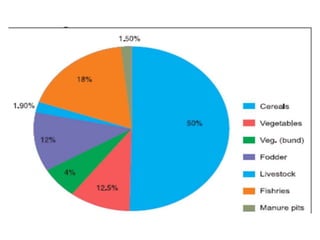
1) Cereal crops (50% area)
Kharif: Rice
Rabi: Wheat/Maize/Lentil/Mustard
2) Horticultural crops (Fruits +Vegetables): 12.5 % area
vegetables
Kharif: Cucurbits/Brinjal/Okra
Summer: Brinjal/Boro/ Okra/ Bitter gourd / Cucumber
etc.
Fruits: Papaya, guava, lemon, banana
3) All around the field bunds cucurbits or seasonal
vegetables having lesser water requirement.
4) Fish + Duck integration (17.8% area)
i) Mix carp culture: Rohu, Catla, Mrigal
ii) Duck: For 1000 m2 water area 40
numbers of ducks are sufficient, Khakhi
Campbell breed of duck is right choice for
this area (Dual purpose) A thatched hut of
10 x 15’ size is optimum for 40 ducks above
the water or on the pond’s dike.
5) Livestock (1.80% area)
A size of 3 adult cows + 3 calves
6. Fodder production (12.5% area): For feeding
of 3 cows and 3 calves 1000 m² land is sufficient
Kharif: M.P. Chari/Sudan grass/ Napier/Maize
Summer: Boro/Lobia/Maize/Sudan grass
Rabi: Berseem/Oat/Maize etc.
7.Spices:Turmaric, ginger, etc...
8. FYM/ vermi-composting pits: (1.4 % area)
ECONOMICS OF 2 ACRE IFS MODEL
B. One acre IFS module (midland situation)
Components:
Crop + Goat + Poultry
Allied: Mushroom/Goat manure/Vermi-composting
1) Cereal crops (50% area)
Kharif: Rice
Rabi: Wheat/Maize/Lentil/Mustard
2. Horticultural crops (Fruits + vegetables): 22.5 %
area vegetables
3) All around the field bunds cucurbits or seasonal
vegetables having lesser water requirement.
4. Livestock (Goat): 2.5% area
A size of 20 female goat + 1 buck is optimum for one
acre and . Black Bengal breed of goat is suitable for this
region.
5) Poultry (100 birds)
100-200 birds (broiler) can be reared in an area of 225
sq. ft.
6) Mushroom:Selection of the mushroom strains should be
done on the basis of climate and humidity in the
atmosphere as
March-September: Straw/paddy/milky mushroom.
October-February: Oyster/ Button mushroom
7) Fodder production: (12.5% area)
For feeding of 20 + 1 unit of goat an area of 600 m2
Kharif: M.P. Chari/Sudan grass/Maize
Summer: Boro/Lobia/Maize/Gunea grass
Rabi: Berseem/Oat/Maize etc..
9) FYM/ vermicomposting pits: (1.4% area)
8) Spices: In the sheds or where light intensity is less
like orchards, spaces between the huts etc. turmeric,
ginger or guinea grass can be taken.
Integrated farming systems, therefore, assume
greater importance for sound management of farm
resources to enhance farm productivity, which will
reduce environment degradation and improve the
quality of life of resource poor
farmers and to maintain agricultural sustainability.
CONCLUSION
REFERENCES
• Desai BK. Integrated Farming System Module for
Livelihood Security (Raichur, Karnataka, India):
Success story under RKVY Project Implemented at
UAS, Raichur, Karnataka, 2015
• Bhardwaj RL, Kumar L. Krishi me tikaupan ka rastha:
Mixed cropping system. Khad Patrika, New Delhi,
2012
WEED COMPOSTING
AND ITS POTENTIALS
Profitable and environment friendly management of
weed through composting and subsequent utilization
as nutrient option alone or in combination with other
nutrient sources
INTRODUCTION
Compost is like gold for your garden. It is free and the
nutrients it provides will help your vegetables grow and
mature very successfully
How to make compost from weeds?
• Have you ever thrown in weeds into your compost
pile just to see them take root and thrive? Some
weeds take advantage of the nutrients they find
there, and if you are not careful your compost area
could become a haven for unwanted weeds.
• Compost equal parts fresh weeds (without seeds) as
a GREEN with BROWN, such as leaves, OR 2 parts
fresh weeds to 1 part dry leaves
• No Weed Gone to Seed should be put in your bin
unless you can heat the pile to above 140°F (60°C) to
kill (roast) the seeds so that they don't sprout in your
garden soil
• Don't compost pernicious weeds or grasses such as
morningglory, buttercups, bermuda grass, oxalis,
quackgrass, crabgrass, etc.
PREPARATION OF WEED COMPOST
• collect the weed biomass before flowering for
making compost || either by NADEP or open pit
method.
• Following procedure can be followed for making
weed compost:
• Make a pit of 3x 6x10feet
(depth x width x length)
• If possible, cover the surface
and sidewalls of the pit with
stone chips. It will protect
absorption of essential nutrient
of compost by the soil surface.
• Arrange about 100 kg dung, 10
kg urea or rock phosphate, soil
(1-2 Quintals) and one drum of
water near the pit.
• Collect all the weed plants from
your field and nearby area.
• Spread about 50 kg of
weeds on the surface of pit.
• Over this sprinkle 500 gm
urea or 3 kg rock
phosphate.
• If possible add Trichoderma
viridi or Trichoderma
harziana (kind of fungi
cultured powder) in the
amount of 50 gm per layer.
• All the above constituents
will make one layer.
• Like first layer make several layers till the pit is filled
upto 1 ft high from the ground surface.
• Fill the pit in dome shape.
• While making layers, apply pressure by feet to
make weed biomass compact.
• When pit is full with above described layers then
cover it with mixture of cow dung, soil and husk.
• After 4-5 months we can get well decomposed
compost.
• We can get 37–45% of compost from 37-42 quintals
of weed biomass.
Sieving of compost:
• After removal of compost from pit spread that
compost in the shady place to dry it. Coming in
contact with air, soon wet of compost becomes dry
and crumpled. Make a heap of this so dry compost.
• Sieve that compost with 2x2cm size mesh. For
selling point of view, make packets of 1, 2, 3, 5 kg
for kitchen garden and 25-50 kg for crops and
horticulture.
Precautions:
During weed compost preparation there is need Of
following attentions:
• Pit should be in open and shady upland.
• Cover the pit with the mixture of soil, dung and
husk
• If you find fresh germination of weed near the pit
where weed was collected to fill up the pit, destroy
them otherwise they may contaminate the
compost after flowering.
Check the
moisture level of
compost. If there
is dryness in the
pit, make a few
holes and pour
water in the pit
and close the
holes.
• During the process, the temperature rises 60-70 °C
due to which seeds are killed.
• While it may take about four to five months to
prepare the compost in a warm climate, in cold
regions it can take more time.
Weed compost is a
type of bio-
fertilizer which has
no harmful effects
on crops, human –
beings and
environment.
BENEFITS
During basal
dressing of the
field, apply 2.5-3.0
tone/hectare.
In plantation of
vegetables crop
apply 4-5
tone/hectare.
AMOUNT FOR USE
WEED COMPOSTING POTENTIALS
• . Compost derived from weeds contains plenty of
micronutrients such as Fe, Zn,Mn, and Cu and
macronutrients including NPK making it two times
richer than farmyard manure.
• Organic acids released during composting help in
liberation of insoluble and increase the uptake of P and
K.
• Compost also contains abundant enzymes, vitamins,
antibiotics, plant growth regulators, and large number
of associated useful microorganisms including
Azotobacter and phosphate solubilizers.
• Moisture holding capacity of compost increases its
utility value.
• Amendment with other plant materials such as saw
dust and poultry manure also gives good quality
compost, minimizing the required dose of chemical
fertilizers.
• Compost formed has shown growth promotion in
chilli,Sorghum ,Vigna radiata and Triticum and
Arachis hypogaea
• Allelochemicals present in the final compost lessen
the chances of infestation by other weeds.
• The manure obtained has low pH and C : N ratio
and contains sufficiently high amounts of essential
nutrients such as N, P, K, Ca , Zn, Cu, and Mn.
CONCLUSION
• Zero waste technology,
• being followed these days, can also be taken into
account
• while shaping these integrated approaches.• Nutritionally rich compost can be obtained from the
weed by composting it formally or by using techniques
of vermicomposting, which can be employed for
increasing productivity of wide variety of agriculturally
important crops.
REFERENCES
•https://www.researchgate.net
•https://biosciencediscovery.com
› Naikw...
•https://scialert.net
THANK YOU

Case studies

  • 1.
    CASE STUDIES ONIFS IN INDIA
  • 2.
    INTRODUCTION The growth rateof agriculture in the recent past is very slow inspite of the rapid economic growth in India.The operational farm holding in India is declining and over 85 million out of 105 million are below the size of 1 ha
  • 3.
  • 4.
    Integrated farming systemmodule for livelihood security (Raichur, Karnataka, India) (Desai. 2015) Teak planting was all along the borders. Bunds between the segments are planted with drumstick, curry leaf and fodder grasses like NB-21, Guinea grass & stylo. CASE STUDY-1
  • 5.
    Segment 1: Bullockpair: 1. Cow: 2 Poultry birds: 60 Kitchen garden Construction of farm pond (Fishery), farm house, Poultry cage, Cattle shed and Vermicompost unit as per the specification
  • 6.
    Segment 2: Horticulturecrops like Mango & Fig/Guava inter-cropped with vegetables like Bhendi, Ridge gourd and leafy vegetables. Segment 3: Maize followed by Bengal gram Segment 4: Bt-cotton Segment 5: Part 1: Jasmine Part 2: Marigold Part 3: Watermelon
  • 7.
    Results/ Outcomes: • Theprofitability of different components of IFS in the first year was comparatively less than second year and third year. • During the first year net income generated from crop component was 30,570 with a B: C ratio of 2.30 while, from allied activities it was about 46,398 with B: C ratio 2.81 respectively.
  • 8.
    • The netincome generated during the second year from the crop component is Rs. 70319 with B:C ratio of 3.69 while, Rs. 57243 with B:C ratio is 3.02 obtained from the allied sector. • The net income generated during third year from the crop components is Rs. 74577 with B: C ratio of 3.64 while Rs. 152821 with B:C ratio is 5.34 obtained from the allied sector.
  • 10.
    Farming systems insouthern Rajasthan (Singh et al. 2013) Model 1: Crop-livestock farming system Kharif: Maize, soybean and cotton, Rabi: wheat, barley and mustard Livestock: Cow and buffalo CASE STUDY-2
  • 11.
    • Model 2:Crop-livestock-horticulture farming system • Kharif: Maize, soybean and cotton, Rabi: wheat, barley and mustard • Livestock: Cow and buffalo • Horticulture: Fruit, Vegetable and flowers
  • 12.
    ECONOMICS OF IFSFOR SMALL FARMERS
  • 13.
    CASE STUDY- 3 Developmentof Region Specific Horticulture based Integrated Farming System Models of Sirohi District of Rajasthan (Bhardwaj and Vyas 2015)
  • 14.
  • 15.
    Region specific integratedfarming system models for partially irrigated arid condition in 2.0 hectare
  • 16.
    Developed two IntegratedFarming Systems. Module for small and marginal farmers of Eastern region for lowland and midland irrigated ecosystems of Bihar (Kumar et al. 2012) [9] . CASE STUDY-4
  • 18.
    A) Two acreIFS module (for lowland situation) Components: Crop + Livestock + Fishery Allied: Duckery / Vermicomposting / Bee keeping/ FYM 1) Cereal crops (50% area) Kharif: Rice Rabi: Wheat/Maize/Lentil/Mustard
  • 19.
    2) Horticultural crops(Fruits +Vegetables): 12.5 % area vegetables Kharif: Cucurbits/Brinjal/Okra Summer: Brinjal/Boro/ Okra/ Bitter gourd / Cucumber etc. Fruits: Papaya, guava, lemon, banana 3) All around the field bunds cucurbits or seasonal vegetables having lesser water requirement.
  • 20.
    4) Fish +Duck integration (17.8% area) i) Mix carp culture: Rohu, Catla, Mrigal ii) Duck: For 1000 m2 water area 40 numbers of ducks are sufficient, Khakhi Campbell breed of duck is right choice for this area (Dual purpose) A thatched hut of 10 x 15’ size is optimum for 40 ducks above the water or on the pond’s dike.
  • 21.
    5) Livestock (1.80%area) A size of 3 adult cows + 3 calves 6. Fodder production (12.5% area): For feeding of 3 cows and 3 calves 1000 m² land is sufficient Kharif: M.P. Chari/Sudan grass/ Napier/Maize Summer: Boro/Lobia/Maize/Sudan grass Rabi: Berseem/Oat/Maize etc. 7.Spices:Turmaric, ginger, etc... 8. FYM/ vermi-composting pits: (1.4 % area)
  • 23.
    ECONOMICS OF 2ACRE IFS MODEL
  • 24.
    B. One acreIFS module (midland situation) Components: Crop + Goat + Poultry Allied: Mushroom/Goat manure/Vermi-composting
  • 26.
    1) Cereal crops(50% area) Kharif: Rice Rabi: Wheat/Maize/Lentil/Mustard 2. Horticultural crops (Fruits + vegetables): 22.5 % area vegetables 3) All around the field bunds cucurbits or seasonal vegetables having lesser water requirement.
  • 27.
    4. Livestock (Goat):2.5% area A size of 20 female goat + 1 buck is optimum for one acre and . Black Bengal breed of goat is suitable for this region. 5) Poultry (100 birds) 100-200 birds (broiler) can be reared in an area of 225 sq. ft.
  • 28.
    6) Mushroom:Selection ofthe mushroom strains should be done on the basis of climate and humidity in the atmosphere as March-September: Straw/paddy/milky mushroom. October-February: Oyster/ Button mushroom 7) Fodder production: (12.5% area) For feeding of 20 + 1 unit of goat an area of 600 m2 Kharif: M.P. Chari/Sudan grass/Maize Summer: Boro/Lobia/Maize/Gunea grass Rabi: Berseem/Oat/Maize etc..
  • 29.
    9) FYM/ vermicompostingpits: (1.4% area) 8) Spices: In the sheds or where light intensity is less like orchards, spaces between the huts etc. turmeric, ginger or guinea grass can be taken.
  • 32.
    Integrated farming systems,therefore, assume greater importance for sound management of farm resources to enhance farm productivity, which will reduce environment degradation and improve the quality of life of resource poor farmers and to maintain agricultural sustainability. CONCLUSION
  • 33.
    REFERENCES • Desai BK.Integrated Farming System Module for Livelihood Security (Raichur, Karnataka, India): Success story under RKVY Project Implemented at UAS, Raichur, Karnataka, 2015 • Bhardwaj RL, Kumar L. Krishi me tikaupan ka rastha: Mixed cropping system. Khad Patrika, New Delhi, 2012
  • 34.
  • 35.
    Profitable and environmentfriendly management of weed through composting and subsequent utilization as nutrient option alone or in combination with other nutrient sources INTRODUCTION Compost is like gold for your garden. It is free and the nutrients it provides will help your vegetables grow and mature very successfully
  • 36.
    How to makecompost from weeds? • Have you ever thrown in weeds into your compost pile just to see them take root and thrive? Some weeds take advantage of the nutrients they find there, and if you are not careful your compost area could become a haven for unwanted weeds.
  • 37.
    • Compost equalparts fresh weeds (without seeds) as a GREEN with BROWN, such as leaves, OR 2 parts fresh weeds to 1 part dry leaves • No Weed Gone to Seed should be put in your bin unless you can heat the pile to above 140°F (60°C) to kill (roast) the seeds so that they don't sprout in your garden soil • Don't compost pernicious weeds or grasses such as morningglory, buttercups, bermuda grass, oxalis, quackgrass, crabgrass, etc.
  • 38.
    PREPARATION OF WEEDCOMPOST • collect the weed biomass before flowering for making compost || either by NADEP or open pit method. • Following procedure can be followed for making weed compost:
  • 39.
    • Make apit of 3x 6x10feet (depth x width x length) • If possible, cover the surface and sidewalls of the pit with stone chips. It will protect absorption of essential nutrient of compost by the soil surface. • Arrange about 100 kg dung, 10 kg urea or rock phosphate, soil (1-2 Quintals) and one drum of water near the pit. • Collect all the weed plants from your field and nearby area.
  • 40.
    • Spread about50 kg of weeds on the surface of pit. • Over this sprinkle 500 gm urea or 3 kg rock phosphate. • If possible add Trichoderma viridi or Trichoderma harziana (kind of fungi cultured powder) in the amount of 50 gm per layer. • All the above constituents will make one layer.
  • 41.
    • Like firstlayer make several layers till the pit is filled upto 1 ft high from the ground surface. • Fill the pit in dome shape. • While making layers, apply pressure by feet to make weed biomass compact. • When pit is full with above described layers then cover it with mixture of cow dung, soil and husk.
  • 42.
    • After 4-5months we can get well decomposed compost. • We can get 37–45% of compost from 37-42 quintals of weed biomass.
  • 43.
    Sieving of compost: •After removal of compost from pit spread that compost in the shady place to dry it. Coming in contact with air, soon wet of compost becomes dry and crumpled. Make a heap of this so dry compost. • Sieve that compost with 2x2cm size mesh. For selling point of view, make packets of 1, 2, 3, 5 kg for kitchen garden and 25-50 kg for crops and horticulture.
  • 44.
    Precautions: During weed compostpreparation there is need Of following attentions: • Pit should be in open and shady upland. • Cover the pit with the mixture of soil, dung and husk • If you find fresh germination of weed near the pit where weed was collected to fill up the pit, destroy them otherwise they may contaminate the compost after flowering.
  • 45.
    Check the moisture levelof compost. If there is dryness in the pit, make a few holes and pour water in the pit and close the holes.
  • 46.
    • During theprocess, the temperature rises 60-70 °C due to which seeds are killed. • While it may take about four to five months to prepare the compost in a warm climate, in cold regions it can take more time.
  • 47.
    Weed compost isa type of bio- fertilizer which has no harmful effects on crops, human – beings and environment. BENEFITS
  • 48.
    During basal dressing ofthe field, apply 2.5-3.0 tone/hectare. In plantation of vegetables crop apply 4-5 tone/hectare. AMOUNT FOR USE
  • 49.
    WEED COMPOSTING POTENTIALS •. Compost derived from weeds contains plenty of micronutrients such as Fe, Zn,Mn, and Cu and macronutrients including NPK making it two times richer than farmyard manure. • Organic acids released during composting help in liberation of insoluble and increase the uptake of P and K. • Compost also contains abundant enzymes, vitamins, antibiotics, plant growth regulators, and large number of associated useful microorganisms including Azotobacter and phosphate solubilizers.
  • 50.
    • Moisture holdingcapacity of compost increases its utility value. • Amendment with other plant materials such as saw dust and poultry manure also gives good quality compost, minimizing the required dose of chemical fertilizers. • Compost formed has shown growth promotion in chilli,Sorghum ,Vigna radiata and Triticum and Arachis hypogaea
  • 51.
    • Allelochemicals presentin the final compost lessen the chances of infestation by other weeds. • The manure obtained has low pH and C : N ratio and contains sufficiently high amounts of essential nutrients such as N, P, K, Ca , Zn, Cu, and Mn.
  • 52.
    CONCLUSION • Zero wastetechnology, • being followed these days, can also be taken into account • while shaping these integrated approaches.• Nutritionally rich compost can be obtained from the weed by composting it formally or by using techniques of vermicomposting, which can be employed for increasing productivity of wide variety of agriculturally important crops.
  • 53.
  • 54.