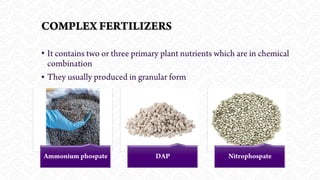
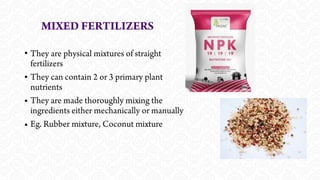
SOIL FERTILITY AND
PRODUCTIVITY, FUE
Soil fertility vs soil productivity –organic manures – bio-fertilizers – green
manures - forms of fertilizers-time and methods of application. Calculation of
fertilizers for important crops – methods to improve FUE .
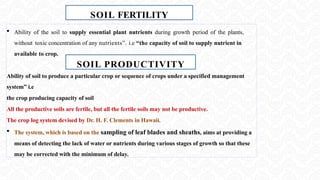
 Ability of the soil to supply essential plant nutrients during growth period of the plants,
without toxic concentration of any nutrients”. i.e “the capacity of soil to supply nutrient in
available to crop.
Ability of soil to produce a particular crop or sequence of crops under a specified management
system” i.e
the crop producing capacity of soil
All the productive soils are fertile, but all the fertile soils may not be productive.
The crop log system devised by Dr. H. F. Clements in Hawaii.
 The system, which is based on the sampling of leaf blades and sheaths, aims at providing a
means of detecting the lack of water or nutrients during various stages of growth so that these
may be corrected with the minimum of delay.
SOIL FERTILITY
SOIL PRODUCTIVITY
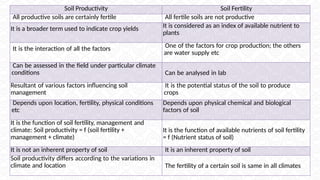
Soil Productivity Soil Fertility
All productive soils are certainly fertile All fertile soils are not productive
It is a broader term used to indicate crop yields It is considered as an index of available nutrient to
plants
It is the interaction of all the factors One of the factors for crop production; the others
are water supply etc
Can be assessed in the field under particular climate
conditions Can be analysed in lab
Resultant of various factors influencing soil
management
It is the potential status of the soil to produce
crops
Depends upon location, fertility, physical conditions
etc
Depends upon physical chemical and biological
factors of soil
It is the function of soil fertility, management and
climate: Soil productivity = f (soil fertility +
management + climate)
It is the function of available nutrients of soil fertility
= f (Nutrient status of soil)
It is not an inherent property of soil It is an inherent property of soil
Soil productivity differs according to the variations in
climate and location The fertility of a certain soil is same in all climates
MANURES AND FERTILISERS
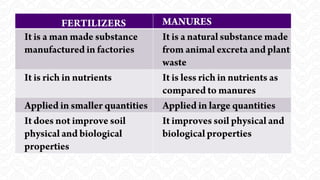
 The nutrient supplying sources are manures and fertilizers.
 N, P and K are the 3 major elements required for the crop growth.
 Help in increasing the crop yield and to maintain the soil fertility.
 Manures - the plant and animal wastes - used as sources of plant nutrients.
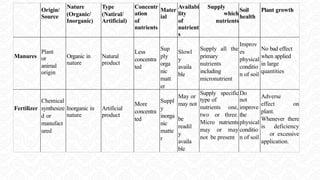
Origin/
Source
Nature
(Organic/
Inorganic)
Type
(Natiral/
Artificial)
Concentr
ation
of
nutrients
Mater
ial
Availabi
lity
of
nutrient
s
Supply
which
nutrients
Soil
health
Plant growth
Manures
Plant
or
animal
origin
Organic in
nature
Natural
product
Less
concentra
ted
Sup
ply
orga
nic
matt
er
Slowl
y
availa
ble
Supply all the
primary
nutrients
including
micronutrient
Improv
es
physical
conditio
n of soil
No bad effect
when applied
in large
quantities
Fertilizer
Chemical
synthesize
d or
manufact
ured
Inorganic in
nature
Artificial
product
More
concentra
ted
Suppl
y
inorga
nic
matte
r
May or
may not
be
readil
y
availa
ble
Supply specific
type of
nutrients one,
two or three.
Micro nutrients
may or may
not be present
Do
not
improve
the
physical
conditio
n of soil
Adverse
effect on
plant.
Whenever there
is deficiency
or excessive
application.
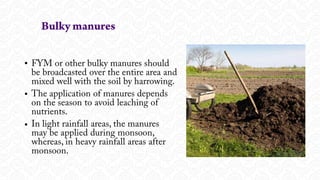
 Well decomposed farmyard manure contains 0.5 per cent N, 0.2 per cent
P2O5and .0.5 per cent K2O.
 FYM - Decomposed mixture of dung and urine of farm animals along with
litter and left-over material from roughages or fodder fed to the cattle.
 The droppings of sheep and goats manure contains 3% N, 1% P2O5 and 2%
K2O.
 Poultry manure contains higher nitrogen and phosphorus compared to other bulky
organic manures. The average nutrient content is 3.03%N; 2.63% P2O5 and 1.4%
K2O.
 Night soil (human excreta collected from pit latrines, Septic tanks at night)
contains 5.5% N; 4% P2O5 and 12% K2O
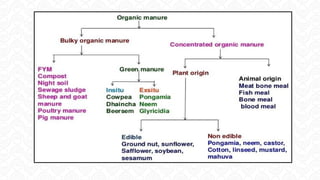
BULKY ORGANIC MANURES
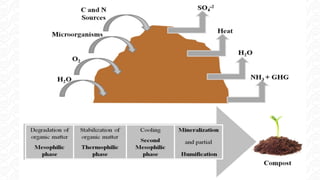
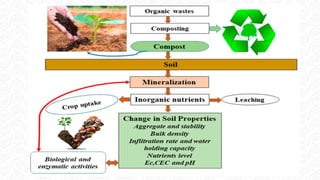
 Composting process - recycles various organic materials - waste products - produces a soil
conditioner called compost - rich in nutrients.
 The greatest potential - biomass resource - field residues of sorghum, maize, soybean, cotton,
sugarcane etc.
 Carbon and nitrogen ratio decides the initiation of composting process. If C:N ratio is wide
(100:1) composting will not take place. Narrow C:N ratio of 30:1 is ideal for composting. To get
a narrow C:N ratio, carbon and nitrogen rich material should be mixed.
 Green coloured waste materials like glyricidia leaves, parthenium, freshly harvested weeds;
sesbania leaves are rich in nitrogen, whereas brown coloured waste material like straw, coir
dust, dried leaves and dried grasses are rich in carbon.
 Minimum 4 feet height should be maintained for composting - Alternate layers of carbon and
nitrogen rich material with intermittent layers of animal dung are essential. After heap formation
the material should be thoroughly moistened.
BULKY OM - COMPOSTING
For one ton crop residues, 40 kg fresh cow dung is required. This 40 kg fresh
cow dung is mixed with 10 L, of water and it should be thoroughly poured
over the waste material. Cow dung slurry acts as nitrogen source as well as
source of microbial inoculum.
 The compost heap should be turned upside down, once in fifteen days - to
allow the fresh air to get inside.
 Throughout the composting period 60% moisture should be maintained.
 Physical factors to be observed for compost maturity - Volume reduction,
black colour, earthy odour, reduction in particle size.
 After curing for one day, the composted material is sieved through 4 mm
sieve to get uniform composted material. The residues collected after
composting has to be again composted to finish the composting process.
 The beneficial microorganisms like Azotobacter or Azospirillum,
Pseudomonas, Phosphobacteria (0.2%) and rock phosphate (2%) have to be
inoculated for one ton of compost. 40 per cent moisture should be
maintained for the maximum growth of inoculated microorganism. This
incubation should be allowed for 20 days for the organism to reach the
maximum population. Now the compost is called as enriched compost.
 The advantage of enriched compost over normal compost is the quality
manure with higher nutrient status with high number of beneficial
microorganisms and plant growth promoting substances.
 Dosage :- 5T/ha enriched biocompost is recommended. It can be used as basal
application in the field before taking up planting work (during manuring stage of
preparation of field for sowing).
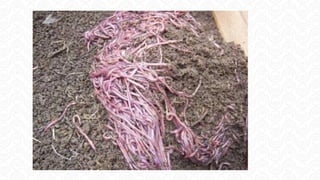
Vermicompost
 Vermicomposting is the process of turning organic debris into worm castings.
 The castings contain high amounts of nitrogen, potassium, phosphorus, calcium, and
magnesium.
 Castings contain: 5 times the available nitrogen, 7 times the available potash, and 1
½ times more calcium than found in
good topsoil.
 Worm castings can hold close to nine times their weight in water.
 “Vermiconversion,” or using earthworms to convert waste into soil additives, is an
effective way to deal with farm waste also. One kilogram of worms numbering
about 600 to 1000 can convert 25 to 45 kg of wet waste per week
 A recommended rate of vermicompost application is 15-20 percent.
 For vermicompost production, the surface dwelling earthworm alone should
be used. The earthworm, which lives below the soil, is not suitable for
vermicompost production.
 The African earthworm (Eudrillus engenial), Red worms (Eisenia sp.) and
composting worm (Peronyx sp.) -used for vermicompost production.
 All the three worms can be mixed together for vermicompost production.
 The African worm (Eudrillus eugeneae) – suitable for Kerala conditions, it
produces higher production of vermicompost in short period of time and
more young ones in the composting period.
• Compost worms are not subject to diseases caused by micro-organisms, but they are subject to
predation by certain animals and insects (red mites) – spray Raksha, KAU botanical @ 10g/L
• A particularly devastating problem in a worm bin is protein poisoning, also called “string of
pearls” or sour crop, evidenced by a serious deformation of the earthworms as their intestines
rupture, inevitably killing the worm itself.
• Protein rich foods produce a greater quantity of acidic compounds as they break down, and if this acid
is not neutralized and calcium supplied to your worms, protein poisoning is inevitable, must add
enough calcium rich buffer to the bedding to neutralize the acid produced by the microorganisms
that digest it.
• 500-1000 nos per pit
• NPK:- 1.5 :0.4:1.8 %, pH- 7-8
• Vermiwash is a liquid extract produced from vermicompost in a medium
where earthworms are richly populated. It comprises a massive decomposer
bacteria count, mucus, vitamins, different bioavailable minerals, hormones,
enzymes, different antimicrobial peptides, etc.
• Vermiprotein - the excess worms can be converted into vermiprotein which
can be utilised as feed for poultry, fish, etc.
Vermicompost - Terminology
Thumburmuzhi composting – ferrocement tanks is used
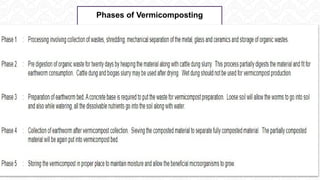
Phases of Vermicomposting
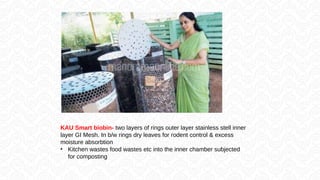
KAU Smart biobin- two layers of rings outer layer stainless stell inner
layer GI Mesh. In b/w rings dry leaves for rodent control & excess
moisture absorbtion
• Kitchen wastes food wastes etc into the inner chamber subjected
for composting
•
•
•
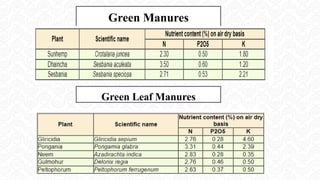
Green Manures
Green Leaf Manures
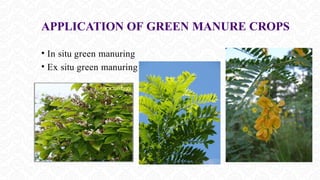
APPLICATION OF GREEN MANURE CROPS
• In situ green manuring
• Ex situ green manuring
•
•
•
•
•
•
•
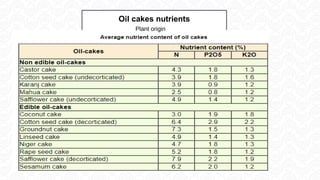
Oil cakes nutrients
Plant origin
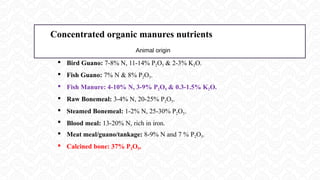
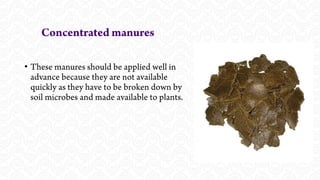
Concentrated organic manures nutrients
 Bird Guano: 7-8% N, 11-14% P2O5 & 2-3% K2O.
 Fish Guano: 7% N & 8% P2O5.
 Fish Manure: 4-10% N, 3-9% P2O5 & 0.3-1.5% K2O.
 Raw Bonemeal: 3-4% N, 20-25% P2O5.
 Steamed Bonemeal: 1-2% N, 25-30% P2O5.
 Blood meal: 13-20% N, rich in iron.
 Meat meal/guano/tankage: 8-9% N and 7 % P2O5.
 Calcined bone: 37% P2O5.
Animal origin
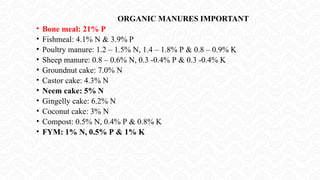
ORGANIC MANURES IMPORTANT
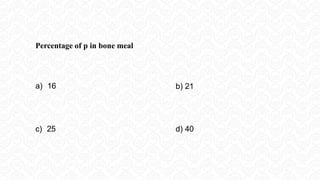
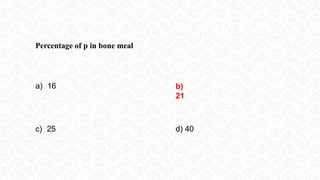
• Bone meal: 21% P
• Fishmeal: 4.1% N & 3.9% P
• Poultry manure: 1.2 – 1.5% N, 1.4 – 1.8% P & 0.8 – 0.9% K
• Sheep manure: 0.8 – 0.6% N, 0.3 -0.4% P & 0.3 -0.4% K
• Groundnut cake: 7.0% N
• Castor cake: 4.3% N
• Neem cake: 5% N
• Gingelly cake: 6.2% N
• Coconut cake: 3% N
• Compost: 0.5% N, 0.4% P & 0.8% K
• FYM: 1% N, 0.5% P & 1% K
•
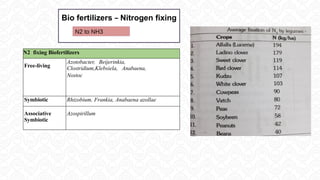
Bio fertilizers – Nitrogen fixing
N2 fixing Biofertilizers
Free-living
Azotobacter, Beijerinkia,
Clostridium,Klebsiela, Anabaena,
Nostoc
Symbiotic Rhizobium, Frankia, Anabaena azollae
Associative
Symbiotic
Azospirillum
N2 to NH3
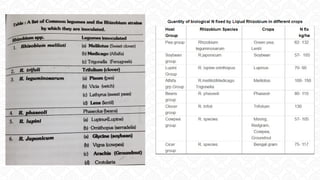
 Rhizobium inoculant was first made in USA and commercialized by private enterprise in 1930s
and the strange situation at that time has been chronicled by Fred (1932).
 Azotobacter chroococcum - dominant inhabitant in arable soils capable of fixing N2 (2-15 mg
N2 fixed /g of carbon source) in culture media.
 Azospirillum lipoferum, A. brasilense, A.amazonense, A.halopraeferens and A.irakense are primary
inhabitants of soil, the rhizosphere and intercellular spaces of root cortex of graminaceous
plants.
 They perform the associative symbiotic relation with the graminaceous plants. Additional
benefits - growth promoting substance production (IAA), disease resistance and drought tolerance.
 Azolla is a free-floating water fern that floats in water and fixes atmospheric nitrogen in association
with nitrogen fixing blue green alga Anabaena azollae. It is used as biofertilizer for wetland rice
and it is known to contribute 40-60 kg N/ha per rice crop.
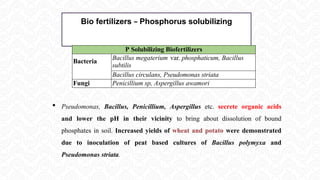
Bio fertilizers – Phosphorus solubilizing
 Pseudomonas, Bacillus, Penicillium, Aspergillus etc. secrete organic acids
and lower the pH in their vicinity to bring about dissolution of bound
phosphates in soil. Increased yields of wheat and potato were demonstrated
due to inoculation of peat based cultures of Bacillus polymyxa and
Pseudomonas striata.
P Solubilizing Biofertilizers
Bacteria
Bacillus megaterium var. phosphaticum, Bacillus
subtilis
Bacillus circulans, Pseudomonas striata
Fungi Penicillium sp, Aspergillus awamori
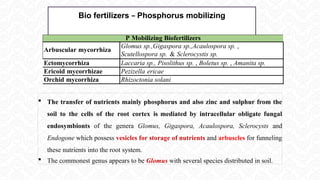
Bio fertilizers – Phosphorus mobilizing
 The transfer of nutrients mainly phosphorus and also zinc and sulphur from the
soil to the cells of the root cortex is mediated by intracellular obligate fungal
endosymbionts of the genera Glomus, Gigaspora, Acaulospora, Sclerocysts and
Endogone which possess vesicles for storage of nutrients and arbuscles for funneling
these nutrients into the root system.
 The commonest genus appears to be Glomus with several species distributed in soil.
P Mobilizing Biofertilizers
Arbuscular mycorrhiza
Glomus sp.,Gigaspora sp.,Acaulospora sp. ,
Scutellospora sp. & Sclerocystis sp.
Ectomycorrhiza Laccaria sp., Pisolithus sp. , Boletus sp. , Amanita sp.
Ericoid mycorrhizae Pezizella ericae
Orchid mycorrhiza Rhizoctonia solani
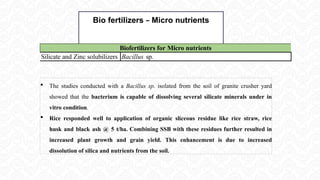
Bio fertilizers – Micro nutrients
 The studies conducted with a Bacillus sp. isolated from the soil of granite crusher yard
showed that the bacterium is capable of dissolving several silicate minerals under in
vitro condition.
 Rice responded well to application of organic sliceous residue like rice straw, rice
husk and black ash @ 5 t/ha. Combining SSB with these residues further resulted in
increased plant growth and grain yield. This enhancement is due to increased
dissolution of silica and nutrients from the soil.
Biofertilizers for Micro nutrients
Silicate and Zinc solubilizers Bacillus sp.
Bio fertilizers - PGPR
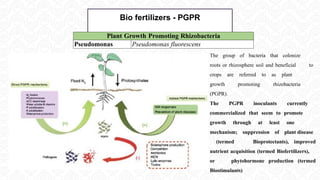
 The group of bacteria that colonize
roots or rhizosphere soil and beneficial to
crops are referred to as plant
growth promoting rhizobacteria
(PGPR).
 The PGPR inoculants currently
commercialized that seem to promote
growth through at least one
mechanism; suppression of plant disease
(termed Bioprotectants), improved
nutrient acquisition (termed Biofertilizers),
or phytohormone production (termed
Biostimulants)
Plant Growth Promoting Rhizobacteria
Pseudomonas Pseudomonas fluorescens
•
•
•
•
•
•
•
•
•
•
•
•
•
•
Seed Treatment
 Most common method adopted for all types of inoculants - effective and economic.
 For small quantity of seeds (up to 5 kg) the coating can done in a plastic bag – After mixing, seed is
dried under the shade for 20-30 minutes.
 For large amount of seeds coating can be done in a bucket/Seed dressing drum and inoculant can be
mixed directly manually/mechanically. Seed treatment with Rhizobium, Azotobacter, Azospirillum,
along with PSM can be done.
 The seed treatment can be done with any of two or more bacteria. There is no side (antagonistic)
effect - seeds must be coated first with Rhizobium,Azotobacter or Azospirillum
 When each seed get a layer of above bacteria then PSM inoculant has to be coated as outer layer.
This method will provide maximum number of each bacteria required for better results.
 Treatments of seed with any two bacteria will not provide maximum number of bacteria on individual
seed.
Liquid Bio-fertilizer - Application methods
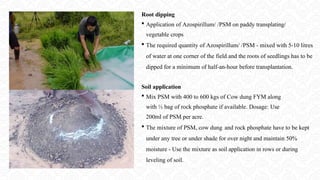
Root dipping
 Application of Azospirillum/ /PSM on paddy transplating/
vegetable crops
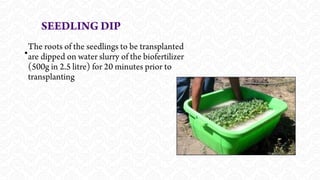
 The required quantity of Azospirillum/ /PSM - mixed with 5-10 litres
of water at one corner of the field and the roots of seedlings has to be
dipped for a minimum of half-an-hour before transplantation.
Soil application
 Mix PSM with 400 to 600 kgs of Cow dung FYM along
with ½ bag of rock phosphate if available. Dosage: Use
200ml of PSM per acre.
 The mixture of PSM, cow dung and rock phosphate have to be kept
under any tree or under shade for over night and maintain 50%
moisture - Use the mixture as soil application in rows or during
leveling of soil.
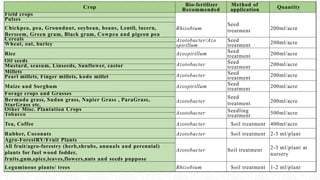
Crop Bio-fertilizer
Recommended
Method of
application Quantity
Field crops
Rhizobium
Seed
treatment 200ml/acre
Pulses
Chickpea, pea, Groundnut, soybean, beans, Lentil, lucern,
Berseem, Green gram, Black gram, Cowpea and pigeon pea
Cereals Azotobacter/Azo
spirillum
Seed
treatment 200ml/acre
Wheat, oat, barley
Rice Azospirillum Seed
treatment 200ml/acre
Oil seeds
Azotobacter Seed
treatment 200ml/acre
Mustard, seasum, Linseeds, Sunflower, castor
Millets
Azotobacter Seed
treatment 200ml/acre
Pearl millets, Finger millets, kodo millet
Maize and Sorghum Azospirillum Seed
treatment 200ml/acre
Forage crops and Grasses
Azotobacter
Seed
treatment 200ml/acre
Bermuda grass, Sudan grass, Napier Grass , ParaGrass,
StarGrass etc.
Other Misc. Plantation Crops
Azotobacter Seedling
treatment 500ml/acre
Tobacco
Tea, Coffee Azotobacter Soil treatment 400ml/acre
Rubber, Coconuts Azotobacter Soil treatment 2-3 ml/plant
Agro-ForestRY/Fruit Plants
Azotobacter Soil treatment 2-3 ml/plant at
nursery
All fruit/agro-forestry (herb,shrubs, annuals and perennial)
plants for fuel wood fodder,
fruits,gum,spice,leaves,flowers,nuts and seeds puppose
Leguminous plants/ trees Rhizobium Soil treatment 1-2 ml/plant
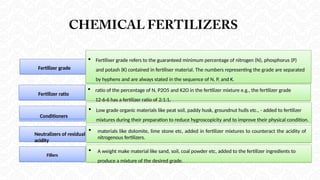
Fertilizer grade
Fertilizer ratio
 Fertiliser grade refers to the guaranteed minimum percentage of nitrogen (N), phosphorus (P)
and potash (K) contained in fertiliser material. The numbers representing the grade are separated
by hyphens and are always stated in the sequence of N, P, and K.
 ratio of the percentage of N, P2O5 and K2O in the fertilizer mixture e.g., the fertilizer grade
12-6-6 has a fertilizer ratio of 2:1:1.
 Low grade organic materials like peat soil, paddy husk, groundnut hulls etc., - added to fertilizer
mixtures during their preparation to reduce hygroscopicity and to improve their physical condition.
Ex: Peat soil, Paddy husk
 A weight make material like sand, soil, coal powder etc, added to the fertilizer ingredients to
produce a mixture of the desired grade.
Conditioners
Fillers
 materials like dolomite, lime stone etc, added in fertilizer mixtures to counteract the acidity of
nitrogenous fertilizers.
Neutralizers of residual
acidity
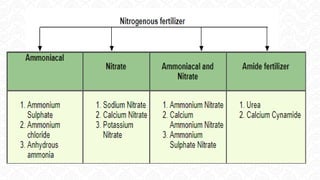
Chemical fertilizers
•
•
•
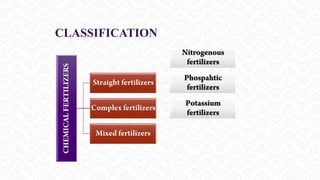
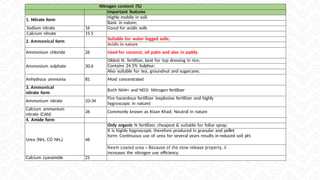
CLASSIFICATION
Nitrogen content (%)
Important features
1. Nitrate form
Highly mobile in soil;
Basic in nature;
Sodium nitrate 16 Good for acidic soils
Calcium nitrate 15.5
2. Ammonical form
Suitable for water logged soils;
Acidic in nature
Ammonium chloride 26 Used for coconut, oil palm and also in paddy.
Ammonium sulphate 20.6
Oldest N. fertilizer, best for top dressing in rice;
Contains 24.5% Sulphur;
Also suitable for tea, groundnut and sugarcane;
Anhydrous ammonia 81 Most concentrated
3. Ammonical
nitrate form
Both NH4+ and NO3- Nitrogen fertilizer
Ammonium nitrate 33-34
Fire hazardous fertilizer (explosive fertilizer and highly
hygroscopic in nature)
Calcium ammonium
nitrate (CAN)
26 Commonly known as Kisan Khad; Neutral in nature
4. Amide form
Urea (NH2 CO NH2) 46
Only organic N fertilizer, cheapest & suitable for foliar spray;
It is highly hygroscopic therefore produced in granular and pellet
form; Continuous use of urea for several years results in reduced soil pH;
Neem coated urea – Because of the slow release property, it
increases the nitrogen use efficiency.
Calcium cyanamide 21
Urea
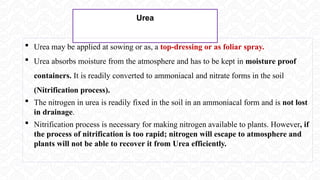
 Urea may be applied at sowing or as, a top-dressing or as foliar spray.
 Urea absorbs moisture from the atmosphere and has to be kept in moisture proof
containers. It is readily converted to ammoniacal and nitrate forms in the soil
(Nitrification process).
 The nitrogen in urea is readily fixed in the soil in an ammoniacal form and is not lost
in drainage.
 Nitrification process is necessary for making nitrogen available to plants. However, if
the process of nitrification is too rapid; nitrogen will escape to atmosphere and
plants will not be able to recover it from Urea efficiently.
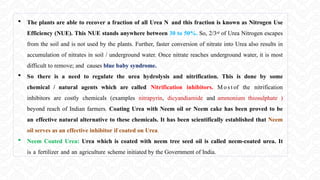
 The plants are able to recover a fraction of all Urea N and this fraction is known as Nitrogen Use
Efficiency (NUE). This NUE stands anywhere between 30 to 50%. So, 2/3rd of Urea Nitrogen escapes
from the soil and is not used by the plants. Further, faster conversion of nitrate into Urea also results in
accumulation of nitrates in soil / underground water. Once nitrate reaches underground water, it is most
difficult to remove; and causes blue baby syndrome.
 So there is a need to regulate the urea hydrolysis and nitrification. This is done by some
chemical / natural agents which are called Nitrification inhibitors. Mo st of the nitrification
inhibitors are costly chemicals (examples nitrapyrin, dicyandiamide and ammonium thiosulphate )
beyond reach of Indian farmers. Coating Urea with Neem oil or Neem cake has been proved to be
an effective natural alternative to these chemicals. It has been scientifically established that Neem
oil serves as an effective inhibitor if coated on Urea.
 Neem Coated Urea: Urea which is coated with neem tree seed oil is called neem-coated urea. It
is a fertilizer and an agriculture scheme initiated by the Government of India.
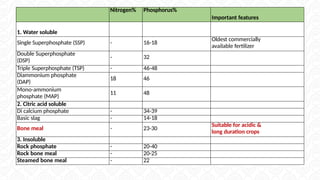
Nitrogen% Phosphorus%
Important features
1. Water soluble
Single Superphosphate (SSP) - 16-18
Oldest commercially
available fertilizer
Double Superphosphate
(DSP)
- 32
Triple Superphosphate (TSP) - 46-48
Diammonium phosphate
(DAP)
18 46
Mono-ammonium
phosphate (MAP)
11 48
2. Citric acid soluble
Di calcium phosphate - 34-39
Basic slag - 14-18
Bone meal - 23-30
Suitable for acidic &
long duration crops
3. Insoluble
Rock phosphate - 20-40
Rock bone meal - 20-25
Steamed bone meal - 22
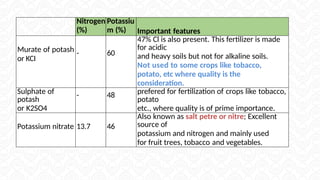
Nitrogen
(%)
Potassiu
m (%) Important features
Murate of potash
or KCI
- 60
47% Cl is also present. This fertilizer is made
for acidic
and heavy soils but not for alkaline soils.
Not used to some crops like tobacco,
potato, etc where quality is the
consideration.
Sulphate of
potash
or K2SO4
- 48 prefered for fertilization of crops like tobacco,
potato
etc., where quality is of prime importance.
Potassium nitrate 13.7 46
Also known as salt petre or nitre; Excellent
source of
potassium and nitrogen and mainly used
for fruit trees, tobacco and vegetables.
•
•
•
•
•
•
•
•
•
•
•
•
•
•
•
•
•
•
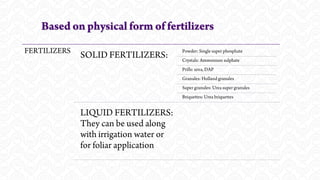
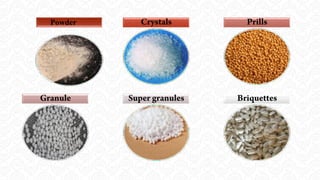
Powder
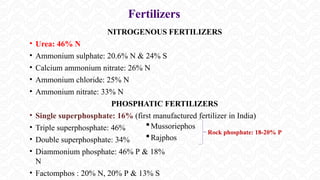
Fertilizers
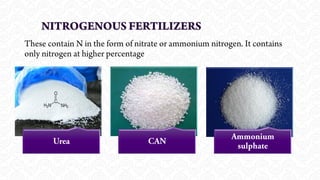
NITROGENOUS FERTILIZERS
• Triple superphosphate: 46%
• Double superphosphate: 34%
• Diammonium phosphate: 46% P & 18%
N
• Factomphos : 20% N, 20% P & 13% S
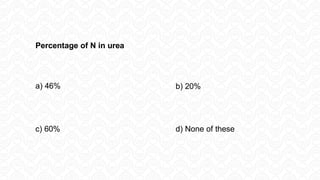
• Urea: 46% N
• Ammonium sulphate: 20.6% N & 24% S
• Calcium ammonium nitrate: 26% N
• Ammonium chloride: 25% N
• Ammonium nitrate: 33% N
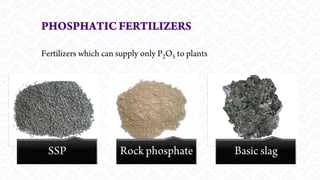
PHOSPHATIC FERTILIZERS
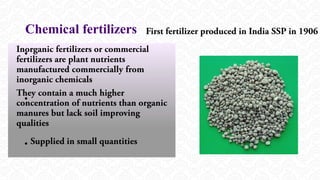
• Single superphosphate: 16% (first manufactured fertilizer in India)
Mussoriephos
Rajphos
Rock phosphate: 18-20% P
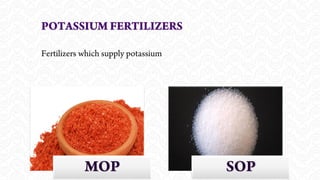
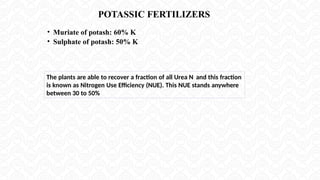
POTASSIC FERTILIZERS
• Muriate of potash: 60% K
• Sulphate of potash: 50% K
The plants are able to recover a fraction of all Urea N and this fraction
is known as Nitrogen Use Efficiency (NUE). This NUE stands anywhere
between 30 to 50%
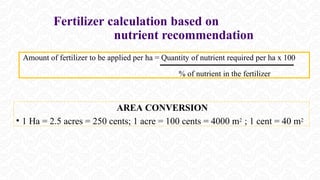
Fertilizer calculation based on
nutrient recommendation
Amount of fertilizer to be applied per ha = Quantity of nutrient required per ha x 100
% of nutrient in the fertilizer
AREA CONVERSION
• 1 Ha = 2.5 acres = 250 cents; 1 acre = 100 cents = 4000 m2 ; 1 cent = 40 m2
Percentage of p in bone meal
a) 16 b) 21
c) 25 d) 40
Percentage of p in bone meal
a) 16 b)
21
c) 25 d) 40
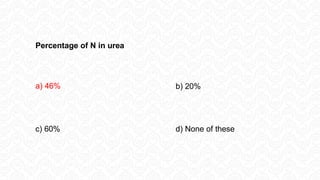
Percentage of N in urea
a) 46% b) 20%
c) 60% d) None of these
Percentage of N in urea
a) 46% b) 20%
c) 60% d) None of these
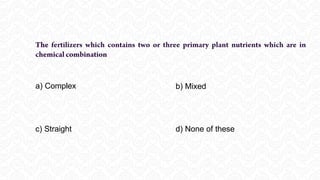
a) Complex b) Mixed
c) Straight d) None of these
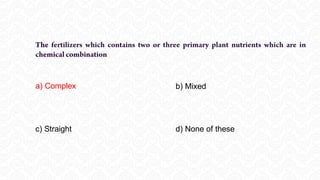
a) Complex b) Mixed
c) Straight d) None of these
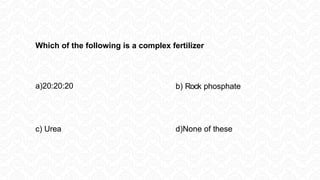
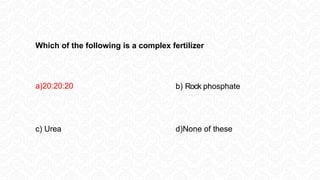
Which of the following is a complex fertilizer
a)20:20:20 b) Rock phosphate
c) Urea d)None of these
Which of the following is a complex fertilizer
a)20:20:20 b) Rock phosphate
c) Urea d)None of these
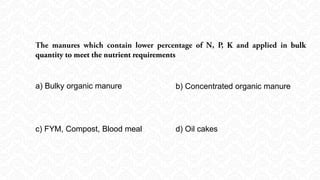
a) Bulky organic manure b) Concentrated organic manure
c) FYM, Compost, Blood meal d) Oil cakes
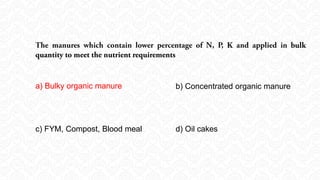
a) Bulky organic manure b) Concentrated organic manure
c) FYM, Compost, Blood meal d) Oil cakes
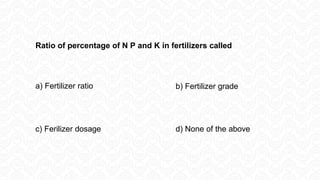
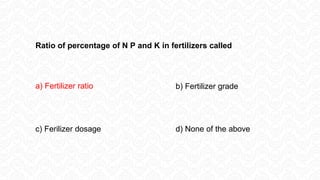
Ratio of percentage of N P and K in fertilizers called
a) Fertilizer ratio b) Fertilizer grade
c) Ferilizer dosage d) None of the above
Ratio of percentage of N P and K in fertilizers called
a) Fertilizer ratio b) Fertilizer grade
c) Ferilizer dosage d) None of the above
a) Fertilizer ratio b) Fertilizer grade
c) Ferilizer dosage d) None of the above
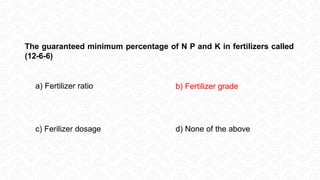
The guaranteed minimum percentage of N P and K in fertilizers called
(12-6-6)
a) Fertilizer ratio b) Fertilizer grade
c) Ferilizer dosage d) None of the above
The guaranteed minimum percentage of N P and K in fertilizers called
(12-6-6)
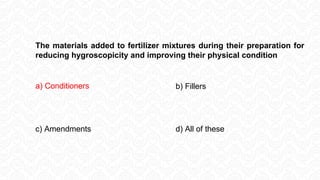
The materials added to fertilizer mixtures during their preparation for
reducing hygroscopicity and improving their physical condition
a) Conditioners b) Fillers
c) Amendments d) All of these
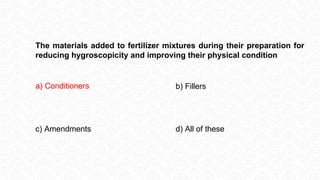
The materials added to fertilizer mixtures during their preparation for
reducing hygroscopicity and improving their physical condition
a) Conditioners b) Fillers
c) Amendments d) All of these
The materials added to fertilizer mixtures during their preparation for
reducing hygroscopicity and improving their physical condition
a) Conditioners b) Fillers
c) Amendments d) All of these
a) Conditioners b) Fillers
c) Amendments d) All of these
The materials added to fertilizer mixtures to makeup their weight
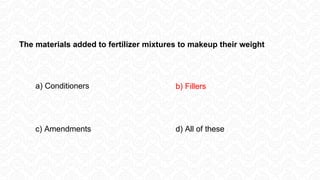
a) Conditioners b) Fillers
c) Amendments d) All of these
The materials added to fertilizer mixtures to makeup their weight
•
•
•
•
•
•
•
•
•
•
•
•
•
•
•
•
•
•
•
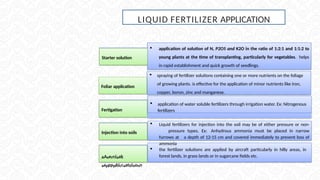
 application of solution of N, P2O5 and K2O in the ratio of 1:2:1 and 1:1:2 to
young plants at the time of transplanting, particularly for vegetables. helps
in rapid establishment and quick growth of seedlings.
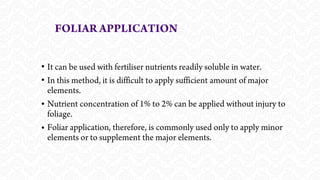
 spraying of fertilizer solutions containing one or more nutrients on the foliage
of growing plants. is effective for the application of minor nutrients like iron,
copper, boron, zinc and manganese.
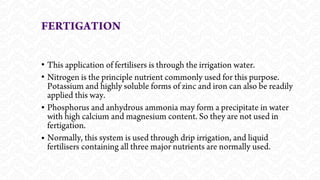
 application of water soluble fertilizers through irrigation water. Ex: Nitrogenous
fertilizers
 the fertilizer solutions are applied by aircraft particularly in hilly areas, in
forest lands, in grass lands or in sugarcane fields etc.
Starter solution
Foliar application
Fertigation
AAeerriiaall
aapppplliiccaattiioonn
 Liquid fertilizers for injection into the soil may be of either pressure or non-
pressure types. Ex: Anhydrous ammonia must be placed in narrow
furrows at a depth of 12-15 cm and covered immediately to prevent loss of
ammonia
Injection into soils
LIQUID FERTILIZER APPLICATION
•
•
•
•
•
•
•
•
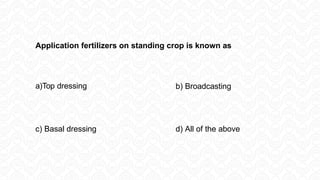
Application fertilizers on standing crop is known as
a)Top dressing b) Broadcasting
c) Basal dressing d) All of the above
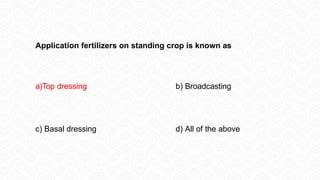
Application fertilizers on standing crop is known as
a)Top dressing b) Broadcasting
c) Basal dressing d) All of the above
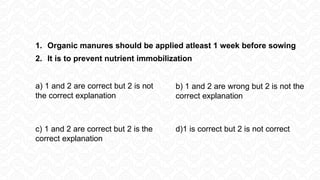
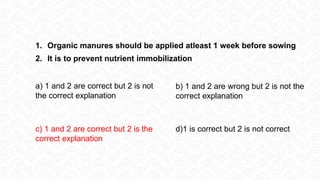
1. Organic manures should be applied atleast 1 week before sowing
2. It is to prevent nutrient immobilization
a) 1 and 2 are correct but 2 is not
the correct explanation
b) 1 and 2 are wrong but 2 is not the
correct explanation
c) 1 and 2 are correct but 2 is the
correct explanation
d)1 is correct but 2 is not correct
1. Organic manures should be applied atleast 1 week before sowing
2. It is to prevent nutrient immobilization
a) 1 and 2 are correct but 2 is not
the correct explanation
b) 1 and 2 are wrong but 2 is not the
correct explanation
c) 1 and 2 are correct but 2 is the
correct explanation
d)1 is correct but 2 is not correct
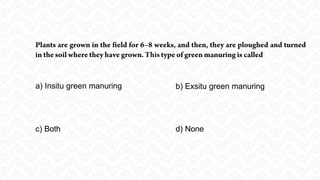
a) Insitu green manuring b) Exsitu green manuring
c) Both d) None
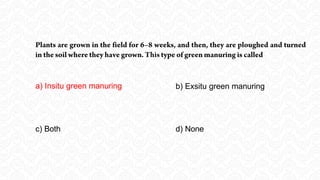
a) Insitu green manuring b) Exsitu green manuring
c) Both d) None
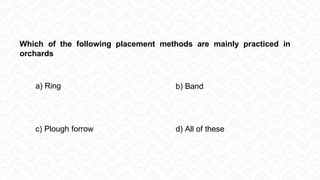
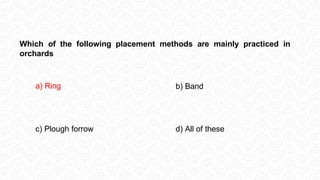
Which of the following placement methods are mainly practiced in
orchards
a) Ring b) Band
c) Plough forrow d) All of these
Which of the following placement methods are mainly practiced in
orchards
a) Ring b) Band
c) Plough forrow d) All of these
Process of application fertilizers through irrigation water
a) Fertigation b) Foliar application
c)Root dip d) Placement
Process of application fertilizers through irrigation water
a) Fertigation b) Foliar application
c)Root dip d) Placement
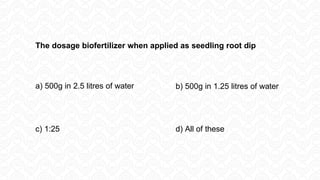
The dosage biofertilizer when applied as seedling root dip
a) 500g in 2.5 litres of water b) 500g in 1.25 litres of water
c) 1:25 d) All of these
The dosage biofertilizer when applied as seedling root dip
a) 500g in 2.5 litres of water b) 500g in 1.25 litres of water
c) 1:25 d) All of these
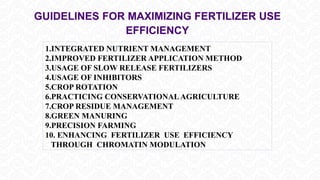
GUIDELINES FOR MAXIMIZING FERTILIZER USE
EFFICIENCY
1.INTEGRATED NUTRIENT MANAGEMENT
2.IMPROVED FERTILIZER APPLICATION METHOD
3.USAGE OF SLOW RELEASE FERTILIZERS
4.USAGE OF INHIBITORS
5.CROP ROTATION
6.PRACTICING CONSERVATIONALAGRICULTURE
7.CROP RESIDUE MANAGEMENT
8.GREEN MANURING
9.PRECISION FARMING
10. ENHANCING FERTILIZER USE EFFICIENCY
THROUGH CHROMATIN MODULATION
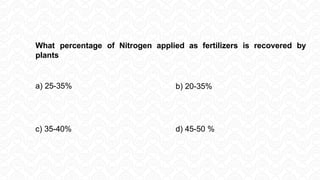
What percentage of Nitrogen applied as fertilizers is recovered by
plants
a) 25-35% b) 20-35%
c) 35-40% d) 45-50 %
What percentage of Nitrogen applied as fertilizers is recovered by
plants
a) 25-35% b) 20-35%
c) 35-40% d) 45-50 %
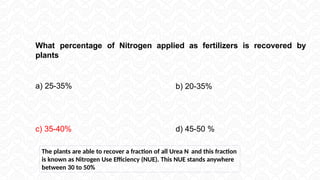
The plants are able to recover a fraction of all Urea N and this fraction
is known as Nitrogen Use Efficiency (NUE). This NUE stands anywhere
between 30 to 50%
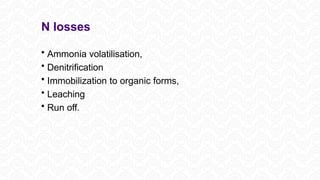
N losses
• Ammonia volatilisation,
• Denitrification
• Immobilization to organic forms,
• Leaching
• Run off.
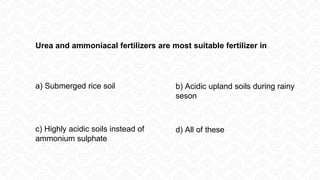
Urea and ammoniacal fertilizers are most suitable fertilizer in
a) Submerged rice soil b) Acidic upland soils during rainy
seson
d) All of these
c) Highly acidic soils instead of
ammonium sulphate
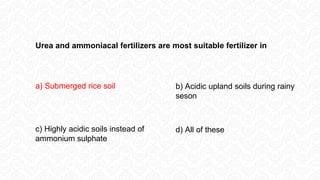
Urea and ammoniacal fertilizers are most suitable fertilizer in
a) Submerged rice soil b) Acidic upland soils during rainy
seson
d) All of these
c) Highly acidic soils instead of
ammonium sulphate
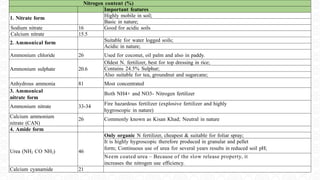
Nitrogen content (%)
Important features
1. Nitrate form Highly mobile in soil;
Basic in nature;
Sodium nitrate 16 Good for acidic soils
Calcium nitrate 15.5
2. Ammonical form Suitable for water logged soils;
Acidic in nature;
Ammonium chloride 26 Used for coconut, oil palm and also in paddy.
Ammonium sulphate 20.6
Oldest N. fertilizer, best for top dressing in rice;
Contains 24.5% Sulphur;
Also suitable for tea, groundnut and sugarcane;
Anhydrous ammonia 81 Most concentrated
3. Ammonical
nitrate form
Both NH4+ and NO3- Nitrogen fertilizer
Ammonium nitrate 33-34
Fire hazardous fertilizer (explosive fertilizer and highly
hygroscopic in nature)
Calcium ammonium
nitrate (CAN)
26 Commonly known as Kisan Khad; Neutral in nature
4. Amide form
Urea (NH2 CO NH2) 46
Only organic N fertilizer, cheapest & suitable for foliar spray;
It is highly hygroscopic therefore produced in granular and pellet
form; Continuous use of urea for several years results in reduced soil pH;
Neem coated urea – Because of the slow release property, it
increases the nitrogen use efficiency.
Calcium cyanamide 21
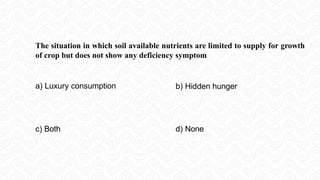
The situation in which soil available nutrients are limited to supply for growth
of crop but does not show any deficiency symptom
a) Luxury consumption b) Hidden hunger
c) Both d) None
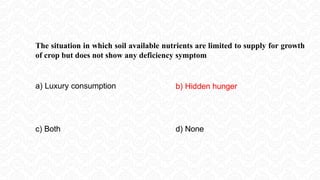
The situation in which soil available nutrients are limited to supply for growth
of crop but does not show any deficiency symptom
a) Luxury consumption b) Hidden hunger
c) Both d) None
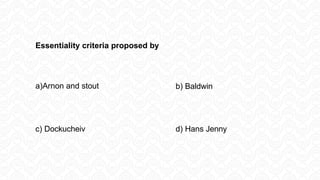
Essentiality criteria proposed by
a)Arnon and stout b) Baldwin
c) Dockucheiv d) Hans Jenny
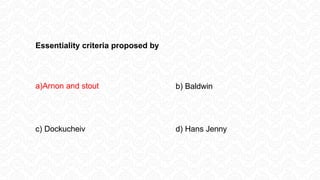
Essentiality criteria proposed by
a)Arnon and stout b) Baldwin
c) Dockucheiv d) Hans Jenny
MANURES AND FERTILISERS, biofertilisers application

MANURES AND FERTILISERS, biofertilisers application

  • 1.
    SOIL FERTILITY AND PRODUCTIVITY,FUE Soil fertility vs soil productivity –organic manures – bio-fertilizers – green manures - forms of fertilizers-time and methods of application. Calculation of fertilizers for important crops – methods to improve FUE .
  • 2.
     Ability ofthe soil to supply essential plant nutrients during growth period of the plants, without toxic concentration of any nutrients”. i.e “the capacity of soil to supply nutrient in available to crop. Ability of soil to produce a particular crop or sequence of crops under a specified management system” i.e the crop producing capacity of soil All the productive soils are fertile, but all the fertile soils may not be productive. The crop log system devised by Dr. H. F. Clements in Hawaii.  The system, which is based on the sampling of leaf blades and sheaths, aims at providing a means of detecting the lack of water or nutrients during various stages of growth so that these may be corrected with the minimum of delay. SOIL FERTILITY SOIL PRODUCTIVITY
  • 3.
    Soil Productivity SoilFertility All productive soils are certainly fertile All fertile soils are not productive It is a broader term used to indicate crop yields It is considered as an index of available nutrient to plants It is the interaction of all the factors One of the factors for crop production; the others are water supply etc Can be assessed in the field under particular climate conditions Can be analysed in lab Resultant of various factors influencing soil management It is the potential status of the soil to produce crops Depends upon location, fertility, physical conditions etc Depends upon physical chemical and biological factors of soil It is the function of soil fertility, management and climate: Soil productivity = f (soil fertility + management + climate) It is the function of available nutrients of soil fertility = f (Nutrient status of soil) It is not an inherent property of soil It is an inherent property of soil Soil productivity differs according to the variations in climate and location The fertility of a certain soil is same in all climates
  • 4.
    MANURES AND FERTILISERS The nutrient supplying sources are manures and fertilizers.  N, P and K are the 3 major elements required for the crop growth.  Help in increasing the crop yield and to maintain the soil fertility.  Manures - the plant and animal wastes - used as sources of plant nutrients.
  • 5.
    Origin/ Source Nature (Organic/ Inorganic) Type (Natiral/ Artificial) Concentr ation of nutrients Mater ial Availabi lity of nutrient s Supply which nutrients Soil health Plant growth Manures Plant or animal origin Organic in nature Natural product Less concentra ted Sup ply orga nic matt er Slowl y availa ble Supplyall the primary nutrients including micronutrient Improv es physical conditio n of soil No bad effect when applied in large quantities Fertilizer Chemical synthesize d or manufact ured Inorganic in nature Artificial product More concentra ted Suppl y inorga nic matte r May or may not be readil y availa ble Supply specific type of nutrients one, two or three. Micro nutrients may or may not be present Do not improve the physical conditio n of soil Adverse effect on plant. Whenever there is deficiency or excessive application.
  • 8.
     Well decomposedfarmyard manure contains 0.5 per cent N, 0.2 per cent P2O5and .0.5 per cent K2O.  FYM - Decomposed mixture of dung and urine of farm animals along with litter and left-over material from roughages or fodder fed to the cattle.  The droppings of sheep and goats manure contains 3% N, 1% P2O5 and 2% K2O.  Poultry manure contains higher nitrogen and phosphorus compared to other bulky organic manures. The average nutrient content is 3.03%N; 2.63% P2O5 and 1.4% K2O.  Night soil (human excreta collected from pit latrines, Septic tanks at night) contains 5.5% N; 4% P2O5 and 12% K2O BULKY ORGANIC MANURES
  • 9.
     Composting process- recycles various organic materials - waste products - produces a soil conditioner called compost - rich in nutrients.  The greatest potential - biomass resource - field residues of sorghum, maize, soybean, cotton, sugarcane etc.  Carbon and nitrogen ratio decides the initiation of composting process. If C:N ratio is wide (100:1) composting will not take place. Narrow C:N ratio of 30:1 is ideal for composting. To get a narrow C:N ratio, carbon and nitrogen rich material should be mixed.  Green coloured waste materials like glyricidia leaves, parthenium, freshly harvested weeds; sesbania leaves are rich in nitrogen, whereas brown coloured waste material like straw, coir dust, dried leaves and dried grasses are rich in carbon.  Minimum 4 feet height should be maintained for composting - Alternate layers of carbon and nitrogen rich material with intermittent layers of animal dung are essential. After heap formation the material should be thoroughly moistened. BULKY OM - COMPOSTING
  • 10.
    For one toncrop residues, 40 kg fresh cow dung is required. This 40 kg fresh cow dung is mixed with 10 L, of water and it should be thoroughly poured over the waste material. Cow dung slurry acts as nitrogen source as well as source of microbial inoculum.  The compost heap should be turned upside down, once in fifteen days - to allow the fresh air to get inside.  Throughout the composting period 60% moisture should be maintained.  Physical factors to be observed for compost maturity - Volume reduction, black colour, earthy odour, reduction in particle size.  After curing for one day, the composted material is sieved through 4 mm sieve to get uniform composted material. The residues collected after composting has to be again composted to finish the composting process.
  • 12.
     The beneficialmicroorganisms like Azotobacter or Azospirillum, Pseudomonas, Phosphobacteria (0.2%) and rock phosphate (2%) have to be inoculated for one ton of compost. 40 per cent moisture should be maintained for the maximum growth of inoculated microorganism. This incubation should be allowed for 20 days for the organism to reach the maximum population. Now the compost is called as enriched compost.  The advantage of enriched compost over normal compost is the quality manure with higher nutrient status with high number of beneficial microorganisms and plant growth promoting substances.  Dosage :- 5T/ha enriched biocompost is recommended. It can be used as basal application in the field before taking up planting work (during manuring stage of preparation of field for sowing).
  • 14.
    Vermicompost  Vermicomposting isthe process of turning organic debris into worm castings.  The castings contain high amounts of nitrogen, potassium, phosphorus, calcium, and magnesium.  Castings contain: 5 times the available nitrogen, 7 times the available potash, and 1 ½ times more calcium than found in good topsoil.  Worm castings can hold close to nine times their weight in water.  “Vermiconversion,” or using earthworms to convert waste into soil additives, is an effective way to deal with farm waste also. One kilogram of worms numbering about 600 to 1000 can convert 25 to 45 kg of wet waste per week
  • 15.
     A recommendedrate of vermicompost application is 15-20 percent.  For vermicompost production, the surface dwelling earthworm alone should be used. The earthworm, which lives below the soil, is not suitable for vermicompost production.  The African earthworm (Eudrillus engenial), Red worms (Eisenia sp.) and composting worm (Peronyx sp.) -used for vermicompost production.  All the three worms can be mixed together for vermicompost production.  The African worm (Eudrillus eugeneae) – suitable for Kerala conditions, it produces higher production of vermicompost in short period of time and more young ones in the composting period.
  • 17.
    • Compost wormsare not subject to diseases caused by micro-organisms, but they are subject to predation by certain animals and insects (red mites) – spray Raksha, KAU botanical @ 10g/L • A particularly devastating problem in a worm bin is protein poisoning, also called “string of pearls” or sour crop, evidenced by a serious deformation of the earthworms as their intestines rupture, inevitably killing the worm itself. • Protein rich foods produce a greater quantity of acidic compounds as they break down, and if this acid is not neutralized and calcium supplied to your worms, protein poisoning is inevitable, must add enough calcium rich buffer to the bedding to neutralize the acid produced by the microorganisms that digest it. • 500-1000 nos per pit • NPK:- 1.5 :0.4:1.8 %, pH- 7-8
  • 18.
    • Vermiwash isa liquid extract produced from vermicompost in a medium where earthworms are richly populated. It comprises a massive decomposer bacteria count, mucus, vitamins, different bioavailable minerals, hormones, enzymes, different antimicrobial peptides, etc. • Vermiprotein - the excess worms can be converted into vermiprotein which can be utilised as feed for poultry, fish, etc. Vermicompost - Terminology Thumburmuzhi composting – ferrocement tanks is used
  • 19.
  • 20.
    KAU Smart biobin-two layers of rings outer layer stainless stell inner layer GI Mesh. In b/w rings dry leaves for rodent control & excess moisture absorbtion • Kitchen wastes food wastes etc into the inner chamber subjected for composting
  • 21.
  • 22.
  • 23.
    APPLICATION OF GREENMANURE CROPS • In situ green manuring • Ex situ green manuring
  • 24.
  • 25.
  • 26.
  • 27.
    Concentrated organic manuresnutrients  Bird Guano: 7-8% N, 11-14% P2O5 & 2-3% K2O.  Fish Guano: 7% N & 8% P2O5.  Fish Manure: 4-10% N, 3-9% P2O5 & 0.3-1.5% K2O.  Raw Bonemeal: 3-4% N, 20-25% P2O5.  Steamed Bonemeal: 1-2% N, 25-30% P2O5.  Blood meal: 13-20% N, rich in iron.  Meat meal/guano/tankage: 8-9% N and 7 % P2O5.  Calcined bone: 37% P2O5. Animal origin
  • 28.
    ORGANIC MANURES IMPORTANT •Bone meal: 21% P • Fishmeal: 4.1% N & 3.9% P • Poultry manure: 1.2 – 1.5% N, 1.4 – 1.8% P & 0.8 – 0.9% K • Sheep manure: 0.8 – 0.6% N, 0.3 -0.4% P & 0.3 -0.4% K • Groundnut cake: 7.0% N • Castor cake: 4.3% N • Neem cake: 5% N • Gingelly cake: 6.2% N • Coconut cake: 3% N • Compost: 0.5% N, 0.4% P & 0.8% K • FYM: 1% N, 0.5% P & 1% K
  • 29.
  • 30.
    Bio fertilizers –Nitrogen fixing N2 fixing Biofertilizers Free-living Azotobacter, Beijerinkia, Clostridium,Klebsiela, Anabaena, Nostoc Symbiotic Rhizobium, Frankia, Anabaena azollae Associative Symbiotic Azospirillum N2 to NH3
  • 31.
     Rhizobium inoculantwas first made in USA and commercialized by private enterprise in 1930s and the strange situation at that time has been chronicled by Fred (1932).  Azotobacter chroococcum - dominant inhabitant in arable soils capable of fixing N2 (2-15 mg N2 fixed /g of carbon source) in culture media.  Azospirillum lipoferum, A. brasilense, A.amazonense, A.halopraeferens and A.irakense are primary inhabitants of soil, the rhizosphere and intercellular spaces of root cortex of graminaceous plants.  They perform the associative symbiotic relation with the graminaceous plants. Additional benefits - growth promoting substance production (IAA), disease resistance and drought tolerance.  Azolla is a free-floating water fern that floats in water and fixes atmospheric nitrogen in association with nitrogen fixing blue green alga Anabaena azollae. It is used as biofertilizer for wetland rice and it is known to contribute 40-60 kg N/ha per rice crop.
  • 33.
    Bio fertilizers –Phosphorus solubilizing  Pseudomonas, Bacillus, Penicillium, Aspergillus etc. secrete organic acids and lower the pH in their vicinity to bring about dissolution of bound phosphates in soil. Increased yields of wheat and potato were demonstrated due to inoculation of peat based cultures of Bacillus polymyxa and Pseudomonas striata. P Solubilizing Biofertilizers Bacteria Bacillus megaterium var. phosphaticum, Bacillus subtilis Bacillus circulans, Pseudomonas striata Fungi Penicillium sp, Aspergillus awamori
  • 34.
    Bio fertilizers –Phosphorus mobilizing  The transfer of nutrients mainly phosphorus and also zinc and sulphur from the soil to the cells of the root cortex is mediated by intracellular obligate fungal endosymbionts of the genera Glomus, Gigaspora, Acaulospora, Sclerocysts and Endogone which possess vesicles for storage of nutrients and arbuscles for funneling these nutrients into the root system.  The commonest genus appears to be Glomus with several species distributed in soil. P Mobilizing Biofertilizers Arbuscular mycorrhiza Glomus sp.,Gigaspora sp.,Acaulospora sp. , Scutellospora sp. & Sclerocystis sp. Ectomycorrhiza Laccaria sp., Pisolithus sp. , Boletus sp. , Amanita sp. Ericoid mycorrhizae Pezizella ericae Orchid mycorrhiza Rhizoctonia solani
  • 35.
    Bio fertilizers –Micro nutrients  The studies conducted with a Bacillus sp. isolated from the soil of granite crusher yard showed that the bacterium is capable of dissolving several silicate minerals under in vitro condition.  Rice responded well to application of organic sliceous residue like rice straw, rice husk and black ash @ 5 t/ha. Combining SSB with these residues further resulted in increased plant growth and grain yield. This enhancement is due to increased dissolution of silica and nutrients from the soil. Biofertilizers for Micro nutrients Silicate and Zinc solubilizers Bacillus sp.
  • 36.
    Bio fertilizers -PGPR  The group of bacteria that colonize roots or rhizosphere soil and beneficial to crops are referred to as plant growth promoting rhizobacteria (PGPR).  The PGPR inoculants currently commercialized that seem to promote growth through at least one mechanism; suppression of plant disease (termed Bioprotectants), improved nutrient acquisition (termed Biofertilizers), or phytohormone production (termed Biostimulants) Plant Growth Promoting Rhizobacteria Pseudomonas Pseudomonas fluorescens
  • 37.
  • 38.
  • 39.
  • 40.
  • 41.
    Seed Treatment  Mostcommon method adopted for all types of inoculants - effective and economic.  For small quantity of seeds (up to 5 kg) the coating can done in a plastic bag – After mixing, seed is dried under the shade for 20-30 minutes.  For large amount of seeds coating can be done in a bucket/Seed dressing drum and inoculant can be mixed directly manually/mechanically. Seed treatment with Rhizobium, Azotobacter, Azospirillum, along with PSM can be done.  The seed treatment can be done with any of two or more bacteria. There is no side (antagonistic) effect - seeds must be coated first with Rhizobium,Azotobacter or Azospirillum  When each seed get a layer of above bacteria then PSM inoculant has to be coated as outer layer. This method will provide maximum number of each bacteria required for better results.  Treatments of seed with any two bacteria will not provide maximum number of bacteria on individual seed. Liquid Bio-fertilizer - Application methods
  • 43.
    Root dipping  Applicationof Azospirillum/ /PSM on paddy transplating/ vegetable crops  The required quantity of Azospirillum/ /PSM - mixed with 5-10 litres of water at one corner of the field and the roots of seedlings has to be dipped for a minimum of half-an-hour before transplantation. Soil application  Mix PSM with 400 to 600 kgs of Cow dung FYM along with ½ bag of rock phosphate if available. Dosage: Use 200ml of PSM per acre.  The mixture of PSM, cow dung and rock phosphate have to be kept under any tree or under shade for over night and maintain 50% moisture - Use the mixture as soil application in rows or during leveling of soil.
  • 44.
    Crop Bio-fertilizer Recommended Method of applicationQuantity Field crops Rhizobium Seed treatment 200ml/acre Pulses Chickpea, pea, Groundnut, soybean, beans, Lentil, lucern, Berseem, Green gram, Black gram, Cowpea and pigeon pea Cereals Azotobacter/Azo spirillum Seed treatment 200ml/acre Wheat, oat, barley Rice Azospirillum Seed treatment 200ml/acre Oil seeds Azotobacter Seed treatment 200ml/acre Mustard, seasum, Linseeds, Sunflower, castor Millets Azotobacter Seed treatment 200ml/acre Pearl millets, Finger millets, kodo millet Maize and Sorghum Azospirillum Seed treatment 200ml/acre Forage crops and Grasses Azotobacter Seed treatment 200ml/acre Bermuda grass, Sudan grass, Napier Grass , ParaGrass, StarGrass etc. Other Misc. Plantation Crops Azotobacter Seedling treatment 500ml/acre Tobacco Tea, Coffee Azotobacter Soil treatment 400ml/acre Rubber, Coconuts Azotobacter Soil treatment 2-3 ml/plant Agro-ForestRY/Fruit Plants Azotobacter Soil treatment 2-3 ml/plant at nursery All fruit/agro-forestry (herb,shrubs, annuals and perennial) plants for fuel wood fodder, fruits,gum,spice,leaves,flowers,nuts and seeds puppose Leguminous plants/ trees Rhizobium Soil treatment 1-2 ml/plant
  • 45.
    Fertilizer grade Fertilizer ratio Fertiliser grade refers to the guaranteed minimum percentage of nitrogen (N), phosphorus (P) and potash (K) contained in fertiliser material. The numbers representing the grade are separated by hyphens and are always stated in the sequence of N, P, and K.  ratio of the percentage of N, P2O5 and K2O in the fertilizer mixture e.g., the fertilizer grade 12-6-6 has a fertilizer ratio of 2:1:1.  Low grade organic materials like peat soil, paddy husk, groundnut hulls etc., - added to fertilizer mixtures during their preparation to reduce hygroscopicity and to improve their physical condition. Ex: Peat soil, Paddy husk  A weight make material like sand, soil, coal powder etc, added to the fertilizer ingredients to produce a mixture of the desired grade. Conditioners Fillers  materials like dolomite, lime stone etc, added in fertilizer mixtures to counteract the acidity of nitrogenous fertilizers. Neutralizers of residual acidity
  • 46.
  • 47.
  • 51.
    Nitrogen content (%) Importantfeatures 1. Nitrate form Highly mobile in soil; Basic in nature; Sodium nitrate 16 Good for acidic soils Calcium nitrate 15.5 2. Ammonical form Suitable for water logged soils; Acidic in nature Ammonium chloride 26 Used for coconut, oil palm and also in paddy. Ammonium sulphate 20.6 Oldest N. fertilizer, best for top dressing in rice; Contains 24.5% Sulphur; Also suitable for tea, groundnut and sugarcane; Anhydrous ammonia 81 Most concentrated 3. Ammonical nitrate form Both NH4+ and NO3- Nitrogen fertilizer Ammonium nitrate 33-34 Fire hazardous fertilizer (explosive fertilizer and highly hygroscopic in nature) Calcium ammonium nitrate (CAN) 26 Commonly known as Kisan Khad; Neutral in nature 4. Amide form Urea (NH2 CO NH2) 46 Only organic N fertilizer, cheapest & suitable for foliar spray; It is highly hygroscopic therefore produced in granular and pellet form; Continuous use of urea for several years results in reduced soil pH; Neem coated urea – Because of the slow release property, it increases the nitrogen use efficiency. Calcium cyanamide 21
  • 52.
    Urea  Urea maybe applied at sowing or as, a top-dressing or as foliar spray.  Urea absorbs moisture from the atmosphere and has to be kept in moisture proof containers. It is readily converted to ammoniacal and nitrate forms in the soil (Nitrification process).  The nitrogen in urea is readily fixed in the soil in an ammoniacal form and is not lost in drainage.  Nitrification process is necessary for making nitrogen available to plants. However, if the process of nitrification is too rapid; nitrogen will escape to atmosphere and plants will not be able to recover it from Urea efficiently.
  • 53.
     The plantsare able to recover a fraction of all Urea N and this fraction is known as Nitrogen Use Efficiency (NUE). This NUE stands anywhere between 30 to 50%. So, 2/3rd of Urea Nitrogen escapes from the soil and is not used by the plants. Further, faster conversion of nitrate into Urea also results in accumulation of nitrates in soil / underground water. Once nitrate reaches underground water, it is most difficult to remove; and causes blue baby syndrome.  So there is a need to regulate the urea hydrolysis and nitrification. This is done by some chemical / natural agents which are called Nitrification inhibitors. Mo st of the nitrification inhibitors are costly chemicals (examples nitrapyrin, dicyandiamide and ammonium thiosulphate ) beyond reach of Indian farmers. Coating Urea with Neem oil or Neem cake has been proved to be an effective natural alternative to these chemicals. It has been scientifically established that Neem oil serves as an effective inhibitor if coated on Urea.  Neem Coated Urea: Urea which is coated with neem tree seed oil is called neem-coated urea. It is a fertilizer and an agriculture scheme initiated by the Government of India.
  • 55.
    Nitrogen% Phosphorus% Important features 1.Water soluble Single Superphosphate (SSP) - 16-18 Oldest commercially available fertilizer Double Superphosphate (DSP) - 32 Triple Superphosphate (TSP) - 46-48 Diammonium phosphate (DAP) 18 46 Mono-ammonium phosphate (MAP) 11 48 2. Citric acid soluble Di calcium phosphate - 34-39 Basic slag - 14-18 Bone meal - 23-30 Suitable for acidic & long duration crops 3. Insoluble Rock phosphate - 20-40 Rock bone meal - 20-25 Steamed bone meal - 22
  • 57.
    Nitrogen (%) Potassiu m (%) Importantfeatures Murate of potash or KCI - 60 47% Cl is also present. This fertilizer is made for acidic and heavy soils but not for alkaline soils. Not used to some crops like tobacco, potato, etc where quality is the consideration. Sulphate of potash or K2SO4 - 48 prefered for fertilization of crops like tobacco, potato etc., where quality is of prime importance. Potassium nitrate 13.7 46 Also known as salt petre or nitre; Excellent source of potassium and nitrogen and mainly used for fruit trees, tobacco and vegetables.
  • 58.
  • 59.
  • 60.
  • 61.
  • 63.
  • 64.
    Fertilizers NITROGENOUS FERTILIZERS • Triplesuperphosphate: 46% • Double superphosphate: 34% • Diammonium phosphate: 46% P & 18% N • Factomphos : 20% N, 20% P & 13% S • Urea: 46% N • Ammonium sulphate: 20.6% N & 24% S • Calcium ammonium nitrate: 26% N • Ammonium chloride: 25% N • Ammonium nitrate: 33% N PHOSPHATIC FERTILIZERS • Single superphosphate: 16% (first manufactured fertilizer in India) Mussoriephos Rajphos Rock phosphate: 18-20% P
  • 65.
    POTASSIC FERTILIZERS • Muriateof potash: 60% K • Sulphate of potash: 50% K The plants are able to recover a fraction of all Urea N and this fraction is known as Nitrogen Use Efficiency (NUE). This NUE stands anywhere between 30 to 50%
  • 66.
    Fertilizer calculation basedon nutrient recommendation Amount of fertilizer to be applied per ha = Quantity of nutrient required per ha x 100 % of nutrient in the fertilizer AREA CONVERSION • 1 Ha = 2.5 acres = 250 cents; 1 acre = 100 cents = 4000 m2 ; 1 cent = 40 m2
  • 67.
    Percentage of pin bone meal a) 16 b) 21 c) 25 d) 40
  • 68.
    Percentage of pin bone meal a) 16 b) 21 c) 25 d) 40
  • 69.
    Percentage of Nin urea a) 46% b) 20% c) 60% d) None of these
  • 70.
    Percentage of Nin urea a) 46% b) 20% c) 60% d) None of these
  • 71.
    a) Complex b)Mixed c) Straight d) None of these
  • 72.
    a) Complex b)Mixed c) Straight d) None of these
  • 73.
    Which of thefollowing is a complex fertilizer a)20:20:20 b) Rock phosphate c) Urea d)None of these
  • 74.
    Which of thefollowing is a complex fertilizer a)20:20:20 b) Rock phosphate c) Urea d)None of these
  • 75.
    a) Bulky organicmanure b) Concentrated organic manure c) FYM, Compost, Blood meal d) Oil cakes
  • 76.
    a) Bulky organicmanure b) Concentrated organic manure c) FYM, Compost, Blood meal d) Oil cakes
  • 77.
    Ratio of percentageof N P and K in fertilizers called a) Fertilizer ratio b) Fertilizer grade c) Ferilizer dosage d) None of the above
  • 78.
    Ratio of percentageof N P and K in fertilizers called a) Fertilizer ratio b) Fertilizer grade c) Ferilizer dosage d) None of the above
  • 79.
    a) Fertilizer ratiob) Fertilizer grade c) Ferilizer dosage d) None of the above The guaranteed minimum percentage of N P and K in fertilizers called (12-6-6)
  • 80.
    a) Fertilizer ratiob) Fertilizer grade c) Ferilizer dosage d) None of the above The guaranteed minimum percentage of N P and K in fertilizers called (12-6-6)
  • 81.
    The materials addedto fertilizer mixtures during their preparation for reducing hygroscopicity and improving their physical condition a) Conditioners b) Fillers c) Amendments d) All of these
  • 82.
    The materials addedto fertilizer mixtures during their preparation for reducing hygroscopicity and improving their physical condition a) Conditioners b) Fillers c) Amendments d) All of these
  • 83.
    The materials addedto fertilizer mixtures during their preparation for reducing hygroscopicity and improving their physical condition a) Conditioners b) Fillers c) Amendments d) All of these
  • 84.
    a) Conditioners b)Fillers c) Amendments d) All of these The materials added to fertilizer mixtures to makeup their weight
  • 85.
    a) Conditioners b)Fillers c) Amendments d) All of these The materials added to fertilizer mixtures to makeup their weight
  • 87.
  • 88.
  • 91.
  • 95.
  • 96.
  • 97.
  • 98.
  • 101.
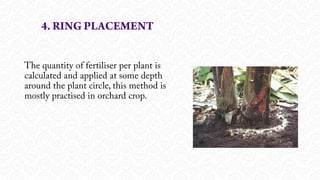
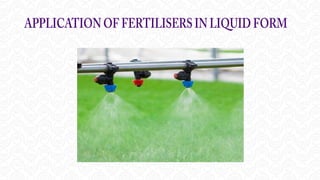
     application ofsolution of N, P2O5 and K2O in the ratio of 1:2:1 and 1:1:2 to young plants at the time of transplanting, particularly for vegetables. helps in rapid establishment and quick growth of seedlings.  spraying of fertilizer solutions containing one or more nutrients on the foliage of growing plants. is effective for the application of minor nutrients like iron, copper, boron, zinc and manganese.  application of water soluble fertilizers through irrigation water. Ex: Nitrogenous fertilizers  the fertilizer solutions are applied by aircraft particularly in hilly areas, in forest lands, in grass lands or in sugarcane fields etc. Starter solution Foliar application Fertigation AAeerriiaall aapppplliiccaattiioonn  Liquid fertilizers for injection into the soil may be of either pressure or non- pressure types. Ex: Anhydrous ammonia must be placed in narrow furrows at a depth of 12-15 cm and covered immediately to prevent loss of ammonia Injection into soils LIQUID FERTILIZER APPLICATION
  • 102.
  • 103.
  • 104.
    Application fertilizers onstanding crop is known as a)Top dressing b) Broadcasting c) Basal dressing d) All of the above
  • 105.
    Application fertilizers onstanding crop is known as a)Top dressing b) Broadcasting c) Basal dressing d) All of the above
  • 106.
    1. Organic manuresshould be applied atleast 1 week before sowing 2. It is to prevent nutrient immobilization a) 1 and 2 are correct but 2 is not the correct explanation b) 1 and 2 are wrong but 2 is not the correct explanation c) 1 and 2 are correct but 2 is the correct explanation d)1 is correct but 2 is not correct
  • 107.
    1. Organic manuresshould be applied atleast 1 week before sowing 2. It is to prevent nutrient immobilization a) 1 and 2 are correct but 2 is not the correct explanation b) 1 and 2 are wrong but 2 is not the correct explanation c) 1 and 2 are correct but 2 is the correct explanation d)1 is correct but 2 is not correct
  • 108.
    a) Insitu greenmanuring b) Exsitu green manuring c) Both d) None
  • 109.
    a) Insitu greenmanuring b) Exsitu green manuring c) Both d) None
  • 110.
    Which of thefollowing placement methods are mainly practiced in orchards a) Ring b) Band c) Plough forrow d) All of these
  • 111.
    Which of thefollowing placement methods are mainly practiced in orchards a) Ring b) Band c) Plough forrow d) All of these
  • 112.
    Process of applicationfertilizers through irrigation water a) Fertigation b) Foliar application c)Root dip d) Placement
  • 113.
    Process of applicationfertilizers through irrigation water a) Fertigation b) Foliar application c)Root dip d) Placement
  • 114.
    The dosage biofertilizerwhen applied as seedling root dip a) 500g in 2.5 litres of water b) 500g in 1.25 litres of water c) 1:25 d) All of these
  • 115.
    The dosage biofertilizerwhen applied as seedling root dip a) 500g in 2.5 litres of water b) 500g in 1.25 litres of water c) 1:25 d) All of these
  • 116.
    GUIDELINES FOR MAXIMIZINGFERTILIZER USE EFFICIENCY 1.INTEGRATED NUTRIENT MANAGEMENT 2.IMPROVED FERTILIZER APPLICATION METHOD 3.USAGE OF SLOW RELEASE FERTILIZERS 4.USAGE OF INHIBITORS 5.CROP ROTATION 6.PRACTICING CONSERVATIONALAGRICULTURE 7.CROP RESIDUE MANAGEMENT 8.GREEN MANURING 9.PRECISION FARMING 10. ENHANCING FERTILIZER USE EFFICIENCY THROUGH CHROMATIN MODULATION
  • 117.
    What percentage ofNitrogen applied as fertilizers is recovered by plants a) 25-35% b) 20-35% c) 35-40% d) 45-50 %
  • 118.
    What percentage ofNitrogen applied as fertilizers is recovered by plants a) 25-35% b) 20-35% c) 35-40% d) 45-50 % The plants are able to recover a fraction of all Urea N and this fraction is known as Nitrogen Use Efficiency (NUE). This NUE stands anywhere between 30 to 50%
  • 119.
    N losses • Ammoniavolatilisation, • Denitrification • Immobilization to organic forms, • Leaching • Run off.
  • 120.
    Urea and ammoniacalfertilizers are most suitable fertilizer in a) Submerged rice soil b) Acidic upland soils during rainy seson d) All of these c) Highly acidic soils instead of ammonium sulphate
  • 121.
    Urea and ammoniacalfertilizers are most suitable fertilizer in a) Submerged rice soil b) Acidic upland soils during rainy seson d) All of these c) Highly acidic soils instead of ammonium sulphate
  • 122.
    Nitrogen content (%) Importantfeatures 1. Nitrate form Highly mobile in soil; Basic in nature; Sodium nitrate 16 Good for acidic soils Calcium nitrate 15.5 2. Ammonical form Suitable for water logged soils; Acidic in nature; Ammonium chloride 26 Used for coconut, oil palm and also in paddy. Ammonium sulphate 20.6 Oldest N. fertilizer, best for top dressing in rice; Contains 24.5% Sulphur; Also suitable for tea, groundnut and sugarcane; Anhydrous ammonia 81 Most concentrated 3. Ammonical nitrate form Both NH4+ and NO3- Nitrogen fertilizer Ammonium nitrate 33-34 Fire hazardous fertilizer (explosive fertilizer and highly hygroscopic in nature) Calcium ammonium nitrate (CAN) 26 Commonly known as Kisan Khad; Neutral in nature 4. Amide form Urea (NH2 CO NH2) 46 Only organic N fertilizer, cheapest & suitable for foliar spray; It is highly hygroscopic therefore produced in granular and pellet form; Continuous use of urea for several years results in reduced soil pH; Neem coated urea – Because of the slow release property, it increases the nitrogen use efficiency. Calcium cyanamide 21
  • 123.
    The situation inwhich soil available nutrients are limited to supply for growth of crop but does not show any deficiency symptom a) Luxury consumption b) Hidden hunger c) Both d) None
  • 124.
    The situation inwhich soil available nutrients are limited to supply for growth of crop but does not show any deficiency symptom a) Luxury consumption b) Hidden hunger c) Both d) None
  • 125.
    Essentiality criteria proposedby a)Arnon and stout b) Baldwin c) Dockucheiv d) Hans Jenny
  • 126.
    Essentiality criteria proposedby a)Arnon and stout b) Baldwin c) Dockucheiv d) Hans Jenny