


Putting it all together
The 5 Rules for Maintaining Soil
Health
Ellen Polishuk
SSAWG Conference
Chattanooga, January 2018
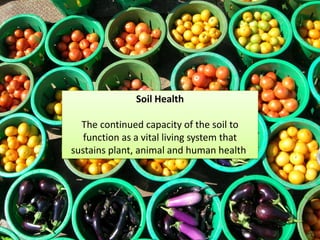
Soil Health
The continued capacity of the soil to
function as a vital living system that
sustains plant, animal and human health.
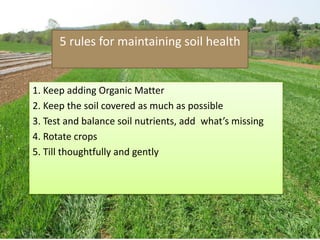
5 rules for maintaining soil health
1. Keep adding Organic Matter
2. Keep the soil covered as much as possible
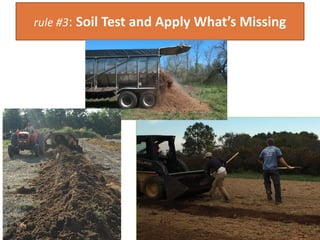
3. Test and balance soil nutrients, add what’s missing
4. Rotate crops
5. Till thoughtfully and gently
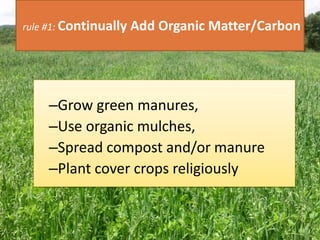
rule #1: Continually Add Organic Matter/Carbon
–Grow green manures,
–Use organic mulches,
–Spread compost and/or manure
–Plant cover crops religiously
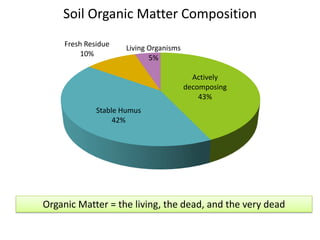
Soil Organic Matter Composition
Actively
decomposing
43%
Stable Humus
42%
Fresh Residue
10%
Living Organisms
5%
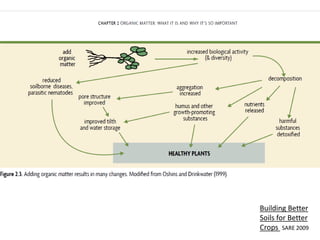
Organic Matter = the living, the dead, and the very dead
Building Better
Soils for Better
Crops SARE 2009
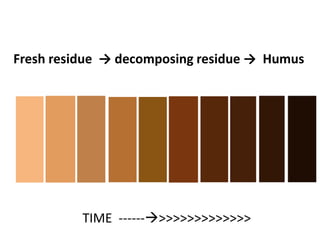
Fresh residue → decomposing residue → Humus
TIME ------>>>>>>>>>>>>>
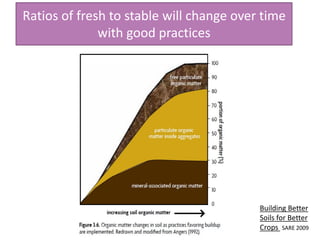
Ratios of fresh to stable will change over time
with good practices
Building Better
Soils for Better
Crops SARE 2009
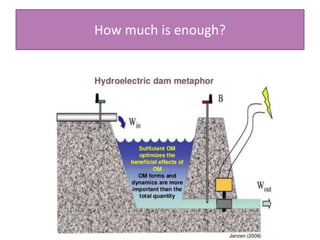
How much is enough?
Green versus Brown Carbon
Green Carbon
• Nutrient cycling
• Bacteria Food
Brown Carbon
• Humus development
• Fungal Food
Cover Crops vs Green Manures
• Goals
– Erosion prevention
– Nutrient Cycling
– Nitrogen Addition
• Timing = over winter
• My choices:
– Wheat, rye, barley
– Crimson clover, vetch
• Incorporate?
• Goals
– Soil building
– Nutrient creation (N)
• Timing = main season!
• My choices:
– Sorghum sudan, millet
– Cowpeas, soybean, sunhemp
– Buckwheat
– Oats/field peas (spring only)
• Incorporate?
Cover Crops
Green Manures/Soil
Building Crops
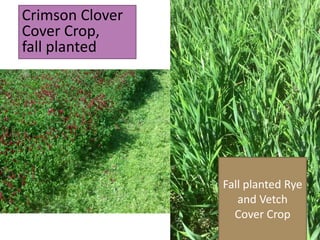
Fall planted Rye
and Vetch
Cover Crop
Crimson Clover
Cover Crop,
fall planted
Rye can be trouble
What about tillage radish?
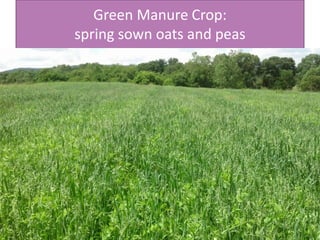
Green Manure Crop:
spring sown oats and peas
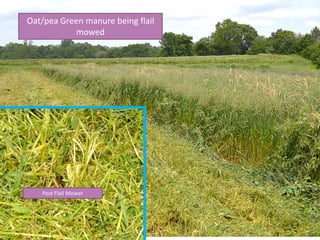
Oat/pea Green manure being flail
mowed
Post Flail Mower
Summer
Green
Manure
Sudex and
cowpeas
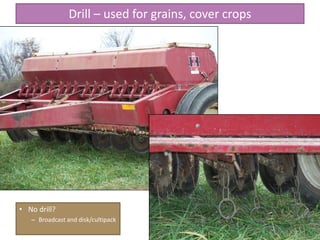
Drill – used for grains, cover crops
• No drill?
– Broadcast and disk/cultipack
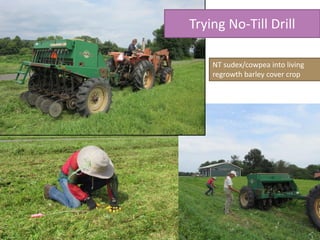
Trying No-Till Drill
NT sudex/cowpea into living
regrowth barley cover crop
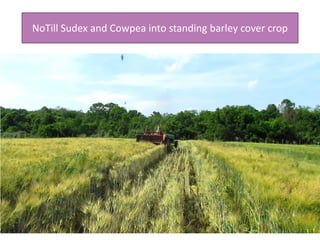
NoTill Sudex and Cowpea into standing barley cover crop
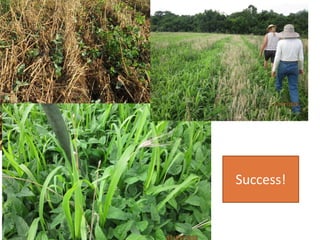
Success!
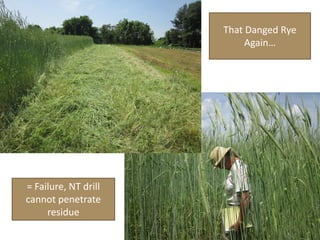
That Danged Rye
Again…
= Failure, NT drill
cannot penetrate
residue
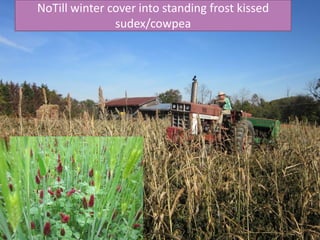
NoTill winter cover into standing frost kissed
sudex/cowpea
Lessons learned from NT trials
• NT Drill Quality/Age/Wear makes a big difference in what you
can cut through
• If the crop you NT into is so-so, lots of weeds will germ and
have time to set seed
• Use heavier than normal seeding rate, around double,
– Cross hatch field or
– double rate through seeder
What is the role of compost?
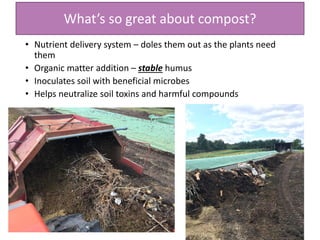
What’s so great about compost?
• Nutrient delivery system – doles them out as the plants need
them
• Organic matter addition – stable humus
• Inoculates soil with beneficial microbes
• Helps neutralize soil toxins and harmful compounds
Compost extras
• Microbial inoculants
• Putting other
amendments into the
compost will make them
biologically “charged” and
even more plant available.
• Rock powders and other
mineral amendments
– Rock phosphate
– Azomite
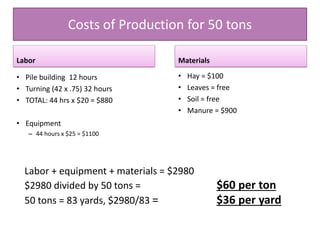
Costs of Production for 50 tons
Labor Materials
• Pile building 12 hours
• Turning (42 x .75) 32 hours
• TOTAL: 44 hrs x $20 = $880
• Equipment
– 44 hours x $25 = $1100
• Hay = $100
• Leaves = free
• Soil = free
• Manure = $900
Labor + equipment + materials = $2980
$2980 divided by 50 tons = $60 per ton
50 tons = 83 yards, $2980/83 = $36 per yard
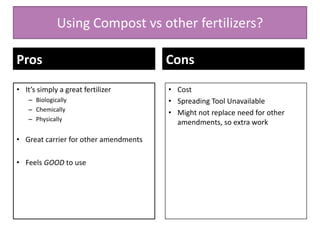
Using Compost vs other fertilizers?
Pros Cons
• It’s simply a great fertilizer
– Biologically
– Chemically
– Physically
• Great carrier for other amendments
• Feels GOOD to use
• Cost
• Spreading Tool Unavailable
• Might not replace need for other
amendments, so extra work
Not all Compost is Created Equal
It wasn’t really aerobic!
Unfinished compost can be toxic to plants
All the nutrients washed out
How to Evaluate Purchased Compost?
Compost Analysis
No Analysis?
– Can you see the parent materials?
– Is it warm to the touch?
– Smell?
– Can the maker describe the process?
rule #1: Continually Add Organic Matter/Carbon
–Grow green manures,
–Use organic mulches,
–Spread compost and/or manure
–Plant cover crops religiously
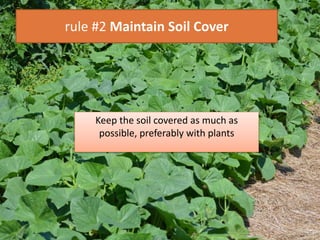
rule #2 Maintain Soil Cover
Keep the soil covered as much as
possible, preferably with plants
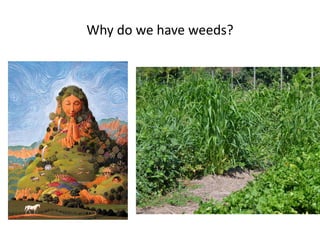
Why do we have weeds?
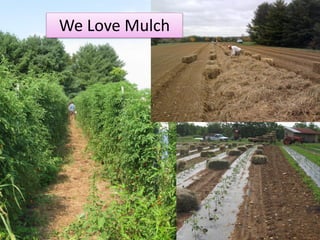
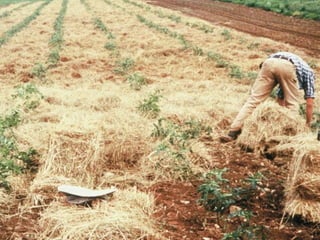
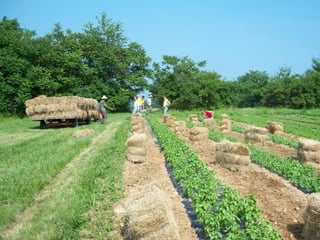
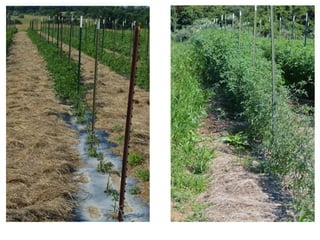
We Love Mulch
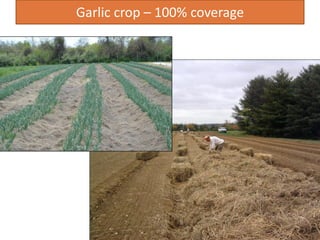
Garlic crop – 100% coverage
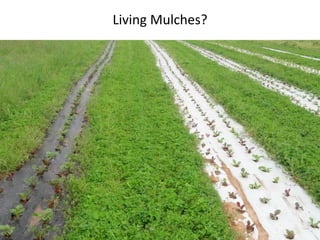
Living Mulches?
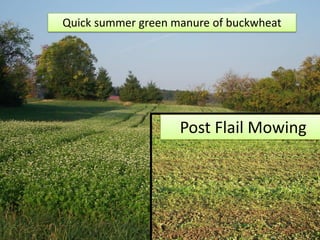
Green Manures
Post Flail Mowing
Quick summer green manure of buckwheat
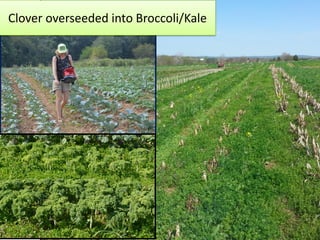
Clover overseeded into Broccoli/Kale
Tools for Quick Turnover
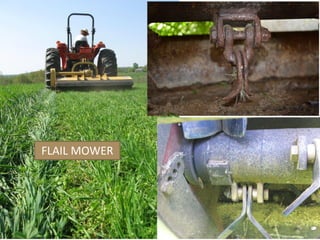
FLAIL MOWER
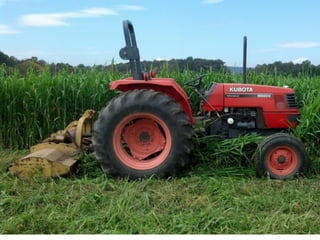
Taking down 8 foot sudex:
Bushhog, flail 2-3 weeks later,
Spading Machine
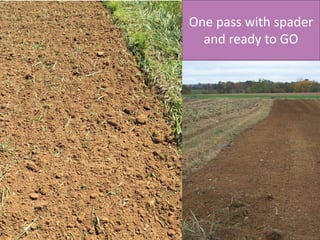
One pass with spader
and ready to GO
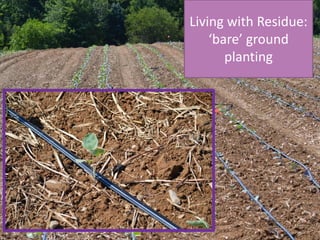
Living with Residue:
‘bare’ ground
planting
rule #3: Soil Test and Apply What’s Missing
Can’t we just grow it all ourselves?
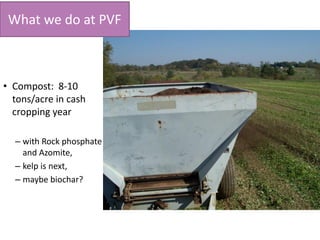
What we do at PVF
• Compost: 8-10
tons/acre in cash
cropping year
– with Rock phosphate
and Azomite,
– kelp is next,
– maybe biochar?
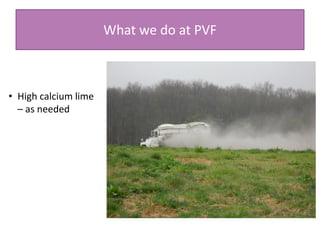
What we do at PVF
• High calcium lime
– as needed
What we do at PVF
MBA custom blend
broadcast at rate
determined by soil test.
Contains:
Calcium, potassium,
magnesium, traces
(boron!), sulfur, feather
meal all wrapped in
humates 
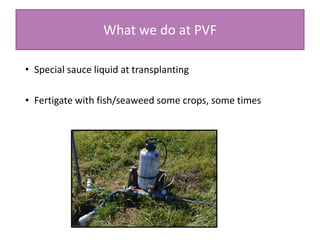
What we do at PVF
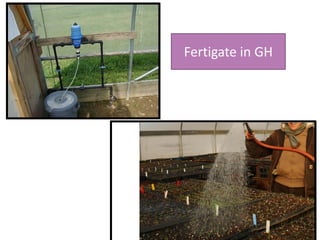
• Special sauce liquid at transplanting
• Fertigate with fish/seaweed some crops, some times
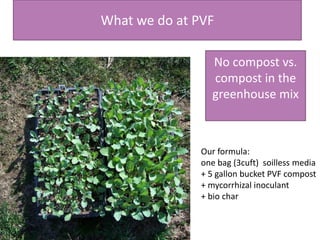
No compost vs.
compost in the
greenhouse mix
Our formula:
one bag (3cuft) soilless media
+ 5 gallon bucket PVF compost
+ mycorrhizal inoculant
+ bio char
What we do at PVF
Fertigate in GH
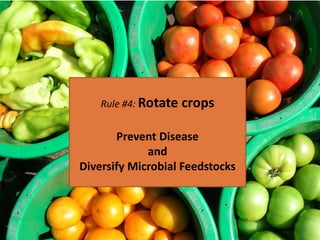
Rule #4: Rotate crops
Prevent Disease
and
Diversify Microbial Feedstocks
What is Crop Rotation?
• A planned system
• plant crops that are not related botanically
• Rotation is both spatial (crops move over an area)
and temporal (crops change over time)
Why Is Crop Rotation Important?
planned diversity,
breaks up disease, weed, and insect life cycles
encourages better (more complete/balanced) use of soil
nutrients and amendments
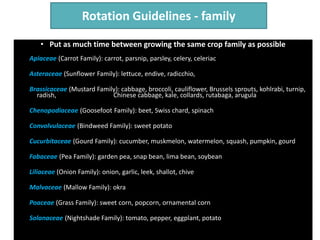
Rotation Guidelines - family
• Put as much time between growing the same crop family as possible
Apiaceae (Carrot Family): carrot, parsnip, parsley, celery, celeriac
Asteraceae (Sunflower Family): lettuce, endive, radicchio,
Brassicaceae (Mustard Family): cabbage, broccoli, cauliflower, Brussels sprouts, kohlrabi, turnip,
radish, Chinese cabbage, kale, collards, rutabaga, arugula
Chenopodiaceae (Goosefoot Family): beet, Swiss chard, spinach
Convolvulaceae (Bindweed Family): sweet potato
Cucurbitaceae (Gourd Family): cucumber, muskmelon, watermelon, squash, pumpkin, gourd
Fabaceae (Pea Family): garden pea, snap bean, lima bean, soybean
Liliaceae (Onion Family): onion, garlic, leek, shallot, chive
Malvaceae (Mallow Family): okra
Poaceae (Grass Family): sweet corn, popcorn, ornamental corn
Solanaceae (Nightshade Family): tomato, pepper, eggplant, potato
Rotation Guidelines – finer points
• Alternate heavy feeders with light feeders
• Alternate root crops with leaf crops with fruit crops
• Alternate deep rooted with shallow rooted
Tips to make it easier to “live” with a Rotation
• Make rotational units (blocks/sections/fields) the same size
if possible, with the size large enough to hold either the
crop with the most space/production requirements or half
of it
• If the rotational unit is not filled with cash crops then grow a
cover crop
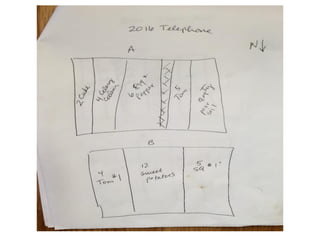
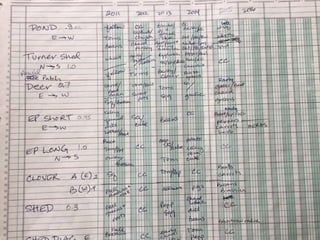
Maintain good records of your crop rotation plans!
“Although vegetable crop rotations are unlikely to be
fulfilled exactly as planned, it is still advisable to
develop a written plan and to follow it up by writing
down what was actually planted where. Such record-
keeping is key to improving rotations over time, since
it helps track what worked and what didn’t) –
information that should be the basis of future plans.” –
Vernon Grubinger
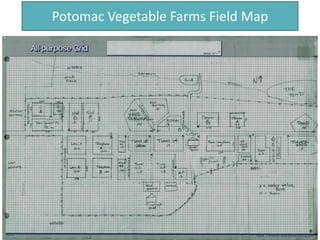
• Map of ellens?
Potomac Vegetable Farms Field Map
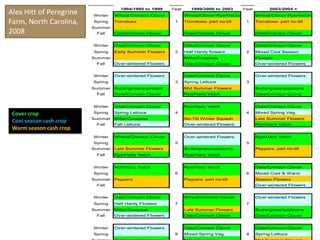
1994/1995 to 1999 Year 1999/2000 to 2003 Year 2003/2004 +
Winter Wheat/Crimson Clover Wheat/Clover-Rye/Vetch Wheat/Clover-Rye/Vetch
Spring Tomatoes 1 Tomatoes- part no-till 1 Tomatoes- part no-till
Summer
Fall Oats/Crimson Clover Oats/Crimson Clover Oats/Crimson Clover
Winter Oats/Crimson Clover Oats/Crimson Clover Oats/Crimson Clover
Spring Early Summer Flowers 2 Half Hardy flowers 2 Mixed Cool Season
Summer Millet/Cowpeas Flowers
Fall Over-wintered Flowers Oats/Crimson Clover Over-wintered Flowers
Winter Over-wintered Flowers Oats/Crimson Clover Over-wintered Flowers
Spring 3 Spring Lettuce 3
Summer Sudangrass/soybeans Mid Summer Flowers Sudangrass/soybeans
Fall Oats/Crimson Clover Rye/Hairy Vetch Oats/Crimson Clover
Winter Oats/Crimson Clover Rye/Hairy Vetch Oats/Crimson Clover
Spring Spring Lettuce 4 4 Mixed Spring Veg.
Summer Millet/Cowpeas No-Till Winter Squash Late Summer Flowers
Fall Fall Lettuce Over-wintered Flowers Rye/Hairy Vetch
Winter Wheat/Crimson Clover Over-wintered Flowers Rye/Hairy Vetch
Spring 5 5
Summer Late Summer Flowers Sudangrass/soybeans Peppers- part no-till
Fall Rye/Hairy Vetch Rye/Hairy Vetch
Winter Rye/Hairy Vetch Rye/Hairy Vetch Oats/Crimson Clover
Spring 6 6 Mixed Cool & Warm
Summer Peppers Peppers- part no-till Season Flowers
Fall Over-wintered Flowers
Winter Oats/Crimson Clover Wheat/Crimson Clover Over-wintered Flowers
Spring Half Hardy Flowers 7 7
Summer Millet/Cowpeas Late Summer Flowers Sudangrass/soybeans
Fall Over-wintered Flowers Oats/Crimson Clover Oats/Crimson Clover
Winter Over-wintered Flowers Oats/Crimson Clover Oats/Crimson Clover
Spring 8 Mixed Spring Veg. 8 Spring Lettuce
Alex Hitt of Peregrine
Farm, North Carolina,
2008
Cover crop
Cool season cash crop
Warm season cash crop
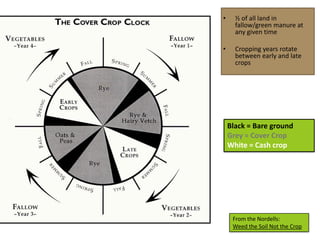
Black = Bare ground
Grey = Cover Crop
White = Cash crop
From the Nordells:
Weed the Soil Not the Crop
• ½ of all land in
fallow/green manure at
any given time
• Cropping years rotate
between early and late
crops
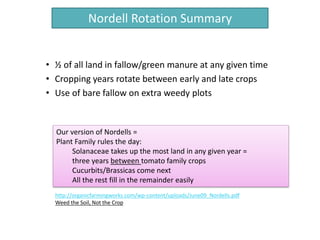
Nordell Rotation Summary
• ½ of all land in fallow/green manure at any given time
• Cropping years rotate between early and late crops
• Use of bare fallow on extra weedy plots
http://organicfarmingworks.com/wp-content/uploads/June09_Nordells.pdf
Weed the Soil, Not the Crop
Our version of Nordells =
Plant Family rules the day:
Solanaceae takes up the most land in any given year =
three years between tomato family crops
Cucurbits/Brassicas come next
All the rest fill in the remainder easily
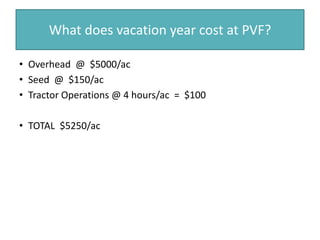
What does vacation year cost at PVF?
• Overhead @ $5000/ac
• Seed @ $150/ac
• Tractor Operations @ 4 hours/ac = $100
• TOTAL $5250/ac
What does vacation year pay?
• Weed Control
• Carbon Addition
• Nitrogen Addition
• Microbial Enhancement
• Soil Aggregation Improvement
• What is all that worth in $$$ ?
Other Ideas?
2 years on, 2 years
vacation?
3 years on, 2 years off?
Etc etc etc
Goals of Crop Rotation
• Disease/Insect Prevention
• Weed Management
• Feeding the Microbes
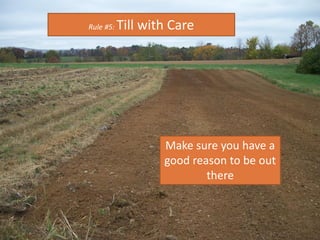
Rule #5: Till with Care
Make sure you have a
good reason to be out
there
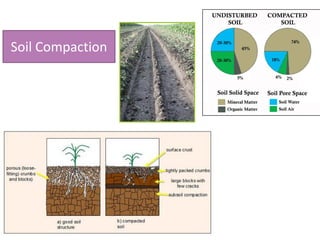
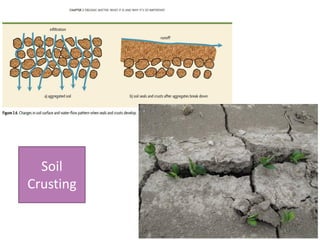
Possible/Probable Impacts of Tillage
• ↓ soil OM (loss of soil carbon)
• ↓ soil aggregation – tillage can pulverize soil and ruin
aggregates
• ↑ Erosion potential
• If these are not mitigated then overall decrease in soil
health ensues:
– ↓ pore space = ↓ oxygen = ↑ in compaction
– ↓ nutrient holding capacity
– ↓ water holding capacity (droughty)
– ↓ drainage (ponding)
Soil Compaction
Soil
Crusting
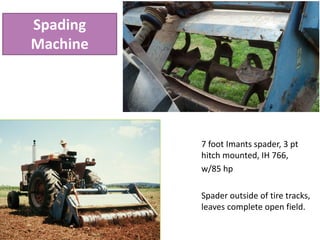
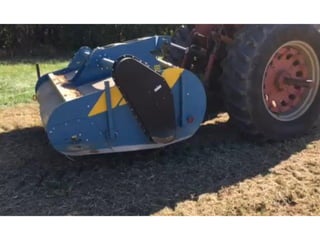
Spading
Machine
7 foot Imants spader, 3 pt
hitch mounted, IH 766,
w/85 hp
Spader outside of tire tracks,
leaves complete open field.
Spading vs. other Tillage
• Get a spader when you can – (I prefer Imants)
– How else to incorporate green manures and lots of
residue?
– The most gentle tillage ever
• Avoid rototillers/rotovators, if you can
• Get a field cultivator like the Perfecta II for quick
shallow pre-plant preparation
Unverferth Perfecta II,
S-tine field cultivator
Advantages?
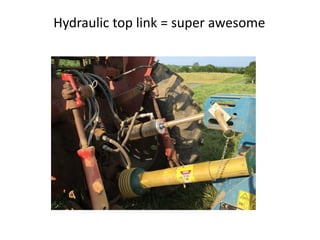
Hydraulic top link = super awesome
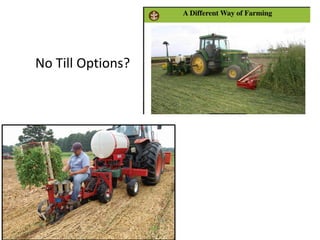
No Till Options?
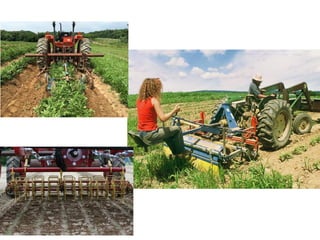
What about Weed Control?
It’s tillage too
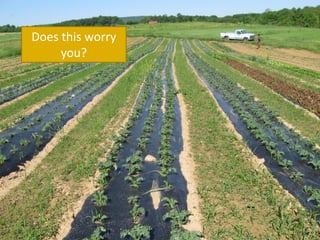
Does this worry
you?
What are 3 farming practices you might change?
5 rules for maintaining soil health
1. Keep adding Organic Matter
2. Keep the soil covered as much as possible
3. Test and balance soil nutrients, add what’s missing
4. Rotate crops
5. Till thoughtfully and gently
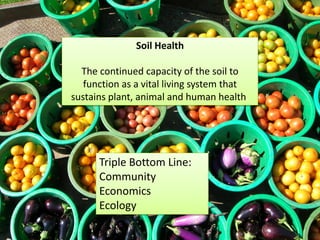
Soil Health
The continued capacity of the soil to
function as a vital living system that
sustains plant, animal and human health.
Triple Bottom Line:
Community
Economics
Ecology
Let’s Grow Better, Together
Ellen Polishuk
Ellen@planttoprofit.com
For a copy of the 5 Rules for Healthy Soils Guide, please go here:
http://www.planttoprofit.com/ssawg/

Ssawg 2018 soils mini part 2

  • 1.
    Putting it alltogether The 5 Rules for Maintaining Soil Health Ellen Polishuk SSAWG Conference Chattanooga, January 2018
  • 2.
    Soil Health The continuedcapacity of the soil to function as a vital living system that sustains plant, animal and human health.
  • 3.
    5 rules formaintaining soil health 1. Keep adding Organic Matter 2. Keep the soil covered as much as possible 3. Test and balance soil nutrients, add what’s missing 4. Rotate crops 5. Till thoughtfully and gently
  • 4.
    rule #1: ContinuallyAdd Organic Matter/Carbon –Grow green manures, –Use organic mulches, –Spread compost and/or manure –Plant cover crops religiously
  • 5.
    Soil Organic MatterComposition Actively decomposing 43% Stable Humus 42% Fresh Residue 10% Living Organisms 5% Organic Matter = the living, the dead, and the very dead
  • 6.
    Building Better Soils forBetter Crops SARE 2009
  • 7.
    Fresh residue →decomposing residue → Humus TIME ------>>>>>>>>>>>>>
  • 8.
    Ratios of freshto stable will change over time with good practices Building Better Soils for Better Crops SARE 2009
  • 9.
    How much isenough?
  • 10.
    Green versus BrownCarbon Green Carbon • Nutrient cycling • Bacteria Food Brown Carbon • Humus development • Fungal Food
  • 11.
    Cover Crops vsGreen Manures • Goals – Erosion prevention – Nutrient Cycling – Nitrogen Addition • Timing = over winter • My choices: – Wheat, rye, barley – Crimson clover, vetch • Incorporate? • Goals – Soil building – Nutrient creation (N) • Timing = main season! • My choices: – Sorghum sudan, millet – Cowpeas, soybean, sunhemp – Buckwheat – Oats/field peas (spring only) • Incorporate? Cover Crops Green Manures/Soil Building Crops
  • 12.
    Fall planted Rye andVetch Cover Crop Crimson Clover Cover Crop, fall planted
  • 13.
    Rye can betrouble
  • 14.
  • 15.
    Green Manure Crop: springsown oats and peas
  • 16.
    Oat/pea Green manurebeing flail mowed Post Flail Mower
  • 17.
  • 18.
    Drill – usedfor grains, cover crops • No drill? – Broadcast and disk/cultipack
  • 19.
    Trying No-Till Drill NTsudex/cowpea into living regrowth barley cover crop
  • 20.
    NoTill Sudex andCowpea into standing barley cover crop
  • 21.
  • 22.
    That Danged Rye Again… =Failure, NT drill cannot penetrate residue
  • 23.
    NoTill winter coverinto standing frost kissed sudex/cowpea
  • 24.
    Lessons learned fromNT trials • NT Drill Quality/Age/Wear makes a big difference in what you can cut through • If the crop you NT into is so-so, lots of weeds will germ and have time to set seed • Use heavier than normal seeding rate, around double, – Cross hatch field or – double rate through seeder
  • 25.
    What is therole of compost?
  • 26.
    What’s so greatabout compost? • Nutrient delivery system – doles them out as the plants need them • Organic matter addition – stable humus • Inoculates soil with beneficial microbes • Helps neutralize soil toxins and harmful compounds
  • 27.
    Compost extras • Microbialinoculants • Putting other amendments into the compost will make them biologically “charged” and even more plant available. • Rock powders and other mineral amendments – Rock phosphate – Azomite
  • 28.
    Costs of Productionfor 50 tons Labor Materials • Pile building 12 hours • Turning (42 x .75) 32 hours • TOTAL: 44 hrs x $20 = $880 • Equipment – 44 hours x $25 = $1100 • Hay = $100 • Leaves = free • Soil = free • Manure = $900 Labor + equipment + materials = $2980 $2980 divided by 50 tons = $60 per ton 50 tons = 83 yards, $2980/83 = $36 per yard
  • 29.
    Using Compost vsother fertilizers? Pros Cons • It’s simply a great fertilizer – Biologically – Chemically – Physically • Great carrier for other amendments • Feels GOOD to use • Cost • Spreading Tool Unavailable • Might not replace need for other amendments, so extra work
  • 30.
    Not all Compostis Created Equal It wasn’t really aerobic! Unfinished compost can be toxic to plants All the nutrients washed out
  • 31.
    How to EvaluatePurchased Compost? Compost Analysis No Analysis? – Can you see the parent materials? – Is it warm to the touch? – Smell? – Can the maker describe the process?
  • 32.
    rule #1: ContinuallyAdd Organic Matter/Carbon –Grow green manures, –Use organic mulches, –Spread compost and/or manure –Plant cover crops religiously
  • 33.
    rule #2 MaintainSoil Cover Keep the soil covered as much as possible, preferably with plants
  • 34.
    Why do wehave weeds?
  • 35.
  • 39.
    Garlic crop –100% coverage
  • 40.
  • 41.
    Green Manures Post FlailMowing Quick summer green manure of buckwheat
  • 42.
  • 43.
  • 44.
  • 46.
    Taking down 8foot sudex: Bushhog, flail 2-3 weeks later, Spading Machine
  • 47.
    One pass withspader and ready to GO
  • 48.
  • 49.
    rule #3: SoilTest and Apply What’s Missing
  • 50.
    Can’t we justgrow it all ourselves?
  • 51.
    What we doat PVF • Compost: 8-10 tons/acre in cash cropping year – with Rock phosphate and Azomite, – kelp is next, – maybe biochar?
  • 52.
    What we doat PVF • High calcium lime – as needed
  • 53.
    What we doat PVF MBA custom blend broadcast at rate determined by soil test. Contains: Calcium, potassium, magnesium, traces (boron!), sulfur, feather meal all wrapped in humates 
  • 54.
    What we doat PVF • Special sauce liquid at transplanting • Fertigate with fish/seaweed some crops, some times
  • 55.
    No compost vs. compostin the greenhouse mix Our formula: one bag (3cuft) soilless media + 5 gallon bucket PVF compost + mycorrhizal inoculant + bio char What we do at PVF
  • 56.
  • 57.
    Rule #4: Rotatecrops Prevent Disease and Diversify Microbial Feedstocks
  • 58.
    What is CropRotation? • A planned system • plant crops that are not related botanically • Rotation is both spatial (crops move over an area) and temporal (crops change over time)
  • 59.
    Why Is CropRotation Important? planned diversity, breaks up disease, weed, and insect life cycles encourages better (more complete/balanced) use of soil nutrients and amendments
  • 60.
    Rotation Guidelines -family • Put as much time between growing the same crop family as possible Apiaceae (Carrot Family): carrot, parsnip, parsley, celery, celeriac Asteraceae (Sunflower Family): lettuce, endive, radicchio, Brassicaceae (Mustard Family): cabbage, broccoli, cauliflower, Brussels sprouts, kohlrabi, turnip, radish, Chinese cabbage, kale, collards, rutabaga, arugula Chenopodiaceae (Goosefoot Family): beet, Swiss chard, spinach Convolvulaceae (Bindweed Family): sweet potato Cucurbitaceae (Gourd Family): cucumber, muskmelon, watermelon, squash, pumpkin, gourd Fabaceae (Pea Family): garden pea, snap bean, lima bean, soybean Liliaceae (Onion Family): onion, garlic, leek, shallot, chive Malvaceae (Mallow Family): okra Poaceae (Grass Family): sweet corn, popcorn, ornamental corn Solanaceae (Nightshade Family): tomato, pepper, eggplant, potato
  • 61.
    Rotation Guidelines –finer points • Alternate heavy feeders with light feeders • Alternate root crops with leaf crops with fruit crops • Alternate deep rooted with shallow rooted
  • 62.
    Tips to makeit easier to “live” with a Rotation • Make rotational units (blocks/sections/fields) the same size if possible, with the size large enough to hold either the crop with the most space/production requirements or half of it • If the rotational unit is not filled with cash crops then grow a cover crop
  • 63.
    Maintain good recordsof your crop rotation plans! “Although vegetable crop rotations are unlikely to be fulfilled exactly as planned, it is still advisable to develop a written plan and to follow it up by writing down what was actually planted where. Such record- keeping is key to improving rotations over time, since it helps track what worked and what didn’t) – information that should be the basis of future plans.” – Vernon Grubinger
  • 66.
    • Map ofellens? Potomac Vegetable Farms Field Map
  • 67.
    1994/1995 to 1999Year 1999/2000 to 2003 Year 2003/2004 + Winter Wheat/Crimson Clover Wheat/Clover-Rye/Vetch Wheat/Clover-Rye/Vetch Spring Tomatoes 1 Tomatoes- part no-till 1 Tomatoes- part no-till Summer Fall Oats/Crimson Clover Oats/Crimson Clover Oats/Crimson Clover Winter Oats/Crimson Clover Oats/Crimson Clover Oats/Crimson Clover Spring Early Summer Flowers 2 Half Hardy flowers 2 Mixed Cool Season Summer Millet/Cowpeas Flowers Fall Over-wintered Flowers Oats/Crimson Clover Over-wintered Flowers Winter Over-wintered Flowers Oats/Crimson Clover Over-wintered Flowers Spring 3 Spring Lettuce 3 Summer Sudangrass/soybeans Mid Summer Flowers Sudangrass/soybeans Fall Oats/Crimson Clover Rye/Hairy Vetch Oats/Crimson Clover Winter Oats/Crimson Clover Rye/Hairy Vetch Oats/Crimson Clover Spring Spring Lettuce 4 4 Mixed Spring Veg. Summer Millet/Cowpeas No-Till Winter Squash Late Summer Flowers Fall Fall Lettuce Over-wintered Flowers Rye/Hairy Vetch Winter Wheat/Crimson Clover Over-wintered Flowers Rye/Hairy Vetch Spring 5 5 Summer Late Summer Flowers Sudangrass/soybeans Peppers- part no-till Fall Rye/Hairy Vetch Rye/Hairy Vetch Winter Rye/Hairy Vetch Rye/Hairy Vetch Oats/Crimson Clover Spring 6 6 Mixed Cool & Warm Summer Peppers Peppers- part no-till Season Flowers Fall Over-wintered Flowers Winter Oats/Crimson Clover Wheat/Crimson Clover Over-wintered Flowers Spring Half Hardy Flowers 7 7 Summer Millet/Cowpeas Late Summer Flowers Sudangrass/soybeans Fall Over-wintered Flowers Oats/Crimson Clover Oats/Crimson Clover Winter Over-wintered Flowers Oats/Crimson Clover Oats/Crimson Clover Spring 8 Mixed Spring Veg. 8 Spring Lettuce Alex Hitt of Peregrine Farm, North Carolina, 2008 Cover crop Cool season cash crop Warm season cash crop
  • 68.
    Black = Bareground Grey = Cover Crop White = Cash crop From the Nordells: Weed the Soil Not the Crop • ½ of all land in fallow/green manure at any given time • Cropping years rotate between early and late crops
  • 69.
    Nordell Rotation Summary •½ of all land in fallow/green manure at any given time • Cropping years rotate between early and late crops • Use of bare fallow on extra weedy plots http://organicfarmingworks.com/wp-content/uploads/June09_Nordells.pdf Weed the Soil, Not the Crop Our version of Nordells = Plant Family rules the day: Solanaceae takes up the most land in any given year = three years between tomato family crops Cucurbits/Brassicas come next All the rest fill in the remainder easily
  • 72.
    What does vacationyear cost at PVF? • Overhead @ $5000/ac • Seed @ $150/ac • Tractor Operations @ 4 hours/ac = $100 • TOTAL $5250/ac
  • 73.
    What does vacationyear pay? • Weed Control • Carbon Addition • Nitrogen Addition • Microbial Enhancement • Soil Aggregation Improvement • What is all that worth in $$$ ? Other Ideas? 2 years on, 2 years vacation? 3 years on, 2 years off? Etc etc etc
  • 74.
    Goals of CropRotation • Disease/Insect Prevention • Weed Management • Feeding the Microbes
  • 75.
    Rule #5: Tillwith Care Make sure you have a good reason to be out there
  • 76.
    Possible/Probable Impacts ofTillage • ↓ soil OM (loss of soil carbon) • ↓ soil aggregation – tillage can pulverize soil and ruin aggregates • ↑ Erosion potential • If these are not mitigated then overall decrease in soil health ensues: – ↓ pore space = ↓ oxygen = ↑ in compaction – ↓ nutrient holding capacity – ↓ water holding capacity (droughty) – ↓ drainage (ponding)
  • 77.
  • 79.
  • 80.
    Spading Machine 7 foot Imantsspader, 3 pt hitch mounted, IH 766, w/85 hp Spader outside of tire tracks, leaves complete open field.
  • 82.
    Spading vs. otherTillage • Get a spader when you can – (I prefer Imants) – How else to incorporate green manures and lots of residue? – The most gentle tillage ever • Avoid rototillers/rotovators, if you can • Get a field cultivator like the Perfecta II for quick shallow pre-plant preparation
  • 83.
    Unverferth Perfecta II, S-tinefield cultivator Advantages?
  • 84.
    Hydraulic top link= super awesome
  • 85.
  • 86.
    What about WeedControl? It’s tillage too
  • 88.
  • 89.
    What are 3farming practices you might change?
  • 90.
    5 rules formaintaining soil health 1. Keep adding Organic Matter 2. Keep the soil covered as much as possible 3. Test and balance soil nutrients, add what’s missing 4. Rotate crops 5. Till thoughtfully and gently
  • 91.
    Soil Health The continuedcapacity of the soil to function as a vital living system that sustains plant, animal and human health. Triple Bottom Line: Community Economics Ecology
  • 92.
    Let’s Grow Better,Together Ellen Polishuk Ellen@planttoprofit.com For a copy of the 5 Rules for Healthy Soils Guide, please go here: http://www.planttoprofit.com/ssawg/ http://www.planttoprofit.com/ssawg/