CP - 321
CROP- WHAET
PLOT NO- 18
SUBMITTED BY:
MANORANJAN ROUT 36C/14
OMRITA JAISWAL 37C/14
WHEAT
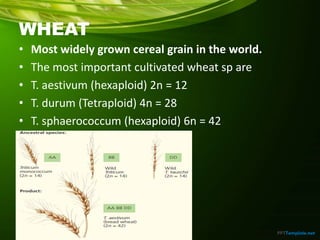
• Most widely grown cereal grain in the world.
• The most important cultivated wheat sp are
• T. aestivum (hexaploid) 2n = 12
• T. durum (Tetraploid) 4n = 28
• T. sphaerococcum (hexaploid) 6n = 42
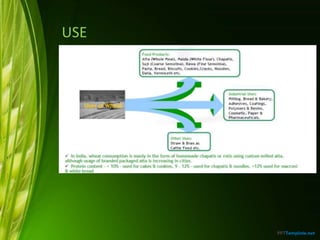
USE
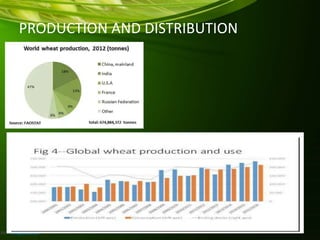
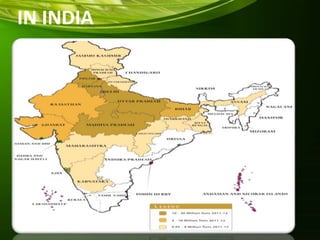
PRODUCTION AND DISTRIBUTION
IN INDIA
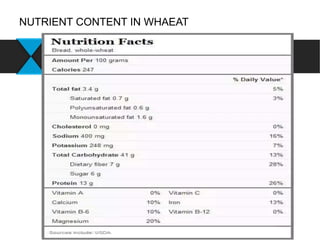
NUTRIENT CONTENT IN WHAEAT
:
SOIL AMD CLIMATE
• In India, wheat is grown in different soils; but
it does well on well drained loams and clay
loams. Best growth is achieved in allurial
soils of Gangetic plains; but it does also well
on black cotton soils of central India.
•
Climatic requirement
• Wide adaptability
- Prefer areas with cool, moist weather during
growing period followed by dry, warm
weather.
- Optimum temperature range for ideal
germination of seed is 20 – 25 0 C
- Can germinate in the temp range of 3.5 –
350C
- Areas with warm and damp climate are not
suited for wheat growing.
Field Preparation
• Requires a well pulverized soils for good
germination
• Field after the harvest of previous crop
should be properly ploughed and harrowed
2-3 times followed by planking
• Pre-sowing irrigation (wetland) 7-10 days
before sowing seed is needed for proper
germination.
• Light leveling is required before sowing seed
Management Practices
• In rain-fed areas (dry land) – FP should be
done with care as conservation of moisture
is dependent on it.
• Fields are deep ploughed and done planking
• Usu. done in evening times and furrow
should be kept opened whole night to
absorb moisture from dew.
• Planking should be done in the morning
Seed and sowing
• RAISED BED SEED SOWING
• SPACING MAINTAINED
• Row to row 25cm
• Plant to plant 5cm
• Sowing was done by broadcasting in the row
• TIME OF SOWING :
• 1st week of November
• Seed rate 100-120kg/ha
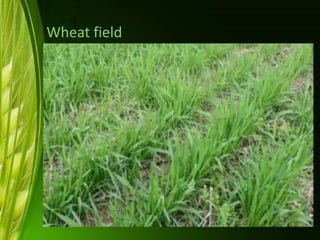
Wheat field
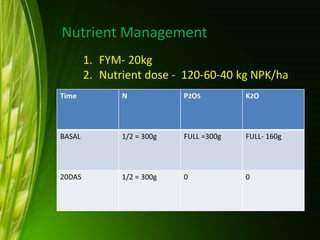
Nutrient Management
1. FYM- 20kg
2. Nutrient dose - 120-60-40 kg NPK/ha
Time N P2O5 K2O
BASAL 1/2 = 300g FULL =300g FULL- 160g
20DAS 1/2 = 300g 0 0
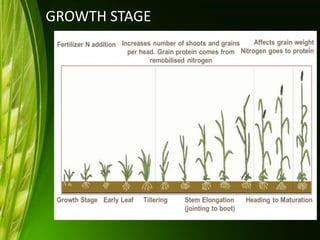
GROWTH STAGE
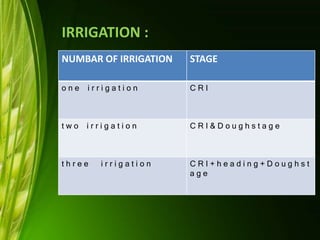
IRRIGATION :
NUMBAR OF IRRIGATION STAGE
o n e i r r i g a t i o n C R I
t w o i r r i g a t i o n C R I & D o u g h s t a g e
t h r e e i r r i g a t i o n C R I + h e a d i n g + D o u g h s t
a g e
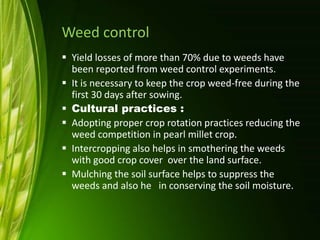
Weed control
 Yield losses of more than 70% due to weeds have
been reported from weed control experiments.
 It is necessary to keep the crop weed-free during the
first 30 days after sowing.
 Cultural practices :
 Adopting proper crop rotation practices reducing the
weed competition in pearl millet crop.
 Intercropping also helps in smothering the weeds
with good crop cover over the land surface.
 Mulching the soil surface helps to suppress the
weeds and also he in conserving the soil moisture.
Chemical control :
• Pre-emergence application :
• It applied after sowing but before emergence of
seedling.
• - Atrazine (0.5-1.0)
• - Pendimethalin (1.0-1.5)
• - Tebutryn (1.0-2.0) for light soils
• - Norea (1.0-2.0) for heavy soils
• Post-emergence application :
• In case of severe infestation.
• Low rates of 2,4-D (0.5-1.0 kg/ha) may be
applied when the plants are about 10 to 30 cm
tall.
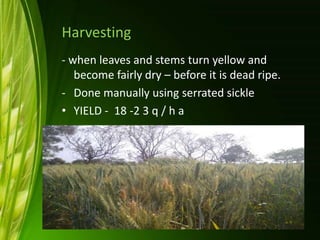
Harvesting
- when leaves and stems turn yellow and
become fairly dry – before it is dead ripe.
- Done manually using serrated sickle
• YIELD - 18 -2 3 q / h a
wheat cultivation

wheat cultivation

  • 1.
    CP - 321 CROP-WHAET PLOT NO- 18 SUBMITTED BY: MANORANJAN ROUT 36C/14 OMRITA JAISWAL 37C/14
  • 2.
    WHEAT • Most widelygrown cereal grain in the world. • The most important cultivated wheat sp are • T. aestivum (hexaploid) 2n = 12 • T. durum (Tetraploid) 4n = 28 • T. sphaerococcum (hexaploid) 6n = 42
  • 3.
  • 4.
  • 5.
  • 6.
  • 7.
    SOIL AMD CLIMATE •In India, wheat is grown in different soils; but it does well on well drained loams and clay loams. Best growth is achieved in allurial soils of Gangetic plains; but it does also well on black cotton soils of central India. •
  • 8.
    Climatic requirement • Wideadaptability - Prefer areas with cool, moist weather during growing period followed by dry, warm weather. - Optimum temperature range for ideal germination of seed is 20 – 25 0 C - Can germinate in the temp range of 3.5 – 350C - Areas with warm and damp climate are not suited for wheat growing.
  • 9.
    Field Preparation • Requiresa well pulverized soils for good germination • Field after the harvest of previous crop should be properly ploughed and harrowed 2-3 times followed by planking • Pre-sowing irrigation (wetland) 7-10 days before sowing seed is needed for proper germination. • Light leveling is required before sowing seed
  • 10.
    Management Practices • Inrain-fed areas (dry land) – FP should be done with care as conservation of moisture is dependent on it. • Fields are deep ploughed and done planking • Usu. done in evening times and furrow should be kept opened whole night to absorb moisture from dew. • Planking should be done in the morning
  • 11.
    Seed and sowing •RAISED BED SEED SOWING • SPACING MAINTAINED • Row to row 25cm • Plant to plant 5cm • Sowing was done by broadcasting in the row • TIME OF SOWING : • 1st week of November • Seed rate 100-120kg/ha
  • 12.
  • 13.
    Nutrient Management 1. FYM-20kg 2. Nutrient dose - 120-60-40 kg NPK/ha Time N P2O5 K2O BASAL 1/2 = 300g FULL =300g FULL- 160g 20DAS 1/2 = 300g 0 0
  • 14.
  • 15.
    IRRIGATION : NUMBAR OFIRRIGATION STAGE o n e i r r i g a t i o n C R I t w o i r r i g a t i o n C R I & D o u g h s t a g e t h r e e i r r i g a t i o n C R I + h e a d i n g + D o u g h s t a g e
  • 16.
    Weed control  Yieldlosses of more than 70% due to weeds have been reported from weed control experiments.  It is necessary to keep the crop weed-free during the first 30 days after sowing.  Cultural practices :  Adopting proper crop rotation practices reducing the weed competition in pearl millet crop.  Intercropping also helps in smothering the weeds with good crop cover over the land surface.  Mulching the soil surface helps to suppress the weeds and also he in conserving the soil moisture.
  • 17.
    Chemical control : •Pre-emergence application : • It applied after sowing but before emergence of seedling. • - Atrazine (0.5-1.0) • - Pendimethalin (1.0-1.5) • - Tebutryn (1.0-2.0) for light soils • - Norea (1.0-2.0) for heavy soils • Post-emergence application : • In case of severe infestation. • Low rates of 2,4-D (0.5-1.0 kg/ha) may be applied when the plants are about 10 to 30 cm tall.
  • 18.
    Harvesting - when leavesand stems turn yellow and become fairly dry – before it is dead ripe. - Done manually using serrated sickle • YIELD - 18 -2 3 q / h a