JOURNAL CLUP, ID
Dr. Naif S Saglan ,, F1
CASE DISCUSSION :
• 21 years , female , dx in 2008 as ALL .
• Dx and Tx in KAMC + UK and complete her chemo
therapy 2010.
• Patient got marred 2015 , and during her antenatal
care her obstetrician notice her CBC was not normal .
• Admitted again to KAMC and Dx as relapsed with
different type of leukemia as AML.
• She received chemo therapy 3 cycle . ( 25/06/2015
to 2/07/2015 ).
Cont.
• Her chemo postponed after delivery .
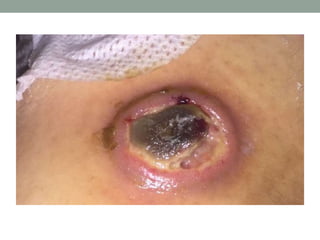
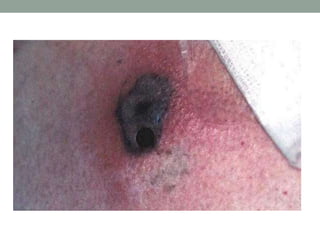
• During her chemo therapy course patient
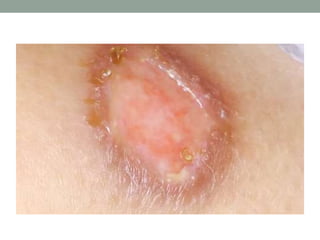
developed a skin lesion on her RT arm , on the
extensor surface , round in shape , red walls with
pus and discharge and foul smiling associated
with itching and high grade fever (38C -39C), no
other lesions .
• Last cycle was (21-24 /08/2015) .
Cont. .
• Fever 38, intermittent pattern relived by anti pyritic
associated with rigor and chills , bone pain , palpitations.
• No rashes .
• No cough or expectoration.
• No meningeal signs or abnormal movements .
• No change of her level of conscious .
 Past Medical Hx :
Cardiac myopathy .
Skin lesion in her genitalia (2008).
Cont. .
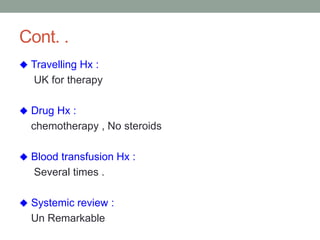
 Travelling Hx :
UK for therapy
 Drug Hx :
chemotherapy , No steroids
 Blood transfusion Hx :
Several times .
 Systemic review :
Un Remarkable
Cont. .
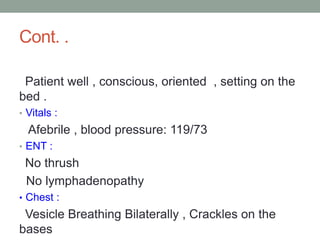
Patient well , conscious, oriented , setting on the
bed .
• Vitals :
Afebrile , blood pressure: 119/73
• ENT :
No thrush
No lymphadenopathy
• Chest :
Vesicle Breathing Bilaterally , Crackles on the
bases
Cont. .
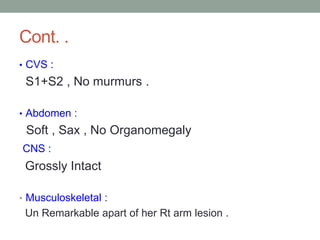
• CVS :
S1+S2 , No murmurs .
• Abdomen :
Soft , Sax , No Organomegaly
CNS :
Grossly Intact
• Musculoskeletal :
Un Remarkable apart of her Rt arm lesion .
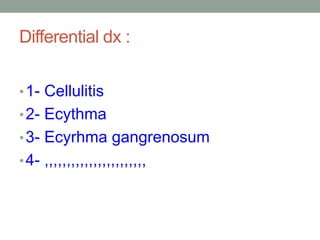
Differential dx :
•1- Cellulitis
•2- Ecythma
•3- Ecyrhma gangrenosum
•4- ,,,,,,,,,,,,,,,,,,,,,,,
Investigations :
 CBC :
Thrombocytopenia
Leukopenia
KIDNEY AND LIVER PROFILE :
Normal Limit
IMAGES :
No Focus
 Cultures :
Blood
Sputum ALL NO GROWTH
Urine
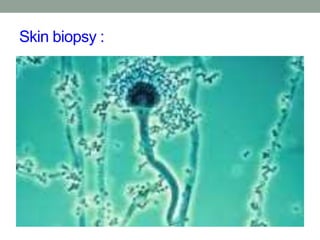
Skin biopsy :
DIAGNOSIS :
Aspergillus Fumigatus
Treatment :
 Voriconazole
(6 mg/kg IV every 12 h for 1 day, followed by 4 mg/kg IV
every 12 h )
 Dermatologic Manifestations of
Aspergillosis :
 Cutaneous aspergillosis is usually a cutaneous
manifestation of disseminated infection with the
fungus Aspergillus.
 Primary cutaneous disease is rare and is most
commonly caused by Aspergillus fumigatus and
Aspergillus flavus.
 Skin lesions occur in 5-10% of patients with
disseminated aspergillosis
Cont. .
The most typical presentation is implantation of
the fungus following trauma, including infections
at the site of intravenous cannulas, or
venipuncture wounds.
 A fumigatus is the most common pathogen
associated with disseminated disease with
cutaneous involvement.
 A flavus or A terreus most often causes the less
frequent primary infections of the skin. Aspergillus
Cont. .
 Invasive aspergillosis affects people who have
weakened immune systems, such as people who
have had a stem cell transplant or organ
transplant, are getting chemotherapy for cancer,
or are taking high doses of corticosteroids.
 Cutaneous presentations of systemic
aspergillosis most frequently begin as solitary or
multiple erythematous or violaceous indurated
papules or plaques . lesions are often tender, but
Cont. .
 In both disseminated and limited cutaneous
aspergillosis, high-dose intravenous amphotericin
B, in traditional or liposomal form.
 Voriconazole is also approved as a first-line
agent for aspergillosis.
 Treatment options for aspergillosis include
itraconazole .
 Reference
 IDSA
 Up to date
 Medscape
THANK S FOR ATTENTION

Case discusion

  • 1.
    JOURNAL CLUP, ID Dr.Naif S Saglan ,, F1
  • 2.
    CASE DISCUSSION : •21 years , female , dx in 2008 as ALL . • Dx and Tx in KAMC + UK and complete her chemo therapy 2010. • Patient got marred 2015 , and during her antenatal care her obstetrician notice her CBC was not normal . • Admitted again to KAMC and Dx as relapsed with different type of leukemia as AML. • She received chemo therapy 3 cycle . ( 25/06/2015 to 2/07/2015 ).
  • 3.
    Cont. • Her chemopostponed after delivery . • During her chemo therapy course patient developed a skin lesion on her RT arm , on the extensor surface , round in shape , red walls with pus and discharge and foul smiling associated with itching and high grade fever (38C -39C), no other lesions . • Last cycle was (21-24 /08/2015) .
  • 5.
    Cont. . • Fever38, intermittent pattern relived by anti pyritic associated with rigor and chills , bone pain , palpitations. • No rashes . • No cough or expectoration. • No meningeal signs or abnormal movements . • No change of her level of conscious .  Past Medical Hx : Cardiac myopathy . Skin lesion in her genitalia (2008).
  • 6.
    Cont. .  TravellingHx : UK for therapy  Drug Hx : chemotherapy , No steroids  Blood transfusion Hx : Several times .  Systemic review : Un Remarkable
  • 7.
    Cont. . Patient well, conscious, oriented , setting on the bed . • Vitals : Afebrile , blood pressure: 119/73 • ENT : No thrush No lymphadenopathy • Chest : Vesicle Breathing Bilaterally , Crackles on the bases
  • 8.
    Cont. . • CVS: S1+S2 , No murmurs . • Abdomen : Soft , Sax , No Organomegaly CNS : Grossly Intact • Musculoskeletal : Un Remarkable apart of her Rt arm lesion .
  • 9.
    Differential dx : •1-Cellulitis •2- Ecythma •3- Ecyrhma gangrenosum •4- ,,,,,,,,,,,,,,,,,,,,,,,
  • 10.
    Investigations :  CBC: Thrombocytopenia Leukopenia KIDNEY AND LIVER PROFILE : Normal Limit IMAGES : No Focus  Cultures : Blood Sputum ALL NO GROWTH Urine
  • 11.
  • 12.
  • 13.
    Treatment :  Voriconazole (6mg/kg IV every 12 h for 1 day, followed by 4 mg/kg IV every 12 h )
  • 15.
     Dermatologic Manifestationsof Aspergillosis :  Cutaneous aspergillosis is usually a cutaneous manifestation of disseminated infection with the fungus Aspergillus.  Primary cutaneous disease is rare and is most commonly caused by Aspergillus fumigatus and Aspergillus flavus.  Skin lesions occur in 5-10% of patients with disseminated aspergillosis
  • 16.
    Cont. . The mosttypical presentation is implantation of the fungus following trauma, including infections at the site of intravenous cannulas, or venipuncture wounds.  A fumigatus is the most common pathogen associated with disseminated disease with cutaneous involvement.  A flavus or A terreus most often causes the less frequent primary infections of the skin. Aspergillus
  • 17.
    Cont. .  Invasiveaspergillosis affects people who have weakened immune systems, such as people who have had a stem cell transplant or organ transplant, are getting chemotherapy for cancer, or are taking high doses of corticosteroids.  Cutaneous presentations of systemic aspergillosis most frequently begin as solitary or multiple erythematous or violaceous indurated papules or plaques . lesions are often tender, but
  • 19.
    Cont. .  Inboth disseminated and limited cutaneous aspergillosis, high-dose intravenous amphotericin B, in traditional or liposomal form.  Voriconazole is also approved as a first-line agent for aspergillosis.  Treatment options for aspergillosis include itraconazole .
  • 20.
     Reference  IDSA Up to date  Medscape
  • 21.
    THANK S FORATTENTION