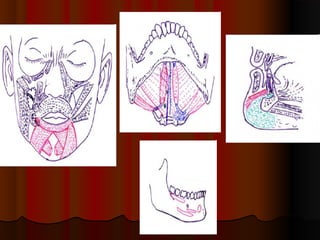
SEMINAR ONSEMINAR ON
SPREAD OF ORALSPREAD OF ORAL
INFECTIONSINFECTIONS
PRESENTED BY :-PRESENTED BY :-
DR. IPSHA DHALIDR. IPSHA DHALI
CellulitisCellulitis
((PhlegmonPhlegmon))
Defination :-Defination :-
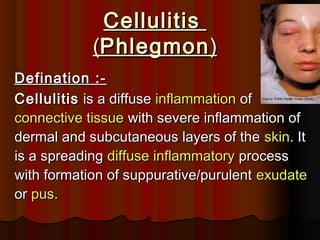
CellulitisCellulitis is a diffuseis a diffuse inflammationinflammation ofof
connective tissueconnective tissue with severe inflammation ofwith severe inflammation of
dermal and subcutaneous layers of thedermal and subcutaneous layers of the skinskin. It. It
is a spreadingis a spreading diffusediffuse inflammatoryinflammatory processprocess
with formation of suppurative/purulentwith formation of suppurative/purulent exudateexudate
oror puspus..
1.1. Cellulitis can be caused by normalCellulitis can be caused by normal skin floraskin flora or byor by
exogenous bacteriaexogenous bacteria[[streptococcus and/orstreptococcus and/or
staphylococcus bacteria]staphylococcus bacteria]..
2.2. Often occurs where the skin has previously beenOften occurs where the skin has previously been
broken: cracks in the skin, cuts,broken: cracks in the skin, cuts, blistersblisters,, burnsburns,,
insect bitesinsect bites,, surgical woundssurgical wounds, or sites of, or sites of
intravenousintravenous cathetercatheter insertion.insertion.
3.3. Skin on the face is most commonly affected bySkin on the face is most commonly affected by
this infection, though cellulitis can occur on anythis infection, though cellulitis can occur on any
part of the body.part of the body.
4.4. The mainstay of therapy remains treatment withThe mainstay of therapy remains treatment with
appropriateappropriate antibioticsantibiotics, and recovery periods can, and recovery periods can
INTRODUCTION :-
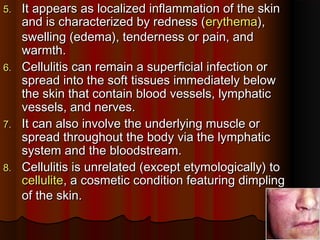
5.5. It appears as localized inflammation of the skinIt appears as localized inflammation of the skin
and is characterized by redness (and is characterized by redness (erythemaerythema),),
swelling (edema), tenderness or pain, andswelling (edema), tenderness or pain, and
warmth.warmth.
6.6. Cellulitis can remain a superficial infection orCellulitis can remain a superficial infection or
spread into the soft tissues immediately belowspread into the soft tissues immediately below
the skin that contain blood vessels, lymphaticthe skin that contain blood vessels, lymphatic
vessels, and nerves.vessels, and nerves.
7.7. It can also involve the underlying muscle orIt can also involve the underlying muscle or
spread throughout the body via the lymphaticspread throughout the body via the lymphatic
system and the bloodstream.system and the bloodstream.
8.8. Cellulitis is unrelated (except etymologically) toCellulitis is unrelated (except etymologically) to
cellulitecellulite, a cosmetic condition featuring dimpling, a cosmetic condition featuring dimpling
of the skin.of the skin.
NOTE :NOTE :
 Risk:Risk:
1.1. Age is not generally considered a risk factor for cellulites, althoughAge is not generally considered a risk factor for cellulites, although
some studies show slightly higher incidence in individuals over agesome studies show slightly higher incidence in individuals over age
45.45.
2.2. Individuals who are immunodeficient as a result of geneticIndividuals who are immunodeficient as a result of genetic
conditions , illness (e.g.,conditions , illness (e.g., HIVHIV infection,infection, cancercancer), or), or
immunosuppressive drugs (e.g.,immunosuppressive drugs (e.g., chemotherapychemotherapy, corticosteroids,, corticosteroids,
antirejection drugs in transplant recipients) are at increased risk ofantirejection drugs in transplant recipients) are at increased risk of
infections such as cellulitis.infections such as cellulitis.
3.3. DiabetesDiabetes impairs the immune system and decreases bloodimpairs the immune system and decreases blood
circulation, increasing risk of infection.circulation, increasing risk of infection.
4.4. Chronic skin conditions such asChronic skin conditions such as psoriasispsoriasis,, dermatitisdermatitis, or, or eczemaeczema cancan
create an opportunity for entry of infectious bacteria. Individuals whocreate an opportunity for entry of infectious bacteria. Individuals who
have recurrent fungal infections of the feet are greater risk forhave recurrent fungal infections of the feet are greater risk for
developing cellulitis.developing cellulitis.
5.5. Impaired peripheral circulation such as arterial insufficiency orImpaired peripheral circulation such as arterial insufficiency or
venous stasis is also a risk factor.venous stasis is also a risk factor.
6.6. Subcutaneous or intravenous drug injection, body piercing, andSubcutaneous or intravenous drug injection, body piercing, and
tattoos are all associated with higher risk for cellulitis.tattoos are all associated with higher risk for cellulitis.
7.7. Cellulitis may also occur as a complication of certain surgicalCellulitis may also occur as a complication of certain surgical
Incidence and PrevalenceIncidence and Prevalence
1.1. Cellulitis can affect anyone of any age; cellulitisCellulitis can affect anyone of any age; cellulitis
of the face is more common in children andof the face is more common in children and
adults over age 50 (Cunningham).adults over age 50 (Cunningham).
2.2. The actual incidence of cellulitis is unknownThe actual incidence of cellulitis is unknown
because cases are seldom reported.because cases are seldom reported.
3.3. The incidence of infection by methicillin-The incidence of infection by methicillin-
resistant Staphylococcus aureus (MRSA) andresistant Staphylococcus aureus (MRSA) and
other antibiotic-resistant bacteria has increasedother antibiotic-resistant bacteria has increased
dramatically in recent years (Mayo Clinic Staff).dramatically in recent years (Mayo Clinic Staff).
Infection by these organisms is much moreInfection by these organisms is much more
serious.serious.
DiagnosisDiagnosis
 History:History:
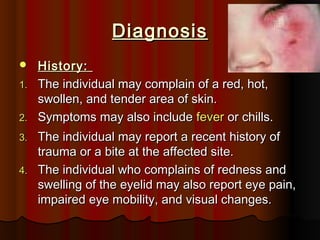
1.1. The individual may complain of a red, hot,The individual may complain of a red, hot,
swollen, and tender area of skin.swollen, and tender area of skin.
2.2. Symptoms may also includeSymptoms may also include feverfever or chills.or chills.
3.3. The individual may report a recent history ofThe individual may report a recent history of
trauma or a bite at the affected site.trauma or a bite at the affected site.
4.4. The individual who complains of redness andThe individual who complains of redness and
swelling of the eyelid may also report eye pain,swelling of the eyelid may also report eye pain,
impaired eye mobility, and visual changes.impaired eye mobility, and visual changes.
 Physical exam:Physical exam:
1.1. The appearance of red, swollen, tender skin that isThe appearance of red, swollen, tender skin that is
warm to the touch is usually sufficient forwarm to the touch is usually sufficient for
diagnosis.diagnosis.
2.2. The texture of the skin may resemble orange peelThe texture of the skin may resemble orange peel
(peau d'orange) and be firm to the touch. Regional(peau d'orange) and be firm to the touch. Regional
lymph nodes may be inflamed and swollen.lymph nodes may be inflamed and swollen.
3.3. Adjacent skin may reveal red streaksAdjacent skin may reveal red streaks
characteristic of inflamed lymphatic vessels (characteristic of inflamed lymphatic vessels (
lymphangitislymphangitis).).
4.4. If the lower leg is affected, symptoms (warmth,If the lower leg is affected, symptoms (warmth,
pain, and swelling) may mimic those of clotpain, and swelling) may mimic those of clot
formation in leg veins (venousformation in leg veins (venous thrombosisthrombosis).).
5.5. Individuals with orbital cellulitis should undergo aIndividuals with orbital cellulitis should undergo a
thorough examination of the face, sinuses, teeth,thorough examination of the face, sinuses, teeth,
mouth, and nasopharynx to identify the source ofmouth, and nasopharynx to identify the source of
infection.infection.
 Tests:Tests:
1.1. A complete blood count may be performed to determineA complete blood count may be performed to determine
the level of white blood cells, a sensitive marker ofthe level of white blood cells, a sensitive marker of
infection.infection.
2.2. Cultures of pus or other drainage from the area ofCultures of pus or other drainage from the area of
infection and/or blood cultures may be performed toinfection and/or blood cultures may be performed to
identify the causative organism(s).identify the causative organism(s).
3.3. Often, the causative agent is not identified, or the reportOften, the causative agent is not identified, or the report
shows multiple skin organisms that may include normalshows multiple skin organisms that may include normal
flora.flora.
4.4. Antibiotic sensitivity tests may be performed on theAntibiotic sensitivity tests may be performed on the
cultured organisms to aid in determining the mostcultured organisms to aid in determining the most
appropriate antibiotic therapy.appropriate antibiotic therapy.
5.5. Individuals with orbital cellulitis may require imagingIndividuals with orbital cellulitis may require imaging
studies (studies (x-raysx-rays,, CTCT, or, or MRIMRI of the sinuses) to localize theof the sinuses) to localize the
source of infection.source of infection.
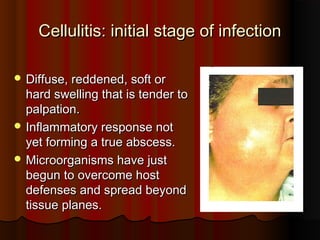
Cellulitis: initial stage of infectionCellulitis: initial stage of infection
 Diffuse, reddened, soft orDiffuse, reddened, soft or
hard swelling that is tender tohard swelling that is tender to
palpation.palpation.
 Inflammatory response notInflammatory response not
yet forming a true abscess.yet forming a true abscess.
 Microorganisms have justMicroorganisms have just
begun to overcome hostbegun to overcome host
defenses and spread beyonddefenses and spread beyond
tissue planes.tissue planes.
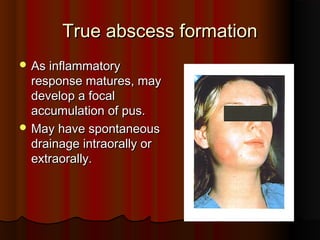
True abscess formationTrue abscess formation
 As inflammatoryAs inflammatory
response matures, mayresponse matures, may
develop a focaldevelop a focal
accumulation of pus.accumulation of pus.
 May have spontaneousMay have spontaneous
drainage intraorally ordrainage intraorally or
extraorally.extraorally.
Clinical FeaturesClinical Features
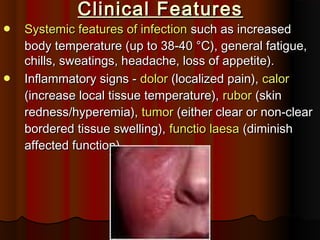
 Systemic features of infectionSystemic features of infection such as increasedsuch as increased
body temperature (up to 38-40 °C), general fatigue,body temperature (up to 38-40 °C), general fatigue,
chills, sweatings, headache, loss of appetite).chills, sweatings, headache, loss of appetite).
 Inflammatory signs -Inflammatory signs - dolordolor (localized pain),(localized pain), calorcalor
(increase local tissue temperature),(increase local tissue temperature), ruborrubor (skin(skin
redness/hyperemia),redness/hyperemia), tumortumor (either clear or non-clear(either clear or non-clear
bordered tissue swelling),bordered tissue swelling), functio laesafunctio laesa (diminish(diminish
affected function).affected function).
CausesCauses
1.1. Cellulitis is caused by a type ofCellulitis is caused by a type of bacteriabacteria entering the skin, usually by way of a cut, abrasion,entering the skin, usually by way of a cut, abrasion,
or break in the skin. This break does not need to be visible.or break in the skin. This break does not need to be visible. Group AGroup A StreptococcusStreptococcus andand
StaphylococcusStaphylococcus are the most common of these bacteria, which are part of the normal flora ofare the most common of these bacteria, which are part of the normal flora of
the skin but cause no actual infection while on the skin's outer surface.the skin but cause no actual infection while on the skin's outer surface.
2.2. Predisposing conditions for cellulitis include insect bites,Predisposing conditions for cellulitis include insect bites, blisteringblistering, animal bite,, animal bite, tattoostattoos,,
pruriticpruritic (itchy) skin rash, recent(itchy) skin rash, recent surgerysurgery,, athlete's footathlete's foot,, dry skindry skin,, eczemaeczema, injecting drugs, injecting drugs
(especially subcutaneous or intramuscular injection or where an attempted IV injection(especially subcutaneous or intramuscular injection or where an attempted IV injection
"misses" or blows the vein), pregnancy, diabetes and obesity, which can affect circulation, as"misses" or blows the vein), pregnancy, diabetes and obesity, which can affect circulation, as
well as burns andwell as burns and boilsboils, though there is debate as to whether minor foot lesions contribute., though there is debate as to whether minor foot lesions contribute.
Spider bitesSpider bites are also known to cause cellulitis.are also known to cause cellulitis.
3.3. Occurrences of cellulitis may also be associated with the rare conditionOccurrences of cellulitis may also be associated with the rare condition
Hidradenitis SuppurativaHidradenitis Suppurativa..
4.4. The photos shown here of Cellulitis are of mild cases and are not representative of earlierThe photos shown here of Cellulitis are of mild cases and are not representative of earlier
stages of the disease. Usually the itch and/or rash appears a little after it vanishes leavingstages of the disease. Usually the itch and/or rash appears a little after it vanishes leaving
only a small mark which is commonly ignored.only a small mark which is commonly ignored.
5.5. The appearance of the skin will assist a doctor in determining a diagnosis. A doctor may alsoThe appearance of the skin will assist a doctor in determining a diagnosis. A doctor may also
suggest blood tests, a wound culture or other tests to help rule out a blood clot deep in thesuggest blood tests, a wound culture or other tests to help rule out a blood clot deep in the
veins of the legs. Cellulitis in the lower leg is characterized by signs and symptoms that mayveins of the legs. Cellulitis in the lower leg is characterized by signs and symptoms that may
be similar to those of a clot occurring deep in the veins, such as warmth, pain and swellingbe similar to those of a clot occurring deep in the veins, such as warmth, pain and swelling
(inflammation).(inflammation).
6.6. This reddened skin or rash may signal a deeper, more serious infection of the inner layers ofThis reddened skin or rash may signal a deeper, more serious infection of the inner layers of
skin. Once below the skin, the bacteria can spread rapidly, entering the lymph nodes and theskin. Once below the skin, the bacteria can spread rapidly, entering the lymph nodes and the
bloodstream and spreading throughout the body.This can result in flu like symptoms with abloodstream and spreading throughout the body.This can result in flu like symptoms with a
high temperature and sweating or feeling very cold with shaking as the sufferer cannot gethigh temperature and sweating or feeling very cold with shaking as the sufferer cannot get
warm.warm.
7.7. In rare cases, the infection can spread to the deep layer of tissue called the fascial lining.In rare cases, the infection can spread to the deep layer of tissue called the fascial lining.
Necrotizing fasciitisNecrotizing fasciitis, also called by the media "flesh-eating bacteria," is an example of a, also called by the media "flesh-eating bacteria," is an example of a
deep-layer infection. It represents an extremedeep-layer infection. It represents an extreme medical emergencymedical emergency..
Histological featuresHistological features
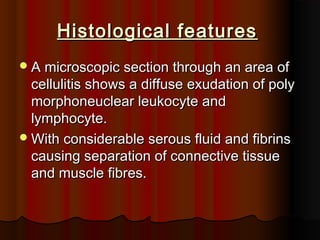
A microscopic section through an area ofA microscopic section through an area of
cellulitis shows a diffuse exudation of polycellulitis shows a diffuse exudation of poly
morphoneuclear leukocyte andmorphoneuclear leukocyte and
lymphocyte.lymphocyte.
With considerable serous fluid and fibrinsWith considerable serous fluid and fibrins
causing separation of connective tissuecausing separation of connective tissue
and muscle fibres.and muscle fibres.
TreatmentTreatment
1.1. Treatment consists of resting the affected area,Treatment consists of resting the affected area,
cutting away dead tissue, and antibiotics (either oralcutting away dead tissue, and antibiotics (either oral
oror intravenousintravenous).).
2.2. FlucloxacillinFlucloxacillin oror DicloxacillinDicloxacillin monotherapy (to covermonotherapy (to cover
staphylococcal infection) is often sufficient in mildstaphylococcal infection) is often sufficient in mild
cellulitis, but in more moderate cases, or wherecellulitis, but in more moderate cases, or where
streptococcalstreptococcal infection is suspected, then thisinfection is suspected, then this
course is usually combined with oralcourse is usually combined with oral
phenoxymethylpenicillinphenoxymethylpenicillin or intravenousor intravenous
benzylpenicillinbenzylpenicillin, or, or ampicillinampicillin//amoxicillinamoxicillin
3.3. Pain relief is also often prescribed, but excessivePain relief is also often prescribed, but excessive
pain should always be investigated as it is apain should always be investigated as it is a
symptom ofsymptom of necrotising fasciitisnecrotising fasciitis, ., .
4.4. As in other maladies characterized by wounds orAs in other maladies characterized by wounds or
tissue destruction,tissue destruction, hyperbaric oxygenhyperbaric oxygen treatment cantreatment can
be a valuable adjunctive therapy, but is not widelybe a valuable adjunctive therapy, but is not widely
PrognosisPrognosis
Antibiotic therapy usually provides promptAntibiotic therapy usually provides prompt
and complete resolution of cellulitis. If leftand complete resolution of cellulitis. If left
untreated, cellulitis can occasionally killuntreated, cellulitis can occasionally kill
the tissue (the tissue (gangrenegangrene), and/or the bacteria), and/or the bacteria
may enter the bloodstream (may enter the bloodstream (bacteremiabacteremia))
and multiply, causing a serious, systemic,and multiply, causing a serious, systemic,
life-threatening condition (life-threatening condition (sepsissepsis).).
ComplicationsComplications
1.1. Cellulitis can progress to lymphangitis,Cellulitis can progress to lymphangitis, abscessabscess formation,formation,
or sepsis.or sepsis.
2.2. Infection by additional species of bacteria (superinfection)Infection by additional species of bacteria (superinfection)
may occur, complicating treatment. Infection can alsomay occur, complicating treatment. Infection can also
spread to the layer of tissue enveloping muscles (fascia),spread to the layer of tissue enveloping muscles (fascia),
causing a serious infection (necrotizing fasciitis) Cellulitis ofcausing a serious infection (necrotizing fasciitis) Cellulitis of
the scalp may cause scarring, leading to hair loss (the scalp may cause scarring, leading to hair loss (alopeciaalopecia
).).
3.3. Orbital cellulitis may progress toOrbital cellulitis may progress to blindnessblindness, cavernous sinus, cavernous sinus
clots (clots (thrombosisthrombosis), or inflammation of all tissues of the eye), or inflammation of all tissues of the eye
(panophthalmitis).(panophthalmitis).
4.4. Infection may spread from the orbit to the brain or tissuesInfection may spread from the orbit to the brain or tissues
lining the brain and spinal cord (lining the brain and spinal cord (meningesmeninges).).
5.5. Older individuals may develop a blood clot (Older individuals may develop a blood clot (
thrombophlebitisthrombophlebitis) as a result of cellulitis in more superficial) as a result of cellulitis in more superficial
tissues.tissues.
Infection spreadInfection spread
via tissuevia tissue
spacesspaces
General ConsiderationsGeneral Considerations
Common types of infection:Common types of infection:
 Periapical, peridontal, postsurgical, pericoronalPeriapical, peridontal, postsurgical, pericoronal
May begin as well-delineated, self-limiting conditionMay begin as well-delineated, self-limiting condition
with potential to spread and result in a major fascialwith potential to spread and result in a major fascial
space infection.space infection.
Life-threatening sequelae can ensue:Life-threatening sequelae can ensue:
 Septicemia, cavernous sinus thrombosis, airway obstruction,Septicemia, cavernous sinus thrombosis, airway obstruction,
mediastinitismediastinitis
MicrobiologyMicrobiology
Odontogenic infections are multimicrobial:Odontogenic infections are multimicrobial:
Gram (+) cocci, aerobic and anaerobic:Gram (+) cocci, aerobic and anaerobic:
Streptococci and their anaerobic counterpart,Streptococci and their anaerobic counterpart,
peptostreptococcipeptostreptococci
Staphylococci, and their anaerobic counterpart,Staphylococci, and their anaerobic counterpart,
peptococcipeptococci
Gram (+) rods:Gram (+) rods:
Lactobacillus, diphtheroids, ActinomycesLactobacillus, diphtheroids, Actinomyces
Gram (-) rods:Gram (-) rods:
Fusobacterium, Bacteroids, Eikenella,Fusobacterium, Bacteroids, Eikenella,
Psuedomonas (occasional)Psuedomonas (occasional)
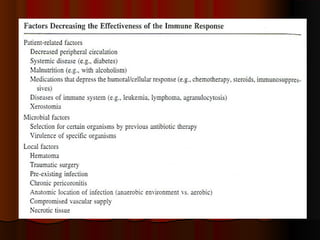
Host FactorsHost Factors
Immunity against intraoral infection isImmunity against intraoral infection is
composed of three sets ofcomposed of three sets of
mechanisms:mechanisms:
Humoral factorsHumoral factors
Cellular factorsCellular factors
Local factorsLocal factors
Decrease one of these mechanisms andDecrease one of these mechanisms and
it increases the potential for infection.it increases the potential for infection.
Humoral FactorsHumoral Factors
Circulating immunoglobulins, along withCirculating immunoglobulins, along with
complement, combine with microbes tocomplement, combine with microbes to
form opsonins that promote phagocytosisform opsonins that promote phagocytosis
by macrophages.by macrophages.
IgA prevents colonization of microbes onIgA prevents colonization of microbes on
oral mucosal surfaces.oral mucosal surfaces.
In presence of infection, histamine,In presence of infection, histamine,
serotonin, prostaglandins supportserotonin, prostaglandins support
inflammationinflammation →→ vasodilation and increasedvasodilation and increased
vascular permeability.vascular permeability.
Cellular factorsCellular factors
Phagocytes engulf and kill microbes,Phagocytes engulf and kill microbes,
removing them, preventing replication.removing them, preventing replication.
Lymphocytes produce lymphokines andLymphocytes produce lymphokines and
immunoglobulines (aids humoral).immunoglobulines (aids humoral).
Lymphokines stimulate reproduction ofLymphokines stimulate reproduction of
other lymphocytes, and kills antigens.other lymphocytes, and kills antigens.
Local FactorsLocal Factors
Specific factors leading to resistance:Specific factors leading to resistance:
Abundant vascular supply allowing humoral andAbundant vascular supply allowing humoral and
cellular response.cellular response.
Mechanical cleansing by salivary flow.Mechanical cleansing by salivary flow.
Secretory IgA contained within saliva.Secretory IgA contained within saliva.
High epithelial turnover and sloughing, taking with itHigh epithelial turnover and sloughing, taking with it
adherent bacteria.adherent bacteria.
A variety of microflora normally preventing selectionA variety of microflora normally preventing selection
for a single organism by competing for nutrients orfor a single organism by competing for nutrients or
release of by-products.release of by-products.
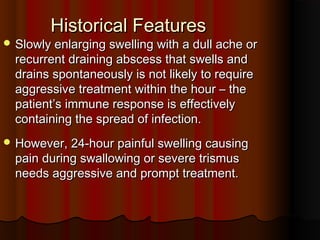
Historical FeaturesHistorical Features
 Slowly enlarging swelling with a dull ache orSlowly enlarging swelling with a dull ache or
recurrent draining abscess that swells andrecurrent draining abscess that swells and
drains spontaneously is not likely to requiredrains spontaneously is not likely to require
aggressive treatment within the hour – theaggressive treatment within the hour – the
patient’s immune response is effectivelypatient’s immune response is effectively
containing the spread of infection.containing the spread of infection.
 However, 24-hour painful swelling causingHowever, 24-hour painful swelling causing
pain during swallowing or severe trismuspain during swallowing or severe trismus
needs aggressive and prompt treatment.needs aggressive and prompt treatment.
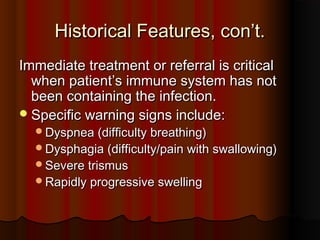
Historical Features, con’t.Historical Features, con’t.
Immediate treatment or referral is criticalImmediate treatment or referral is critical
when patient’s immune system has notwhen patient’s immune system has not
been containing the infection.been containing the infection.
Specific warning signs include:Specific warning signs include:
Dyspnea (difficulty breathing)Dyspnea (difficulty breathing)
Dysphagia (difficulty/pain with swallowing)Dysphagia (difficulty/pain with swallowing)
Severe trismusSevere trismus
Rapidly progressive swellingRapidly progressive swelling
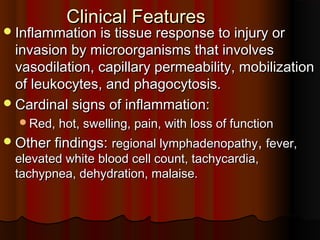
Clinical FeaturesClinical Features
Inflammation is tissue response to injury orInflammation is tissue response to injury or
invasion by microorganisms that involvesinvasion by microorganisms that involves
vasodilation, capillary permeability, mobilizationvasodilation, capillary permeability, mobilization
of leukocytes, and phagocytosis.of leukocytes, and phagocytosis.
Cardinal signs of inflammation:Cardinal signs of inflammation:
Red, hot, swelling, pain, with loss of functionRed, hot, swelling, pain, with loss of function
Other findings:Other findings: regional lymphadenopathyregional lymphadenopathy,, fever,fever,
elevated white blood cell count, tachycardia,elevated white blood cell count, tachycardia,
tachypnea, dehydration, malaise.tachypnea, dehydration, malaise.
Infection can spread via the blood, lymphInfection can spread via the blood, lymph
and the tissue spaces. In dentistry, theand the tissue spaces. In dentistry, the
most relevant tissue spaces are the:most relevant tissue spaces are the:
1.1. Pterygomandibular spacePterygomandibular space
2.2. Lateral pharyngeal spaceLateral pharyngeal space
3.3. Retropharyngeal spaceRetropharyngeal space
4.4. Infratemporal fossaInfratemporal fossa
5.5. Buccal spaceBuccal space
6.6. Vestibular spaceVestibular space
7.7. Sublingual spaceSublingual space
8.8. Submandibular spaceSubmandibular space
9.9. Submental spaceSubmental space
NOTE :NOTE :
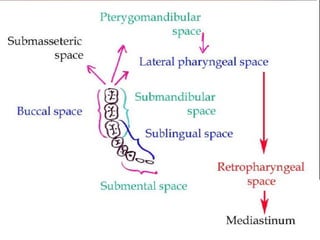
1.1. Many of these spaces run into each other,Many of these spaces run into each other,
allowing infection to spread from one spaceallowing infection to spread from one space
to another.to another.
2.2. For example, an infection from a wisdomFor example, an infection from a wisdom
tooth can spread to the pterygomandibulartooth can spread to the pterygomandibular
space and from there it can travel to thespace and from there it can travel to the
lateral pharyngeal space, then to thelateral pharyngeal space, then to the
retropharyngeal space and even to theretropharyngeal space and even to the
mediastinummediastinum..
3.3. Infection can also spread to theInfection can also spread to the
pterygomandibular space and lateralpterygomandibular space and lateral
pharyngeal space from the infratemporalpharyngeal space from the infratemporal
fossa.fossa.
Infection spread fromInfection spread from
maxillary teethmaxillary teeth
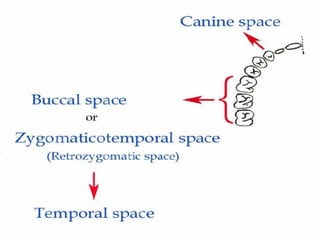
1.1. Infections from the maxillary teeth can spread to theInfections from the maxillary teeth can spread to the
maxillary sinus, the canine fossa, palatal space,maxillary sinus, the canine fossa, palatal space,
infratemporal fossa, buccal space and vestibularinfratemporal fossa, buccal space and vestibular
space.space.
2.2. Infection will spread to the buccal space if theInfection will spread to the buccal space if the
infection's path is outside the attachment of theinfection's path is outside the attachment of the
buccinator muscle, but will spread to the vestibularbuccinator muscle, but will spread to the vestibular
space if the infection's path is inside the attachmentspace if the infection's path is inside the attachment
of the buccinator muscle.of the buccinator muscle.
3.3. Infection can spread to the cavernous sinus from theInfection can spread to the cavernous sinus from the
infratemporal fossa and from the canine fossa.infratemporal fossa and from the canine fossa.
Infection in the cavernous sinus can lead toInfection in the cavernous sinus can lead to
cavernous sinus thrombosiscavernous sinus thrombosis, which is potentially, which is potentially
fatal.fatal.
Infection spread fromInfection spread from
mandibular teethmandibular teeth
1.1. Infections from mandibular teeth can spread to theInfections from mandibular teeth can spread to the
vestibular and buccal space in the same way as from thevestibular and buccal space in the same way as from the
maxillary teeth.maxillary teeth.
2.2. Infection can also spread to the pterygomandibular space,Infection can also spread to the pterygomandibular space,
sublingual space, submandibular space and submentalsublingual space, submandibular space and submental
space.space.
3.3. The sublingual, submental and submandibular spaces canThe sublingual, submental and submandibular spaces can
be referred collectively as the submandibular spaces.be referred collectively as the submandibular spaces.
4.4. Sometimes when an infection spreads to the submandibularSometimes when an infection spreads to the submandibular
spaces a life threatening condition called Ludwig's anginaspaces a life threatening condition called Ludwig's angina
occurs. Angina is latin for strangle therefore this angina isoccurs. Angina is latin for strangle therefore this angina is
referring to the sensation of being strangled caused by thereferring to the sensation of being strangled caused by the
swelling of the neck region. Tracheotomy is sometimesswelling of the neck region. Tracheotomy is sometimes
necessary to maintain the airway.necessary to maintain the airway.
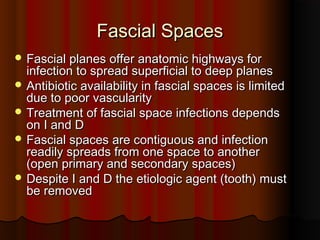
Fascial SpacesFascial Spaces
 Fascial planes offer anatomic highways forFascial planes offer anatomic highways for
infection to spread superficial to deep planesinfection to spread superficial to deep planes
 Antibiotic availability in fascial spaces is limitedAntibiotic availability in fascial spaces is limited
due to poor vascularitydue to poor vascularity
 Treatment of fascial space infections dependsTreatment of fascial space infections depends
on I and Don I and D
 Fascial spaces are contiguous and infectionFascial spaces are contiguous and infection
readily spreads from one space to anotherreadily spreads from one space to another
(open primary and secondary spaces)(open primary and secondary spaces)
 Despite I and D the etiologic agent (tooth) mustDespite I and D the etiologic agent (tooth) must
be removedbe removed
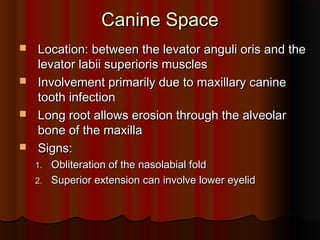
Canine SpaceCanine Space
 Location: between the levator anguli oris and theLocation: between the levator anguli oris and the
levator labii superioris muscleslevator labii superioris muscles
 Involvement primarily due to maxillary canineInvolvement primarily due to maxillary canine
tooth infectiontooth infection
 Long root allows erosion through the alveolarLong root allows erosion through the alveolar
bone of the maxillabone of the maxilla
 Signs:Signs:
1.1. Obliteration of the nasolabial foldObliteration of the nasolabial fold
2.2. Superior extension can involve lower eyelidSuperior extension can involve lower eyelid
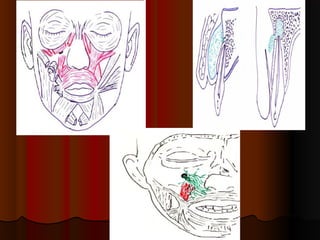
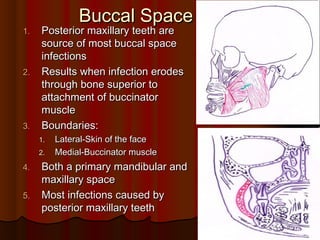
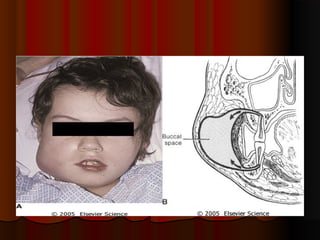
Buccal SpaceBuccal Space
1.1. Posterior maxillary teeth arePosterior maxillary teeth are
source of most buccal spacesource of most buccal space
infectionsinfections
2.2. Results when infection erodesResults when infection erodes
through bone superior tothrough bone superior to
attachment of buccinatorattachment of buccinator
musclemuscle
3.3. Boundaries:Boundaries:
1.1. Lateral-Skin of the faceLateral-Skin of the face
2.2. Medial-Buccinator muscleMedial-Buccinator muscle
4.4. Both a primary mandibular andBoth a primary mandibular and
maxillary spacemaxillary space
5.5. Most infections caused byMost infections caused by
posterior maxillary teethposterior maxillary teeth
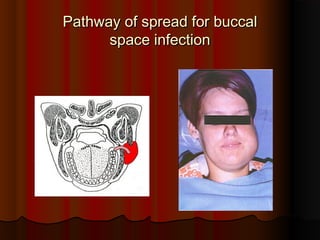
Pathway of spread for buccalPathway of spread for buccal
space infectionspace infection
Infratemproal spaceInfratemproal space
 Infratemproal space is aInfratemproal space is a
potential space lying behindpotential space lying behind
the maxilla.the maxilla.
 Boundaries of infratemporalBoundaries of infratemporal
fossa:fossa:
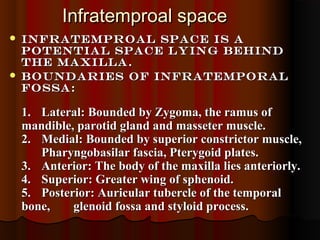
1.1. Lateral: Bounded by Zygoma, the ramus ofLateral: Bounded by Zygoma, the ramus of
mandible, parotid gland and masseter muscle.mandible, parotid gland and masseter muscle.
2.2. Medial: Bounded by superior constrictor muscle,Medial: Bounded by superior constrictor muscle,
Pharyngobasilar fascia, Pterygoid plates.Pharyngobasilar fascia, Pterygoid plates.
3.3. Anterior: The body of the maxilla lies anteriorly.Anterior: The body of the maxilla lies anteriorly.
4.4. Superior: Greater wing of sphenoid.Superior: Greater wing of sphenoid.
5.5. Posterior: Auricular tubercle of the temporalPosterior: Auricular tubercle of the temporal
bone,bone, glenoid fossa and styloid process.glenoid fossa and styloid process.
INFECTION OF INFRATEMPORALINFECTION OF INFRATEMPORAL
SPACESPACE
 Infective complications can develop and presentInfective complications can develop and present
following the extraction of clinically non-infected teethfollowing the extraction of clinically non-infected teeth
 Infratemporal space infection is a rare complication ofInfratemporal space infection is a rare complication of
dental extractiondental extraction
 The cardinal clinical signs of maxillary andThe cardinal clinical signs of maxillary and
mandibular neurosensory deficit may not bemandibular neurosensory deficit may not be
immediately apparentimmediately apparent
 The diagnosis, as in this case, can only be confirmedThe diagnosis, as in this case, can only be confirmed
using scanning imaging modalities (CT or MRI)using scanning imaging modalities (CT or MRI)
Clinical features :-Clinical features :-
Severe trismusSevere trismus
Buldging of temporalis muscleBuldging of temporalis muscle
Swelling extraorally over the region of sigmoiSwelling extraorally over the region of sigmoi
notch and intraorally in tuberosity region.notch and intraorally in tuberosity region.
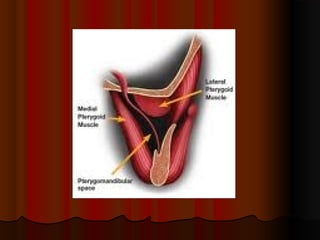
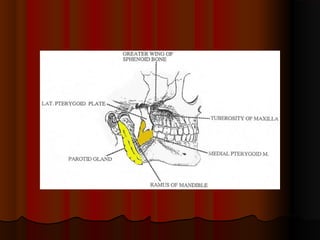
Pterygomandibular spacePterygomandibular space
The space between the medial area of theThe space between the medial area of the
mandible and the medial pterygoidmandible and the medial pterygoid
muscle, a target area for administeringmuscle, a target area for administering
local anesthesia to the inferior alveolarlocal anesthesia to the inferior alveolar
nerve.nerve.
Boundries of pterygomandibularBoundries of pterygomandibular
spacespace
1.1. Medially – medial pterygoid muscleMedially – medial pterygoid muscle
2.2. Laterally – medial surface of ramus of mandibleLaterally – medial surface of ramus of mandible
3.3. Superiorly – lateral pterygoidSuperiorly – lateral pterygoid
4.4. Posteriorly – deep lobe of parotid glandPosteriorly – deep lobe of parotid gland
5.5. Inferiorly – attachment of medial pterygoid otoInferiorly – attachment of medial pterygoid oto
the mandiblethe mandible
6.6. Anteriorly – pterygomandibular rapheAnteriorly – pterygomandibular raphe
infectioninfection
 From lower third molarFrom lower third molar
 Clinical features :-Clinical features :-
1.1. TrismusTrismus
2.2. Intraoral sweeling in the medial aspect ofIntraoral sweeling in the medial aspect of
ramus of mandibleramus of mandible
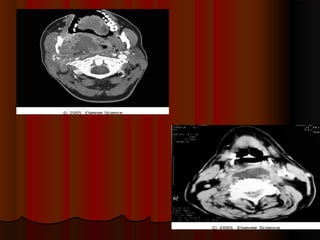
Retropharyngeal SpaceRetropharyngeal Space
1.1. Posteromedial to lateral pharyngeal space and anteriorPosteromedial to lateral pharyngeal space and anterior
to the prevertebral spaceto the prevertebral space
2.2. Anterior: superior pharyngeal constrictor muscleAnterior: superior pharyngeal constrictor muscle
3.3. Posterior: alar layer of prevertebral fasciaPosterior: alar layer of prevertebral fascia
4.4. Extends from skull base superiorly to C7 to T1 inferiorlyExtends from skull base superiorly to C7 to T1 inferiorly
5.5. Retropharyngeal space infections can spread toRetropharyngeal space infections can spread to
mediastinummediastinum
6.6. Other complications of retropharyngeal spaceOther complications of retropharyngeal space
involvement:involvement:
1.1. Airway obstructionAirway obstruction
2.2. Aspiration of pus in the event of spontaneous ruptureAspiration of pus in the event of spontaneous rupture
3.3. Rupture can occur during endotracheal intubationRupture can occur during endotracheal intubation
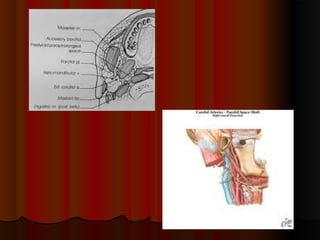
Parotid spaceParotid space
 AA deepdeep hollowhollow on theon the sideside at the sides of theat the sides of the faceface
flanking theflanking the posteriorposterior aspectaspect of theof the ramusramus
of the mandibleof the mandible with its attachedwith its attached musclesmuscles which iswhich is
occupied by theoccupied by the parotid glandparotid gland; it is lined with; it is lined with
fascialfascial laminae (thelaminae (the parotid sheathparotid sheath) derived from) derived from
thethe investing layerinvesting layer of deepof deep cervical fasciacervical fascia; the; the
structuresstructures bounding thebounding the spacespace collectivelycollectively
constitute theconstitute the parotid bedparotid bed.. SurgeonsSurgeons operating inoperating in
thethe areaarea taketake advantage of the fact that theadvantage of the fact that the
anteroposterioranteroposterior dimensionsdimensions of theof the parotidparotid spacespace
increaseincrease withwith protrusionprotrusion of theof the mandiblemandible..
Clinical featuresClinical features
1.1. Facial swelling and progressive trismusFacial swelling and progressive trismus
are described.are described.
2.2. Intraoral wound drainage and prolongedIntraoral wound drainage and prolonged
antibiotic therapy failed to control theantibiotic therapy failed to control the
resultant chronic cellulitis.resultant chronic cellulitis.
Submental spaceSubmental space
1.1. Infection can result directly due to infectedInfection can result directly due to infected
mandibular incisor or indirectly from themandibular incisor or indirectly from the
submandibular spacesubmandibular space
2.2. Space located between the anterior bellies of theSpace located between the anterior bellies of the
digastric muscle laterally, deeply by the mylohyoiddigastric muscle laterally, deeply by the mylohyoid
muscle, and superiorly by the deep cervical fascia,muscle, and superiorly by the deep cervical fascia,
the platysma muscle, the superficial cervical fascia,the platysma muscle, the superficial cervical fascia,
and the skinand the skin
3.3. Dependent drainage of this space is performed byDependent drainage of this space is performed by
placing a horizontal incision in the most dependentplacing a horizontal incision in the most dependent
area of the swelling extraorally with a cosmetic scararea of the swelling extraorally with a cosmetic scar
being the resultbeing the result
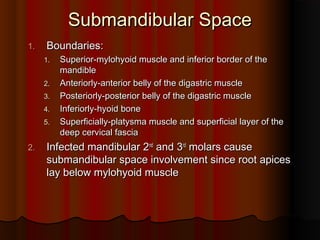
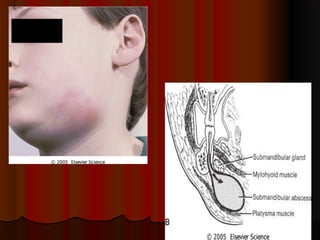
Submandibular SpaceSubmandibular Space
1.1. Boundaries:Boundaries:
1.1. Superior-mylohyoid muscle and inferior border of theSuperior-mylohyoid muscle and inferior border of the
mandiblemandible
2.2. Anteriorly-anterior belly of the digastric muscleAnteriorly-anterior belly of the digastric muscle
3.3. Posteriorly-posterior belly of the digastric musclePosteriorly-posterior belly of the digastric muscle
4.4. Inferiorly-hyoid boneInferiorly-hyoid bone
5.5. Superficially-platysma muscle and superficial layer of theSuperficially-platysma muscle and superficial layer of the
deep cervical fasciadeep cervical fascia
2.2. Infected mandibular 2Infected mandibular 2ndnd
and 3and 3rdrd
molars causemolars cause
submandibular space involvement since root apicessubmandibular space involvement since root apices
lay below mylohyoid musclelay below mylohyoid muscle
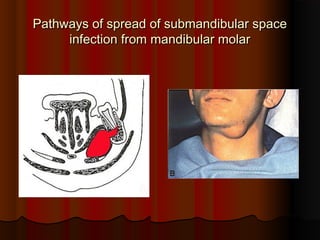
Pathways of spread of submandibular spacePathways of spread of submandibular space
infection from mandibular molarinfection from mandibular molar
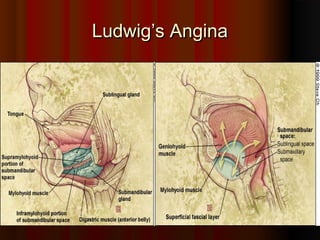
Sublingual SpaceSublingual Space
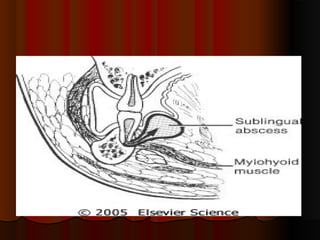
1.1. Submandibular and sublingual spacesSubmandibular and sublingual spaces
surgically distinct, but should be considered assurgically distinct, but should be considered as
surgical unit due to proximity and frequent dualsurgical unit due to proximity and frequent dual
involvement in odontogenic infections.involvement in odontogenic infections.
2.2. Boundaries:Boundaries:
1.1. Superior-oral mucosaSuperior-oral mucosa
2.2. Inferior-mylohyoid muscleInferior-mylohyoid muscle
3.3. Infected premolar and 1Infected premolar and 1stst
molar teeth frequentlymolar teeth frequently
drain into this space due to their root apicesdrain into this space due to their root apices
existing superior to the mylohyoid muscleexisting superior to the mylohyoid muscle
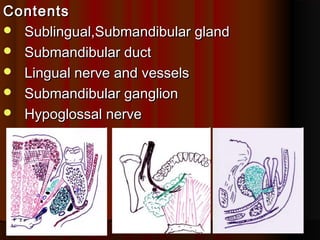
ContentsContents
 Sublingual,Submandibular glandSublingual,Submandibular gland
 Submandibular ductSubmandibular duct
 Lingual nerve and vesselsLingual nerve and vessels
 Submandibular ganglionSubmandibular ganglion
 Hypoglossal nerveHypoglossal nerve
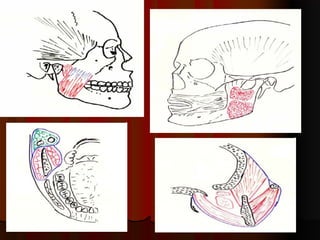
Masseteric SpaceMasseteric Space
1.1. Located between lateral aspect of theLocated between lateral aspect of the
mandible and the masseter musclemandible and the masseter muscle
2.2. Involvement of this space generally occursInvolvement of this space generally occurs
from buccal space primary involvementfrom buccal space primary involvement
3.3. Signs of involvement of the masseteric spaceSigns of involvement of the masseteric space
include trismus and posterior-inferior faceinclude trismus and posterior-inferior face
swellingswelling
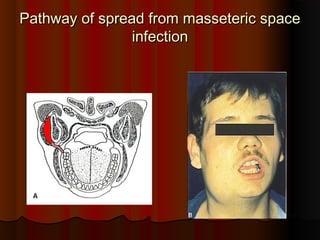
Pathway of spread from masseteric spacePathway of spread from masseteric space
infectioninfection
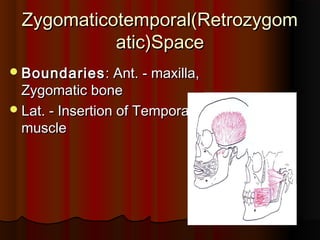
Zygomaticotemporal(RetrozygomZygomaticotemporal(Retrozygom
atic)Spaceatic)Space
BoundariesBoundaries: Ant. - maxilla,: Ant. - maxilla,
Zygomatic boneZygomatic bone
Lat. - Insertion of TemporalisLat. - Insertion of Temporalis
musclemuscle
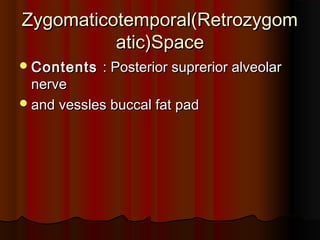
Zygomaticotemporal(RetrozygomZygomaticotemporal(Retrozygom
atic)Spaceatic)Space
ContentsContents : Posterior suprerior alveolar: Posterior suprerior alveolar
nervenerve
and vessles buccal fat padand vessles buccal fat pad
Oral tissue examinationOral tissue examination
Examine quality and consistency:Examine quality and consistency:
Soft to fluctuant (fluid filled) to hard (indurated)Soft to fluctuant (fluid filled) to hard (indurated)
Color and temperature determine the presenceColor and temperature determine the presence
and extent of infectionand extent of infection
Normal v abnormal tissue architecture:Normal v abnormal tissue architecture:
Distortion of mucobuccal foldDistortion of mucobuccal fold
Soft palate symmetric with uvula in midlineSoft palate symmetric with uvula in midline (deviation(deviation
→ involvement of lateral pharyngeal space)→ involvement of lateral pharyngeal space)
Nasal tip, nasolabial fold, circumorbital areasNasal tip, nasolabial fold, circumorbital areas
Examination, con’t.Examination, con’t.
Identify causative factors:Identify causative factors:
Tooth, root tip, foreign body, etc.Tooth, root tip, foreign body, etc.
Vital signs should be taken:Vital signs should be taken:
TemperaturesTemperatures >> 101 to 102101 to 102°F°F
accompanied by an elevated heart rateaccompanied by an elevated heart rate
indicate systemic involvement of theindicate systemic involvement of the
infection and increased urgency ofinfection and increased urgency of
treatment.treatment.
Principles in Treatment of OralPrinciples in Treatment of Oral
InfectionsInfections
1.1. Remove the cause.Remove the cause.
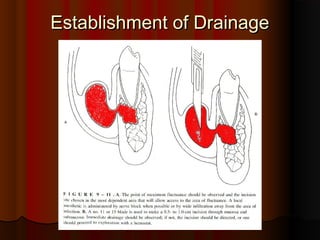
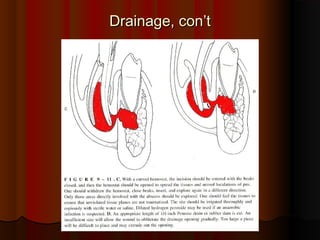
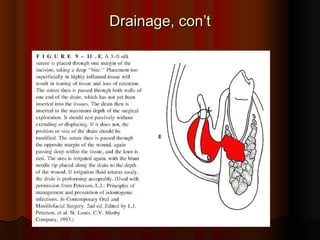
2.2. Establish drainage.Establish drainage.
3.3. Institute antibiotic therapy.Institute antibiotic therapy.
4.4. Supportive care, including proper restSupportive care, including proper rest
and nutrition.and nutrition.
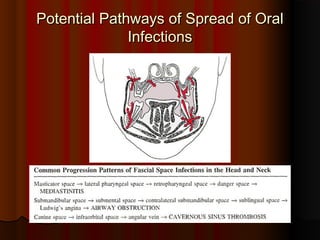
Potential Pathways of Spread of OralPotential Pathways of Spread of Oral
InfectionsInfections
Establishment of DrainageEstablishment of Drainage
Drainage, con’tDrainage, con’t
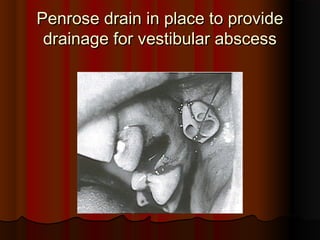
Penrose drain in place to providePenrose drain in place to provide
drainage for vestibular abscessdrainage for vestibular abscess
Antibiotic TherapyAntibiotic Therapy
Removal of the cause, drainage, andRemoval of the cause, drainage, and
supportive care more important thansupportive care more important than
antibiotic therapy.antibiotic therapy.
Infections are cured by the patient’sInfections are cured by the patient’s
defenses,defenses, notnot antibiotics.antibiotics.
Risks of allergy, toxicity, side effects,Risks of allergy, toxicity, side effects,
resistance and superinfection causingresistance and superinfection causing
serious or potentially fatal consequencesserious or potentially fatal consequences
must be considered.must be considered.
Antibiotic therapy, con’t.Antibiotic therapy, con’t.
Oral infections are typically polymicrobial.Oral infections are typically polymicrobial.
Antibiotic effectiveness dependent uponAntibiotic effectiveness dependent upon
adequate tissue (not serum) concentration foradequate tissue (not serum) concentration for
an appropriate amount of time.an appropriate amount of time.
Antibiotics should be prescribed for at leastAntibiotics should be prescribed for at least
one week – adequate tissue concentrationone week – adequate tissue concentration
achieved in 24-48 hours, with bacteriocidalachieved in 24-48 hours, with bacteriocidal
activity occurring over the next 3-5 days.activity occurring over the next 3-5 days.
Antibiotic therapy, con’t.Antibiotic therapy, con’t.
PenicillinPenicillin (bacteriocidal) drug of choice for(bacteriocidal) drug of choice for
treatment of odontogenic infections (5% incidenttreatment of odontogenic infections (5% incident
of allergy).of allergy).
ClindamycinClindamycin (batericiodal) 1(batericiodal) 1stst
line afterline after
penicillin; effective against anaerobes; stop takingpenicillin; effective against anaerobes; stop taking
at first sign of diarrhea.at first sign of diarrhea.
CephalosporinCephalosporin (slightly broader spectrum(slightly broader spectrum
and bacteriocidal); cautious use in penicillin-and bacteriocidal); cautious use in penicillin-
allergic patientsallergic patients → cross-sensitivity; if history of→ cross-sensitivity; if history of
anaphylaxis to penicillin, do not use.anaphylaxis to penicillin, do not use.
Antibiotic therapy, con’t.Antibiotic therapy, con’t.
ErythromycinErythromycin (bacteriostatic) good 2(bacteriostatic) good 2ndnd
lineline
drug after penicillin; use enteric-coated todrug after penicillin; use enteric-coated to
reduce GI upset.reduce GI upset.
MetronidazoleMetronidazole (bacteriocidal) excellent(bacteriocidal) excellent
against anaerobes only.against anaerobes only.
AugmentinAugmentin (amoxicillin + clavulanic acid)(amoxicillin + clavulanic acid)
kills penicillinase-producing bacteria thatkills penicillinase-producing bacteria that
interferes with amoxicillin; expensive.interferes with amoxicillin; expensive.
Supportive CareSupportive Care
To ensure the patient’s maximum immuneTo ensure the patient’s maximum immune
response:response:
Increase fluid intake (16 ounces/hour).Increase fluid intake (16 ounces/hour).
Nutritional intake (soups, protein drinks, solids)Nutritional intake (soups, protein drinks, solids)
with three meals/day.with three meals/day.
May need to see patient daily, untilMay need to see patient daily, until
resolution has begun.resolution has begun.
If no improvement within 24- 48 hours, referIf no improvement within 24- 48 hours, refer
immediately to an oral and maxillofacialimmediately to an oral and maxillofacial
surgeon.surgeon.
Ludwig’s AnginaLudwig’s Angina
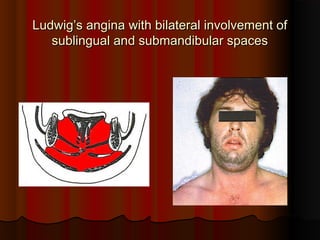
Ludwig’s angina with bilateral involvement ofLudwig’s angina with bilateral involvement of
sublingual and submandibular spacessublingual and submandibular spaces
DEFINATIONDEFINATION
 Ludwig's angina, otherwise known as angina ludovici, is aLudwig's angina, otherwise known as angina ludovici, is a
serious, potentially life-threateningserious, potentially life-threatening cellulitiscellulitis[1][1], or, or
connective tissue infection, of the floor of the mouth,connective tissue infection, of the floor of the mouth,
usually occurring in adults with concomitant dentalusually occurring in adults with concomitant dental
infections. It is named after the German physician,infections. It is named after the German physician,
Wilhelm Friedrich von LudwigWilhelm Friedrich von Ludwig who first described thiswho first described this
condition in 1836.condition in 1836.[2][2][3][3] Other names include "anginaOther names include "angina
Maligna" and "Morbus Strangularis".Maligna" and "Morbus Strangularis".
 Ludwig's angina should not be confused withLudwig's angina should not be confused with
angina pectorisangina pectoris, which is also otherwise commonly known, which is also otherwise commonly known
as "as "anginaangina". The word "". The word "anginaangina" comes from the" comes from the GreekGreek
wordword ankhonankhon, meaning "strangling", so in this case,, meaning "strangling", so in this case,
Ludwig's angina refers to the feeling of strangling, not theLudwig's angina refers to the feeling of strangling, not the
feeling of chest pain, though there may be chest pain infeeling of chest pain, though there may be chest pain in
Ludwig's angina if the infection spreads into theLudwig's angina if the infection spreads into the
CausesCauses
 The cause is usually an infection withThe cause is usually an infection with StreptococcalStreptococcal bacteria,bacteria,
although other bacteria can cause the condition. Since thealthough other bacteria can cause the condition. Since the
advent ofadvent of antibioticsantibiotics, Ludwig's angina has become a rare, Ludwig's angina has become a rare
disease.disease.
 The route of infection in most cases is from infected lower thirdThe route of infection in most cases is from infected lower third
molarsmolars or fromor from pericoronitispericoronitis, which is an infection of the gums, which is an infection of the gums
surrounding the partially erupted lower third molars. Althoughsurrounding the partially erupted lower third molars. Although
the widespread involvement seen in Ludwig's is usuallythe widespread involvement seen in Ludwig's is usually
develops indevelops in immunocompromisedimmunocompromised persons, it can also developpersons, it can also develop
in otherwise healthy individuals. Thus, it is very important toin otherwise healthy individuals. Thus, it is very important to
obtain dental consultation for lower-third molars at the first signobtain dental consultation for lower-third molars at the first sign
of any pain, bleeding from the gums, sensitivity to heat/cold orof any pain, bleeding from the gums, sensitivity to heat/cold or
swelling at the angle of the jaw.swelling at the angle of the jaw.
 Ludwig's angina is also associated withLudwig's angina is also associated with piercingspiercings of theof the linguallingual
frenulumfrenulum..
SymptomsSymptoms
 The symptoms include swelling, pain and raising of theThe symptoms include swelling, pain and raising of the
tongue, swelling of the neck and the tissues of thetongue, swelling of the neck and the tissues of the
submandibular andsubmandibular and sublingual spacessublingual spaces, malaise,, malaise, feverfever,,
dysphagiadysphagia (difficulty swallowing) and, in severe cases,(difficulty swallowing) and, in severe cases,
stridor or difficulty breathing.stridor or difficulty breathing.
 Swelling of the submandibular and/or sublingual spacesSwelling of the submandibular and/or sublingual spaces
are distinctive in that they are hard and classicallyare distinctive in that they are hard and classically
'boardlike'. Important signs include the patient not being'boardlike'. Important signs include the patient not being
able to swallow his/her own saliva and the presence ofable to swallow his/her own saliva and the presence of
audible stridor as these strongly suggest that airwayaudible stridor as these strongly suggest that airway
compromise is imminent.compromise is imminent.
TreatmentTreatment
 Treatment involves appropriate antibiotic medications,Treatment involves appropriate antibiotic medications,
monitoring and protection of the airway in severemonitoring and protection of the airway in severe
cases, and, where appropriate, urgent maxillo-facialcases, and, where appropriate, urgent maxillo-facial
surgery and/or dental consultation to incise and drainsurgery and/or dental consultation to incise and drain
the collections.the collections.
 A nasotracheal tube is sometimes warranted forA nasotracheal tube is sometimes warranted for
ventilation if the tissues of the mouth make insertion ofventilation if the tissues of the mouth make insertion of
an oral airway difficult or impossible.an oral airway difficult or impossible.
 In cases where the patency of the airway isIn cases where the patency of the airway is
compromised, skilled airway management iscompromised, skilled airway management is
mandatory.mandatory.
 This entails management of the airway according to theThis entails management of the airway according to the
American Society of Anesthesiologists' "DifficultAmerican Society of Anesthesiologists' "Difficult
Airway Algorithm" and necessitates fiberopticAirway Algorithm" and necessitates fiberoptic
intubation.intubation.
MaxillaryMaxillary
SinusitisSinusitis
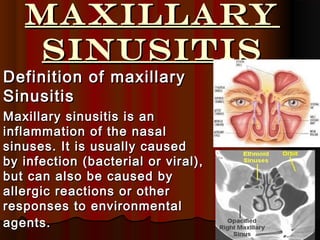
Definition of maxillaryDefinition of maxillary
SinusitisSinusitis
Maxillary sinusitis is anMaxillary sinusitis is an
inflammation of the nasalinflammation of the nasal
sinuses. It is usually causedsinuses. It is usually caused
by infection (bacterial or viral),by infection (bacterial or viral),
but can also be caused bybut can also be caused by
allergic reactions or otherallergic reactions or other
responses to environmentalresponses to environmental
agents.agents.
Causes and RiskCauses and Risk
Factors of maxillaryFactors of maxillary
SinusitisSinusitis Most maxillary sinusitis is caused by infection (such as aMost maxillary sinusitis is caused by infection (such as a
cold or an upper respiratory tract infection) spreading tocold or an upper respiratory tract infection) spreading to
the sinuses from the nose along the narrow passages thatthe sinuses from the nose along the narrow passages that
drain mucus from the sinuses into the nose.drain mucus from the sinuses into the nose.
 Allergies to dust, pollen, pet dander; indoor air pollutants,Allergies to dust, pollen, pet dander; indoor air pollutants,
such as cigarette smoke, rug shampoo and formaldehydesuch as cigarette smoke, rug shampoo and formaldehyde
(used in the manufacture of carpeting, particleboard and(used in the manufacture of carpeting, particleboard and
plywood); and outdoor air pollutants all can induceplywood); and outdoor air pollutants all can induce
inflammation.inflammation.
 Excessive dryness in homes and offices from dry-airExcessive dryness in homes and offices from dry-air
heating and air-conditioning systems can also inflame theheating and air-conditioning systems can also inflame the
sinuses.sinuses.
 Immunologic, as well as structural problems, such asImmunologic, as well as structural problems, such as
narrow drainage passages, nasal obstruction (tumors,narrow drainage passages, nasal obstruction (tumors,
polyps or a deviated septum) problems are other possiblepolyps or a deviated septum) problems are other possible
causes of sinusitis.causes of sinusitis.
Symptoms ofSymptoms of
maxillary Sinusitismaxillary Sinusitis
 Maxillary sinusitis manifestsMaxillary sinusitis manifests
as cheek or dental pain.as cheek or dental pain.
 The classic symptoms of acuteThe classic symptoms of acute
(short lasting) Maxillary(short lasting) Maxillary
sinusitis are:sinusitis are:
1.1. FeverFever
2.2. Nasal obstructionNasal obstruction
3.3. Raspy voiceRaspy voice
4.4. Pus-like (purulent) nasal dischargePus-like (purulent) nasal discharge
5.5. Loss of sense of smellLoss of sense of smell
6.6. Facial pain or headache that is sometimesFacial pain or headache that is sometimes
aggravated by bending over (When pain isaggravated by bending over (When pain is
present, this may suggest which sinus ispresent, this may suggest which sinus is
affected.)affected.)
Symptoms ofSymptoms of
maxillarymaxillary
SinusitisSinusitis
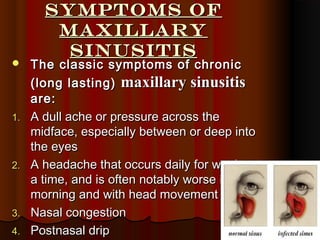
 The classic symptoms of chronicThe classic symptoms of chronic
(long lasting)(long lasting) maxillary sinusitismaxillary sinusitis
are:are:
1.1. A dull ache or pressure across theA dull ache or pressure across the
midface, especially between or deep intomidface, especially between or deep into
the eyesthe eyes
2.2. A headache that occurs daily for weeks atA headache that occurs daily for weeks at
a time, and is often notably worse in thea time, and is often notably worse in the
morning and with head movementmorning and with head movement
3.3. Nasal congestionNasal congestion
4.4. Postnasal dripPostnasal drip
Less common signsLess common signs
of maxillaryof maxillary
sinusitis include:sinusitis include:1.1. Sore throatSore throat
2.2. SnoringSnoring
3.3. Bad breathBad breath
4.4. Chronic throat clearingChronic throat clearing
5.5. Puffy eyesPuffy eyes
6.6. CoughingCoughing
7.7. Stuffy earsStuffy ears
8.8. Fatigue, irritability and depressionFatigue, irritability and depression
9.9. A chronic coldA chronic cold
10.10. AsthmaAsthma
11.11. BronchitisBronchitis
Diagnosis ofDiagnosis of
maxillary Sinusitismaxillary Sinusitis
 The doctor will examine the mouth and throat and look up the nasalThe doctor will examine the mouth and throat and look up the nasal
passages to determine whether the sinus outlets are blocked. Additionally,passages to determine whether the sinus outlets are blocked. Additionally,
the doctor may do a transillumintion or a CAT scan.the doctor may do a transillumintion or a CAT scan.
 Transillumination is done in a dark room with a very bright flashlight thatTransillumination is done in a dark room with a very bright flashlight that
is pressed against the forehead or cheek. If the light shines through theis pressed against the forehead or cheek. If the light shines through the
sinuses, the doctor can rule out sinusitis. If little or no light penetrates, thesinuses, the doctor can rule out sinusitis. If little or no light penetrates, the
cavity is clogged and sinusitis is evident.cavity is clogged and sinusitis is evident.
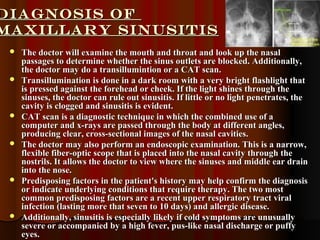
 CAT scan is a diagnostic technique in which the combined use of aCAT scan is a diagnostic technique in which the combined use of a
computer and x-rays are passed through the body at different angles,computer and x-rays are passed through the body at different angles,
producing clear, cross-sectional images of the nasal cavities.producing clear, cross-sectional images of the nasal cavities.
 The doctor may also perform an endoscopic examination. This is a narrow,The doctor may also perform an endoscopic examination. This is a narrow,
flexible fiber-optic scope that is placed into the nasal cavity through theflexible fiber-optic scope that is placed into the nasal cavity through the
nostrils. It allows the doctor to view where the sinuses and middle ear drainnostrils. It allows the doctor to view where the sinuses and middle ear drain
into the nose.into the nose.
 Predisposing factors in the patient's history may help confirm the diagnosisPredisposing factors in the patient's history may help confirm the diagnosis
or indicate underlying conditions that require therapy. The two mostor indicate underlying conditions that require therapy. The two most
common predisposing factors are a recent upper respiratory tract viralcommon predisposing factors are a recent upper respiratory tract viral
infection (lasting more that seven to 10 days) and allergic disease.infection (lasting more that seven to 10 days) and allergic disease.
 Additionally, sinusitis is especially likely if cold symptoms are unusuallyAdditionally, sinusitis is especially likely if cold symptoms are unusually
severe or accompanied by a high fever, pus-like nasal discharge or puffysevere or accompanied by a high fever, pus-like nasal discharge or puffy
eyes.eyes.
Treatment ofTreatment of
maxillary Sinusitismaxillary Sinusitis
If a bacterial infection is present, antibiotics,If a bacterial infection is present, antibiotics,
such as amoxicillin, erythromycin or sulfasuch as amoxicillin, erythromycin or sulfa
drugs, are usually prescribed for about 10drugs, are usually prescribed for about 10
days.days.
Your doctor also may prescribe one or moreYour doctor also may prescribe one or more
of the following remedies (which can beof the following remedies (which can be
useful in reducing inflammation in theuseful in reducing inflammation in the
sinuses and nose and speeding recovery):sinuses and nose and speeding recovery):
 Decongestants.Decongestants. These temporarily relieve symptoms andThese temporarily relieve symptoms and
also help the healing process by draining the nose andalso help the healing process by draining the nose and
sinuses.sinuses.
 Decongestants like pseudoephedrine, phenylpherine andDecongestants like pseudoephedrine, phenylpherine and
phenylpropanolaminephenylpropanolamine constrict the blood vessels andconstrict the blood vessels and
shrink the sinus and nasal membranes, thus, reducingshrink the sinus and nasal membranes, thus, reducing
stuffiness in the sinuses and nasal passageways.stuffiness in the sinuses and nasal passageways.
 Over-the-Counter Nasal Sprays.Over-the-Counter Nasal Sprays. These products, includingThese products, including
Afrin and Dristan, are decongestants in a spray form. TheyAfrin and Dristan, are decongestants in a spray form. They
are effective when used for a few days, but can be addictingare effective when used for a few days, but can be addicting
when used for longer periods of time.when used for longer periods of time.
 After using decongestant sprays for three days, peopleAfter using decongestant sprays for three days, people
usually experience a rebound effectusually experience a rebound effect - when they stop using- when they stop using
the spray, they become even more congested and need morethe spray, they become even more congested and need more
spray for relief. People with chronic allergies or sinusspray for relief. People with chronic allergies or sinus
problems should limit the use of decongestant sprays to fiveproblems should limit the use of decongestant sprays to five
treatments a week.treatments a week.
 Prescription inhalersPrescription inhalers. Several types of prescription nasal. Several types of prescription nasal
inhalers can help reduce sinus inflammation (these are notinhalers can help reduce sinus inflammation (these are not
decongestants and are not habit-forming). Prescription inhalersdecongestants and are not habit-forming). Prescription inhalers
help heal sinus membranes after the bacteria have beenhelp heal sinus membranes after the bacteria have been
eliminated. These drugs include Beconase, Nasalide andeliminated. These drugs include Beconase, Nasalide and
Vancenase (all cortisone derivatives) and Nasalcrom (a non-Vancenase (all cortisone derivatives) and Nasalcrom (a non-
cortisone drug).cortisone drug).
 When used as directed by a doctor, prescription inhalers can beWhen used as directed by a doctor, prescription inhalers can be
taken safely for months.taken safely for months.
 Expectorants.Expectorants. Medicines, such as Guaifenesin, thin the mucus soMedicines, such as Guaifenesin, thin the mucus so
it drains more easily.it drains more easily.
 Antihistamines.Antihistamines. These medications help relieve nasal itchinessThese medications help relieve nasal itchiness
and inflammation by blocking the action of histamine, however,and inflammation by blocking the action of histamine, however,
they do not help mucus drain. Antihistamines includethey do not help mucus drain. Antihistamines include
chlorpheniramine, Hismanal, Seldane and Tavist.chlorpheniramine, Hismanal, Seldane and Tavist.
 Humidifiers and salt-water sprays.Humidifiers and salt-water sprays. Dry-air heating systems andDry-air heating systems and
air-conditioning can cause sinus membranes to dry out, crackair-conditioning can cause sinus membranes to dry out, crack
and become vulnerable to irritants, inflammation and infection.and become vulnerable to irritants, inflammation and infection.
Keeping a humidifier running in your home and office or usingKeeping a humidifier running in your home and office or using
an over-the-counter salt-water spray (inhaled through the nose)an over-the-counter salt-water spray (inhaled through the nose)
five or six times a day can provide dramatic relieffive or six times a day can provide dramatic relief..
 Recurring maxillary sinusitis accompanied by aRecurring maxillary sinusitis accompanied by a
bacterial infection usually requires one of thebacterial infection usually requires one of the
new, stronger antibiotics, such as Augmentin,new, stronger antibiotics, such as Augmentin,
Ceclor or Ceftin. These drugs may be given inCeclor or Ceftin. These drugs may be given in
larger doses for a longer period of time (up tolarger doses for a longer period of time (up to
four weeks) than required for a brief bout offour weeks) than required for a brief bout of
sinusitis. The doctor may also recommendsinusitis. The doctor may also recommend
continued use of a prescription nasal inhaler forcontinued use of a prescription nasal inhaler for
several months to keep the inflammation downseveral months to keep the inflammation down
and prevent a recurrence.and prevent a recurrence.
Prevention ofPrevention of
MAXILLARYMAXILLARY
SinusitisSinusitis
 Reduce exposure to allergens.Reduce exposure to allergens.
 Improve household ventilation by opening windowsImprove household ventilation by opening windows
whenever possible.whenever possible.
 Use a humidifier in the home or office when the person hasUse a humidifier in the home or office when the person has
a cold.a cold.
 Sleep with the head of the bed elevated. This promotesSleep with the head of the bed elevated. This promotes
sinus drainage.sinus drainage.
 Use decongestants with caution.Use decongestants with caution.
 Avoid air pollutants (such as smoke) that irritate the nose.Avoid air pollutants (such as smoke) that irritate the nose.
 Eat a balanced diet and exercise.Eat a balanced diet and exercise.
 Minimize exposure to persons with known infections.Minimize exposure to persons with known infections.
Cellulitis 110219224340-phpapp01

Cellulitis 110219224340-phpapp01

  • 1.
    SEMINAR ONSEMINAR ON SPREADOF ORALSPREAD OF ORAL INFECTIONSINFECTIONS PRESENTED BY :-PRESENTED BY :- DR. IPSHA DHALIDR. IPSHA DHALI
  • 2.
    CellulitisCellulitis ((PhlegmonPhlegmon)) Defination :-Defination :- CellulitisCellulitisis a diffuseis a diffuse inflammationinflammation ofof connective tissueconnective tissue with severe inflammation ofwith severe inflammation of dermal and subcutaneous layers of thedermal and subcutaneous layers of the skinskin. It. It is a spreadingis a spreading diffusediffuse inflammatoryinflammatory processprocess with formation of suppurative/purulentwith formation of suppurative/purulent exudateexudate oror puspus..
  • 3.
    1.1. Cellulitis canbe caused by normalCellulitis can be caused by normal skin floraskin flora or byor by exogenous bacteriaexogenous bacteria[[streptococcus and/orstreptococcus and/or staphylococcus bacteria]staphylococcus bacteria].. 2.2. Often occurs where the skin has previously beenOften occurs where the skin has previously been broken: cracks in the skin, cuts,broken: cracks in the skin, cuts, blistersblisters,, burnsburns,, insect bitesinsect bites,, surgical woundssurgical wounds, or sites of, or sites of intravenousintravenous cathetercatheter insertion.insertion. 3.3. Skin on the face is most commonly affected bySkin on the face is most commonly affected by this infection, though cellulitis can occur on anythis infection, though cellulitis can occur on any part of the body.part of the body. 4.4. The mainstay of therapy remains treatment withThe mainstay of therapy remains treatment with appropriateappropriate antibioticsantibiotics, and recovery periods can, and recovery periods can INTRODUCTION :-
  • 4.
    5.5. It appearsas localized inflammation of the skinIt appears as localized inflammation of the skin and is characterized by redness (and is characterized by redness (erythemaerythema),), swelling (edema), tenderness or pain, andswelling (edema), tenderness or pain, and warmth.warmth. 6.6. Cellulitis can remain a superficial infection orCellulitis can remain a superficial infection or spread into the soft tissues immediately belowspread into the soft tissues immediately below the skin that contain blood vessels, lymphaticthe skin that contain blood vessels, lymphatic vessels, and nerves.vessels, and nerves. 7.7. It can also involve the underlying muscle orIt can also involve the underlying muscle or spread throughout the body via the lymphaticspread throughout the body via the lymphatic system and the bloodstream.system and the bloodstream. 8.8. Cellulitis is unrelated (except etymologically) toCellulitis is unrelated (except etymologically) to cellulitecellulite, a cosmetic condition featuring dimpling, a cosmetic condition featuring dimpling of the skin.of the skin.
  • 5.
    NOTE :NOTE : Risk:Risk: 1.1. Age is not generally considered a risk factor for cellulites, althoughAge is not generally considered a risk factor for cellulites, although some studies show slightly higher incidence in individuals over agesome studies show slightly higher incidence in individuals over age 45.45. 2.2. Individuals who are immunodeficient as a result of geneticIndividuals who are immunodeficient as a result of genetic conditions , illness (e.g.,conditions , illness (e.g., HIVHIV infection,infection, cancercancer), or), or immunosuppressive drugs (e.g.,immunosuppressive drugs (e.g., chemotherapychemotherapy, corticosteroids,, corticosteroids, antirejection drugs in transplant recipients) are at increased risk ofantirejection drugs in transplant recipients) are at increased risk of infections such as cellulitis.infections such as cellulitis. 3.3. DiabetesDiabetes impairs the immune system and decreases bloodimpairs the immune system and decreases blood circulation, increasing risk of infection.circulation, increasing risk of infection. 4.4. Chronic skin conditions such asChronic skin conditions such as psoriasispsoriasis,, dermatitisdermatitis, or, or eczemaeczema cancan create an opportunity for entry of infectious bacteria. Individuals whocreate an opportunity for entry of infectious bacteria. Individuals who have recurrent fungal infections of the feet are greater risk forhave recurrent fungal infections of the feet are greater risk for developing cellulitis.developing cellulitis. 5.5. Impaired peripheral circulation such as arterial insufficiency orImpaired peripheral circulation such as arterial insufficiency or venous stasis is also a risk factor.venous stasis is also a risk factor. 6.6. Subcutaneous or intravenous drug injection, body piercing, andSubcutaneous or intravenous drug injection, body piercing, and tattoos are all associated with higher risk for cellulitis.tattoos are all associated with higher risk for cellulitis. 7.7. Cellulitis may also occur as a complication of certain surgicalCellulitis may also occur as a complication of certain surgical
  • 6.
    Incidence and PrevalenceIncidenceand Prevalence 1.1. Cellulitis can affect anyone of any age; cellulitisCellulitis can affect anyone of any age; cellulitis of the face is more common in children andof the face is more common in children and adults over age 50 (Cunningham).adults over age 50 (Cunningham). 2.2. The actual incidence of cellulitis is unknownThe actual incidence of cellulitis is unknown because cases are seldom reported.because cases are seldom reported. 3.3. The incidence of infection by methicillin-The incidence of infection by methicillin- resistant Staphylococcus aureus (MRSA) andresistant Staphylococcus aureus (MRSA) and other antibiotic-resistant bacteria has increasedother antibiotic-resistant bacteria has increased dramatically in recent years (Mayo Clinic Staff).dramatically in recent years (Mayo Clinic Staff). Infection by these organisms is much moreInfection by these organisms is much more serious.serious.
  • 7.
    DiagnosisDiagnosis  History:History: 1.1. Theindividual may complain of a red, hot,The individual may complain of a red, hot, swollen, and tender area of skin.swollen, and tender area of skin. 2.2. Symptoms may also includeSymptoms may also include feverfever or chills.or chills. 3.3. The individual may report a recent history ofThe individual may report a recent history of trauma or a bite at the affected site.trauma or a bite at the affected site. 4.4. The individual who complains of redness andThe individual who complains of redness and swelling of the eyelid may also report eye pain,swelling of the eyelid may also report eye pain, impaired eye mobility, and visual changes.impaired eye mobility, and visual changes.
  • 8.
     Physical exam:Physicalexam: 1.1. The appearance of red, swollen, tender skin that isThe appearance of red, swollen, tender skin that is warm to the touch is usually sufficient forwarm to the touch is usually sufficient for diagnosis.diagnosis. 2.2. The texture of the skin may resemble orange peelThe texture of the skin may resemble orange peel (peau d'orange) and be firm to the touch. Regional(peau d'orange) and be firm to the touch. Regional lymph nodes may be inflamed and swollen.lymph nodes may be inflamed and swollen. 3.3. Adjacent skin may reveal red streaksAdjacent skin may reveal red streaks characteristic of inflamed lymphatic vessels (characteristic of inflamed lymphatic vessels ( lymphangitislymphangitis).). 4.4. If the lower leg is affected, symptoms (warmth,If the lower leg is affected, symptoms (warmth, pain, and swelling) may mimic those of clotpain, and swelling) may mimic those of clot formation in leg veins (venousformation in leg veins (venous thrombosisthrombosis).). 5.5. Individuals with orbital cellulitis should undergo aIndividuals with orbital cellulitis should undergo a thorough examination of the face, sinuses, teeth,thorough examination of the face, sinuses, teeth, mouth, and nasopharynx to identify the source ofmouth, and nasopharynx to identify the source of infection.infection.
  • 9.
     Tests:Tests: 1.1. Acomplete blood count may be performed to determineA complete blood count may be performed to determine the level of white blood cells, a sensitive marker ofthe level of white blood cells, a sensitive marker of infection.infection. 2.2. Cultures of pus or other drainage from the area ofCultures of pus or other drainage from the area of infection and/or blood cultures may be performed toinfection and/or blood cultures may be performed to identify the causative organism(s).identify the causative organism(s). 3.3. Often, the causative agent is not identified, or the reportOften, the causative agent is not identified, or the report shows multiple skin organisms that may include normalshows multiple skin organisms that may include normal flora.flora. 4.4. Antibiotic sensitivity tests may be performed on theAntibiotic sensitivity tests may be performed on the cultured organisms to aid in determining the mostcultured organisms to aid in determining the most appropriate antibiotic therapy.appropriate antibiotic therapy. 5.5. Individuals with orbital cellulitis may require imagingIndividuals with orbital cellulitis may require imaging studies (studies (x-raysx-rays,, CTCT, or, or MRIMRI of the sinuses) to localize theof the sinuses) to localize the source of infection.source of infection.
  • 10.
    Cellulitis: initial stageof infectionCellulitis: initial stage of infection  Diffuse, reddened, soft orDiffuse, reddened, soft or hard swelling that is tender tohard swelling that is tender to palpation.palpation.  Inflammatory response notInflammatory response not yet forming a true abscess.yet forming a true abscess.  Microorganisms have justMicroorganisms have just begun to overcome hostbegun to overcome host defenses and spread beyonddefenses and spread beyond tissue planes.tissue planes.
  • 11.
    True abscess formationTrueabscess formation  As inflammatoryAs inflammatory response matures, mayresponse matures, may develop a focaldevelop a focal accumulation of pus.accumulation of pus.  May have spontaneousMay have spontaneous drainage intraorally ordrainage intraorally or extraorally.extraorally.
  • 12.
    Clinical FeaturesClinical Features Systemic features of infectionSystemic features of infection such as increasedsuch as increased body temperature (up to 38-40 °C), general fatigue,body temperature (up to 38-40 °C), general fatigue, chills, sweatings, headache, loss of appetite).chills, sweatings, headache, loss of appetite).  Inflammatory signs -Inflammatory signs - dolordolor (localized pain),(localized pain), calorcalor (increase local tissue temperature),(increase local tissue temperature), ruborrubor (skin(skin redness/hyperemia),redness/hyperemia), tumortumor (either clear or non-clear(either clear or non-clear bordered tissue swelling),bordered tissue swelling), functio laesafunctio laesa (diminish(diminish affected function).affected function).
  • 13.
    CausesCauses 1.1. Cellulitis iscaused by a type ofCellulitis is caused by a type of bacteriabacteria entering the skin, usually by way of a cut, abrasion,entering the skin, usually by way of a cut, abrasion, or break in the skin. This break does not need to be visible.or break in the skin. This break does not need to be visible. Group AGroup A StreptococcusStreptococcus andand StaphylococcusStaphylococcus are the most common of these bacteria, which are part of the normal flora ofare the most common of these bacteria, which are part of the normal flora of the skin but cause no actual infection while on the skin's outer surface.the skin but cause no actual infection while on the skin's outer surface. 2.2. Predisposing conditions for cellulitis include insect bites,Predisposing conditions for cellulitis include insect bites, blisteringblistering, animal bite,, animal bite, tattoostattoos,, pruriticpruritic (itchy) skin rash, recent(itchy) skin rash, recent surgerysurgery,, athlete's footathlete's foot,, dry skindry skin,, eczemaeczema, injecting drugs, injecting drugs (especially subcutaneous or intramuscular injection or where an attempted IV injection(especially subcutaneous or intramuscular injection or where an attempted IV injection "misses" or blows the vein), pregnancy, diabetes and obesity, which can affect circulation, as"misses" or blows the vein), pregnancy, diabetes and obesity, which can affect circulation, as well as burns andwell as burns and boilsboils, though there is debate as to whether minor foot lesions contribute., though there is debate as to whether minor foot lesions contribute. Spider bitesSpider bites are also known to cause cellulitis.are also known to cause cellulitis. 3.3. Occurrences of cellulitis may also be associated with the rare conditionOccurrences of cellulitis may also be associated with the rare condition Hidradenitis SuppurativaHidradenitis Suppurativa.. 4.4. The photos shown here of Cellulitis are of mild cases and are not representative of earlierThe photos shown here of Cellulitis are of mild cases and are not representative of earlier stages of the disease. Usually the itch and/or rash appears a little after it vanishes leavingstages of the disease. Usually the itch and/or rash appears a little after it vanishes leaving only a small mark which is commonly ignored.only a small mark which is commonly ignored. 5.5. The appearance of the skin will assist a doctor in determining a diagnosis. A doctor may alsoThe appearance of the skin will assist a doctor in determining a diagnosis. A doctor may also suggest blood tests, a wound culture or other tests to help rule out a blood clot deep in thesuggest blood tests, a wound culture or other tests to help rule out a blood clot deep in the veins of the legs. Cellulitis in the lower leg is characterized by signs and symptoms that mayveins of the legs. Cellulitis in the lower leg is characterized by signs and symptoms that may be similar to those of a clot occurring deep in the veins, such as warmth, pain and swellingbe similar to those of a clot occurring deep in the veins, such as warmth, pain and swelling (inflammation).(inflammation). 6.6. This reddened skin or rash may signal a deeper, more serious infection of the inner layers ofThis reddened skin or rash may signal a deeper, more serious infection of the inner layers of skin. Once below the skin, the bacteria can spread rapidly, entering the lymph nodes and theskin. Once below the skin, the bacteria can spread rapidly, entering the lymph nodes and the bloodstream and spreading throughout the body.This can result in flu like symptoms with abloodstream and spreading throughout the body.This can result in flu like symptoms with a high temperature and sweating or feeling very cold with shaking as the sufferer cannot gethigh temperature and sweating or feeling very cold with shaking as the sufferer cannot get warm.warm. 7.7. In rare cases, the infection can spread to the deep layer of tissue called the fascial lining.In rare cases, the infection can spread to the deep layer of tissue called the fascial lining. Necrotizing fasciitisNecrotizing fasciitis, also called by the media "flesh-eating bacteria," is an example of a, also called by the media "flesh-eating bacteria," is an example of a deep-layer infection. It represents an extremedeep-layer infection. It represents an extreme medical emergencymedical emergency..
  • 14.
    Histological featuresHistological features Amicroscopic section through an area ofA microscopic section through an area of cellulitis shows a diffuse exudation of polycellulitis shows a diffuse exudation of poly morphoneuclear leukocyte andmorphoneuclear leukocyte and lymphocyte.lymphocyte. With considerable serous fluid and fibrinsWith considerable serous fluid and fibrins causing separation of connective tissuecausing separation of connective tissue and muscle fibres.and muscle fibres.
  • 15.
    TreatmentTreatment 1.1. Treatment consistsof resting the affected area,Treatment consists of resting the affected area, cutting away dead tissue, and antibiotics (either oralcutting away dead tissue, and antibiotics (either oral oror intravenousintravenous).). 2.2. FlucloxacillinFlucloxacillin oror DicloxacillinDicloxacillin monotherapy (to covermonotherapy (to cover staphylococcal infection) is often sufficient in mildstaphylococcal infection) is often sufficient in mild cellulitis, but in more moderate cases, or wherecellulitis, but in more moderate cases, or where streptococcalstreptococcal infection is suspected, then thisinfection is suspected, then this course is usually combined with oralcourse is usually combined with oral phenoxymethylpenicillinphenoxymethylpenicillin or intravenousor intravenous benzylpenicillinbenzylpenicillin, or, or ampicillinampicillin//amoxicillinamoxicillin 3.3. Pain relief is also often prescribed, but excessivePain relief is also often prescribed, but excessive pain should always be investigated as it is apain should always be investigated as it is a symptom ofsymptom of necrotising fasciitisnecrotising fasciitis, ., . 4.4. As in other maladies characterized by wounds orAs in other maladies characterized by wounds or tissue destruction,tissue destruction, hyperbaric oxygenhyperbaric oxygen treatment cantreatment can be a valuable adjunctive therapy, but is not widelybe a valuable adjunctive therapy, but is not widely
  • 16.
    PrognosisPrognosis Antibiotic therapy usuallyprovides promptAntibiotic therapy usually provides prompt and complete resolution of cellulitis. If leftand complete resolution of cellulitis. If left untreated, cellulitis can occasionally killuntreated, cellulitis can occasionally kill the tissue (the tissue (gangrenegangrene), and/or the bacteria), and/or the bacteria may enter the bloodstream (may enter the bloodstream (bacteremiabacteremia)) and multiply, causing a serious, systemic,and multiply, causing a serious, systemic, life-threatening condition (life-threatening condition (sepsissepsis).).
  • 17.
    ComplicationsComplications 1.1. Cellulitis canprogress to lymphangitis,Cellulitis can progress to lymphangitis, abscessabscess formation,formation, or sepsis.or sepsis. 2.2. Infection by additional species of bacteria (superinfection)Infection by additional species of bacteria (superinfection) may occur, complicating treatment. Infection can alsomay occur, complicating treatment. Infection can also spread to the layer of tissue enveloping muscles (fascia),spread to the layer of tissue enveloping muscles (fascia), causing a serious infection (necrotizing fasciitis) Cellulitis ofcausing a serious infection (necrotizing fasciitis) Cellulitis of the scalp may cause scarring, leading to hair loss (the scalp may cause scarring, leading to hair loss (alopeciaalopecia ).). 3.3. Orbital cellulitis may progress toOrbital cellulitis may progress to blindnessblindness, cavernous sinus, cavernous sinus clots (clots (thrombosisthrombosis), or inflammation of all tissues of the eye), or inflammation of all tissues of the eye (panophthalmitis).(panophthalmitis). 4.4. Infection may spread from the orbit to the brain or tissuesInfection may spread from the orbit to the brain or tissues lining the brain and spinal cord (lining the brain and spinal cord (meningesmeninges).). 5.5. Older individuals may develop a blood clot (Older individuals may develop a blood clot ( thrombophlebitisthrombophlebitis) as a result of cellulitis in more superficial) as a result of cellulitis in more superficial tissues.tissues.
  • 18.
    Infection spreadInfection spread viatissuevia tissue spacesspaces
  • 19.
    General ConsiderationsGeneral Considerations Commontypes of infection:Common types of infection:  Periapical, peridontal, postsurgical, pericoronalPeriapical, peridontal, postsurgical, pericoronal May begin as well-delineated, self-limiting conditionMay begin as well-delineated, self-limiting condition with potential to spread and result in a major fascialwith potential to spread and result in a major fascial space infection.space infection. Life-threatening sequelae can ensue:Life-threatening sequelae can ensue:  Septicemia, cavernous sinus thrombosis, airway obstruction,Septicemia, cavernous sinus thrombosis, airway obstruction, mediastinitismediastinitis
  • 20.
    MicrobiologyMicrobiology Odontogenic infections aremultimicrobial:Odontogenic infections are multimicrobial: Gram (+) cocci, aerobic and anaerobic:Gram (+) cocci, aerobic and anaerobic: Streptococci and their anaerobic counterpart,Streptococci and their anaerobic counterpart, peptostreptococcipeptostreptococci Staphylococci, and their anaerobic counterpart,Staphylococci, and their anaerobic counterpart, peptococcipeptococci Gram (+) rods:Gram (+) rods: Lactobacillus, diphtheroids, ActinomycesLactobacillus, diphtheroids, Actinomyces Gram (-) rods:Gram (-) rods: Fusobacterium, Bacteroids, Eikenella,Fusobacterium, Bacteroids, Eikenella, Psuedomonas (occasional)Psuedomonas (occasional)
  • 21.
    Host FactorsHost Factors Immunityagainst intraoral infection isImmunity against intraoral infection is composed of three sets ofcomposed of three sets of mechanisms:mechanisms: Humoral factorsHumoral factors Cellular factorsCellular factors Local factorsLocal factors Decrease one of these mechanisms andDecrease one of these mechanisms and it increases the potential for infection.it increases the potential for infection.
  • 22.
    Humoral FactorsHumoral Factors Circulatingimmunoglobulins, along withCirculating immunoglobulins, along with complement, combine with microbes tocomplement, combine with microbes to form opsonins that promote phagocytosisform opsonins that promote phagocytosis by macrophages.by macrophages. IgA prevents colonization of microbes onIgA prevents colonization of microbes on oral mucosal surfaces.oral mucosal surfaces. In presence of infection, histamine,In presence of infection, histamine, serotonin, prostaglandins supportserotonin, prostaglandins support inflammationinflammation →→ vasodilation and increasedvasodilation and increased vascular permeability.vascular permeability.
  • 23.
    Cellular factorsCellular factors Phagocytesengulf and kill microbes,Phagocytes engulf and kill microbes, removing them, preventing replication.removing them, preventing replication. Lymphocytes produce lymphokines andLymphocytes produce lymphokines and immunoglobulines (aids humoral).immunoglobulines (aids humoral). Lymphokines stimulate reproduction ofLymphokines stimulate reproduction of other lymphocytes, and kills antigens.other lymphocytes, and kills antigens.
  • 24.
    Local FactorsLocal Factors Specificfactors leading to resistance:Specific factors leading to resistance: Abundant vascular supply allowing humoral andAbundant vascular supply allowing humoral and cellular response.cellular response. Mechanical cleansing by salivary flow.Mechanical cleansing by salivary flow. Secretory IgA contained within saliva.Secretory IgA contained within saliva. High epithelial turnover and sloughing, taking with itHigh epithelial turnover and sloughing, taking with it adherent bacteria.adherent bacteria. A variety of microflora normally preventing selectionA variety of microflora normally preventing selection for a single organism by competing for nutrients orfor a single organism by competing for nutrients or release of by-products.release of by-products.
  • 25.
    Historical FeaturesHistorical Features Slowly enlarging swelling with a dull ache orSlowly enlarging swelling with a dull ache or recurrent draining abscess that swells andrecurrent draining abscess that swells and drains spontaneously is not likely to requiredrains spontaneously is not likely to require aggressive treatment within the hour – theaggressive treatment within the hour – the patient’s immune response is effectivelypatient’s immune response is effectively containing the spread of infection.containing the spread of infection.  However, 24-hour painful swelling causingHowever, 24-hour painful swelling causing pain during swallowing or severe trismuspain during swallowing or severe trismus needs aggressive and prompt treatment.needs aggressive and prompt treatment.
  • 27.
    Historical Features, con’t.HistoricalFeatures, con’t. Immediate treatment or referral is criticalImmediate treatment or referral is critical when patient’s immune system has notwhen patient’s immune system has not been containing the infection.been containing the infection. Specific warning signs include:Specific warning signs include: Dyspnea (difficulty breathing)Dyspnea (difficulty breathing) Dysphagia (difficulty/pain with swallowing)Dysphagia (difficulty/pain with swallowing) Severe trismusSevere trismus Rapidly progressive swellingRapidly progressive swelling
  • 28.
    Clinical FeaturesClinical Features Inflammationis tissue response to injury orInflammation is tissue response to injury or invasion by microorganisms that involvesinvasion by microorganisms that involves vasodilation, capillary permeability, mobilizationvasodilation, capillary permeability, mobilization of leukocytes, and phagocytosis.of leukocytes, and phagocytosis. Cardinal signs of inflammation:Cardinal signs of inflammation: Red, hot, swelling, pain, with loss of functionRed, hot, swelling, pain, with loss of function Other findings:Other findings: regional lymphadenopathyregional lymphadenopathy,, fever,fever, elevated white blood cell count, tachycardia,elevated white blood cell count, tachycardia, tachypnea, dehydration, malaise.tachypnea, dehydration, malaise.
  • 29.
    Infection can spreadvia the blood, lymphInfection can spread via the blood, lymph and the tissue spaces. In dentistry, theand the tissue spaces. In dentistry, the most relevant tissue spaces are the:most relevant tissue spaces are the: 1.1. Pterygomandibular spacePterygomandibular space 2.2. Lateral pharyngeal spaceLateral pharyngeal space 3.3. Retropharyngeal spaceRetropharyngeal space 4.4. Infratemporal fossaInfratemporal fossa 5.5. Buccal spaceBuccal space 6.6. Vestibular spaceVestibular space 7.7. Sublingual spaceSublingual space 8.8. Submandibular spaceSubmandibular space 9.9. Submental spaceSubmental space
  • 30.
    NOTE :NOTE : 1.1.Many of these spaces run into each other,Many of these spaces run into each other, allowing infection to spread from one spaceallowing infection to spread from one space to another.to another. 2.2. For example, an infection from a wisdomFor example, an infection from a wisdom tooth can spread to the pterygomandibulartooth can spread to the pterygomandibular space and from there it can travel to thespace and from there it can travel to the lateral pharyngeal space, then to thelateral pharyngeal space, then to the retropharyngeal space and even to theretropharyngeal space and even to the mediastinummediastinum.. 3.3. Infection can also spread to theInfection can also spread to the pterygomandibular space and lateralpterygomandibular space and lateral pharyngeal space from the infratemporalpharyngeal space from the infratemporal fossa.fossa.
  • 31.
    Infection spread fromInfectionspread from maxillary teethmaxillary teeth 1.1. Infections from the maxillary teeth can spread to theInfections from the maxillary teeth can spread to the maxillary sinus, the canine fossa, palatal space,maxillary sinus, the canine fossa, palatal space, infratemporal fossa, buccal space and vestibularinfratemporal fossa, buccal space and vestibular space.space. 2.2. Infection will spread to the buccal space if theInfection will spread to the buccal space if the infection's path is outside the attachment of theinfection's path is outside the attachment of the buccinator muscle, but will spread to the vestibularbuccinator muscle, but will spread to the vestibular space if the infection's path is inside the attachmentspace if the infection's path is inside the attachment of the buccinator muscle.of the buccinator muscle. 3.3. Infection can spread to the cavernous sinus from theInfection can spread to the cavernous sinus from the infratemporal fossa and from the canine fossa.infratemporal fossa and from the canine fossa. Infection in the cavernous sinus can lead toInfection in the cavernous sinus can lead to cavernous sinus thrombosiscavernous sinus thrombosis, which is potentially, which is potentially fatal.fatal.
  • 32.
    Infection spread fromInfectionspread from mandibular teethmandibular teeth 1.1. Infections from mandibular teeth can spread to theInfections from mandibular teeth can spread to the vestibular and buccal space in the same way as from thevestibular and buccal space in the same way as from the maxillary teeth.maxillary teeth. 2.2. Infection can also spread to the pterygomandibular space,Infection can also spread to the pterygomandibular space, sublingual space, submandibular space and submentalsublingual space, submandibular space and submental space.space. 3.3. The sublingual, submental and submandibular spaces canThe sublingual, submental and submandibular spaces can be referred collectively as the submandibular spaces.be referred collectively as the submandibular spaces. 4.4. Sometimes when an infection spreads to the submandibularSometimes when an infection spreads to the submandibular spaces a life threatening condition called Ludwig's anginaspaces a life threatening condition called Ludwig's angina occurs. Angina is latin for strangle therefore this angina isoccurs. Angina is latin for strangle therefore this angina is referring to the sensation of being strangled caused by thereferring to the sensation of being strangled caused by the swelling of the neck region. Tracheotomy is sometimesswelling of the neck region. Tracheotomy is sometimes necessary to maintain the airway.necessary to maintain the airway.
  • 33.
    Fascial SpacesFascial Spaces Fascial planes offer anatomic highways forFascial planes offer anatomic highways for infection to spread superficial to deep planesinfection to spread superficial to deep planes  Antibiotic availability in fascial spaces is limitedAntibiotic availability in fascial spaces is limited due to poor vascularitydue to poor vascularity  Treatment of fascial space infections dependsTreatment of fascial space infections depends on I and Don I and D  Fascial spaces are contiguous and infectionFascial spaces are contiguous and infection readily spreads from one space to anotherreadily spreads from one space to another (open primary and secondary spaces)(open primary and secondary spaces)  Despite I and D the etiologic agent (tooth) mustDespite I and D the etiologic agent (tooth) must be removedbe removed
  • 36.
    Canine SpaceCanine Space Location: between the levator anguli oris and theLocation: between the levator anguli oris and the levator labii superioris muscleslevator labii superioris muscles  Involvement primarily due to maxillary canineInvolvement primarily due to maxillary canine tooth infectiontooth infection  Long root allows erosion through the alveolarLong root allows erosion through the alveolar bone of the maxillabone of the maxilla  Signs:Signs: 1.1. Obliteration of the nasolabial foldObliteration of the nasolabial fold 2.2. Superior extension can involve lower eyelidSuperior extension can involve lower eyelid
  • 38.
    Buccal SpaceBuccal Space 1.1.Posterior maxillary teeth arePosterior maxillary teeth are source of most buccal spacesource of most buccal space infectionsinfections 2.2. Results when infection erodesResults when infection erodes through bone superior tothrough bone superior to attachment of buccinatorattachment of buccinator musclemuscle 3.3. Boundaries:Boundaries: 1.1. Lateral-Skin of the faceLateral-Skin of the face 2.2. Medial-Buccinator muscleMedial-Buccinator muscle 4.4. Both a primary mandibular andBoth a primary mandibular and maxillary spacemaxillary space 5.5. Most infections caused byMost infections caused by posterior maxillary teethposterior maxillary teeth
  • 39.
    Pathway of spreadfor buccalPathway of spread for buccal space infectionspace infection
  • 41.
    Infratemproal spaceInfratemproal space  Infratemproal spaceis aInfratemproal space is a potential space lying behindpotential space lying behind the maxilla.the maxilla.  Boundaries of infratemporalBoundaries of infratemporal fossa:fossa: 1.1. Lateral: Bounded by Zygoma, the ramus ofLateral: Bounded by Zygoma, the ramus of mandible, parotid gland and masseter muscle.mandible, parotid gland and masseter muscle. 2.2. Medial: Bounded by superior constrictor muscle,Medial: Bounded by superior constrictor muscle, Pharyngobasilar fascia, Pterygoid plates.Pharyngobasilar fascia, Pterygoid plates. 3.3. Anterior: The body of the maxilla lies anteriorly.Anterior: The body of the maxilla lies anteriorly. 4.4. Superior: Greater wing of sphenoid.Superior: Greater wing of sphenoid. 5.5. Posterior: Auricular tubercle of the temporalPosterior: Auricular tubercle of the temporal bone,bone, glenoid fossa and styloid process.glenoid fossa and styloid process.
  • 43.
    INFECTION OF INFRATEMPORALINFECTIONOF INFRATEMPORAL SPACESPACE  Infective complications can develop and presentInfective complications can develop and present following the extraction of clinically non-infected teethfollowing the extraction of clinically non-infected teeth  Infratemporal space infection is a rare complication ofInfratemporal space infection is a rare complication of dental extractiondental extraction  The cardinal clinical signs of maxillary andThe cardinal clinical signs of maxillary and mandibular neurosensory deficit may not bemandibular neurosensory deficit may not be immediately apparentimmediately apparent  The diagnosis, as in this case, can only be confirmedThe diagnosis, as in this case, can only be confirmed using scanning imaging modalities (CT or MRI)using scanning imaging modalities (CT or MRI)
  • 44.
    Clinical features :-Clinicalfeatures :- Severe trismusSevere trismus Buldging of temporalis muscleBuldging of temporalis muscle Swelling extraorally over the region of sigmoiSwelling extraorally over the region of sigmoi notch and intraorally in tuberosity region.notch and intraorally in tuberosity region.
  • 45.
    Pterygomandibular spacePterygomandibular space Thespace between the medial area of theThe space between the medial area of the mandible and the medial pterygoidmandible and the medial pterygoid muscle, a target area for administeringmuscle, a target area for administering local anesthesia to the inferior alveolarlocal anesthesia to the inferior alveolar nerve.nerve.
  • 46.
    Boundries of pterygomandibularBoundriesof pterygomandibular spacespace 1.1. Medially – medial pterygoid muscleMedially – medial pterygoid muscle 2.2. Laterally – medial surface of ramus of mandibleLaterally – medial surface of ramus of mandible 3.3. Superiorly – lateral pterygoidSuperiorly – lateral pterygoid 4.4. Posteriorly – deep lobe of parotid glandPosteriorly – deep lobe of parotid gland 5.5. Inferiorly – attachment of medial pterygoid otoInferiorly – attachment of medial pterygoid oto the mandiblethe mandible 6.6. Anteriorly – pterygomandibular rapheAnteriorly – pterygomandibular raphe
  • 48.
    infectioninfection  From lowerthird molarFrom lower third molar  Clinical features :-Clinical features :- 1.1. TrismusTrismus 2.2. Intraoral sweeling in the medial aspect ofIntraoral sweeling in the medial aspect of ramus of mandibleramus of mandible
  • 49.
    Retropharyngeal SpaceRetropharyngeal Space 1.1.Posteromedial to lateral pharyngeal space and anteriorPosteromedial to lateral pharyngeal space and anterior to the prevertebral spaceto the prevertebral space 2.2. Anterior: superior pharyngeal constrictor muscleAnterior: superior pharyngeal constrictor muscle 3.3. Posterior: alar layer of prevertebral fasciaPosterior: alar layer of prevertebral fascia 4.4. Extends from skull base superiorly to C7 to T1 inferiorlyExtends from skull base superiorly to C7 to T1 inferiorly 5.5. Retropharyngeal space infections can spread toRetropharyngeal space infections can spread to mediastinummediastinum 6.6. Other complications of retropharyngeal spaceOther complications of retropharyngeal space involvement:involvement: 1.1. Airway obstructionAirway obstruction 2.2. Aspiration of pus in the event of spontaneous ruptureAspiration of pus in the event of spontaneous rupture 3.3. Rupture can occur during endotracheal intubationRupture can occur during endotracheal intubation
  • 51.
    Parotid spaceParotid space AA deepdeep hollowhollow on theon the sideside at the sides of theat the sides of the faceface flanking theflanking the posteriorposterior aspectaspect of theof the ramusramus of the mandibleof the mandible with its attachedwith its attached musclesmuscles which iswhich is occupied by theoccupied by the parotid glandparotid gland; it is lined with; it is lined with fascialfascial laminae (thelaminae (the parotid sheathparotid sheath) derived from) derived from thethe investing layerinvesting layer of deepof deep cervical fasciacervical fascia; the; the structuresstructures bounding thebounding the spacespace collectivelycollectively constitute theconstitute the parotid bedparotid bed.. SurgeonsSurgeons operating inoperating in thethe areaarea taketake advantage of the fact that theadvantage of the fact that the anteroposterioranteroposterior dimensionsdimensions of theof the parotidparotid spacespace increaseincrease withwith protrusionprotrusion of theof the mandiblemandible..
  • 53.
    Clinical featuresClinical features 1.1.Facial swelling and progressive trismusFacial swelling and progressive trismus are described.are described. 2.2. Intraoral wound drainage and prolongedIntraoral wound drainage and prolonged antibiotic therapy failed to control theantibiotic therapy failed to control the resultant chronic cellulitis.resultant chronic cellulitis.
  • 54.
    Submental spaceSubmental space 1.1.Infection can result directly due to infectedInfection can result directly due to infected mandibular incisor or indirectly from themandibular incisor or indirectly from the submandibular spacesubmandibular space 2.2. Space located between the anterior bellies of theSpace located between the anterior bellies of the digastric muscle laterally, deeply by the mylohyoiddigastric muscle laterally, deeply by the mylohyoid muscle, and superiorly by the deep cervical fascia,muscle, and superiorly by the deep cervical fascia, the platysma muscle, the superficial cervical fascia,the platysma muscle, the superficial cervical fascia, and the skinand the skin 3.3. Dependent drainage of this space is performed byDependent drainage of this space is performed by placing a horizontal incision in the most dependentplacing a horizontal incision in the most dependent area of the swelling extraorally with a cosmetic scararea of the swelling extraorally with a cosmetic scar being the resultbeing the result
  • 56.
    Submandibular SpaceSubmandibular Space 1.1.Boundaries:Boundaries: 1.1. Superior-mylohyoid muscle and inferior border of theSuperior-mylohyoid muscle and inferior border of the mandiblemandible 2.2. Anteriorly-anterior belly of the digastric muscleAnteriorly-anterior belly of the digastric muscle 3.3. Posteriorly-posterior belly of the digastric musclePosteriorly-posterior belly of the digastric muscle 4.4. Inferiorly-hyoid boneInferiorly-hyoid bone 5.5. Superficially-platysma muscle and superficial layer of theSuperficially-platysma muscle and superficial layer of the deep cervical fasciadeep cervical fascia 2.2. Infected mandibular 2Infected mandibular 2ndnd and 3and 3rdrd molars causemolars cause submandibular space involvement since root apicessubmandibular space involvement since root apices lay below mylohyoid musclelay below mylohyoid muscle
  • 57.
    Pathways of spreadof submandibular spacePathways of spread of submandibular space infection from mandibular molarinfection from mandibular molar
  • 59.
    Sublingual SpaceSublingual Space 1.1.Submandibular and sublingual spacesSubmandibular and sublingual spaces surgically distinct, but should be considered assurgically distinct, but should be considered as surgical unit due to proximity and frequent dualsurgical unit due to proximity and frequent dual involvement in odontogenic infections.involvement in odontogenic infections. 2.2. Boundaries:Boundaries: 1.1. Superior-oral mucosaSuperior-oral mucosa 2.2. Inferior-mylohyoid muscleInferior-mylohyoid muscle 3.3. Infected premolar and 1Infected premolar and 1stst molar teeth frequentlymolar teeth frequently drain into this space due to their root apicesdrain into this space due to their root apices existing superior to the mylohyoid muscleexisting superior to the mylohyoid muscle
  • 61.
    ContentsContents  Sublingual,Submandibular glandSublingual,Submandibulargland  Submandibular ductSubmandibular duct  Lingual nerve and vesselsLingual nerve and vessels  Submandibular ganglionSubmandibular ganglion  Hypoglossal nerveHypoglossal nerve
  • 62.
    Masseteric SpaceMasseteric Space 1.1.Located between lateral aspect of theLocated between lateral aspect of the mandible and the masseter musclemandible and the masseter muscle 2.2. Involvement of this space generally occursInvolvement of this space generally occurs from buccal space primary involvementfrom buccal space primary involvement 3.3. Signs of involvement of the masseteric spaceSigns of involvement of the masseteric space include trismus and posterior-inferior faceinclude trismus and posterior-inferior face swellingswelling
  • 63.
    Pathway of spreadfrom masseteric spacePathway of spread from masseteric space infectioninfection
  • 65.
    Zygomaticotemporal(RetrozygomZygomaticotemporal(Retrozygom atic)Spaceatic)Space BoundariesBoundaries: Ant. -maxilla,: Ant. - maxilla, Zygomatic boneZygomatic bone Lat. - Insertion of TemporalisLat. - Insertion of Temporalis musclemuscle
  • 66.
    Zygomaticotemporal(RetrozygomZygomaticotemporal(Retrozygom atic)Spaceatic)Space ContentsContents : Posteriorsuprerior alveolar: Posterior suprerior alveolar nervenerve and vessles buccal fat padand vessles buccal fat pad
  • 67.
    Oral tissue examinationOraltissue examination Examine quality and consistency:Examine quality and consistency: Soft to fluctuant (fluid filled) to hard (indurated)Soft to fluctuant (fluid filled) to hard (indurated) Color and temperature determine the presenceColor and temperature determine the presence and extent of infectionand extent of infection Normal v abnormal tissue architecture:Normal v abnormal tissue architecture: Distortion of mucobuccal foldDistortion of mucobuccal fold Soft palate symmetric with uvula in midlineSoft palate symmetric with uvula in midline (deviation(deviation → involvement of lateral pharyngeal space)→ involvement of lateral pharyngeal space) Nasal tip, nasolabial fold, circumorbital areasNasal tip, nasolabial fold, circumorbital areas
  • 68.
    Examination, con’t.Examination, con’t. Identifycausative factors:Identify causative factors: Tooth, root tip, foreign body, etc.Tooth, root tip, foreign body, etc. Vital signs should be taken:Vital signs should be taken: TemperaturesTemperatures >> 101 to 102101 to 102°F°F accompanied by an elevated heart rateaccompanied by an elevated heart rate indicate systemic involvement of theindicate systemic involvement of the infection and increased urgency ofinfection and increased urgency of treatment.treatment.
  • 69.
    Principles in Treatmentof OralPrinciples in Treatment of Oral InfectionsInfections 1.1. Remove the cause.Remove the cause. 2.2. Establish drainage.Establish drainage. 3.3. Institute antibiotic therapy.Institute antibiotic therapy. 4.4. Supportive care, including proper restSupportive care, including proper rest and nutrition.and nutrition.
  • 70.
    Potential Pathways ofSpread of OralPotential Pathways of Spread of Oral InfectionsInfections
  • 71.
  • 72.
  • 73.
  • 74.
    Penrose drain inplace to providePenrose drain in place to provide drainage for vestibular abscessdrainage for vestibular abscess
  • 75.
    Antibiotic TherapyAntibiotic Therapy Removalof the cause, drainage, andRemoval of the cause, drainage, and supportive care more important thansupportive care more important than antibiotic therapy.antibiotic therapy. Infections are cured by the patient’sInfections are cured by the patient’s defenses,defenses, notnot antibiotics.antibiotics. Risks of allergy, toxicity, side effects,Risks of allergy, toxicity, side effects, resistance and superinfection causingresistance and superinfection causing serious or potentially fatal consequencesserious or potentially fatal consequences must be considered.must be considered.
  • 76.
    Antibiotic therapy, con’t.Antibiotictherapy, con’t. Oral infections are typically polymicrobial.Oral infections are typically polymicrobial. Antibiotic effectiveness dependent uponAntibiotic effectiveness dependent upon adequate tissue (not serum) concentration foradequate tissue (not serum) concentration for an appropriate amount of time.an appropriate amount of time. Antibiotics should be prescribed for at leastAntibiotics should be prescribed for at least one week – adequate tissue concentrationone week – adequate tissue concentration achieved in 24-48 hours, with bacteriocidalachieved in 24-48 hours, with bacteriocidal activity occurring over the next 3-5 days.activity occurring over the next 3-5 days.
  • 77.
    Antibiotic therapy, con’t.Antibiotictherapy, con’t. PenicillinPenicillin (bacteriocidal) drug of choice for(bacteriocidal) drug of choice for treatment of odontogenic infections (5% incidenttreatment of odontogenic infections (5% incident of allergy).of allergy). ClindamycinClindamycin (batericiodal) 1(batericiodal) 1stst line afterline after penicillin; effective against anaerobes; stop takingpenicillin; effective against anaerobes; stop taking at first sign of diarrhea.at first sign of diarrhea. CephalosporinCephalosporin (slightly broader spectrum(slightly broader spectrum and bacteriocidal); cautious use in penicillin-and bacteriocidal); cautious use in penicillin- allergic patientsallergic patients → cross-sensitivity; if history of→ cross-sensitivity; if history of anaphylaxis to penicillin, do not use.anaphylaxis to penicillin, do not use.
  • 78.
    Antibiotic therapy, con’t.Antibiotictherapy, con’t. ErythromycinErythromycin (bacteriostatic) good 2(bacteriostatic) good 2ndnd lineline drug after penicillin; use enteric-coated todrug after penicillin; use enteric-coated to reduce GI upset.reduce GI upset. MetronidazoleMetronidazole (bacteriocidal) excellent(bacteriocidal) excellent against anaerobes only.against anaerobes only. AugmentinAugmentin (amoxicillin + clavulanic acid)(amoxicillin + clavulanic acid) kills penicillinase-producing bacteria thatkills penicillinase-producing bacteria that interferes with amoxicillin; expensive.interferes with amoxicillin; expensive.
  • 79.
    Supportive CareSupportive Care Toensure the patient’s maximum immuneTo ensure the patient’s maximum immune response:response: Increase fluid intake (16 ounces/hour).Increase fluid intake (16 ounces/hour). Nutritional intake (soups, protein drinks, solids)Nutritional intake (soups, protein drinks, solids) with three meals/day.with three meals/day. May need to see patient daily, untilMay need to see patient daily, until resolution has begun.resolution has begun. If no improvement within 24- 48 hours, referIf no improvement within 24- 48 hours, refer immediately to an oral and maxillofacialimmediately to an oral and maxillofacial surgeon.surgeon.
  • 80.
  • 81.
    Ludwig’s angina withbilateral involvement ofLudwig’s angina with bilateral involvement of sublingual and submandibular spacessublingual and submandibular spaces
  • 82.
    DEFINATIONDEFINATION  Ludwig's angina,otherwise known as angina ludovici, is aLudwig's angina, otherwise known as angina ludovici, is a serious, potentially life-threateningserious, potentially life-threatening cellulitiscellulitis[1][1], or, or connective tissue infection, of the floor of the mouth,connective tissue infection, of the floor of the mouth, usually occurring in adults with concomitant dentalusually occurring in adults with concomitant dental infections. It is named after the German physician,infections. It is named after the German physician, Wilhelm Friedrich von LudwigWilhelm Friedrich von Ludwig who first described thiswho first described this condition in 1836.condition in 1836.[2][2][3][3] Other names include "anginaOther names include "angina Maligna" and "Morbus Strangularis".Maligna" and "Morbus Strangularis".  Ludwig's angina should not be confused withLudwig's angina should not be confused with angina pectorisangina pectoris, which is also otherwise commonly known, which is also otherwise commonly known as "as "anginaangina". The word "". The word "anginaangina" comes from the" comes from the GreekGreek wordword ankhonankhon, meaning "strangling", so in this case,, meaning "strangling", so in this case, Ludwig's angina refers to the feeling of strangling, not theLudwig's angina refers to the feeling of strangling, not the feeling of chest pain, though there may be chest pain infeeling of chest pain, though there may be chest pain in Ludwig's angina if the infection spreads into theLudwig's angina if the infection spreads into the
  • 83.
    CausesCauses  The causeis usually an infection withThe cause is usually an infection with StreptococcalStreptococcal bacteria,bacteria, although other bacteria can cause the condition. Since thealthough other bacteria can cause the condition. Since the advent ofadvent of antibioticsantibiotics, Ludwig's angina has become a rare, Ludwig's angina has become a rare disease.disease.  The route of infection in most cases is from infected lower thirdThe route of infection in most cases is from infected lower third molarsmolars or fromor from pericoronitispericoronitis, which is an infection of the gums, which is an infection of the gums surrounding the partially erupted lower third molars. Althoughsurrounding the partially erupted lower third molars. Although the widespread involvement seen in Ludwig's is usuallythe widespread involvement seen in Ludwig's is usually develops indevelops in immunocompromisedimmunocompromised persons, it can also developpersons, it can also develop in otherwise healthy individuals. Thus, it is very important toin otherwise healthy individuals. Thus, it is very important to obtain dental consultation for lower-third molars at the first signobtain dental consultation for lower-third molars at the first sign of any pain, bleeding from the gums, sensitivity to heat/cold orof any pain, bleeding from the gums, sensitivity to heat/cold or swelling at the angle of the jaw.swelling at the angle of the jaw.  Ludwig's angina is also associated withLudwig's angina is also associated with piercingspiercings of theof the linguallingual frenulumfrenulum..
  • 84.
    SymptomsSymptoms  The symptomsinclude swelling, pain and raising of theThe symptoms include swelling, pain and raising of the tongue, swelling of the neck and the tissues of thetongue, swelling of the neck and the tissues of the submandibular andsubmandibular and sublingual spacessublingual spaces, malaise,, malaise, feverfever,, dysphagiadysphagia (difficulty swallowing) and, in severe cases,(difficulty swallowing) and, in severe cases, stridor or difficulty breathing.stridor or difficulty breathing.  Swelling of the submandibular and/or sublingual spacesSwelling of the submandibular and/or sublingual spaces are distinctive in that they are hard and classicallyare distinctive in that they are hard and classically 'boardlike'. Important signs include the patient not being'boardlike'. Important signs include the patient not being able to swallow his/her own saliva and the presence ofable to swallow his/her own saliva and the presence of audible stridor as these strongly suggest that airwayaudible stridor as these strongly suggest that airway compromise is imminent.compromise is imminent.
  • 85.
    TreatmentTreatment  Treatment involvesappropriate antibiotic medications,Treatment involves appropriate antibiotic medications, monitoring and protection of the airway in severemonitoring and protection of the airway in severe cases, and, where appropriate, urgent maxillo-facialcases, and, where appropriate, urgent maxillo-facial surgery and/or dental consultation to incise and drainsurgery and/or dental consultation to incise and drain the collections.the collections.  A nasotracheal tube is sometimes warranted forA nasotracheal tube is sometimes warranted for ventilation if the tissues of the mouth make insertion ofventilation if the tissues of the mouth make insertion of an oral airway difficult or impossible.an oral airway difficult or impossible.  In cases where the patency of the airway isIn cases where the patency of the airway is compromised, skilled airway management iscompromised, skilled airway management is mandatory.mandatory.  This entails management of the airway according to theThis entails management of the airway according to the American Society of Anesthesiologists' "DifficultAmerican Society of Anesthesiologists' "Difficult Airway Algorithm" and necessitates fiberopticAirway Algorithm" and necessitates fiberoptic intubation.intubation.
  • 86.
    MaxillaryMaxillary SinusitisSinusitis Definition of maxillaryDefinitionof maxillary SinusitisSinusitis Maxillary sinusitis is anMaxillary sinusitis is an inflammation of the nasalinflammation of the nasal sinuses. It is usually causedsinuses. It is usually caused by infection (bacterial or viral),by infection (bacterial or viral), but can also be caused bybut can also be caused by allergic reactions or otherallergic reactions or other responses to environmentalresponses to environmental agents.agents.
  • 87.
    Causes and RiskCausesand Risk Factors of maxillaryFactors of maxillary SinusitisSinusitis Most maxillary sinusitis is caused by infection (such as aMost maxillary sinusitis is caused by infection (such as a cold or an upper respiratory tract infection) spreading tocold or an upper respiratory tract infection) spreading to the sinuses from the nose along the narrow passages thatthe sinuses from the nose along the narrow passages that drain mucus from the sinuses into the nose.drain mucus from the sinuses into the nose.  Allergies to dust, pollen, pet dander; indoor air pollutants,Allergies to dust, pollen, pet dander; indoor air pollutants, such as cigarette smoke, rug shampoo and formaldehydesuch as cigarette smoke, rug shampoo and formaldehyde (used in the manufacture of carpeting, particleboard and(used in the manufacture of carpeting, particleboard and plywood); and outdoor air pollutants all can induceplywood); and outdoor air pollutants all can induce inflammation.inflammation.  Excessive dryness in homes and offices from dry-airExcessive dryness in homes and offices from dry-air heating and air-conditioning systems can also inflame theheating and air-conditioning systems can also inflame the sinuses.sinuses.  Immunologic, as well as structural problems, such asImmunologic, as well as structural problems, such as narrow drainage passages, nasal obstruction (tumors,narrow drainage passages, nasal obstruction (tumors, polyps or a deviated septum) problems are other possiblepolyps or a deviated septum) problems are other possible causes of sinusitis.causes of sinusitis.
  • 88.
    Symptoms ofSymptoms of maxillarySinusitismaxillary Sinusitis  Maxillary sinusitis manifestsMaxillary sinusitis manifests as cheek or dental pain.as cheek or dental pain.  The classic symptoms of acuteThe classic symptoms of acute (short lasting) Maxillary(short lasting) Maxillary sinusitis are:sinusitis are: 1.1. FeverFever 2.2. Nasal obstructionNasal obstruction 3.3. Raspy voiceRaspy voice 4.4. Pus-like (purulent) nasal dischargePus-like (purulent) nasal discharge 5.5. Loss of sense of smellLoss of sense of smell 6.6. Facial pain or headache that is sometimesFacial pain or headache that is sometimes aggravated by bending over (When pain isaggravated by bending over (When pain is present, this may suggest which sinus ispresent, this may suggest which sinus is affected.)affected.)
  • 89.
    Symptoms ofSymptoms of maxillarymaxillary SinusitisSinusitis The classic symptoms of chronicThe classic symptoms of chronic (long lasting)(long lasting) maxillary sinusitismaxillary sinusitis are:are: 1.1. A dull ache or pressure across theA dull ache or pressure across the midface, especially between or deep intomidface, especially between or deep into the eyesthe eyes 2.2. A headache that occurs daily for weeks atA headache that occurs daily for weeks at a time, and is often notably worse in thea time, and is often notably worse in the morning and with head movementmorning and with head movement 3.3. Nasal congestionNasal congestion 4.4. Postnasal dripPostnasal drip
  • 90.
    Less common signsLesscommon signs of maxillaryof maxillary sinusitis include:sinusitis include:1.1. Sore throatSore throat 2.2. SnoringSnoring 3.3. Bad breathBad breath 4.4. Chronic throat clearingChronic throat clearing 5.5. Puffy eyesPuffy eyes 6.6. CoughingCoughing 7.7. Stuffy earsStuffy ears 8.8. Fatigue, irritability and depressionFatigue, irritability and depression 9.9. A chronic coldA chronic cold 10.10. AsthmaAsthma 11.11. BronchitisBronchitis
  • 91.
    Diagnosis ofDiagnosis of maxillarySinusitismaxillary Sinusitis  The doctor will examine the mouth and throat and look up the nasalThe doctor will examine the mouth and throat and look up the nasal passages to determine whether the sinus outlets are blocked. Additionally,passages to determine whether the sinus outlets are blocked. Additionally, the doctor may do a transillumintion or a CAT scan.the doctor may do a transillumintion or a CAT scan.  Transillumination is done in a dark room with a very bright flashlight thatTransillumination is done in a dark room with a very bright flashlight that is pressed against the forehead or cheek. If the light shines through theis pressed against the forehead or cheek. If the light shines through the sinuses, the doctor can rule out sinusitis. If little or no light penetrates, thesinuses, the doctor can rule out sinusitis. If little or no light penetrates, the cavity is clogged and sinusitis is evident.cavity is clogged and sinusitis is evident.  CAT scan is a diagnostic technique in which the combined use of aCAT scan is a diagnostic technique in which the combined use of a computer and x-rays are passed through the body at different angles,computer and x-rays are passed through the body at different angles, producing clear, cross-sectional images of the nasal cavities.producing clear, cross-sectional images of the nasal cavities.  The doctor may also perform an endoscopic examination. This is a narrow,The doctor may also perform an endoscopic examination. This is a narrow, flexible fiber-optic scope that is placed into the nasal cavity through theflexible fiber-optic scope that is placed into the nasal cavity through the nostrils. It allows the doctor to view where the sinuses and middle ear drainnostrils. It allows the doctor to view where the sinuses and middle ear drain into the nose.into the nose.  Predisposing factors in the patient's history may help confirm the diagnosisPredisposing factors in the patient's history may help confirm the diagnosis or indicate underlying conditions that require therapy. The two mostor indicate underlying conditions that require therapy. The two most common predisposing factors are a recent upper respiratory tract viralcommon predisposing factors are a recent upper respiratory tract viral infection (lasting more that seven to 10 days) and allergic disease.infection (lasting more that seven to 10 days) and allergic disease.  Additionally, sinusitis is especially likely if cold symptoms are unusuallyAdditionally, sinusitis is especially likely if cold symptoms are unusually severe or accompanied by a high fever, pus-like nasal discharge or puffysevere or accompanied by a high fever, pus-like nasal discharge or puffy eyes.eyes.
  • 92.
    Treatment ofTreatment of maxillarySinusitismaxillary Sinusitis If a bacterial infection is present, antibiotics,If a bacterial infection is present, antibiotics, such as amoxicillin, erythromycin or sulfasuch as amoxicillin, erythromycin or sulfa drugs, are usually prescribed for about 10drugs, are usually prescribed for about 10 days.days. Your doctor also may prescribe one or moreYour doctor also may prescribe one or more of the following remedies (which can beof the following remedies (which can be useful in reducing inflammation in theuseful in reducing inflammation in the sinuses and nose and speeding recovery):sinuses and nose and speeding recovery):
  • 93.
     Decongestants.Decongestants. Thesetemporarily relieve symptoms andThese temporarily relieve symptoms and also help the healing process by draining the nose andalso help the healing process by draining the nose and sinuses.sinuses.  Decongestants like pseudoephedrine, phenylpherine andDecongestants like pseudoephedrine, phenylpherine and phenylpropanolaminephenylpropanolamine constrict the blood vessels andconstrict the blood vessels and shrink the sinus and nasal membranes, thus, reducingshrink the sinus and nasal membranes, thus, reducing stuffiness in the sinuses and nasal passageways.stuffiness in the sinuses and nasal passageways.  Over-the-Counter Nasal Sprays.Over-the-Counter Nasal Sprays. These products, includingThese products, including Afrin and Dristan, are decongestants in a spray form. TheyAfrin and Dristan, are decongestants in a spray form. They are effective when used for a few days, but can be addictingare effective when used for a few days, but can be addicting when used for longer periods of time.when used for longer periods of time.  After using decongestant sprays for three days, peopleAfter using decongestant sprays for three days, people usually experience a rebound effectusually experience a rebound effect - when they stop using- when they stop using the spray, they become even more congested and need morethe spray, they become even more congested and need more spray for relief. People with chronic allergies or sinusspray for relief. People with chronic allergies or sinus problems should limit the use of decongestant sprays to fiveproblems should limit the use of decongestant sprays to five treatments a week.treatments a week.
  • 94.
     Prescription inhalersPrescriptioninhalers. Several types of prescription nasal. Several types of prescription nasal inhalers can help reduce sinus inflammation (these are notinhalers can help reduce sinus inflammation (these are not decongestants and are not habit-forming). Prescription inhalersdecongestants and are not habit-forming). Prescription inhalers help heal sinus membranes after the bacteria have beenhelp heal sinus membranes after the bacteria have been eliminated. These drugs include Beconase, Nasalide andeliminated. These drugs include Beconase, Nasalide and Vancenase (all cortisone derivatives) and Nasalcrom (a non-Vancenase (all cortisone derivatives) and Nasalcrom (a non- cortisone drug).cortisone drug).  When used as directed by a doctor, prescription inhalers can beWhen used as directed by a doctor, prescription inhalers can be taken safely for months.taken safely for months.  Expectorants.Expectorants. Medicines, such as Guaifenesin, thin the mucus soMedicines, such as Guaifenesin, thin the mucus so it drains more easily.it drains more easily.  Antihistamines.Antihistamines. These medications help relieve nasal itchinessThese medications help relieve nasal itchiness and inflammation by blocking the action of histamine, however,and inflammation by blocking the action of histamine, however, they do not help mucus drain. Antihistamines includethey do not help mucus drain. Antihistamines include chlorpheniramine, Hismanal, Seldane and Tavist.chlorpheniramine, Hismanal, Seldane and Tavist.  Humidifiers and salt-water sprays.Humidifiers and salt-water sprays. Dry-air heating systems andDry-air heating systems and air-conditioning can cause sinus membranes to dry out, crackair-conditioning can cause sinus membranes to dry out, crack and become vulnerable to irritants, inflammation and infection.and become vulnerable to irritants, inflammation and infection. Keeping a humidifier running in your home and office or usingKeeping a humidifier running in your home and office or using an over-the-counter salt-water spray (inhaled through the nose)an over-the-counter salt-water spray (inhaled through the nose) five or six times a day can provide dramatic relieffive or six times a day can provide dramatic relief..
  • 95.
     Recurring maxillarysinusitis accompanied by aRecurring maxillary sinusitis accompanied by a bacterial infection usually requires one of thebacterial infection usually requires one of the new, stronger antibiotics, such as Augmentin,new, stronger antibiotics, such as Augmentin, Ceclor or Ceftin. These drugs may be given inCeclor or Ceftin. These drugs may be given in larger doses for a longer period of time (up tolarger doses for a longer period of time (up to four weeks) than required for a brief bout offour weeks) than required for a brief bout of sinusitis. The doctor may also recommendsinusitis. The doctor may also recommend continued use of a prescription nasal inhaler forcontinued use of a prescription nasal inhaler for several months to keep the inflammation downseveral months to keep the inflammation down and prevent a recurrence.and prevent a recurrence.
  • 96.
    Prevention ofPrevention of MAXILLARYMAXILLARY SinusitisSinusitis Reduce exposure to allergens.Reduce exposure to allergens.  Improve household ventilation by opening windowsImprove household ventilation by opening windows whenever possible.whenever possible.  Use a humidifier in the home or office when the person hasUse a humidifier in the home or office when the person has a cold.a cold.  Sleep with the head of the bed elevated. This promotesSleep with the head of the bed elevated. This promotes sinus drainage.sinus drainage.  Use decongestants with caution.Use decongestants with caution.  Avoid air pollutants (such as smoke) that irritate the nose.Avoid air pollutants (such as smoke) that irritate the nose.  Eat a balanced diet and exercise.Eat a balanced diet and exercise.  Minimize exposure to persons with known infections.Minimize exposure to persons with known infections.