GROUP EXID-1
COST ALLOCATION
METHOD
ACI Pharmaceuticals Ltd.
CASE STUDY
4/30/2015
1
Submitted To Honourable Course Teacher
Tahmina Ahmed
Lecturer
Dept. of Accounting & Information Systems
University of Dhaka
2
Members’ List
Md. Naymur Rahman 19110
Ashraf Siddique 19117
Masud Rana 19130
Shohan Molla 19 116
Kaniz Fatema Nourine 19 141
Maliha Jahan 19 146
3
Introduction:
Inventory valuation and the cost accumulation methods are generally known as cost accounting
systems. Here we conduct a case about allocation method of the ACI pharmaceutics has different
product line regarding pharmaceuticals. In this case the essence of cost allocation is given which
will help to solve any particular cost allocation problem in future.
Background of the Organization:
In 1973, the UK based multinational pharmaceutical company, ICI plc, established a subsidiary
in Dhaka, known as ICI Bangladesh Manufacturers Limited. In 1992, ICI plc divested its share to
local management, and the company was renamed Advanced Chemical Industries (ACI)
Limited.
ACI formulates and markets a comprehensive range of more than 387 products covering all
major therapeutic areas, which come in tablet, capsule, powder, liquid, cream, ointment, gel
,ophthalmic and injection forms. ACI also markets world-renowned branded pharmaceutical
products like Arimidex, Casodex, Zoladex, Atarax etc. from world-class multinational
companies like ASTRAZENECA, UK and UCB, BELGIUM in Bangladesh.
ACI’s mission is to enrich the quality of the life of the product through responsibly using the
knowledge, power and skills. For this reason, this company has to allocate and utilize its product.
ACI follow international standards for the quality management systems for ensuring the
consistent quality of the product. The prime commitment of this company is to serve product
enriched with quality and attain the customer satisfaction. ACI also meets all national and
regulatory requirements relating to the current business operation recommended by World
Health Organizations (WHO).
Objectives of this Study:
For conducting any report or study there have some objects which helps to direct the study on the
point. The overview of the study is conducted with those objectives:
4
 Identifying the cost accounting system of ACI
 Identifying the Allocation method ACI
 Analyzing the advantages of the using allocation method this organization
 Analyzing the disadvantages of allocation method used by ACI
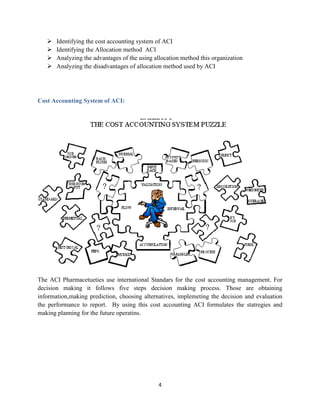
Cost Accounting System of ACI:
The ACI Pharmacetueties use international Standars for the cost accounting management. For
decision making it follows five steps decision making process. Those are obtaining
information,making prediction, choosing alternatives, implemeting the decision and evaluation
the performance to report. By using this cost accounting ACI formulates the statregies and
making planning for the future operatins.
5
Allocation Metod of ACI:
In ACI pharmaceutics there have mainly four types of product objects from where the revenue
generates and those are Pharmaceutics, agrochemical, animal health, and diagnostics devices.
Without those the rest of the product is named as other devices.
Through interviewing the accountant officer of the ACI pharmaceutics, we knew that this
organization uses the traditional costing method for the overhead allocation.
Step of this Method:
When we conduct with the accountant of this organization he exposed that for the cost allocation
ACI use traditional method and for this allocation they mainly use seven steps. Those are:
Step-1: Identify the products that are chosen cost objects.
Step-2: Identify the direct cost of the product.
Step-3: Select the cost allocation bases for allocating indirect cost to the products.
Step-4: Identify the indirect cost associated with each cost allocation base.
Step-5: Compute the rate per unit of each cost allocation base used to allocate indirect cost to the
products.
Step6-: Compute the indirect cost allocated to the product.
Step-7: Compute the total cost of the product adding all direct and indirect cost assigned to the
product.
Information about overhead cost recording and allocation:
ACI Pharmaceuticals follows two methods for single departments cost allocation. These are
1. Single rate method
2. Dual rate method
They also follow three methods for overhead cost allocation of multiple support departments.
These are
1. Direct method
2. Step down method
3. Reciprocal method
6
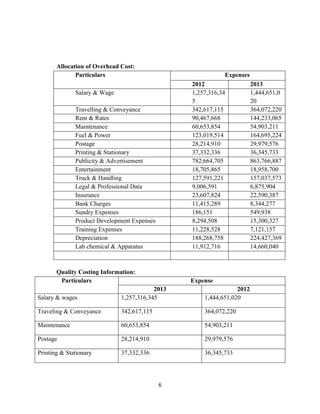
Allocation of Overhead Cost:
Particulars Expenses
2012 2013
Salary & Wage 1,257,316,34
5
1,444,651,0
20
Travelling & Conveyance 342,617,115 364,072,220
Rent & Rates 90,467,668 144,233,065
Maintenance 60,653,854 54,903,211
Fuel & Power 123,019,514 164,695,224
Postage 28,214,910 29,979,576
Printing & Stationary 37,332,336 36,345,733
Publicity & Advertisement 782,664,705 863,766,887
Entertainment 18,705,865 18,958,700
Truck & Handling 127,591,221 157,037,573
Legal & Professional Data 9,006,591 6,875,904
Insurance 23,607,824 22,590,387
Bank Charges 11,415,289 8,344,277
Sundry Expenses 186,151 549,938
Product Development Expenses 8,294,508 15,300,327
Training Expenses 11,228,528 7,121,157
Depreciation 188,268,758 224,427,369
Lab chemical & Apparatus 11,912,716 14,660,040
Quality Costing Information:
Particulars Expense
2013 2012
Salary & wages 1,257,316,345 1,444,651,020
Traveling & Conveyance 342,617,115 364,072,220
Maintenance 60,653,854 54,903,211
Postage 28,214,910 29,979,576
Printing & Stationary 37,332,336 36,345,733
7
Vehicle Maintenance 90,968,630 87,540,259
Insurance 23,607,824 22,590,387
Product Development
Maintenance
8,294,508 15,300,327
Training Expense 11,228,528 7,121,157
Depreciation 188,268,758 224,427,369
Lab Chemical & Apparatus 11,912,716 14,660,040
Ideally, a cost driver is an activity that is the root cause of why a cost occurs. In the past century,
the root cause of indirect manufacturing costs has changed from a single cost driver (such as
direct labor hours) to several cost drivers. Due to sophisticated manufacturing and increased
demands from customers, direct labor is no longer the main cost driver of indirect manufacturing
overhead. In addition to direct labor, today's drivers of indirect manufacturing costs include the
number of machine setups required, the number of engineering change orders, the demands from
customers for special inspections, handling and storage, the number of components in the units
produced, and the number of production machine hours. Manufacturers that want to know the
true costs of their products need to know what is driving their indirect manufacturing costs. For
these companies it is not sufficient to merely spread overhead costs to products by using a single
factor such as direct labor hours or production machine hours. In traditional costing the cost
driver to allocate indirect cost to cost objects was volume of output. With the change in business
structures, technology and thereby cost structures it was found that the volume of output was not
the only cost driver. Some examples of indirect costs and their drivers are: indirect costs for
maintenance, with the possible driver of this cost being the number of machine hours; or, the
indirect cost of handling raw-material cost, which may be driven by the number of orders
received; or, inspection costs that are driven by the number of inspections or the hours of
inspection or production runs.
Cost included for the local raw materials purchased are 1) Procurement cost 2) Transportation
cost 3) Bank charge
As they follow the traditional method so they have to depend several cost drivers for different
product line of single allocation base as well as departmental allocation base. Major cost
drivers/allocation bases are
 Direct Labor Cost
 Machine Hour
 Direct Labor Hour
 Direct Material Cost
 Volume of Production
 Weight
8
 Direct/Prime costs
 They allocate the overhead cost by some rate. Those are
 Total plant wide rate
 Blanket rate
 Overhead rate for groups of cost centers
 Overhead rate for Each Machine
Advantages of Traditional Costing Method:
1. Traditional costing method is easy to apply in calculation process.
2. This method provides a good idea of the costs of manufacturing a product.
3. This is the precise method in comparison of other methods.
4. This reduces the work load.
5. Traditional costing method helps in reducing the time consumption.
Disadvantages of Traditional Costing Method:
1. There is more than one product in this firm. So, using this method appropriate cost
allocation accurately is not possible always.
2. Accurate pricing of different products is not possible here.
3. It implies that there is only one cost driver, so costing becomes misleading.
4. Since the cost of many of the diverse activities does not correlate at all with the number
of production machine hours, the resulting allocations are misleading.
Conclusion:
Choosing a best cost allocation method is very crucial part of conducting business. As ACI
pharmaceuticals follows traditional cost allocation method which use several cost drivers for
several product line. This is very important for every business to recognize its cost which will in
return increase accountability of every department.

Cost Allocation Method

  • 1.
    GROUP EXID-1 COST ALLOCATION METHOD ACIPharmaceuticals Ltd. CASE STUDY 4/30/2015
  • 2.
    1 Submitted To HonourableCourse Teacher Tahmina Ahmed Lecturer Dept. of Accounting & Information Systems University of Dhaka
  • 3.
    2 Members’ List Md. NaymurRahman 19110 Ashraf Siddique 19117 Masud Rana 19130 Shohan Molla 19 116 Kaniz Fatema Nourine 19 141 Maliha Jahan 19 146
  • 4.
    3 Introduction: Inventory valuation andthe cost accumulation methods are generally known as cost accounting systems. Here we conduct a case about allocation method of the ACI pharmaceutics has different product line regarding pharmaceuticals. In this case the essence of cost allocation is given which will help to solve any particular cost allocation problem in future. Background of the Organization: In 1973, the UK based multinational pharmaceutical company, ICI plc, established a subsidiary in Dhaka, known as ICI Bangladesh Manufacturers Limited. In 1992, ICI plc divested its share to local management, and the company was renamed Advanced Chemical Industries (ACI) Limited. ACI formulates and markets a comprehensive range of more than 387 products covering all major therapeutic areas, which come in tablet, capsule, powder, liquid, cream, ointment, gel ,ophthalmic and injection forms. ACI also markets world-renowned branded pharmaceutical products like Arimidex, Casodex, Zoladex, Atarax etc. from world-class multinational companies like ASTRAZENECA, UK and UCB, BELGIUM in Bangladesh. ACI’s mission is to enrich the quality of the life of the product through responsibly using the knowledge, power and skills. For this reason, this company has to allocate and utilize its product. ACI follow international standards for the quality management systems for ensuring the consistent quality of the product. The prime commitment of this company is to serve product enriched with quality and attain the customer satisfaction. ACI also meets all national and regulatory requirements relating to the current business operation recommended by World Health Organizations (WHO). Objectives of this Study: For conducting any report or study there have some objects which helps to direct the study on the point. The overview of the study is conducted with those objectives:
  • 5.
    4  Identifying thecost accounting system of ACI  Identifying the Allocation method ACI  Analyzing the advantages of the using allocation method this organization  Analyzing the disadvantages of allocation method used by ACI Cost Accounting System of ACI: The ACI Pharmacetueties use international Standars for the cost accounting management. For decision making it follows five steps decision making process. Those are obtaining information,making prediction, choosing alternatives, implemeting the decision and evaluation the performance to report. By using this cost accounting ACI formulates the statregies and making planning for the future operatins.
  • 6.
    5 Allocation Metod ofACI: In ACI pharmaceutics there have mainly four types of product objects from where the revenue generates and those are Pharmaceutics, agrochemical, animal health, and diagnostics devices. Without those the rest of the product is named as other devices. Through interviewing the accountant officer of the ACI pharmaceutics, we knew that this organization uses the traditional costing method for the overhead allocation. Step of this Method: When we conduct with the accountant of this organization he exposed that for the cost allocation ACI use traditional method and for this allocation they mainly use seven steps. Those are: Step-1: Identify the products that are chosen cost objects. Step-2: Identify the direct cost of the product. Step-3: Select the cost allocation bases for allocating indirect cost to the products. Step-4: Identify the indirect cost associated with each cost allocation base. Step-5: Compute the rate per unit of each cost allocation base used to allocate indirect cost to the products. Step6-: Compute the indirect cost allocated to the product. Step-7: Compute the total cost of the product adding all direct and indirect cost assigned to the product. Information about overhead cost recording and allocation: ACI Pharmaceuticals follows two methods for single departments cost allocation. These are 1. Single rate method 2. Dual rate method They also follow three methods for overhead cost allocation of multiple support departments. These are 1. Direct method 2. Step down method 3. Reciprocal method
  • 7.
    6 Allocation of OverheadCost: Particulars Expenses 2012 2013 Salary & Wage 1,257,316,34 5 1,444,651,0 20 Travelling & Conveyance 342,617,115 364,072,220 Rent & Rates 90,467,668 144,233,065 Maintenance 60,653,854 54,903,211 Fuel & Power 123,019,514 164,695,224 Postage 28,214,910 29,979,576 Printing & Stationary 37,332,336 36,345,733 Publicity & Advertisement 782,664,705 863,766,887 Entertainment 18,705,865 18,958,700 Truck & Handling 127,591,221 157,037,573 Legal & Professional Data 9,006,591 6,875,904 Insurance 23,607,824 22,590,387 Bank Charges 11,415,289 8,344,277 Sundry Expenses 186,151 549,938 Product Development Expenses 8,294,508 15,300,327 Training Expenses 11,228,528 7,121,157 Depreciation 188,268,758 224,427,369 Lab chemical & Apparatus 11,912,716 14,660,040 Quality Costing Information: Particulars Expense 2013 2012 Salary & wages 1,257,316,345 1,444,651,020 Traveling & Conveyance 342,617,115 364,072,220 Maintenance 60,653,854 54,903,211 Postage 28,214,910 29,979,576 Printing & Stationary 37,332,336 36,345,733
  • 8.
    7 Vehicle Maintenance 90,968,63087,540,259 Insurance 23,607,824 22,590,387 Product Development Maintenance 8,294,508 15,300,327 Training Expense 11,228,528 7,121,157 Depreciation 188,268,758 224,427,369 Lab Chemical & Apparatus 11,912,716 14,660,040 Ideally, a cost driver is an activity that is the root cause of why a cost occurs. In the past century, the root cause of indirect manufacturing costs has changed from a single cost driver (such as direct labor hours) to several cost drivers. Due to sophisticated manufacturing and increased demands from customers, direct labor is no longer the main cost driver of indirect manufacturing overhead. In addition to direct labor, today's drivers of indirect manufacturing costs include the number of machine setups required, the number of engineering change orders, the demands from customers for special inspections, handling and storage, the number of components in the units produced, and the number of production machine hours. Manufacturers that want to know the true costs of their products need to know what is driving their indirect manufacturing costs. For these companies it is not sufficient to merely spread overhead costs to products by using a single factor such as direct labor hours or production machine hours. In traditional costing the cost driver to allocate indirect cost to cost objects was volume of output. With the change in business structures, technology and thereby cost structures it was found that the volume of output was not the only cost driver. Some examples of indirect costs and their drivers are: indirect costs for maintenance, with the possible driver of this cost being the number of machine hours; or, the indirect cost of handling raw-material cost, which may be driven by the number of orders received; or, inspection costs that are driven by the number of inspections or the hours of inspection or production runs. Cost included for the local raw materials purchased are 1) Procurement cost 2) Transportation cost 3) Bank charge As they follow the traditional method so they have to depend several cost drivers for different product line of single allocation base as well as departmental allocation base. Major cost drivers/allocation bases are  Direct Labor Cost  Machine Hour  Direct Labor Hour  Direct Material Cost  Volume of Production  Weight
  • 9.
    8  Direct/Prime costs They allocate the overhead cost by some rate. Those are  Total plant wide rate  Blanket rate  Overhead rate for groups of cost centers  Overhead rate for Each Machine Advantages of Traditional Costing Method: 1. Traditional costing method is easy to apply in calculation process. 2. This method provides a good idea of the costs of manufacturing a product. 3. This is the precise method in comparison of other methods. 4. This reduces the work load. 5. Traditional costing method helps in reducing the time consumption. Disadvantages of Traditional Costing Method: 1. There is more than one product in this firm. So, using this method appropriate cost allocation accurately is not possible always. 2. Accurate pricing of different products is not possible here. 3. It implies that there is only one cost driver, so costing becomes misleading. 4. Since the cost of many of the diverse activities does not correlate at all with the number of production machine hours, the resulting allocations are misleading. Conclusion: Choosing a best cost allocation method is very crucial part of conducting business. As ACI pharmaceuticals follows traditional cost allocation method which use several cost drivers for several product line. This is very important for every business to recognize its cost which will in return increase accountability of every department.