ASSIGNMENT PROBLEM
The assignment problem is one of the fundamental
combinatorial optimization problems in the branch of
optimization or operations research in mathematics. It
consists of finding a maximum weight matching (or
minimum weight perfect matching) in a weighted
bipartite graph.
HUNGARIAN METHOD
The Hungarian method is a combinatorial optimization
algorithm that solves the assignment problem in polynomial
time and which anticipated later primal-dual methods. It
was developed and published by Harold Kuhn in 1955, who
gave the name "Hungarian method" because the algorithm
was largely based on the earlier works of two Hungarian
mathematicians: Denes Konig and Jeno Egervary.
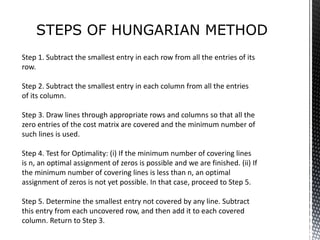
STEPS OF HUNGARIAN METHOD
Step 1. Subtract the smallest entry in each row from all the entries of its
row.
Step 2. Subtract the smallest entry in each column from all the entries
of its column.
Step 3. Draw lines through appropriate rows and columns so that all the
zero entries of the cost matrix are covered and the minimum number of
such lines is used.
Step 4. Test for Optimality: (i) If the minimum number of covering lines
is n, an optimal assignment of zeros is possible and we are finished. (ii) If
the minimum number of covering lines is less than n, an optimal
assignment of zeros is not yet possible. In that case, proceed to Step 5.
Step 5. Determine the smallest entry not covered by any line. Subtract
this entry from each uncovered row, and then add it to each covered
column. Return to Step 3.
Hungarian assignment problem

Hungarian assignment problem

  • 2.
    ASSIGNMENT PROBLEM The assignmentproblem is one of the fundamental combinatorial optimization problems in the branch of optimization or operations research in mathematics. It consists of finding a maximum weight matching (or minimum weight perfect matching) in a weighted bipartite graph.
  • 3.
    HUNGARIAN METHOD The Hungarianmethod is a combinatorial optimization algorithm that solves the assignment problem in polynomial time and which anticipated later primal-dual methods. It was developed and published by Harold Kuhn in 1955, who gave the name "Hungarian method" because the algorithm was largely based on the earlier works of two Hungarian mathematicians: Denes Konig and Jeno Egervary.
  • 4.
    STEPS OF HUNGARIANMETHOD Step 1. Subtract the smallest entry in each row from all the entries of its row. Step 2. Subtract the smallest entry in each column from all the entries of its column. Step 3. Draw lines through appropriate rows and columns so that all the zero entries of the cost matrix are covered and the minimum number of such lines is used. Step 4. Test for Optimality: (i) If the minimum number of covering lines is n, an optimal assignment of zeros is possible and we are finished. (ii) If the minimum number of covering lines is less than n, an optimal assignment of zeros is not yet possible. In that case, proceed to Step 5. Step 5. Determine the smallest entry not covered by any line. Subtract this entry from each uncovered row, and then add it to each covered column. Return to Step 3.