CHAPTER-3
COST ALLOCATION
1
Cost allocation
 Cost allocation refers to the assignment of all indirect costs to a
cost object using an allocation base.
 The ultimate goal of cost allocation is to make certain that all
costs incurred by the organization finally are assigned to its
products or services.
 This is important for several purposes including;
 cost based pricing, bidding, cost reimbursement
(return) from outside parties like insurance
companies, valuation of inventory, determination of
income and all other economic decisions.
 The allocation of all costs to departments serves to make
departmental managers aware of the cost incurred.
2
Product cost Elements
 Also called inventoriable costs.
 Classified in to three:
 Direct material cost
 Direct labor cost
 Manufacturing overhead costs (indirect costs)
 Direct costs are costs that are conveniently and economically
traced to a specific cost object.
 Direct materials and Direct labor costs are
referred as direct cost.
 Indirect costs are costs that cannot be conveniently or
economically traced to a specific cost object.
 Any production cost not classified as a direct cost
is an indirect cost. 3
Direct
Materials
Direct
Labor
Assigned
Overhead
Traceable
Unit Cost
for Finished
Goods
Allocation
Mfg. Process
(Work in
Process)
Estimated Overhead
POR = --------------------------
Estimated Units in Activity Base
Solution?
4
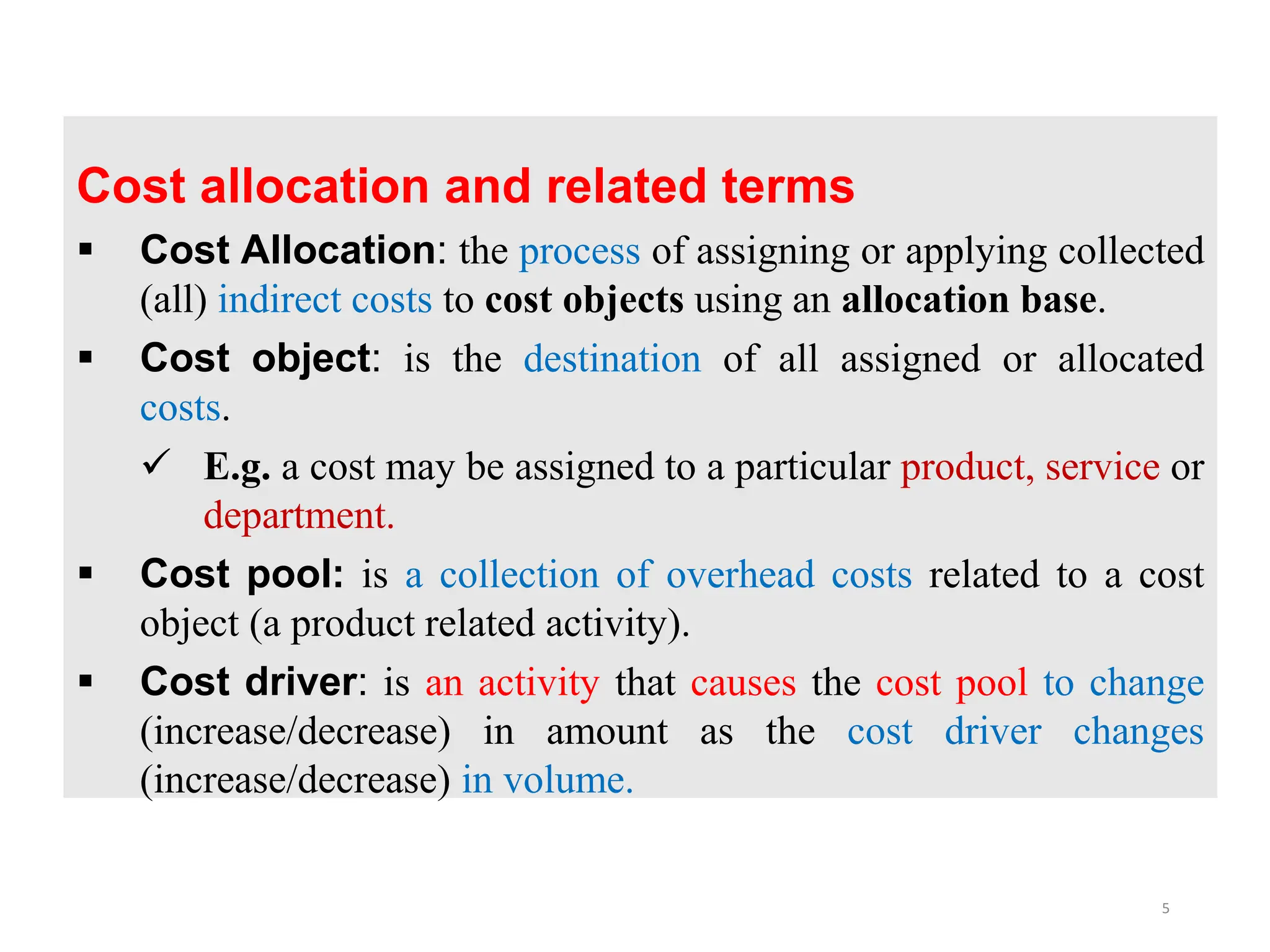
Cost allocation and related terms
 Cost Allocation: the process of assigning or applying collected
(all) indirect costs to cost objects using an allocation base.
 Cost object: is the destination of all assigned or allocated
costs.
 E.g. a cost may be assigned to a particular product, service or
department.
 Cost pool: is a collection of overhead costs related to a cost
object (a product related activity).
 Cost driver: is an activity that causes the cost pool to change
(increase/decrease) in amount as the cost driver changes
(increase/decrease) in volume.
5
Purposes of cost allocation
 To provide information for economic decisions:
 For making economic decisions like add a new product to
existing product, make or buy a product, and pricing of a
product true cost is required.
 The true cost can be arrived only if the MoH costs are
properly and correctly assigned to a product.
 To motivate mangers and other employees:
 To encourage the design of products that is simpler to
manufacture or less costly to service.
 To encourage sales representatives to increase high profit
margin product or services.
6
 To justify costs for fair pricing and reimbursement:
 To fix the fair price for a product, the true costs are to be
arrived.
 To get reimbursement for a consulting firm, the correct and
true costs are to be arrived.
 To measure income and assets for reporting to external
parties:
 The true cost of product enables the management;
 to measure the costs of inventory and cost of goods sold.
 to report inventories correctly in financial reporting.
 to cost inventories for reporting to tax authorities.
7
Criteria to guide cost allocation decisions
 While allocating cost to different units or products or some other
cost objects, there should be some criteria to be followed.
Cause and Effect
 The managers should identify the variable or variables that
cause resources to be consumed.
Example, Managers may use hours of testing as the variable
when allocating the costs of quality testing area to products.
 Cost allocation based on the cause and effect criterion are
likely to be the most credible to operating personnel.
8
Benefits Received
 The mangers should identify the beneficiaries of the outputs
of the cost object.
 The costs of the cost object are allocated among the
beneficiaries in proportion to the benefits receives.
Example, corporate wide advertising program that promotes the
general image of the corporation rather than any individual
product.
 The costs of this program may be allocated on the basis of
division revenues.
 The higher the revenues, the higher the division’s allocated
cost of the advertising program.
9
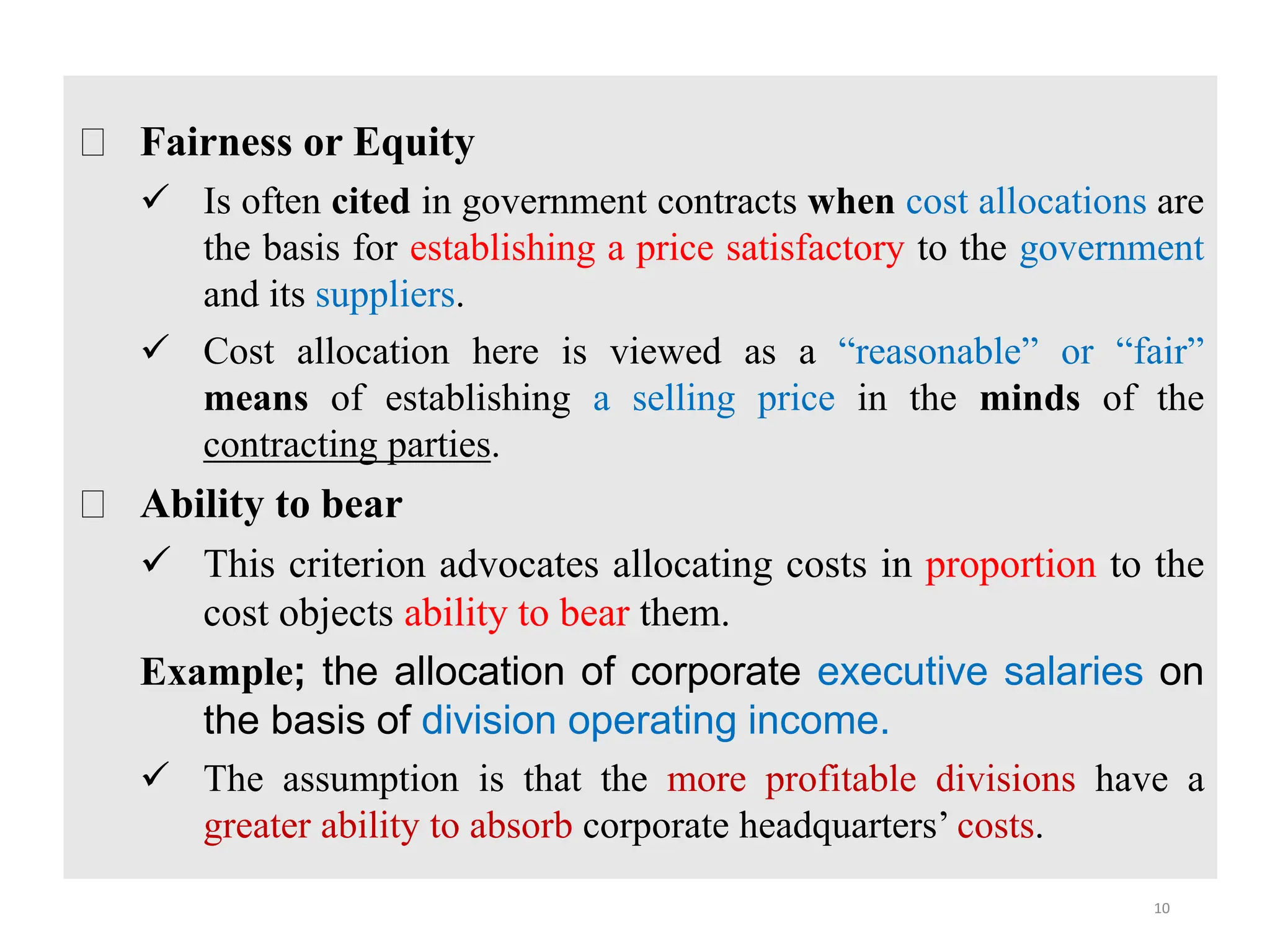
Fairness or Equity
 Is often cited in government contracts when cost allocations are
the basis for establishing a price satisfactory to the government
and its suppliers.
 Cost allocation here is viewed as a “reasonable” or “fair”
means of establishing a selling price in the minds of the
contracting parties.
Ability to bear
 This criterion advocates allocating costs in proportion to the
cost objects ability to bear them.
Example; the allocation of corporate executive salaries on
the basis of division operating income.
 The assumption is that the more profitable divisions have a
greater ability to absorb corporate headquarters’ costs.
10
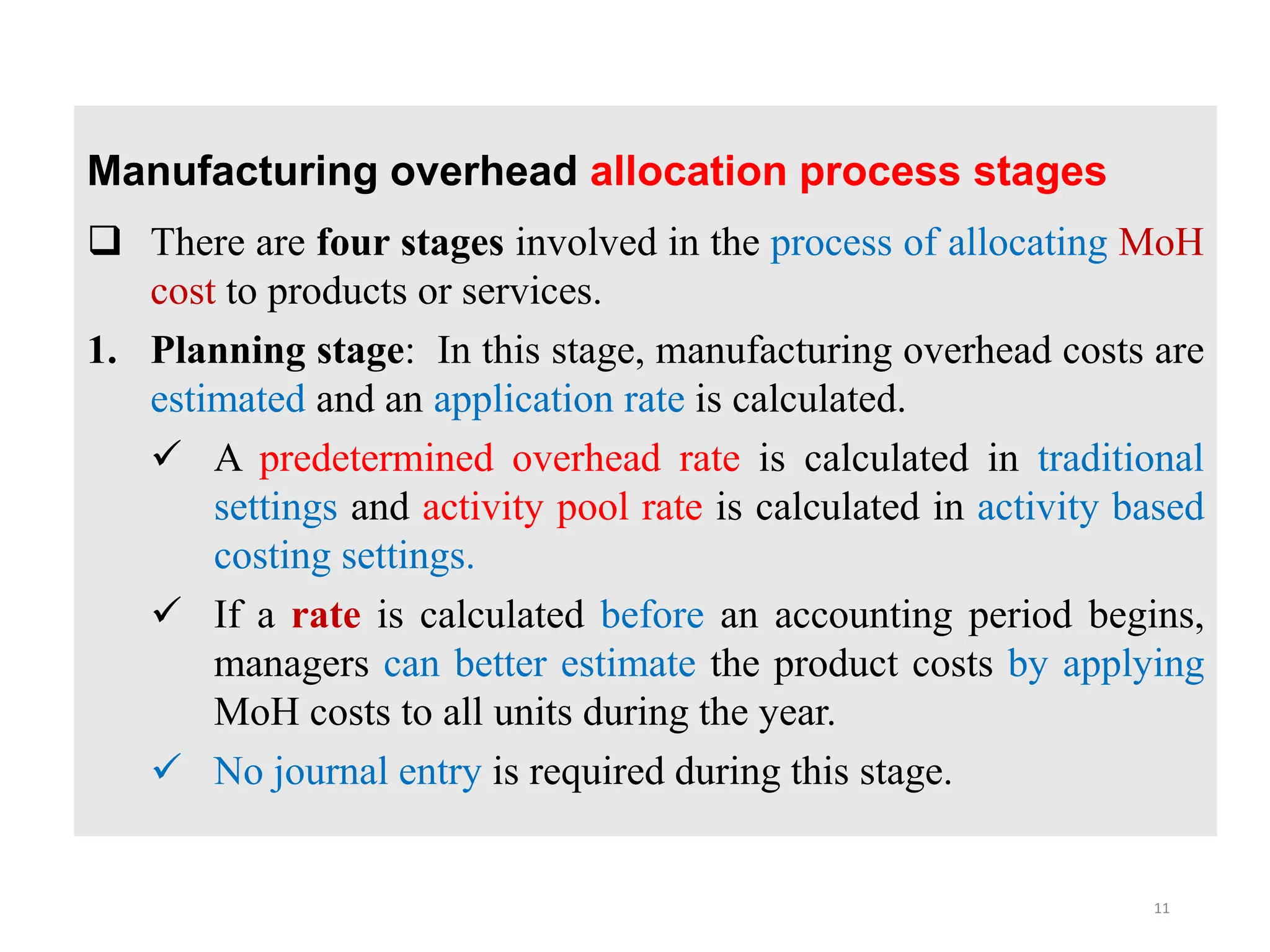
Manufacturing overhead allocation process stages
 There are four stages involved in the process of allocating MoH
cost to products or services.
1. Planning stage: In this stage, manufacturing overhead costs are
estimated and an application rate is calculated.
 A predetermined overhead rate is calculated in traditional
settings and activity pool rate is calculated in activity based
costing settings.
 If a rate is calculated before an accounting period begins,
managers can better estimate the product costs by applying
MoH costs to all units during the year.
 No journal entry is required during this stage.
11
2. Application step: In this step, the estimated manufacturing
overhead costs are assigned to the products costs as units are
manufactured.
 The actual cost driver level (for example, the actual number of
direct labor hours used to complete the product) is multiplied by
the predetermined manufacturing overhead rate or activity
pool rate for that cost driver.
 The following entry is required in this step.
Work in process inventory ………….. xxx
Manufacturing overhead ………….. Xxx
Applied manufacturing Actual cost Predetermined
manufacturing
overhead cost = driver level X overhead rate
12
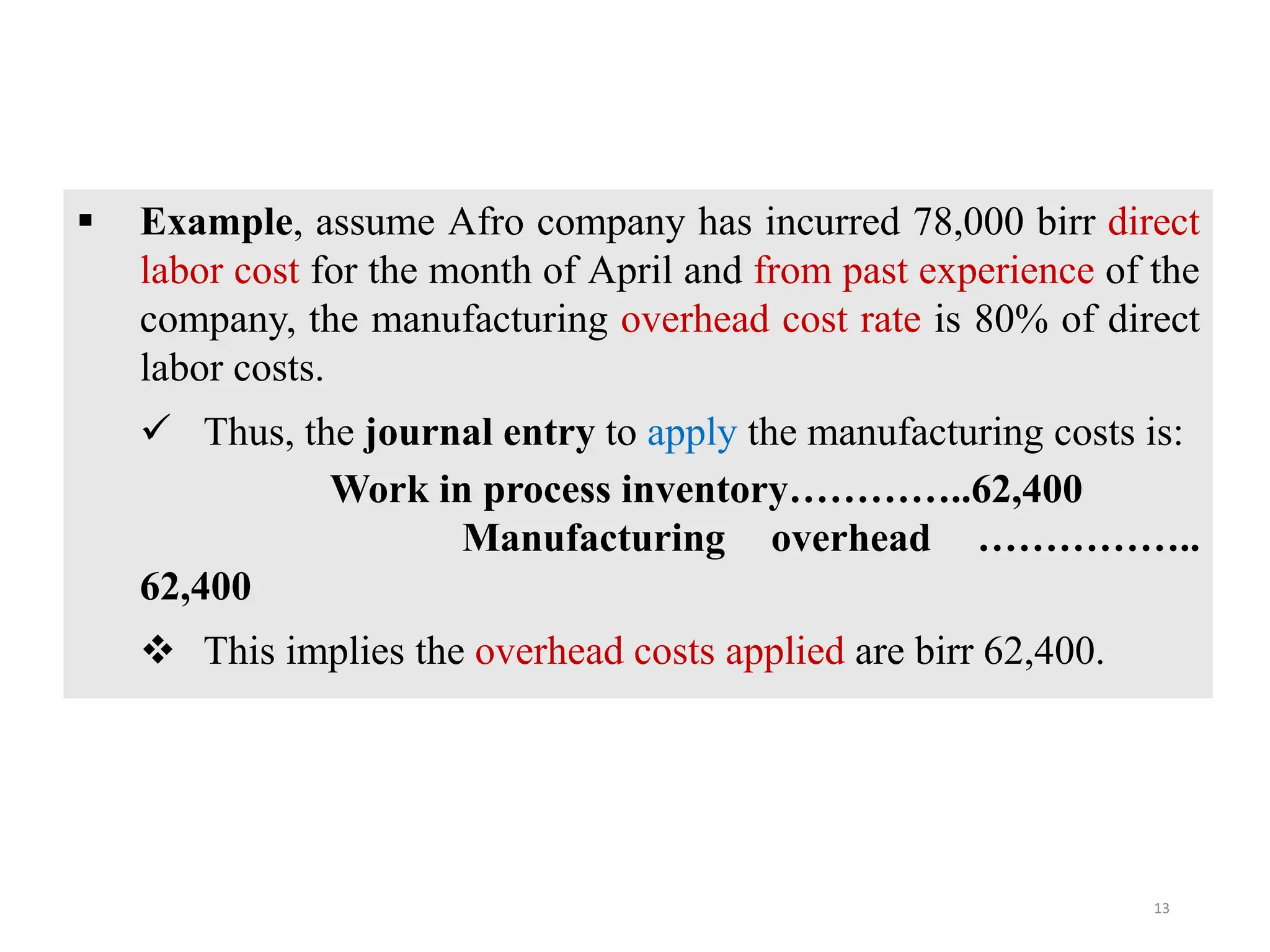
 Example, assume Afro company has incurred 78,000 birr direct
labor cost for the month of April and from past experience of the
company, the manufacturing overhead cost rate is 80% of direct
labor costs.
 Thus, the journal entry to apply the manufacturing costs is:
Work in process inventory…………..62,400
Manufacturing overhead ……………..
62,400
 This implies the overhead costs applied are birr 62,400.
13
3. Recording step: In this step, the actual manufacturing overhead
costs incurred during the accounting period are recorded.
 These costs will be part of the actual product cost and include the
costs of indirect materials, indirect labor, depreciation, property taxes
and other production cost.
Journal entry:
Manufacturing overhead cost……………xxx
Cash or A/p
……………………………………….xxx
 Example, the actual overhead cost incurred by Afro company in the
month of April indicates that birr 12,000 for indirect materials purchased
on account, indirect labor cost of birr 28,000 and other manufacturing
costs other than indirect materials and indirect labor are birr 28,000.
 The journal entry to record the actually incurred overhead costs is:
Manufacturing overhead cost …………. 68,000
Various accounts
………………………………68,000
(The various accounts stand for accounts payable, wages payable and other accounts like
depreciation costs, tax paid, etc.)
14
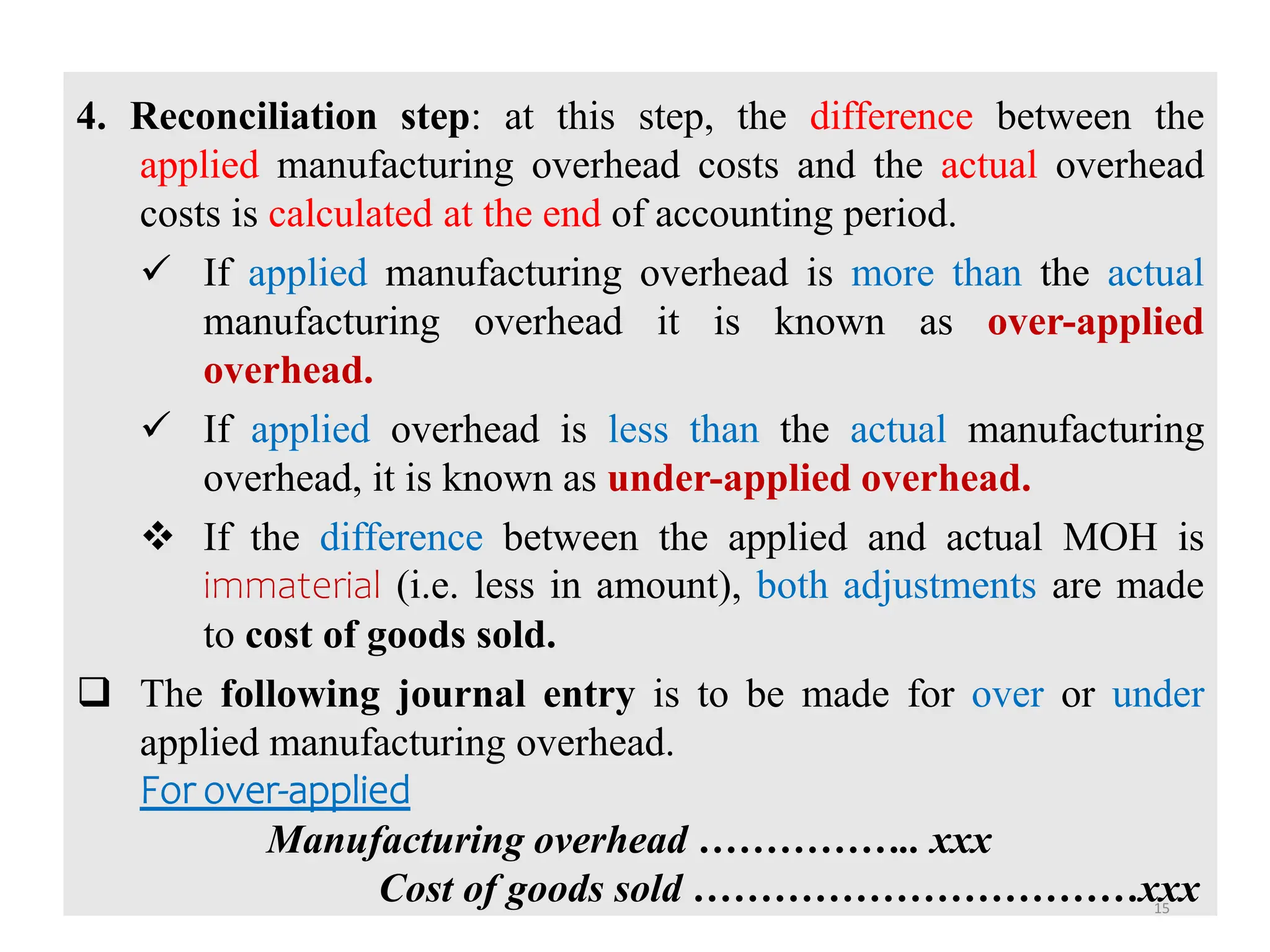
4. Reconciliation step: at this step, the difference between the
applied manufacturing overhead costs and the actual overhead
costs is calculated at the end of accounting period.
 If applied manufacturing overhead is more than the actual
manufacturing overhead it is known as over-applied
overhead.
 If applied overhead is less than the actual manufacturing
overhead, it is known as under-applied overhead.
 If the difference between the applied and actual MOH is
immaterial (i.e. less in amount), both adjustments are made
to cost of goods sold.
 The following journal entry is to be made for over or under
applied manufacturing overhead.
For over-applied
Manufacturing overhead …………….. xxx
Cost of goods sold ……………………………xxx
15
For under-applied
Cost of goods sold ………………..xxx
Manufacturing overhead cost…………………xxx
 However, if the over or under-applied overhead is material (i.e.
more) the adjustments are made not only to cost of goods sold
but also to work in process inventory and finished goods
inventory.
 Because, the materiality of the over applied or under applied has
a material effect on not only cost of goods sold but also on
working in process and finished goods.
Example, based on step 2 & 3 before, the applied
overhead cost is birr 62,400 and the actual overhead
cost incurred is birr 68,000, therefore, there is under-
application of overhead costs by birr 5,600 and
assume the under-applied overhead cost is immaterial
(i.e., the amount is not significant).
 The journal entry to record the under-applied overhead is: 16
 However, if the under-applied overhead is material, the
adjustment should be to cost of goods sold, work in process and
finished goods based on their ending balances.
 Assume at the end of April, the Afro Company has birr 50,000 work
in process, birr 30,000 finished goods reported in its balance sheet
and birr 120,000 cost of goods sold reported in its income
statement.
 Accordingly, the under-applied is allocated to the three accounts
as follows: Cost of goods sold ………3,360
Work in process ………..1,400
Finished goods ……………840
MoH cost
……………………..…5,600
17
Manufacturing overhead allocation
Using the Traditional approach and Activity based
1. Traditional Approach
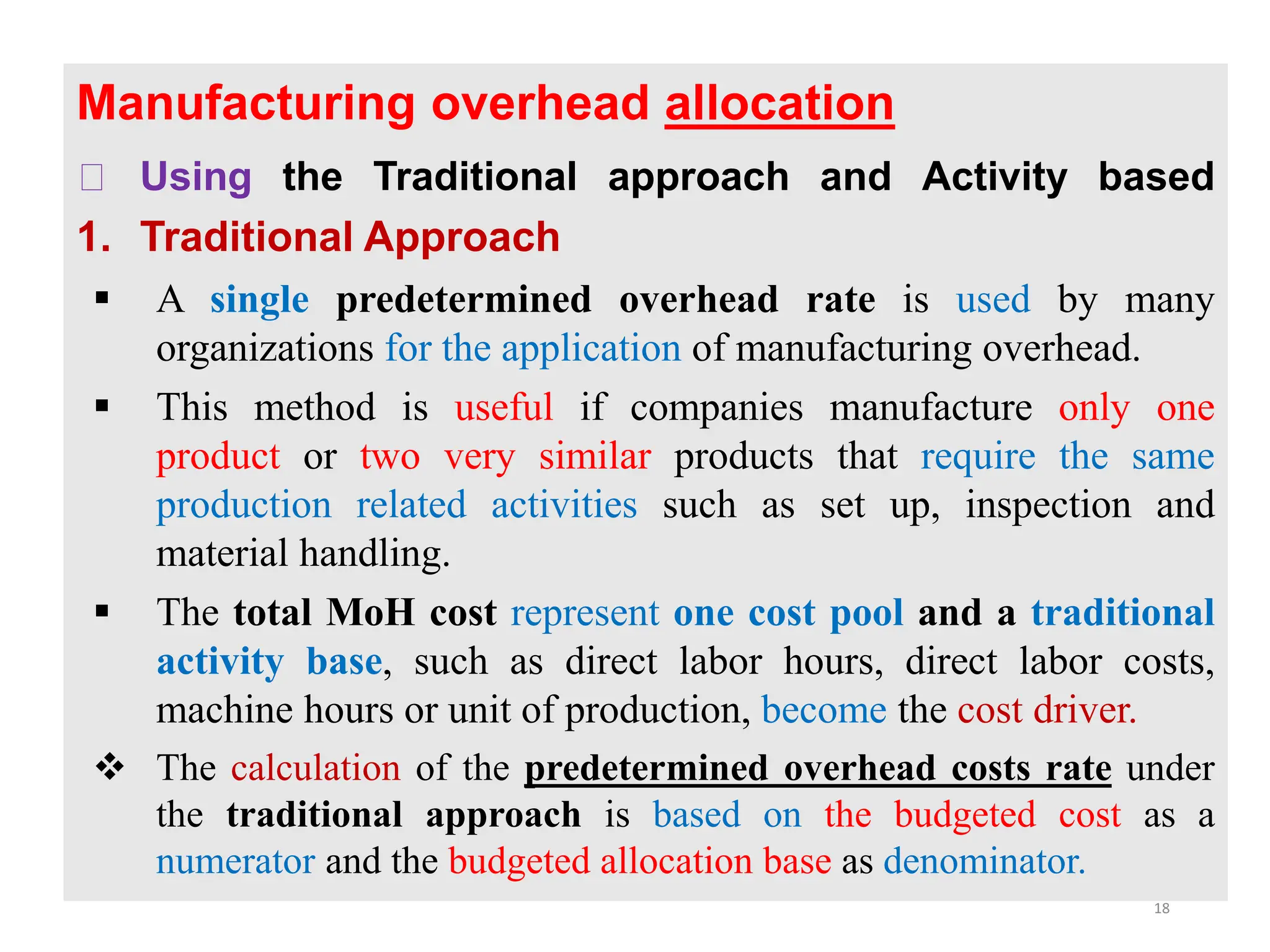
 A single predetermined overhead rate is used by many
organizations for the application of manufacturing overhead.
 This method is useful if companies manufacture only one
product or two very similar products that require the same
production related activities such as set up, inspection and
material handling.
 The total MoH cost represent one cost pool and a traditional
activity base, such as direct labor hours, direct labor costs,
machine hours or unit of production, become the cost driver.
 The calculation of the predetermined overhead costs rate under
the traditional approach is based on the budgeted cost as a
numerator and the budgeted allocation base as denominator.
18
 However, the application of manufacturing overhead costs to the
products is based on the actual usage, i.e., the budgeted rate
multiplied by the actual usage of the allocation base or cost driver
by each product or batch of product.
 Example: Assume Philips TV set manufacturer
producing 14” and 21” color TV sets.
 They are using the application of one cost pool of
manufacturing overhead costs to two product
lines.
 Suppose the Philips set manufactures choose
machine hours as the cost driver.
 For the next year, the overhead cost will amount to
$300,000 and that total machine hours worked will
be 30,000 hours.
 The corporation supplied the following data for the two
product lines:
14 inch 21 inch
Actual direct materials cost/unit $ 70 $ 80
Actual direct labor cost/unit 30 40
Prime cost per unit 100 120
19
Required: Using Traditional Approach
a) Compute the predetermined overhead rate
b) Apply manufacturing overhead to the products
Step1. Compute the predetermined overhead rate
20
Step 2: Apply manufacturing overhead to the products.
 Assume, during the year 10,000 machine hours were used to
produce 5000, 14-inch TV sets and 20,000 machine hours were
used to produce 4000, 21-inch TV sets.
 Philips Corporation used the predetermined overhead rate,
 the portion of MoH cost applied to the 14-inch TV sets = $100,000
($10 x 10,000 MHrs) or $20 per unit ($100,000/ 5,000units) and
 the portion of MoH cost applied to 21-inch TV sets totaled =
$200,000 ($10 x 20,000 MHrs) or $50 per unit ($200,000/
4000units)
14 inch 21 inch
Cost drive
level
Cost applied Cost drive level Cost applied
Overhead cost applied:
Manufacturing overhead rate:
$10/MHrs
x 10,000MHrs $100,000 X 20,000MHrs $200,000
Number of units 5,000 units 4,000units
Manufacturing overhead cost
per unit
$ 20 $ 50
21
 Philips Corporation also wanted to calculate the normal
product unit cost during the accounting period.
 The 21-inch product unit cost of $170 is higher than the 14-inch
product unit cost of $120 because the 21-inch TV set required
more materials that are expensive and more machines time.
Product unit Cost for each product line is
14inch 21inch
Direct Materials $70 $80
Direct labor 30 40
Manufacturing overhead 20 50
Product unit cost 120 170
22
2. Activity Based costing (ABC)
 Activity–Based Costing (ABC) is a method of assigning costs
that calculates a more accurate product cost by categorizing
all indirect costs by activity, tracing the indirect costs to
those activities and assigning activity costs to product using
cost driver that are related to the cause of the product.
 ABC identifies production-related activities, events and
circumstances that cause, or drive those activities, such as
number of inspections, number of moves or maintenance hours.
 As a result, many smaller activity pools are created based on
their similarity to obtain more accurate product costs.
 ABC will improve the accuracy of product costs for
organizations that sell many different types of products
(product diversity).
23
 It would provide managers with better information for making
decisions related to fixing selling prices, determination of accurate
income, ask compensation, tax refunds, inventory valuation and make
or buy decisions.
 Avoids understatement or overstatement of income and
inventory valuation through accurate costs of products or
services
 The manager will calculate a predetermined overhead rate or
activity cost rate, for each activity pool and then use that rate
and a cost driver amount to determine the portion of
manufacturing overhead costs to assign to a product.
 Example: refer the above example and observe how activities
and costs are pooled in to different activity pools and activity
cost pools and how costs are allocated under the Activity Based
Costing Approach in the following illustration
24
Philips Corporation analyzed the production related activities and
decided that the estimated $300,000 in manufacturing overhead
cost should be grouped into four activity pools.
 The first activity, setup, includes estimated total costs of
$100,000 for indirect labor and indirect materials used in
preparing machines for each batch of production.
 The second activity, inspection, includes $90,000 for salaries
and costs of indirect materials, indirect labor and depreciation
on testing equipment.
 Packaging, the third activity, includes estimated total costs of $
65,000 for indirect materials, indirect labor and equipment
depreciation.
 The last activity, building, includes, estimated total cost
$45,000 for wages, property taxes, insurance, security and all
other costs not related to the first three activities.
25
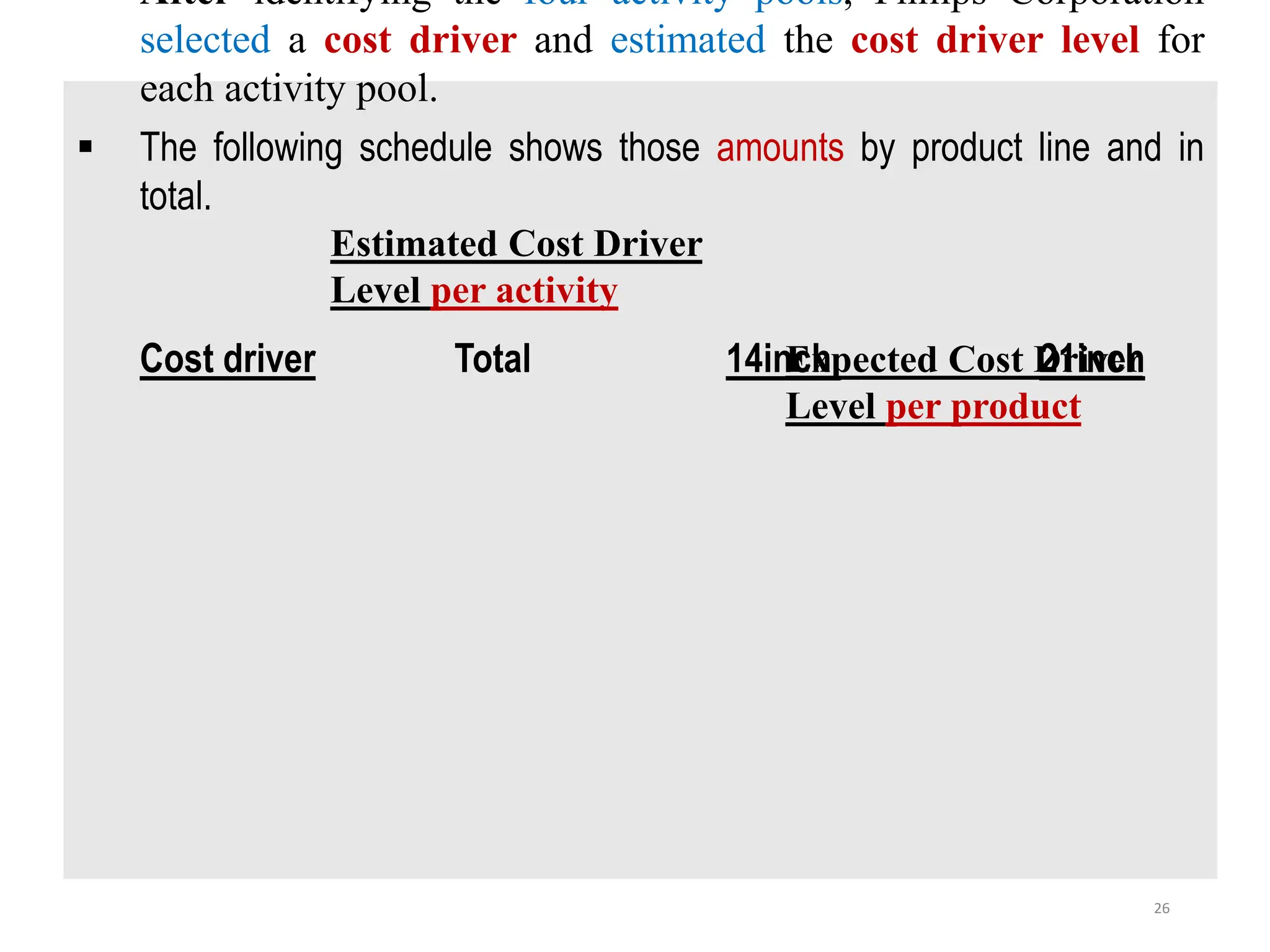
 After identifying the four activity pools, Philips Corporation
selected a cost driver and estimated the cost driver level for
each activity pool.
 The following schedule shows those amounts by product line and in
total.
Estimated Cost Driver
Level per activity
Cost driver Total 14inch 21inch
26
Expected Cost Driver
Level per product
Step 1: Calculate activity cost rate using ABC Approach
Activity
Pool
Estimated
Activity
pool
amount
Cost
Driver
Budgeted Cost
driver level Activity cost
rate
Set up $100,000 No. of set
ups
1,000 setups $100 per setup
Inspection 90,000 No. of
inspections
600
inspections
$150 per inspection
Packaging 65,000 Packaging
hours
2,500 packing
hours
$26 per packing
hour
Building 45,000 Machine
hours
30,000Machin
e hours
$1.5 per machine
hour
27
Step 2: Application of manufacturing overhead costs to
production:
 In applying the MoH to the products, the activity pool rate is
multiplied by the actual cost driver used by the products.
14 inch 21 inch
Activity
pool
Activity cost
rate
Cost
Driver
level
Cost
applied
Cost
Driver
level
Cost
applied
Set up $100 per set
up
*500 set
ups
$ 50,000 *500 set
ups
$50,000
Inspect
ion
$150 per
inspection
*250
inspection
$ 37,500 *350
inspection
s
$52,500
Packin
g
$26 per
packing hour
*1,200
packing
hour
$31,200 *1,300
packing
hour
$33,800
Buildin $1.5 per *14,000 $21,000 *16,000 $24,000
Cost applied = Activity cost pool rate x actual cost driver
level
28
Product Unit Cost
14inch 21inch
Product cost per unit:
Direct materials $ 70 $ 80
Direct labor 30 40
Manufacturing overhead 28 40
Product unit cost 128 160
14-inch
21-inch
Product unit cost:
One MoH Cost pool (traditional approach). $ 120 $ 170
Product unit cost: (ABC with four activity pools) $ 128
$ 160
Differences: Decrease (increase) $ (8)
$ 10
 Management accountant presented the following information
to Philips Corporation using two approaches
29
Allocating corporate costs to divisions and products
 Corporate costs are costs that are incurred at the corporate level
(administration level of the organization).
 There are several choices in accumulating and allocating
corporate costs to divisions and products.
 The essence of accumulating and allocating overhead costs is
different in different organization.
Some of these are presented as below:
1) Some companies allocate all corporate costs to
divisions
 They maintain that corporate costs are incurred to support the
activities of the divisions.
 In this case, companies that want to calculate the full cost of
products must allocate corporate costs to activity-cost pools
of divisions 30
2. Other companies do not allocate corporate costs to
divisions.
 They maintain that division managers generally have no say
or role in incurring corporate costs.
3. Still other companies allocate only those corporate costs,
such as corporate human resources costs, for which there is
widespread agreement that they are either
causally/fundamentally/ relate to division activities or they
provide explicit benefits to divisions.
 These companies exclude corporate costs such as corporate
donations to the charitable foundations because
 division manager often have no say in making these
decisions.
 these benefits to the divisions are less evident or too remote.
31
Why do we allocate corporate costs and other support
costs to divisions and departments?
a) To remind profit center managers that indirect costs exists and that
profit center earnings must be adequate to cover some share of
corporate cost as well as their costs.
b) To encourage use of central services that would otherwise be
underutilized; and
c) To stimulate profit - center managers’ to put pressure on central
manager to control service costs.
 Other different studies cited the following objectives, ranked in order of
importance, for allocating costs to divisions and departments: -
a. to determine costs
b. to evaluate profit centers
c. to fix accountability
d. to allocate costs per unit of usage
e. to promote more effective resources usage and
f. to foster cost awareness
32
 In most manufacturing and non-manufacturing organizations,
corporate costs are grouped in to three major categories of
costs.
 These are:
1) Treasury costs:- interest on debt used to finance the
construction of new assembly equipment divisions.
2) Human resource management costs:- recruitment
and ongoing employee training and development .
3) Corporate administration costs:- executive salaries,
rent and general administration costs.
 Thus, corporate overhead costs can be allocated to products by
establishing its own activity pool cost.
33
Allocating costs from one department to another
Why costs of one department are allocated to another department?
 Cost of a central department which emerges to give service for
other departments centrally are incurred only because it provides
service to these departments or divisions.
 Accordingly, the costs of this department should be allocated to
the departments or divisions that are directly involved in the
production process or accomplishments of activities to ascertain
the actual costs of the activities or products.
 The issues of allocating costs from a corporate department to
divisions are to be:
 Whether different methods of allocation be used for fixed costs and
variable costs
 Whether budgeted rates or actual rates be used
 Whether budgeted quantities or actual quantities is used.
34
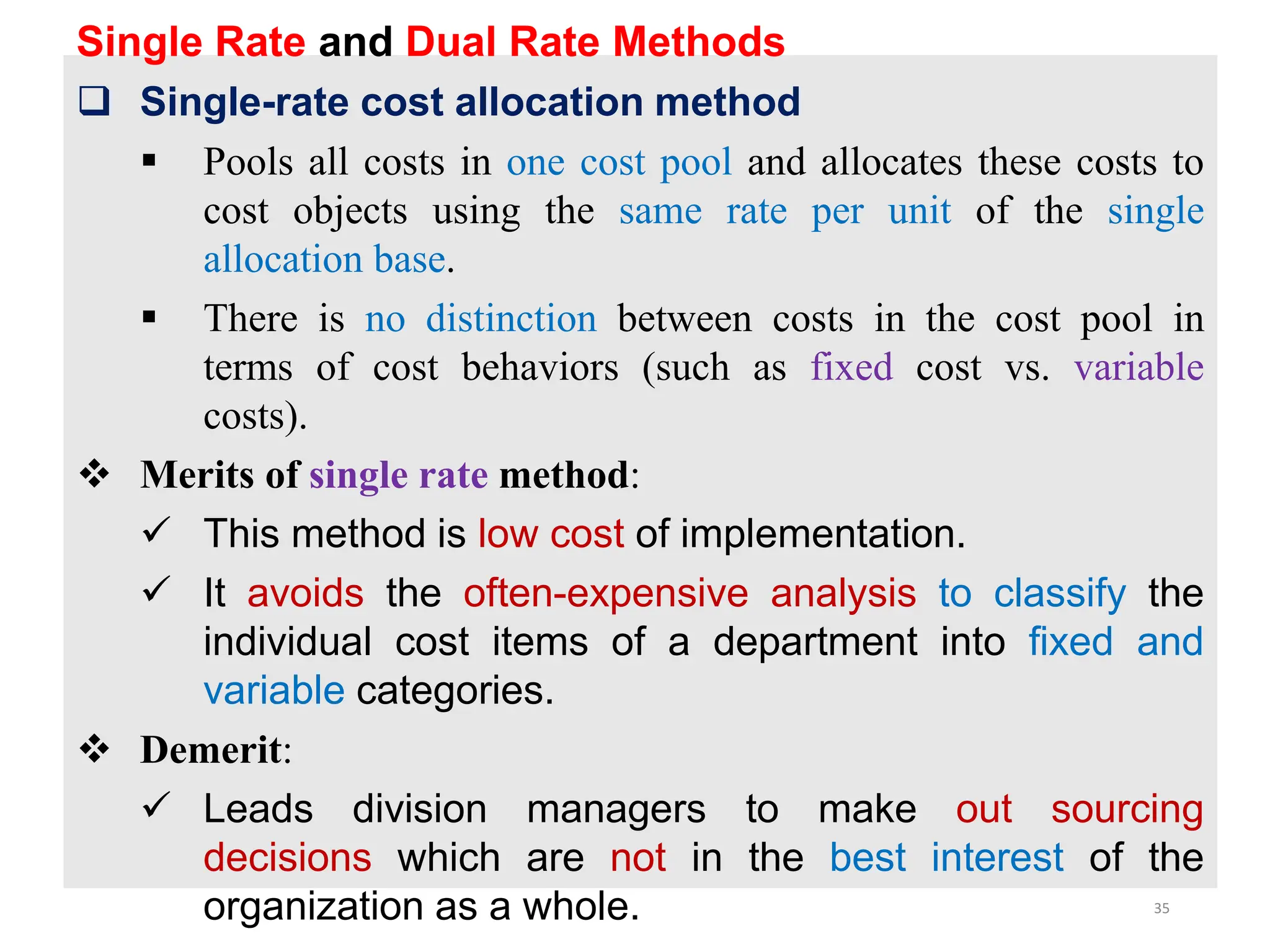
Single Rate and Dual Rate Methods
 Single-rate cost allocation method
 Pools all costs in one cost pool and allocates these costs to
cost objects using the same rate per unit of the single
allocation base.
 There is no distinction between costs in the cost pool in
terms of cost behaviors (such as fixed cost vs. variable
costs).
 Merits of single rate method:
 This method is low cost of implementation.
 It avoids the often-expensive analysis to classify the
individual cost items of a department into fixed and
variable categories.
 Demerit:
 Leads division managers to make out sourcing
decisions which are not in the best interest of the
organization as a whole. 35
 The dual- rate cost allocation method
 Classify costs in each cost pool into two sub-cost pools (a
variable cost sub-pool and a fixed cost sub-pool).
 When the dual rate method is used, allocation bases must be
chosen for each cost pool.
 Assume that the budgeted rates are used, the allocation
quantities chosen are budgeted usage for fixed costs and
actual usage for variable costs.
 Merit: This method indicates to division managers;
 how variable costs and fixed costs behave differently.
 to make decisions that benefit the organization as a whole
as well as each division.
36
Budgeted Vs Actual Rates
Budgeted Rates:
 When cost allocations are made using budgeted rates,
managers of divisions to which costs are allocated, face no
uncertainty about the rates to be used in that budget period.
 Budgeted rates let the user departments know in advance the
cost rates they will be charged.
 Users are then better equipped to determine the amount of the
service to request and if the option exists whether to use the
internal department source or an external vendor.
 Budgeted rates also help to motivate the manager of the
supplier department to improve efficiency.
 As inefficiencies at the department providing the service do not
affect the costs allocated to the user department.
37
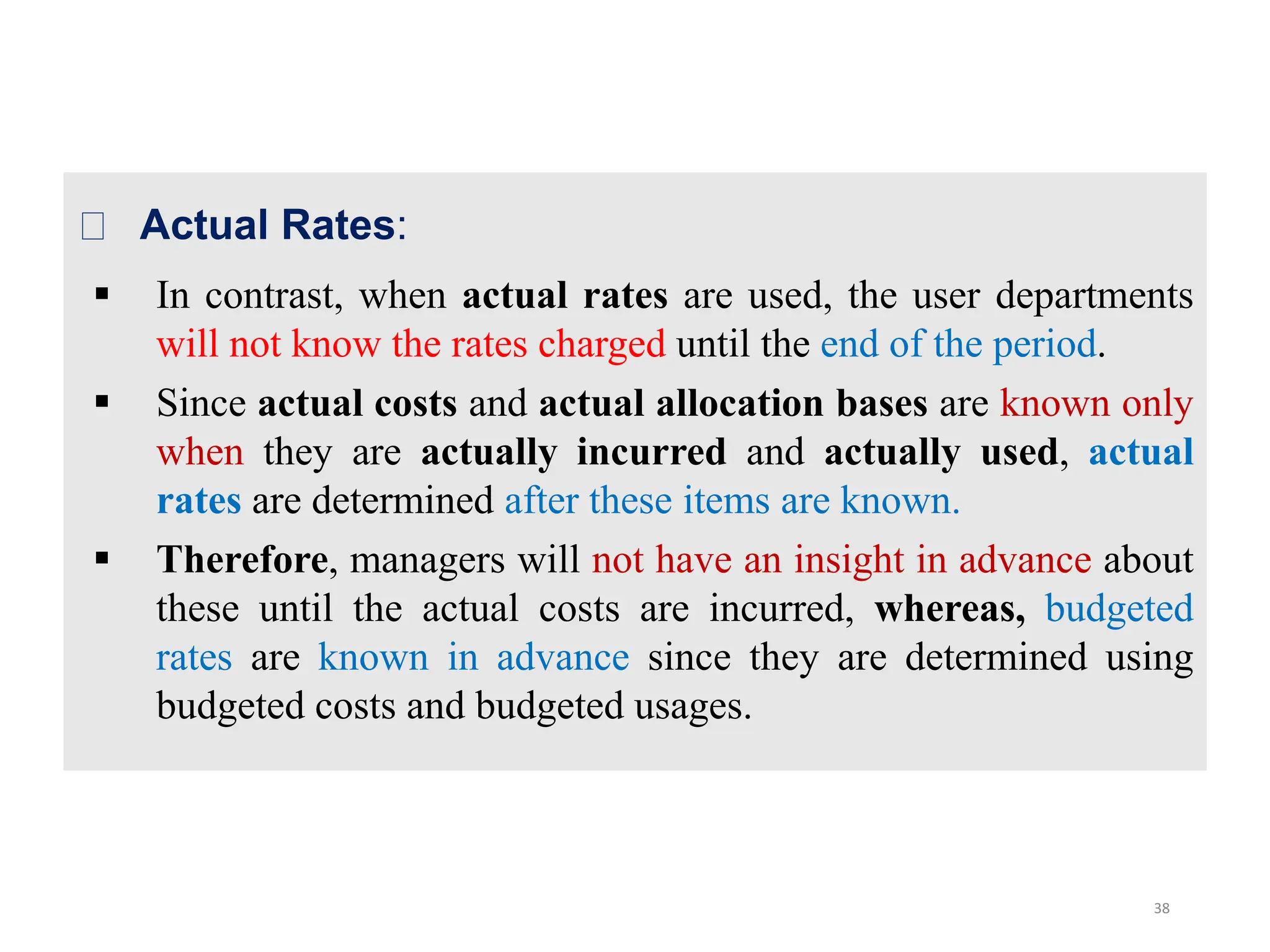
Actual Rates:
 In contrast, when actual rates are used, the user departments
will not know the rates charged until the end of the period.
 Since actual costs and actual allocation bases are known only
when they are actually incurred and actually used, actual
rates are determined after these items are known.
 Therefore, managers will not have an insight in advance about
these until the actual costs are incurred, whereas, budgeted
rates are known in advance since they are determined using
budgeted costs and budgeted usages.
38
Example:
 Dell Computer Corporation has a central computer
department.
 This department has only two users–Dell- Microcomputer
division and Dell peripheral equipment division.
The following data apply to the coming budget year:
Fixed costs of operating the computer facility in the 4000
to 12000 hours= $4,000,000 per annum relevant range
Total capacity available…………………………..…….=
12,000 hours
Budgeted long run usage………………………………=
10,000 hours
Microcomputer Division…………………………=
7,500 hours
Peripheral Equipment Division……………………=
2,500 hours
Budgeted variable cost per hour (4000 to 12000 hours
39
You are required to calculate:
a) Under single rate method (assuming budgeted usage is
the allocation base and budgeted rates are used)
i. Total cost pool
ii. Budgeted total rate per hour.
iii. Total cost allocated to Microcomputer division
iv. Total cost allocated to peripheral Division
b) Under Dual Rate Method (Budgeted usage for fixed costs
and actual usage for variable costs)
i. Total fixed cost for microcomputer division
ii. Total fixed cost for peripheral equipment division
iii. Total cost allocated to microcomputer division
iv. Total cost allocated to peripheral division.
Note: Assuming that during the coming year the microcomputer
division actually uses 8000 hours and peripheral equipment division
2000 hours.
40
Solution:
a) Under Single Rate Method:
(i) Calculation of total cost pool:
Fixed cost (Budgeted) for the year……….=$ 4,000,000
Variable cost @ $300 per hour for
10,000 budgeted hours ……………….= 3,000,000
=$ 7,000,000 per annum
ii) Calculation of Budgeted rate per hour:
Budgeted total cost pool………………= 7,000,000 per
annum
Budgeted total hours…………………..= 10,000 hours
Budgeted rate per hour = 7,000,000/10,000
= $700 per hour used.
41
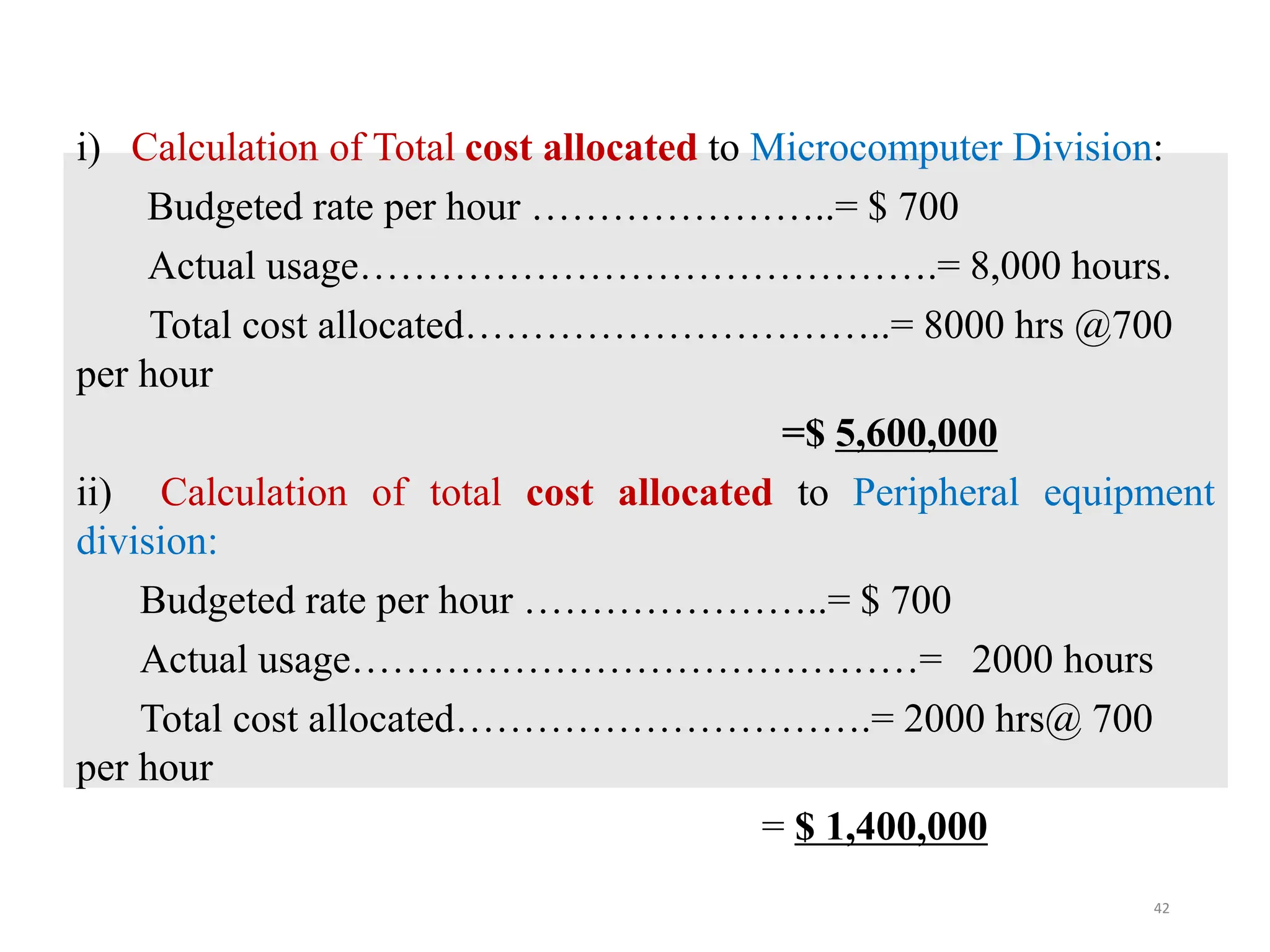
i) Calculation of Total cost allocated to Microcomputer Division:
Budgeted rate per hour …………………..= $ 700
Actual usage…………………………………….= 8,000 hours.
Total cost allocated…………………………..= 8000 hrs @700
per hour
=$ 5,600,000
ii) Calculation of total cost allocated to Peripheral equipment
division:
Budgeted rate per hour …………………..= $ 700
Actual usage……………………………………= 2000 hours
Total cost allocated………………………….= 2000 hrs@ 700
per hour
= $ 1,400,000
42
B) Under Dual Rate Method:
(i) Calculation of fixed cost for Microcomputer Division:-
Total fixed cost (for 10,000hrs)……………….= $ 4,000,000
P.a.
Total fixed cost for budgeted hours
of 7,500 hours………………………………....=
4,000,000 x
= $3,000,000
(ii) Calculation of fixed cost for Peripheral equipment Division:-
Total fixed cost (for 10,000hrs)……………….= $ 4,000,000
P.a.
Total fixed cost for budgeted hours
of 2,500 hours…………………………….…..= 4,000,000
x
= $1,000,000
000
,
10
7500
000
,
10
2500
43
(iii). Calculation of total cost allocated to microcomputer
division
Fixed cost allocated……………………………… = $
3,000,000.
Variable cost @300 per hour
for 8000 actual hours…………………………=
2,400,000
Total cost allocation………………………………= $
5,400,000
(iv). Calculation of total cost allocated to peripheral division:
Fixed cost allocated…………………………………..= $
1,000,000
Variable cost @300 per hour
for 2000 actual hours…………………………….=
600,000
Total cost………………………………………………..=
1,600,000
44
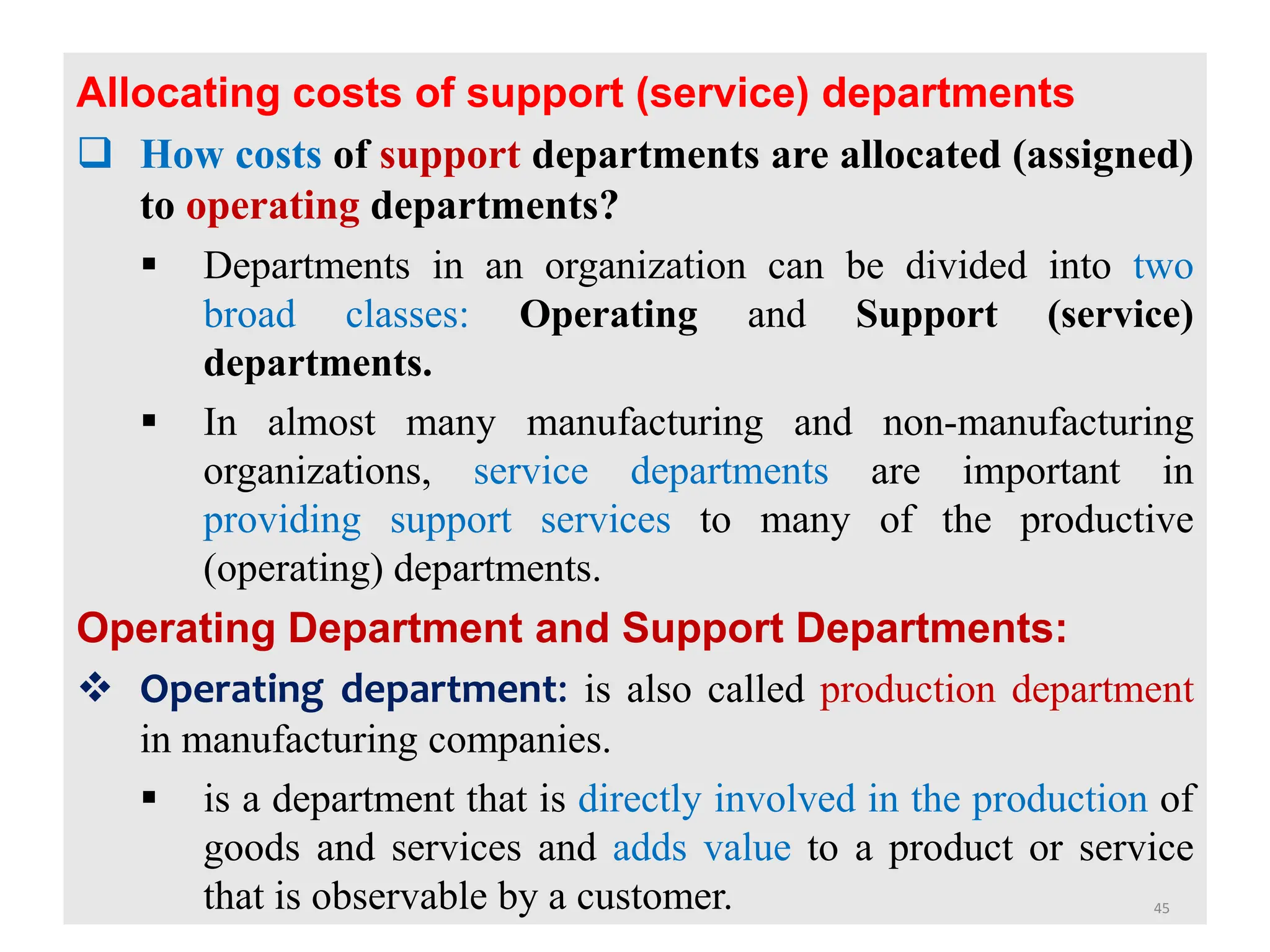
Allocating costs of support (service) departments
 How costs of support departments are allocated (assigned)
to operating departments?
 Departments in an organization can be divided into two
broad classes: Operating and Support (service)
departments.
 In almost many manufacturing and non-manufacturing
organizations, service departments are important in
providing support services to many of the productive
(operating) departments.
Operating Department and Support Departments:
 Operating department: is also called production department
in manufacturing companies.
 is a department that is directly involved in the production of
goods and services and adds value to a product or service
that is observable by a customer. 45
 Example include the surgery department in a hospital; the
undergraduate and graduate programs in a university;
various flight groups in an airline;
 Production department such as milling, assembly, and
painting in a manufacturing company, etc.
 Support department: It is also called service department.
 A support department provides the services to other internal
departments (operating and other support departments) in
the organization.
 Support department does provide a service that enables the
organization’s production process to takes place.
 In order to determine the cost of those goods or services, all
service department costs must be allocated to the production
departments in which the goods or services are produced.
46
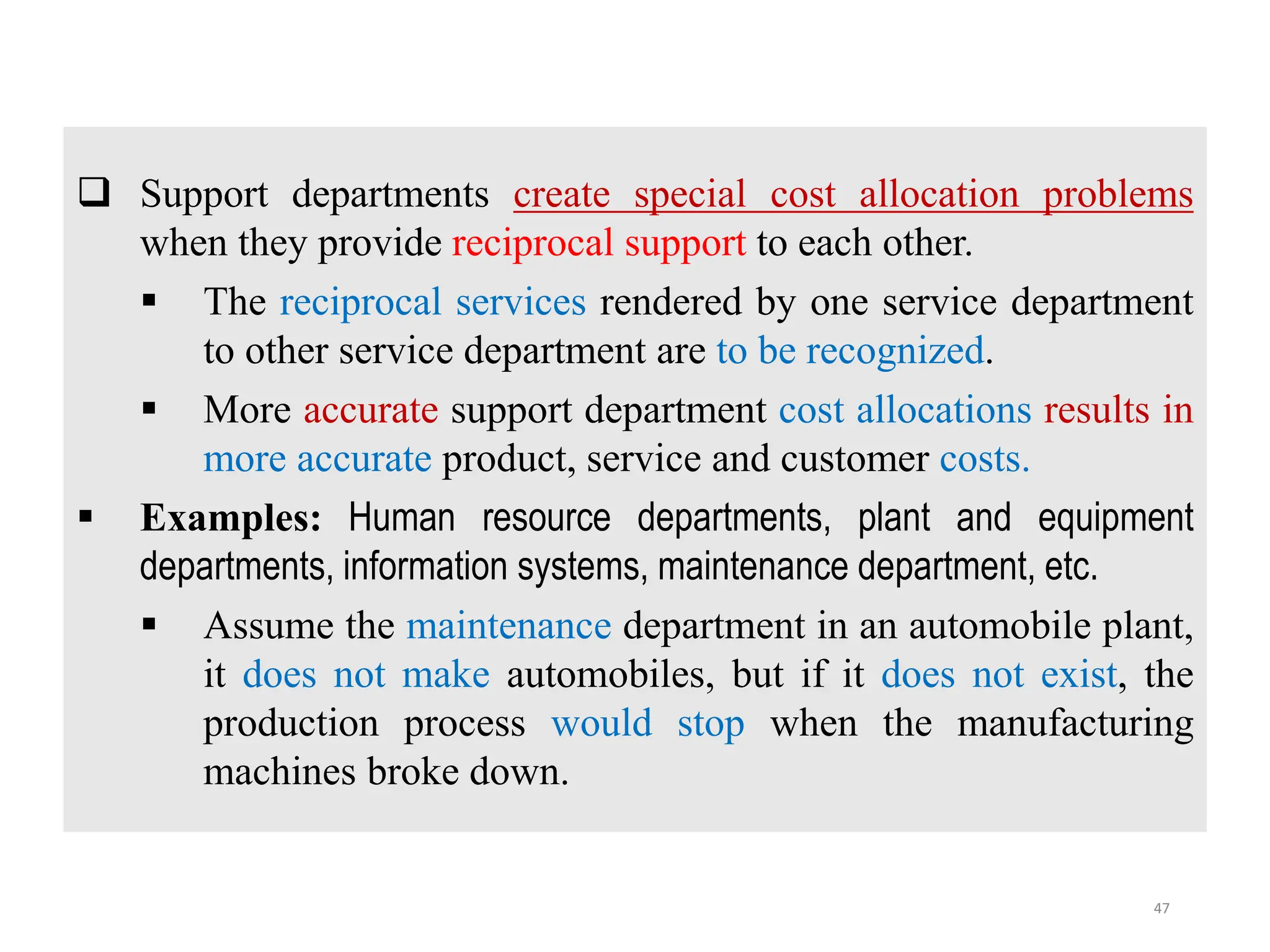
 Support departments create special cost allocation problems
when they provide reciprocal support to each other.
 The reciprocal services rendered by one service department
to other service department are to be recognized.
 More accurate support department cost allocations results in
more accurate product, service and customer costs.
 Examples: Human resource departments, plant and equipment
departments, information systems, maintenance department, etc.
 Assume the maintenance department in an automobile plant,
it does not make automobiles, but if it does not exist, the
production process would stop when the manufacturing
machines broke down.
47
Effect of service department costs on products and services
 Service department cost are allocated to operating department
 Operating department overhead costs, plus allocated service
department costs, are applied to products and services by means
of departmental overhead rates
Service
department-I
Service
department-II
Service
department-III
Operating
department-A
Operating
department-B
Product or
service costs
48
Methods of Cost Allocation
 To recognize and allocate service department costs, there are
three different methods to be followed.
 These are direct method, step-down method and reciprocal
method
1. Direct Method:
 Is the most widely used method allocates each support
department’s costs directly to the operating departments.
 It ignores any reciprocal services among support
departments (it ignores the services provided by service
departments to another service departments).
49
 Its advantage is its simplicity.
 There is no need to predict the usage of support department
services by other support department.
 Its disadvantage is its failure to recognize reciprocal
services provided among support departments.
Manufacturing
Information Systems
Accounting
Packaging
Support Departments Production Departments
50
 Example
 Assume we are given the following information by Agora
manufacturing company: this example will help us to allocate
all support (Service) department costs under all methods (Direct
method, step-down method and reciprocal method)
51
30/80
10/90
0% 0%
Support
Departments
Operating
Departments
$4,000,000
Machining
$2,000,000
Assembly
Maintenance
$6,300,000
Information System
$1,452,150
3/31/2022 Mekonnen K. 52
Solution: Direct allocation method
$6, 300,000 ×
30
30+50
= $2,362,500
3/31/2022 Mekonnen K. 53
3/31/2022 Mekonnen K. 54
2. Step-Down Method
 Also called the sequential allocation method
 Allocates support-department costs to other support departments
and to operating departments in a sequential manner
 (begins with the support department that renders the
highest percentage of its total services to other
support department, followed by the next highest
percentage of total service and ending with the
lowest percentage of total services to other support
departments).
 Partially recognizes the services rendered by support
departments to other support departments.
 Once a support department’s costs have been allocated, no
subsequent support department’s costs are allocated back to it
rather goes down ward to other support and operating
departments.
3/31/2022 Mekonnen K. 55
Manufacturing
Information Systems
Accounting
Packaging
Support Departments Production Departments
3/31/2022 Mekonnen K. 56
Support
Departments
Operating
Departments
$4,000,000
Machining
$2,000,000
Assembly
30%
10/90
20% 0%
Maintenance
$6,300,000
Information System
$1,452,150
3/31/2022 Mekonnen K. 57
$2,712,150 ×
10
10+80 = $301,350
$ 2,712,150 ×
80
10+80 = $2,410,800
3/31/2022 Mekonnen K. 58
3/31/2022 Mekonnen K. 59
3. Reciprocal Method
 The reciprocal allocation method allocates costs including
the mutual services provided among all support
departments.
 Reciprocal method fully incorporates interdepartmental
relationships into the support-department cost allocation.
 The direct method and the step down method are less
accurate than the reciprocal method when support
departments provide services to one another reciprocally.
3/31/2022 Mekonnen K. 60
Manufacturing
Information Systems
Accounting
Packaging
Support Departments Production Departments
Implementing the reciprocal allocation method requires the following
three steps:
Step 1: Express support department costs and support
department reciprocal relationships in the form of linear
equations.
Step 2: Solve the set of linear equations to obtain the complete
reciprocal costs of each department
Step 3: Allocate the complete reciprocal costs each support
department to all other departments (both support
departments and operating departments) based on the
usage percentages (Based on the total units of service
3/31/2022 Mekonnen K. 61
30%
10%
20% 10%
Support
Departments
Operating
Departments
$4,000,000
Machining
$2,000,000
Assembly
Maintenance
$6,300,000
Information System
$1,452,150
3/31/2022 Mekonnen K. 62
C. $2,767,500 ×
10
10+80+10
= $276,750
B. $6, 576,750 ×
20
20+30+50
= $1,315,350
0.1[$1,452,150+0.2X ] = $6,576,750
A. X=$6, 300,000 +
3/31/2022 Mekonnen K. 63
Items Total
Operating Depts. Support Depts.
Machinin
g
Assembl
y
Maintena
nce
Informatio
n system
Budgeted
MOH
(amounts are
given in birr)
13,752,150 4,000,000 2,000,000 6,300,000 1,452,150
Allocation of
Maintenance ,
3:5:2
1,973,025 3,288,375
(-) 276,
750
1,315,350
Information
system, 8:1:1 2,214,000 276,750 276, 750 (-) 1, 315,350
Total 3,752,150 8,187,025 5,565,125 0 0
3/31/2022 Mekonnen K. 64
Allocation of Manufacturing Overhead to Products
 Once the service departments MoH costs are distributed to the
operating departments, then they are to be allocated to products
produced by the concerned departments (operating
departments).
 For this purpose, two steps are to be followed
i. Computing overhead rate (either machine hour, or
direct labor hour or any other suitable base it to be
calculated) and
ii. Apply the overhead rate to the products by
multiplying the overhead rate calculated in step no.1
by machine hours taken or direct labor hours taken by
the production department.
MoH applied = Overhead rate X machine hr or DL hrs taken
3/31/2022 Mekonnen K. 65
Example: The manufacturing overhead after reallocating service
department overhead costs to production departments are (all
amounts are given in birr):
Dept Direct method Step down method Reciprocal
method
Machining 7,653,300 8,300,800 8,187,025
Assembly 6,089,850 5,451,350 5,565,125
 The budgeted machine hours for machining department
are 10000 hours and direct labor hours for assembly
department are 7000 hours.
 Compute the manufacturing overhead rate for
machining department and Assembly department and
also calculate manufacturing overhead charged to a
product consuming 1000 machine hours for plant
machining department and 500 direct labor hours for
assembly departments under three methods.
3/31/2022 Mekonnen K. 66
Solution:
a) Computation of overhead rate
Support depts.
Allocation
Method
Total Budgeted
MOH after reallocation of
support departments
Budgeted overhead rate per
hour for product costing
purposes
Machining Assembly Machining
(10000 hours)
Assembly
(7000 hours)
Direct 7,653,300 6,089,850 765.00
(7,653,300/10000)
870.00
(6,089,850/7000)
Step down 8,300,800 5,451,350 830.00 778.00
Reciprocal 8,187,025 5,565,125 818.00 795.00
b) Allocation of manufacturing overhead to products.
Allocation Methods
Direct method Step method Reciprocal method
Machining 1000hrs x 765 =
765,000
1000hrs x 830 =
830,000
1000hrs x 818 =
818,000
Assembly: 500hrs x 870 =
435,000
500hrs x 778 =
389,000
500hrs x 795 =
397,500
3/31/2022 Mekonnen K. 67
Methods of Allocating Common Costs
 A common cost is a cost of operating a facility, activity or like
cost object that is shared by two or more users.
 There are two methods to be followed to allocate among or
between prospective users.
a) Stand alone cost- Allocation Method:
 This uses information pertaining to each user of a cost object
as a separate entity to determine the cost allocation weights.
 Fairness occurs because each employer bears a proportionate
share of total costs in relation to their individual stand–alone
costs.
3/31/2022 Mekonnen K. 68
b) Incremental Cost –Allocation Method:
 The incremental cost-allocation method ranks (may be based on
order of dates etc) the individual users of a cost object and then
uses this ranking to allocate costs among those users.
 The first ranked user is termed the primary party and is
allocated costs up to the costs of the primary party as a
stand-alone user.
 The second ranked user is termed the incremental party and
is allocated the additional cost that arises from two users
instead of only the primary user.
 Subsequent users are handled in the same manner as the
second ranked user.
3/31/2022 Mekonnen K. 69
Example: A, B, and C are members of the first service
group. They share an apartment that has a lounge room with
the latest 50” T.V. (owns the apartment, its furniture and the
TV.)
He can subscribe to a cable television company that has the
following packages available:
A is a TV news in big way, has average interest in movies and
zero interest in sports (they are overpaid jocks)
B is a movie buff, likes sports and avoids the news (it is all
depressing anyway).
C is into sports in a big way, has average interest in news and
zero interest in movies (he always falls asleep before the
end).
They all agree that the purchase of the $110 total package is a
“win-win-win” situation.
Each of the roommates works on a different eight-hour shift at
3/31/2022 Mekonnen K. 70
Required
i. What criteria might be used to guide the choice about how to
allocate the $110 monthly cable fee among A, B & C?
ii. Outline two methods of allocating the $110 among A, B &
C.
Solution:
1) There are four criteria can be used to allocate common cost.
 They are: 1, caused and Effect, 2, Benefits received, 3, Fairness
or Equity and 4, Ability to pay.
 Cause and effect, and the benefits received criteria, especially
when the purpose of cost allocated is economic decisions or
motivation.
 Fairness and ability to bear are less frequently used criteria than
cause and effect or benefits received.
3/31/2022 Mekonnen K. 71
 Fairness is an especially difficult criterion on which to obtain
agreement.
 The cause and effect criterion is the primary one in activity
based costing applications.
 Fairness or Equity is advocated for this problem because the
costs allocated to A, B &C should be fair.
2) The common cost allocation is made based on the two
methods as follows:
a) Stand alone – cost allocation method: -
3/31/2022 Mekonnen K. 72
b) Incremental Method of allocation:
3/31/2022 Mekonnen K. 73
End of Chapter 3
3/31/2022
Mekonnen K. 74

Chapter -3 Cost Allocation cost accounting.pptx

  • 1.
  • 2.
    Cost allocation  Costallocation refers to the assignment of all indirect costs to a cost object using an allocation base.  The ultimate goal of cost allocation is to make certain that all costs incurred by the organization finally are assigned to its products or services.  This is important for several purposes including;  cost based pricing, bidding, cost reimbursement (return) from outside parties like insurance companies, valuation of inventory, determination of income and all other economic decisions.  The allocation of all costs to departments serves to make departmental managers aware of the cost incurred. 2
  • 3.
    Product cost Elements Also called inventoriable costs.  Classified in to three:  Direct material cost  Direct labor cost  Manufacturing overhead costs (indirect costs)  Direct costs are costs that are conveniently and economically traced to a specific cost object.  Direct materials and Direct labor costs are referred as direct cost.  Indirect costs are costs that cannot be conveniently or economically traced to a specific cost object.  Any production cost not classified as a direct cost is an indirect cost. 3
  • 4.
    Direct Materials Direct Labor Assigned Overhead Traceable Unit Cost for Finished Goods Allocation Mfg.Process (Work in Process) Estimated Overhead POR = -------------------------- Estimated Units in Activity Base Solution? 4
  • 5.
    Cost allocation andrelated terms  Cost Allocation: the process of assigning or applying collected (all) indirect costs to cost objects using an allocation base.  Cost object: is the destination of all assigned or allocated costs.  E.g. a cost may be assigned to a particular product, service or department.  Cost pool: is a collection of overhead costs related to a cost object (a product related activity).  Cost driver: is an activity that causes the cost pool to change (increase/decrease) in amount as the cost driver changes (increase/decrease) in volume. 5
  • 6.
    Purposes of costallocation  To provide information for economic decisions:  For making economic decisions like add a new product to existing product, make or buy a product, and pricing of a product true cost is required.  The true cost can be arrived only if the MoH costs are properly and correctly assigned to a product.  To motivate mangers and other employees:  To encourage the design of products that is simpler to manufacture or less costly to service.  To encourage sales representatives to increase high profit margin product or services. 6
  • 7.
     To justifycosts for fair pricing and reimbursement:  To fix the fair price for a product, the true costs are to be arrived.  To get reimbursement for a consulting firm, the correct and true costs are to be arrived.  To measure income and assets for reporting to external parties:  The true cost of product enables the management;  to measure the costs of inventory and cost of goods sold.  to report inventories correctly in financial reporting.  to cost inventories for reporting to tax authorities. 7
  • 8.
    Criteria to guidecost allocation decisions  While allocating cost to different units or products or some other cost objects, there should be some criteria to be followed. Cause and Effect  The managers should identify the variable or variables that cause resources to be consumed. Example, Managers may use hours of testing as the variable when allocating the costs of quality testing area to products.  Cost allocation based on the cause and effect criterion are likely to be the most credible to operating personnel. 8
  • 9.
    Benefits Received  Themangers should identify the beneficiaries of the outputs of the cost object.  The costs of the cost object are allocated among the beneficiaries in proportion to the benefits receives. Example, corporate wide advertising program that promotes the general image of the corporation rather than any individual product.  The costs of this program may be allocated on the basis of division revenues.  The higher the revenues, the higher the division’s allocated cost of the advertising program. 9
  • 10.
    Fairness or Equity Is often cited in government contracts when cost allocations are the basis for establishing a price satisfactory to the government and its suppliers.  Cost allocation here is viewed as a “reasonable” or “fair” means of establishing a selling price in the minds of the contracting parties. Ability to bear  This criterion advocates allocating costs in proportion to the cost objects ability to bear them. Example; the allocation of corporate executive salaries on the basis of division operating income.  The assumption is that the more profitable divisions have a greater ability to absorb corporate headquarters’ costs. 10
  • 11.
    Manufacturing overhead allocationprocess stages  There are four stages involved in the process of allocating MoH cost to products or services. 1. Planning stage: In this stage, manufacturing overhead costs are estimated and an application rate is calculated.  A predetermined overhead rate is calculated in traditional settings and activity pool rate is calculated in activity based costing settings.  If a rate is calculated before an accounting period begins, managers can better estimate the product costs by applying MoH costs to all units during the year.  No journal entry is required during this stage. 11
  • 12.
    2. Application step:In this step, the estimated manufacturing overhead costs are assigned to the products costs as units are manufactured.  The actual cost driver level (for example, the actual number of direct labor hours used to complete the product) is multiplied by the predetermined manufacturing overhead rate or activity pool rate for that cost driver.  The following entry is required in this step. Work in process inventory ………….. xxx Manufacturing overhead ………….. Xxx Applied manufacturing Actual cost Predetermined manufacturing overhead cost = driver level X overhead rate 12
  • 13.
     Example, assumeAfro company has incurred 78,000 birr direct labor cost for the month of April and from past experience of the company, the manufacturing overhead cost rate is 80% of direct labor costs.  Thus, the journal entry to apply the manufacturing costs is: Work in process inventory…………..62,400 Manufacturing overhead …………….. 62,400  This implies the overhead costs applied are birr 62,400. 13
  • 14.
    3. Recording step:In this step, the actual manufacturing overhead costs incurred during the accounting period are recorded.  These costs will be part of the actual product cost and include the costs of indirect materials, indirect labor, depreciation, property taxes and other production cost. Journal entry: Manufacturing overhead cost……………xxx Cash or A/p ……………………………………….xxx  Example, the actual overhead cost incurred by Afro company in the month of April indicates that birr 12,000 for indirect materials purchased on account, indirect labor cost of birr 28,000 and other manufacturing costs other than indirect materials and indirect labor are birr 28,000.  The journal entry to record the actually incurred overhead costs is: Manufacturing overhead cost …………. 68,000 Various accounts ………………………………68,000 (The various accounts stand for accounts payable, wages payable and other accounts like depreciation costs, tax paid, etc.) 14
  • 15.
    4. Reconciliation step:at this step, the difference between the applied manufacturing overhead costs and the actual overhead costs is calculated at the end of accounting period.  If applied manufacturing overhead is more than the actual manufacturing overhead it is known as over-applied overhead.  If applied overhead is less than the actual manufacturing overhead, it is known as under-applied overhead.  If the difference between the applied and actual MOH is immaterial (i.e. less in amount), both adjustments are made to cost of goods sold.  The following journal entry is to be made for over or under applied manufacturing overhead. For over-applied Manufacturing overhead …………….. xxx Cost of goods sold ……………………………xxx 15
  • 16.
    For under-applied Cost ofgoods sold ………………..xxx Manufacturing overhead cost…………………xxx  However, if the over or under-applied overhead is material (i.e. more) the adjustments are made not only to cost of goods sold but also to work in process inventory and finished goods inventory.  Because, the materiality of the over applied or under applied has a material effect on not only cost of goods sold but also on working in process and finished goods. Example, based on step 2 & 3 before, the applied overhead cost is birr 62,400 and the actual overhead cost incurred is birr 68,000, therefore, there is under- application of overhead costs by birr 5,600 and assume the under-applied overhead cost is immaterial (i.e., the amount is not significant).  The journal entry to record the under-applied overhead is: 16
  • 17.
     However, ifthe under-applied overhead is material, the adjustment should be to cost of goods sold, work in process and finished goods based on their ending balances.  Assume at the end of April, the Afro Company has birr 50,000 work in process, birr 30,000 finished goods reported in its balance sheet and birr 120,000 cost of goods sold reported in its income statement.  Accordingly, the under-applied is allocated to the three accounts as follows: Cost of goods sold ………3,360 Work in process ………..1,400 Finished goods ……………840 MoH cost ……………………..…5,600 17
  • 18.
    Manufacturing overhead allocation Usingthe Traditional approach and Activity based 1. Traditional Approach  A single predetermined overhead rate is used by many organizations for the application of manufacturing overhead.  This method is useful if companies manufacture only one product or two very similar products that require the same production related activities such as set up, inspection and material handling.  The total MoH cost represent one cost pool and a traditional activity base, such as direct labor hours, direct labor costs, machine hours or unit of production, become the cost driver.  The calculation of the predetermined overhead costs rate under the traditional approach is based on the budgeted cost as a numerator and the budgeted allocation base as denominator. 18
  • 19.
     However, theapplication of manufacturing overhead costs to the products is based on the actual usage, i.e., the budgeted rate multiplied by the actual usage of the allocation base or cost driver by each product or batch of product.  Example: Assume Philips TV set manufacturer producing 14” and 21” color TV sets.  They are using the application of one cost pool of manufacturing overhead costs to two product lines.  Suppose the Philips set manufactures choose machine hours as the cost driver.  For the next year, the overhead cost will amount to $300,000 and that total machine hours worked will be 30,000 hours.  The corporation supplied the following data for the two product lines: 14 inch 21 inch Actual direct materials cost/unit $ 70 $ 80 Actual direct labor cost/unit 30 40 Prime cost per unit 100 120 19
  • 20.
    Required: Using TraditionalApproach a) Compute the predetermined overhead rate b) Apply manufacturing overhead to the products Step1. Compute the predetermined overhead rate 20
  • 21.
    Step 2: Applymanufacturing overhead to the products.  Assume, during the year 10,000 machine hours were used to produce 5000, 14-inch TV sets and 20,000 machine hours were used to produce 4000, 21-inch TV sets.  Philips Corporation used the predetermined overhead rate,  the portion of MoH cost applied to the 14-inch TV sets = $100,000 ($10 x 10,000 MHrs) or $20 per unit ($100,000/ 5,000units) and  the portion of MoH cost applied to 21-inch TV sets totaled = $200,000 ($10 x 20,000 MHrs) or $50 per unit ($200,000/ 4000units) 14 inch 21 inch Cost drive level Cost applied Cost drive level Cost applied Overhead cost applied: Manufacturing overhead rate: $10/MHrs x 10,000MHrs $100,000 X 20,000MHrs $200,000 Number of units 5,000 units 4,000units Manufacturing overhead cost per unit $ 20 $ 50 21
  • 22.
     Philips Corporationalso wanted to calculate the normal product unit cost during the accounting period.  The 21-inch product unit cost of $170 is higher than the 14-inch product unit cost of $120 because the 21-inch TV set required more materials that are expensive and more machines time. Product unit Cost for each product line is 14inch 21inch Direct Materials $70 $80 Direct labor 30 40 Manufacturing overhead 20 50 Product unit cost 120 170 22
  • 23.
    2. Activity Basedcosting (ABC)  Activity–Based Costing (ABC) is a method of assigning costs that calculates a more accurate product cost by categorizing all indirect costs by activity, tracing the indirect costs to those activities and assigning activity costs to product using cost driver that are related to the cause of the product.  ABC identifies production-related activities, events and circumstances that cause, or drive those activities, such as number of inspections, number of moves or maintenance hours.  As a result, many smaller activity pools are created based on their similarity to obtain more accurate product costs.  ABC will improve the accuracy of product costs for organizations that sell many different types of products (product diversity). 23
  • 24.
     It wouldprovide managers with better information for making decisions related to fixing selling prices, determination of accurate income, ask compensation, tax refunds, inventory valuation and make or buy decisions.  Avoids understatement or overstatement of income and inventory valuation through accurate costs of products or services  The manager will calculate a predetermined overhead rate or activity cost rate, for each activity pool and then use that rate and a cost driver amount to determine the portion of manufacturing overhead costs to assign to a product.  Example: refer the above example and observe how activities and costs are pooled in to different activity pools and activity cost pools and how costs are allocated under the Activity Based Costing Approach in the following illustration 24
  • 25.
    Philips Corporation analyzedthe production related activities and decided that the estimated $300,000 in manufacturing overhead cost should be grouped into four activity pools.  The first activity, setup, includes estimated total costs of $100,000 for indirect labor and indirect materials used in preparing machines for each batch of production.  The second activity, inspection, includes $90,000 for salaries and costs of indirect materials, indirect labor and depreciation on testing equipment.  Packaging, the third activity, includes estimated total costs of $ 65,000 for indirect materials, indirect labor and equipment depreciation.  The last activity, building, includes, estimated total cost $45,000 for wages, property taxes, insurance, security and all other costs not related to the first three activities. 25
  • 26.
     After identifyingthe four activity pools, Philips Corporation selected a cost driver and estimated the cost driver level for each activity pool.  The following schedule shows those amounts by product line and in total. Estimated Cost Driver Level per activity Cost driver Total 14inch 21inch 26 Expected Cost Driver Level per product
  • 27.
    Step 1: Calculateactivity cost rate using ABC Approach Activity Pool Estimated Activity pool amount Cost Driver Budgeted Cost driver level Activity cost rate Set up $100,000 No. of set ups 1,000 setups $100 per setup Inspection 90,000 No. of inspections 600 inspections $150 per inspection Packaging 65,000 Packaging hours 2,500 packing hours $26 per packing hour Building 45,000 Machine hours 30,000Machin e hours $1.5 per machine hour 27
  • 28.
    Step 2: Applicationof manufacturing overhead costs to production:  In applying the MoH to the products, the activity pool rate is multiplied by the actual cost driver used by the products. 14 inch 21 inch Activity pool Activity cost rate Cost Driver level Cost applied Cost Driver level Cost applied Set up $100 per set up *500 set ups $ 50,000 *500 set ups $50,000 Inspect ion $150 per inspection *250 inspection $ 37,500 *350 inspection s $52,500 Packin g $26 per packing hour *1,200 packing hour $31,200 *1,300 packing hour $33,800 Buildin $1.5 per *14,000 $21,000 *16,000 $24,000 Cost applied = Activity cost pool rate x actual cost driver level 28
  • 29.
    Product Unit Cost 14inch21inch Product cost per unit: Direct materials $ 70 $ 80 Direct labor 30 40 Manufacturing overhead 28 40 Product unit cost 128 160 14-inch 21-inch Product unit cost: One MoH Cost pool (traditional approach). $ 120 $ 170 Product unit cost: (ABC with four activity pools) $ 128 $ 160 Differences: Decrease (increase) $ (8) $ 10  Management accountant presented the following information to Philips Corporation using two approaches 29
  • 30.
    Allocating corporate coststo divisions and products  Corporate costs are costs that are incurred at the corporate level (administration level of the organization).  There are several choices in accumulating and allocating corporate costs to divisions and products.  The essence of accumulating and allocating overhead costs is different in different organization. Some of these are presented as below: 1) Some companies allocate all corporate costs to divisions  They maintain that corporate costs are incurred to support the activities of the divisions.  In this case, companies that want to calculate the full cost of products must allocate corporate costs to activity-cost pools of divisions 30
  • 31.
    2. Other companiesdo not allocate corporate costs to divisions.  They maintain that division managers generally have no say or role in incurring corporate costs. 3. Still other companies allocate only those corporate costs, such as corporate human resources costs, for which there is widespread agreement that they are either causally/fundamentally/ relate to division activities or they provide explicit benefits to divisions.  These companies exclude corporate costs such as corporate donations to the charitable foundations because  division manager often have no say in making these decisions.  these benefits to the divisions are less evident or too remote. 31
  • 32.
    Why do weallocate corporate costs and other support costs to divisions and departments? a) To remind profit center managers that indirect costs exists and that profit center earnings must be adequate to cover some share of corporate cost as well as their costs. b) To encourage use of central services that would otherwise be underutilized; and c) To stimulate profit - center managers’ to put pressure on central manager to control service costs.  Other different studies cited the following objectives, ranked in order of importance, for allocating costs to divisions and departments: - a. to determine costs b. to evaluate profit centers c. to fix accountability d. to allocate costs per unit of usage e. to promote more effective resources usage and f. to foster cost awareness 32
  • 33.
     In mostmanufacturing and non-manufacturing organizations, corporate costs are grouped in to three major categories of costs.  These are: 1) Treasury costs:- interest on debt used to finance the construction of new assembly equipment divisions. 2) Human resource management costs:- recruitment and ongoing employee training and development . 3) Corporate administration costs:- executive salaries, rent and general administration costs.  Thus, corporate overhead costs can be allocated to products by establishing its own activity pool cost. 33
  • 34.
    Allocating costs fromone department to another Why costs of one department are allocated to another department?  Cost of a central department which emerges to give service for other departments centrally are incurred only because it provides service to these departments or divisions.  Accordingly, the costs of this department should be allocated to the departments or divisions that are directly involved in the production process or accomplishments of activities to ascertain the actual costs of the activities or products.  The issues of allocating costs from a corporate department to divisions are to be:  Whether different methods of allocation be used for fixed costs and variable costs  Whether budgeted rates or actual rates be used  Whether budgeted quantities or actual quantities is used. 34
  • 35.
    Single Rate andDual Rate Methods  Single-rate cost allocation method  Pools all costs in one cost pool and allocates these costs to cost objects using the same rate per unit of the single allocation base.  There is no distinction between costs in the cost pool in terms of cost behaviors (such as fixed cost vs. variable costs).  Merits of single rate method:  This method is low cost of implementation.  It avoids the often-expensive analysis to classify the individual cost items of a department into fixed and variable categories.  Demerit:  Leads division managers to make out sourcing decisions which are not in the best interest of the organization as a whole. 35
  • 36.
     The dual-rate cost allocation method  Classify costs in each cost pool into two sub-cost pools (a variable cost sub-pool and a fixed cost sub-pool).  When the dual rate method is used, allocation bases must be chosen for each cost pool.  Assume that the budgeted rates are used, the allocation quantities chosen are budgeted usage for fixed costs and actual usage for variable costs.  Merit: This method indicates to division managers;  how variable costs and fixed costs behave differently.  to make decisions that benefit the organization as a whole as well as each division. 36
  • 37.
    Budgeted Vs ActualRates Budgeted Rates:  When cost allocations are made using budgeted rates, managers of divisions to which costs are allocated, face no uncertainty about the rates to be used in that budget period.  Budgeted rates let the user departments know in advance the cost rates they will be charged.  Users are then better equipped to determine the amount of the service to request and if the option exists whether to use the internal department source or an external vendor.  Budgeted rates also help to motivate the manager of the supplier department to improve efficiency.  As inefficiencies at the department providing the service do not affect the costs allocated to the user department. 37
  • 38.
    Actual Rates:  Incontrast, when actual rates are used, the user departments will not know the rates charged until the end of the period.  Since actual costs and actual allocation bases are known only when they are actually incurred and actually used, actual rates are determined after these items are known.  Therefore, managers will not have an insight in advance about these until the actual costs are incurred, whereas, budgeted rates are known in advance since they are determined using budgeted costs and budgeted usages. 38
  • 39.
    Example:  Dell ComputerCorporation has a central computer department.  This department has only two users–Dell- Microcomputer division and Dell peripheral equipment division. The following data apply to the coming budget year: Fixed costs of operating the computer facility in the 4000 to 12000 hours= $4,000,000 per annum relevant range Total capacity available…………………………..…….= 12,000 hours Budgeted long run usage………………………………= 10,000 hours Microcomputer Division…………………………= 7,500 hours Peripheral Equipment Division……………………= 2,500 hours Budgeted variable cost per hour (4000 to 12000 hours 39
  • 40.
    You are requiredto calculate: a) Under single rate method (assuming budgeted usage is the allocation base and budgeted rates are used) i. Total cost pool ii. Budgeted total rate per hour. iii. Total cost allocated to Microcomputer division iv. Total cost allocated to peripheral Division b) Under Dual Rate Method (Budgeted usage for fixed costs and actual usage for variable costs) i. Total fixed cost for microcomputer division ii. Total fixed cost for peripheral equipment division iii. Total cost allocated to microcomputer division iv. Total cost allocated to peripheral division. Note: Assuming that during the coming year the microcomputer division actually uses 8000 hours and peripheral equipment division 2000 hours. 40
  • 41.
    Solution: a) Under SingleRate Method: (i) Calculation of total cost pool: Fixed cost (Budgeted) for the year……….=$ 4,000,000 Variable cost @ $300 per hour for 10,000 budgeted hours ……………….= 3,000,000 =$ 7,000,000 per annum ii) Calculation of Budgeted rate per hour: Budgeted total cost pool………………= 7,000,000 per annum Budgeted total hours…………………..= 10,000 hours Budgeted rate per hour = 7,000,000/10,000 = $700 per hour used. 41
  • 42.
    i) Calculation ofTotal cost allocated to Microcomputer Division: Budgeted rate per hour …………………..= $ 700 Actual usage…………………………………….= 8,000 hours. Total cost allocated…………………………..= 8000 hrs @700 per hour =$ 5,600,000 ii) Calculation of total cost allocated to Peripheral equipment division: Budgeted rate per hour …………………..= $ 700 Actual usage……………………………………= 2000 hours Total cost allocated………………………….= 2000 hrs@ 700 per hour = $ 1,400,000 42
  • 43.
    B) Under DualRate Method: (i) Calculation of fixed cost for Microcomputer Division:- Total fixed cost (for 10,000hrs)……………….= $ 4,000,000 P.a. Total fixed cost for budgeted hours of 7,500 hours………………………………....= 4,000,000 x = $3,000,000 (ii) Calculation of fixed cost for Peripheral equipment Division:- Total fixed cost (for 10,000hrs)……………….= $ 4,000,000 P.a. Total fixed cost for budgeted hours of 2,500 hours…………………………….…..= 4,000,000 x = $1,000,000 000 , 10 7500 000 , 10 2500 43
  • 44.
    (iii). Calculation oftotal cost allocated to microcomputer division Fixed cost allocated……………………………… = $ 3,000,000. Variable cost @300 per hour for 8000 actual hours…………………………= 2,400,000 Total cost allocation………………………………= $ 5,400,000 (iv). Calculation of total cost allocated to peripheral division: Fixed cost allocated…………………………………..= $ 1,000,000 Variable cost @300 per hour for 2000 actual hours…………………………….= 600,000 Total cost………………………………………………..= 1,600,000 44
  • 45.
    Allocating costs ofsupport (service) departments  How costs of support departments are allocated (assigned) to operating departments?  Departments in an organization can be divided into two broad classes: Operating and Support (service) departments.  In almost many manufacturing and non-manufacturing organizations, service departments are important in providing support services to many of the productive (operating) departments. Operating Department and Support Departments:  Operating department: is also called production department in manufacturing companies.  is a department that is directly involved in the production of goods and services and adds value to a product or service that is observable by a customer. 45
  • 46.
     Example includethe surgery department in a hospital; the undergraduate and graduate programs in a university; various flight groups in an airline;  Production department such as milling, assembly, and painting in a manufacturing company, etc.  Support department: It is also called service department.  A support department provides the services to other internal departments (operating and other support departments) in the organization.  Support department does provide a service that enables the organization’s production process to takes place.  In order to determine the cost of those goods or services, all service department costs must be allocated to the production departments in which the goods or services are produced. 46
  • 47.
     Support departmentscreate special cost allocation problems when they provide reciprocal support to each other.  The reciprocal services rendered by one service department to other service department are to be recognized.  More accurate support department cost allocations results in more accurate product, service and customer costs.  Examples: Human resource departments, plant and equipment departments, information systems, maintenance department, etc.  Assume the maintenance department in an automobile plant, it does not make automobiles, but if it does not exist, the production process would stop when the manufacturing machines broke down. 47
  • 48.
    Effect of servicedepartment costs on products and services  Service department cost are allocated to operating department  Operating department overhead costs, plus allocated service department costs, are applied to products and services by means of departmental overhead rates Service department-I Service department-II Service department-III Operating department-A Operating department-B Product or service costs 48
  • 49.
    Methods of CostAllocation  To recognize and allocate service department costs, there are three different methods to be followed.  These are direct method, step-down method and reciprocal method 1. Direct Method:  Is the most widely used method allocates each support department’s costs directly to the operating departments.  It ignores any reciprocal services among support departments (it ignores the services provided by service departments to another service departments). 49
  • 50.
     Its advantageis its simplicity.  There is no need to predict the usage of support department services by other support department.  Its disadvantage is its failure to recognize reciprocal services provided among support departments. Manufacturing Information Systems Accounting Packaging Support Departments Production Departments 50
  • 51.
     Example  Assumewe are given the following information by Agora manufacturing company: this example will help us to allocate all support (Service) department costs under all methods (Direct method, step-down method and reciprocal method) 51
  • 52.
  • 53.
    Solution: Direct allocationmethod $6, 300,000 × 30 30+50 = $2,362,500 3/31/2022 Mekonnen K. 53
  • 54.
  • 55.
    2. Step-Down Method Also called the sequential allocation method  Allocates support-department costs to other support departments and to operating departments in a sequential manner  (begins with the support department that renders the highest percentage of its total services to other support department, followed by the next highest percentage of total service and ending with the lowest percentage of total services to other support departments).  Partially recognizes the services rendered by support departments to other support departments.  Once a support department’s costs have been allocated, no subsequent support department’s costs are allocated back to it rather goes down ward to other support and operating departments. 3/31/2022 Mekonnen K. 55
  • 56.
  • 57.
  • 58.
    $2,712,150 × 10 10+80 =$301,350 $ 2,712,150 × 80 10+80 = $2,410,800 3/31/2022 Mekonnen K. 58
  • 59.
  • 60.
    3. Reciprocal Method The reciprocal allocation method allocates costs including the mutual services provided among all support departments.  Reciprocal method fully incorporates interdepartmental relationships into the support-department cost allocation.  The direct method and the step down method are less accurate than the reciprocal method when support departments provide services to one another reciprocally. 3/31/2022 Mekonnen K. 60
  • 61.
    Manufacturing Information Systems Accounting Packaging Support DepartmentsProduction Departments Implementing the reciprocal allocation method requires the following three steps: Step 1: Express support department costs and support department reciprocal relationships in the form of linear equations. Step 2: Solve the set of linear equations to obtain the complete reciprocal costs of each department Step 3: Allocate the complete reciprocal costs each support department to all other departments (both support departments and operating departments) based on the usage percentages (Based on the total units of service 3/31/2022 Mekonnen K. 61
  • 62.
  • 63.
    C. $2,767,500 × 10 10+80+10 =$276,750 B. $6, 576,750 × 20 20+30+50 = $1,315,350 0.1[$1,452,150+0.2X ] = $6,576,750 A. X=$6, 300,000 + 3/31/2022 Mekonnen K. 63
  • 64.
    Items Total Operating Depts.Support Depts. Machinin g Assembl y Maintena nce Informatio n system Budgeted MOH (amounts are given in birr) 13,752,150 4,000,000 2,000,000 6,300,000 1,452,150 Allocation of Maintenance , 3:5:2 1,973,025 3,288,375 (-) 276, 750 1,315,350 Information system, 8:1:1 2,214,000 276,750 276, 750 (-) 1, 315,350 Total 3,752,150 8,187,025 5,565,125 0 0 3/31/2022 Mekonnen K. 64
  • 65.
    Allocation of ManufacturingOverhead to Products  Once the service departments MoH costs are distributed to the operating departments, then they are to be allocated to products produced by the concerned departments (operating departments).  For this purpose, two steps are to be followed i. Computing overhead rate (either machine hour, or direct labor hour or any other suitable base it to be calculated) and ii. Apply the overhead rate to the products by multiplying the overhead rate calculated in step no.1 by machine hours taken or direct labor hours taken by the production department. MoH applied = Overhead rate X machine hr or DL hrs taken 3/31/2022 Mekonnen K. 65
  • 66.
    Example: The manufacturingoverhead after reallocating service department overhead costs to production departments are (all amounts are given in birr): Dept Direct method Step down method Reciprocal method Machining 7,653,300 8,300,800 8,187,025 Assembly 6,089,850 5,451,350 5,565,125  The budgeted machine hours for machining department are 10000 hours and direct labor hours for assembly department are 7000 hours.  Compute the manufacturing overhead rate for machining department and Assembly department and also calculate manufacturing overhead charged to a product consuming 1000 machine hours for plant machining department and 500 direct labor hours for assembly departments under three methods. 3/31/2022 Mekonnen K. 66
  • 67.
    Solution: a) Computation ofoverhead rate Support depts. Allocation Method Total Budgeted MOH after reallocation of support departments Budgeted overhead rate per hour for product costing purposes Machining Assembly Machining (10000 hours) Assembly (7000 hours) Direct 7,653,300 6,089,850 765.00 (7,653,300/10000) 870.00 (6,089,850/7000) Step down 8,300,800 5,451,350 830.00 778.00 Reciprocal 8,187,025 5,565,125 818.00 795.00 b) Allocation of manufacturing overhead to products. Allocation Methods Direct method Step method Reciprocal method Machining 1000hrs x 765 = 765,000 1000hrs x 830 = 830,000 1000hrs x 818 = 818,000 Assembly: 500hrs x 870 = 435,000 500hrs x 778 = 389,000 500hrs x 795 = 397,500 3/31/2022 Mekonnen K. 67
  • 68.
    Methods of AllocatingCommon Costs  A common cost is a cost of operating a facility, activity or like cost object that is shared by two or more users.  There are two methods to be followed to allocate among or between prospective users. a) Stand alone cost- Allocation Method:  This uses information pertaining to each user of a cost object as a separate entity to determine the cost allocation weights.  Fairness occurs because each employer bears a proportionate share of total costs in relation to their individual stand–alone costs. 3/31/2022 Mekonnen K. 68
  • 69.
    b) Incremental Cost–Allocation Method:  The incremental cost-allocation method ranks (may be based on order of dates etc) the individual users of a cost object and then uses this ranking to allocate costs among those users.  The first ranked user is termed the primary party and is allocated costs up to the costs of the primary party as a stand-alone user.  The second ranked user is termed the incremental party and is allocated the additional cost that arises from two users instead of only the primary user.  Subsequent users are handled in the same manner as the second ranked user. 3/31/2022 Mekonnen K. 69
  • 70.
    Example: A, B,and C are members of the first service group. They share an apartment that has a lounge room with the latest 50” T.V. (owns the apartment, its furniture and the TV.) He can subscribe to a cable television company that has the following packages available: A is a TV news in big way, has average interest in movies and zero interest in sports (they are overpaid jocks) B is a movie buff, likes sports and avoids the news (it is all depressing anyway). C is into sports in a big way, has average interest in news and zero interest in movies (he always falls asleep before the end). They all agree that the purchase of the $110 total package is a “win-win-win” situation. Each of the roommates works on a different eight-hour shift at 3/31/2022 Mekonnen K. 70
  • 71.
    Required i. What criteriamight be used to guide the choice about how to allocate the $110 monthly cable fee among A, B & C? ii. Outline two methods of allocating the $110 among A, B & C. Solution: 1) There are four criteria can be used to allocate common cost.  They are: 1, caused and Effect, 2, Benefits received, 3, Fairness or Equity and 4, Ability to pay.  Cause and effect, and the benefits received criteria, especially when the purpose of cost allocated is economic decisions or motivation.  Fairness and ability to bear are less frequently used criteria than cause and effect or benefits received. 3/31/2022 Mekonnen K. 71
  • 72.
     Fairness isan especially difficult criterion on which to obtain agreement.  The cause and effect criterion is the primary one in activity based costing applications.  Fairness or Equity is advocated for this problem because the costs allocated to A, B &C should be fair. 2) The common cost allocation is made based on the two methods as follows: a) Stand alone – cost allocation method: - 3/31/2022 Mekonnen K. 72
  • 73.
    b) Incremental Methodof allocation: 3/31/2022 Mekonnen K. 73
  • 74.
    End of Chapter3 3/31/2022 Mekonnen K. 74

Editor's Notes

  • #5 POR = Predetermined Overhead Rate Activity base = a measured activity that is used to allocate overhead costs. Example = the number of machine hours used during a reporting period is a reasonable activity to use as the basis for allocating machine costs to units produced.
  • #8 Reimbursement = a sum paid to cover money that has been spent or lost. = the action of repaying a person who has spent or lost money
  • #12 ABC method is more expensive in terms of time and other costs. Traditional method (using one cost driver) and the ABC method (using multiple cost drivers). Traditional = When direct labor is a large portion of the product cost ABC = When technology is a large portion of the product cost
  • #19 Q = Compare and Contrast Traditional and Activity-Based Costing Systems (advantage and disadvantage of each system)?
  • #22  Applied manufacturing Actual cost Predetermined manufacturing overhead cost = driver level X overhead rate
  • #29 Overhead costs are allocated to products (Applied overhead) = predetermined overhead rate for each activity multiplying by the level of cost driver activity used by the product
  • #36 Disadvantage of Single-rate Since a singular rate is being imposed in all the departments, the actual cost of a particular department cannot be determined. As the actual cost of a department is miscalculated thus, the results may show an increase or decrease in the actual costs.
  • #38 Budgeted cost rates motivate the manager of the support department to improve efficiency because user divisions pay for any costs or inefficiencies of the support department that cause actual rates to exceed budgeted rates. The use of budgeted indirect cost allocation rates rather than actual indirect rates has several attractive features to the manager of a user department: the user knows the costs in advance and can factor them into ongoing operating choices, the cost allocated to a particular user department does not depend on the amount of resources used by other user departments, and inefficiencies at the department providing the service do not affect the costs allocated to the user department.
  • #44 10,000 = 4,000,000 7,500 = ?