ACTIVITY BASED
COSTING SYSTEM
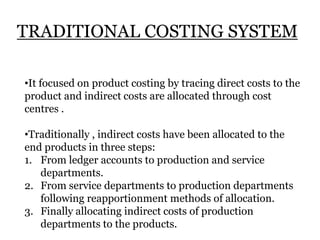
TRADITIONAL COSTING SYSTEM
•It focused on product costing by tracing direct costs to the
product and indirect costs are allocated through cost
centres .
•Traditionally , indirect costs have been allocated to the
end products in three steps:
1. From ledger accounts to production and service
departments.
2. From service departments to production departments
following reapportionment methods of allocation.
3. Finally allocating indirect costs of production
departments to the products.
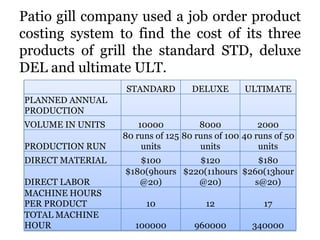
Patio gill company used a job order product
costing system to find the cost of its three
products of grill the standard STD, deluxe
DEL and ultimate ULT.
STANDARD

DELUXE

ULTIMATE

PLANNED ANNUAL
PRODUCTION

VOLUME IN UNITS
PRODUCTION RUN
DIRECT MATERIAL
DIRECT LABOR
MACHINE HOURS
PER PRODUCT
TOTAL MACHINE
HOUR

10000
8000
2000
80 runs of 125 80 runs of 100 40 runs of 50
units
units
units
$100
$120
$180
$180(9hours $220(11hours $260(13hour
@20)
@20)
s@20)
10

12

17

100000

960000

340000
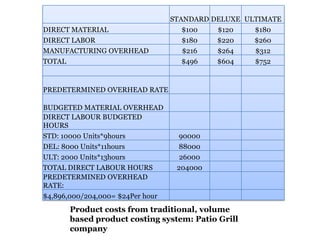
DIRECT MATERIAL
DIRECT LABOR
MANUFACTURING OVERHEAD
TOTAL

STANDARD DELUXE ULTIMATE
$100
$120
$180
$180
$220
$260
$216
$264
$312
$496
$604
$752

PREDETERMINED OVERHEAD RATE
BUDGETED MATERIAL OVERHEAD
DIRECT LABOUR BUDGETED
HOURS
STD: 10000 Units*9hours
DEL: 8000 Units*11hours
ULT: 2000 Units*13hours
TOTAL DIRECT LABOUR HOURS
PREDETERMINED OVERHEAD
RATE:
$4,896,000/204,000= $24Per hour

90000
88000
26000
204000

Product costs from traditional, volume
based product costing system: Patio Grill
company
Trouble in patio company
• Less profitability by the prodcts
• Unable to achieve target price( 120% of
full product cost)
standard

Deluxe

Ultimate

Production cost
under traditional
volume based
system

$496.00

$604.00

$752.00

Target selling price

$595.00

$724.80

$902.40

Actual selling price

$585.00

$705.00

$940.00
The Need for a New Approach
•Tremendous change in manufacturing and service
industries.
•Decrease in amount of direct labour and direct material
usage.
•Significant increase in total overhead costs.
•Intense global competition.
•Costs of non – volume related activities can not be
apportioned on volume basis as in traditional method.
•There was an urgent need to integrate activity
measurement and financial measurement.
Defintion as per CIMA:
Cost attribution to cost units on the basis of benefit
received from indirect activities such as ordering,setting
up,assuring,quality.
Meaning:
Activity based costing is an accounting
methodology that assigns costs to activities
rather than products or services .
•Focuses on activities as the fundamental cost
objects.
•Costs are grouped according to what causes
them to be incurred.
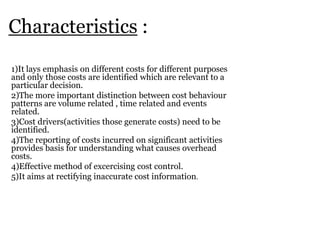
Characteristics :
1)It lays emphasis on different costs for different purposes
and only those costs are identified which are relevant to a
particular decision.
2)The more important distinction between cost behaviour
patterns are volume related , time related and events
related.
3)Cost drivers(activities those generate costs) need to be
identified.
4)The reporting of costs incurred on significant activities
provides basis for understanding what causes overhead
costs.
4)Effective method of excercising cost control.
5)It aims at rectifying inaccurate cost information.
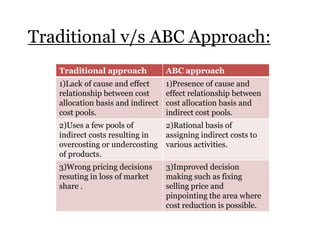
Traditional v/s ABC Approach:
Traditional approach

ABC approach

1)Lack of cause and effect
relationship between cost
allocation basis and indirect
cost pools.

1)Presence of cause and
effect relationship between
cost allocation basis and
indirect cost pools.

2)Uses a few pools of
indirect costs resulting in
overcosting or undercosting
of products.

2)Rational basis of
assigning indirect costs to
various activities.

3)Wrong pricing decisions
resuting in loss of market
share .

3)Improved decision
making such as fixing
selling price and
pinpointing the area where
cost reduction is possible.
Cost driver
It is a characteristic of an activity of an
event or activity that results in the
incurrence of costs.
Factors affecting selection of
cost drivers
• Degree of correlation
• Cost of measurement
• Behavioral effects
Activity Cost Pool:
The overhead cost attributed to a distinct type of activity.
For example: ordering materials or setting up machines
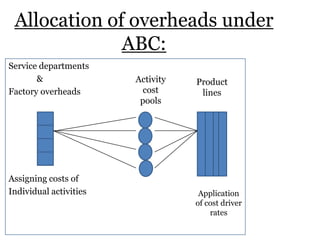
Allocation of overheads under
ABC:
Service departments
&
Factory overheads

Assigning costs of
Individual activities

Activity
cost
pools

Product
lines

Application
of cost driver
rates
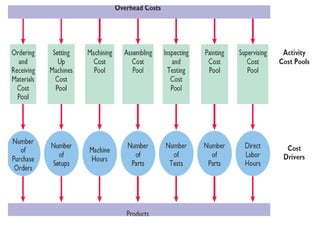
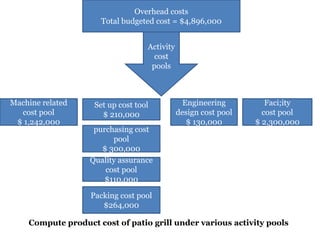
Overhead costs
Total budgeted cost = $4,896,000
Activity
cost
pools

Machine related
cost pool
$ 1,242,000

Set up cost tool
$ 210,000
purchasing cost
pool
$ 300,000
Quality assurance
cost pool
$110,000

Engineering
design cost pool
$ 130,000

Faci;ity
cost pool
$ 2,300,000

Packing cost pool
$264,000
Compute product cost of patio grill under various activity pools
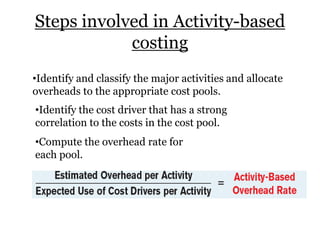
Steps involved in Activity-based
costing
•Identify and classify the major activities and allocate
overheads to the appropriate cost pools.
•Identify the cost driver that has a strong
correlation to the costs in the cost pool.
•Compute the overhead rate for
each pool.
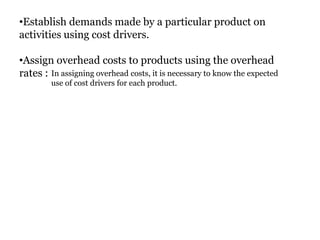
•Establish demands made by a particular product on
activities using cost drivers.
•Assign overhead costs to products using the overhead
rates : In assigning overhead costs, it is necessary to know the expected
use of cost drivers for each product.
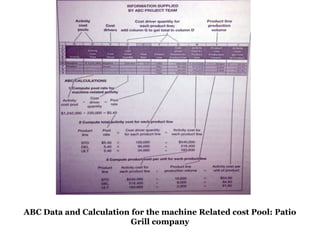
ABC Data and Calculation for the machine Related cost Pool: Patio
Grill company
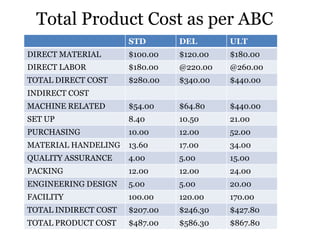
Total Product Cost as per ABC
STD

DEL

ULT

DIRECT MATERIAL

$100.00

$120.00

$180.00

DIRECT LABOR

$180.00

@220.00

@260.00

TOTAL DIRECT COST

$280.00

$340.00

$440.00

MACHINE RELATED

$54.00

$64.80

$440.00

SET UP

8.40

10.50

21.00

PURCHASING

10.00

12.00

52.00

MATERIAL HANDELING

13.60

17.00

34.00

QUALITY ASSURANCE

4.00

5.00

15.00

PACKING

12.00

12.00

24.00

ENGINEERING DESIGN

5.00

5.00

20.00

FACILITY

100.00

120.00

170.00

TOTAL INDIRECT COST

$207.00

$246.30

$427.80

TOTAL PRODUCT COST

$487.00

$586.30

$867.80

INDIRECT COST
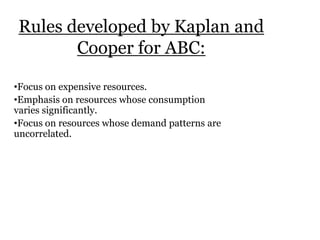
Rules developed by Kaplan and
Cooper for ABC:
•Focus on expensive resources.
•Emphasis on resources whose consumption
varies significantly.
•Focus on resources whose demand patterns are
uncorrelated.
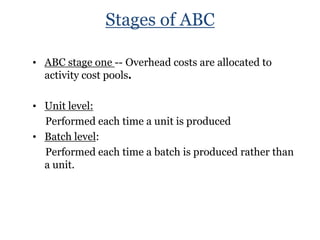
Stages of ABC
• ABC stage one -- Overhead costs are allocated to
activity cost pools.
• Unit level:
Performed each time a unit is produced
• Batch level:
Performed each time a batch is produced rather than
a unit.
•Product-sustaining level:
It includes activities that are needed to support entire product line .
• Facility level [general operations level]:
These activities are required in order for the entire production process to
occur
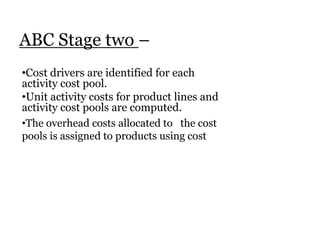
ABC Stage two –
•Cost drivers are identified for each
activity cost pool.
•Unit activity costs for product lines and
activity cost pools are computed.
•The overhead costs allocated to the cost
pools is assigned to products using cost
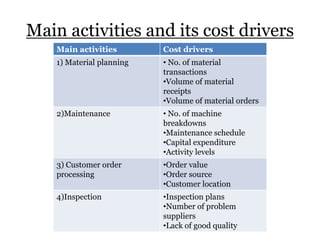
Main activities and its cost drivers
Main activities

Cost drivers

1) Material planning

• No. of material
transactions
•Volume of material
receipts
•Volume of material orders

2)Maintenance

• No. of machine
breakdowns
•Maintenance schedule
•Capital expenditure
•Activity levels

3) Customer order
processing

•Order value
•Order source
•Customer location

4)Inspection

•Inspection plans
•Number of problem
suppliers
•Lack of good quality
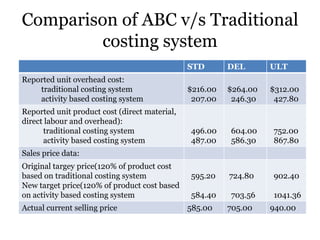
Comparison of ABC v/s Traditional
costing system
STD
Reported unit overhead cost:
traditional costing system
activity based costing system
Reported unit product cost (direct material,
direct labour and overhead):
traditional costing system
activity based costing system

DEL

ULT

$216.00
207.00

$264.00
246.30

$312.00
427.80

496.00
487.00

604.00
586.30

752.00
867.80

595.20

724.80

902.40

584.40

703.56

1041.36

Sales price data:
Original targey price(120% of product cost
based on traditional costing system
New target price(120% of product cost based
on activity based costing system
Actual current selling price

585.00

705.00

940.00
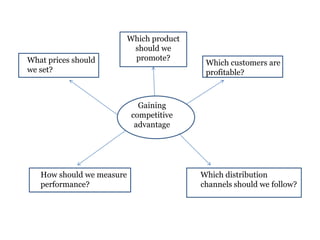
What prices should
we set?

Which product
should we
promote?

Which customers are
profitable?

Gaining
competitive
advantage

How should we measure
performance?

Which distribution
channels should we follow?
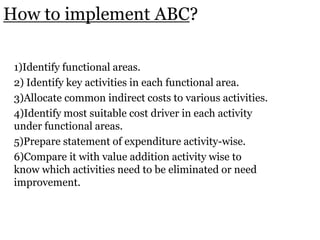
How to implement ABC?
1)Identify functional areas.
2) Identify key activities in each functional area.
3)Allocate common indirect costs to various activities.
4)Identify most suitable cost driver in each activity
under functional areas.
5)Prepare statement of expenditure activity-wise.
6)Compare it with value addition activity wise to
know which activities need to be eliminated or need
improvement.
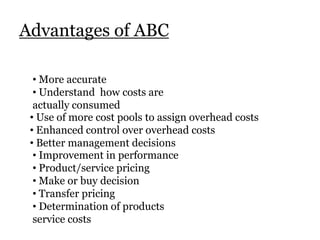
Advantages of ABC
• More accurate
• Understand how costs are
actually consumed
• Use of more cost pools to assign overhead costs
• Enhanced control over overhead costs
• Better management decisions
• Improvement in performance
• Product/service pricing
• Make or buy decision
• Transfer pricing
• Determination of products
service costs
Limitations of ABC
•Can be expensive to use
•Does not measure incremental costs
Ways of achieving cost reduction
under ABC

Ways of achieving cost
reduction

ABC system

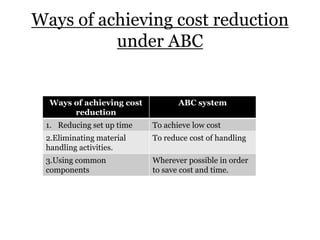
1. Reducing set up time

To achieve low cost

2.Eliminating material
handling activities.

To reduce cost of handling

3.Using common
components

Wherever possible in order
to save cost and time.
Conclusion:
•In order to reduce the direct cost of the
product , we can control the overheads when
one has the information of cost centres.
•It becomes necessary to have a costing
system based on activity done.
•Can not be applied if there is no clear
distinction for the costs attached to various
activities.
•Implemented in different segments of an
organisation .
•Equally applied in service sectors.
Thank
You!!

ABC ANALYSIS

  • 1.
  • 2.
    TRADITIONAL COSTING SYSTEM •Itfocused on product costing by tracing direct costs to the product and indirect costs are allocated through cost centres . •Traditionally , indirect costs have been allocated to the end products in three steps: 1. From ledger accounts to production and service departments. 2. From service departments to production departments following reapportionment methods of allocation. 3. Finally allocating indirect costs of production departments to the products.
  • 3.
    Patio gill companyused a job order product costing system to find the cost of its three products of grill the standard STD, deluxe DEL and ultimate ULT. STANDARD DELUXE ULTIMATE PLANNED ANNUAL PRODUCTION VOLUME IN UNITS PRODUCTION RUN DIRECT MATERIAL DIRECT LABOR MACHINE HOURS PER PRODUCT TOTAL MACHINE HOUR 10000 8000 2000 80 runs of 125 80 runs of 100 40 runs of 50 units units units $100 $120 $180 $180(9hours $220(11hours $260(13hour @20) @20) s@20) 10 12 17 100000 960000 340000
  • 4.
    DIRECT MATERIAL DIRECT LABOR MANUFACTURINGOVERHEAD TOTAL STANDARD DELUXE ULTIMATE $100 $120 $180 $180 $220 $260 $216 $264 $312 $496 $604 $752 PREDETERMINED OVERHEAD RATE BUDGETED MATERIAL OVERHEAD DIRECT LABOUR BUDGETED HOURS STD: 10000 Units*9hours DEL: 8000 Units*11hours ULT: 2000 Units*13hours TOTAL DIRECT LABOUR HOURS PREDETERMINED OVERHEAD RATE: $4,896,000/204,000= $24Per hour 90000 88000 26000 204000 Product costs from traditional, volume based product costing system: Patio Grill company
  • 5.
    Trouble in patiocompany • Less profitability by the prodcts • Unable to achieve target price( 120% of full product cost) standard Deluxe Ultimate Production cost under traditional volume based system $496.00 $604.00 $752.00 Target selling price $595.00 $724.80 $902.40 Actual selling price $585.00 $705.00 $940.00
  • 6.
    The Need fora New Approach •Tremendous change in manufacturing and service industries. •Decrease in amount of direct labour and direct material usage. •Significant increase in total overhead costs. •Intense global competition. •Costs of non – volume related activities can not be apportioned on volume basis as in traditional method. •There was an urgent need to integrate activity measurement and financial measurement.
  • 7.
    Defintion as perCIMA: Cost attribution to cost units on the basis of benefit received from indirect activities such as ordering,setting up,assuring,quality.
  • 8.
    Meaning: Activity based costingis an accounting methodology that assigns costs to activities rather than products or services . •Focuses on activities as the fundamental cost objects. •Costs are grouped according to what causes them to be incurred.
  • 9.
    Characteristics : 1)It laysemphasis on different costs for different purposes and only those costs are identified which are relevant to a particular decision. 2)The more important distinction between cost behaviour patterns are volume related , time related and events related. 3)Cost drivers(activities those generate costs) need to be identified. 4)The reporting of costs incurred on significant activities provides basis for understanding what causes overhead costs. 4)Effective method of excercising cost control. 5)It aims at rectifying inaccurate cost information.
  • 10.
    Traditional v/s ABCApproach: Traditional approach ABC approach 1)Lack of cause and effect relationship between cost allocation basis and indirect cost pools. 1)Presence of cause and effect relationship between cost allocation basis and indirect cost pools. 2)Uses a few pools of indirect costs resulting in overcosting or undercosting of products. 2)Rational basis of assigning indirect costs to various activities. 3)Wrong pricing decisions resuting in loss of market share . 3)Improved decision making such as fixing selling price and pinpointing the area where cost reduction is possible.
  • 11.
    Cost driver It isa characteristic of an activity of an event or activity that results in the incurrence of costs.
  • 12.
    Factors affecting selectionof cost drivers • Degree of correlation • Cost of measurement • Behavioral effects
  • 13.
    Activity Cost Pool: Theoverhead cost attributed to a distinct type of activity. For example: ordering materials or setting up machines
  • 14.
    Allocation of overheadsunder ABC: Service departments & Factory overheads Assigning costs of Individual activities Activity cost pools Product lines Application of cost driver rates
  • 16.
    Overhead costs Total budgetedcost = $4,896,000 Activity cost pools Machine related cost pool $ 1,242,000 Set up cost tool $ 210,000 purchasing cost pool $ 300,000 Quality assurance cost pool $110,000 Engineering design cost pool $ 130,000 Faci;ity cost pool $ 2,300,000 Packing cost pool $264,000 Compute product cost of patio grill under various activity pools
  • 17.
    Steps involved inActivity-based costing •Identify and classify the major activities and allocate overheads to the appropriate cost pools. •Identify the cost driver that has a strong correlation to the costs in the cost pool. •Compute the overhead rate for each pool.
  • 18.
    •Establish demands madeby a particular product on activities using cost drivers. •Assign overhead costs to products using the overhead rates : In assigning overhead costs, it is necessary to know the expected use of cost drivers for each product.
  • 19.
    ABC Data andCalculation for the machine Related cost Pool: Patio Grill company
  • 20.
    Total Product Costas per ABC STD DEL ULT DIRECT MATERIAL $100.00 $120.00 $180.00 DIRECT LABOR $180.00 @220.00 @260.00 TOTAL DIRECT COST $280.00 $340.00 $440.00 MACHINE RELATED $54.00 $64.80 $440.00 SET UP 8.40 10.50 21.00 PURCHASING 10.00 12.00 52.00 MATERIAL HANDELING 13.60 17.00 34.00 QUALITY ASSURANCE 4.00 5.00 15.00 PACKING 12.00 12.00 24.00 ENGINEERING DESIGN 5.00 5.00 20.00 FACILITY 100.00 120.00 170.00 TOTAL INDIRECT COST $207.00 $246.30 $427.80 TOTAL PRODUCT COST $487.00 $586.30 $867.80 INDIRECT COST
  • 21.
    Rules developed byKaplan and Cooper for ABC: •Focus on expensive resources. •Emphasis on resources whose consumption varies significantly. •Focus on resources whose demand patterns are uncorrelated.
  • 22.
    Stages of ABC •ABC stage one -- Overhead costs are allocated to activity cost pools. • Unit level: Performed each time a unit is produced • Batch level: Performed each time a batch is produced rather than a unit.
  • 23.
    •Product-sustaining level: It includesactivities that are needed to support entire product line . • Facility level [general operations level]: These activities are required in order for the entire production process to occur
  • 24.
    ABC Stage two– •Cost drivers are identified for each activity cost pool. •Unit activity costs for product lines and activity cost pools are computed. •The overhead costs allocated to the cost pools is assigned to products using cost
  • 25.
    Main activities andits cost drivers Main activities Cost drivers 1) Material planning • No. of material transactions •Volume of material receipts •Volume of material orders 2)Maintenance • No. of machine breakdowns •Maintenance schedule •Capital expenditure •Activity levels 3) Customer order processing •Order value •Order source •Customer location 4)Inspection •Inspection plans •Number of problem suppliers •Lack of good quality
  • 26.
    Comparison of ABCv/s Traditional costing system STD Reported unit overhead cost: traditional costing system activity based costing system Reported unit product cost (direct material, direct labour and overhead): traditional costing system activity based costing system DEL ULT $216.00 207.00 $264.00 246.30 $312.00 427.80 496.00 487.00 604.00 586.30 752.00 867.80 595.20 724.80 902.40 584.40 703.56 1041.36 Sales price data: Original targey price(120% of product cost based on traditional costing system New target price(120% of product cost based on activity based costing system Actual current selling price 585.00 705.00 940.00
  • 27.
    What prices should weset? Which product should we promote? Which customers are profitable? Gaining competitive advantage How should we measure performance? Which distribution channels should we follow?
  • 28.
    How to implementABC? 1)Identify functional areas. 2) Identify key activities in each functional area. 3)Allocate common indirect costs to various activities. 4)Identify most suitable cost driver in each activity under functional areas. 5)Prepare statement of expenditure activity-wise. 6)Compare it with value addition activity wise to know which activities need to be eliminated or need improvement.
  • 29.
    Advantages of ABC •More accurate • Understand how costs are actually consumed • Use of more cost pools to assign overhead costs • Enhanced control over overhead costs • Better management decisions • Improvement in performance • Product/service pricing • Make or buy decision • Transfer pricing • Determination of products service costs
  • 30.
    Limitations of ABC •Canbe expensive to use •Does not measure incremental costs
  • 31.
    Ways of achievingcost reduction under ABC Ways of achieving cost reduction ABC system 1. Reducing set up time To achieve low cost 2.Eliminating material handling activities. To reduce cost of handling 3.Using common components Wherever possible in order to save cost and time.
  • 32.
    Conclusion: •In order toreduce the direct cost of the product , we can control the overheads when one has the information of cost centres. •It becomes necessary to have a costing system based on activity done. •Can not be applied if there is no clear distinction for the costs attached to various activities. •Implemented in different segments of an organisation . •Equally applied in service sectors.
  • 33.