Cartesian
Coordinate
System
Called also
rectangular
coordinate
system
Definitions
• X-axis – the horizontal axis
• Y –axis – the vertical axis
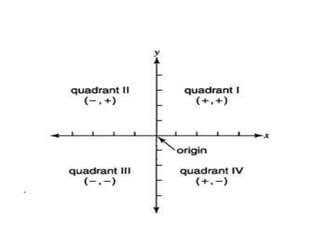
• Rectangular coordinate system: where the x-axis
and the y-axis intersect
• Ordered pair: identifies the location of a point on
the rectangular coordinate system
• (x coordinate, y coordinate)
• Origin: (0,0) – intersection of the x and y axis
• Quadrant: a section of the rectangular
coordinate system
How to identify
a point?
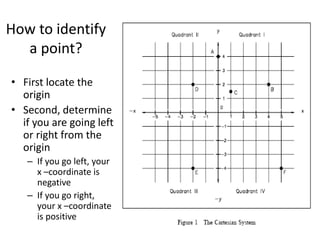
• First locate the
origin
• Second, determine
if you are going left
or right from the
origin
– If you go left, your
x –coordinate is
negative
– If you go right,
your x –coordinate
is positive
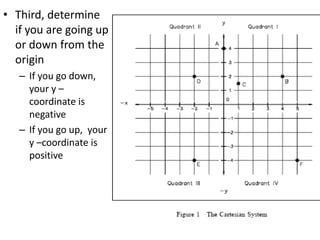
• Third, determine
if you are going up
or down from the
origin
– If you go down,
your y –
coordinate is
negative
– If you go up, your
y –coordinate is
positive
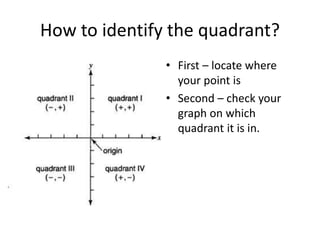
How to identify the quadrant?
• First – locate where
your point is
• Second – check your
graph on which
quadrant it is in.
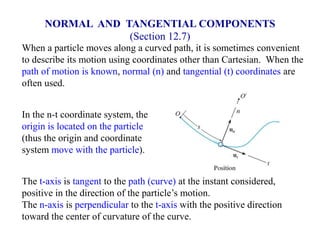
When a particle moves along a curved path, it is sometimes convenient
to describe its motion using coordinates other than Cartesian. When the
path of motion is known, normal (n) and tangential (t) coordinates are
often used.
In the n-t coordinate system, the
origin is located on the particle
(thus the origin and coordinate
system move with the particle).
The t-axis is tangent to the path (curve) at the instant considered,
positive in the direction of the particle’s motion.
The n-axis is perpendicular to the t-axis with the positive direction
toward the center of curvature of the curve.
NORMAL AND TANGENTIAL COMPONENTS
(Section 12.7)
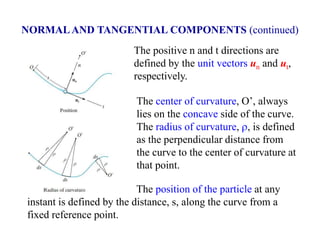
The position of the particle at any
instant is defined by the distance, s, along the curve from a
fixed reference point.
The positive n and t directions are
defined by the unit vectors un and ut,
respectively.
The center of curvature, O’, always
lies on the concave side of the curve.
The radius of curvature, r, is defined
as the perpendicular distance from
the curve to the center of curvature at
that point.
NORMALAND TANGENTIAL COMPONENTS (continued)
VELOCITY IN THE n-t COORDINATE SYSTEM
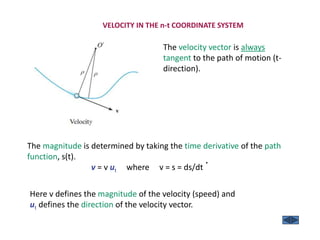
The velocity vector is always
tangent to the path of motion (t-
direction).
The magnitude is determined by taking the time derivative of the path
function, s(t).
v = v ut where v = s = ds/dt
.
Here v defines the magnitude of the velocity (speed) and
ut defines the direction of the velocity vector.
ACCELERATION IN THE n-t COORDINATE SYSTEMS
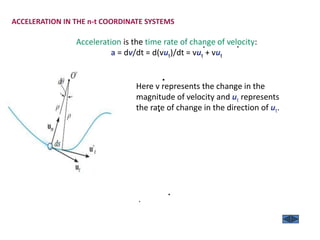
Acceleration is the time rate of change of velocity:
a = dv/dt = d(vut)/dt = vut + vut
.
Here v represents the change in the
magnitude of velocity and ut represents
the rate of change in the direction of ut.
.
.
.
.
.

Cartesian co.ordinates

  • 1.
  • 3.
    Definitions • X-axis –the horizontal axis • Y –axis – the vertical axis • Rectangular coordinate system: where the x-axis and the y-axis intersect • Ordered pair: identifies the location of a point on the rectangular coordinate system • (x coordinate, y coordinate) • Origin: (0,0) – intersection of the x and y axis • Quadrant: a section of the rectangular coordinate system
  • 5.
    How to identify apoint? • First locate the origin • Second, determine if you are going left or right from the origin – If you go left, your x –coordinate is negative – If you go right, your x –coordinate is positive
  • 6.
    • Third, determine ifyou are going up or down from the origin – If you go down, your y – coordinate is negative – If you go up, your y –coordinate is positive
  • 7.
    How to identifythe quadrant? • First – locate where your point is • Second – check your graph on which quadrant it is in.
  • 8.
    When a particlemoves along a curved path, it is sometimes convenient to describe its motion using coordinates other than Cartesian. When the path of motion is known, normal (n) and tangential (t) coordinates are often used. In the n-t coordinate system, the origin is located on the particle (thus the origin and coordinate system move with the particle). The t-axis is tangent to the path (curve) at the instant considered, positive in the direction of the particle’s motion. The n-axis is perpendicular to the t-axis with the positive direction toward the center of curvature of the curve. NORMAL AND TANGENTIAL COMPONENTS (Section 12.7)
  • 9.
    The position ofthe particle at any instant is defined by the distance, s, along the curve from a fixed reference point. The positive n and t directions are defined by the unit vectors un and ut, respectively. The center of curvature, O’, always lies on the concave side of the curve. The radius of curvature, r, is defined as the perpendicular distance from the curve to the center of curvature at that point. NORMALAND TANGENTIAL COMPONENTS (continued)
  • 10.
    VELOCITY IN THEn-t COORDINATE SYSTEM The velocity vector is always tangent to the path of motion (t- direction). The magnitude is determined by taking the time derivative of the path function, s(t). v = v ut where v = s = ds/dt . Here v defines the magnitude of the velocity (speed) and ut defines the direction of the velocity vector.
  • 11.
    ACCELERATION IN THEn-t COORDINATE SYSTEMS Acceleration is the time rate of change of velocity: a = dv/dt = d(vut)/dt = vut + vut . Here v represents the change in the magnitude of velocity and ut represents the rate of change in the direction of ut. . . . . .