Cartelisation People of the same trade seldom meet together, even for merriment and diversion; but the conversation ends in a conspiracy against the public, or in some contrivance to raise prices.   Adam Smith in ‘ The Wealth of Nations ’.  Presented by Deepa  Chandrasekar  IIPM Gurgaon
Cooperative Oligopoly When there are only small number of firms  Non Cooperative & Cooperative behaviour . Firms operate in a  cooperative  mode when they try to  control competition They engage in  collusion . Two or more firms jointly set prices Divide the market among them Make business decision jointly
What is cartelisation? Cartel is an arrangement of independent firms, producing similar products. They work together  Organise and Control distribution To set Prices To Reduce Competition To Share Technical Expertise To Lower Total Production To Raise list Prices
Cartels are formed . Economies of Scale Standardized products offer consumers price reductions driven by economies of scale and supplier substitution effects.  However a relatively small number of suppliers of any commodity gives rise to the possibility of price fixing and collusive behaviour.
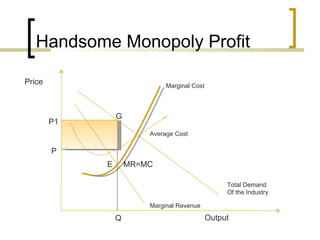
Handsome Monopoly Profit Total Demand Of the Industry Marginal Revenue Price Output Marginal Cost Average Cost P1 Q MR=MC G E P
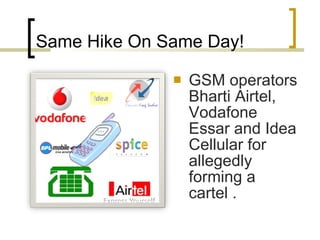
Same Hike On Same Day! GSM operators Bharti Airtel, Vodafone Essar and Idea Cellular for allegedly forming a cartel .
GSM Operators get slammed for forming cartel They all fixed the tariff of their local call at Rs 1.20 a minute… Tariff hike targeted especially at low-end users indicates the operator’s concern about declining ARPUs.  Consumer groups, however, pointed out that the operators have not given any publicity to the increase in tariffs to create awareness among users.
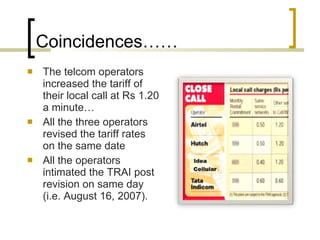
Coincidences…… The telcom operators increased the tariff of their local call at Rs 1.20 a minute… All the three operators revised the tariff rates on the same date All the operators intimated the TRAI post revision on same day (i.e. August 16, 2007).
Free to Fix any Tariff  TRAI refused to intervene in this cartel as GSM operators are free to fix any tariff for their services “ But it can not be mere coincidence” that the tariff revision by them is of the identical scale.”  The MRTPC Bench directed the three companies to give explanation.
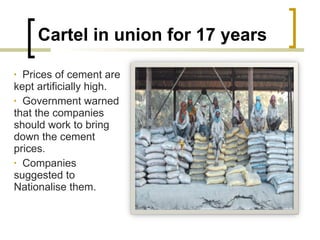
Cartel in union for 17 years Prices of cement are kept artificially high. Government warned that the companies should work to bring down the cement prices. Companies suggested to Nationalise them.
Cartelisation in cement sector  An internal investigation by the MRTPC, revealed cartelisation leading to 'exorbitant' increase in cement prices. The government allowed imports from Pakistan to meet the demand The price of cement sold by Indian co’s were approx. 50% higher than the landed price of imported cement.
Cartelisation in cement sector  Apparently such a high price differential between the international prices and the domestic prices was a indication that all is  not well within the cement industry.  The cement lobby raised the issue of Pakistani factories  not having ISI license .  But the MRTP Commission passed only cease and desist orders, which have had no penal impact.
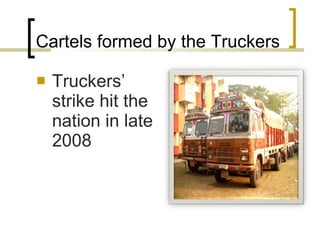
Cartels formed by the Truckers Truckers’ strike hit the nation in late 2008
Cartelisation in Aviation industry The  Jet-Kingfisher alliance  is seen as one such.  Though the professed reason for the alliance is reduce the operational expense The outcome could well be the exploitation of passengers through such means as route rationalisation and higher tariffs.
Penalised Cartels October 2005 The United States Department of Justice slapped a  fine of $300 million   on Samsung Electronics for participating in an international conspiracy to fix prices in the DRAM market.  October 2004 Infineon Technologies AGcompany was sentenced  a fine of $160 million  for participating in the conspiracy to fix prices in the DRAM market.
The Cartel Attack October 2003 The European Commission  fined Aventis €99 million  for its alleged involvement in a cartel alongside four Japanese companies for controlling price of the sorbates. The five companies controlled up to 85% of European sorbates market and met twice a year to set prices and production quotas.
Why Cartels exists in India? The MRTP Act is still the extant competition law in India, as the Competition Act has not yet been fully implemented  It might take at least three years from now for the Competition Act to come into full swing . Competition Commission of India can actually impose monetary penalties on companies, but it hasn’t done yet since the commission is not fully operational yet .
Success of Cartels in India Even if monetary penalties are imposed, that is not a deterrent for companies to return back to such malpractices.  Both the Central and State governments are empowered to take complaints to the MRTP Commission. not a single case has been filed under the MRTP Act by any government.  cease and desist’ orders were issued, which were often ignored.
How to Handle cartels in india? In United States and Brazil there are provisions of imprisonment, which nowhere exist in India.  Belgium – member of the European Union has this provision of rewarding cartel whistle blowers.  Authorities have power to tap phones . Conduct raids to unearth evidence of cartels.
Thank you DeepaChandrasekar

Cartelisation

  • 1.
    Cartelisation People ofthe same trade seldom meet together, even for merriment and diversion; but the conversation ends in a conspiracy against the public, or in some contrivance to raise prices. Adam Smith in ‘ The Wealth of Nations ’. Presented by Deepa Chandrasekar IIPM Gurgaon
  • 2.
    Cooperative Oligopoly Whenthere are only small number of firms Non Cooperative & Cooperative behaviour . Firms operate in a cooperative mode when they try to control competition They engage in collusion . Two or more firms jointly set prices Divide the market among them Make business decision jointly
  • 3.
    What is cartelisation?Cartel is an arrangement of independent firms, producing similar products. They work together Organise and Control distribution To set Prices To Reduce Competition To Share Technical Expertise To Lower Total Production To Raise list Prices
  • 4.
    Cartels are formed. Economies of Scale Standardized products offer consumers price reductions driven by economies of scale and supplier substitution effects. However a relatively small number of suppliers of any commodity gives rise to the possibility of price fixing and collusive behaviour.
  • 5.
    Handsome Monopoly ProfitTotal Demand Of the Industry Marginal Revenue Price Output Marginal Cost Average Cost P1 Q MR=MC G E P
  • 6.
    Same Hike OnSame Day! GSM operators Bharti Airtel, Vodafone Essar and Idea Cellular for allegedly forming a cartel .
  • 7.
    GSM Operators getslammed for forming cartel They all fixed the tariff of their local call at Rs 1.20 a minute… Tariff hike targeted especially at low-end users indicates the operator’s concern about declining ARPUs. Consumer groups, however, pointed out that the operators have not given any publicity to the increase in tariffs to create awareness among users.
  • 8.
    Coincidences…… The telcomoperators increased the tariff of their local call at Rs 1.20 a minute… All the three operators revised the tariff rates on the same date All the operators intimated the TRAI post revision on same day (i.e. August 16, 2007).
  • 9.
    Free to Fixany Tariff TRAI refused to intervene in this cartel as GSM operators are free to fix any tariff for their services “ But it can not be mere coincidence” that the tariff revision by them is of the identical scale.” The MRTPC Bench directed the three companies to give explanation.
  • 10.
    Cartel in unionfor 17 years Prices of cement are kept artificially high. Government warned that the companies should work to bring down the cement prices. Companies suggested to Nationalise them.
  • 11.
    Cartelisation in cementsector An internal investigation by the MRTPC, revealed cartelisation leading to 'exorbitant' increase in cement prices. The government allowed imports from Pakistan to meet the demand The price of cement sold by Indian co’s were approx. 50% higher than the landed price of imported cement.
  • 12.
    Cartelisation in cementsector Apparently such a high price differential between the international prices and the domestic prices was a indication that all is not well within the cement industry. The cement lobby raised the issue of Pakistani factories not having ISI license . But the MRTP Commission passed only cease and desist orders, which have had no penal impact.
  • 13.
    Cartels formed bythe Truckers Truckers’ strike hit the nation in late 2008
  • 14.
    Cartelisation in Aviationindustry The Jet-Kingfisher alliance is seen as one such. Though the professed reason for the alliance is reduce the operational expense The outcome could well be the exploitation of passengers through such means as route rationalisation and higher tariffs.
  • 15.
    Penalised Cartels October2005 The United States Department of Justice slapped a fine of $300 million on Samsung Electronics for participating in an international conspiracy to fix prices in the DRAM market. October 2004 Infineon Technologies AGcompany was sentenced a fine of $160 million for participating in the conspiracy to fix prices in the DRAM market.
  • 16.
    The Cartel AttackOctober 2003 The European Commission fined Aventis €99 million for its alleged involvement in a cartel alongside four Japanese companies for controlling price of the sorbates. The five companies controlled up to 85% of European sorbates market and met twice a year to set prices and production quotas.
  • 17.
    Why Cartels existsin India? The MRTP Act is still the extant competition law in India, as the Competition Act has not yet been fully implemented It might take at least three years from now for the Competition Act to come into full swing . Competition Commission of India can actually impose monetary penalties on companies, but it hasn’t done yet since the commission is not fully operational yet .
  • 18.
    Success of Cartelsin India Even if monetary penalties are imposed, that is not a deterrent for companies to return back to such malpractices. Both the Central and State governments are empowered to take complaints to the MRTP Commission. not a single case has been filed under the MRTP Act by any government. cease and desist’ orders were issued, which were often ignored.
  • 19.
    How to Handlecartels in india? In United States and Brazil there are provisions of imprisonment, which nowhere exist in India. Belgium – member of the European Union has this provision of rewarding cartel whistle blowers. Authorities have power to tap phones . Conduct raids to unearth evidence of cartels.
  • 20.