Ajay Agarwal
Akhilesh Singh Rawat
Alok Veer Yadav
Ashish Rawat
9TH
PGP-PPM (GP-I)
Cartelization in Cement Industry in India
The boom in real estate and construction
industry in India
 India saw a sudden & sharp increase in price of
cement
 Price increment was as high as 17% in a single month
 Investigative arm DG Investigations (DGIR) pointed
cartelisation and slammed Cement Manufacturers'
Association for the "exorbitant" increase in prices”.
( Economic Times, 25 July, 2007)
 Anti-monopoly watchdog MRTPC issued notices to 14
cement firms including Grasim, ACC and Ultratech
Probability of ongoing collusive behaviour
among major cement players continues
 It took 17 years for MRTPC to come to a decision on an old
case of pernicious cement cartel in India of 1990s
 In spite of notices & warnings by Govt. and competition
commission, price of cement has breached all limits
 High investment need in construction & infrastructure
industry, high price of cement seriously impact economy’s
growth
Topics to be Discussed
 Our presentation attempt to explain reason
behind rapid rise in cement price
 Further it attempt to explain elements of
cartel detection and highlight continuing
cartelization in the Indian cement
industry
 We discuss issues about cartels and
collusive behavior of sudden increase ,
Competition Versus Collusion:
 Followed by a brief overview of the
competition law in India
 We conclude the cement industry has
behaved in a collusive manner and
suggest measures to deal with it
A. Problem of Cement
Industry in India
B. Cement Cartels in
India
C. Oligopoly and
understanding
cartels
D. Way ahead to bring
competition and
secure customers
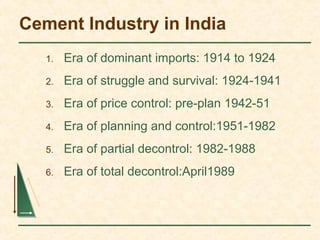
Cement Industry in India
1. Era of dominant imports: 1914 to 1924
2. Era of struggle and survival: 1924-1941
3. Era of price control: pre-plan 1942-51
4. Era of planning and control:1951-1982
5. Era of partial decontrol: 1982-1988
6. Era of total decontrol:April1989
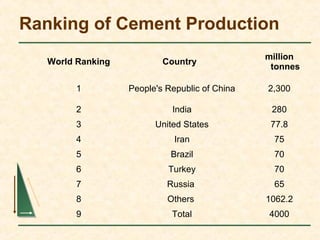
Ranking of Cement Production
World Ranking Country
million
tonnes
1 People's Republic of China 2,300
2 India 280
3 United States 77.8
4 Iran 75
5 Brazil 70
6 Turkey 70
7 Russia 65
8 Others 1062.2
9 Total 4000
CEMENT INDUSTRY STRUCTURE :
 India ranks second in world cement producing countries –
produces 7%.
 While it took 8 decades to reach the 1st
1000 Lakh tonne
capacity, 2nd
1000 Lakh tonne was added in just 10 years.
 The Indian cement industry is weakly oligopolistic in
nature on a national level with top 11 to 12 firms among
more than 100 firms capturing 70% of the cement market.
 The major players are ACC Ltd, Ambuja Cements,
Ultratech Cement Ltd., India Cements Ltd., Jaiprakash
Associates Ltd., Birla Corporation Ltd., Lafarge India Pvt.
Ltd, Madras Cements .
 The shares in terms of All India cement production, of
these top companies have fluctuated by small amounts in
the last six years.
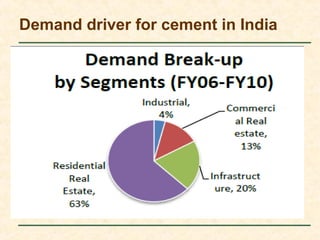
Demand driver for cement in India
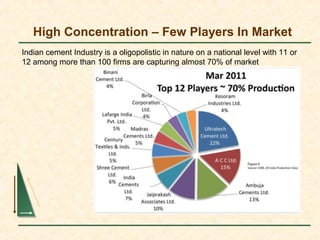
High Concentration – Few Players In Market
Indian cement Industry is a oligopolistic in nature on a national level with 11 or
12 among more than 100 firms are capturing almost 70% of market
Latest case of Cartelization
 BAI lodged a complaint with the Competition Commission
of India.
 The CCI investigated allegations of cartelization against
major cement companies - Lafarge India, India
Cement, JP Associates, Binani Cement, Ambuja
Cement, Madras Cement and J K Cement etc.
 CCI imposed a heavy fine of Rs 6307 Crores on all
cement producers in June 2012.
 These companies together control a little over one-third of
the country's total cement manufacturing capacity of 300
million tonnes.
Conditions conducive for cartel
formation in cement industry
1. High concentration: few players in market
2. Excess Capacity
3. High entry and exit barriers
4. Similar production cost
5. High dependence of consumers on product
6. History of collusion in the industry
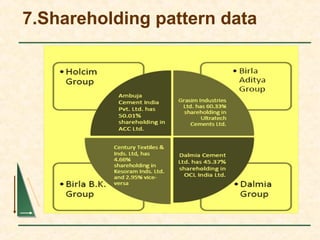
7. Shareholding pattern data
8. Unusually high profit
9. Demand variability
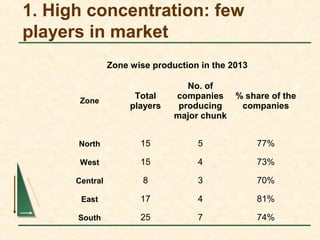
1. High concentration: few
players in market
Zone wise production in the 2013
Zone
Total
players
No. of
companies
producing
major chunk
% share of the
companies
North 15 5 77%
West 15 4 73%
Central 8 3 70%
East 17 4 81%
South 25 7 74%
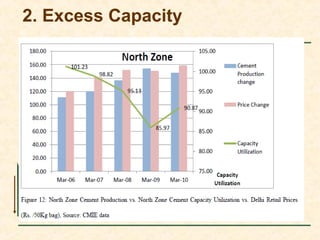
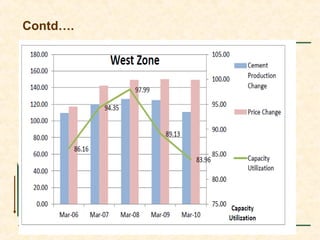
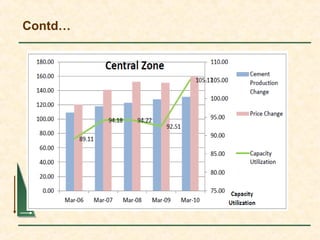
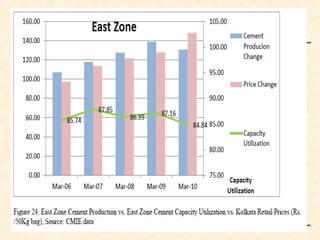
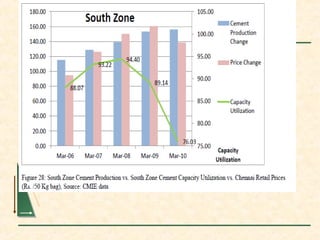
2. Excess Capacity
Contd….
Contd…
3. High entry and exit barriers
 very high cost of cement production
plants, be it cost of setting up new
plants or
 operational costs of existing plants.
 To exit a losing position in cement
industry would incur huge losses for the
firm(s)
4. Similar production cost
 The cement manufacturers’ share in market has
remained steady at national level and also at
regional levels in past years
 Similarity in pattern of increasing (and
decreasing) Operating profit and Profit after Tax
of cement manufacturers shows that production
costs in same markets are highly similar
5. High dependence of consumers on
product
 Cement, practically, has no substitutes
and thus cement industry traditionally
has high degree of supplier power
6. History of collusion & role of trade
associations in the industry
 History of collusion in the cement industry in
various countries in the world
 Cement as an industry has been known to
have collusive behaviour among firms
operating in the same market
 Cement manufacturers are registered with the
Cement manufacturers’ Association
 Presence of such an association can always
fuel collusion among member firms
7.Shareholding pattern data
Contd….
 ACC Ltd. and Ambuja Cement Ltd. operating
across India in almost every zone
 Dalmia Cement Ltd. operating in the southern
zone and OCL India Ltd operating the eastern
zone
 Grasim Industries Ltd. and Ultratech Cement
Ltd. operating across India in almost every
zone
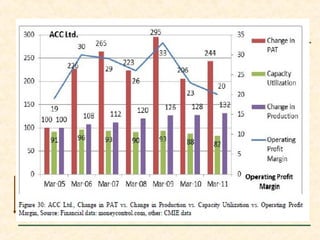
8. Unusually high profit
 Research shows that during 2005-06 to
2010-11, the operating profit margin all the
companies has soared to reach new high.
 Also, the Profit after Tax (PAT) for all the
companies closely resembles the path of
the operating margin, though for most of
the cases, the PAT is still well above the
2005 levels
9. Demand variability
 A stable demand encourages the
formation of a cartel. If the demand is
variable and changing over the years,
cartels are unlikely
 Under conditions of low demand,
members would like to deviate from the
carte, while high demand gave more
incentives to the cartel
UNDERSTANDING CARTELS
“people of the same trade seldom meet
together, even for merriment or diversion; but the
conversation ends in a conspiracy against the
public or in some contrivance to raise the prices”
Adam Smith in “The Wealth of Nations”
OLIGOPOLY
 Greek word meaning “ few sellers”
 Oligopoly is an industry dominated by a small
number of firms
Characteristics:
 Profit maximization conditions/Non-Price
Competition
 Ability to set price
 Barrier to entry
 Fewer number of firms
 Long run profits
 Interdependence
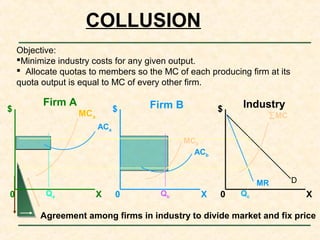
COLLUSION
Agreement among firms in industry to divide market and fix price
Objective:
Minimize industry costs for any given output.
 Allocate quotas to members so the MC of each producing firm at its
quota output is equal to MC of every other firm.
0 X
$
0 X
$
0 X
$
DMR
ACb
MCb
MCa
ACa
∑MC
Firm A Firm B Industry
QcQbQa
MOTIVATIONS FOR COLLUSION
 Decrease competition
 Achieve monopoly-like behavior
 Decrease uncertainty
 Decrease ease of entry
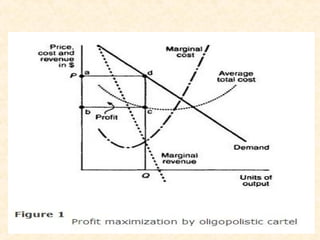
WHAT IS A CARTEL
group of firms that agree to collude so they
can act as a monopoly to increase profit
Colluding firms produce less, charge more,
block new firms and earn more profit
Consumers pay high prices and potential
entrants are denied opportunity to compete
Cartels occur in an Oligopolistic Industry
PRIVATE / PUBLIC CARTELS
 Public cartels : Government is involved to
enforce the cartel agreement and the
government's sovereignty shields such cartels
from legal actions. To pass on benefits to the
populace as a whole. Coal mining, OPEC
 Private cartels : the purpose of private cartels is
to benefit only those individuals who constitute it.
 Private cartels in most jurisdictions are viewed as
violating antitrust laws. Cement, Airlines,
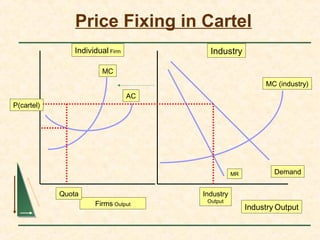
Price Fixing in Cartel
Individual Firm Industry
Firms Output
Industry Output
MC (industry)
DemandMR
P(cartel)
MC
AC
Quota Industry
Output
The way ahead
Spectrum of competition: Perfect Comp---- Monopoly
Free Market ….Cartel: Multiple firms functioning like a monopoly
 Free entry and exit
 Perfect knowledge
 In the long-run, free entry and exit
will eliminate economic profits or
losses.
The way ahead
One requirement for efficiency is
 Everyone who values the good for at least its cost gets it
and P=MC produces that result
 The other is that the product only be produced if the total
value>total cost
Regulation
 Order the monopoly to sell at marginal cost? (How
does the government know what MC is?)
The way ahead
Preventing Cartels
 Not enforcing cartel agreements
 Indeed, trying to punish them, If detected
 Firms might merge--perhaps lose some efficiency but solve the
cartel problem ?
 So restrictions on merger to monopoly
 But … what about mergers for efficiency?
 Price Discrimination
 One approach is to separate markets
 Another is different prices for one customer
 Perfect PD solves that problem, imperfect could make it worse !
Recommendation to contain cartelization
A. The effective regulatory body and legal framework set up-
a. Antitrust laws and Regulations used to reduce market power and
move outcome closer to competition and efficiency.
B. CCI/Govt to make intensive investigation into the offices of
companies in question and of Cement Manufacturers’ Association ,
collect evidence of an agreement and pursue stringent punishment
by competition regulatory authorities.
C. Collect data on plant level cement production and capacity utilization
D. Collect data on timing of the capacity additions done
E. Government regulators controlling output and price ?
F. Support smallest members to have more influence (If the Saudis
increase output, the cartel breaks)
A glimpse of general historical trend in number
of Domestic Cartels
Year Germany Austria Czech
.
Switz
erlan
d
Franc
e
Britai
n
Japan
1865 4
1887 70
1890/1 117
1900/2 300 50
1905/6 385 100 40
[93]
1911/2 550-660 120
1921 446 8
1929/30 2100 40-50,
70-80
100+ 9
0
+
80+ 30+
*Source: Fischer and Wagenführ (1929); Wagenführ (1931); Hadley (1970)
A different view
 Cartels are not necessarily opposite of liberalism and competition
 but a variation on them. For better or for worse, they shaped economic
and business history since the late 19th century.
 Business historians have shown varied effects and services provided by
cartels (quality standards, technology transfers, or risk management) that
extend beyond conspiratorial motivation to raise prices.
 Voluminous scale of cartels before 1939, and after 1945 in Europe and
Japan means that any analysis of corporate strategy, and organization
 National Economic Development must incorporate impact of cartels
 Yet the most neglected area of research is the most important one for
business historians
 What impact did cartels have on economic and corporate development
 Cartels do not abolish competition, but regulate it.
 The question is not cartels or competition, but cartels and competition
Cartels and Alliances
enabled greater competition
 Regulators have made hard-core types of cartels illegal.
 Antitrust regulations often exempt four types of industrial or social
policy cartels because of their alleged benefits.
 Yet they also enabled breakthroughs.
 Cartels and networks are interrelated phenomenon. In reality and
in concept they reinforce one another.
 Can cartels act as an incentive to innovate like networks even if
consumers lose in the short-run?
 If one conceives of cartels as a subset of networks, a richer set of
motivations than just the desire to raise prices would come to fore.
 Studies of the networks of social and professional ties that
embedded cartels would enhance our understanding of the critical
organizational and “idiosyncratic” factors that help cartels endure.
Cartels are a surprisingly slippery subject !
Rather than conspiracy (Mariti and Smiley 1983)
Putting the cartel question into a wider framework of regulation
 There is no mystery as to cartel dynamics, yet those dynamics are
not sufficient to explain any given cartel
 So far the weight of research has stressed why cartels fail, rather
than why they endure.
 The internal organizational dynamics of cartels needs more
research, embedding it in economic, organizational, and political
theory.
 Constant negotiations and monitoring that allow cartels to work
created new social networks- Once one learns to cooperate over
time, the socialization process might strengthen further
cooperation/collusion
 The more one moves from markets to networks,
 more social history approaches would prove invaluable and
 less effective price considerations alone can gauge relationships
Perspective on joining cartels as form of competitive
strategy, on the road towards future competition
 why cartels have not damaged economic growth as much as
some might expect ?
 Economic analysis works with a stark dichotomy of markets
(cartels as distortions) or hierarchies (cartels as incomplete,
inefficient internalization).
 This conceptual straitjacket leads to one of largest misconceptions
about cartels that they halt competition and innovation. Instead
they reshape rules of the game on which competition rests
(similarly Wurm 1993: 291).
 If one reframes cartels as private self-management of an industry,
 Cartel research can fruitfully intersect with studies of
government regulation and
 The burgeoning discussion about business self-regulation.
Studying cartels opens intriguing question
when is competition essential to efficiency and innovation?
 The cartel question highlights the tradeoffs between
 Costs of stop-go, boom-and-bust volatility under capitalism
 Benefits of moderate stability and risk management
 between price and quality,
 between consumer and producers
 Tradeoffs not easily answered.
 Graham and Richardson (1997: 6) noted
 “While competition is familiar to most, few reflect deeply on
cooperation
 Almost all market competitors are business organizations (social
groupings) that are, for the most part, internally cooperative, not
competitive.”
 Cartels provide one forum for reflecting on how and when cooperation
can be efficient and innovative.
Thanks for your
kind attention

CARTEL MICRO ECONOMICS

  • 1.
    Ajay Agarwal Akhilesh SinghRawat Alok Veer Yadav Ashish Rawat 9TH PGP-PPM (GP-I) Cartelization in Cement Industry in India
  • 2.
    The boom inreal estate and construction industry in India  India saw a sudden & sharp increase in price of cement  Price increment was as high as 17% in a single month  Investigative arm DG Investigations (DGIR) pointed cartelisation and slammed Cement Manufacturers' Association for the "exorbitant" increase in prices”. ( Economic Times, 25 July, 2007)  Anti-monopoly watchdog MRTPC issued notices to 14 cement firms including Grasim, ACC and Ultratech
  • 3.
    Probability of ongoingcollusive behaviour among major cement players continues  It took 17 years for MRTPC to come to a decision on an old case of pernicious cement cartel in India of 1990s  In spite of notices & warnings by Govt. and competition commission, price of cement has breached all limits  High investment need in construction & infrastructure industry, high price of cement seriously impact economy’s growth
  • 4.
    Topics to beDiscussed  Our presentation attempt to explain reason behind rapid rise in cement price  Further it attempt to explain elements of cartel detection and highlight continuing cartelization in the Indian cement industry  We discuss issues about cartels and collusive behavior of sudden increase , Competition Versus Collusion:  Followed by a brief overview of the competition law in India  We conclude the cement industry has behaved in a collusive manner and suggest measures to deal with it A. Problem of Cement Industry in India B. Cement Cartels in India C. Oligopoly and understanding cartels D. Way ahead to bring competition and secure customers
  • 5.
    Cement Industry inIndia 1. Era of dominant imports: 1914 to 1924 2. Era of struggle and survival: 1924-1941 3. Era of price control: pre-plan 1942-51 4. Era of planning and control:1951-1982 5. Era of partial decontrol: 1982-1988 6. Era of total decontrol:April1989
  • 6.
    Ranking of CementProduction World Ranking Country million tonnes 1 People's Republic of China 2,300 2 India 280 3 United States 77.8 4 Iran 75 5 Brazil 70 6 Turkey 70 7 Russia 65 8 Others 1062.2 9 Total 4000
  • 7.
    CEMENT INDUSTRY STRUCTURE:  India ranks second in world cement producing countries – produces 7%.  While it took 8 decades to reach the 1st 1000 Lakh tonne capacity, 2nd 1000 Lakh tonne was added in just 10 years.  The Indian cement industry is weakly oligopolistic in nature on a national level with top 11 to 12 firms among more than 100 firms capturing 70% of the cement market.  The major players are ACC Ltd, Ambuja Cements, Ultratech Cement Ltd., India Cements Ltd., Jaiprakash Associates Ltd., Birla Corporation Ltd., Lafarge India Pvt. Ltd, Madras Cements .  The shares in terms of All India cement production, of these top companies have fluctuated by small amounts in the last six years.
  • 8.
    Demand driver forcement in India
  • 9.
    High Concentration –Few Players In Market Indian cement Industry is a oligopolistic in nature on a national level with 11 or 12 among more than 100 firms are capturing almost 70% of market
  • 11.
    Latest case ofCartelization  BAI lodged a complaint with the Competition Commission of India.  The CCI investigated allegations of cartelization against major cement companies - Lafarge India, India Cement, JP Associates, Binani Cement, Ambuja Cement, Madras Cement and J K Cement etc.  CCI imposed a heavy fine of Rs 6307 Crores on all cement producers in June 2012.  These companies together control a little over one-third of the country's total cement manufacturing capacity of 300 million tonnes.
  • 12.
    Conditions conducive forcartel formation in cement industry 1. High concentration: few players in market 2. Excess Capacity 3. High entry and exit barriers 4. Similar production cost 5. High dependence of consumers on product 6. History of collusion in the industry 7. Shareholding pattern data 8. Unusually high profit 9. Demand variability
  • 13.
    1. High concentration:few players in market Zone wise production in the 2013 Zone Total players No. of companies producing major chunk % share of the companies North 15 5 77% West 15 4 73% Central 8 3 70% East 17 4 81% South 25 7 74%
  • 14.
  • 15.
  • 16.
  • 19.
    3. High entryand exit barriers  very high cost of cement production plants, be it cost of setting up new plants or  operational costs of existing plants.  To exit a losing position in cement industry would incur huge losses for the firm(s)
  • 20.
    4. Similar productioncost  The cement manufacturers’ share in market has remained steady at national level and also at regional levels in past years  Similarity in pattern of increasing (and decreasing) Operating profit and Profit after Tax of cement manufacturers shows that production costs in same markets are highly similar
  • 21.
    5. High dependenceof consumers on product  Cement, practically, has no substitutes and thus cement industry traditionally has high degree of supplier power
  • 22.
    6. History ofcollusion & role of trade associations in the industry  History of collusion in the cement industry in various countries in the world  Cement as an industry has been known to have collusive behaviour among firms operating in the same market  Cement manufacturers are registered with the Cement manufacturers’ Association  Presence of such an association can always fuel collusion among member firms
  • 23.
  • 24.
    Contd….  ACC Ltd.and Ambuja Cement Ltd. operating across India in almost every zone  Dalmia Cement Ltd. operating in the southern zone and OCL India Ltd operating the eastern zone  Grasim Industries Ltd. and Ultratech Cement Ltd. operating across India in almost every zone
  • 25.
    8. Unusually highprofit  Research shows that during 2005-06 to 2010-11, the operating profit margin all the companies has soared to reach new high.  Also, the Profit after Tax (PAT) for all the companies closely resembles the path of the operating margin, though for most of the cases, the PAT is still well above the 2005 levels
  • 27.
    9. Demand variability A stable demand encourages the formation of a cartel. If the demand is variable and changing over the years, cartels are unlikely  Under conditions of low demand, members would like to deviate from the carte, while high demand gave more incentives to the cartel
  • 28.
    UNDERSTANDING CARTELS “people ofthe same trade seldom meet together, even for merriment or diversion; but the conversation ends in a conspiracy against the public or in some contrivance to raise the prices” Adam Smith in “The Wealth of Nations”
  • 29.
    OLIGOPOLY  Greek wordmeaning “ few sellers”  Oligopoly is an industry dominated by a small number of firms Characteristics:  Profit maximization conditions/Non-Price Competition  Ability to set price  Barrier to entry  Fewer number of firms  Long run profits  Interdependence
  • 30.
    COLLUSION Agreement among firmsin industry to divide market and fix price Objective: Minimize industry costs for any given output.  Allocate quotas to members so the MC of each producing firm at its quota output is equal to MC of every other firm. 0 X $ 0 X $ 0 X $ DMR ACb MCb MCa ACa ∑MC Firm A Firm B Industry QcQbQa
  • 31.
    MOTIVATIONS FOR COLLUSION Decrease competition  Achieve monopoly-like behavior  Decrease uncertainty  Decrease ease of entry
  • 32.
    WHAT IS ACARTEL group of firms that agree to collude so they can act as a monopoly to increase profit Colluding firms produce less, charge more, block new firms and earn more profit Consumers pay high prices and potential entrants are denied opportunity to compete Cartels occur in an Oligopolistic Industry
  • 33.
    PRIVATE / PUBLICCARTELS  Public cartels : Government is involved to enforce the cartel agreement and the government's sovereignty shields such cartels from legal actions. To pass on benefits to the populace as a whole. Coal mining, OPEC  Private cartels : the purpose of private cartels is to benefit only those individuals who constitute it.  Private cartels in most jurisdictions are viewed as violating antitrust laws. Cement, Airlines,
  • 34.
    Price Fixing inCartel Individual Firm Industry Firms Output Industry Output MC (industry) DemandMR P(cartel) MC AC Quota Industry Output
  • 36.
    The way ahead Spectrumof competition: Perfect Comp---- Monopoly Free Market ….Cartel: Multiple firms functioning like a monopoly  Free entry and exit  Perfect knowledge  In the long-run, free entry and exit will eliminate economic profits or losses.
  • 37.
    The way ahead Onerequirement for efficiency is  Everyone who values the good for at least its cost gets it and P=MC produces that result  The other is that the product only be produced if the total value>total cost Regulation  Order the monopoly to sell at marginal cost? (How does the government know what MC is?)
  • 38.
    The way ahead PreventingCartels  Not enforcing cartel agreements  Indeed, trying to punish them, If detected  Firms might merge--perhaps lose some efficiency but solve the cartel problem ?  So restrictions on merger to monopoly  But … what about mergers for efficiency?  Price Discrimination  One approach is to separate markets  Another is different prices for one customer  Perfect PD solves that problem, imperfect could make it worse !
  • 39.
    Recommendation to containcartelization A. The effective regulatory body and legal framework set up- a. Antitrust laws and Regulations used to reduce market power and move outcome closer to competition and efficiency. B. CCI/Govt to make intensive investigation into the offices of companies in question and of Cement Manufacturers’ Association , collect evidence of an agreement and pursue stringent punishment by competition regulatory authorities. C. Collect data on plant level cement production and capacity utilization D. Collect data on timing of the capacity additions done E. Government regulators controlling output and price ? F. Support smallest members to have more influence (If the Saudis increase output, the cartel breaks)
  • 40.
    A glimpse ofgeneral historical trend in number of Domestic Cartels Year Germany Austria Czech . Switz erlan d Franc e Britai n Japan 1865 4 1887 70 1890/1 117 1900/2 300 50 1905/6 385 100 40 [93] 1911/2 550-660 120 1921 446 8 1929/30 2100 40-50, 70-80 100+ 9 0 + 80+ 30+ *Source: Fischer and Wagenführ (1929); Wagenführ (1931); Hadley (1970)
  • 41.
    A different view Cartels are not necessarily opposite of liberalism and competition  but a variation on them. For better or for worse, they shaped economic and business history since the late 19th century.  Business historians have shown varied effects and services provided by cartels (quality standards, technology transfers, or risk management) that extend beyond conspiratorial motivation to raise prices.  Voluminous scale of cartels before 1939, and after 1945 in Europe and Japan means that any analysis of corporate strategy, and organization  National Economic Development must incorporate impact of cartels  Yet the most neglected area of research is the most important one for business historians  What impact did cartels have on economic and corporate development  Cartels do not abolish competition, but regulate it.  The question is not cartels or competition, but cartels and competition
  • 42.
    Cartels and Alliances enabledgreater competition  Regulators have made hard-core types of cartels illegal.  Antitrust regulations often exempt four types of industrial or social policy cartels because of their alleged benefits.  Yet they also enabled breakthroughs.  Cartels and networks are interrelated phenomenon. In reality and in concept they reinforce one another.  Can cartels act as an incentive to innovate like networks even if consumers lose in the short-run?  If one conceives of cartels as a subset of networks, a richer set of motivations than just the desire to raise prices would come to fore.  Studies of the networks of social and professional ties that embedded cartels would enhance our understanding of the critical organizational and “idiosyncratic” factors that help cartels endure.
  • 43.
    Cartels are asurprisingly slippery subject ! Rather than conspiracy (Mariti and Smiley 1983) Putting the cartel question into a wider framework of regulation  There is no mystery as to cartel dynamics, yet those dynamics are not sufficient to explain any given cartel  So far the weight of research has stressed why cartels fail, rather than why they endure.  The internal organizational dynamics of cartels needs more research, embedding it in economic, organizational, and political theory.  Constant negotiations and monitoring that allow cartels to work created new social networks- Once one learns to cooperate over time, the socialization process might strengthen further cooperation/collusion  The more one moves from markets to networks,  more social history approaches would prove invaluable and  less effective price considerations alone can gauge relationships
  • 44.
    Perspective on joiningcartels as form of competitive strategy, on the road towards future competition  why cartels have not damaged economic growth as much as some might expect ?  Economic analysis works with a stark dichotomy of markets (cartels as distortions) or hierarchies (cartels as incomplete, inefficient internalization).  This conceptual straitjacket leads to one of largest misconceptions about cartels that they halt competition and innovation. Instead they reshape rules of the game on which competition rests (similarly Wurm 1993: 291).  If one reframes cartels as private self-management of an industry,  Cartel research can fruitfully intersect with studies of government regulation and  The burgeoning discussion about business self-regulation.
  • 45.
    Studying cartels opensintriguing question when is competition essential to efficiency and innovation?  The cartel question highlights the tradeoffs between  Costs of stop-go, boom-and-bust volatility under capitalism  Benefits of moderate stability and risk management  between price and quality,  between consumer and producers  Tradeoffs not easily answered.  Graham and Richardson (1997: 6) noted  “While competition is familiar to most, few reflect deeply on cooperation  Almost all market competitors are business organizations (social groupings) that are, for the most part, internally cooperative, not competitive.”  Cartels provide one forum for reflecting on how and when cooperation can be efficient and innovative.
  • 46.

Editor's Notes

  • #3 Monopolies and Restrictive Trade Practices Commission (MRTPC)