ECONOMICS 1
Principles of Economics with Taxation and Agrarian Reform
Instructor: Mr. Henry p. de Leon M.B.A. M.A.T.
Exchange Economy
By:
Catanes, Darren Lance
EXCHANGE ECONOMY
• Exchange economy is a technical term used in microeconomics
research to describe interaction between several agents. Each
agent brings his/her own endowment, and they can exchange
products among them, based on a price system.
Two types of exchange economy:
Pure Exchange Economy
A pure exchange economy, or more simply an exchange economy, is a
model of an economy with no production. Goods have already been produced, found,
inherited, or endowed, and the only issue is how they should be distributed and consumed.
(R. Serrano, A. Feldman)
Exchange economy with production/Market Economy
In contrast to pure economic exchange wherein the agents only exchange goods that
have already been endowed, in an exchange economy with production, some or all agents
may also produce new goods.
FOUR BROAD CATEGORIES OF MARKET TYPES
„ Monopoly
„ Oligopoly
„ Perfect competition
„ Monopolistic competition
MONOPOLY
• In business terms, a monopoly refers to a sector or industry dominated by one
corporation, firm or entity.
• Monopolies can be considered an extreme result of free market capitalism. There
are no restriction or restraints when a single company, group or an enterprise
becomes big enough to own all or nearly all of the market (goods, supplies,
commodities, infrastructure and assets) for a particular type of product or service.
• "Monopoly" can also be used to mean the entity that has total or near-total control
of a market.
• A monopoly is characterized by the absence of competition, which can lead to high
costs for consumers, inferior products and services, and corrupt behavior. A
company that dominates a business sector or industry can use that dominance to its
advantage, and at the expense of others. It can create artificial scarcities, fixed
prices, and otherwise circumvent natural laws of supply and demand. It can impede
new entrants into the field, discriminate, and inhibit experimentation or new product
development, while the public – robbed of the recourse of using a competitor – is at
its mercy. A monopolized market often becomes an unequal, and even an inefficient
one.
Why are monopolies illegal?
Antitrust Laws
Sherman Anti-Trust Act, Clayton Antitrust Act, Federal Trade Commission Act:
These laws are intended to preserve competition and allow smaller companies to
enter a market.
Sherman Anti Trust Act - Named after John Sherman. The Sherman Antitrust
Act of 1890 was the first measure passed by the U.S. Congress to prohibit abusive
monopolies, and in some ways it remains the most important.
For example, the Act bans groups of companies from participating in “price fixing,”
or mutually agreeing to unfairly control prices of similar products or services.
Clayton Antitrust Act – Clayton Anti Trust Law bolsters the Sherman antitrust
law. The Clayton Act addresses unfair practices not clearly prohibited by the Sherman
Act, such as predatory mergers and “interlocking directorates,” arrangements in which
the same person makes business decisions for several competing companies.
For example, Section 7 of the Clayton Act bans companies from merging with or
acquiring other companies when the effect “may be substantially to lessen
competition, or to tend to create a monopoly.”(ThoughtCo, Robert Longley)
Federal Trade Commission Act - The Federal Trade Commission (FTC) is an
independent federal agency whose main goals are to protect consumers and to
ensure a strong competitive market by enforcing a variety of consumer protection and
antitrust laws. These laws guard against harmful business practices and protect the
market from anti-competitive practices such as large mergers and price-fixing
conspiracies.
OLIGOPOLY
An oligopoly is an economic market whereby a small number of companies or
countries generate and control the entire supply of a good or service. Companies in
an oligopoly are keenly interested in what the other members of the oligopoly will do
next. The goal of a company involved in an oligopoly is to increase profits by
attempting to monopolize the market by finding and maintaining competitive
advantages.
• Few Sellers: Under the Oligopoly market, the sellers are few, and the customers are
many. Few firms dominating the market enjoys a considerable control over the price
of the product.
• Interdependence: it is one of the most important features of an Oligopoly market,
wherein, the seller has to be cautious with respect to any action taken by the
competing firms. Since there are few sellers in the market, if any firm makes the
change in the price or promotional scheme, all other firms in the industry have to
comply with it, to remain in the competition. Thus, every firm remains alert to the
actions of others and plan their counterattack beforehand, to escape the turmoil.
Hence, there is a complete interdependence among the sellers with respect to their
price-output policies.
Features of Oligopoly Market
• Advertising: Under Oligopoly market, every firm advertises their products on a
frequent basis, with the intention to reach more and more customers and increase
their customer base. This is due to the advertising that makes the competition
intense. If any firm does a lot of advertisement while the other remained silent, then
he will observe that his customers are going to that firm who is continuously
promoting its product. Thus, in order to be in the race, each firm spends lots of
money on advertisement activities.
• Competition: It is genuine that with a few players in the market, there will be an
intense competition among the sellers. Any move taken by the firm will have a
considerable impact on its rivals. Thus, every seller keeps an eye over its rival and be
ready with the counterattack.
• Entry and Exit Barriers: The firms can easily exit the industry whenever it wants, but
has to face certain barriers to entering into it. These barriers could be Government
license, Patent, large firm’s economies of scale, high capital requirement, complex
technology, etc. Also, sometimes the government regulations favor the existing
large firms, thereby acting as a barrier for the new entrants.
• Lack of Uniformity: There is a lack of uniformity among the firms in terms of their
size, some are big, and some are small. Since there are less number of firms, any
action taken by one firm has a considerable effect on the other. Thus, every firm
must keep a close eye on its counterpart and plan the promotional activities
accordingly.
• Open Vs Closed Oligopoly: This classification is made on the basis of freedom to enter into the new industry. An
open Oligopoly is the market situation wherein a firm can enter into the industry any time it wants, whereas, in
case of a closed Oligopoly, there are certain restrictions that act as a barrier for a new firm to enter into the
industry.
• Partial Vs Full Oligopoly: This classification is done on the basis of price leadership. The partial Oligopoly refers
to the market situation, wherein one large firm dominates the market and is looked upon as a price leader.
Whereas in full Oligopoly, the price leadership is conspicuous by its absence.
• Perfect (Pure) Vs Imperfect (Differential) Oligopoly: This classification is made on the basis of product
differentiation. The Oligopoly is perfect or pure when the firms deal in the homogeneous products. Whereas

Oligopoly is said to be imperfect, when the firms deal in heterogeneous products, i.e. products that are close
are not perfect substitutes.
• Syndicated Vs Organized Oligopoly: This classification is done on the basis of a degree of coordination found
among the firms. When the firms come together and sell their products with the common interest is called as a
Syndicate Oligopoly. Whereas, in the case of an Organized Oligopoly, the firms have a central association for
the prices, outputs, and quotas.
• Collusive Vs Non-Collusive Oligopoly: This classification is made on the basis of agreement or understanding
between the firms. In Collusive Oligopoly, instead of competing with each other, the firms come together and
the consensus of all fixes the price and the outputs. Whereas in the case of a non-collusive Oligopoly, there is a
lack of understanding among the firms and they compete against each other to achieve their respective targets.
Types of Oligopoly Market
EXAMPLES OF OLIGOPOLIES
• In the wireless cell phone service industry, the providers that tend to dominate the
industry are Smart and Globe. Similarly, for smartphone operating systems, Android,
iOS and Windows are the most prevalent options.
• Oil Industries (e.g. Petrol, Caltex, Shell etc.)
• Super Markets (SM, Robinsons etc.)
• Soft drink Industries (Pepsi cola, Coca Cola, Dr. Pepper)
Advantages
• Large firms having strong hold over the market are able to make huge profits as
there are few competitions in the market.
• In oligopoly, many times, products of two competitive companies are derived from
one large firm. Therefore whichever company makes profit, it finally ends up as
profit of the parent firm.
Disadvantages
• Setting of prices may be advantageous for the firms, but may prove to be a great
disadvantage for the consumers.
• Firms cannot take independent decisions and always have to consider the views of
dominant players in the market.
• With the lack of competition dominant companies may not think of improving their
products.
Advantage and Disadvantages
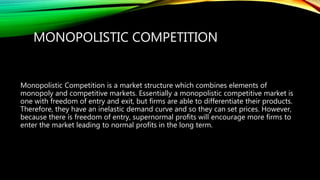
MONOPOLISTIC COMPETITION
Monopolistic Competition is a market structure which combines elements of
monopoly and competitive markets. Essentially a monopolistic competitive market is
one with freedom of entry and exit, but firms are able to differentiate their products.
Therefore, they have an inelastic demand curve and so they can set prices. However,
because there is freedom of entry, supernormal profits will encourage more firms to
enter the market leading to normal profits in the long term.
• Many firms
• Freedom of entry and exit
• Produce differentiated products. Therefore firms have inelastic demand, they are
price makers because the good is highly differentiated
• Make normal profits in the long run, but could make supernormal profits in the
short term
• Are allocatively and productively inefficient.
Features of a Monopolistic
Competition
Examples of monopolistic competition
• Restaurants
• Hair dressers
Advantages
• No significant entry barriers, therefore markets are contestable.
• Differentiation creates diversity, choice and utility.
• The market is more efficient than monopoly but less efficient than pure competition.
Disadvantages
• They can be wasteful, firms don’t produce enough output to efficiently lower the
average cost and benefit from economies of scale.
• It is allocatively inefficient as not enough of the product gets produced for society
to benefit.
• A higher price is charged than would be the case under perfect/pure competition.
Advantages and Disadvantages
PURE/PERFECT COMPETITION
A perfectly competitive market is rare, but the ones that do exist are very large, such
as the markets for agricultural products, stocks, foreign exchange, and most
commodities. Pure competition also offers a simplified economic market model that
yields useful insights into the nature of competition and how it provides the greatest
value to consumers.
Perfect competition is the opposite of a monopoly, in which only a single firm supplies
a particular good or service, and that firm can charge whatever price it wants because
consumers have no alternatives and it is difficult for would-be competitors to enter
the marketplace. Under perfect competition, there are many buyers and sellers, and
prices reflect supply and demand.
• All firms sell an identical product.
• All firms have a relatively small market share.
• Buyers have complete information about the product being sold and the prices
charged by each firm.
• The industry is characterized by freedom of entry and exit.
Features of a Pure/Perfect competition
Advantages
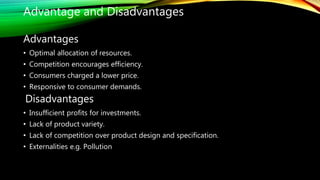
• Optimal allocation of resources.
• Competition encourages efficiency.
• Consumers charged a lower price.
• Responsive to consumer demands.
Disadvantages
• Insufficient profits for investments.
• Lack of product variety.
• Lack of competition over product design and specification.
• Externalities e.g. Pollution
Advantage and Disadvantages
References:
https://www.thoughtco.com/the-clayton-antitrust-act-4136271
http://www.investopedia.com/terms/m/marketeconomy.asp
http://www.econ.brown.edu/Faculty/serrano/textbook/Lesson15PlusGraphs.pdf
https://www.intelligenteconomist.com/market-structure-oligopoly/
http://www.investinganswers.com/financial-dictionary/economics/oligopoly-104
http://www.economicshelp.org/microessays/markets
https://www.slideshare.net/murarisharma94/imperfect-competion-2
http://businessjargons.com/oligopoly-market.html
https://www.slideshare.net/pujasakhla/domestic-airlines-inindialeveragingprice

Economics

  • 1.
    ECONOMICS 1 Principles ofEconomics with Taxation and Agrarian Reform Instructor: Mr. Henry p. de Leon M.B.A. M.A.T. Exchange Economy By: Catanes, Darren Lance
  • 2.
    EXCHANGE ECONOMY • Exchangeeconomy is a technical term used in microeconomics research to describe interaction between several agents. Each agent brings his/her own endowment, and they can exchange products among them, based on a price system.
  • 3.
    Two types ofexchange economy: Pure Exchange Economy A pure exchange economy, or more simply an exchange economy, is a model of an economy with no production. Goods have already been produced, found, inherited, or endowed, and the only issue is how they should be distributed and consumed. (R. Serrano, A. Feldman) Exchange economy with production/Market Economy In contrast to pure economic exchange wherein the agents only exchange goods that have already been endowed, in an exchange economy with production, some or all agents may also produce new goods.
  • 4.
    FOUR BROAD CATEGORIESOF MARKET TYPES „ Monopoly „ Oligopoly „ Perfect competition „ Monopolistic competition
  • 5.
    MONOPOLY • In businessterms, a monopoly refers to a sector or industry dominated by one corporation, firm or entity. • Monopolies can be considered an extreme result of free market capitalism. There are no restriction or restraints when a single company, group or an enterprise becomes big enough to own all or nearly all of the market (goods, supplies, commodities, infrastructure and assets) for a particular type of product or service. • "Monopoly" can also be used to mean the entity that has total or near-total control of a market.
  • 6.
    • A monopolyis characterized by the absence of competition, which can lead to high costs for consumers, inferior products and services, and corrupt behavior. A company that dominates a business sector or industry can use that dominance to its advantage, and at the expense of others. It can create artificial scarcities, fixed prices, and otherwise circumvent natural laws of supply and demand. It can impede new entrants into the field, discriminate, and inhibit experimentation or new product development, while the public – robbed of the recourse of using a competitor – is at its mercy. A monopolized market often becomes an unequal, and even an inefficient one. Why are monopolies illegal? Antitrust Laws Sherman Anti-Trust Act, Clayton Antitrust Act, Federal Trade Commission Act: These laws are intended to preserve competition and allow smaller companies to enter a market.
  • 7.
    Sherman Anti TrustAct - Named after John Sherman. The Sherman Antitrust Act of 1890 was the first measure passed by the U.S. Congress to prohibit abusive monopolies, and in some ways it remains the most important. For example, the Act bans groups of companies from participating in “price fixing,” or mutually agreeing to unfairly control prices of similar products or services. Clayton Antitrust Act – Clayton Anti Trust Law bolsters the Sherman antitrust law. The Clayton Act addresses unfair practices not clearly prohibited by the Sherman Act, such as predatory mergers and “interlocking directorates,” arrangements in which the same person makes business decisions for several competing companies. For example, Section 7 of the Clayton Act bans companies from merging with or acquiring other companies when the effect “may be substantially to lessen competition, or to tend to create a monopoly.”(ThoughtCo, Robert Longley)
  • 8.
    Federal Trade CommissionAct - The Federal Trade Commission (FTC) is an independent federal agency whose main goals are to protect consumers and to ensure a strong competitive market by enforcing a variety of consumer protection and antitrust laws. These laws guard against harmful business practices and protect the market from anti-competitive practices such as large mergers and price-fixing conspiracies.
  • 9.
    OLIGOPOLY An oligopoly isan economic market whereby a small number of companies or countries generate and control the entire supply of a good or service. Companies in an oligopoly are keenly interested in what the other members of the oligopoly will do next. The goal of a company involved in an oligopoly is to increase profits by attempting to monopolize the market by finding and maintaining competitive advantages.
  • 10.
    • Few Sellers:Under the Oligopoly market, the sellers are few, and the customers are many. Few firms dominating the market enjoys a considerable control over the price of the product. • Interdependence: it is one of the most important features of an Oligopoly market, wherein, the seller has to be cautious with respect to any action taken by the competing firms. Since there are few sellers in the market, if any firm makes the change in the price or promotional scheme, all other firms in the industry have to comply with it, to remain in the competition. Thus, every firm remains alert to the actions of others and plan their counterattack beforehand, to escape the turmoil. Hence, there is a complete interdependence among the sellers with respect to their price-output policies. Features of Oligopoly Market
  • 11.
    • Advertising: UnderOligopoly market, every firm advertises their products on a frequent basis, with the intention to reach more and more customers and increase their customer base. This is due to the advertising that makes the competition intense. If any firm does a lot of advertisement while the other remained silent, then he will observe that his customers are going to that firm who is continuously promoting its product. Thus, in order to be in the race, each firm spends lots of money on advertisement activities. • Competition: It is genuine that with a few players in the market, there will be an intense competition among the sellers. Any move taken by the firm will have a considerable impact on its rivals. Thus, every seller keeps an eye over its rival and be ready with the counterattack.
  • 12.
    • Entry andExit Barriers: The firms can easily exit the industry whenever it wants, but has to face certain barriers to entering into it. These barriers could be Government license, Patent, large firm’s economies of scale, high capital requirement, complex technology, etc. Also, sometimes the government regulations favor the existing large firms, thereby acting as a barrier for the new entrants. • Lack of Uniformity: There is a lack of uniformity among the firms in terms of their size, some are big, and some are small. Since there are less number of firms, any action taken by one firm has a considerable effect on the other. Thus, every firm must keep a close eye on its counterpart and plan the promotional activities accordingly.
  • 13.
    • Open VsClosed Oligopoly: This classification is made on the basis of freedom to enter into the new industry. An open Oligopoly is the market situation wherein a firm can enter into the industry any time it wants, whereas, in case of a closed Oligopoly, there are certain restrictions that act as a barrier for a new firm to enter into the industry. • Partial Vs Full Oligopoly: This classification is done on the basis of price leadership. The partial Oligopoly refers to the market situation, wherein one large firm dominates the market and is looked upon as a price leader. Whereas in full Oligopoly, the price leadership is conspicuous by its absence. • Perfect (Pure) Vs Imperfect (Differential) Oligopoly: This classification is made on the basis of product differentiation. The Oligopoly is perfect or pure when the firms deal in the homogeneous products. Whereas Oligopoly is said to be imperfect, when the firms deal in heterogeneous products, i.e. products that are close are not perfect substitutes. • Syndicated Vs Organized Oligopoly: This classification is done on the basis of a degree of coordination found among the firms. When the firms come together and sell their products with the common interest is called as a Syndicate Oligopoly. Whereas, in the case of an Organized Oligopoly, the firms have a central association for the prices, outputs, and quotas. • Collusive Vs Non-Collusive Oligopoly: This classification is made on the basis of agreement or understanding between the firms. In Collusive Oligopoly, instead of competing with each other, the firms come together and the consensus of all fixes the price and the outputs. Whereas in the case of a non-collusive Oligopoly, there is a lack of understanding among the firms and they compete against each other to achieve their respective targets. Types of Oligopoly Market
  • 14.
    EXAMPLES OF OLIGOPOLIES •In the wireless cell phone service industry, the providers that tend to dominate the industry are Smart and Globe. Similarly, for smartphone operating systems, Android, iOS and Windows are the most prevalent options. • Oil Industries (e.g. Petrol, Caltex, Shell etc.) • Super Markets (SM, Robinsons etc.) • Soft drink Industries (Pepsi cola, Coca Cola, Dr. Pepper)
  • 15.
    Advantages • Large firmshaving strong hold over the market are able to make huge profits as there are few competitions in the market. • In oligopoly, many times, products of two competitive companies are derived from one large firm. Therefore whichever company makes profit, it finally ends up as profit of the parent firm. Disadvantages • Setting of prices may be advantageous for the firms, but may prove to be a great disadvantage for the consumers. • Firms cannot take independent decisions and always have to consider the views of dominant players in the market. • With the lack of competition dominant companies may not think of improving their products. Advantage and Disadvantages
  • 16.
    MONOPOLISTIC COMPETITION Monopolistic Competitionis a market structure which combines elements of monopoly and competitive markets. Essentially a monopolistic competitive market is one with freedom of entry and exit, but firms are able to differentiate their products. Therefore, they have an inelastic demand curve and so they can set prices. However, because there is freedom of entry, supernormal profits will encourage more firms to enter the market leading to normal profits in the long term.
  • 17.
    • Many firms •Freedom of entry and exit • Produce differentiated products. Therefore firms have inelastic demand, they are price makers because the good is highly differentiated • Make normal profits in the long run, but could make supernormal profits in the short term • Are allocatively and productively inefficient. Features of a Monopolistic Competition Examples of monopolistic competition • Restaurants • Hair dressers
  • 18.
    Advantages • No significantentry barriers, therefore markets are contestable. • Differentiation creates diversity, choice and utility. • The market is more efficient than monopoly but less efficient than pure competition. Disadvantages • They can be wasteful, firms don’t produce enough output to efficiently lower the average cost and benefit from economies of scale. • It is allocatively inefficient as not enough of the product gets produced for society to benefit. • A higher price is charged than would be the case under perfect/pure competition. Advantages and Disadvantages
  • 19.
    PURE/PERFECT COMPETITION A perfectlycompetitive market is rare, but the ones that do exist are very large, such as the markets for agricultural products, stocks, foreign exchange, and most commodities. Pure competition also offers a simplified economic market model that yields useful insights into the nature of competition and how it provides the greatest value to consumers. Perfect competition is the opposite of a monopoly, in which only a single firm supplies a particular good or service, and that firm can charge whatever price it wants because consumers have no alternatives and it is difficult for would-be competitors to enter the marketplace. Under perfect competition, there are many buyers and sellers, and prices reflect supply and demand.
  • 20.
    • All firmssell an identical product. • All firms have a relatively small market share. • Buyers have complete information about the product being sold and the prices charged by each firm. • The industry is characterized by freedom of entry and exit. Features of a Pure/Perfect competition
  • 21.
    Advantages • Optimal allocationof resources. • Competition encourages efficiency. • Consumers charged a lower price. • Responsive to consumer demands. Disadvantages • Insufficient profits for investments. • Lack of product variety. • Lack of competition over product design and specification. • Externalities e.g. Pollution Advantage and Disadvantages
  • 22.