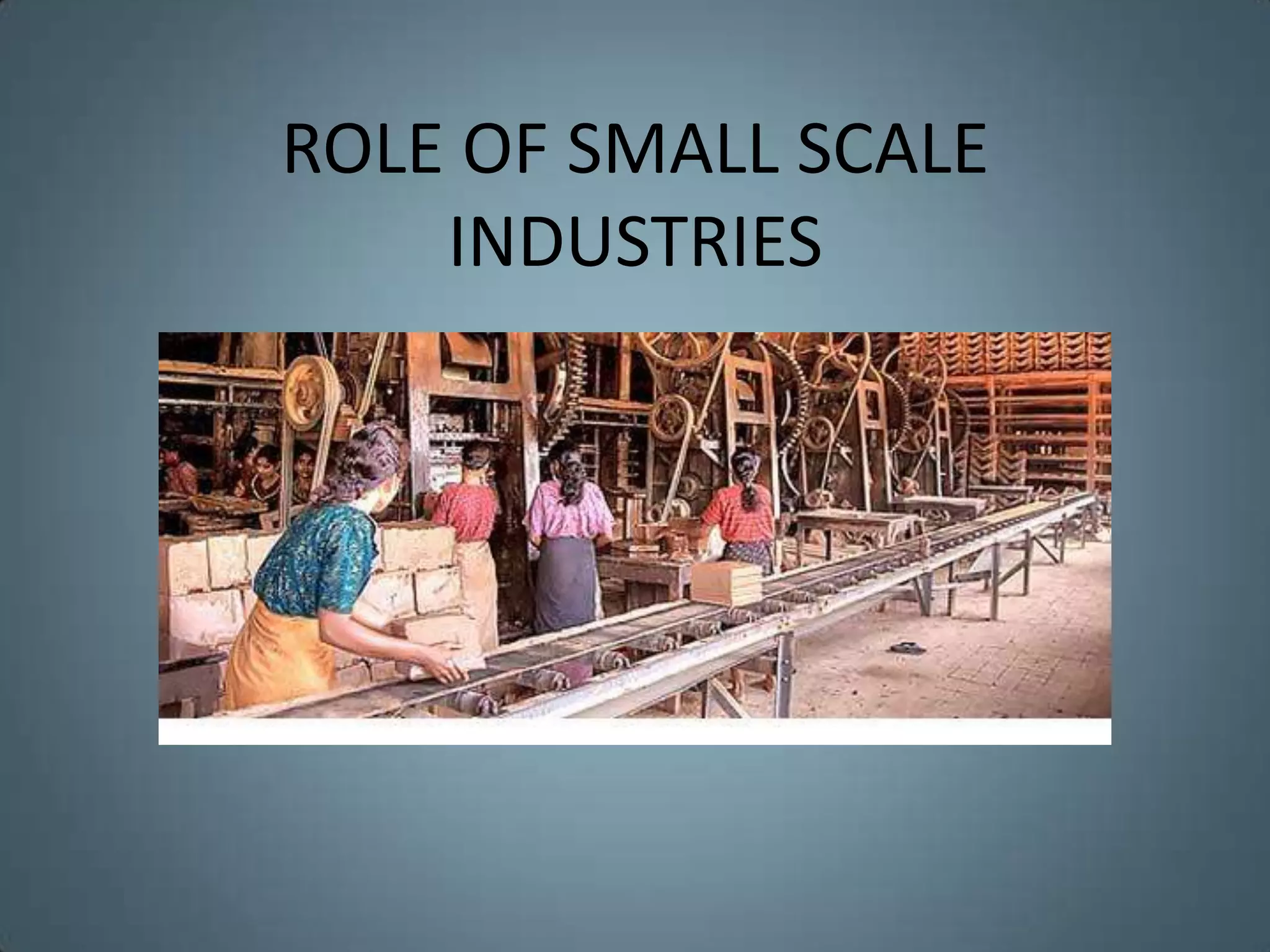
ROLE OF SMALL SCALE
    INDUSTRIES
WHAT ARE SSIs?
As per the latest definition which is effective since
December 21, 1999, for any industrial unit to be
regarded as Small Scale Industrial unit the following
conditions are to be satisfied: -

• Investment in fixed assets like plants and
  equipment's either held on ownership term on lease
  or on hire purchase should not be more than Rs 10
  million.
• Less than 150 employees in a unit.
• The policy reservation of items for manufacturing in SSIs was introduced in
  1967. Initially only 47 items were reserved, but as of today about 675
  items are reserved.
• SSIs are the second largest employers of Human resources after
  agriculture in India.
• They generate more employment opportunities per unit of capital
  invested than large-scale industries.
• Employment provided to more than 273. 97 lakh persons.
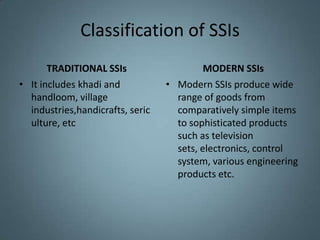
Classification of SSIs
       TRADITIONAL SSIs                    MODERN SSIs
• It includes khadi and           • Modern SSIs produce wide
  handloom, village                 range of goods from
  industries,handicrafts, seric     comparatively simple items
  ulture, etc                       to sophisticated products
                                    such as television
                                    sets, electronics, control
                                    system, various engineering
                                    products etc.
IMPORTANCE OF SMALL SCALE
       INDUSTRIES
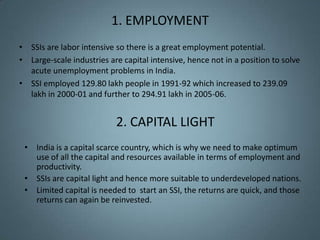
1. EMPLOYMENT
• SSIs are labor intensive so there is a great employment potential.
• Large-scale industries are capital intensive, hence not in a position to solve
  acute unemployment problems in India.
• SSI employed 129.80 lakh people in 1991-92 which increased to 239.09
  lakh in 2000-01 and further to 294.91 lakh in 2005-06.


                           2. CAPITAL LIGHT
 • India is a capital scarce country, which is why we need to make optimum
   use of all the capital and resources available in terms of employment and
   productivity.
 • SSIs are capital light and hence more suitable to underdeveloped nations.
 • Limited capital is needed to start an SSI, the returns are quick, and those
   returns can again be reinvested.
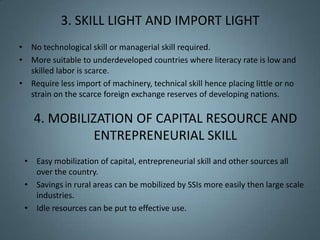
3. SKILL LIGHT AND IMPORT LIGHT
• No technological skill or managerial skill required.
• More suitable to underdeveloped countries where literacy rate is low and
  skilled labor is scarce.
• Require less import of machinery, technical skill hence placing little or no
  strain on the scarce foreign exchange reserves of developing nations.

    4. MOBILIZATION OF CAPITAL RESOURCE AND
              ENTREPRENEURIAL SKILL
 • Easy mobilization of capital, entrepreneurial skill and other sources all
   over the country.
 • Savings in rural areas can be mobilized by SSIs more easily then large scale
   industries.
 • Idle resources can be put to effective use.
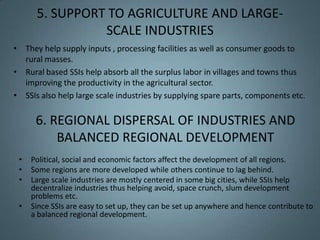
5. SUPPORT TO AGRICULTURE AND LARGE-
                SCALE INDUSTRIES
• They help supply inputs , processing facilities as well as consumer goods to
  rural masses.
• Rural based SSIs help absorb all the surplus labor in villages and towns thus
  improving the productivity in the agricultural sector.
• SSIs also help large scale industries by supplying spare parts, components etc.

      6. REGIONAL DISPERSAL OF INDUSTRIES AND
          BALANCED REGIONAL DEVELOPMENT
 •   Political, social and economic factors affect the development of all regions.
 •   Some regions are more developed while others continue to lag behind.
 •   Large scale industries are mostly centered in some big cities, while SSIs help
     decentralize industries thus helping avoid, space crunch, slum development
     problems etc.
 •   Since SSIs are easy to set up, they can be set up anywhere and hence contribute to
     a balanced regional development.
7. REDUCTION IN INCOME-INEQUALITIES AND
      EQUITABLE DISTRIBUTION OF NATIONAL INCOME
• SSIs help equitable distribution of national income because of 2 reasons:
a) Ownership of SSI is more widespread than large-scale industries.
b) SSIs possess large employment potential.

  8. CONTRIBUTION TO EXPORTS AND INDUSTRIAL
                   OUTPUT
  •    45%-50% of the Indian Exports is being contributed by SSI Sector.
  •    Direct exports from the SSI Sector account for nearly 35% of total exports.
  •    It is estimated that small scale industrial units contribute around 15% to
       exports indirectly.
  •    The exports from SSI sector has been clocking excellent growth rates mostly
       fuelled by the performance of garment, leather and gems and jewellery units
       from this sector.
  •    No. of industrial units has grown from 23.9L in ‘93-94 to 118. 59L in ‘04-05.
       Output has increased from 241,648 cr in ‘93-94 to 4,18,263 cr in ‘04-05.
9. LESS INDUSTRIAL DISPUTES

• Do not face problem of frequent strikes and lockouts. Hence no loss of
  man-days and output in SSIs.
THANK YOU

Small Scale Industries

  • 1.
    ROLE OF SMALLSCALE INDUSTRIES
  • 2.
    WHAT ARE SSIs? Asper the latest definition which is effective since December 21, 1999, for any industrial unit to be regarded as Small Scale Industrial unit the following conditions are to be satisfied: - • Investment in fixed assets like plants and equipment's either held on ownership term on lease or on hire purchase should not be more than Rs 10 million. • Less than 150 employees in a unit.
  • 3.
    • The policyreservation of items for manufacturing in SSIs was introduced in 1967. Initially only 47 items were reserved, but as of today about 675 items are reserved. • SSIs are the second largest employers of Human resources after agriculture in India. • They generate more employment opportunities per unit of capital invested than large-scale industries. • Employment provided to more than 273. 97 lakh persons.
  • 4.
    Classification of SSIs TRADITIONAL SSIs MODERN SSIs • It includes khadi and • Modern SSIs produce wide handloom, village range of goods from industries,handicrafts, seric comparatively simple items ulture, etc to sophisticated products such as television sets, electronics, control system, various engineering products etc.
  • 5.
    IMPORTANCE OF SMALLSCALE INDUSTRIES
  • 6.
    1. EMPLOYMENT • SSIsare labor intensive so there is a great employment potential. • Large-scale industries are capital intensive, hence not in a position to solve acute unemployment problems in India. • SSI employed 129.80 lakh people in 1991-92 which increased to 239.09 lakh in 2000-01 and further to 294.91 lakh in 2005-06. 2. CAPITAL LIGHT • India is a capital scarce country, which is why we need to make optimum use of all the capital and resources available in terms of employment and productivity. • SSIs are capital light and hence more suitable to underdeveloped nations. • Limited capital is needed to start an SSI, the returns are quick, and those returns can again be reinvested.
  • 7.
    3. SKILL LIGHTAND IMPORT LIGHT • No technological skill or managerial skill required. • More suitable to underdeveloped countries where literacy rate is low and skilled labor is scarce. • Require less import of machinery, technical skill hence placing little or no strain on the scarce foreign exchange reserves of developing nations. 4. MOBILIZATION OF CAPITAL RESOURCE AND ENTREPRENEURIAL SKILL • Easy mobilization of capital, entrepreneurial skill and other sources all over the country. • Savings in rural areas can be mobilized by SSIs more easily then large scale industries. • Idle resources can be put to effective use.
  • 8.
    5. SUPPORT TOAGRICULTURE AND LARGE- SCALE INDUSTRIES • They help supply inputs , processing facilities as well as consumer goods to rural masses. • Rural based SSIs help absorb all the surplus labor in villages and towns thus improving the productivity in the agricultural sector. • SSIs also help large scale industries by supplying spare parts, components etc. 6. REGIONAL DISPERSAL OF INDUSTRIES AND BALANCED REGIONAL DEVELOPMENT • Political, social and economic factors affect the development of all regions. • Some regions are more developed while others continue to lag behind. • Large scale industries are mostly centered in some big cities, while SSIs help decentralize industries thus helping avoid, space crunch, slum development problems etc. • Since SSIs are easy to set up, they can be set up anywhere and hence contribute to a balanced regional development.
  • 9.
    7. REDUCTION ININCOME-INEQUALITIES AND EQUITABLE DISTRIBUTION OF NATIONAL INCOME • SSIs help equitable distribution of national income because of 2 reasons: a) Ownership of SSI is more widespread than large-scale industries. b) SSIs possess large employment potential. 8. CONTRIBUTION TO EXPORTS AND INDUSTRIAL OUTPUT • 45%-50% of the Indian Exports is being contributed by SSI Sector. • Direct exports from the SSI Sector account for nearly 35% of total exports. • It is estimated that small scale industrial units contribute around 15% to exports indirectly. • The exports from SSI sector has been clocking excellent growth rates mostly fuelled by the performance of garment, leather and gems and jewellery units from this sector. • No. of industrial units has grown from 23.9L in ‘93-94 to 118. 59L in ‘04-05. Output has increased from 241,648 cr in ‘93-94 to 4,18,263 cr in ‘04-05.
  • 10.
    9. LESS INDUSTRIALDISPUTES • Do not face problem of frequent strikes and lockouts. Hence no loss of man-days and output in SSIs.
  • 11.