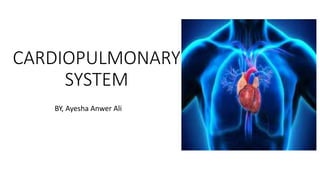
CARDIOPULMONARY
SYSTEM
BY, Ayesha Anwer Ali
Outline…!
• Introduction
• Anatomy
• Physiology
• Pathophysiology
• Diagnostic tests and procedures
• Surgical interventions monitoring and support
• Cardiopulmonary assessment and intervention
ANATOMY OF CARDIOVASCULAR AND
RESPIRATORY SYSTEM
Human Respiratory System
Functions:
• Works closely with circulatory
system, exchanging gases between
air and blood:
• Takes up oxygen from air and
supplies it to blood (for cellular
respiration).
• Removal and disposal of carbon
dioxide from blood (waste product
from cellular respiration).
Structure
•Nose
•Pharynx
•Larynx
•Trachea
•Bronchi
•Bronchioles
•Alveoli
1. Nose: Air enters
nostrils, is filtered
by hairs, warmed,
moistened, and
sampled for odors
as it flows through
a maze of nasal
passages.
2. Pharynx
(Throat):
Intersection
where pathway
for air and food
cross. Most of the
time, the pathway
for air is open,
except when we
swallow.
3. Larynx (Voice Box):
Reinforced with cartilage.
Contains vocal cords, which
allow us to make sounds by
voluntarily tensing muscles.
• High pitched sounds: Vocal
cords are tense, vibrate
fast.
• Low pitched sounds: Vocal
cords are relaxed, vibrate
slowly.
• More prominent in males.
• 4. Trachea
(Windpipe):
Rings of
cartilage
maintain shape
of trachea, to
prevent it from
closing. Forks
into two
bronchi.
5. Bronchi (Sing.
Bronchus): Each
bronchus leads
into a lung and
branches into
smaller and
smaller
bronchioles,
resembling an
inverted tree.
• 6. Bronchioles: Fine
tubes that allow
passage of air.
Epithelium of
bronchioles is covered
with cilia and mucus
to trap and remove
dust and other
particles.
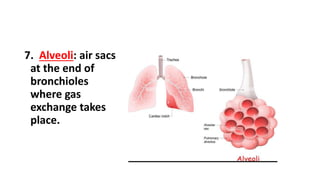
7. Alveoli: air sacs
at the end of
bronchioles
where gas
exchange takes
place.
GAS EXCHANGE
• Gas exchange
takes place in the
alveoli.
• Oxygen diffuses
into the blood.
• Carbon dioxide in
the blood diffuses
into the alveolus.
Capillary
O2
CO2
HOW DOES THE BODY USE OXYGEN?
Oxygen is for respiration.
• In biology, respiration means different things.
• Cellular respiration is the release of energy from the
breakdown of food in the presence of oxygen.
• At the organism level, respiration is the process of gas exchange
- the release of carbon dioxide and the uptake of oxygen that
occurs between RBCs and alveoli
• Breathing is the actual mechanical intake of air
HOW THE LUNGS WORK?
BREATHING
• Lungs are sealed in
pleural membranes
inside the chest cavity.
• At the bottom of the
cavity is a large, flat
muscle known as the
diaphragm.
HOW THE LUNGS WORK?
• During inhalation, the diaphragm
contracts and the rib cage rises up.
• This expands the volume of the
chest cavity.
• The chest cavity is sealed, so this
creates a partial vacuum inside the
cavity.
• Atmospheric pressure fills the
lungs as air rushes into the
breathing passages.
HOW THE LUNGS WORK?
• Often exhaling is a passive
event.
• When the rib cage lowers
and the diaphragm relaxes,
pressure in the chest cavity
is greater than atmospheric
pressure.
• Air is pushed out of the
lungs.
DEAD SPACES
• Some of the air the person breathes never reaches the gas exchange
areas but simply fills respiratory passages where gas exchange does not
occur, such as the nose, pharynx, and trachea.
• This air is called dead space air because it is not useful for gas exchange.
• The normal dead space air in a young adult man is about 150ml. This
increases slightly with age.
THE CIRCULATORY SYSTEM AKA
CARDIOVASCULAR SYSTEM
THE HEART
21
HEART
• Cone shaped muscle
• Four chambers
• Two atria, two ventricles
• Double pump – the ventricles
• Two circulations
• Systemic circuit: blood vessels that transport blood to and
from all the body tissues
• Pulmonary circuit: blood vessels that carry blood to and from
the lungs
HEART’S POSITION IN THORAX
• In mediastinum –
behind sternum and
pointing left, lying on
the diaphragm
• It weighs 250-350 gm
(about 1 pound)
23
LAYERS OF THE HEART WALL
• Muscle of the heart with inner and outer membrane coverings.
• Muscle of heart = “Myocardium”
• The layers from out to in:
• Epicardium = visceral layer of serous pericardium
• Myocardium = the muscle
• Endocardium lining the chambers
HEART BLOOD SUPPLY
• Coronary circulation demands high oxygen and nutrients for the cardiac
muscle cells.
• Coronary arteries originate at the base of the ascending aorta.
• Interconnections between arteries called anastomoses ensure a constant
blood supply.
FUNCTION OF THE CIRCULATORY SYSTEM
• Circulate blood throughout entire body for
• Transport of oxygen to cells
• Transport of CO2 away from cells
• Transport of nutrients (glucose) to cells
• Movement of immune system components (cells, antibodies)
• Transport of endocrine gland secretions
THE MAIN ORGANS AND THEIR FUNCTIONS
• Heart is the pump
• Arteries and veins are main tubes (plumbing)
• Arteries Away from Heart
• Veins to Heart
• Capillaries is where diffusion happens (oxygen, CO2, and glucose
diffuse in or out of blood)
• Blood – transports material to every cell of the body.
OUR CIRCULATORY SYSTEM IS A DOUBLE
CIRCULATORY SYSTEM.
THIS MEANS IT HAS TWO PARTS.
the left side of the system
deals with deoxygenated blood.
the right side of the system
deals with oxygenated blood.
BLOOD FROM THE HEART GETS AROUND
THE BODY THROUGH BLOOD VESSELS
• There are 3 types of blood vessels
• a. ARTERY
• b. VEIN
• c. CAPILLARY
THE ARTERY
• Arteries have strong, muscular walls to carry blood away from
the heart.
the elastic fibres allow the
artery to stretch under
pressure
The VEIN
• Veins carry blood towards the heart.
The CAPILLARY
• Capillaries link Arteries with Veins
PATHOPHYSIOLOGY OF ISCHEMIC
HEART DISEASE?
 WHAT IS ISCHEMIA?
 Ischemia is a condition in which the blood flow (and thus
oxygen) is restricted or reduced in a part of the body. Cardiac
ischemia is the name for decreased blood flow and oxygen to
the heart muscle.
EARLY CHANGES IN INFARCTION (MINUTES TO
DAYS)
• Drop in tissue oxygen levels
• Rapid conversion from aerobic to anaerobic metabolism
• Impaired glycolysis and ATP production → impaired contractile protein
function
• Systolic dysfunction – loss of synchronous myocyte contraction
→ compromised cardiac output
• Diastolic dysfunction – reduced ventricular compliance (i.e. impaired
relaxation) and elevation of ventricular filling pressures
• Accumulation of lactic acid and reduction in pH
• Impairment of transmembrane Na-K-ATPase due to impaired ATP
production
• Increased intracellular Na → intracellular edema
• Increased extracellular K → alteration in transmembrane potential
→ electrical instability and susceptibility to arrhythmias
• Increased intracellular Ca → activation of degradative lipases and proteases
→ tissue necrosis
• Acute inflammatory response with infiltration of neutrophils leading
to further tissue damage
LATE CHANGES IN INFARCTION (DAYS TO
WEEKS)
 REABSORPTION OF IRREVERSIBLY INJURED/DEAD MYOCYTES BY
MACROPHAGES
• Structural weakness of ventricular wall and susceptibility to myocardial wall
rupture
• Fibrous tissue deposition and scarring
 VENTRICULAR REMODELING
• Infarct expansion – thinning and dilatation of necrotic tissue without
additional necrosis
• Increased ventricular wall stress
• Further impairment in systolic contractile function
• Increased likelihood of aneurysm formation
 REMODELING OF NON-INFARCTED VENTRICLE
• Dilatation of overworked non-infarcted segments subjected to
increased wall stress
• Enlargement initially compensatory to increase cardiac output via
Frank-Starling mechanism, but can eventually predispose to
ventricular arrhythmias and lead to heart failure
CHRONIC OBSTRUCTIVE PULMONARY DISEASE
PATHOPHYSIOLOGY;
• COPD results from the combined processes of peripheral airway
inflammation and narrowing of the airways. This leads to airflow
limitation and the destruction and loss of alveoli, terminal
bronchioles and surrounding capillary vessels and tissues, which adds
to airflow limitation and leads to decreased gas transfer capacity. The
extent of airflow limitation is determined by the severity of
inflammation, development of fibrosis within the airway and
presence of secretions or exudates.
DIAGNOSTIC TESTS AND PROCEDURE
ELECTROCARDIOGRAPHY
• An electrocardiogram (ECG) is a simple test that can be used to check
your heart's rhythm and electrical activity. Sensors attached to the
skin are used to detect the electrical signals produced by your heart
each time it beats.
WHY IT'S DONE?
 A health care provider might use an electrocardiogram to determine or
detect:
Irregular heart rhythms (arrhythmias)
If blocked or narrowed arteries in the heart (coronary artery disease) are
causing chest pain or a heart attack.
Whether you have had a previous heart attack.
How well certain heart disease treatments, such as a pacemaker, are
working.
YOU MAY NEED AN ECG IF YOU HAVE ANY OF THE
FOLLOWING SIGNS AND SYMPTOMS:
Chest pain
Dizziness, lightheadedness or confusion
Heart palpitations
Rapid pulse
Shortness of breath
Weakness, fatigue or a decline in ability to exercise
TYPES
• Holter monitor: It is a small, wearable device that records a
continuous ECG, usually for 24 to 48 hours.
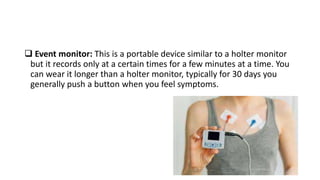
 Event monitor: This is a portable device similar to a holter monitor
but it records only at a certain times for a few minutes at a time. You
can wear it longer than a holter monitor, typically for 30 days you
generally push a button when you feel symptoms.
PULMONARY FUNCTION TESTS
• Pulmonary function tests (PFTs) are noninvasive tests that show how
well the lungs are working. The tests measure lung volume, capacity,
rates of flow, and gas exchange. This information can help your
healthcare provider diagnose and decide the treatment of certain
lung disorders.
• PFT can be done with 2 methods. These 2 methods may be used
together and perform different tests, depending on the information
that your healthcare provider is looking for:
SPIROMETER.
• A spirometer is a device with a mouthpiece hooked up to a small
electronic machine.
PLETHYSMOGRAPHY.
• You sit or stand inside an air-tight box that looks like a short, square
telephone booth to do the tests.
PFT MEASURES:
• Tidal volume (VT). This is the amount of air inhaled or exhaled during
normal breathing.
• Vital capacity (VC). This is the total volume of air that can be exhaled
after inhaling as much as you can.
• Functional residual capacity (FRC). This is the amount of air left in
lungs after exhaling normally.
• Residual volume. This is the amount of air left in the lungs after
exhaling as much as you can.
• Total lung capacity. This is the total volume of the lungs when filled
with as much air as possible.
SURGICAL INTERVENTIONS MONITORING AND
SUPPORT
• The aim of post
operative care is to
provide the patient
with as quick, painless
and safe recovery.
SURGICAL TREATMENT PROCESS POST-OP
CARE:
 SUPPLY BASIC NEED OF PATIENT;
1. Comfort
2. Fluid and electrolytes
3. Nutrition
 SUPPORT ORGAN AND FUNCTION;
1. Wound care
2. Monitoring for complication
3. Advice for home care
4. follow up the plan.
Cardiopulmonary system.pptx 1.pptx

Cardiopulmonary system.pptx 1.pptx

  • 1.
  • 2.
    Outline…! • Introduction • Anatomy •Physiology • Pathophysiology • Diagnostic tests and procedures • Surgical interventions monitoring and support • Cardiopulmonary assessment and intervention
  • 3.
    ANATOMY OF CARDIOVASCULARAND RESPIRATORY SYSTEM
  • 4.
    Human Respiratory System Functions: •Works closely with circulatory system, exchanging gases between air and blood: • Takes up oxygen from air and supplies it to blood (for cellular respiration). • Removal and disposal of carbon dioxide from blood (waste product from cellular respiration).
  • 5.
  • 6.
    1. Nose: Airenters nostrils, is filtered by hairs, warmed, moistened, and sampled for odors as it flows through a maze of nasal passages.
  • 7.
    2. Pharynx (Throat): Intersection where pathway forair and food cross. Most of the time, the pathway for air is open, except when we swallow.
  • 8.
    3. Larynx (VoiceBox): Reinforced with cartilage. Contains vocal cords, which allow us to make sounds by voluntarily tensing muscles. • High pitched sounds: Vocal cords are tense, vibrate fast. • Low pitched sounds: Vocal cords are relaxed, vibrate slowly. • More prominent in males.
  • 9.
    • 4. Trachea (Windpipe): Ringsof cartilage maintain shape of trachea, to prevent it from closing. Forks into two bronchi.
  • 10.
    5. Bronchi (Sing. Bronchus):Each bronchus leads into a lung and branches into smaller and smaller bronchioles, resembling an inverted tree.
  • 11.
    • 6. Bronchioles:Fine tubes that allow passage of air. Epithelium of bronchioles is covered with cilia and mucus to trap and remove dust and other particles.
  • 12.
    7. Alveoli: airsacs at the end of bronchioles where gas exchange takes place.
  • 13.
    GAS EXCHANGE • Gasexchange takes place in the alveoli. • Oxygen diffuses into the blood. • Carbon dioxide in the blood diffuses into the alveolus. Capillary O2 CO2
  • 14.
    HOW DOES THEBODY USE OXYGEN? Oxygen is for respiration. • In biology, respiration means different things. • Cellular respiration is the release of energy from the breakdown of food in the presence of oxygen. • At the organism level, respiration is the process of gas exchange - the release of carbon dioxide and the uptake of oxygen that occurs between RBCs and alveoli • Breathing is the actual mechanical intake of air
  • 15.
    HOW THE LUNGSWORK? BREATHING • Lungs are sealed in pleural membranes inside the chest cavity. • At the bottom of the cavity is a large, flat muscle known as the diaphragm.
  • 16.
    HOW THE LUNGSWORK? • During inhalation, the diaphragm contracts and the rib cage rises up. • This expands the volume of the chest cavity. • The chest cavity is sealed, so this creates a partial vacuum inside the cavity. • Atmospheric pressure fills the lungs as air rushes into the breathing passages.
  • 17.
    HOW THE LUNGSWORK? • Often exhaling is a passive event. • When the rib cage lowers and the diaphragm relaxes, pressure in the chest cavity is greater than atmospheric pressure. • Air is pushed out of the lungs.
  • 18.
    DEAD SPACES • Someof the air the person breathes never reaches the gas exchange areas but simply fills respiratory passages where gas exchange does not occur, such as the nose, pharynx, and trachea. • This air is called dead space air because it is not useful for gas exchange. • The normal dead space air in a young adult man is about 150ml. This increases slightly with age.
  • 19.
    THE CIRCULATORY SYSTEMAKA CARDIOVASCULAR SYSTEM
  • 20.
  • 21.
    21 HEART • Cone shapedmuscle • Four chambers • Two atria, two ventricles • Double pump – the ventricles • Two circulations • Systemic circuit: blood vessels that transport blood to and from all the body tissues • Pulmonary circuit: blood vessels that carry blood to and from the lungs
  • 22.
    HEART’S POSITION INTHORAX • In mediastinum – behind sternum and pointing left, lying on the diaphragm • It weighs 250-350 gm (about 1 pound)
  • 23.
    23 LAYERS OF THEHEART WALL • Muscle of the heart with inner and outer membrane coverings. • Muscle of heart = “Myocardium” • The layers from out to in: • Epicardium = visceral layer of serous pericardium • Myocardium = the muscle • Endocardium lining the chambers
  • 25.
    HEART BLOOD SUPPLY •Coronary circulation demands high oxygen and nutrients for the cardiac muscle cells. • Coronary arteries originate at the base of the ascending aorta. • Interconnections between arteries called anastomoses ensure a constant blood supply.
  • 27.
    FUNCTION OF THECIRCULATORY SYSTEM • Circulate blood throughout entire body for • Transport of oxygen to cells • Transport of CO2 away from cells • Transport of nutrients (glucose) to cells • Movement of immune system components (cells, antibodies) • Transport of endocrine gland secretions
  • 28.
    THE MAIN ORGANSAND THEIR FUNCTIONS • Heart is the pump • Arteries and veins are main tubes (plumbing) • Arteries Away from Heart • Veins to Heart • Capillaries is where diffusion happens (oxygen, CO2, and glucose diffuse in or out of blood) • Blood – transports material to every cell of the body.
  • 29.
    OUR CIRCULATORY SYSTEMIS A DOUBLE CIRCULATORY SYSTEM. THIS MEANS IT HAS TWO PARTS. the left side of the system deals with deoxygenated blood. the right side of the system deals with oxygenated blood.
  • 30.
    BLOOD FROM THEHEART GETS AROUND THE BODY THROUGH BLOOD VESSELS • There are 3 types of blood vessels • a. ARTERY • b. VEIN • c. CAPILLARY
  • 31.
    THE ARTERY • Arterieshave strong, muscular walls to carry blood away from the heart. the elastic fibres allow the artery to stretch under pressure
  • 32.
    The VEIN • Veinscarry blood towards the heart.
  • 33.
    The CAPILLARY • Capillarieslink Arteries with Veins
  • 34.
    PATHOPHYSIOLOGY OF ISCHEMIC HEARTDISEASE?  WHAT IS ISCHEMIA?  Ischemia is a condition in which the blood flow (and thus oxygen) is restricted or reduced in a part of the body. Cardiac ischemia is the name for decreased blood flow and oxygen to the heart muscle.
  • 35.
    EARLY CHANGES ININFARCTION (MINUTES TO DAYS) • Drop in tissue oxygen levels • Rapid conversion from aerobic to anaerobic metabolism • Impaired glycolysis and ATP production → impaired contractile protein function • Systolic dysfunction – loss of synchronous myocyte contraction → compromised cardiac output • Diastolic dysfunction – reduced ventricular compliance (i.e. impaired relaxation) and elevation of ventricular filling pressures • Accumulation of lactic acid and reduction in pH
  • 36.
    • Impairment oftransmembrane Na-K-ATPase due to impaired ATP production • Increased intracellular Na → intracellular edema • Increased extracellular K → alteration in transmembrane potential → electrical instability and susceptibility to arrhythmias • Increased intracellular Ca → activation of degradative lipases and proteases → tissue necrosis • Acute inflammatory response with infiltration of neutrophils leading to further tissue damage
  • 37.
    LATE CHANGES ININFARCTION (DAYS TO WEEKS)  REABSORPTION OF IRREVERSIBLY INJURED/DEAD MYOCYTES BY MACROPHAGES • Structural weakness of ventricular wall and susceptibility to myocardial wall rupture • Fibrous tissue deposition and scarring  VENTRICULAR REMODELING • Infarct expansion – thinning and dilatation of necrotic tissue without additional necrosis • Increased ventricular wall stress • Further impairment in systolic contractile function • Increased likelihood of aneurysm formation
  • 38.
     REMODELING OFNON-INFARCTED VENTRICLE • Dilatation of overworked non-infarcted segments subjected to increased wall stress • Enlargement initially compensatory to increase cardiac output via Frank-Starling mechanism, but can eventually predispose to ventricular arrhythmias and lead to heart failure
  • 39.
    CHRONIC OBSTRUCTIVE PULMONARYDISEASE PATHOPHYSIOLOGY; • COPD results from the combined processes of peripheral airway inflammation and narrowing of the airways. This leads to airflow limitation and the destruction and loss of alveoli, terminal bronchioles and surrounding capillary vessels and tissues, which adds to airflow limitation and leads to decreased gas transfer capacity. The extent of airflow limitation is determined by the severity of inflammation, development of fibrosis within the airway and presence of secretions or exudates.
  • 41.
  • 42.
    ELECTROCARDIOGRAPHY • An electrocardiogram(ECG) is a simple test that can be used to check your heart's rhythm and electrical activity. Sensors attached to the skin are used to detect the electrical signals produced by your heart each time it beats.
  • 43.
    WHY IT'S DONE? A health care provider might use an electrocardiogram to determine or detect: Irregular heart rhythms (arrhythmias) If blocked or narrowed arteries in the heart (coronary artery disease) are causing chest pain or a heart attack. Whether you have had a previous heart attack. How well certain heart disease treatments, such as a pacemaker, are working.
  • 44.
    YOU MAY NEEDAN ECG IF YOU HAVE ANY OF THE FOLLOWING SIGNS AND SYMPTOMS: Chest pain Dizziness, lightheadedness or confusion Heart palpitations Rapid pulse Shortness of breath Weakness, fatigue or a decline in ability to exercise
  • 45.
    TYPES • Holter monitor:It is a small, wearable device that records a continuous ECG, usually for 24 to 48 hours.
  • 46.
     Event monitor:This is a portable device similar to a holter monitor but it records only at a certain times for a few minutes at a time. You can wear it longer than a holter monitor, typically for 30 days you generally push a button when you feel symptoms.
  • 47.
    PULMONARY FUNCTION TESTS •Pulmonary function tests (PFTs) are noninvasive tests that show how well the lungs are working. The tests measure lung volume, capacity, rates of flow, and gas exchange. This information can help your healthcare provider diagnose and decide the treatment of certain lung disorders. • PFT can be done with 2 methods. These 2 methods may be used together and perform different tests, depending on the information that your healthcare provider is looking for:
  • 48.
    SPIROMETER. • A spirometeris a device with a mouthpiece hooked up to a small electronic machine.
  • 49.
    PLETHYSMOGRAPHY. • You sitor stand inside an air-tight box that looks like a short, square telephone booth to do the tests.
  • 50.
    PFT MEASURES: • Tidalvolume (VT). This is the amount of air inhaled or exhaled during normal breathing. • Vital capacity (VC). This is the total volume of air that can be exhaled after inhaling as much as you can. • Functional residual capacity (FRC). This is the amount of air left in lungs after exhaling normally. • Residual volume. This is the amount of air left in the lungs after exhaling as much as you can. • Total lung capacity. This is the total volume of the lungs when filled with as much air as possible.
  • 51.
    SURGICAL INTERVENTIONS MONITORINGAND SUPPORT • The aim of post operative care is to provide the patient with as quick, painless and safe recovery.
  • 52.
    SURGICAL TREATMENT PROCESSPOST-OP CARE:  SUPPLY BASIC NEED OF PATIENT; 1. Comfort 2. Fluid and electrolytes 3. Nutrition  SUPPORT ORGAN AND FUNCTION; 1. Wound care 2. Monitoring for complication 3. Advice for home care 4. follow up the plan.