Copyright © 2007 Lippincott Williams & Wilkins. McArdle, Katch, and Katch: Exercise Physiology: Energy,
Nutrition, and Human Performance, Sixth Edition
Chapter 14
Dynamics of Pulmonary Ventilation
Copyright © 2007 Lippincott Williams & Wilkins. McArdle, Katch, and Katch: Exercise Physiology: Energy,
Nutrition, and Human Performance, Sixth Edition
Ventilatory Control
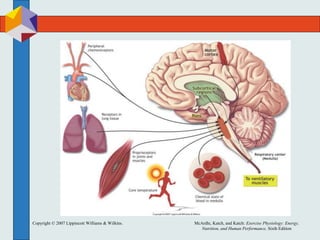
• Complex mechanisms adjust rate and depth
of breathing in response to metabolic
needs.
• Neural circuits relay information.
• Receptors in various tissues monitor pH,
PCO2, PO2, and temperature.
Copyright © 2007 Lippincott Williams & Wilkins. McArdle, Katch, and Katch: Exercise Physiology: Energy,
Nutrition, and Human Performance, Sixth Edition
Neural Factors
• Medulla contains respiratory center
• Neurons activate diaphragm and intercostals
• Neural center in the hypothalamus integrates
input from descending neurons to influence
the duration and intensity of respiratory
cycle
Copyright © 2007 Lippincott Williams & Wilkins. McArdle, Katch, and Katch: Exercise Physiology: Energy,
Nutrition, and Human Performance, Sixth Edition
Copyright © 2007 Lippincott Williams & Wilkins. McArdle, Katch, and Katch: Exercise Physiology: Energy,
Nutrition, and Human Performance, Sixth Edition
Humoral Factors
• At rest, chemical state of blood exerts the
greatest control of pulmonary ventilation
Copyright © 2007 Lippincott Williams & Wilkins. McArdle, Katch, and Katch: Exercise Physiology: Energy,
Nutrition, and Human Performance, Sixth Edition
Plasma PO2 and Peripheral
Chemoreceptors
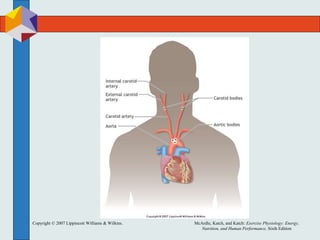
• Peripheral chemoreceptors are located in
aorta and carotid arteries
• Monitor PO2
• During exercise
– PCO2 increases
– Temperature increases
– Decreased pH stimulates peripheral
chemoreceptors
Copyright © 2007 Lippincott Williams & Wilkins. McArdle, Katch, and Katch: Exercise Physiology: Energy,
Nutrition, and Human Performance, Sixth Edition
Copyright © 2007 Lippincott Williams & Wilkins. McArdle, Katch, and Katch: Exercise Physiology: Energy,
Nutrition, and Human Performance, Sixth Edition
Hyperventilation & Breath Holding
• Hyperventilation decreases alveolar PCO2 to
near ambient levels.
• This increases breath-holding time.
Copyright © 2007 Lippincott Williams & Wilkins. McArdle, Katch, and Katch: Exercise Physiology: Energy,
Nutrition, and Human Performance, Sixth Edition
Regulation of Ventilation
During Exercise
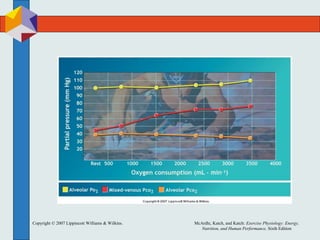
• Chemical control
– Does not entirely account for increased
ventilation during exercise
Copyright © 2007 Lippincott Williams & Wilkins. McArdle, Katch, and Katch: Exercise Physiology: Energy,
Nutrition, and Human Performance, Sixth Edition
Copyright © 2007 Lippincott Williams & Wilkins. McArdle, Katch, and Katch: Exercise Physiology: Energy,
Nutrition, and Human Performance, Sixth Edition
Nonchemical Control
• Neurogenic factors
– Cortical influence
– Peripheral influence
• Temperature has little influence on
respiratory rate during exercise.
Copyright © 2007 Lippincott Williams & Wilkins. McArdle, Katch, and Katch: Exercise Physiology: Energy,
Nutrition, and Human Performance, Sixth Edition
Integrated Regulation During
Exercise
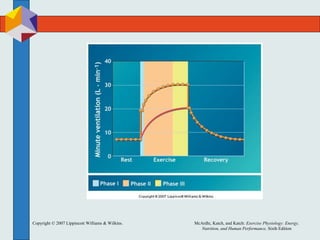
• Phase I (beginning of exercise): Neurogenic
stimuli from cortex increase respiration.
• Phase II: After about 20 seconds, VE rises
exponentially to reach steady state.
– Central command
– Peripheral chemoreceptors
• Phase III: Fine tuning of steady-state ventilation
through peripheral sensory feedback
mechanisms
Copyright © 2007 Lippincott Williams & Wilkins. McArdle, Katch, and Katch: Exercise Physiology: Energy,
Nutrition, and Human Performance, Sixth Edition
In Recovery
• An abrupt decline in ventilation reflects
removal of central command and input from
receptors in active muscle
• Slower recovery phase from gradual
metabolic, chemical, and thermal
adjustments
Copyright © 2007 Lippincott Williams & Wilkins. McArdle, Katch, and Katch: Exercise Physiology: Energy,
Nutrition, and Human Performance, Sixth Edition
Copyright © 2007 Lippincott Williams & Wilkins. McArdle, Katch, and Katch: Exercise Physiology: Energy,
Nutrition, and Human Performance, Sixth Edition
Ventilation and Energy
Demands
• Exercise places the most profound
physiologic stress on the respiratory
system.
Copyright © 2007 Lippincott Williams & Wilkins. McArdle, Katch, and Katch: Exercise Physiology: Energy,
Nutrition, and Human Performance, Sixth Edition
Ventilation in Steady-Rate
Exercise
• During light to moderate exercise
– Ventilation increases linearly with O2
consumption and CO2 production
Copyright © 2007 Lippincott Williams & Wilkins. McArdle, Katch, and Katch: Exercise Physiology: Energy,
Nutrition, and Human Performance, Sixth Edition
Ventilatory Equivalent
• TVE / O2
• Normal values ~ 25 in adults
– 25 L air breathed / LO2 consumed
• Normal values ~ 32 in children
V

Copyright © 2007 Lippincott Williams & Wilkins. McArdle, Katch, and Katch: Exercise Physiology: Energy,
Nutrition, and Human Performance, Sixth Edition
Ventilation in Non–Steady-Rate
Exercise
• VE rises sharply and the ventilatory
equivalent rises as high as 35 – 40 L of air
per liter of oxygen.
Copyright © 2007 Lippincott Williams & Wilkins. McArdle, Katch, and Katch: Exercise Physiology: Energy,
Nutrition, and Human Performance, Sixth Edition
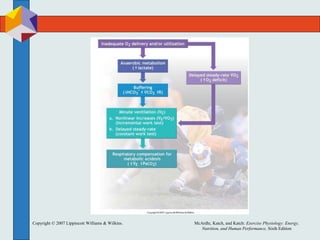
Ventilatory Threshold VT
• The point at which pulmonary vent increases
disproportionately with O2 consumption during
exercise
• Sodium bicarbonate in the blood buffers almost all
of the lactate generated via glycolysis.
• As lactate is buffered, CO2 is regenerated from the
bicarbonate, stimulating ventilation.
Copyright © 2007 Lippincott Williams & Wilkins. McArdle, Katch, and Katch: Exercise Physiology: Energy,
Nutrition, and Human Performance, Sixth Edition
Onset of Blood Lactation
Accumulation
• Lactate threshold
– Describes highest O2 consumption of exercise
intensity with less than a 1-mM per liter increase
in blood lactate above resting level
• OBLA signifies when blood lactate shows a
systemic increase equal to 4.0 mM.
Copyright © 2007 Lippincott Williams & Wilkins. McArdle, Katch, and Katch: Exercise Physiology: Energy,
Nutrition, and Human Performance, Sixth Edition
Copyright © 2007 Lippincott Williams & Wilkins. McArdle, Katch, and Katch: Exercise Physiology: Energy,
Nutrition, and Human Performance, Sixth Edition
Specificity of OBLA
• OBLA differs with exercise mode due to
muscle mass being activated.
• OBLA occurs at lower exercise levels during
cycling of arm-crank exercise.
Copyright © 2007 Lippincott Williams & Wilkins. McArdle, Katch, and Katch: Exercise Physiology: Energy,
Nutrition, and Human Performance, Sixth Edition
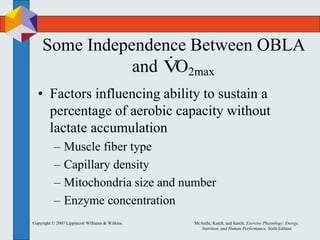
Some Independence Between OBLA
and O2max
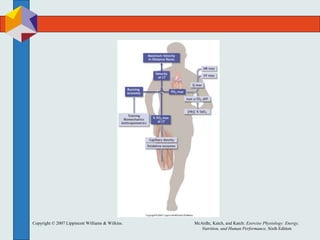
• Factors influencing ability to sustain a
percentage of aerobic capacity without
lactate accumulation
– Muscle fiber type
– Capillary density
– Mitochondria size and number
– Enzyme concentration
V

Copyright © 2007 Lippincott Williams & Wilkins. McArdle, Katch, and Katch: Exercise Physiology: Energy,
Nutrition, and Human Performance, Sixth Edition
Copyright © 2007 Lippincott Williams & Wilkins. McArdle, Katch, and Katch: Exercise Physiology: Energy,
Nutrition, and Human Performance, Sixth Edition
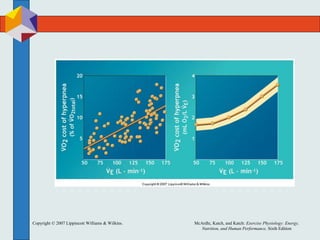
Energy Cost of Breathing
• At rest and during light exercise, the O2 cost
of breathing is small.
• During maximal exercise, the respiratory
muscles require a significant portion of total
blood flow (up to 15%).
Copyright © 2007 Lippincott Williams & Wilkins. McArdle, Katch, and Katch: Exercise Physiology: Energy,
Nutrition, and Human Performance, Sixth Edition
Copyright © 2007 Lippincott Williams & Wilkins. McArdle, Katch, and Katch: Exercise Physiology: Energy,
Nutrition, and Human Performance, Sixth Edition
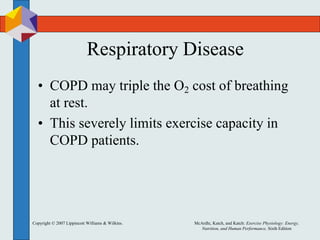
Respiratory Disease
• COPD may triple the O2 cost of breathing
at rest.
• This severely limits exercise capacity in
COPD patients.
Copyright © 2007 Lippincott Williams & Wilkins. McArdle, Katch, and Katch: Exercise Physiology: Energy,
Nutrition, and Human Performance, Sixth Edition
Cigarette Smoking
• Increased airway resistance
• Increased rates of asthma and related
symptoms
• Smoking increases reliance on CHO during
exercise.
• Smoking blunts HR response to exercise.
Copyright © 2007 Lippincott Williams & Wilkins. McArdle, Katch, and Katch: Exercise Physiology: Energy,
Nutrition, and Human Performance, Sixth Edition
Does Ventilation Limit Aerobic
Power and Endurance?
• Healthy individuals overbreathe at higher
levels of O2 consumption.
• At max exercise, there usually is a breathing
reserve.
• Ventilation in healthy individuals is not the
limiting factor in exercise.
Copyright © 2007 Lippincott Williams & Wilkins. McArdle, Katch, and Katch: Exercise Physiology: Energy,
Nutrition, and Human Performance, Sixth Edition
An Important Exception
• Exercise-induced arterial hypoxemia may
occur in elite endurance athletes.
• Potential mechanisms include
– V/Q inequalities
– Shunting of blood flow bypassing alveolar
capillaries
– Failure to achieve end-capillary PO2
equilibrium
Copyright © 2007 Lippincott Williams & Wilkins. McArdle, Katch, and Katch: Exercise Physiology: Energy,
Nutrition, and Human Performance, Sixth Edition
Acid–Base Regulation
• Buffering
– Acids dissociate in solution and release H+.
– Bases accept H+ to form OH− ions.
– Buffers minimize changes in pH.
Copyright © 2007 Lippincott Williams & Wilkins. McArdle, Katch, and Katch: Exercise Physiology: Energy,
Nutrition, and Human Performance, Sixth Edition
Acid–Base Regulation
• Alkalosis increases pH.
• Acidosis decreases pH.
• Three mechanisms help regulate internal
pH.
– Chemical buffers
– Pulmonary ventilation
– Renal function
Copyright © 2007 Lippincott Williams & Wilkins. McArdle, Katch, and Katch: Exercise Physiology: Energy,
Nutrition, and Human Performance, Sixth Edition
Chemical Buffers
• Chemical buffers consist of a weak acid
and the salt of that acid.
• Bicarbonate buffers = weak acid, carbonic
acid, salt of the acid, and sodium
bicarbonate
Copyright © 2007 Lippincott Williams & Wilkins. McArdle, Katch, and Katch: Exercise Physiology: Energy,
Nutrition, and Human Performance, Sixth Edition
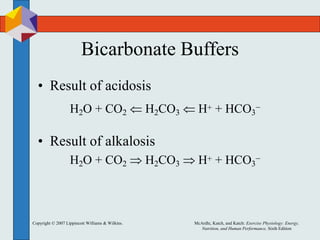
Bicarbonate Buffers
• Result of acidosis
H2O + CO2  H2CO3  H+ + HCO3
−
• Result of alkalosis
H2O + CO2  H2CO3  H+ + HCO3
−
Copyright © 2007 Lippincott Williams & Wilkins. McArdle, Katch, and Katch: Exercise Physiology: Energy,
Nutrition, and Human Performance, Sixth Edition
Phosphate Buffer
• Phosphoric acid and sodium phosphate
• Exerts effects in renal tubules and
intracellular fluids
Copyright © 2007 Lippincott Williams & Wilkins. McArdle, Katch, and Katch: Exercise Physiology: Energy,
Nutrition, and Human Performance, Sixth Edition
Protein Buffer
• Intracellular proteins possess free radicals
that, when dissociated, form OH−, which
reacts with H+ to form H2O.
• Hemoglobin is the most important protein
buffer.
Copyright © 2007 Lippincott Williams & Wilkins. McArdle, Katch, and Katch: Exercise Physiology: Energy,
Nutrition, and Human Performance, Sixth Edition
Physiologic Buffers
• Ventilatory buffer
– Increase in free H+ stimulates ventilation
– Increase ventilation, decrease PCO2
• Lower plasma PCO2 accelerates
recombination of H+ + HCO3
−, lowering H+
concentration
Copyright © 2007 Lippincott Williams & Wilkins. McArdle, Katch, and Katch: Exercise Physiology: Energy,
Nutrition, and Human Performance, Sixth Edition
Renal Buffer
• Kidneys regulate acidity by secreting
ammonia and H+ into urine and reabsorbing
chloride and bicarbonate.
Copyright © 2007 Lippincott Williams & Wilkins. McArdle, Katch, and Katch: Exercise Physiology: Energy,
Nutrition, and Human Performance, Sixth Edition
Effects of Intense Exercise
• During exercise, pH decreases as CO2 and
lactate production increase.
• Low levels of pH are not well tolerated and
need to be quickly buffered.

Chapter14 Dynamics of Pulmonary Ventilation (2).ppt

  • 1.
    Copyright © 2007Lippincott Williams & Wilkins. McArdle, Katch, and Katch: Exercise Physiology: Energy, Nutrition, and Human Performance, Sixth Edition Chapter 14 Dynamics of Pulmonary Ventilation
  • 2.
    Copyright © 2007Lippincott Williams & Wilkins. McArdle, Katch, and Katch: Exercise Physiology: Energy, Nutrition, and Human Performance, Sixth Edition Ventilatory Control • Complex mechanisms adjust rate and depth of breathing in response to metabolic needs. • Neural circuits relay information. • Receptors in various tissues monitor pH, PCO2, PO2, and temperature.
  • 3.
    Copyright © 2007Lippincott Williams & Wilkins. McArdle, Katch, and Katch: Exercise Physiology: Energy, Nutrition, and Human Performance, Sixth Edition Neural Factors • Medulla contains respiratory center • Neurons activate diaphragm and intercostals • Neural center in the hypothalamus integrates input from descending neurons to influence the duration and intensity of respiratory cycle
  • 4.
    Copyright © 2007Lippincott Williams & Wilkins. McArdle, Katch, and Katch: Exercise Physiology: Energy, Nutrition, and Human Performance, Sixth Edition
  • 5.
    Copyright © 2007Lippincott Williams & Wilkins. McArdle, Katch, and Katch: Exercise Physiology: Energy, Nutrition, and Human Performance, Sixth Edition Humoral Factors • At rest, chemical state of blood exerts the greatest control of pulmonary ventilation
  • 6.
    Copyright © 2007Lippincott Williams & Wilkins. McArdle, Katch, and Katch: Exercise Physiology: Energy, Nutrition, and Human Performance, Sixth Edition Plasma PO2 and Peripheral Chemoreceptors • Peripheral chemoreceptors are located in aorta and carotid arteries • Monitor PO2 • During exercise – PCO2 increases – Temperature increases – Decreased pH stimulates peripheral chemoreceptors
  • 7.
    Copyright © 2007Lippincott Williams & Wilkins. McArdle, Katch, and Katch: Exercise Physiology: Energy, Nutrition, and Human Performance, Sixth Edition
  • 8.
    Copyright © 2007Lippincott Williams & Wilkins. McArdle, Katch, and Katch: Exercise Physiology: Energy, Nutrition, and Human Performance, Sixth Edition Hyperventilation & Breath Holding • Hyperventilation decreases alveolar PCO2 to near ambient levels. • This increases breath-holding time.
  • 9.
    Copyright © 2007Lippincott Williams & Wilkins. McArdle, Katch, and Katch: Exercise Physiology: Energy, Nutrition, and Human Performance, Sixth Edition Regulation of Ventilation During Exercise • Chemical control – Does not entirely account for increased ventilation during exercise
  • 10.
    Copyright © 2007Lippincott Williams & Wilkins. McArdle, Katch, and Katch: Exercise Physiology: Energy, Nutrition, and Human Performance, Sixth Edition
  • 11.
    Copyright © 2007Lippincott Williams & Wilkins. McArdle, Katch, and Katch: Exercise Physiology: Energy, Nutrition, and Human Performance, Sixth Edition Nonchemical Control • Neurogenic factors – Cortical influence – Peripheral influence • Temperature has little influence on respiratory rate during exercise.
  • 12.
    Copyright © 2007Lippincott Williams & Wilkins. McArdle, Katch, and Katch: Exercise Physiology: Energy, Nutrition, and Human Performance, Sixth Edition Integrated Regulation During Exercise • Phase I (beginning of exercise): Neurogenic stimuli from cortex increase respiration. • Phase II: After about 20 seconds, VE rises exponentially to reach steady state. – Central command – Peripheral chemoreceptors • Phase III: Fine tuning of steady-state ventilation through peripheral sensory feedback mechanisms
  • 13.
    Copyright © 2007Lippincott Williams & Wilkins. McArdle, Katch, and Katch: Exercise Physiology: Energy, Nutrition, and Human Performance, Sixth Edition In Recovery • An abrupt decline in ventilation reflects removal of central command and input from receptors in active muscle • Slower recovery phase from gradual metabolic, chemical, and thermal adjustments
  • 14.
    Copyright © 2007Lippincott Williams & Wilkins. McArdle, Katch, and Katch: Exercise Physiology: Energy, Nutrition, and Human Performance, Sixth Edition
  • 15.
    Copyright © 2007Lippincott Williams & Wilkins. McArdle, Katch, and Katch: Exercise Physiology: Energy, Nutrition, and Human Performance, Sixth Edition Ventilation and Energy Demands • Exercise places the most profound physiologic stress on the respiratory system.
  • 16.
    Copyright © 2007Lippincott Williams & Wilkins. McArdle, Katch, and Katch: Exercise Physiology: Energy, Nutrition, and Human Performance, Sixth Edition Ventilation in Steady-Rate Exercise • During light to moderate exercise – Ventilation increases linearly with O2 consumption and CO2 production
  • 17.
    Copyright © 2007Lippincott Williams & Wilkins. McArdle, Katch, and Katch: Exercise Physiology: Energy, Nutrition, and Human Performance, Sixth Edition Ventilatory Equivalent • TVE / O2 • Normal values ~ 25 in adults – 25 L air breathed / LO2 consumed • Normal values ~ 32 in children V 
  • 18.
    Copyright © 2007Lippincott Williams & Wilkins. McArdle, Katch, and Katch: Exercise Physiology: Energy, Nutrition, and Human Performance, Sixth Edition Ventilation in Non–Steady-Rate Exercise • VE rises sharply and the ventilatory equivalent rises as high as 35 – 40 L of air per liter of oxygen.
  • 19.
    Copyright © 2007Lippincott Williams & Wilkins. McArdle, Katch, and Katch: Exercise Physiology: Energy, Nutrition, and Human Performance, Sixth Edition Ventilatory Threshold VT • The point at which pulmonary vent increases disproportionately with O2 consumption during exercise • Sodium bicarbonate in the blood buffers almost all of the lactate generated via glycolysis. • As lactate is buffered, CO2 is regenerated from the bicarbonate, stimulating ventilation.
  • 20.
    Copyright © 2007Lippincott Williams & Wilkins. McArdle, Katch, and Katch: Exercise Physiology: Energy, Nutrition, and Human Performance, Sixth Edition Onset of Blood Lactation Accumulation • Lactate threshold – Describes highest O2 consumption of exercise intensity with less than a 1-mM per liter increase in blood lactate above resting level • OBLA signifies when blood lactate shows a systemic increase equal to 4.0 mM.
  • 21.
    Copyright © 2007Lippincott Williams & Wilkins. McArdle, Katch, and Katch: Exercise Physiology: Energy, Nutrition, and Human Performance, Sixth Edition
  • 22.
    Copyright © 2007Lippincott Williams & Wilkins. McArdle, Katch, and Katch: Exercise Physiology: Energy, Nutrition, and Human Performance, Sixth Edition Specificity of OBLA • OBLA differs with exercise mode due to muscle mass being activated. • OBLA occurs at lower exercise levels during cycling of arm-crank exercise.
  • 23.
    Copyright © 2007Lippincott Williams & Wilkins. McArdle, Katch, and Katch: Exercise Physiology: Energy, Nutrition, and Human Performance, Sixth Edition Some Independence Between OBLA and O2max • Factors influencing ability to sustain a percentage of aerobic capacity without lactate accumulation – Muscle fiber type – Capillary density – Mitochondria size and number – Enzyme concentration V 
  • 24.
    Copyright © 2007Lippincott Williams & Wilkins. McArdle, Katch, and Katch: Exercise Physiology: Energy, Nutrition, and Human Performance, Sixth Edition
  • 25.
    Copyright © 2007Lippincott Williams & Wilkins. McArdle, Katch, and Katch: Exercise Physiology: Energy, Nutrition, and Human Performance, Sixth Edition Energy Cost of Breathing • At rest and during light exercise, the O2 cost of breathing is small. • During maximal exercise, the respiratory muscles require a significant portion of total blood flow (up to 15%).
  • 26.
    Copyright © 2007Lippincott Williams & Wilkins. McArdle, Katch, and Katch: Exercise Physiology: Energy, Nutrition, and Human Performance, Sixth Edition
  • 27.
    Copyright © 2007Lippincott Williams & Wilkins. McArdle, Katch, and Katch: Exercise Physiology: Energy, Nutrition, and Human Performance, Sixth Edition Respiratory Disease • COPD may triple the O2 cost of breathing at rest. • This severely limits exercise capacity in COPD patients.
  • 28.
    Copyright © 2007Lippincott Williams & Wilkins. McArdle, Katch, and Katch: Exercise Physiology: Energy, Nutrition, and Human Performance, Sixth Edition Cigarette Smoking • Increased airway resistance • Increased rates of asthma and related symptoms • Smoking increases reliance on CHO during exercise. • Smoking blunts HR response to exercise.
  • 29.
    Copyright © 2007Lippincott Williams & Wilkins. McArdle, Katch, and Katch: Exercise Physiology: Energy, Nutrition, and Human Performance, Sixth Edition Does Ventilation Limit Aerobic Power and Endurance? • Healthy individuals overbreathe at higher levels of O2 consumption. • At max exercise, there usually is a breathing reserve. • Ventilation in healthy individuals is not the limiting factor in exercise.
  • 30.
    Copyright © 2007Lippincott Williams & Wilkins. McArdle, Katch, and Katch: Exercise Physiology: Energy, Nutrition, and Human Performance, Sixth Edition An Important Exception • Exercise-induced arterial hypoxemia may occur in elite endurance athletes. • Potential mechanisms include – V/Q inequalities – Shunting of blood flow bypassing alveolar capillaries – Failure to achieve end-capillary PO2 equilibrium
  • 31.
    Copyright © 2007Lippincott Williams & Wilkins. McArdle, Katch, and Katch: Exercise Physiology: Energy, Nutrition, and Human Performance, Sixth Edition Acid–Base Regulation • Buffering – Acids dissociate in solution and release H+. – Bases accept H+ to form OH− ions. – Buffers minimize changes in pH.
  • 32.
    Copyright © 2007Lippincott Williams & Wilkins. McArdle, Katch, and Katch: Exercise Physiology: Energy, Nutrition, and Human Performance, Sixth Edition Acid–Base Regulation • Alkalosis increases pH. • Acidosis decreases pH. • Three mechanisms help regulate internal pH. – Chemical buffers – Pulmonary ventilation – Renal function
  • 33.
    Copyright © 2007Lippincott Williams & Wilkins. McArdle, Katch, and Katch: Exercise Physiology: Energy, Nutrition, and Human Performance, Sixth Edition Chemical Buffers • Chemical buffers consist of a weak acid and the salt of that acid. • Bicarbonate buffers = weak acid, carbonic acid, salt of the acid, and sodium bicarbonate
  • 34.
    Copyright © 2007Lippincott Williams & Wilkins. McArdle, Katch, and Katch: Exercise Physiology: Energy, Nutrition, and Human Performance, Sixth Edition Bicarbonate Buffers • Result of acidosis H2O + CO2  H2CO3  H+ + HCO3 − • Result of alkalosis H2O + CO2  H2CO3  H+ + HCO3 −
  • 35.
    Copyright © 2007Lippincott Williams & Wilkins. McArdle, Katch, and Katch: Exercise Physiology: Energy, Nutrition, and Human Performance, Sixth Edition Phosphate Buffer • Phosphoric acid and sodium phosphate • Exerts effects in renal tubules and intracellular fluids
  • 36.
    Copyright © 2007Lippincott Williams & Wilkins. McArdle, Katch, and Katch: Exercise Physiology: Energy, Nutrition, and Human Performance, Sixth Edition Protein Buffer • Intracellular proteins possess free radicals that, when dissociated, form OH−, which reacts with H+ to form H2O. • Hemoglobin is the most important protein buffer.
  • 37.
    Copyright © 2007Lippincott Williams & Wilkins. McArdle, Katch, and Katch: Exercise Physiology: Energy, Nutrition, and Human Performance, Sixth Edition Physiologic Buffers • Ventilatory buffer – Increase in free H+ stimulates ventilation – Increase ventilation, decrease PCO2 • Lower plasma PCO2 accelerates recombination of H+ + HCO3 −, lowering H+ concentration
  • 38.
    Copyright © 2007Lippincott Williams & Wilkins. McArdle, Katch, and Katch: Exercise Physiology: Energy, Nutrition, and Human Performance, Sixth Edition Renal Buffer • Kidneys regulate acidity by secreting ammonia and H+ into urine and reabsorbing chloride and bicarbonate.
  • 39.
    Copyright © 2007Lippincott Williams & Wilkins. McArdle, Katch, and Katch: Exercise Physiology: Energy, Nutrition, and Human Performance, Sixth Edition Effects of Intense Exercise • During exercise, pH decreases as CO2 and lactate production increase. • Low levels of pH are not well tolerated and need to be quickly buffered.