Tendon Release therapy
Dr Ayesha Anwer Ali
Tendon Release therapy
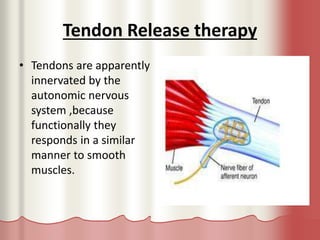
• Tendons are apparently
innervated by the
autonomic nervous
system ,because
functionally they
responds in a similar
manner to smooth
muscles.
• when there is the hypertonicity of the tendon, it
presents as a rigidity of the tendon.
• There is reduced capacity of elongation and
contraction of the tendon fibers.
• Treatment of tendons with advance strain and
counterstrain is 1 minute because all innervated
muscles requires 1 minute for the release of
hypertonicity, as compare to 90 seconds release for
voluntary nervous system innervated muscles.
Step-by-step instructions for tendon
release therapy:.
1. Place the index finger (or the index finger plus the middle finger) pad
of the distal phalanx of the caudal hand over the place of insertion of
the inferior end of the tendon
2. Place the index finger (or the index finger plus the middle finger) pad
of the distal phalanx of the superior hand over the musculotendinous
interface of the muscle and tendon, at the superior aspect of the
tendon.
3. Push on the tendon tissue with both hands with 1lb force
perpendicular onto the bone.
4. Then compress the superior and inferior aspects of the tendon
together with 1lb force, bringing the distal and proximal end of the
tendon closer together. this compression should be along the
longitudinal length of the tendon fiber
5. Maintain these compressive forces for 1 minute for the release of the
hyper tonicity of the tendon.
6. NOTE:- there may remain fascial restrictions of the tendon, which may
still require fascial release.
Example of tendon release: ACHILLES
TENDON:-
• Tender point:-
At the insertion of Achilles tendon
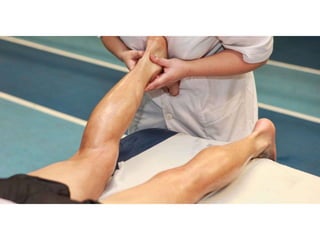
• Position of the patient:-
PRONE LYING. A small towel is placed
under the ankle, or foot is off the edge of the
bed/couch, so that the foot and ankle is not
placed in forced planter flexion
Treatment :-
1. Place the index finger (or the index finger plus the middle
finger) pad of the distal phalanx of the caudal hand over the
place of insertion of the Achilles tendon at the calcaneus
2. Place the index finger (or the index finger plus the middle
finger) pad of the distal phalanx of the superior hand over
the musculotendinous interface of the gastronemius muscle
with the achilles tendon, at the superior aspect of the
tendon.
3. Push the tissue with 1lb force perpendicular towards the
tibia
4. Then compress the superior and inferior aspect of the
tendon together with 1lb force, bringing the 2 ends of the
tendon closer together.
5. Maintain these compressive forces for 1 minute.
Indications of tendon release therapy:-
• There are essentially no contraindication of the tendon
release therapy, when performed in this manner , unless
there is total rupture of the tendon.
• When there is total rupture of the tendon , the technique will
not be effective.
• If there is a tear or rupture of the tendon, but there is a
correction performed (surgical) the technique can be
performed. Although not 100% effective, the technique will
give some results in decreased hypertonicity or rigidity of the
tendon,
• If tendon release therapy is performed immediately after
surgery , there will be facilitated healing of the tendinous
injury
Tendons which responds well to tendon
release therapy:-
• Achilles tendon
• Medial and lateral hamstring tendons
• Quadriceps tendon
• Tibialis anterior and posterior tendons
• Extensors/flexors tendons of foot and toes.
• Adductor tendon of hip
• Rotator cuff tendons: supraspinatus, infraspinatus,
subscapularis.
• Flexors/extensors tendons of Wrist and fingers
• Latissimus dorsi
• Biceps (short and long head)
• Triceps tendon
• Coracobrachialis and Brachioradialis tendons….etc
Common disorders which responds well
to tendon release therapy:-
• Tendonitis
• Hypertonicity
• Protective muscle spasm and spasticity
• Fibromyalgias
• Tenosinovitis
• Tear and rupture
• Calcification of tendon

tendon release therapy(1).pptx

  • 1.
    Tendon Release therapy DrAyesha Anwer Ali
  • 2.
    Tendon Release therapy •Tendons are apparently innervated by the autonomic nervous system ,because functionally they responds in a similar manner to smooth muscles.
  • 3.
    • when thereis the hypertonicity of the tendon, it presents as a rigidity of the tendon. • There is reduced capacity of elongation and contraction of the tendon fibers. • Treatment of tendons with advance strain and counterstrain is 1 minute because all innervated muscles requires 1 minute for the release of hypertonicity, as compare to 90 seconds release for voluntary nervous system innervated muscles.
  • 5.
    Step-by-step instructions fortendon release therapy:. 1. Place the index finger (or the index finger plus the middle finger) pad of the distal phalanx of the caudal hand over the place of insertion of the inferior end of the tendon 2. Place the index finger (or the index finger plus the middle finger) pad of the distal phalanx of the superior hand over the musculotendinous interface of the muscle and tendon, at the superior aspect of the tendon. 3. Push on the tendon tissue with both hands with 1lb force perpendicular onto the bone. 4. Then compress the superior and inferior aspects of the tendon together with 1lb force, bringing the distal and proximal end of the tendon closer together. this compression should be along the longitudinal length of the tendon fiber 5. Maintain these compressive forces for 1 minute for the release of the hyper tonicity of the tendon. 6. NOTE:- there may remain fascial restrictions of the tendon, which may still require fascial release.
  • 6.
    Example of tendonrelease: ACHILLES TENDON:-
  • 7.
    • Tender point:- Atthe insertion of Achilles tendon • Position of the patient:- PRONE LYING. A small towel is placed under the ankle, or foot is off the edge of the bed/couch, so that the foot and ankle is not placed in forced planter flexion
  • 10.
    Treatment :- 1. Placethe index finger (or the index finger plus the middle finger) pad of the distal phalanx of the caudal hand over the place of insertion of the Achilles tendon at the calcaneus 2. Place the index finger (or the index finger plus the middle finger) pad of the distal phalanx of the superior hand over the musculotendinous interface of the gastronemius muscle with the achilles tendon, at the superior aspect of the tendon. 3. Push the tissue with 1lb force perpendicular towards the tibia 4. Then compress the superior and inferior aspect of the tendon together with 1lb force, bringing the 2 ends of the tendon closer together. 5. Maintain these compressive forces for 1 minute.
  • 11.
    Indications of tendonrelease therapy:- • There are essentially no contraindication of the tendon release therapy, when performed in this manner , unless there is total rupture of the tendon. • When there is total rupture of the tendon , the technique will not be effective. • If there is a tear or rupture of the tendon, but there is a correction performed (surgical) the technique can be performed. Although not 100% effective, the technique will give some results in decreased hypertonicity or rigidity of the tendon, • If tendon release therapy is performed immediately after surgery , there will be facilitated healing of the tendinous injury
  • 12.
    Tendons which respondswell to tendon release therapy:- • Achilles tendon • Medial and lateral hamstring tendons • Quadriceps tendon • Tibialis anterior and posterior tendons • Extensors/flexors tendons of foot and toes. • Adductor tendon of hip • Rotator cuff tendons: supraspinatus, infraspinatus, subscapularis. • Flexors/extensors tendons of Wrist and fingers • Latissimus dorsi • Biceps (short and long head) • Triceps tendon • Coracobrachialis and Brachioradialis tendons….etc
  • 13.
    Common disorders whichresponds well to tendon release therapy:- • Tendonitis • Hypertonicity • Protective muscle spasm and spasticity • Fibromyalgias • Tenosinovitis • Tear and rupture • Calcification of tendon